







Walk
Where Wisdom Keeps You Young
Coimbra, Portugal
Walk
Where Wisdom Keeps You Young
Coimbra, Portugal
6 km
Distance
2h25
Durée
26
Audios
Loop
Parcours
Shutterstock
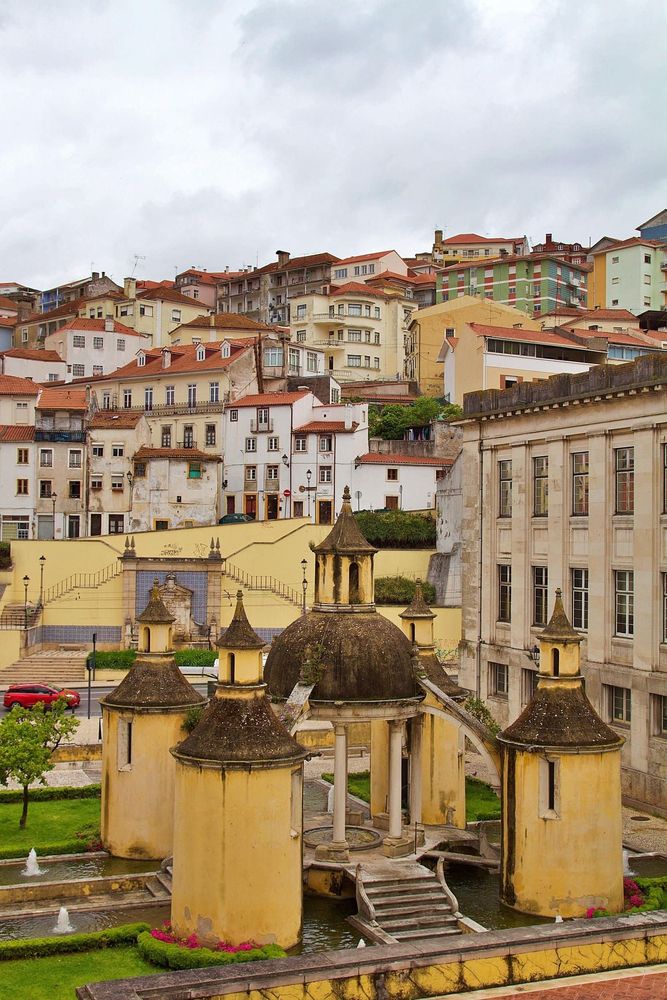
The Jardim da Manga is a surprising Renaissance monument of Coimbra, with a singular form and colour. The Coimbra audio-guided tour stops here to evoke this enchanted place, a former cloister of the monastery of Santa Cruz, classified national monument.
The Jardim da Manga emerges on the way like a kind of enchanted place. Between its unusual yellow colour and its surprising form, all the ingredients are gathered to make the imagination work. Classified national monument since 1934, it was born in the sixteenth century as a cloister, during a reconstruction of the neighbouring monastery of Santa Cruz. Its central dome-shaped composition, supported by columns and lateral buttresses, comes under an irreproachable symmetry, a key element of the Renaissance style that we owe to the talented sculptor João de Ruão. The ensemble, with its central basin from which radiate four branches of water, also possesses a rich religious symbolism. Today surrounded by a pleasant garden, this unusual and refined monument offers a refreshing stop in the heart of the town. An architectural curiosity and a jewel of the Portuguese Renaissance, the Jardim da Manga is a charming stop of Coimbra.
You admire the surprising Renaissance monument with a yellow colour and a singular form, a former sixteenth-century cloister of the monastery of Santa Cruz, classified national monument, with its dome composition supported by columns and buttresses of an irreproachable symmetry by João de Ruão, and its central basin. The Jardim da Manga is a jewel of the Renaissance of Coimbra. It is a charming stop, to be explored on foot.
The Jardim da Manga lies near the monastery of Santa Cruz, in the Baixa of Coimbra, reachable on foot. It is a monument and a public garden in the open air, generally freely accessible according to its hours. The promenade is particularly pleasant in fine weather.
A surprising Renaissance monument, born in the sixteenth century as a cloister of the monastery of Santa Cruz, classified national monument since 1934; its yellow dome composition, of an irreproachable symmetry, is the work of the sculptor João de Ruão.
Near the monastery of Santa Cruz, in the Baixa of Coimbra, in Portugal.
Aucun avis pour le moment
