





Walk
A Vintage Soul on the Douro
Porto, Portugal
Walk
A Vintage Soul on the Douro
Porto, Portugal
7.2 km
Distance
3h00
Durée
29
Audios
Loop
Parcours
Shutterstock
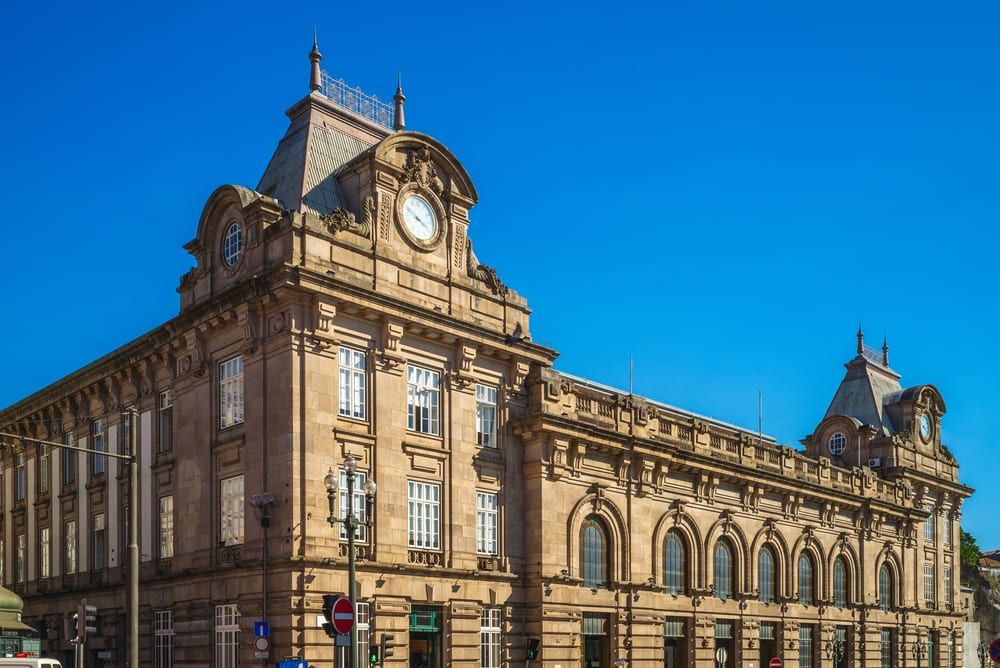
The Porto audio-guided tour leads you to São Bento railway station, one of the finest of the city, whose main hall is a veritable masterpiece of azulejos.
Put into service in 1896 and inaugurated for travellers in 1916, São Bento station took about thirty years to come into being. It rises on the site of the former Benedictine convent of São Bento de Avé Maria, which gave it its name. The work of the architect José Marques da Silva, a figure of Porto, it takes inspiration from the French Beaux-Arts style, with an imposing and symmetrical façade flanked by two towers. But the finest part is discovered inside: the main hall displays some twenty thousand azulejos, those decorated faience tiles found everywhere in Portugal, which retrace scenes of the country's history.
São Bento station charms with its Beaux-Arts façade, but above all with its main hall, lined with thousands of azulejos retracing the history of Portugal. It is one of the finest stations in Europe, a veritable work of art accessible to all. An essential stop, even without taking the train, in the heart of Porto.
São Bento station is in the heart of Porto. An active station, its azulejo hall can be visited freely, with respect for the travellers; it is accessible on the level at the opening hours of the station.
Some twenty thousand faience tiles that retrace scenes of the history of Portugal, in the main hall.
From the former Benedictine convent of São Bento de Avé Maria, on the site of which the station was built.
Aucun avis pour le moment
