





RyoCity
The City of Dragons
Ljubljana, Slovenia
RyoCity
The City of Dragons
Ljubljana, Slovenia
3.7 km
Distance
1h30
Durée
27
Audios
Boucle
Parcours
Shutterstock
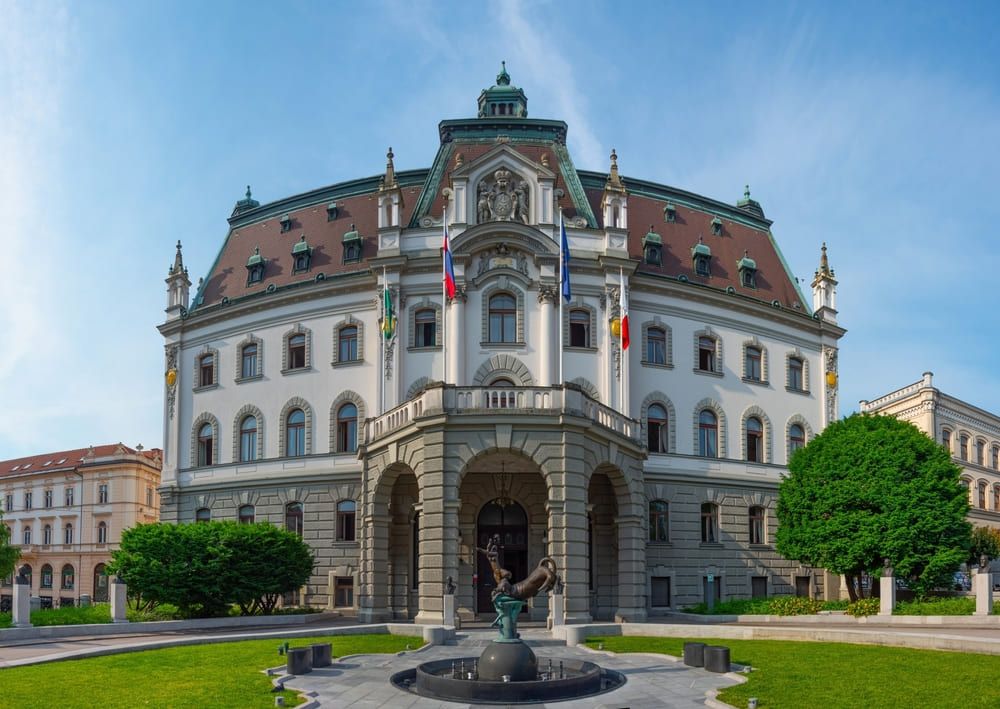
In front of you rises the “university palace,” built on the site of the former seat of provincial power. It was right here in 1821 that the famous Congress of the Holy Alliance took place, the event that gave Congress Square its name. After the devastating earthquake of 1895 severely damaged the old palace, a new Neo-Renaissance building was constructed and completed in 1902. It first housed the provincial government, but just a year later it became the rectorate of the newly founded University of Ljubljana. Its facade has all the grandeur of a classical palace, with a central portal and a sweeping balcony. That very balcony went on to play its own role in history: in May 1945, just after the end of the Second World War, Josip Broz Tito, leader of socialist Yugoslavia, addressed the crowds gathered here to celebrate victory. It was a powerful image that cemented the square’s role as a civic stage for Ljubljana. And if you glance at the green-and-white facade next door, you’ll spot the Philharmonic Hall. Founded in 1701, it is home to one of the oldest orchestras in Europe, whose honorary members once included Beethoven, Brahms, and Haydn. This square really is Ljubljana in a nutshell: a place where culture, ideas, and public life all come together.
