






Walk
The city of sea and freedom
Cadiz, Spain
Walk
The city of sea and freedom
Cadiz, Spain
5.4 km
Distance
2h30
Durée
25
Audios
Loop
Parcours
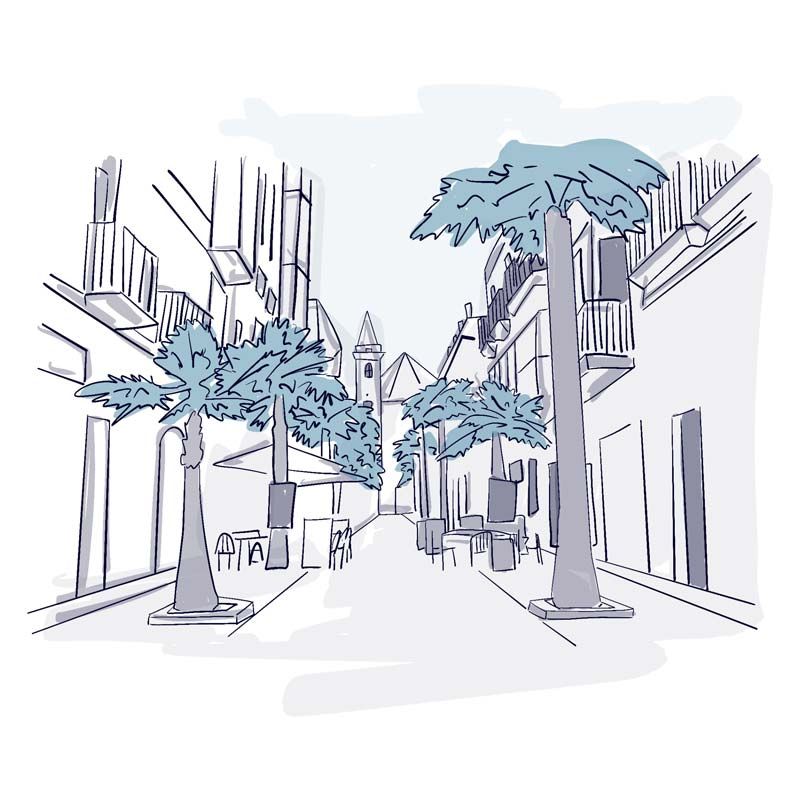
The district of La Viña is one of the most popular and authentic of Cadix, former stronghold of the fishermen of La Caleta, beating heart of the famous carnival. The Cadix audio-guided tour stops here to evoke this district of colourful alleys, formerly covered with vines, where each February the chirigotas and the comparsas of one of the oldest and most original festivals of Spain resound.
If you continue straight ahead, you will come upon the Calle de la Rosa, that marks the entrance of the district of La Viña, one of the most popular and authentic of Cadix. Formerly covered with vineyards, hence its name, it became from the eighteenth century the stronghold of the fishermen of La Caleta. Its narrow alleys, its colourful houses and its convivial atmosphere still reflect today this simple and warm identity. But it is especially in the month of February that La Viña reveals all its soul: the district then becomes the heart of the carnival of Cadix, and its streets transform into an open-air stage where chirigotas and comparsas resound. This carnival is one of the oldest and most original festivals of Spain, a carnival where humour, satire and imagination count much more than glitter. Its roots go back to the fifteenth century, when Cadix, a port town open onto the world, adopted traditions come from Italy thanks to the Genoese merchants. Even today, this influence is felt in the satirical songs and the inventive disguises of the carnival groups, that mock current events with a wholly Gaditan verve. The rest of the year, La Viña recovers its calm and its authenticity, between fish bars, shady squares and neighbourhood life. A popular district and a cradle of the carnival, La Viña is a fine stop of the discovery of Cadix.
Here you discover one of the most popular and authentic districts of Cadix, formerly covered with vines then become the stronghold of the fishermen of La Caleta, with its colourful alleys and its convivial atmosphere; each February, it becomes the heart of the carnival of Cadix, one of the oldest and most original festivals of Spain, where chirigotas and comparsas resound. La Viña is the cradle of the carnival of Cadix. It is a fine stop, to be explored on foot.
The district of La Viña lies in the old town of Cadix, towards La Caleta, reachable on foot. It is a popular district freely accessible, to be explored with respect for its inhabitants, animated by fish bars and squares; it vibrates particularly during the February carnival. You discover it during a stroll.
Because it is the heart of the carnival of Cadix, one of the oldest and most original festivals of Spain, where humour and satire dominate; former wine-growing district become the stronghold of the fishermen of La Caleta, with its colourful alleys and its convivial atmosphere, it vibrates each February to the rhythm of the chirigotas and the comparsas, heirs of a tradition come from Italy in the fifteenth century.
In the old town of Cadix, towards La Caleta, in Spain.
Aucun avis pour le moment
