



Walk
A well-kept Roman secret
Mérida, Spain
Walk
A well-kept Roman secret
Mérida, Spain
6.5 km
Distance
2h40
Durée
19
Audios
Loop
Parcours
Shutterstock
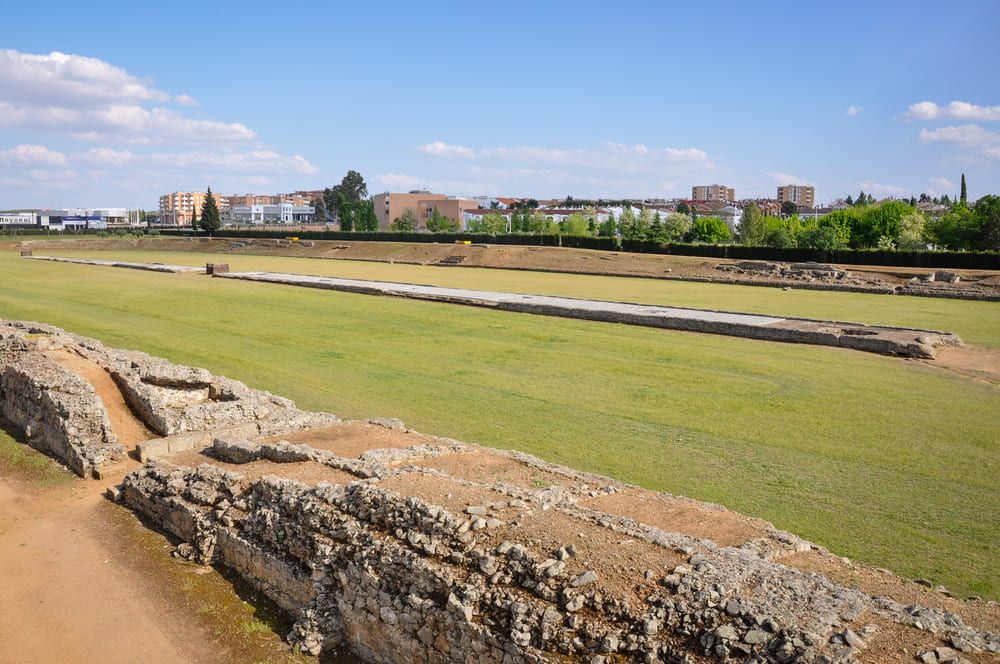
The Roman circus of Mérida is one of the best preserved circuses of the Empire and the largest ever built in the Iberian peninsula, where spectacular chariot races were disputed. The Mérida audio-guided tour stops here to evoke this immense work of more than four hundred metres, that could host up to thirty thousand spectators, almost the whole population of the town.
You will have guessed it by its oblong form recognisable among a thousand: you are in front of the ancient Roman circus of Mérida. It is one of the best preserved circuses of the whole Empire and one of the most important after the Circus Maximus of Rome; it is in any case the largest ever built on the Iberian peninsula. It measures about four hundred and forty metres long by one hundred and fifteen metres wide, and its capacity could reach thirty thousand spectators. Imagine yourself for a moment in front of such a crowd, settled in the tiers all around the track: it represented almost the whole of the inhabitants of the town. The spectators took their place in tiers hierarchised in three levels, ima, media and summa cavea, according to their social rank. In the centre stretched the spina, a long terreplein decorated with monuments, obelisks and markers around which the chariots turned at full speed. For it is there that the famous chariot races took place, these quadrigae drawn by four horses, launched at full speed in frantic competitions that passionate the public and made the glory of the best charioteers, true stars of the era. According to an inscription, the circus, first reserved for these races, was then arranged for other games, including nautical shows. Situated a little apart, outside the old walls, it completes the extraordinary trio of the great show buildings of the town, with the theatre and the amphitheatre. An ancient circus and an arena of the chariots, the Roman circus of Mérida is a fine stop of the discovery of the town.
Here you discover one of the best preserved Roman circuses of the Empire and the largest of the peninsula, about four hundred and forty metres long, that could host thirty thousand spectators in hierarchised tiers; around the central spina were disputed the spectacular races of quadrigae, chariots drawn by four horses. The Roman circus is one of the great show buildings of Mérida. It is a fine stop, to be explored on foot.
The Roman circus lies a little apart from the centre of Mérida, outside the old walls, reachable on foot. It follows its own days and opening hours, variable, and entry is generally subject to a fee, often included in a combined entry to the sites of the town. It is best to enquire before coming.
There were disputed the famous chariot races, the quadrigae drawn by four horses, launched at full speed around the central spina; this circus, one of the best preserved of the Empire and the largest of the peninsula, about four hundred and forty metres, could host thirty thousand spectators and was then arranged for other games.
A little apart from the centre of Mérida, outside the old walls, in Spain.
Aucun avis pour le moment