






Walk
Discovering Stockholm, island by island
Stockholm, Sweden
Walk
Discovering Stockholm, island by island
Stockholm, Sweden
5.5 km
Distance
2h20
Durée
26
Audios
Loop
Parcours
Shutterstock
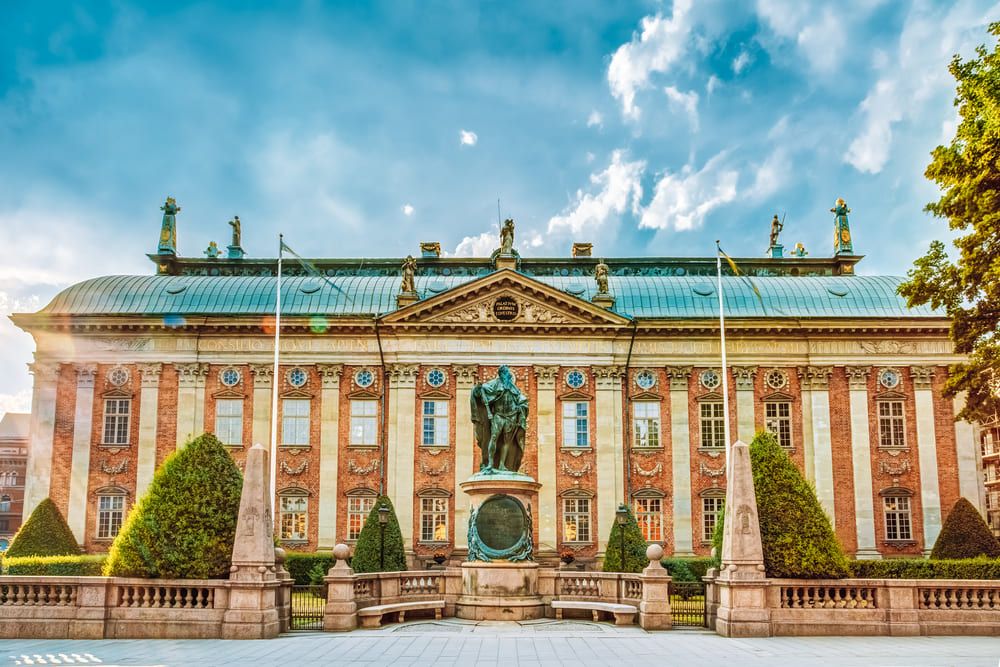
The Stockholm audio-guided tour leads you before the Riddarhuset, the House of Nobility, one of the great symbols of the Swedish aristocracy. Built in the 17th century in an impressive Baroque style, it was much more than a palace: for more than two centuries, it housed the parliament of the nobility.
Built from 1641 to 1672, the House of Nobility was the meeting place of the noble families. From 1668 to 1865, within the system of estates, the nobility sat there alongside the three other orders of the kingdom: the clergy, the bourgeoisie and the peasantry. The walls of its great hall are still adorned with thousands of coats of arms of Swedish noble families, bearing witness to the history of the country's aristocracy.
The House of Nobility, with its Baroque facade adorned with statues and its characteristic roof, is one of the finest buildings in the old town. The great hall, covered with coats of arms, is a striking spectacle that sums up centuries of noble history. On Riddarhustorget square, it forms with the Bonde Palace a remarkable Baroque ensemble.
The House of Nobility is on Riddarhustorget square, in the old town of Stockholm. The interior, including the great hall, is generally visited from April to September, with an entrance fee and hours that vary by season. The facade can be seen freely from the square; it is best to check the information in advance.
It was the parliament of the Swedish nobility, which sat there from 1668 to 1865 within the system of estates.
Thousands of coats of arms of Swedish noble families adorn the walls of the great hall of the House of Nobility.
Aucun avis pour le moment
