





Walk
The birth of a nation
Philadelphia, United States
Walk
The birth of a nation
Philadelphia, United States
4.7 km
Distance
2h00
Durée
24
Audios
Loop
Parcours
Shutterstock
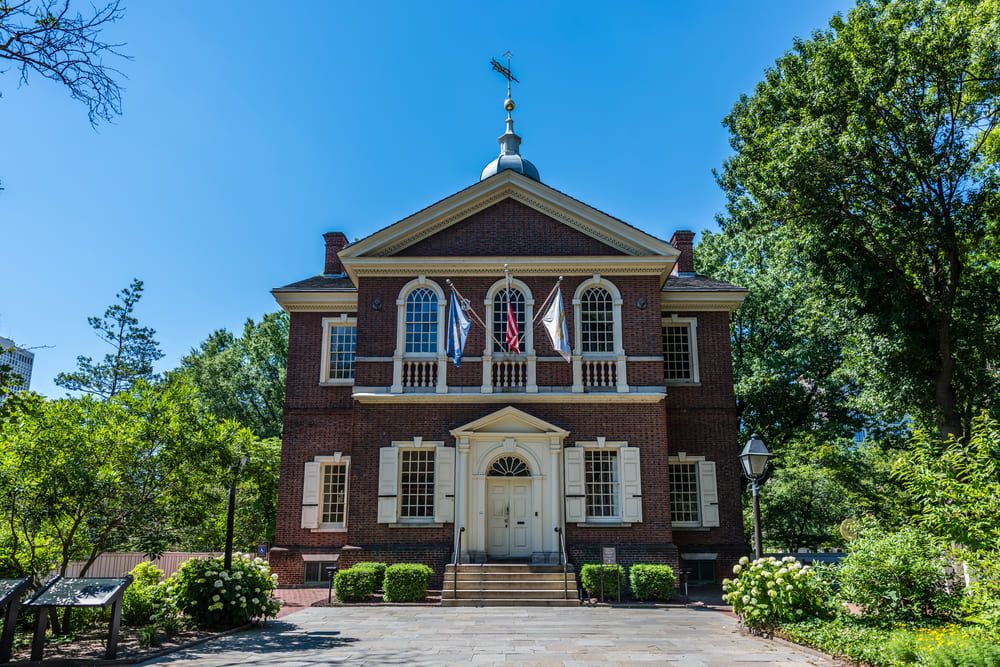
You’re standing in front of Carpenters’ Hall, one of the most characteristic buildings of revolutionary Philadelphia. Construction began in 1770 for a guild of master builders, and it was designed by architect Robert Smith as both a meeting place and a workspace for this community. But the building quickly took on a much larger role.
In 1774, it hosted the First Continental Congress, bringing together 56 delegates from all the colonies except Georgia. It was here that the colonies began to coordinate a shared response to British policies, especially after rising tensions in Boston. At that stage, independence was not yet the goal.
The delegates were mainly trying to express their demands and organize economic and political resistance. The choice of this location is meaningful. Unlike official government buildings, Carpenters’ Hall was a private space, which allowed for more open discussions, less directly tied to colonial authority.
The building also played a role in 1776 for Pennsylvania, hosting meetings that helped shape a new local political structure. Over time, it served many different purposes. It housed the Library Company of Philadelphia, founded by Benjamin Franklin, was used as an infirmary during the Revolution, and later as a hospital during the British occupation.
It also hosted the American Philosophical Society. One interesting detail involves Franklin himself. In 1775, he held discreet meetings here with a French envoy, helping to draw France’s attention to the American cause.
Today, Carpenters’ Hall is a reminder that the early stages of American political life didn’t happen only in official institutions, but also in quieter places like this one, where cooperation between the colonies gradually began to take shape.
Aucun avis pour le moment
