



Walk
The Story of a Promised Land
Salt Lake City, United States
Walk
The Story of a Promised Land
Salt Lake City, United States
Distance
4.8 kmDurée
2h00Audios
23Parcours
Loop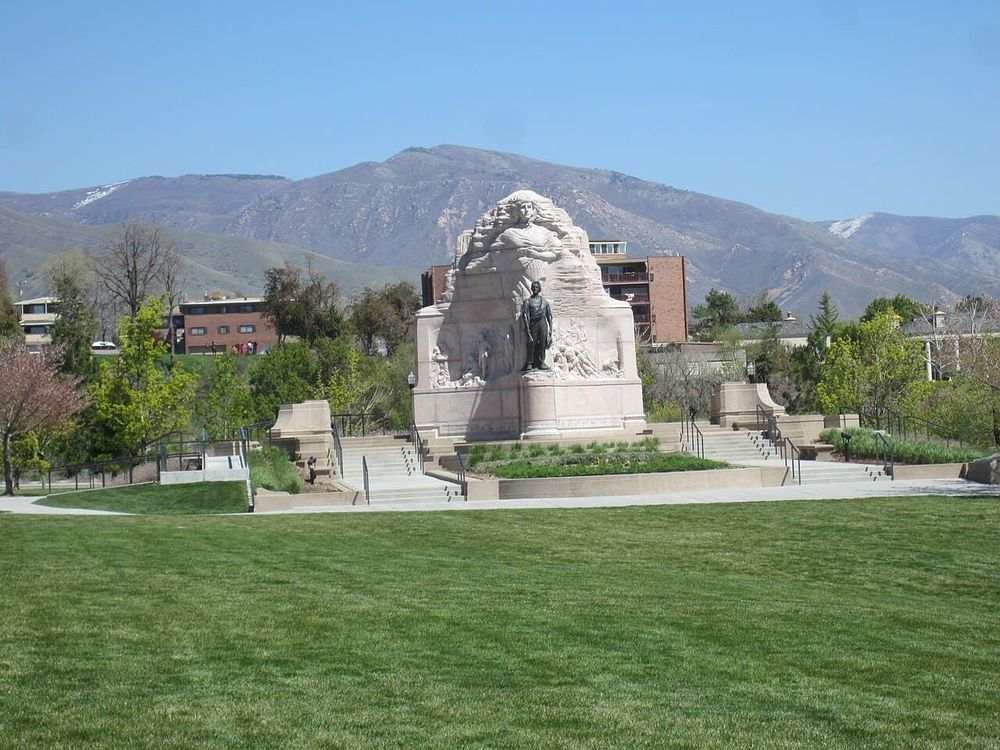
©Another Believer, CC BY-SA 4.0 <https://creativecommons.org/licenses/by-sa/4.0/deed.fr>via Wikipedia Commons
On your right, next to the Utah State Capitol, stands the Mormon Battalion Monument, which commemorates a little-known but remarkable chapter in American history. The story begins in 1846, during the Mexican-American War, when more than 500 Mormon volunteers enlisted in the U.S. Army. Their mission was to make their way across much of the country to California, helping secure the territory recently conquered by the United States. What followed was an extraordinary journey of more than 1,860 miles (3,000 kilometers) on foot, taking them through deserts, mountains, and some of the most remote parts of the American West. It would become one of the longest infantry marches in U.S. history. And here's something surprising: despite all those miles, the battalion never fought in a major battle. Its contribution, however, was far from insignificant. The route its members helped establish would later be used by many other settlers making their way west. This remarkable journey is commemorated by the monument before you, unveiled in 1927. Through a series of sculpted scenes, it tells the story of the volunteers, from their enlistment and the hardships of their long march to their arrival in California and eventual return to Utah. And the area's connection to Salt Lake City's early history doesn't end there. Across the road, you'll notice the White Community Memorial Chapel, a beautiful little building whose Gothic Revival architecture, tall windows, and elegant steeple stand in striking contrast to the imposing structures nearby. Although it looks as though it has stood here for well over a century, the chapel is actually a faithful reconstruction of a building originally erected in 1883 in the Avenues neighborhood, just a few blocks away. It served as a place of worship for one of the city's earliest congregations of the Church of Jesus Christ of Latter-day Saints, while also playing an important role in community life, particularly through activities for young people. By the 1970s, however, the original chapel was threatened with demolition. Rather than lose this piece of local history, preservationists carefully dismantled it and rebuilt it here, preserving several original features, including the stained-glass windows, pews, and steeple. Today, the chapel has taken on a new role. No longer used for religious services, it welcomes the wider community as a venue for weddings, ceremonies, and other special events.
Aucun avis pour le moment
