





Walk
The birth of a nation
Philadelphia, United States
Walk
The birth of a nation
Philadelphia, United States
4.7 km
Distance
2h00
Durée
24
Audios
Loop
Parcours
Shutterstock
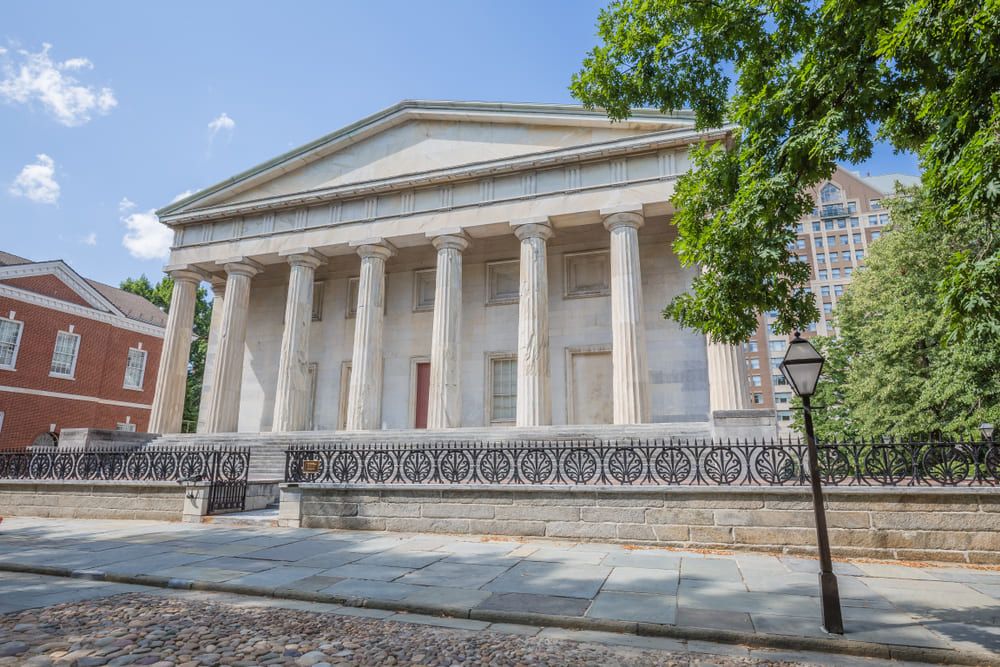
If you continue a few meters along Chestnut Street, you’ll come across the Second Bank of the United States, with its striking Greek temple–like design and marble columns. Founded in 1817, it played a key role in stabilizing the country’s finances after the War of 1812. Like the first bank, located just a couple of streets away, it reflects the early efforts of the young American nation to organize its financial system.
At the time, the United States had no central bank, so these institutions were created to manage public funds and debt, handle government payments, and regulate the circulation of money by issuing banknotes and overseeing state banks. But the Second Bank is best known for what came later. It was at the center of the “Bank War,” a major political conflict between its president, Nicholas Biddle, and President Andrew Jackson.
Jackson viewed the bank as unconstitutional, too powerful, and too closely tied to financial elites, arguing that it went against the principles of a republic. His decision to veto the renewal of its charter and withdraw federal funds eventually led to its closure in 1836. This episode marked a turning point, raising lasting questions about the balance between political power and financial institutions in a growing nation.
Aucun avis pour le moment
