





Walk
The birth of a nation
Philadelphia, United States
Walk
The birth of a nation
Philadelphia, United States
4.7 km
Distance
2h00
Durée
24
Audios
Loop
Parcours
Shutterstock
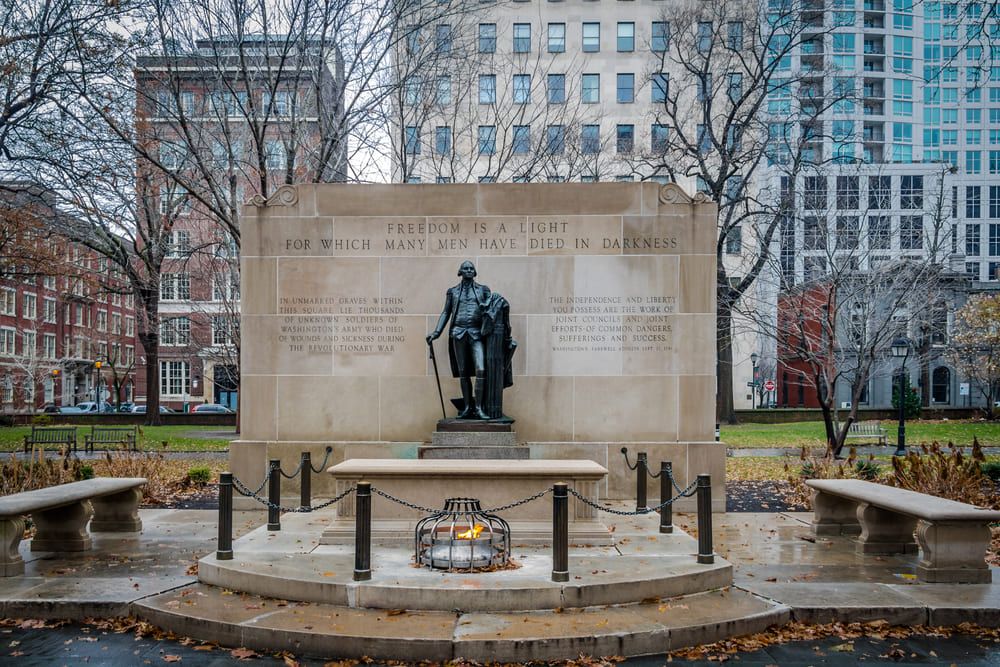
You’re now standing in the heart of Washington Square Park, one of the five original squares imagined by William Penn, founder of both the city and the colony. Today, it feels like a calm and pleasant public garden, but the history of this place is much more somber. In the 18th century, it served as a public burial ground for those who had no means or family plots.
Anonymous residents were buried here, along with free and enslaved African Americans, travelers, and soldiers who died during the American Revolution. During the yellow fever epidemics of the 1790s, the park was also used to bury many victims. Burials stopped in 1794, and the space was gradually transformed into a public square.
Today, the park quite literally sits on former burial grounds, making it both a place of memory and a space for everyday life. In 1957, a monument was installed to honor the unknown soldiers of the American Revolution buried here, with an inscription reminding visitors that they died for freedom, often without recognition. The square was renamed in 1825 in honor of George Washington, which makes this a good place to look more closely at his life.
He was born in 1732 in Virginia into a family of planters. He began his career as a surveyor, then served as an officer in the colonial militia, where he gained his first military experience. He later became a large landowner at Mount Vernon, where his wealth depended in part on the labor of enslaved people.
In 1775, at the start of the American Revolution, he was appointed Commander-in-Chief of the Continental Army. For several years, he led a fragile and often poorly equipped force, yet managed to maintain resistance against Great Britain. His victories, especially at Trenton and Yorktown, with French support, helped secure American independence.
After the war, he voluntarily gave up his military power, a decision that left a strong impression at the time. In 1789, he became the first President of the United States and helped define what that role would be by laying the foundations of the executive branch. After two terms, he chose to step down, setting an important precedent in a young democracy.
He died in 1799, leaving behind the image of a leader who held power without trying to keep it. His legacy remains complex, as he owned enslaved people throughout his life, although he provided for the emancipation of those he personally owned in his will.
Aucun avis pour le moment
