© Shutterstock
 Votre guide Ryo
Ottawa for First-Time Visitors: A Complete 2026 Guide to Canada's Capital
This guide to Ottawa for first time visitors starts from a simple observation: Canada's capital is compact enough to explore at an easy pace and still see almost everything that matters. Wrapped around a 202-kilometre canal that carries UNESCO World Heritage status and becomes one of the world's largest naturally frozen skating rinks in winter, downtown Ottawa packs Gothic Revival government buildings, a cluster of national museums, and a market older than the country itself into a core you can cross on foot in about twenty minutes. Ryo's audio-guided tour of Ottawa follows that same compact logic, threading the landmarks below into one guided walk you can start the moment you arrive.
The surprises tend to cluster for newcomers. A giant bronze spider guards the entrance to the National Gallery of Canada. A 1912 railway hotel topped in oxidized copper still serves a formal afternoon tea. A fried-dough stand smaller than most food trucks has become one of the most photographed stops in the country, and a single cannon fires over the river every day at noon. Add bilingual signage everywhere, a dollar coin nicknamed the loonie, and riverside neighborhoods that feel more like small towns than capital-city suburbs, and it's easy to see why so many people underestimate how much is packed into this city before their first time here.
Iconic Landmarks and Monuments
This is the cluster you'll probably photograph first, and it rewards a slow morning rather than a rushed hour.
Parliament Hill and Major's Hill Park
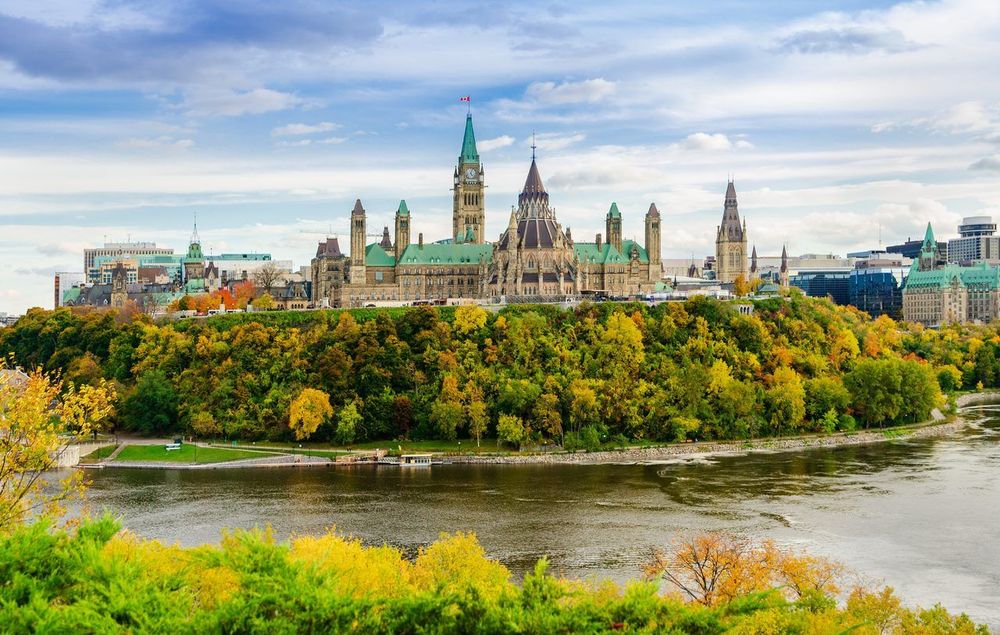
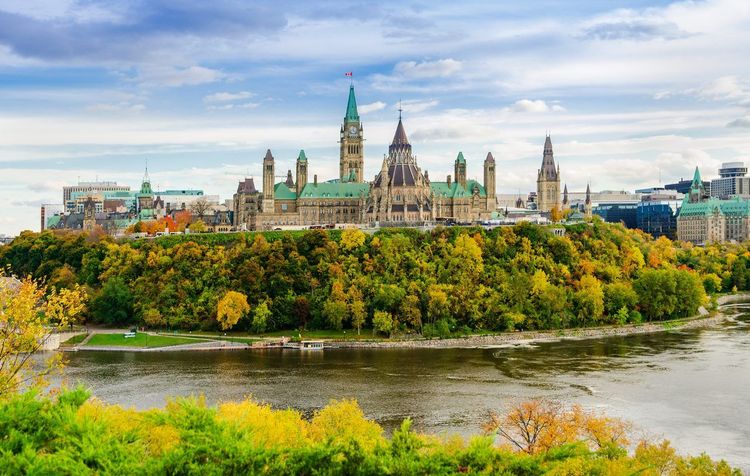
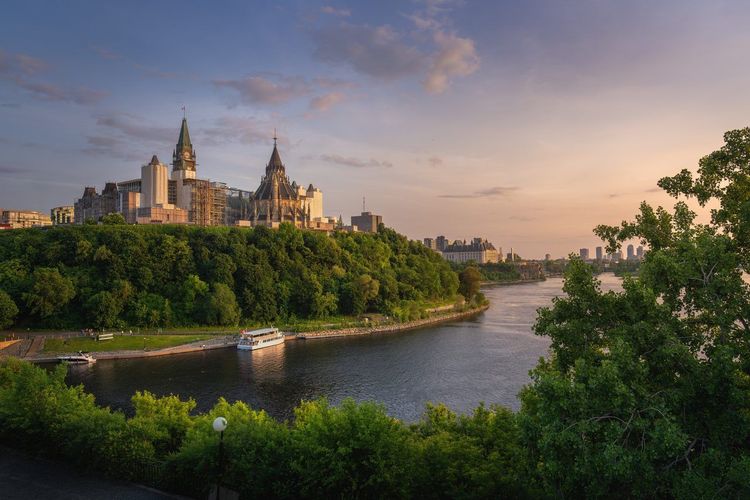
Parliament Hill) sits on a limestone bluff above the Ottawa River, its copper-green Peace Tower visible from nearly every downtown street. The front lawn is free to walk year-round, and between late June and late August you can usually catch the Changing the Guard ceremony around 10am. On summer evenings, check whether the sound-and-light show projected onto the buildings is scheduled during your stay.
Centre Block is closed for a multi-year restoration expected to run into the 2030s, so don't build your visit around its interior. Free guided tours of the House of Commons (now sitting in West Block) and the Senate are the realistic alternative, and in summer the older East Block often opens for tours too. Book online a day or two ahead in July and August; same-day slots go fast.
Cross Sussex Drive and you land in Major's Hill Park), the city's oldest park and arguably its best viewpoint: the river, the Gatineau hills, and the canal locks below all line up in one frame. On summer evenings the park hosts free outdoor events, and the Noon Day Gun on Nepean Point still fires once a day, loudly enough to startle anyone standing nearby who wasn't warned. If you only have an hour for landmarks, start here: Parliament Hill's lawn to Major's Hill Park is a ten-minute walk.
A few blocks further east, look for the oversized Ottawa Sign) letters in the ByWard Market, a photo stop that has quietly become almost as recognizable among visitors as the Peace Tower itself. Go early in the morning if you want a shot without a queue of strangers in it.
The Rideau Canal, the Locks, and Château Laurier
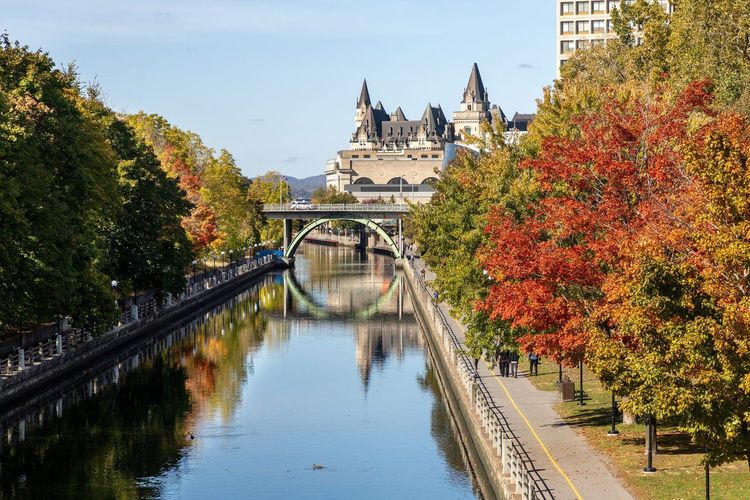
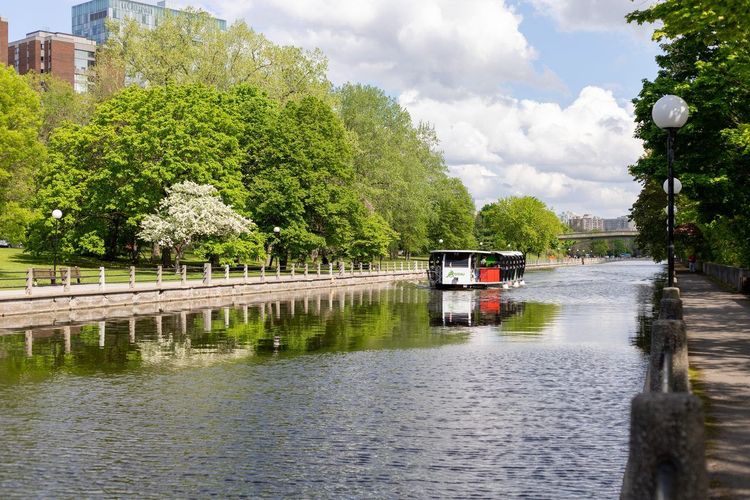
The Rideau Canal is the thread that ties the whole downtown together, and it earns its UNESCO World Heritage listing (2007) honestly. Built between 1826 and 1832 under Lieutenant Colonel John By as a military supply route, the canal's Outstanding Universal Value, as UNESCO describes it, rests on it being the best-preserved example of a slackwater canal from the great North American canal-building era, still operating largely on its original structures. In summer it carries kayaks and tour boats; in winter, roughly 7.8 kilometres of it can freeze into the Rideau Canal Skateway, the backbone of the Winterlude festival, though opening days depend entirely on the weather.
Where the canal meets the Ottawa River, the Rideau Locks still work as designed: a flight of eight locks, hand-cranked by Parks Canada staff rather than run by machinery, lifting boats roughly 24 metres between the river and the canal. Watching a lockmaster wind the mechanism by hand, with the Parliament buildings rising behind, is one of those small moments you don't expect and remember anyway.
Right beside the locks stands the Château Laurier (1 Rideau St, Ottawa, ON K1N 8S7, rated 4.4/5 on Google (7 260 avis)), a 1912 railway hotel whose turrets and copper roof made it an Ottawa landmark in its own right. You don't need to be a guest to look around the lobby, and the hotel's afternoon tea remains one of the more memorable (if splurge-worthy) ways to sit still for an hour downtown. If you'd rather not juggle a map, the Ryo audio guide strings Parliament Hill, the locks and the Château together in a single loop, with a narrated stop at each.
ByWard Market: Food, Stalls, and Nightlife
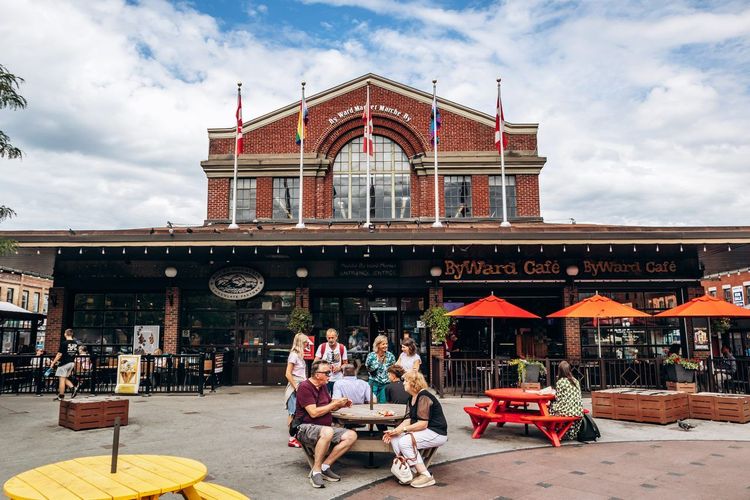
Show up hungry and leave your schedule loose.
Market stalls, bakeries, and the BeaverTails classic
ByWard Market) traces its origins to 1826, when John By laid out the area, which makes it older than Canada itself and one of the longest-running public markets in the country. Outdoor stalls sell produce, flowers, and maple products depending on the season, while the surrounding blocks are dense with bakeries, bistros, and shops tucked into 19th-century brick buildings. Weekend mornings are the liveliest time to browse; weekday afternoons give you more room to actually look at what's for sale.
No first trip through the market skips the BeaverTails stand: a whole-wheat pastry stretched into an oval, fried to order, and topped with anything from cinnamon sugar to chocolate hazelnut spread. The recipe actually started in rural Ontario in the late 1970s, but this ByWard stand, open since 1980, is where most visitors first try it, usually in a line that moves faster than it looks. It's a five-minute stop, not a meal, so pair it with something more substantial from a nearby bakery.
Copper Spirits & Sights and the market after dark
Once the stalls close, the market shifts into Ottawa's main nightlife strip, with restaurant patios and bars filling the same streets that sold vegetables that morning. Copper Spirits & Sights (325 Dalhousie St, Ottawa, ON K1N 7G1, rated 4.1/5 on Google (593 avis)), the rooftop bar on top of the Andaz hotel, is known for cocktails and skyline views toward Parliament; it works well as a single stop if you're not in the mood for a bar crawl.
The Ryo audio-guided tour also has a dedicated stretch through the market, with audio stops on the stories behind the stands and the trading history that shaped the neighborhood. If nightlife isn't your goal, come at dusk instead, when the brick facades catch the last light. Expect much busier streets on weekend nights and during summer festivals, so reserve dinner ahead if you're set on a specific restaurant.
World-Class Museums and Galleries
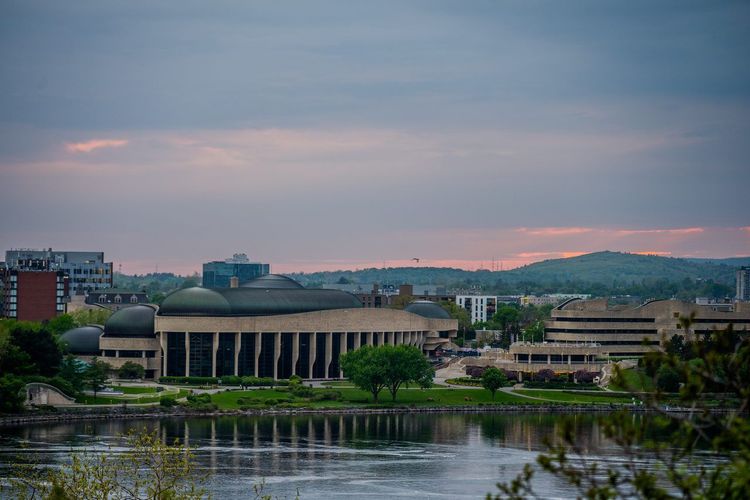
Few cities of a million people have this many national institutions within walking distance, a direct benefit of being the capital.
National museums along the river
The National Gallery of Canada), fronted by Louise Bourgeois's towering bronze spider Maman, holds the country's largest collection of Canadian art, including a strong Group of Seven collection and Indigenous works, inside a glass-and-granite building designed by Moshe Safdie. The Great Hall alone, with Parliament Hill framed through its windows, is worth the ticket before you've seen a single painting. Plan at least two to three hours.
Across the river in Gatineau, the Canadian Museum of History) covers the full sweep of the country's story, from the towering totem poles in its Grand Hall to the immersive Canadian History Hall; its riverside terrace has one of the best views back toward Parliament. The Canadian War Museum (1 Vimy Place, Ottawa, ON K1A 0M8, rated 4.8/5 on Google (10 854 avis)), back on the Ottawa side at LeBreton Flats, takes a strikingly modern, low-slung approach. In its Memorial Hall, a single window is aligned so that sunlight falls on the headstone of the Unknown Soldier at exactly 11am every 11 November, while Regeneration Hall frames the Peace Tower through its glass end wall.
A little south of the core, in Centretown, the Canadian Museum of Nature) occupies the castle-like Victoria Memorial Museum Building. You'll want to see the fossil gallery's dinosaurs, the blue whale skeleton, and the glass Queens' Lantern tower added during the 2010 renovation. It's about a 25-minute walk from Parliament Hill, or a short bus ride.
Most national museums offer free or reduced admission during certain evening hours, and the schedules change, so check each museum's website before you plan a budget museum day. Museums usually close one day a week outside summer, often Monday, which catches out plenty of visitors.
Smaller museums worth a detour
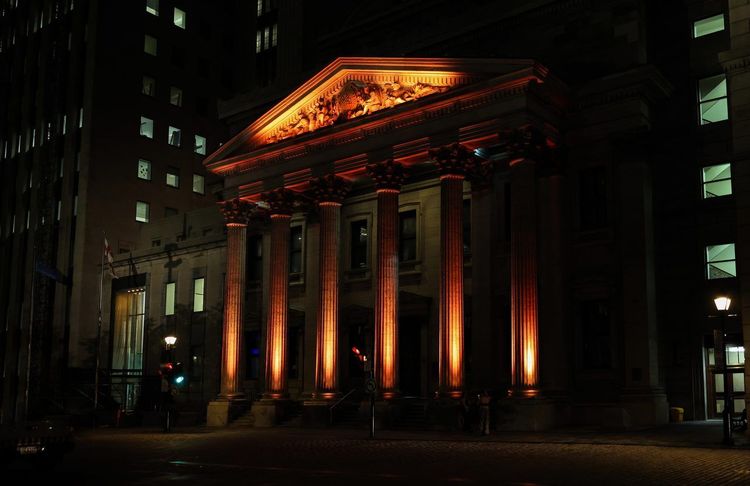
The Bank of Canada Museum) is free, compact, and more hands-on than its name suggests, with interactive exhibits on currency, inflation, and the economy that work surprisingly well even if finance bores you. Kids tend to like it more than their parents expect.
The Supreme Court of Canada), an Art Deco building by Ernest Cormier topped with a steep copper roof, offers free guided tours that take you into the main courtroom when the court isn't sitting. Neither of these draws the crowds of the riverside museums, which is exactly why they're worth fitting in: you'll often have a guide almost to yourself, and both sit close enough to Parliament Hill to slot into the same morning.
Neighborhoods to Explore Beyond Downtown
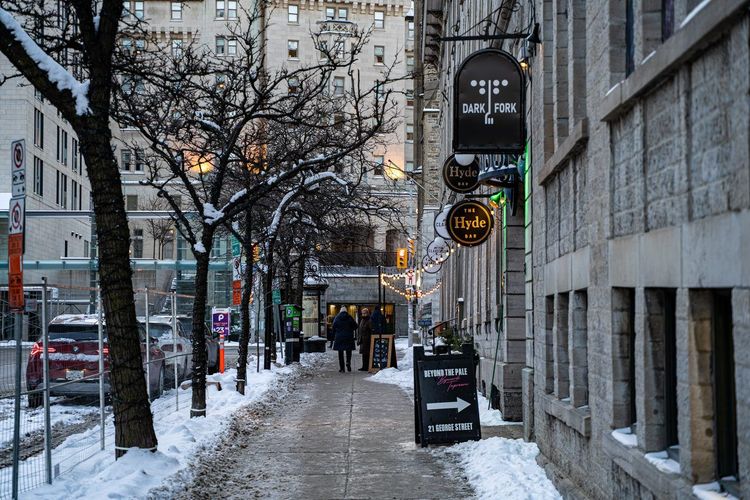
Once the landmarks are ticked off, the neighborhoods are where Ottawa actually feels lived-in.
Sparks Street, the Ottawa Art Gallery, and Notre-Dame Cathedral Basilica
Sparks Street) became Canada's first pedestrian mall in the 1960s, and it still works as a car-free strip one block from Parliament Hill, lined with cafes, shops, and summer festivals such as the ribfest crowds that pack it in August. It's a convenient lunch stop between government buildings and the river.
A short walk east, beside the canal, the Ottawa Art Gallery) reopened in an expanded building in 2018 and charges no admission, so you can treat it as an easy add-on rather than a planned half-day. Back up Sussex Drive, the twin silver spires of Notre-Dame Cathedral Basilica), the oldest church in Ottawa, rise over a richly carved and painted interior that's far more ornate than the plain stone exterior suggests.
Want the backstory without reading plaques? The Ryo audio-guided tour of Ottawa links these downtown stops with short narrated anecdotes, so you see all three without backtracking.
Westboro Village, Hintonburg, and Little Italy's Preston Street
West of downtown, Westboro Village) runs along Richmond Road with boutiques, outdoor-gear shops, and cafes that fill up on weekend mornings, often with cyclists coming off the nearby river pathway. It's an easy O-Train or bus ride and worth half a day if you want a break from monuments.
Closer in, Hintonburg) has shifted over the past two decades from industrial fringe to one of Ottawa's liveliest arts neighborhoods, with independent galleries, murals, craft breweries, and a younger crowd than the government core. Just south of there, Preston Street (Preston St, Ottawa, ON K1R 7P4, rated 4.4/5 on Google (780 reviews)) anchors Ottawa's Little Italy, a strip of Italian restaurants and gelato counters marked by a gateway arch; in June it hosts Italian Week celebrations.
None of these takes more than 20 to 30 minutes to reach from Parliament Hill, so treat them as flexible add-ons rather than full-day commitments.
Parks, Waterways, and Outdoor Escapes
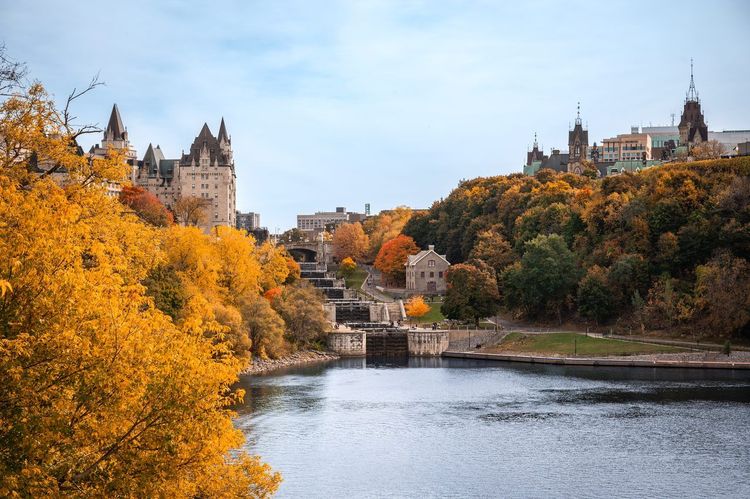
For many locals, the green space is the real reason to live here.
Dow's Lake, Commissioners Park, and Rideau Hall
Dow's Lake, a widened section of the canal south of downtown, draws canoe and pedal-boat renters in summer and skaters in winter, with a lakeside pavilion as a reliable rest stop for food and washrooms.
Beside it, Commissioners Park) turns into a sea of colour every May during the Canadian Tulip Festival, with hundreds of thousands of tulips in bloom along the water. The festival itself goes back to the Dutch royal family's thank-you gift of bulbs after the Second World War, and the Netherlands still sends tulips every year.
In New Edinburgh, Rideau Hall) has been the official residence of Canada's Governor General since 1867. Its landscaped grounds are open to the public for free, with walking paths, ceremonial trees planted by visiting dignitaries, and a summer guard ceremony of its own. Guided tours of the residence's public rooms run seasonally and are free.
Gatineau Park, the Ottawa River Pathway, and Alexandra Bridge Walk
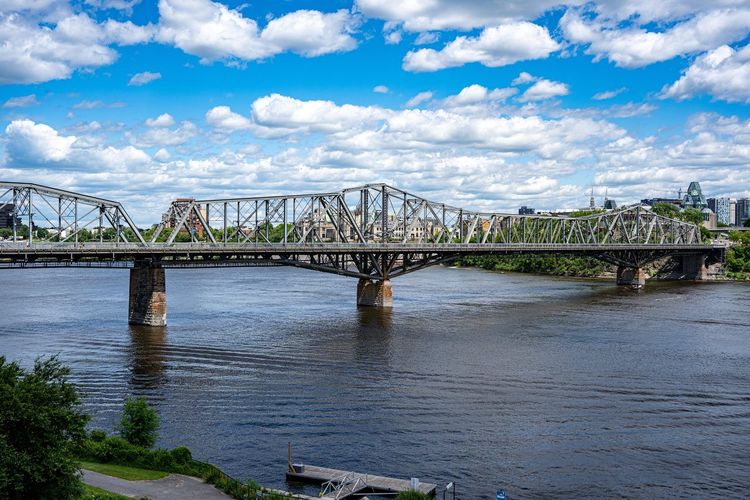
The Ottawa River Pathway) runs for kilometres along the water, popular with cyclists and runners, and gives you some of the best ground-level views of Parliament Hill's cliff. Where the path meets Quebec, the Alexandra Bridge Walk (Alexandra Bridge, Ottawa, ON K1N 5N9, rated 4.6/5 on Google (780 reviews)) offers a dedicated pedestrian and cycling deck with arguably the single best photo angle of Parliament Hill in the city, especially at sunset. The steel bridge, opened in 1901, is slated for replacement later this decade, so enjoy the old structure while it stands.
Part of the Ryo audio route follows the riverfront, which makes it an easy way to pair a walk along the water with the stories of the landmarks you're passing. If you have a spare half-day, Gatineau Park across the river extends the outdoor theme considerably, with hiking trails, the Mackenzie King Estate, and the Champlain Lookout, one of the most reliable fall-foliage viewpoints within a 20-minute drive of downtown.
Gatineau Park covers more than 360 square kilometres, so you'll want a plan before you go. Start at the visitor centre in Chelsea for trail maps and current conditions, then pick one short hike rather than trying to see everything: the Pink Lake trail circles a meromictic lake whose deep water barely mixes, and the Luskville Falls trail rewards a steeper climb with views over the Ottawa Valley. On autumn weekends, the park runs shuttle buses and restricts some parkway traffic, so check before driving up. Without a car, cycling the parkways on a summer Sunday morning, when sections are closed to cars, is one of the best outings in the region.
Where to Stay in Ottawa
Where you stay matters less for comfort than for how much walking you're willing to do.
Downtown and the Parliament Hill area
Staying within a few blocks of Parliament Hill puts you within walking distance of the canal, the locks, Major's Hill Park, and most of the landmarks above. It's the easiest base on your first time in Ottawa if you want to minimize transit decisions, though rates rise during Winterlude, the Tulip Festival and Canada Day (1 July), so book those windows early.
ByWard Market and Centretown
Basing yourself in or near ByWard Market puts restaurants, bars, and the BeaverTails stand on your doorstep, at the cost of more weekend noise. Centretown, just south of Parliament Hill, splits the difference: still walkable to the canal and the museums, quieter in the evenings, and often slightly better value than hotels on the market or facing Parliament itself. On a tighter budget, look across the river in Gatineau, where rates are often lower and the Museum of History is on your doorstep.
Getting Around Ottawa: Transportation Tips
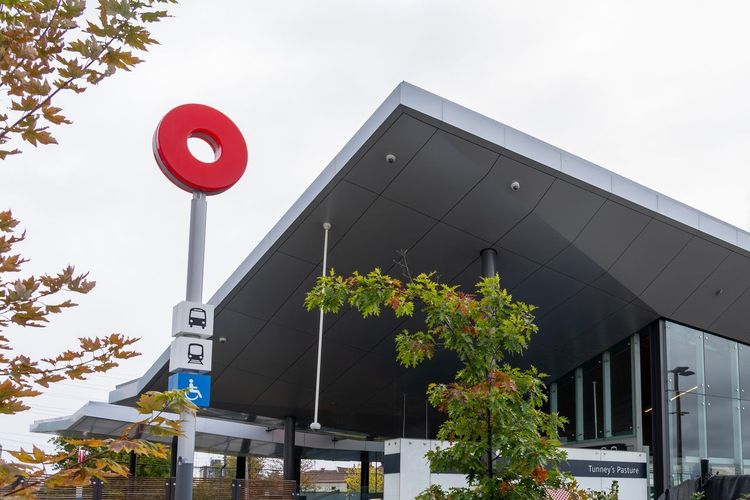
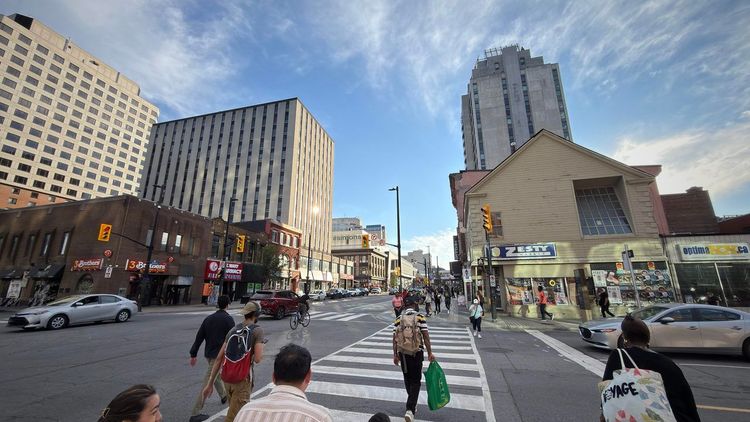
Ottawa's downtown core is walkable, flat, and compact enough that most first-time visitors use transit less than they expected. The O-Train light rail (Line 1, the Confederation Line) runs east-west through downtown, and OC Transpo buses fill in the gaps, with fares payable by Presto card or contactless credit card.
From Ottawa Macdonald-Cartier International Airport, a taxi or rideshare into downtown takes roughly 20 to 25 minutes in normal traffic. The cheaper option is O-Train Line 4, which runs from the airport terminal and connects with the north-south Line 2 toward downtown. If you're driving, parking near the canal and Parliament Hill fills up fast in summer and during festivals, so a hotel with parking, or leaving the car and walking, will save real frustration.
Cycling is a genuinely good option too: the city's pathway network, including the Ottawa River Pathway, is extensive and largely separated from traffic, and seasonal bike-share and rental shops cluster near the canal. In winter, you can skate parts of the commute on the canal when the Skateway is open, which locals actually do.
A few downtown O-Train stations are worth knowing on your first time in the city: Parliament and Lyon stations sit a short walk from Parliament Hill and Sparks Street, Rideau station drops you at the edge of ByWard Market and the Rideau Centre mall, and Pimisi serves the Canadian War Museum and LeBreton Flats. Crossing to Gatineau for the Museum of History is easiest on foot over the Alexandra Bridge, about 15 minutes from the market, or on an STO bus. Taxis and rideshares are easy to find downtown, but for most short hops between sights, walking will be just as quick once you factor in one-way streets.
Best Time to Visit Ottawa
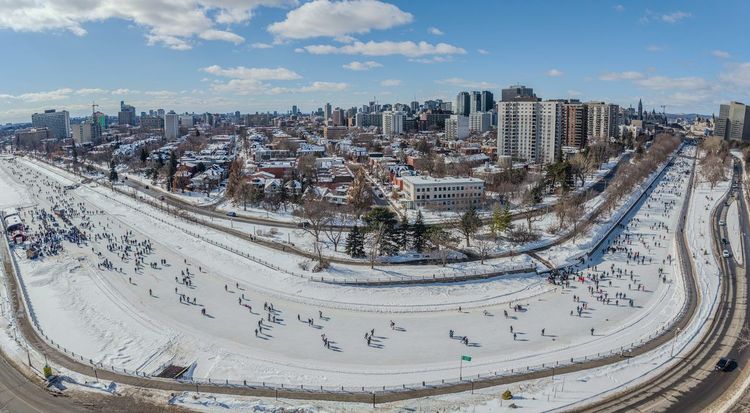
Pick your season deliberately, because the city feels almost unrecognizable across the calendar. Ottawa has a true continental climate: summer highs regularly reach the high twenties Celsius with humid spells, while January nights can drop below minus 20, so the answer to « when » depends heavily on what you want to do. Winter (roughly late January through February) brings the Rideau Canal Skateway and the Winterlude festival, with ice sculptures and outdoor activities built around sub-zero temperatures that you should pack for seriously if you come from a warmer climate.
Spring, particularly mid-May, centres on the Canadian Tulip Festival around Commissioners Park and Dow's Lake, with mild weather that makes walking far more comfortable. Summer (June through August) is peak season for a reason: every major sight runs a full schedule, Parliament Hill holds its guard ceremony, Canada Day turns downtown into one giant party on 1 July, and festivals run almost continuously, though hotel rates and crowds peak too. Fall brings thinner crowds, cooler walking weather, and some of the best foliage in the region across the river in Gatineau Park. If you're weighing a cold-weather trip, Ryo's guide to winter travel in Canada helps decide whether the skating season is worth planning around.
Practical Tips: Safety, Currency, and Local Etiquette
A few practical details smooth out a first visit more than any landmark list. Canada uses the Canadian dollar (CAD); the one-dollar coin is the loonie and the two-dollar coin the toonie. Contactless card payment is accepted almost everywhere, so there's little need to carry much cash. Prices are shown before tax, and Ontario's 13% HST is added at the till, which surprises many international visitors. Many of the federal sights covered in this guide (Parliament tours, Rideau Hall, the Supreme Court, the Bank of Canada Museum, the Ottawa Art Gallery) are free, which helps balance higher hotel and restaurant costs. Tours of Parliament and Rideau Hall involve airport-style security screening, so leave large bags at your hotel and bring photo ID.
Tipping follows North American norms: roughly 15 to 20% at sit-down restaurants and a dollar or two per drink at bars, with tip prompts built into most card machines. Ottawa is officially bilingual, so expect signage, museum placards, and announcements in English and French; staff downtown switch easily, and English is perfectly fine for visitors. A simple « bonjour » goes down well if you cross into Gatineau, where French is the everyday language.
By capital-city standards, Ottawa is considered safe for walking at night in the downtown core and ByWard Market, though the usual habits (watching belongings in crowded areas, sticking to lit streets late at night) still apply. Winter visitors should take the cold seriously: layered clothing, waterproof boots, and short outdoor stints during extreme cold snaps matter more here than in most capitals. International visitors flying in also need an eTA or a visa depending on nationality, so check before you book.
Suggested Itineraries for First-Time Visitors
How you split your time depends on how many days you have, but both plans below build on the same walkable core.
One day in Ottawa
With a single day, stay downtown: Parliament Hill in the morning (Changing the Guard in summer), then Major's Hill Park and the Rideau Locks, then the Château Laurier before lunch in ByWard Market and a BeaverTails for dessert. Spend the afternoon at the National Gallery of Canada, a ten-minute walk from the market, and close the day along the canal as the Peace Tower lights up. It's a tight loop, and the Ryo audio guide to Ottawa covers most of it at your own pace, so you can listen to the stories of each landmark instead of checking directions.
A long weekend (3 days) in Ottawa
With three days, keep day one as the downtown loop above, then give day two to museums: the Canadian Museum of History and the Canadian War Museum in the morning, the Canadian Museum of Nature or the Bank of Canada Museum in the afternoon, depending on how much museum fatigue has set in. Save day three for neighborhoods and the outdoors: Sparks Street and the Ottawa Art Gallery in the morning, Westboro or Hintonburg for lunch, then a walk or bike ride along the Ottawa River Pathway toward Dow's Lake. If you've got energy left, a half-day in Gatineau Park rounds out the trip with the one landscape downtown can't offer.
Have more time? Montreal is about two hours east by car or train, and Quebec City a few hours beyond; our road trip through Quebec shows how to link Ottawa with both.



FAQ
Is Ottawa worth visiting as a tourist?
Yes. Ottawa packs national museums, a UNESCO World Heritage canal, and a market dating back to the 1820s into a downtown core small enough to explore on foot, which makes it unusually efficient for the amount of sightseeing it offers.
Where to stay in Ottawa for the first time?
Downtown, within walking distance of Parliament Hill and the canal, is the easiest base. ByWard Market works well if nightlife and restaurants matter more than quiet evenings, while Centretown offers a calmer middle ground.
What are the top 5 things to do in Ottawa?
Most first-time visitors prioritize Parliament Hill, the Rideau Canal and its locks, ByWard Market, the National Gallery of Canada, and Major's Hill Park, all within a 15 to 20 minute walk of each other.
What is the best month to visit Ottawa?
May (for the Tulip Festival) and September (for mild weather and thinner crowds) offer the best balance, while February suits visitors chasing the Rideau Canal Skateway and Winterlude.
How many days do you need in Ottawa?
One full day covers the essential downtown landmarks; three days lets you add the national museums, the outer neighborhoods, and a half-day in Gatineau Park without feeling rushed.
Is Ottawa safe and easy to get around for first-time visitors?
Ottawa is generally considered safe by capital-city standards, with a walkable, flat downtown and an O-Train and bus network for anything further out. Standard city precautions apply, but there's nothing unusual to worry about.
Ottawa's real strength for first time visitors is how little time you lose between the things worth seeing: landmarks, museums, a historic market, and riverside nature all sit within one walkable loop rather than scattered across a sprawling metro area. Whether you have a single day or a long weekend, a Ryo audio-guided walk through the capital is a relaxed way to take that loop at your own pace, with the stories behind each stop in your ear.