© Shutterstock
 Votre guide Ryo
Walking in Agen in 2026: Old Quarter, Ermitage, and Canal de Garonne
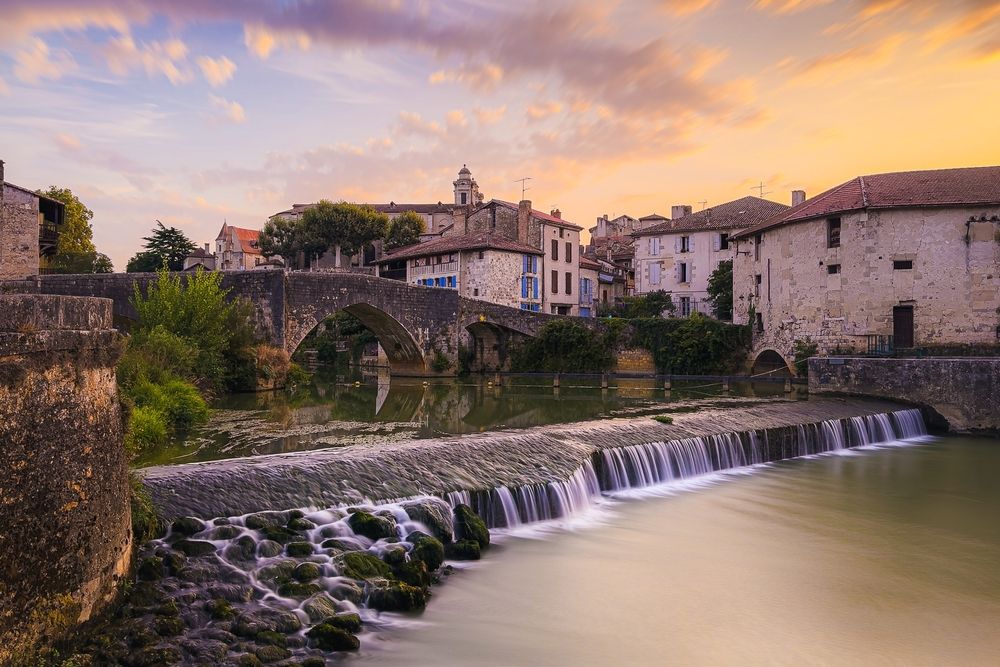
Agen is best experienced on foot, not from a car park. The walk from the forecourt of Saint-Caprais Cathedral to the Ermitage hillside viewpoint can be completed in a single morning and captures everything the town does well. Between the Garonne river that borders the old quarter and the Ermitage hill that looks down over the Lot-et-Garonne prefecture, a good walk in Agen changes scenery every twenty minutes without ever leaving the town limits. A 19th-century canal bridge spans a river more than 200 metres wide, a stone Virgin as tall as a three-storey building has watched over the town since 1866, and eight kilometres of towpath follow the water without a single car in sight. This guide covers every route walkable or cyclable: old Agen and its cathedral with its helical bell tower, the four Ermitage hillside loops, the towpath to the Maison de Garonne, and hidden gems that few visitors know about, such as the Romanesque priory of Moirax or the medieval garden of Laplume. It also includes family-friendly adventure trails, day trips to the bastide towns of the Lot and the Gers, and everything you need to plan the outing practically: bike rental, best season, average duration. To continue exploring once you are on the ground, the Ryo Agen audio-guided tour provides commentary on many of these places as you walk.
Walking Old Agen: Saint-Caprais Cathedral and the Town Centre's Heritage
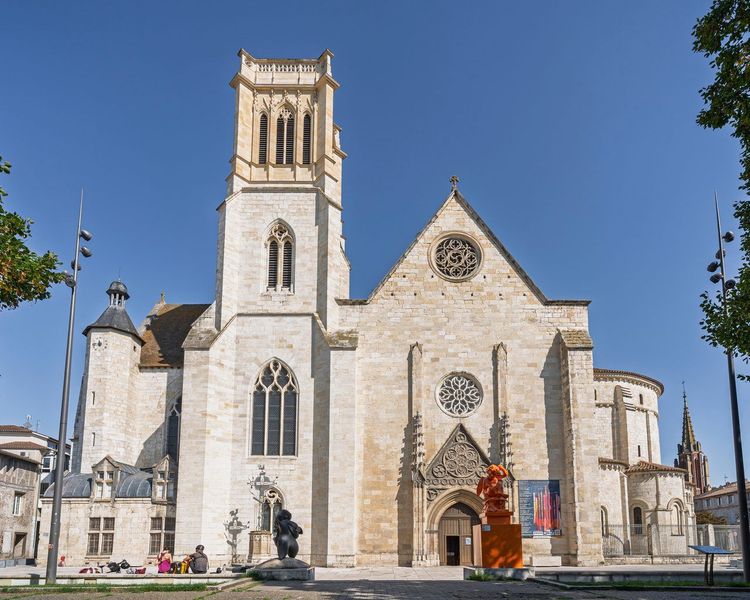
Agen's old town is best discovered through its ancient centre, a grid of narrow lanes that has retained its medieval layout despite the redevelopments of the 19th century. Allow around an hour and a half to cross it at a leisurely pace, stopping at the half-timbered facades on rue Beauville or the arcaded galleries of rue des Cornières.
Founded on a Gaulish site and later developed by the Romans under the name Aginnum, Agen long thrived on its river port before becoming, in the 20th century, the world capital of prunes. This commercial history explains the density of grand bourgeois townhouses in the centre, which you come across by chance in the lanes without necessarily stopping to look.
The natural starting point is Saint-Caprais Cathedral, a listed historic monument renowned for its 11th-century Romanesque chevet, one of the best preserved in the South-West. It features a helical bell tower, a fairly rare sight in France, remodelled in the 19th century, whose silhouette is visible from far down the town-centre streets — a detail that few visitors notice simply by looking up from the forecourt. The building is also one of the listed stops on the Chemin de Saint-Jacques-de-Compostelle in France, a thread that will reappear a little further on the Ermitage hillside.
Continuing towards the historic centre, the Hôtel Hutot de Latour is worth a detour. This 17th-century private mansion, with its inner courtyard and Renaissance features, bears witness to the mercantile wealth of Agen at a time when the town prospered through river trade on the Garonne. It is not always open to visitors, but its street facade alone is worth the slight detour.
The covered market in Agen (Place du Marché, 47000 Agen, rated 4.4/5 on Google with 115 reviews) is open in the mornings almost every day of the week, with Monday being the least reliable day — a quick check of opening times before you go will save any disappointment. You will find local Lot-et-Garonne producers selling Agen prunes in every form, strawberries from the neighbouring Périgord, farmhouse goat's cheeses, and enough to put together a picnic for later on the walk, making it as practical a stop as it is a gastronomic one. To avoid the crowds, visit on a weekday before 10 a.m.: the market then ticks over quietly and the surrounding lanes are virtually deserted, making it much easier to photograph the facades without tourists or cars in the background.
Round off this urban loop at the Monumental Virgin, a stone statue erected in 1866 on the heights overlooking the town. Visible from several points in the historic centre, it already offers a foretaste of the full panorama that awaits on the Ermitage hillside, described just below. Allow a short uphill walk to reach it, with a few cobbled sections that call for closed-toe shoes.
This first walk in Agen fits easily into a morning, including the cathedral, the mansion, the market, and the Virgin, and is suitable for all levels of mobility since it remains almost entirely on flat paving, apart from the final climb. The Agen audio-guided tour follows a similar route, cathedral included.
The Ermitage Loops: the Best Panoramic Views over Agen
The Ermitage hillside (Route de l'Ermitage, 47000 Agen, rated 3.9/5 on Google with 16 reviews) overlooks Agen to the west, offering the most complete viewpoint over the town and the Garonne valley. It is also the area richest in waymarked trails: four loops are laid out here, of varying lengths and difficulties, making it the walk in Agen most often recommended by locals when asked where to go on foot.
The Green Loop is the shortest of the four, around 3.5 km and 1 to 1 h 15 of walking, largely in the shade. It is well suited to an evening outing or a walk with children who cannot manage long distances, while still offering the essential wooded charm of the hillside.
The Gaillard Loop, longer at nearly 6 km, ventures deeper into the undergrowth and crosses farming plots that are a reminder that the Ermitage remains a semi-rural area despite its immediate proximity to the town centre. Allow 1 h 30 to 2 hours depending on your pace.
The Vérone Loop is known for its more pronounced elevation gain but also for its open views over the valley, including a promontory from which the meanders of the Garonne can be seen for several kilometres. It is probably the most photogenic of the four, particularly in the late afternoon when the light rakes across the hillsides.
Finally, the Plateau Loop follows a section of the historic routes towards Santiago de Compostela: Agen lies on the Via Podiensis, one of the French pilgrimage routes to Compostela, which explains the presence of scallop-shell waymarks on this trail. Long-distance pilgrims and Sunday walkers share the same path, a coexistence that gives this loop a distinctive atmosphere, somewhere between spiritual rest stop and weekend outing.
All four loops start from the same waymarked point and can be combined: many walkers link the Green and the Gaillard for a 2 h 30 outing without retracing their steps, simply following the yellow waymarks and then the blue waymarks at the main junction. The hillside alternates between pine woods, oak groves, and a few remaining vineyards, remnants of a wine-growing activity that long occupied these slopes before the expansion of prune cultivation in the plain. In spring, the undergrowth on the Green Loop is carpeted in wild daffodils, a detail that completely changes the atmosphere compared to a winter outing.
What all four loops share, beyond their different distances, is the viewpoint over the town of Agen from the hillside: the rooftops of the historic centre, the helical bell tower of the cathedral, the ribbon of the Garonne, and on a clear day, the hills of the Gers in the background. Many visitors only make it as far as the first viewpoint before turning back, which remains a perfectly valid option if time is short.
A recurring practical question: where to park. There is a free car park at the foot of the hill, on the avenue du Général Leclerc side, but it fills up quickly on weekend mornings. Arriving before 10 a.m. or after 4 p.m. avoids most parking headaches, especially in high season. After the descent, the walk naturally continues towards the Garonne and its lateral canal, about ten minutes on foot from the Ermitage car park.
The Canal Bridge and the Canal de Garonne: a Waterside Walk
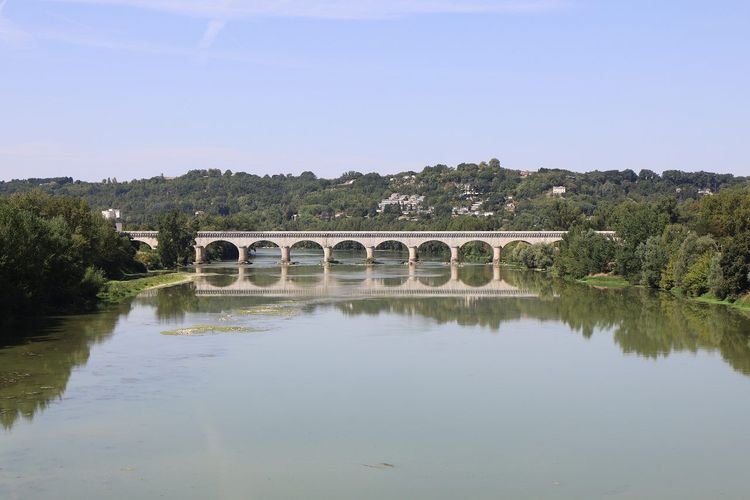
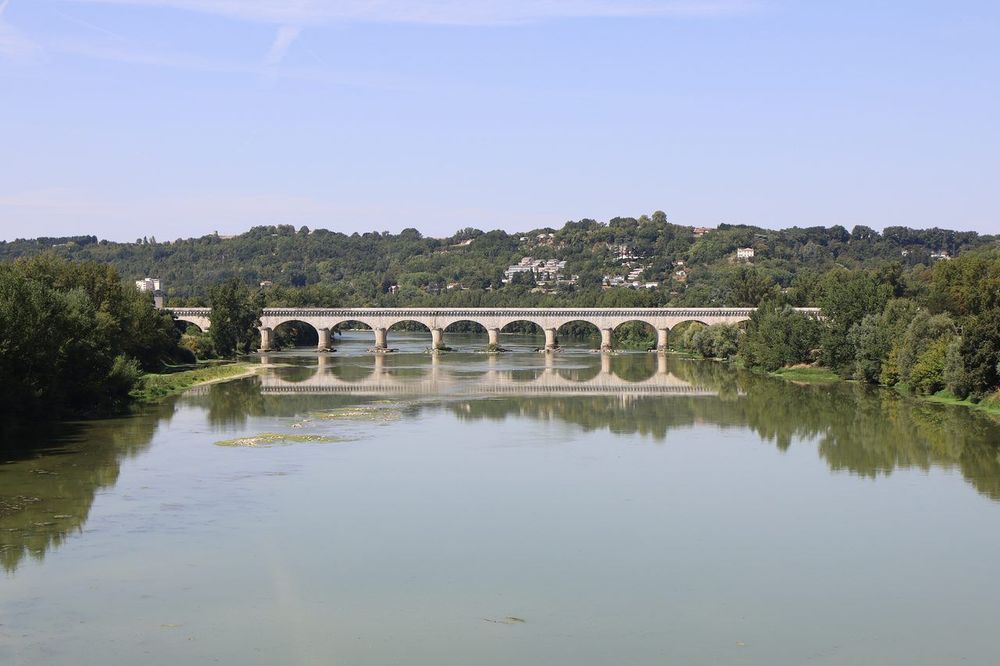
The Agen canal bridge, completed in 1843, remains one of the most spectacular structures on the Canal latéral à la Garonne: 23 stone arches carry the canal nearly 550 metres above the river, a feat of engineering for the time that allows barges to pass serenely above the pleasure boats far below, safe from the Garonne's floods.
The Canal latéral à la Garonne was dug between 1838 and 1856 to give boatmen a reliable alternative to the river, whose floods and sandbanks made navigation unpredictable. Running 193 km between Toulouse and Castets-en-Dorthe, it passes through Agen over several kilometres and is still used today by hotel barges offering slow cruises towards the Bordeaux region.
On either side of the canal bridge, the towpath lends itself to a linear walk of around 8 km if you go the full distance, or a simple one-hour out-and-back to the next bridge. The surface, compacted and flat throughout, is equally suited to walking and cycling, making this the most versatile walk in Agen — accessible to pushchairs and mountain bikes alike. The path is also part of the Vélo Route Voie Verte 80, which links Toulouse to Bordeaux almost without interruption: cyclists planning a longer crossing find Agen a logical staging post, roughly halfway along the full route.
Heading downstream, you pass the Maison de Garonne (Boulevard de la Liberté, 47000 Agen, rated 4.5/5 on Google with 82 reviews), an interpretation centre dedicated to the river ecosystem: historic floods, aquatic wildlife, and bank management. Entry is generally free or low-cost depending on the current exhibition, and the visit complements the walk nicely for anyone who wants to understand why the Garonne shapes the Agen landscape so profoundly.
The area goes by the name Garonne Nature, a label that covers several amenities along the banks: bird-watching hides, educational panels, and shaded picnic areas. Grey herons and cormorants are visible almost year-round, particularly early in the morning when traffic on the quays is light. Anglers regularly occupy the banks at weekends, especially around the locks where the calmer water draws carp and roach; if you are travelling with curious children, stopping for five minutes at a lock to watch a barge manoeuvre is a classic activity that works at any age.
For those who prefer a narrated version of this waterside walk, the sub-route Agen audio-guided tour, C'est le ponpon sur la Garonne covers 3.1 km in around 1 h 15, with 20 audio commentaries that tell the story of the canal bridge and the quays as you walk. In practical terms, aim for the morning or late afternoon in summer: the towpath is completely exposed over several stretches, making the walk exhausting in the full July or August sun.
Hidden Heritage Gems around Agen: Moirax, Laplume, and the Medieval Garden
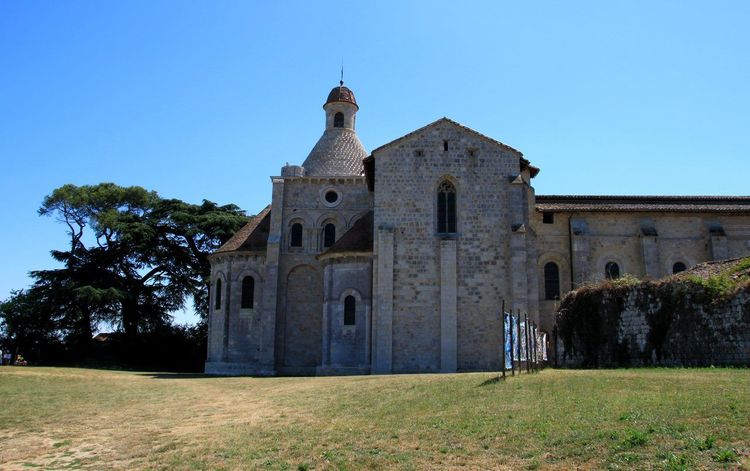
A walk around Agen does not stop at the town boundary. About fifteen minutes by car from the centre, two sites fly under most visitors' radar yet rank among the most interesting in the département.
The Priory of Notre-Dame de Moirax, founded in the 11th century by Cluniac monks, houses one of the finest Romanesque churches in the Lot-et-Garonne. Its sculpted capitals, remarkably well preserved, depict biblical scenes with a delicacy that surprises for a building of such age. The visit is usually self-guided, and the silence of the village of Moirax adds to the sense of escape.
Nearby, the medieval garden Le Buis qui court (Laplume, 47310 Laplume, rated 4.5/5 on Google with 60 reviews), in Laplume, recreates a monastic-inspired garden with its beds of aromatic, medicinal, and kitchen plants laid out according to medieval horticultural principles. It is a modest site in scale but rich in detail, designed for a slow visit of around one hour, best enjoyed in spring or early summer when the plantings are at their peak.
The village of Laplume itself is worth a few minutes of wandering: perched on a hillock, it retains an old covered market hall and an open view over the surrounding countryside, typical of the hillside villages of the Lot-et-Garonne. It is rarely a destination in its own right, but it rounds off a combined outing with the neighbouring medieval garden perfectly.
A word of caution about opening times: these sites often operate on seasonal or association-run schedules, with reduced hours outside spring and summer. A quick call to the Agen tourist office before you go will save you a wasted trip. Allow half a day to combine Moirax and Laplume from Agen, including the driving time: an outing well suited to a quiet Sunday, away from the heavier footfall of the town centre or the Ermitage hillside in high season.
Lakes and Natural Spaces around Agen
The Lot-et-Garonne has a surprising number of lakes and managed natural spaces within less than 20 minutes of Agen, often unknown to passing visitors but very popular with locals at weekends.
The Lac de Bajamont, to the north-west of town, offers a shaded loop of around 3 km around the water, with a few picnic areas and benches facing the lake. It is an easy outing with no significant elevation gain, equally suited to a post-lunch stroll or a gentle jog.
The Lac de la Prade and the Lac de Talives follow a similar pattern: leisure lakes, sometimes used for fishing or supervised swimming in season, surrounded by paths accessible to all levels. Their common quality is tranquillity, far from the busier tourist sites in the département.
The Passeligne lake and nature park (47240 Bon-Encontre, rated 4.4/5 on Google with 1,345 reviews), the largest of the group, combines a lake with wooded areas spread over several hectares. The site is set up to welcome families for a full day, with shaded areas large enough to avoid feeling crowded even on the busiest summer days.
More unusual, the Trotte Lapin nature site offers a discovery trail designed for observing local wildlife without disturbing it, with explanatory panels placed along the path. It is a short outing, aimed more at families or school groups than at serious walkers.
The Réserve naturelle nationale de la Frayère d'Alose protects a spawning site for the allis shad, a migratory fish emblematic of the Garonne whose populations have declined sharply since the first dams were built on the river. The site is best visited via observation trails, with panels explaining the species' life cycle — a fairly unusual angle for a nature reserve open to the general public.
Finally, the arboretum near Agen brings together a variety of tree species, some rare for the region, along a waymarked trail that lends itself to a calm one-hour walk. It is a site particularly appreciated in autumn, when the coloured foliage completely transforms the atmosphere.
Many of these sites lend themselves to a classic forest walk once the lake circuit is done: the woodland surrounding them is generally crossed by secondary paths, less frequented than the main loop, ideal for extending the outing by an extra twenty to thirty minutes if time allows. These lakes make a natural extension to a walk in Agen when the town centre has already been explored the day before. Most have a free car park immediately nearby, which simplifies organising a day that takes in several sites. Do bring water and sunscreen in summer: shade is limited on the stretches that run directly alongside the banks.
To discover other nature routes in the same vein around Agen, the article Ryo: hiking in the Lot-et-Garonne lists several additional loops, lesser-known but equally rewarding.
Family Adventure Trails: Tèrra Aventura, Randoland, and Educational Paths
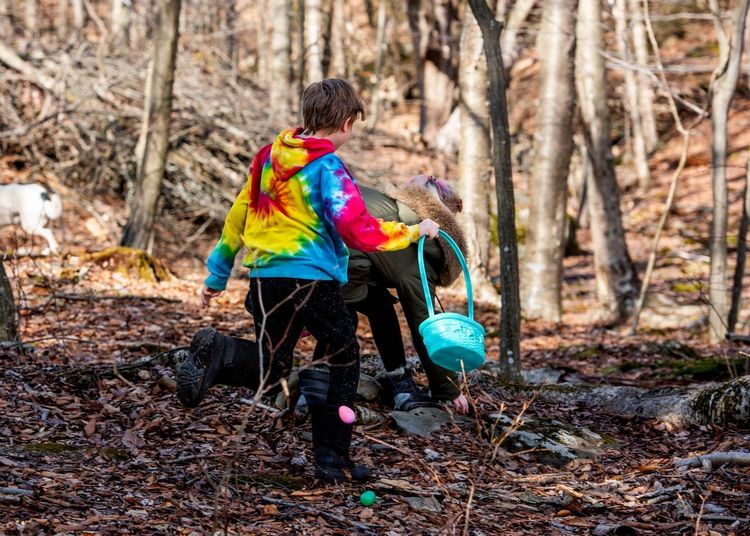
The Lot-et-Garonne around Agen has an impressive concentration of outdoor treasure hunts, a format that turns a simple walk in and around Agen into a geolocated adventure. Three families of trails coexist, each with its own approach.
The Tèrra Aventura trails, developed by the Nouvelle-Aquitaine tourism committees, combine walking with riddles solved through a dedicated app to track down a poï'z, a small collectible figurine. Around Agen, six trails are available: Du rififi au Pont-Canal along the canal and the river, Chevauchée en Pays de Serres, Aux saveurs de Puymirol with a tasty nod to this hilltop village, the first bastide of the Agenais founded in 1246, Poupou sur la Garonne, La Blanche évaz'ion and Sous laplume de l'artiste, a reference to the village of Laplume mentioned above. Each trail takes between 1 h 30 and 3 hours and is suitable for children from age 6–7, provided you have a charged smartphone for the app.
The Randoland trails work without an app: a printed booklet to download guides children through questions answered by observing their surroundings. The Engayrac, Saint-Maurin, and La Sauvetat-de-Savères circuits cover this format around Agen, with distances generally between 3 and 6 km, suited to families with young children who still walk at their own pace.
Finally, the educational and discovery trails add a third layer to this family offer: the Saint-Julien/Engayrac, Beauville/Lacalquetie, Beauville/Marcoux, and Blaymont loops feature explanatory panels placed along the route covering local wildlife, flora, or heritage, with no app or booklet required. These are often the shortest loops in this selection, designed for a one-hour outing with very young children.
Choosing between these three formats is straightforward: Tèrra Aventura suits families with a smartphone who are happy to play the digital treasure hunt game, Randoland suits families who prefer a paper guide, and the educational trails suit short outings with very young walkers. There is nothing to stop you trying several formats over the same stay to keep things varied.
The Tèrra Aventura and Randoland kits are generally free, available from local tourist offices or as direct downloads, making them a zero-cost family activity beyond the petrol to reach the starting point. The one real constraint: check mobile network coverage on some rural trails, which can be patchy away from villages. For families spending several days in the area, combining a Tèrra Aventura trail in the morning with a shorter educational loop in the afternoon allows you to vary the format without boring the children, while covering different geographical areas around Agen.
Day Trips to the Lot Bastide Towns: Moissac, Lauzerte, Puy-l'Évêque, and Duravel
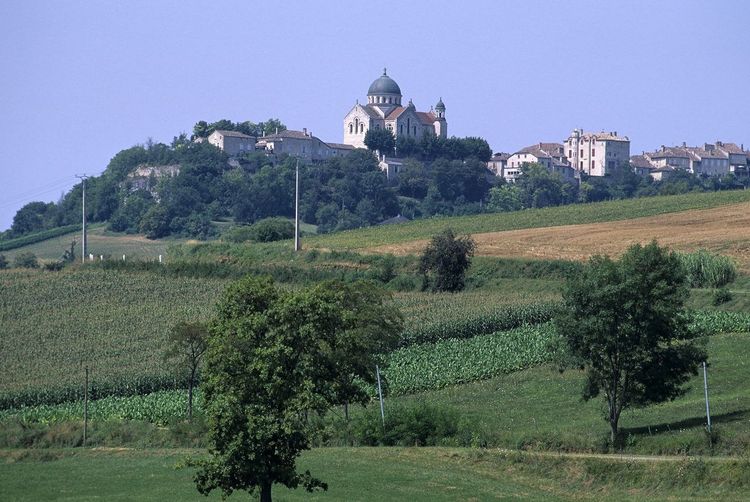
Less than an hour's drive from Agen, the Lot valley lines up some of the finest bastide towns and hilltop villages in the South-West, a natural playground for anyone wanting to extend their walk into a full day out.
Moissac, about 45 minutes away, is visited above all for its Abbaye Saint-Pierre, listed as a UNESCO World Heritage Site as part of the Routes of the Pilgrims to Santiago de Compostela. Its Romanesque cloister, with its 76 sculpted capitals, is one of the most complete ensembles in Europe from that period. The town also benefits from its position at the confluence of the Tarn and the Garonne, with a lively marina in season.
Lauzerte, listed among the Plus Beaux Villages de France, crowns a hilltop with a typical 13th-century bastide square, the Place des Cornières, lined with arcades and half-timbered houses. The climb from the main car park takes about ten minutes on foot and is rewarded with a 360-degree panorama over the Quercy countryside.
Further north, Puy-l'Évêque and Duravel run alongside the Lot valley with a different character: limestone cliffs, ochre houses clinging to the hillside, and a well-established wine reputation thanks to the Cahors appellation that covers much of this area. Puy-l'Évêque dominates the river from a rocky promontory, while Duravel preserves a rare Romanesque crypt that predates the church built above it.
Lafrançaise (82130 Lafrançaise), a quieter village between Moissac and Montauban, rounds out this selection with its 19th-century circular covered market hall and its position on a ledge overlooking the Barguelonne valley — less spectacular than its neighbours but equally representative of rural Quercy Blanc architecture.
The best way to reach these bastide towns remains by car, as public transport links from Agen are infrequent and limited at weekends. Allow around 45 minutes to Moissac or Lauzerte, and a little over an hour for Puy-l'Évêque or Duravel, placing them at the outer limit of a half-day trip rather than a full day out.
For wine lovers, a stop at one of the wine estates around Puy-l'Évêque allows you to taste Cahors straight from the producer, often without a reservation outside the harvest period. At the end of the day, the raking light on the ochre facades of Lauzerte or Puy-l'Évêque creates ideal conditions for photography — reason enough to schedule these village visits for late afternoon rather than midday.
Day Trips into the Gers and Armagnac: Condom, Eauze, and Mézin-Poudenas
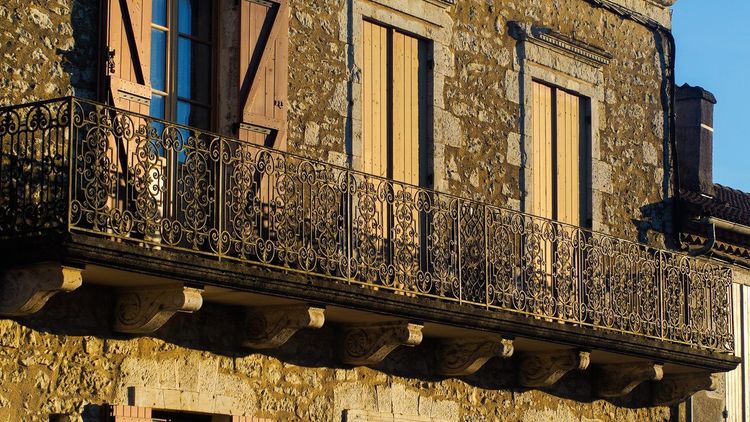
Head south-west this time, towards the Gers and its historic Armagnac heartland, a little over half an hour's drive from Agen. Enough to turn a walk in Agen into a full-day escape, tasting of Armagnac included.
Condom, despite the name that invariably raises a smile, is well worth visiting for its Cathédrale Saint-Pierre and its old quarter laid out around the canal, not to mention the Armagnac négociant houses that recall the historical importance of this brandy to the local economy. To get more out of this stop, the article Ryo: what to do in Condom covers the essential visits on the ground.
Eauze, a little further south, stands out for its colourful Gers market and for the Eauze Treasure, an exceptional collection of Gallo-Roman gold and silver pieces on display at the town's archaeological museum — one of the richest monetary treasures ever discovered in France.
Finally, the road linking Mézin to Poudenas (47170 Poudenas, rated 4.6/5 on Google with 180 reviews) condenses two very different atmospheres into just a few kilometres: Mézin, a medieval bastide known for its cork industry and the museum dedicated to it, and Poudenas, often called the little Italy of the Lot-et-Garonne for its perched château and steep lanes tumbling down towards the Gélise river.
For Armagnac enthusiasts, several négociant houses around Condom offer cellar tours followed by a tasting, an activity that naturally complements the heritage walk without requiring a reservation in low season. Allow around 45 minutes' drive between Agen and Condom, a little more for Eauze or Mézin. If time allows, Auch, the Gers prefecture, is less than an hour from Condom and rounds off this Gascon excursion nicely for anyone with a full weekend rather than a single day.
This excursion works well as a full day from Agen, particularly if you add a lunch of local produce: duck breast, foie gras, and Armagnac are the gastronomic highlights of the area — to be enjoyed in moderation before getting back behind the wheel.
Further Nature Escapes: Pujols, Cuq/Fals, the Ambrus Forest, and the Bouconne Forest
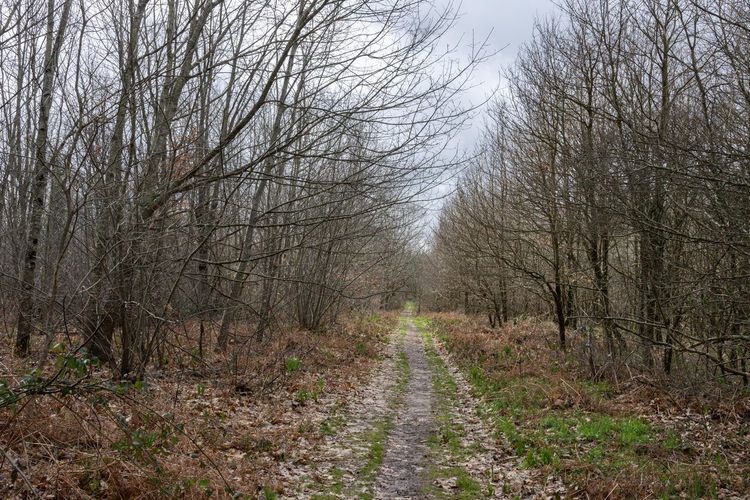
For a weekend rather than a day trip, several more distant nature escapes round out the map of walks around Agen.
Pujols, about twenty minutes from Villeneuve-sur-Lot, is listed among the Plus Beaux Villages de France and overlooks the Lot valley from its promontory. Its flower-lined lanes and old market hall make it a pleasant stop to combine with a walk in the valley below.
The Cuq and Fals area, in Gascony, offers a hiking circuit through a landscape of gentle hills, fairly representative of the neighbouring Gers despite lying on the Lot-et-Garonne side. It is a lesser-frequented route, valued for its quietness rather than for any outstanding heritage highlights.
To the west, the Ambrus Forest offers a Landes-style woodland experience, with its rows of maritime pines that contrast sharply with the hillside and vineyard landscapes that dominate the rest of the département. A forest walk here is possible in any season thanks to the permanent shade of the tree canopy, including in the height of August when the towpath becomes stifling.
Further afield, the Bouconne Forest, on the outskirts of Toulouse, is one of the largest forested areas in the Toulouse region, with kilometres of waymarked trails for walking, mountain biking, and even tree-climbing for families looking for a more active outing.
Finally, the Lac de Samatan (32130 Samatan, rated 4.5/5 on Google with 261 reviews), in the Gers, completes this selection of slightly off-the-beaten-track nature outings: a leisure lake with supervised swimming in season, ideal as a relaxing mid-route pause for anyone exploring the Agen–Auch–Toulouse triangle over several days.
All five of these destinations are more than an hour's drive from Agen, making them better suited to visitors staying in the region for several days rather than a simple afternoon outing. It is best to save them for the end of your stay, once you know how much time and energy you have left. A same-day return trip is possible for Pujols or the Ambrus Forest, but the Bouconne Forest or the Lac de Samatan are better treated as a midway stopover on the road towards Toulouse.
Guided Tours and Events to Extend Your Walk in Agen
Beyond self-guided walks, several guided tours and events allow you to explore Agen in greater depth.
The tour Agen, un cœur de ville aux richesses insoupçonnées offers a professional guide-led walk through the historic centre. An adapted version, Agen pour les pitchouns, targets families with young children with a shorter, more playful format.
The investigation Au cœur de la Résistance agenaise, aidez Margot turns the walk into a historical treasure hunt around the sites connected to the Second World War, a format that goes down particularly well with teenagers. The chapel of the Collège Joseph-Chaumié (Boulevard du Président Carnot, 47000 Agen), rarely open outside organised visits, adds to this offer with an interior that is unexpectedly striking for a school building.
On the events side, the Festival Sans Filtre, the open days of the Aviron agenais rowing club, the Michel Serres philosophical encounters, and the Agen Christmas market punctuate the calendar without fixed dates from one year to the next — it is worth checking the up-to-date programme before planning a visit around any of these events. To organise a tailored visit between events, the Ryo audio-guided tour of Agen remains a good starting point.
Renting a Bike and Practical Tips for Planning Your Outing
The bike remains the most efficient way to string several routes together in a single day: a cycling tour of Agen covers three times as much ground as walking, particularly along the canal and out to the surrounding lakes.
Two rental shops stand out locally: Cycles Sud-Ouest, with a town-centre shop offering hourly or daily hire, and its sister outlet Cycles Sud-Ouest Nérac, useful if your route extends towards Nérac rather than staying on the canal. Café Vélo (Quai de Dunkerque, 47000 Agen, rated 4.3/5 on Google with 818 reviews) combines bike hire with a café, a handy formula for a break before heading back out on the towpath.
The most logical starting point for a walk in Agen remains the historic centre, within easy reach of the covered market and the cathedral, which allows you to move naturally from the old quarter to the canal and the Ermitage loops without doubling back.
A few practical details worth knowing before you set off: the terrain is generally flat in the town centre and along the canal, but becomes hillier as you approach the Ermitage hillside or the hilltop villages of the Lot. Pack closed-toe shoes whenever the plan includes one of these hillier areas.
For the outing itself, bring one water bottle per person for any walk lasting more than two hours, more in summer when shade is sparse on certain canal stretches. A basic first-aid kit is sufficient for most of the routes described in this guide, as none presents any particular technical difficulty. The character of a walk from Agen varies considerably depending on the chosen starting point: a simple one-hour urban loop for the historic centre, up to a full half-day for anyone combining the canal and the Ermitage hillside in a single outing.
On parking, several free or low-cost car parks surround the town centre, notably near the allées de Tourny and the Gravier quarter, a few minutes' walk from the recommended starting point. For visitors without a car, Agen train station is fifteen minutes on foot from the historic centre, making it entirely feasible to plan an outing without any motorised travel for those arriving by train.
When to Go and How Long to Allow for Exploring Agen
Spring and early autumn remain the best seasons for a walk in Agen: moderate temperatures, soft light on the old quarter's facades, and gardens and woodlands at their best, particularly around the Ermitage hillside and the surrounding lakes.
Summer is still manageable, provided you plan the outing for early morning or late afternoon: the historic centre, very stone-heavy, absorbs the heat, and the canal towpath is desperately short of shade over several kilometres. Winter, conversely, suits urban walks and a visit to the cathedral well, but is less ideal for the Ermitage loops, which can become muddy after several days of rain.
In terms of duration, a thorough and original walk through old Agen takes half a day, including the canal and the covered market. Add a full day if you want to include an Ermitage loop and a nature outing to one of the nearby lakes. For those with several days to spare, combining town, hillside, canal, and a bastide town in the Lot or the Gers makes for a complete three-to-four-day stay without repeating yourself from one day to the next.
For tracking your route in real time, the Komoot mobile app is a reference among walkers who know this area, with precise GPS tracks and feedback from other users on trail conditions. It works well alongside the routes described in this guide for anyone who wants autonomous navigation without relying solely on physical waymarking.
A walk in Agen on a weekday is noticeably quieter: weekends and school holidays account for the bulk of visitor numbers, especially on the Ermitage hillside and around the leisure lakes closest to town.
For a first overview of the town before tackling the longer walks, the article Ryo: top 5 things to do in Agen gives a concise overview of the highlights, to be used alongside the detailed routes earlier in this guide.

FAQ
How long does it take to walk around old Agen?
Allow around an hour and a half for a walk through Agen's historic centre, including Saint-Caprais Cathedral, the covered market, and the old lanes. Add thirty minutes if you include the climb to the monumental Virgin, whose viewpoint is well worth the extra effort.
What is the most beautiful walk around Agen?
Locals consistently agree: the Ermitage loops are the most popular walks near Agen, especially the Vérone loop for its open views over the Garonne valley. The canal towpath appeals more to those who prefer flat, linear routes.
Where can I park to do the Ermitage loop in Agen?
There is a free car park at the foot of the hill, on the avenue du Général Leclerc side. It fills up quickly on weekend mornings, so aim to arrive before 10 a.m. or after 4 p.m. to avoid driving around looking for a space.
Can you cycle along the Canal de Garonne in Agen?
Yes, the towpath is compacted and flat along most of its length, making it a comfortable cycling route. It forms part of the Vélo Route Voie Verte 80 linking Toulouse to Bordeaux, and several rental shops in the town centre offer bikes by the hour or by the day.
What family-friendly walks are there around Agen?
The Tèrra Aventura trails and Randoland routes offer the best fun-to-effort ratio for families with children, with no specific fitness level required. The educational trails around Beauville are better suited to younger walkers, covering shorter distances.
When is the best time to go walking in Agen?
Spring and early autumn offer the most pleasant conditions, with moderate temperatures and flattering light on the town centre's heritage buildings. In summer, it is best to head out early in the morning, especially on the towpath, which offers very little shade.
Are the walks around Agen accessible with a pushchair or for families?
The historic centre and the canal towpath are well suited to pushchair outings, as the surface is generally flat. The Ermitage loops, however, include steep sections and natural terrain that are less suitable for pushchairs.
Ultimately, a walk in Agen is never limited to just one outing: within a few square kilometres, the town combines a dense historic centre, a wooded hillside with valley views, a 19th-century canal, and, less than an hour's drive away, bastide towns and hilltop villages that rank among the finest in the South-West. Whether you have a morning or a full week, there is a combination of routes to suit your pace and curiosity.
To make the most of your time on the ground, keep the Ryo Agen audio-guided tour to hand: it provides a continuous commentary on the main sites in the historic centre — from Saint-Caprais Cathedral to the covered market — and along the canal, a practical companion to this guide for those who prefer to walk with their ears open rather than their nose in a map.