© Shutterstock
 Votre guide Ryo
The Museums to Visit in Annecy in 2026: From the Château Museum to Hidden Gems
Annecy's museums are full of surprises: the town fits into a few cobbled streets around its lake, yet it boasts a castle of the counts of Geneva turned museum, a former prison set in the middle of a canal and an entire collection devoted to animated film. The Ryo audio-guided tour of Annecy passes right at the foot of the fortress, with a stop devoted to its past as a comital residence, even before you step inside the rooms.
Between the Palais de l'Île, a former prison listed as a historic monument in 1900, an abbey converted into a contemporary art space and the memorial site of Saint Francis de Sales, Annecy's museums hold more surprises than a simple list of exhibition rooms. You will also come across a bell foundry active since the late 18th century in Sévrier, a 19th-century hydraulic sawmill near Thônes and, less than an hour away by road, the CERN exhibition space. This guide gives you verified prices, free days and the best ways to link visits together to build a cultural programme over several days, between the town centre and excursions around the lake.
The Annecy Château Museum, the Undisputed Star of the City's Museums
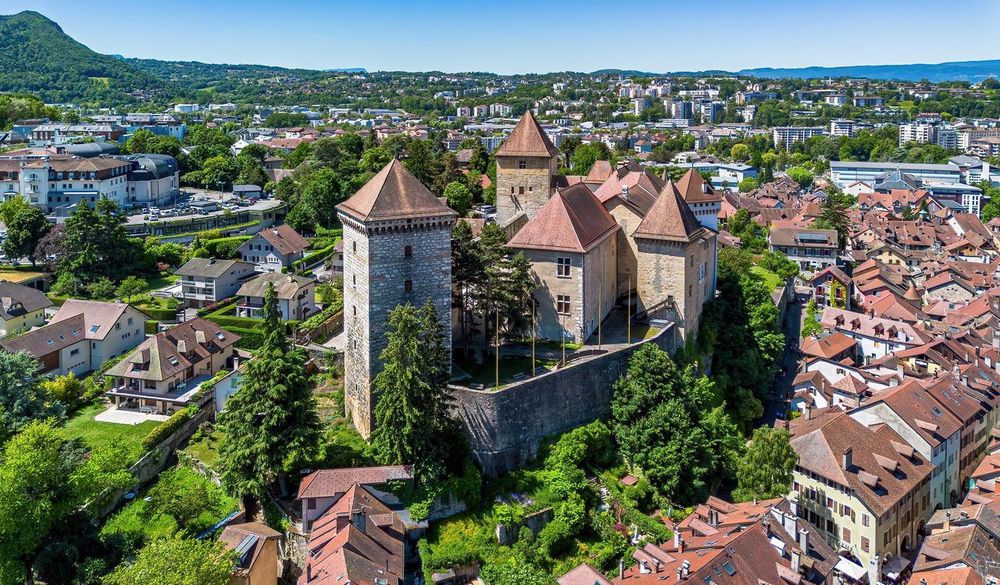
Perched on its rocky spur, the Annecy Château Museum (1 Place du Château, 74000 Annecy, rated 4.1/5 on Google from 5,880 reviews) has overlooked the old town since the counts of Geneva made it their residence in the 13th and 14th centuries. Extended in stages until the 16th century, the building evolved from a medieval fortress into a Renaissance-style château, before serving as barracks for nearly three centuries.
The museum's origins go back to 1953, when the town bought the château to save a complex then in poor condition. Three years later, in 1956, the museum opened its doors, and the site was listed as a historic monument in 1959. Since then, the Annecy château museum has continued to expand its scope, to the point of now bearing the "Musée de France" label and being among the most complete cultural facilities in Haute-Savoie.
What is striking as you walk through the rooms is the diversity of the collections gathered under one roof. The lake archaeology section presents remains of the stilt villages built on the lake shores several millennia ago. Medieval sculpture and fine arts take over, with a fine series of Alpine landscape paintings, while contemporary art takes over entire rooms. Annecy's contemporary art museum is not limited to hung paintings, either: installations, sculptures and videos engage in dialogue with the stone walls.
The folk arts and traditions form another part of the visit: Savoyard furniture and everyday objects tell the story of Alpine life before tourism. On the natural history side, the Perrière lodge houses the Observatoire régional des lacs alpins, with aquariums presenting the lake's fauna and an exhibit on how these large bodies of water work. Finally, one section is devoted to animated film, a nod to the festival that made the town famous.
You can hardly see everything in a single visit, as the rooms follow one another over several levels. Allow a good two hours to go through all the permanent collections without rushing. With children, start with the observatory's aquariums: that is often where their attention is won, before tackling the painting rooms.
The château also hosts temporary exhibitions, devoted in turn to a contemporary artist, a historical period or a regional theme. It is also part of the Art médiéval dans les Alpes network, which promotes the medieval heritage of the Alpine arc across several museums.
Architecturally, look out for the different building periods: the Queen's Tower, the oldest part with very thick walls, the 15th-century Perrière lodge, the Nemours lodge which introduces the French Renaissance style around 1535, and the New Lodge, the last wing to be built. The great hall and its cellar columns are worth a look in themselves.
As for Annecy Château Museum tickets, expect 6.50 euros for the full rate from September to June and 7 euros in July and August, and 3.50 to 4 euros for the reduced rate. Admission is free for children under 12, and free for everyone on the first Sunday of the month from October to May. The museum is closed on Tuesdays and on certain public holidays (1 January, 1 and 8 May, 1 and 11 November, 25 December): check before planning your visit. If you are looking for photos of the Annecy Château Museum to prepare your trip, the inner courtyard and the terrace offer the most spectacular angles over the rooftops of the old town.
Before crossing the drawbridge, listen to the story of the place: the Ryo audio-guided tour climbs through the old town to the foot of the fortress, with an audio stop dedicated to the counts of Geneva. You arrive in the rooms with the right keys to understanding it.
The Palais de l'Île, Annecy's Most Photographed Floating Museum
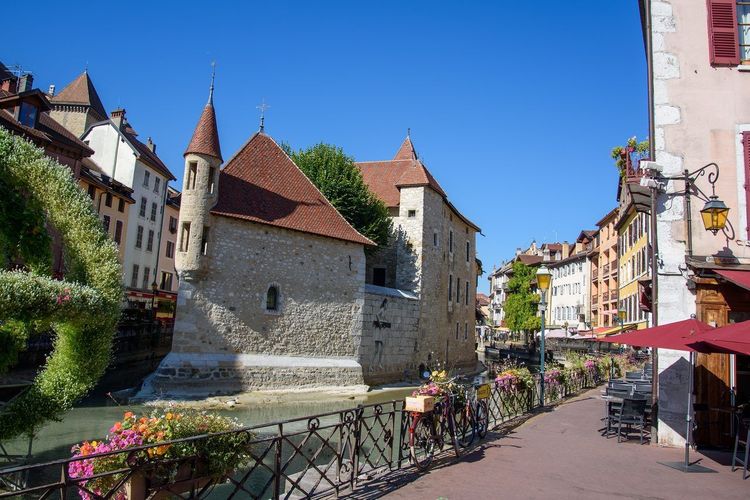
Set in the middle of the Thiou like a stone ship, the Palais de l'Île (3 Passage de l'Île, 74000 Annecy, rated 4.5/5 on Google from 5,375 reviews) is probably the most reproduced image of Annecy, even ahead of the château. Its slender silhouette, surrounded by water, has adorned postcards and travel photos for decades.
Before becoming a museum, the building had a far less photogenic existence. Built in the 12th century as a fortified house on a natural rocky islet, it served as a prison from at least 1325, then housed the mint workshop of the counts of Geneva from 1355. At the end of the 16th century, it became a courthouse, while keeping its dungeons. Its prison function only ended in 1864; the building then briefly housed a hospice, a drawing school and even a gymnasium, before being listed as a historic monument in 1900.
Today, the Palais de l'Île museum in Annecy houses the Centre d'interprétation de l'architecture et du patrimoine (CIAP), which tells the story of how the town and its landscapes were built. You go down into the dungeons of the former prison, then walk through the rooms of the former court. The visit, shorter than that of the château (allow 30 to 45 minutes), makes it one of the easiest historical museums to fit into a day.
The exterior nonetheless remains the star of the place: the best view is from the Perrière bridge or the quai de l'Isle, especially at the end of the day when the low light catches the colourful facades of old Annecy. In summer, the terraces lining the canal offer one of the best viewpoints of the building, ice cream in hand.
Expect to pay 4 euros for admission (5 euros in July and August), 2 euros for young people, and free for children under 12. As at the château, admission is free on the first Sunday of the month from October to May, and the palace is closed on Tuesdays. The walk between the two museums takes only about ten minutes.
Right opposite the Palais, the audio stop on the Ryo tour tells of its past as a prison and courthouse: enough to give the postcard a whole new dimension.
The Conservatoire d'Art et d'Histoire and the Basilica of the Visitation, Religious and Memorial Heritage
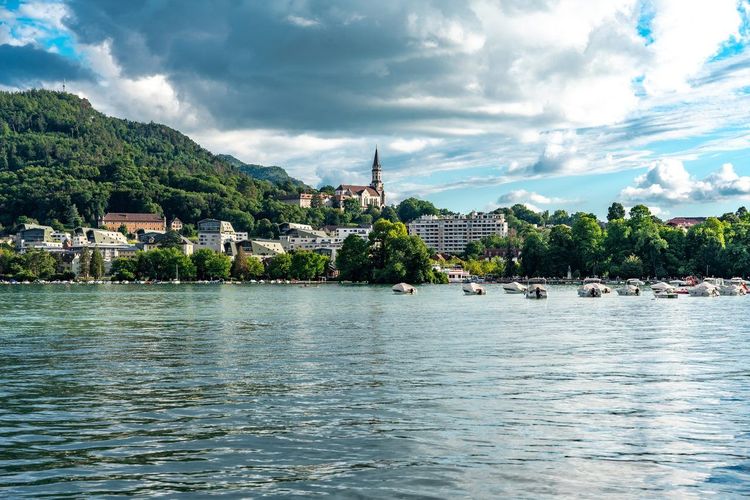
At the foot of the Visitation hill, the Conservatoire d'Art et d'Histoire, at 18 avenue du Trésum, is a large heritage building that now hosts exhibitions and above all the animation film museum, presented below. If you walk up to the basilica, it is a natural stop on your way.
On the hill overlooking the lake, the Basilica of the Visitation is worth the climb even though it is not a museum in the strict sense. Built in the first half of the 20th century, it houses the relics of Saint Francis de Sales and Saint Jane de Chantal, founders of the Order of the Visitation. The adjoining monastery has a small exhibition space devoted to the history of the order, and the forecourt offers one of the finest views of the town and the lake.
The Saint-Maurice church (Place Saint-Maurice, 74000 Annecy, rated 4.3/5 on Google from 137 reviews), meanwhile, stands in the very heart of the old town. A former church of a 15th-century Dominican convent, it preserves wall paintings rare for the region and regularly serves as a venue for concerts. Step inside even for five minutes: the coolness of the nave is welcome in the middle of August.
The Salesian Museum and the Abbaye, a Contemporary Art Space
Do not confuse these two venues, which are radically different in their purpose. What many visitors call the Salesian museum corresponds to the Maison de la Galerie, rue de la Providence: it is where Francis de Sales and Jane de Chantal founded the first Visitation convent in 1610, before it moved two years later. The site, taken over by the Sisters of Saint Joseph in 1855, is today a place of remembrance and contemplation around the bishop of Geneva, with its spring and its souvenirs of the foundation.
At the opposite end, the Abbaye, contemporary art space (contemporary art space, 74000 Annecy, rated 4.5/5 on Google from 75 reviews), in Annecy-le-Vieux, occupies the walls of a former religious building converted into an exhibition venue. The programme changes several times a year and welcomes regional and international artists alike, in a setting where the old stone deliberately contrasts with the most current installations. Admission is generally free, making it an easy stop to slip in between two paid visits.
The contrast between the two venues sums up Annecy's museum diversity well: on one side the religious memory of an order founded in the 17th century, on the other the most current creation. Their opening hours are more limited than those of the château: check them before heading out, especially off-season.
Unusual Themed Museums Just Steps from the Town Centre
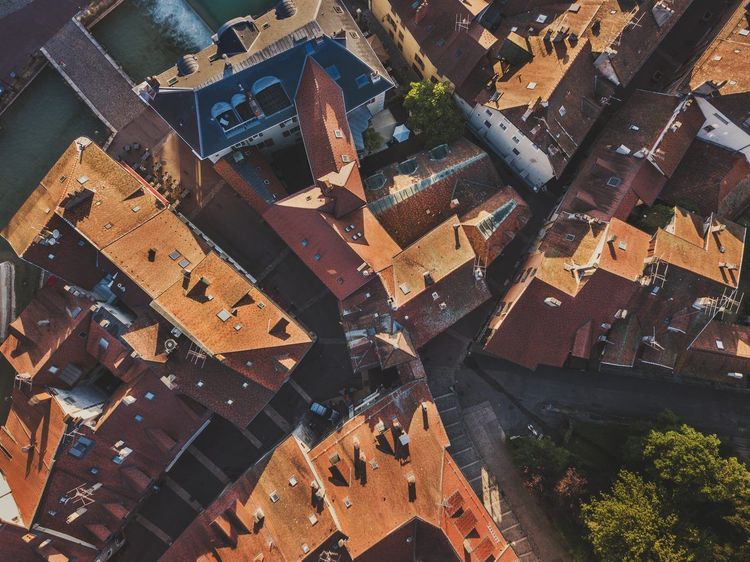
Beyond the château and the Palais de l'Île, Annecy and its surroundings have a handful of human-scale themed venues, often run by enthusiasts or craftspeople, that can be visited in under an hour. What they share: each deals with a single, sometimes incongruous subject, with a seriousness that always surprises a little.
Guides and review sites thus mention a shoemaking museum, devoted to the tools and machines of a trade that has disappeared from shopping streets, and a counterfeit money museum, a nod to the era when Annecy struck its own coins in the workshop of the counts of Geneva housed in the Palais de l'Île. These small venues often open on request or at irregular hours: call before heading out.
If you like to leave with a souvenir made by your own hands, several ceramicists' workshops offer to let you throw your own porcelain piece in short sessions, guided by a craftsperson, to shape a bowl or a cup. Allow a little under an hour and plan to come back for your piece after firing, a few days later.
The name Musée Paccard often comes up in searches: it refers to the bell foundry in Sévrier, on the lake shore, detailed further on among the excursion museums. There is no point looking for it in the old town.
On the west shore of the lake, the Maison du Pays du Laudon, named after the river that flows down towards Saint-Jorioz, works as a small ecomuseum of rural life: mountain farming, traditional cheesemaking and small built heritage are evoked through objects and reconstructions.
What links these small venues is their craft dimension: each tells of a specific skill, often threatened with disappearance, rather than a general collection. They attract only a handful of visitors each day, making for surprisingly quiet visits even in midsummer, unlike the queues that sometimes form in front of the château.
To wander among the alleys where artisans' shops and workshops are tucked away, the Ryo sub-tour The Venice of the Alps unfolds 20 audio clips over 2.6 km, about an hour's walk along the canals of the old town.
The Animation Film Museum and the Ecomuseums of the Thônes Region
Annecy is not just a town of lake and old stones: it is also one of the world capitals of animated film, thanks to its international festival created in 1960 and held annually since 1998. The animation film museum, housed in the Conservatoire d'Art et d'Histoire, extends this identity all year round by tracing a century of evolution in image creation and animation techniques. Good news for your budget: admission is free.
The visit is particularly popular with families. Antique optical devices, ancestors of the cartoon, sit alongside interactive displays that let children understand, frame by frame, how a character comes to life on screen. If you come in June, during the festival, the whole town lives to the rhythm of the screenings: it is the best time to understand why this town of around 130,000 inhabitants has become a global reference in the field, but also the period when accommodation is most expensive.
Heading out towards the Thônes region, a short half-hour drive away, the Écomusée du Bois et de la Forêt (Scierie des Étouvières, 74230 Thônes, rated 4.7/5 on Google from 223 reviews) occupies the Étouvières sawmill, in the Montremont valley. This 19th-century hydraulic sawmill still runs during sawing demonstrations, and the site offers woodworking workshops, a forest discovery trail and cooperative games for families. It is the ideal place to understand the role of wood in the economy of the Savoyard valleys, long before winter tourism.
Allow a good half-day if you combine the ecomuseum with a walk in the forest, more if you follow it with the Thônes market on Saturday morning, renowned for its farmhouse reblochon cheeses.
Museums Not to Miss Around Lake Annecy
The Annecy basin does not end at the town gates: several remarkable museums are within an hour and a half by road, close enough for a day trip.
Towards Geneva, about forty minutes by motorway, two venues target very different audiences. The Geneva Natural History Museum, free of charge, spreads over 8,000 m² the regional fauna, the world's mammals and birds, reptiles and insects, then geology and minerals on the upper floors, with polar dioramas that fascinate children. More surprising, the CERN exhibition space, in Meyrin on the Franco-Swiss border, offers a playful and free immersion in particle physics, a stone's throw from the LHC's 27 km ring.
Towards the Chablais, on the Lake Geneva side, the Musée de Préhistoire et de Géologie de Sciez lets visitors handle prehistoric tools, fire-lighting techniques and rock art in archaeology workshops that families love. A little further on, in Thonon-les-Bains, the Écomusée de la Pêche et du Lac, awarded the Famille Plus label, tells the life of Lake Geneva's professional fishermen through boats, old nets and aquariums of perch and whitefish.
On the Aix-les-Bains side, three quarters of an hour by motorway, the Musée Faure surprises in a spa town: opened in 1949 thanks to the bequest of collector Jean Faure, it brings together sculptures by Rodin and paintings by Corot, Cézanne, Degas or Bonnard, as well as a reconstruction of Lamartine's room.
Closer, in Sévrier, a quarter of an hour from the centre of Annecy by car or by bike along the lake cycle path, the Musée Paccard de la Cloche tells the story of a family foundry founded in 1796: seven generations have cast some 120,000 bells there for churches and carillons around the world. Screenings, casting demonstrations and a concert hall punctuate the visit, which is open from mid-April to mid-October.
Finally, heading towards Chamonix, a little over an hour by road, the Musée des Cristaux (615 Allée du Recteur Payot, 74400 Chamonix-Mont-Blanc, rated 4.6/5 on Google from 1,029 reviews) completes an excursion towards Mont Blanc. Reopened in December 2021 after two years of works, it displays more than 1,900 crystals over 700 m², including pieces found by the massif's "cristalliers" (crystal hunters).
If you can only choose one excursion, go for Sévrier: its proximity lets you combine the foundry with an afternoon of swimming or pedalo, without sacrificing a whole day. For the other trips, group them by direction: one day on the Geneva side (museum and CERN), another on the Chablais side (Sciez and Thonon), a third towards Chamonix. Mixing directions quickly wastes two hours in back-and-forth travel.
Temporary Exhibitions and Activities: What Annecy's Museums Offer All Year Round
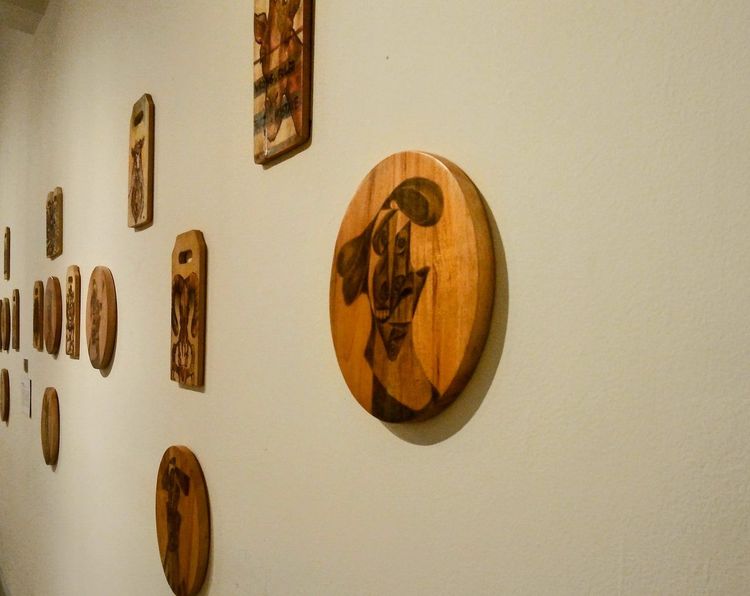
Beyond the permanent collections, Annecy's museums regularly renew their programming, which justifies more than one visit a year.
The Château Museum regularly presents temporary exhibitions devoted to an artist, a historical theme or a collection lent by another institution. To find out which exhibition is currently on, check the calendar on the municipal museums' website before your visit.
The budget tip is the free Sundays: on the first Sunday of each month, from October to May, admission to the château and the Palais de l'Île is free for everyone. The European Heritage Days, on the third weekend of September, also open spaces that are usually closed and multiply guided tours. Our guide to free activities in Annecy lists the other money-saving tips.
For families, the museums organise adapted visits: general-audience château tours, workshops during school holidays, storytelling sessions for the youngest. These short formats (45 minutes to 1 hour) suit children under 10, who quickly lose interest in a classic visit. For more ideas, see our article on visiting Annecy with your family.
Evening openings, rarer, transform the château's atmosphere: subdued lighting and guided tours in small groups. They quickly sell out, so book as soon as ticketing opens.
What to See Around the Museums: Old Town, Jardins de l'Europe and Lake Cruises
The museums are only part of the programme: the town deserves to be explored just as much for its own sake.
Annecy's old town, crossed by the Thiou canals, concentrates colourful facades, arcades and small squares whose atmosphere changes with the time of day. Getting lost on purpose, without an itinerary, remains one of the best ways to discover it between two visits.
Right next door, the Pâquier and the Jardins de l'Europe (Pont des Amours, 74000 Annecy, rated 4.6/5 on Google from 5,983 reviews) form the large green space on the lakeshore, popular for picnics or simply for sitting facing the water after a morning at the château. The Pont des Amours, at the entrance to the gardens, deserves a photo as much as the legend that goes with it.
For a change of perspective, cruises on Lake Annecy leave regularly from the port, with formats ranging from one hour to half a day. Seen from the water, the mountains framing the lake and the silhouette of the château take on a whole new dimension.
To go further, our article on Annecy's neighbourhoods details each area, useful for organising your day between museums and walks. On the listening side, the Ryo audio guide takes you along the quays to the Pâquier: you link the museums on foot without checking a map at every crossroads.
Practical Information: Prices, Opening Hours, Access and Booking
Before building your programme, here is the practical information that comes up most often when visiting Annecy's museums.
Prices: Château Museum 6.50 euros (7 euros in July and August), Palais de l'Île 4 euros (5 euros in summer), with reductions for young people and free admission for children under 12. The animation film museum, the Geneva Museum and the CERN space are free.
Payment methods: bank cards are accepted in the municipal museums; keep a little cash for the small association-run venues.
Opening periods: the château and the Palais de l'Île are open all year, except on Tuesdays and certain public holidays. In winter (October to May), the Palais closes at lunchtime; in summer, it is open continuously. The Musée Paccard is only open from mid-April to mid-October.
Location and access: the château, the Palais de l'Île, Saint-Maurice church and the Maison de la Galerie are all within a ten-minute walk, so you can visit everything without a car. For the excursion museums, plan on a car or the regional buses, which are less frequent on Sundays.
Languages spoken: staff speak French and often English in the municipal museums, with translated visitor documents.
Environment and facilities: the château has a shop, a library and partially adapted access for people with reduced mobility, with limits due to its medieval architecture (narrow staircases, thresholds). The Palais de l'Île, more constrained by its structure, is less accessible.
Services: individual and group guided tours, educational workshops and group rates (from 5 people outside summer) are offered by the municipal museums.
Chains and labels: the Château Museum bears the "Musée de France" label, a guarantee of scientific rigour and conservation recognised by the Ministry of Culture; the Thonon ecomuseum is awarded the Famille Plus label.
Booking: online ticketing avoids waiting in high season, particularly useful in July and August and during the animation festival in June.
Map: to visualise all the museums in this guide, an interactive map remains the best preparation tool, far more practical than a list of addresses.
For any question, the Lake Annecy tourist office remains the most reliable point of contact: up-to-date hours, brochures and advice depending on the length of your stay. If you stay more than three days, spread the excursions (Geneva, Chamonix, Aix-les-Bains) over separate days: the road around the lake takes longer than it seems in summer.
FAQ
How many museums can you visit in Annecy?
Counting the town centre and excursions around the lake, there are about twenty museums and exhibition spaces accessible from Annecy. In the centre alone, five or six venues (the château, the Palais de l'Île, the animation film museum, the Maison de la Galerie and the Abbaye) are easy to visit on foot in two days.
How much does it cost to enter the Annecy Château Museum?
Expect to pay 6.50 euros for the full rate (7 euros in July and August) and 3.50 to 4 euros for the reduced rate. Admission is free for children under 12, and for everyone on the first Sunday of the month from October to May.
Is the Palais de l'Île a museum?
Yes. This former prison, mint workshop and courthouse now houses the Centre d'interprétation de l'architecture et du patrimoine: you can visit the dungeons and the rooms of the former court, for 4 euros (5 euros in summer).
Are there any free museums in Annecy?
Yes: the animation film museum is free all year round, the Abbaye contemporary art space is generally free too, and both the château and the Palais de l'Île are free on the first Sunday of the month from October to May.
Which museum should you visit first in Annecy?
If you can only choose one, the Château Museum remains the most complete, from lake archaeology to contemporary art, including the aquariums of the Observatoire des lacs alpins. The Palais de l'Île is an ideal complement for a shorter visit.
Are Annecy's museums accessible to people with reduced mobility?
The Château Museum offers partially adapted access, with limits due to its medieval architecture. The Palais de l'Île, more constrained, is less accessible. Contact each museum in advance to find out what facilities are available.
In Summary: Putting Together Your Museum Programme in Annecy
Between the Château Museum and its varied collections, the Palais de l'Île and its dungeons, the free animation film museum and the excursions to Sévrier, Geneva or Chamonix, Annecy has plenty to keep a curious visitor busy for several days. Aim for the first Sunday of the month off-season to enjoy free admission, avoid Tuesdays and group excursions by direction.
And to link it all on foot, the Ryo audio-guided tour in Annecy tells you about the old town, the château and the canals as you walk: ideal context-setting before entering the rooms.
À lire également