© Shutterstock
 Votre guide Ryo
Walking in Auxerre: Cathedral, Yonne Riverbanks, and Day Trips from the City (2026)
From the Pont Paul Bert, the city reveals itself all at once: three bell towers aligned above the rooftops, the Yonne gliding below, and the feeling that nothing has really changed since the merchant boats used to sail this far upstream. Search "walking Auxerre" before you leave and you will mostly find the cathedral; on the ground, the essence of the city plays out just as much in the half-timbered lanes, along the riverbanks, and beneath a ninth-century crypt. Auxerre is best appreciated on foot, and that is precisely what many visitors rushing between two château visits in Burgundy miss: the time to wander without a fixed itinerary. A walk in Auxerre, well planned, fits into a half-day for the essentials, or a full day if you add the riverbanks and the abbey. The Ryo audio-guided tour of Auxerre maps out this historic heart, from the Cathédrale Saint-Étienne and the Tour de l'Horloge to the half-timbered lanes that climb up from the river.
This article details the walking itinerary through the old town, the family-friendly stroll along the riverbanks, the Carolingian crypt of the Abbaye Saint-Germain, and even the local nod to Cadet Roussel — a very real bailiff whose song travelled across all of France. You will also find the city's official waymarked routes, addresses for renting a bike, up-to-date admission prices for paid attractions, and the best day trips within an hour's drive: Chablis and its vineyards, Joigny, Sens, Vézelay, and Avallon.
The Historic Heart of Auxerre on Foot
The best way to understand Auxerre is to leave the car in the car park and climb up into the city from the river. The old town sits on a modest hill, yet it packs over a thousand years of architecture into just a few hundred metres — which means stopping every fifty metres is not at all excessive.
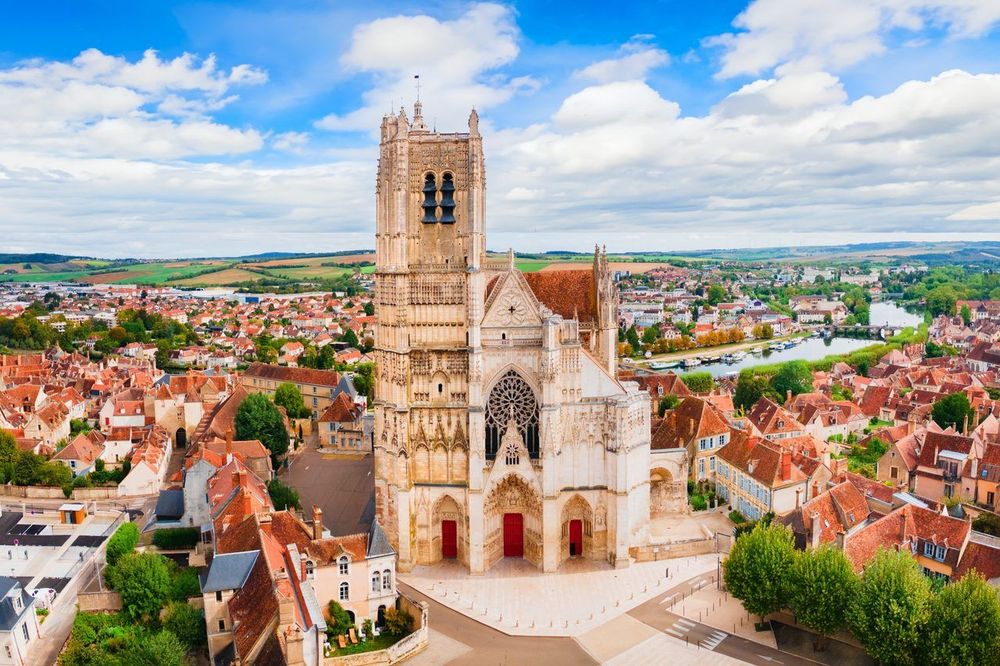
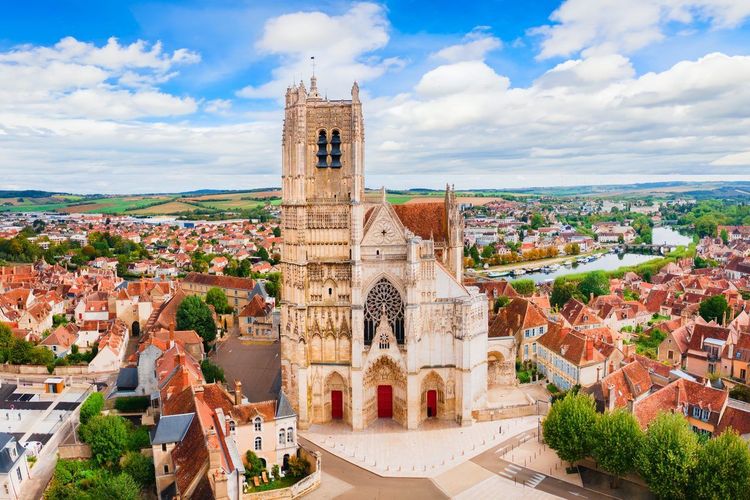
It usually begins with the Cathédrale Saint-Étienne d'Auxerre, visible from almost every point in the lower town thanks to its single spire (the other tower, left unfinished since the sixteenth century, gives the building an asymmetrical silhouette recognisable from afar). Built between the thirteenth and sixteenth centuries on the foundations of earlier structures, it houses some of the best-preserved Gothic stained glass in Burgundy and an eleventh-century Romanesque crypt. That crypt alone is worth the visit: it preserves a fresco depicting Christ on horseback, an iconography so rare that it has virtually no equivalent elsewhere in France.
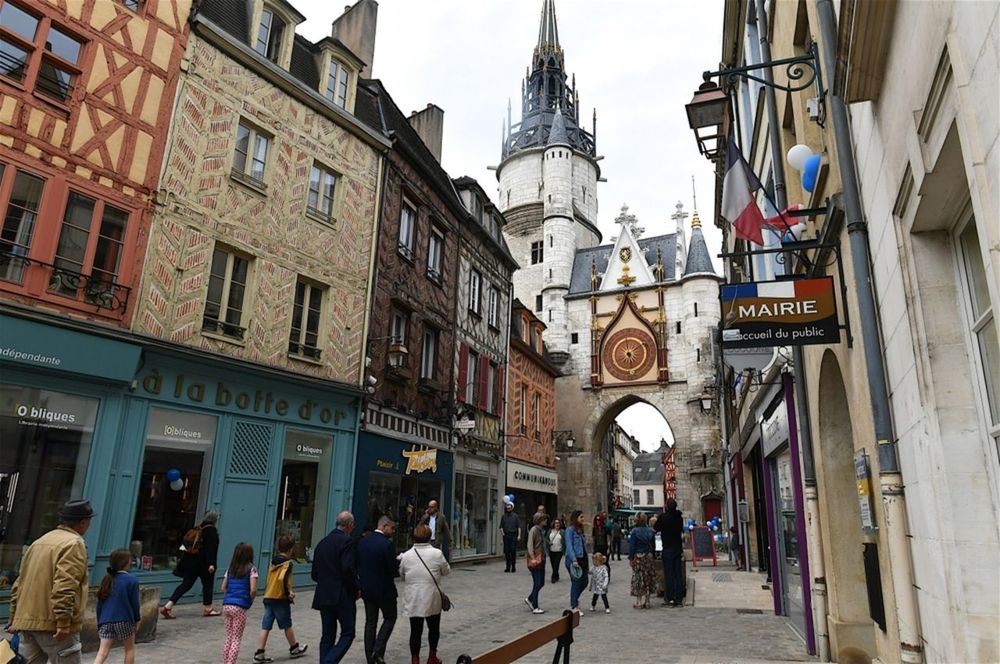
Leaving by the forecourt, take the Rue Fécauderie or the Rue de la Draperie: this is where the walk really comes into its own. Half-timbered facades line the way, some leaning, almost all decorated with flowers in season, with wrought-iron signs recalling the medieval trades once established here — tanners, drapers, goldsmiths. Many visitors move through these streets too quickly, looking for the next landmark on their map, when all it takes is glancing up towards the upper floors to spot the carved details in the beams.
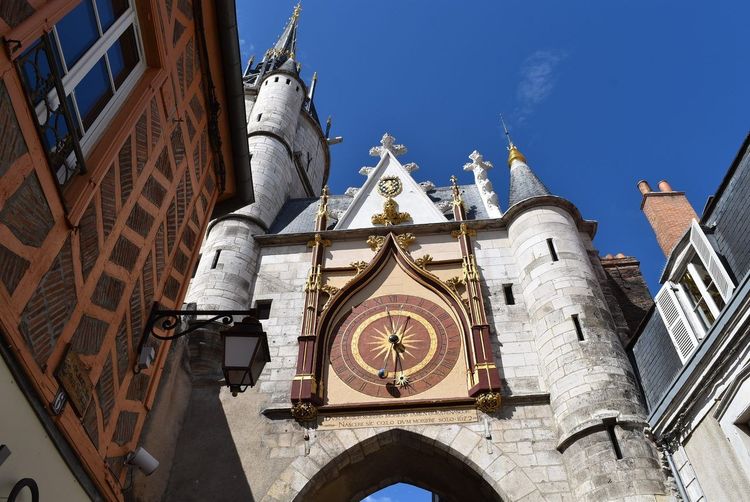
The Tour de l'Horloge marks the old boundary between the upper and lower town. Built in the fifteenth century above the former Porte de Paris, it carries an astronomical clock with two dials — one on the east face, one on the west. Each dial has two hands: the first, marked with a sun, follows the apparent course of the sun over twenty-four hours; the second, tipped with a blue and black sphere, shows the phases of the moon. Few towns of this size still have a mechanism of this type in working order, and it is exactly the kind of detail you miss if you walk through the passage without looking up. The vaulted passage beneath the tower is one of the best photo spots in the city centre, framing the half-timbered buildings alongside the cathedral spire in the background.
Just behind it, the Place Charles-Surugue and its café terraces make a natural pause. You are now halfway through a stroll that, if you stopped nowhere, would take 35 to 40 minutes. But let us be honest: nobody does this walk without stopping at least two or three times, if only for a cheese shop or an antiquarian bookshop tucked into a sixteenth-century stall.
Continuing north, the neighbourhood around the Église Saint-Eusèbe has a tighter urban fabric, with lanes so narrow that two pedestrians can barely pass each other. This is also the area with the best-preserved half-timbered houses, some dated to the fifteenth century by their exposed beams. The contrast with the wider nineteenth-century avenues lower down towards the station is striking: Auxerre has kept its medieval street plan almost entirely intact on this hill, while the rest of the city spread out much later.
Heading west, the Place du Maréchal-Leclerc opens onto an unobstructed view of the Hôtel de Ville, a nineteenth-century building that deliberately contrasts with the rest of the old town. The people of Auxerre use it more as a meeting point than a place to stroll, but the square is worth a stop for its market, which has been held here for generations and remains one of the best ways to leave with some local cheese or a bottle of Crémant de Bourgogne.
A little lower down, remnants of the old ramparts surface here and there, incorporated directly into the foundations of more recent houses. This is not always signposted, and it sometimes takes a sharp eye to distinguish the ancient stonework from the medieval fabric built over it. Those who enjoy this kind of detail will benefit from slowing their pace even further in this area, even if it means walking down the same lane twice.
In the morning, before the river cruise coaches arrive, these lanes belong almost exclusively to shopkeepers opening their shutters and residents crossing on their way to work. Many local guides consider this the best time to photograph the facades without a tour group in the background. In the late afternoon, the low-angled light on the half-timbered frames produces a quite different effect — warmer and more golden — which is equally worth experiencing if you are staying overnight.
This compact layout recalls that of Sens or Joigny, two other towns in the Yonne built on the same principle of an upper town overlooking the river (we return to these later). Auxerre does, however, have an advantage over its neighbours: the density of monuments per square metre, with the cathedral, the Tour de l'Horloge, and the Abbaye Saint-Germain all within a radius of less than one kilometre. The Ryo audio-guided tour follows, for this walk in Auxerre, a route fairly close to this one, with commentary on each notable facade along the way — useful if you prefer a guided walk to a completely free-form wander.
If you only have a morning, this historic core is enough on its own to leave with a real sense of the city. With a full day, however, it becomes the natural first stage before heading down to the riverbanks and then to the Abbaye Saint-Germain. Allow around 1h30 to 2h for this first part of the Auxerre walk if you take the time to really look at the facades, step inside the cathedral, and stop for a coffee on a terrace. Ryo's audio-guided tour, in the footsteps of Cadet Roussel, passes by the half-timbered houses and Place Charles Surugue too, handy if you'd rather have the history narrated as you walk.
The Yonne Riverbanks and the River Port
After the old town, a walk in Auxerre naturally continues by heading down to the river. The riverbanks offer a completely different character: flat, partly shaded, and free of the uneven cobblestones found in the upper lanes.
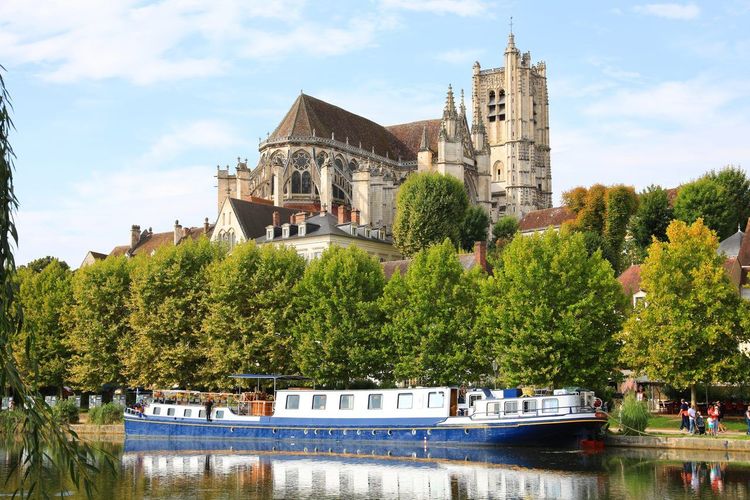
The Pont Paul Bert remains the most photographed viewpoint in the city. People have crossed the Yonne here since antiquity: the first crossing is thought to date from the final decades before our era, on the road linking Autun to Boulogne-sur-Mer. Partially destroyed in 1265, fortified in the fourteenth century, it did not lose its military appearance until the eighteenth century along with the ramparts, and only took its current name in 1889 when the statue of Paul Bert by Émile Peynot was installed here. From the middle of the bridge, the cathedral and the Tour de l'Horloge cut above the rooftops with barges moored in the foreground — a view that has made Auxerre a favourite postcard subject for over a century.
The river port just below still welcomes pleasure craft, some arriving from the nearby Canal du Nivernais. A commented river cruise makes a fine complement to a walk in Auxerre. Les Bateaux Touristiques de l'Auxerrois offer a one-hour discovery cruise — around twelve euros per adult and roughly half price for a child — as well as a 1h30 scenic cruise at around €20. Schedules and departure times change from season to season, so a quick call to the tourist office the day before will save you a wasted trip to the port. All cruises pass through at least one lock, the Batardeau, which takes the boat onto the Canal du Nivernais: watching the chamber fill beneath your feet is worth the ticket price alone when travelling with children. The tourist office also rents small electric boats without a licence, from half an hour to a full day, for those who prefer to be at the helm themselves.
For those who prefer to stay on dry land, the stroll along the riverbanks is effortless for over two kilometres, from the towpath that starts at the Pont Paul Bert to the Parc de l'Arbre Sec, where one of the city's waymarked eco-walks begins (more on this below). It is a waterside walk particularly well suited to families with pushchairs or visitors with reduced mobility, unlike the historic centre where some lanes remain cobbled and slightly sloped.
At the end of the day, the riverbanks fill with joggers and families making the most of the benches set facing the water. Several bars and restaurants have opened terraces directly on the quay, making it easy to extend the walk with a drink overlooking the river without having to head back up into town.
The river level varies noticeably with the season: higher and faster in spring, calmer and better for cruising in summer. If you plan to combine the walk with a boat trip, it is worth booking the day before during the high season, as weekend slots fill quickly between June and August.
The Abbaye Saint-Germain and Its Carolingian Crypt
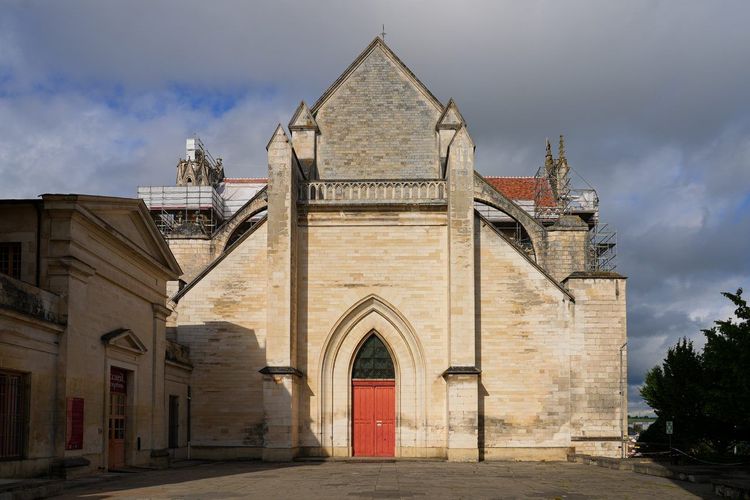
Ten minutes on foot from the riverbanks, heading slightly east, stands one of the most underrated monuments in Auxerre. The Abbaye Saint-Germain, originally founded over the tomb of Saint Germain, Bishop of Auxerre in the fifth century, has undergone fifteen centuries of successive rebuilding — making it an almost unique site for observing the evolution of religious architecture in a single place.
Its most remarkable feature remains the Carolingian crypt, dating from the ninth century. It preserves frescoes that rank among the oldest still visible in situ in France, with colours that have held up surprisingly well given their age. The visit is guided only, for conservation reasons: allow around forty minutes and roughly ten euros per person — slightly less for the crypt alone, depending on the option chosen. It is the only genuinely paid stop on a heritage-focused walk in Auxerre, and arguably the best value.
Above the crypt, the abbey church and the conventual buildings now house the city's art and history museum, with archaeological collections spanning prehistory to the nineteenth century. The abbey garden, open and free of charge, offers a quiet break after the paid crypt visit, with shaded benches and an unobstructed view of the conventual buildings.
Many visitors in a hurry stick to the historic centre and miss the abbey for lack of time — which is a shame, since this is precisely the monument absent from most standard tourist itineraries that sets a genuine heritage walk in Auxerre apart from a simple crossing of the town centre. Allow 40 minutes for the crypt, and a good hour and a half if you continue with the museum and the garden.
Note the closing day: the abbey is shut on Tuesdays, as well as on 1 May, 25 December, and 1 January. From April to October it opens in the morning and afternoon, from 10am to 1pm and 2pm to 6pm; from November to March, the hours narrow considerably. Since guided tours of the crypt depart at fixed times and become less frequent in the low season, checking the day's schedule before you set off will save you an unnecessary wait. If you are only staying for one day, it is best to slot this visit in early afternoon.
In the Footsteps of Cadet Roussel, Auxerre's Unlikely Folk Hero
Few visitors know it, but Cadet Roussel — the character made famous by the popular song of the same name ("Cadet Roussel a trois maisons...") — really existed. Guillaume-Joseph Roussel was born in 1743 in Orgelet, in the Jura, and arrived in Auxerre around 1763: first a servant, then a clerk, he purchased a bailiff's position at the bailiwick in 1780 using his wife's dowry — an Auxerroise sixteen years his senior. He became so adopted by the city that he turned into a local institution, and died in Auxerre in 1807. The song itself was written during his lifetime, around 1792, by a local notable, Gaspard de Chenu, before being carried across all of France by the volunteers from the Yonne who left to join the Revolutionary armies.
The city makes the most of this piece of local folklore and has even turned it into its official discovery trail. "Sur les traces de Cadet Roussel" (In the Footsteps of Cadet Roussel) covers 5 kilometres through the historic centre, marked on the ground by bronze medallions set into the paving: simply follow the bronze studs from one point to the next, with no map or app required. The route takes in 67 points of interest, from the cathedral to facade details you would never notice on your own, and the explanatory booklet is available free of charge at the tourist office, 7 Place de l'Hôtel de Ville, in French, English, German, Italian, or Dutch. It is a different angle on a walk, lighter than the classic heritage visit, and one that appeals particularly to families with children who enjoy hearing the story behind the nursery rhyme.
To explore this folkloric thread in depth without having to hunt for the anecdotes yourself, the Ryo audio-guided tour "À la rencontre de Cadet Roussel" offers 21 commented stops over 1h15, following the places genuinely connected to the character in the city. It is a way of turning a simple walk into a historical treasure hunt, with audio commentary that places each address in its eighteenth-century context.
The song itself, with its three houses "that have neither beams nor rafters", remains one of the most widely sung French nursery rhymes, long chanted in school playgrounds with no one making the connection to the Yonne. This gap between the character's nationwide fame and the discreet town that saw him live out his life gives this themed walk its particular charm: you are walking in the footsteps of a figure almost everyone knows through song, without knowing where he actually came from.
This kind of themed route works well in Auxerre because the city remains compact enough to do it straight after visiting the historic centre, without getting back in the car. Allow around an extra hour if you want to follow the entire Cadet Roussel trail rather than just the main stops: it is probably the most playful version of a walk in Auxerre, and the one that works best for bringing local history to life for children.
The Écobalades: Auxerre's Official Waymarked Routes
Auxerre has developed its own network of waymarked walking routes, the écobalades, not to be confused with the Cadet Roussel trail described above. The city created three of them as part of its Cit'ergie sustainability programme, with a naturalist thread running through all of them: the idea is to spot urban wildlife and plants along the way rather than focusing solely on facades. "L'enVERT et contrefort" loops 3.9 kilometres in around 2 hours, starting from the towpath near the Pont Paul Bert, weaving together heritage and urban nature: common swifts, ivy-leaved toadflax, violet carpenter bees. "Entre deux rives" sets off from the Parc de l'Arbre Sec and can be followed entirely by waymarks, with or without a smartphone. "L'enVERT des quartiers" heads towards the Brichères eco-neighbourhood, on the contemporary side of the city.
The waymarking is complemented by a free mobile app, ecoBalade, available on iOS and Android, which tracks the walker's position and offers species identification games for wildlife encountered along the route. For those who prefer paper, brochures and downloadable maps are available on the city's website and can be picked up at the tourist office and at visitor sites including the museum and the Abbaye Saint-Germain. This approach contrasts with the Ryo audio-guided tour, which focuses on the built heritage of the city centre: the écobalades are better suited to those looking for an active outing in nature — whether jogging or cycling — rather than an architectural wander.
For the best experience on an écobaladle, closed shoes are advisable: some sections follow unsurfaced paths that quickly become muddy after rain. All three loops are accessible to everyone, with no significant elevation change, and can be completed in 1h30 to 2h30 depending on pace and the number of observation stops.
The maps, free at the town hall and online, highlight the naturalist points of interest along the way — invaluable if you are walking in Auxerre with children curious about local wildlife. This is an option worth considering particularly if you are spending several days in Auxerre and have already covered the historic centre: these routes show a different face of the city, greener and less touristy, without needing a vehicle to reach them.
Renting a Bike to Extend Your Walk
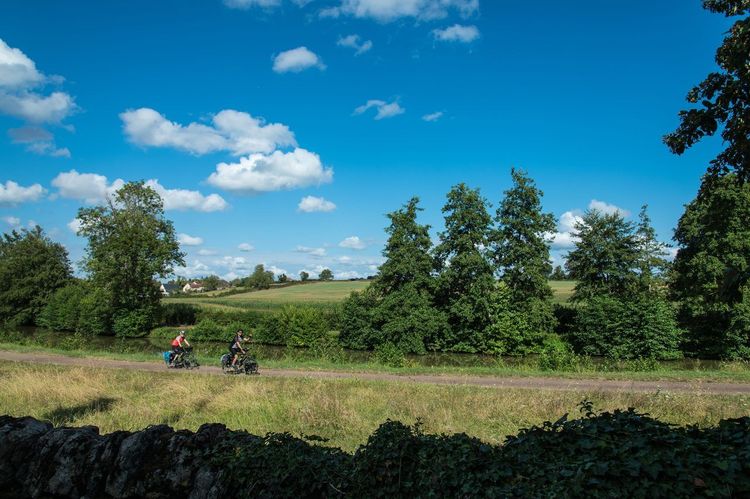
Auxerre lends itself well to cycling: the lower town is flat and the Canal du Nivernais towpath heads south without a single car in sight. Several addresses allow you to rent a bike by the hour or by the day to extend a walk in Auxerre beyond the old town.
La Maison du Vélo (Place Achille Ribain, 89000 Auxerre, rated 4.4/5 on Google based on 148 reviews), on Place Achille Ribain, is the go-to address in town: certified Accueil Vélo, it rents adult bikes, children's models, and even tandems, and carries out on-site repairs.
One detail that matters and that few articles mention: it is open Monday to Friday, 9am–12pm and 2pm–6pm, but closed on Saturday and Sunday. In other words, a cycling weekend in Auxerre requires planning ahead on Friday — not Saturday morning.
The E.Leclerc Location outlets step in as a backup: the one in Auxerre, on Avenue Jean Jaurès, and the one in Tonnerre, on the Route de Paris, about forty minutes to the east, offer short-term rental options including electric bikes depending on the time of year. Further along the Canal de Bourgogne, the Haliotis leisure base near Tonnerre at Tanlay rounds out the offer with family quadricycles — standard or electric-assisted — making it a day out in its own right rather than just a stage of the Auxerre walk.
The finest route from Auxerre is the Canal du Nivernais greenway: 18 kilometres to Vincelles, and nearly 49 kilometres if you push on to Coulanges-sur-Yonne, on a smooth surface with no significant gradient. Towards Chablis, however, there is no greenway: you have to take the road, around twenty kilometres along the D965, which amounts to a good hour of pedalling versus twenty minutes by car. Remember to book your bike the day before during the summer, as stock disappears quickly around bank holidays and long weekends.
Chablis and Its Vineyards, Just a Short Drive from Auxerre
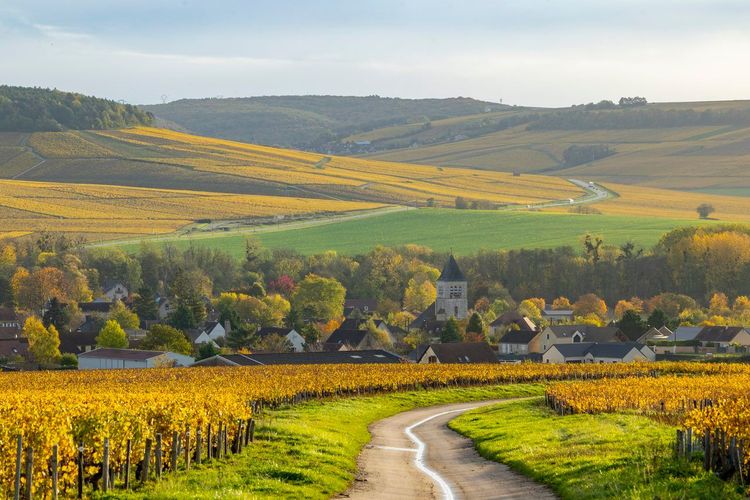
Chablis lies about twenty kilometres east of Auxerre — a twenty-minute drive along the D965 — making it the most obvious day trip to extend a walk in Auxerre. The village's name, known the world over for its white wine, far outstrips its actual size: barely 2,300 inhabitants, yet a vineyard that stretches across the surrounding hills as far as the eye can see.
A vineyard stroll in Chablis usually begins in the village centre, around the Collégiale Saint-Martin, a thirteenth-century collegiate church built in large part thanks to the wealth generated by the wine trade. The lanes around the church are home to several historic négociant houses, some open for visits and tastings directly on site.
What truly sets Chablis apart is the possibility of continuing the walk into the vineyards themselves. Several waymarked paths climb from the village up to the famous Grand Cru plots on the right bank of the Serein: Les Clos, Vaudésir, Grenouilles — parcel names that appear on labels sold across the world. The ascent is moderate and accessible without any particular fitness level, with a panorama that opens progressively over the valley as you gain height.
Many visitors combine this walk with a cellar tasting, usually on reservation during the high season. The Chablis vineyard produces exclusively Chardonnay, with a characteristic minerality that comes directly from the soil composition — rich in Kimmeridgian limestone, a rock laced with marine fossils 150 million years old. It is a detail that resonates with geology enthusiasts just as much as wine lovers.
The vineyard breaks down into four appellation levels, from Petit Chablis grown on the coolest plateaus to the seven Grands Crus clustered on the same south-west-facing hillside, with generic Chablis and Premier Cru in between. This hierarchy is directly readable in the landscape: the higher you climb towards the best plots, the steeper the slope and the stonier the soil — a detail that estate owners are usually happy to explain if you push open the door of a cellar.
The Chablis market, held Sunday mornings on the main square, is a fine complement to a walk planned for the end of the week: local producers, regional cheeses, and a few wine-grower stalls selling their bottles directly without going through a wine shop. It is also a good opportunity to spot a bistro for lunch before heading back to Auxerre or continuing towards Joigny.
In autumn, the harvest completely transforms the atmosphere of the village: the streets fill with pickers, cellars open their doors more widely than usual, and the smell of must literally drifts through the lanes for a few weeks. It is arguably the most vibrant time to visit, as long as you are prepared for higher footfall than the rest of the year.
To explore the area around Auxerre beyond Chablis, this Ryo article on the surroundings of Auxerre details further day-trip options, useful if you are staying several days in the region. Without a car, a bus connects Auxerre to Chablis several times a day on weekdays, with a reduced service at weekends; the cycling option mentioned above remains, weather permitting, the most active way to make the journey under your own steam — around twenty kilometres of minor road.
Joigny and Sens: Two Urban Day Trips in the Yonne
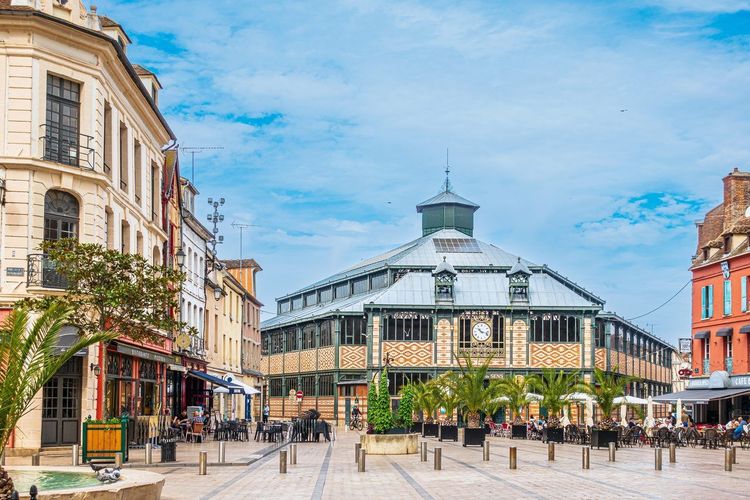
Where Chablis charms with its vineyards, Joigny and Sens offer another side of the Yonne: two towns built, like Auxerre, on a hill overlooking a river, with a dense old centre that can only be explored on foot. These two urban walks are a natural complement to a stay in Auxerre for anyone spending several days in the département.
Joigny, about thirty minutes' drive north-west of Auxerre and the first town in the Yonne to receive the Sites et Cités remarquables de France label, boasts one of the best-preserved collections of half-timbered houses in Burgundy: sixteenth-century facades accented with red brick and medieval carvings, some leaning at quite spectacular angles — a lean of several dozen centimetres in some cases, yet standing for centuries without collapsing. The upper town, around the Église Saint-Jean, is reached by sloping lanes that open onto an unobstructed view of the Yonne valley, known locally as the Côte Saint-Jacques (89300 Joigny, rated 4.5/5 on Google based on 210 reviews).
This hillside, planted with vines and developed as a walking path, rises to 185 metres. From the viewpoint, the Yonne valley spreads out broadly: the Pont Saint-Nicolas, the Burgundian-tiled rooftops of the old town, its bell towers, and the Forêt d'Othe closing the horizon to the north. Allow twenty to thirty minutes for the climb from the town centre through the vines, for those who take their time.
At the foot of the hill, along the river, the Quai Ragobert retains traces of the town's former river trade, with converted warehouses and a shaded promenade that echoes, in spirit, the Auxerre riverbanks described above.
Sens, about fifty minutes' drive north of Auxerre, operates in a different heritage league: its Cathédrale Saint-Étienne is considered one of the very first Gothic cathedrals built in France, predating Notre-Dame de Paris by several decades. Its facade, extensively remodelled over the centuries, blends styles in a way that sometimes disorients visitors accustomed to stricter architectural unity.
Right next door, the Palais Synodal, one of the oldest Gothic civic buildings still standing in Europe, now houses part of the municipal museum. The visit pairs easily with a tour of the historic centre of Sens, more expansive than that of Joigny but generally less hilly — making it a more restful walk for the legs after a morning spent climbing the lanes of Auxerre.
Sens also preserves an unexpected historical connection with England: Thomas Becket, the Archbishop of Canterbury who clashed with King Henry II Plantagenet, spent several years in exile here in the twelfth century before his murder in his own cathedral. The treasury of the cathedral in Sens holds liturgical garments associated with this episode — a rare enough collection to regularly draw visitors who come specifically for this story.
The Paris-Bercy – Auxerre rail line serves both Joigny and Sens, allowing you to take in all three towns without a car if you prefer the train. Some journeys require a change at Laroche-Migennes, but journey times remain short — around 20 to 30 minutes between each stop — making a day trip from Auxerre perfectly feasible, provided you check the evening return times, which become less frequent later in the day.
On the food side, Joigny and Sens share with Auxerre a tradition of covered markets and town-centre bistros serving classic Burgundian specialities: jambon persillé, gougères, and various local versions of andouillette. Sens has also developed a small scene of more contemporary restaurants around the cathedral in recent years, a welcome alternative if you are looking for something beyond traditional cuisine after a morning of sightseeing.
Both towns can be visited in half a day each, or in a single day if you are prepared to move at a brisk pace. To plan this stage in detail, our Ryo selection of the most beautiful villages in the Yonne lists further nearby towns worth visiting if Joigny and Sens have whetted your appetite for exploring the département. This trio — Auxerre, Sens, and Joigny — forms a coherent whole for anyone who really wants to understand the medieval urban fabric of the Yonne: three hilltop towns, three compact historic centres, but three quite different atmospheres depending on the size and economic history of each.
Vézelay and Avallon: Between Hills and Ramparts
Two more possible adventures around Auxerre, a little further afield this time, deserve a full day rather than a mere half-day when a walk in Auxerre stretches over an entire weekend: Vézelay and Avallon, just under an hour's drive to the south-east.
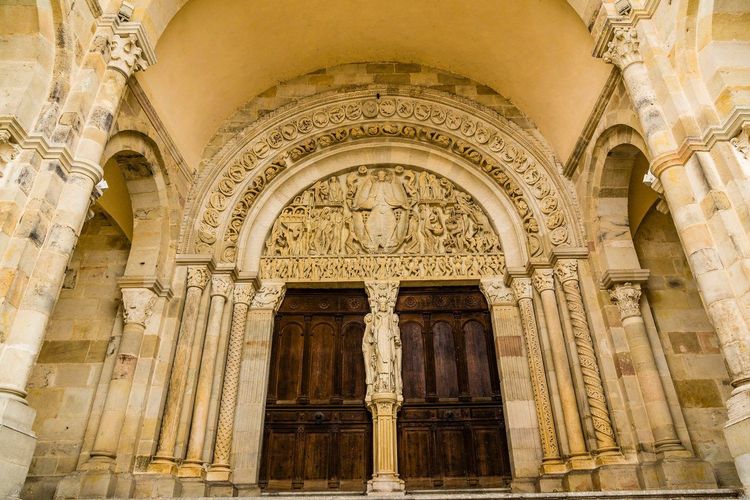
Vézelay sits on an isolated hill in the middle of the Morvan bocage, crowned by the Basilique Sainte-Marie-Madeleine, inscribed on the UNESCO World Heritage List since 1979 and the historic starting point of the Via Lemovicensis, one of the pilgrimage routes to Santiago de Compostela. With nearly a million visitors a year, it is the most visited site in Bourgogne-Franche-Comté — worth knowing before you pick an August Sunday. The Romanesque nave, with its light effects calculated to illuminate specific sculpted capitals at precise moments of the day, remains one of the benchmarks of Burgundian Romanesque art.
A walk in Vézelay is not limited to the basilica: the village itself, built on a slope along the hillside, lines up honey-coloured stone houses partly occupied by craftspeople and art galleries. From the terrace behind the basilica, the panorama over the Cure valley stretches far into the distance, with the Morvan as a backdrop on clear days. The climb from the car park at the foot of the village requires a degree of effort — more demanding than most of the walks described earlier in this article.
The hill and the surrounding communes are part of a Grand Site de France initiative, which manages visitor access over a wide perimeter. In practice, parking is organised: cars are directed to paid car parks below the village, with around ten minutes of walking to reach the centre, and a shuttle runs in summer between the lower car park and the basilica esplanade. This constraint, slightly frustrating at first, at least preserves the village from a flood of vehicles that would entirely undermine the atmosphere of its lanes.
Around the hill, several waymarked hiking trails allow you to extend the visit with a loop through the surrounding bocage, offering views of the basilica that can only be had from a distance. These longer itineraries are aimed at those who want to turn their Vézelay outing into a genuine nature walk rather than a simple monument visit.
Avallon, about twenty minutes from Vézelay, offers a different walk: the town has preserved a good portion of its medieval ramparts and defensive towers, with a partly developed wall walk that overlooks the Cousin valley below. The Collégiale Saint-Lazare, on the main square, rounds out this heritage walk through a small fortified town that has largely stayed off the main tourist radar, which tends to focus on Vézelay.
Avallon has a more commercial and lively everyday feel, with a market well known throughout the region that brings the town centre to life twice a week. The town has also preserved several old houses along the Grande Rue — less striking than those in Joigny, but representative of a Burgundian urban fabric that has remained largely intact since the fifteenth century.
Combining Vézelay and Avallon in the same day is entirely feasible: allow 2h to 2h30 on the ground for each if you take the time for a full walk, plus the drive between the two towns. For those short on time, Avallon alone makes for a satisfying half-day trip, while Vézelay calls for a little more time to really enjoy the climb to the basilica without rushing on the way back down. Both destinations are accessible by car only; no direct train line serves Vézelay, and bus connections from Auxerre add significantly to the journey.
Practical Information for Planning Your Walk in Auxerre
Planning a walk in Auxerre takes all of ten minutes, provided you know where to leave the car. The city is easily reached via the A6 motorway, around 1h40 from Paris and 2h from Lyon. By train, the Gare d'Auxerre-Saint-Gervais is served directly from Paris-Bercy, with a journey time of around 1h50 — making it a realistic destination for a day trip from the capital.
For parking, several paid car parks surround the historic centre, particularly near the riverbanks and around the station; the town centre itself is largely pedestrianised or has restricted access, which is why it is better to park on the immediate outskirts rather than looking for a space as close as possible to the cathedral.
The best season for a walk in Auxerre is spring and early autumn: moderate temperatures, pleasant light on the half-timbered facades, and more manageable tourist numbers than in high summer. Summer is nonetheless the period when river cruises and vineyard visits in Chablis run at full capacity — an advantage if those activities are particularly appealing to you.
In terms of duration, allow half a day (3 to 4 hours) for the historic centre and the riverbanks, a full day if you add the Abbaye Saint-Germain and the Cadet Roussel trail, and two to three days if you want to include day trips to Chablis, Joigny, Sens, Vézelay, or Avallon at a relaxed pace.
Good news for those on a tight budget: it is entirely possible to enjoy a free walk in Auxerre. The historic centre, the riverbanks, the exterior of the Tour de l'Horloge, and the abbey garden are all free to visit; only the Carolingian crypt of the Abbaye Saint-Germain and certain tastings in Chablis require a paid ticket.
For those who prefer a guided walk to a free wander with a paper map, the Ryo audio-guided tour of Auxerre is the simplest option: available directly on a smartphone, with no reservation or fixed departure time, it covers the historic centre and even offers, as mentioned above, a dedicated Cadet Roussel trail. It is a practical alternative to the official écobalades if your priority is built heritage rather than the green spaces on the outskirts.
Wear comfortable closed shoes rather than sandals: the cobblestones of the historic centre are lovely to look at but rather less forgiving underfoot after two hours of walking. A water bottle is not a bad idea in summer either, as shaded terraces are sparse on certain stretches of the route between the cathedral and the abbey.

FAQ
How long should I plan for a walking tour of Auxerre?
Allow 1h30 to 2h for the historic centre alone (cathedral, Tour de l'Horloge, half-timbered lanes). A half-day walk in Auxerre adds the Yonne riverbanks, and a full day if you include the Abbaye Saint-Germain and the Cadet Roussel trail. To explore the surrounding area as well, two to three days allow you to add Chablis and one or two other day trips at a leisurely pace.
What are the must-sees on a walk through Auxerre?
The Cathédrale Saint-Étienne, the Tour de l'Horloge, and the half-timbered lanes of the old town form the unmissable core. The Abbaye Saint-Germain and its Carolingian crypt, often overlooked on quick visits, are equally worth the detour, as is a stroll along the Yonne riverbanks to see the city from the water.
Where should I park to explore the centre of Auxerre on foot?
Since the historic centre is largely pedestrianised, it is best to park in one of the paid car parks on its immediate outskirts, particularly near the Yonne riverbanks or around the station, and then continue on foot. Avoid looking for a space right next to the cathedral, as the surrounding streets are narrow and often in a restricted zone.
Can I visit Auxerre for free?
Yes: the historic centre, the Yonne riverbanks, the exterior of the Tour de l'Horloge, and the garden of the Abbaye Saint-Germain can all be visited freely and at no cost. Only the Carolingian crypt of the abbey and certain paid activities such as wine tastings in Chablis require a ticket or a reservation.
What is the best season to walk around Auxerre?
Spring and early autumn offer the best balance between pleasant weather and moderate crowds. Summer is still appealing if you want to combine a walk with a river cruise or a cycling trip to Chablis, but expect more people in the lanes of the historic centre during peak season.
Can I cycle around Auxerre and its surroundings?
Yes, the lower town is flat and the Canal du Nivernais greenway heads south without a single car to contend with. La Maison du Vélo, on Place Achille Ribain, is the main rental address in town — book on a weekday as it is closed at weekends; the E.Leclerc Location outlets in Auxerre and Tonnerre are a backup for short rentals, and the Haliotis leisure base near Tonnerre adds family quadricycles. Towards Chablis, however, there is no greenway: you have to take the road, a good hour of pedalling.
A walk in Auxerre is ultimately built like Russian dolls: a compact historic centre that stands on its own for a half-day, a ring of riverbanks and monuments that makes it a genuine full-day outing, and then a radius of day trips — from Chablis to Vézelay — that turns the weekend into a complete mini Burgundy stay. Few towns of this size offer such a density of options without ever forcing you back into the car for the main part of the route.
If you prefer a guided walk to a completely free-form stroll, the Ryo audio-guided tour of Auxerre remains the simplest way to miss nothing in the historic centre, with the added bonus of a dedicated Cadet Roussel trail to put a twist on the classic visit. Between the Gothic cathedral, the Carolingian crypt, and a vineyard twenty minutes away by road, Auxerre has more than enough to fill considerably more than a quick there-and-back between two stops on a Burgundy road trip.