© Shutterstock
 Votre guide Ryo
Visiting Biarritz in 1 Day: The Complete Hour-by-Hour Itinerary (2026)
In the morning, the salty mist rising from the Atlantic still blurs the outline of the Biarritz Lighthouse as the first fishermen return to the harbor. Visiting Biarritz in 1 day is no race against the clock: the town fits almost entirely within a two-kilometer radius around its three beaches, and a Ryo audio-guided tour of Biarritz lets you connect these places at your own pace, headphones on, without hunting for your way on a map.
In a well-paced day, you will climb the 248 steps of a lighthouse lit since 1834, cross a footbridge attributed to the Eiffel workshops, watch the surfers who introduced the Basque wave in 1957 at the Côte des Basques, and end in front of a sunset that cuts out the silhouette of the Pyrenees on the horizon. Between stops, the 19th-century covered market and the little Port des Pêcheurs offer plenty of options for a lunch break. Here is the minute-by-minute itinerary, with alternatives if rain sets in or if you are lucky enough to stay longer.
9 a.m.–11 a.m.: The Biarritz Lighthouse and Morning Panoramas
The day starts on the north side, where the rocky coast gives way to the large beaches. Two stops are enough to get a feel for Biarritz before the café terraces fill up.
The Biarritz Lighthouse and the Empress's Viewpoint
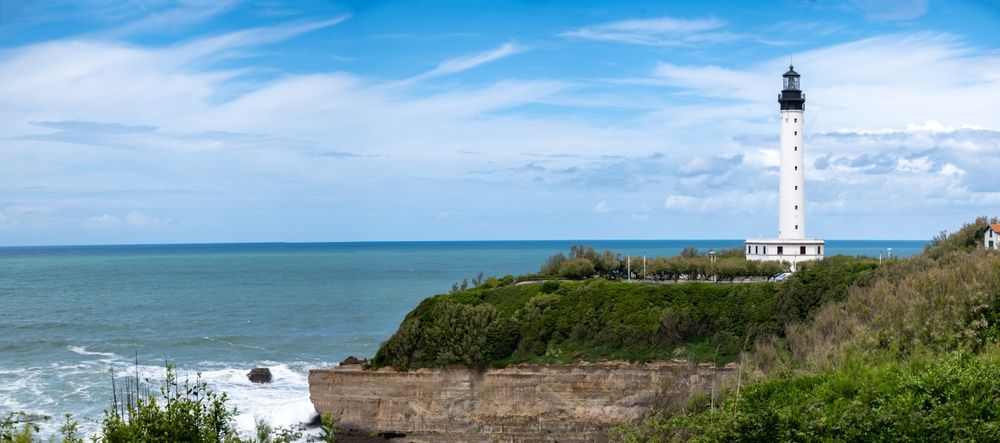
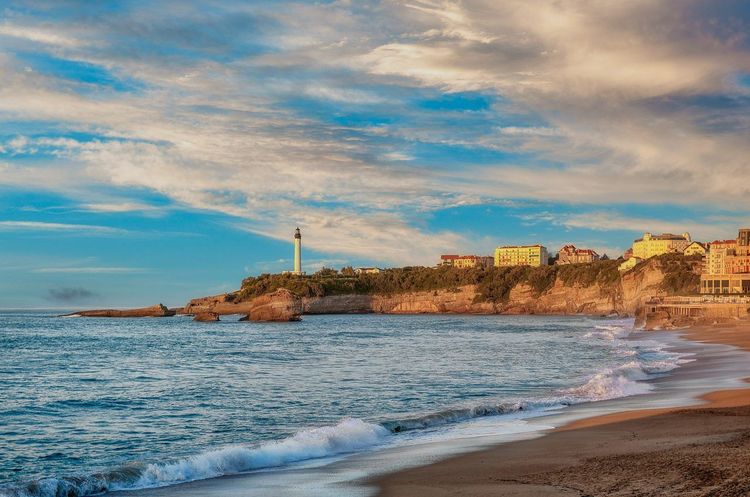
First lit in 1834, the Biarritz Lighthouse watches over the Basque coast from 73 meters above sea level. You have to climb 248 spiral steps to reach the platform, but the reward justifies the effort: on a clear day, the view reaches the first Spanish hills to the south and the dunes of the Landes to the north. The lighthouse generally opens from 10 a.m. to 7 p.m. in high season, with a midday break outside school holidays.
You can climb as soon as it opens to avoid the queue that forms from 11 a.m. Right after coming down, follow the coastal path known as the Empress's Viewpoint: it was from this cliff edge that Eugénie de Montijo, wife of Napoleon III, liked to watch the bathers below. The path runs along the cliff for a few hundred meters, offering a series of ocean views that change with the tide.
The Rocher du Basta and the Hôtel du Palais
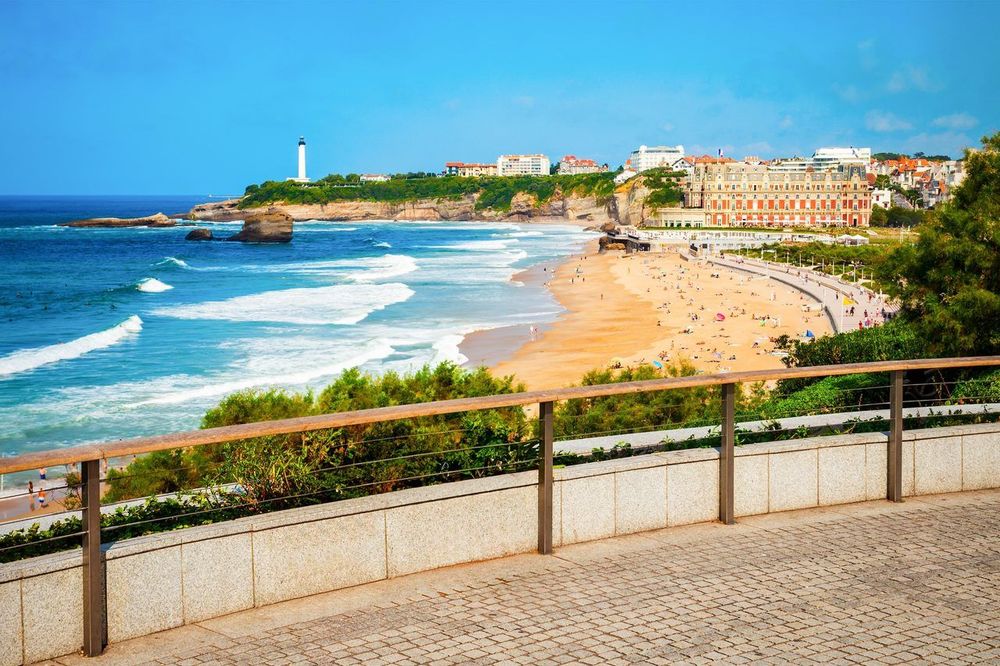
Continuing the walk south, a small metal footbridge links the mainland to the Rocher du Basta, a rock formation that has historically protected the Grande Plage from storm waves. It is a quick photo stop, especially early in the morning when the low light illuminates the red brick façade rising just behind it.
This façade belongs to the Hôtel du Palais (1 Avenue de l'Impératrice, 64200 Biarritz, rated 4.6/5 on Google from 2,078 reviews), built in 1855 at the request of Napoleon III to give Eugénie a summer residence facing the Atlantic. Now a five-star palace hotel, the building preserves its Second Empire salons and its infinity pool open to the beach. You do not need to stay there to enjoy it: the bar terrace remains open to visitors who want a coffee break with a view, provided you book in season.
The Ryo audio-guided tour of Biarritz starts with this very loop between the lighthouse and the Empress's Viewpoint, with commentary on the history of the lighthouse and the coast, handy if you prefer to walk with an attentive ear rather than your nose buried in a paper map.
11:30 a.m.–12:30 p.m.: Les Halles de Biarritz and the Heart of Town
Les Halles, an Unmissable Foodie Stop
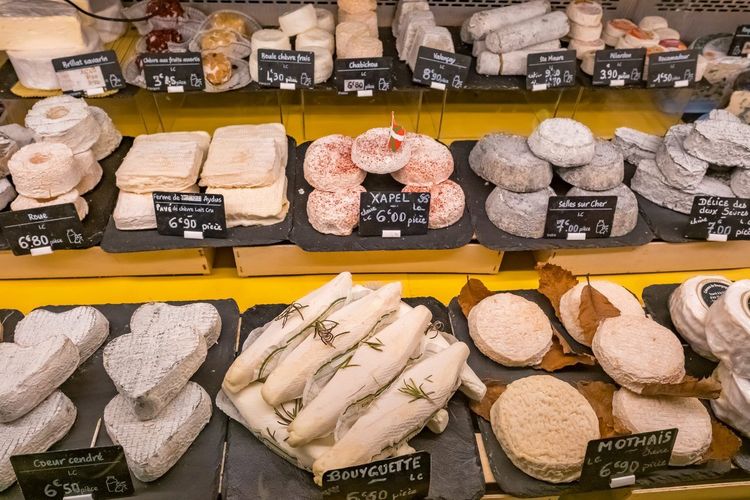
Head to the town center for Les Halles de Biarritz, a covered market with a metal framework built in 1885. About sixty vendors sell Basque pepper, aged Bayonne ham and Basque cake filled with cream or black cherry. Even if you buy nothing, wandering among the stalls is worth the visit for the atmosphere.
If you feel a little hungry before the real lunch, several bars inside Les Halles serve pintxos and a glass of txakoli standing at the counter, a far more local habit than a coffee on the main square.
Rue Mazagran and Sainte-Eugénie Church
Leaving through the east side, Rue Mazagran packs espadrille shops, delicatessens and artisan workshops into a few hundred meters. It is the place to get lost for ten minutes without a set route, between two stops on the program.
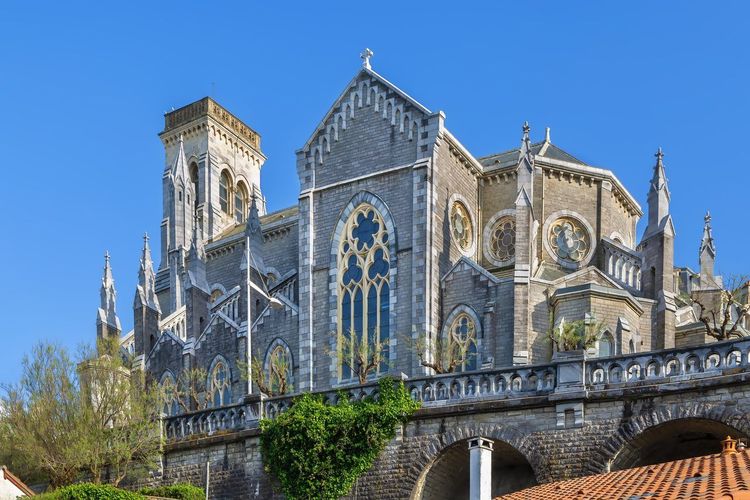
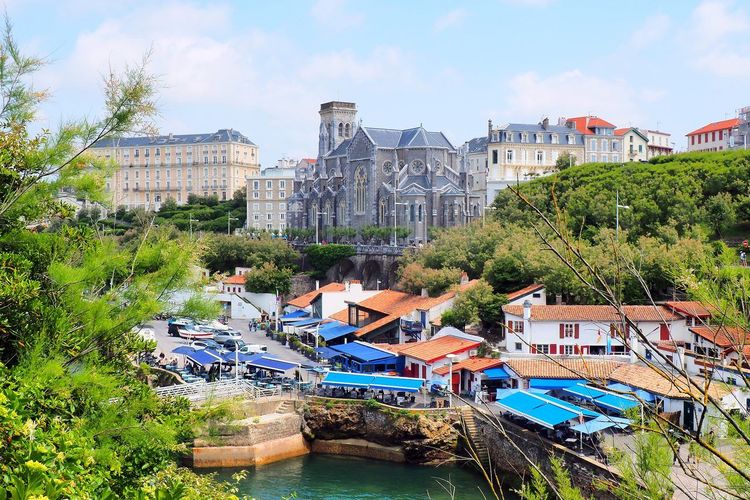
It leads to Sainte-Eugénie Church (Place Sainte-Eugénie, 64200 Biarritz, rated 4.4/5 on Google from 1,733 reviews), built between 1898 and 1903 in a neo-Gothic style, which overlooks the Port-Vieux directly. Its bell tower is a handy visual landmark for finding your way through the maze of streets in the center.
12:30 p.m.–2 p.m.: Lunch at the Port des Pêcheurs
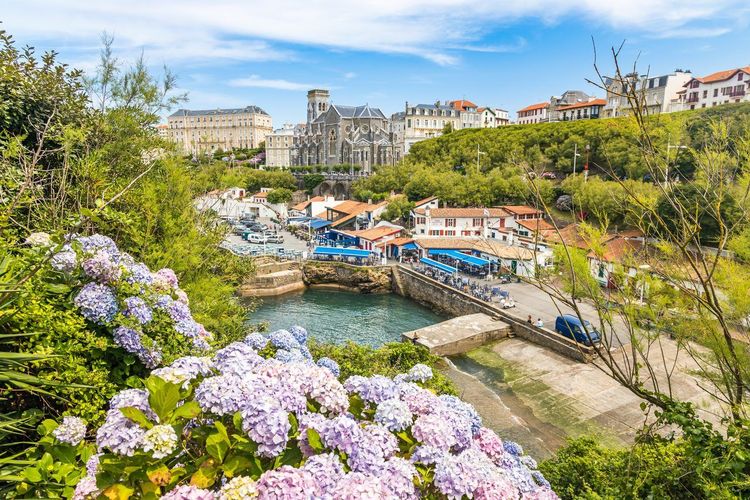
The Port des Pêcheurs (Rue Dérauzan, 64200 Biarritz, rated 4.5/5 on Google from 853 reviews) occupies a small cove carved into the rock, a five-minute walk from Les Halles. The crampottes, those little huts with colorful shutters where fishermen stored nets and gear, now sit alongside a handful of fish restaurants that open their terraces directly onto the port.
Chez Albert remains a safe bet for a fresh fish dish at a reasonable price, but tables go fast between 12:30 and 1:30 p.m.: it is best to book the day before or arrive right at opening. If everything is full, neighboring restaurants in the same port offer a comparable menu, often with only a few minutes' wait. Allow a good hour at the table, long enough for the light to change over the moored boats.
2 p.m.–3:30 p.m.: The Rocher de la Vierge and the Plateau de l'Atalaye
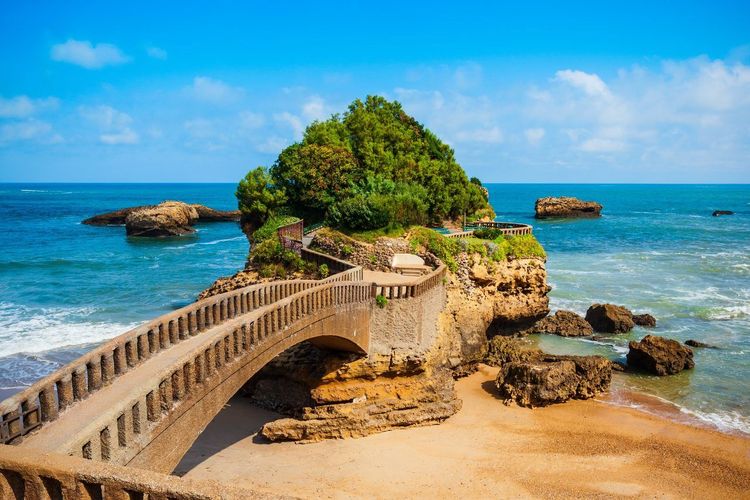
After lunch, the walk continues westward, onto the headland that separates the town's two largest beaches.
The Rocher de la Vierge and Its Eiffel-Attributed Footbridge
The Rocher de la Vierge bears a statue of the Virgin installed in 1865, linked to the shore by a metal footbridge attributed to the Eiffel workshops, built in 1887. In rough seas, the waves crash against the pillars and splash visitors who walk out to the end, a spectacle that draws photographers as much as the curious.
Avoid crossing in strong wind if you are prone to vertigo: the footbridge is narrow with little shelter. The best photos are taken in late morning, when the sun lights the statue from the front rather than leaving it backlit.
The Plateau de l'Atalaye, the Aquarium and the Cité de l'Océan
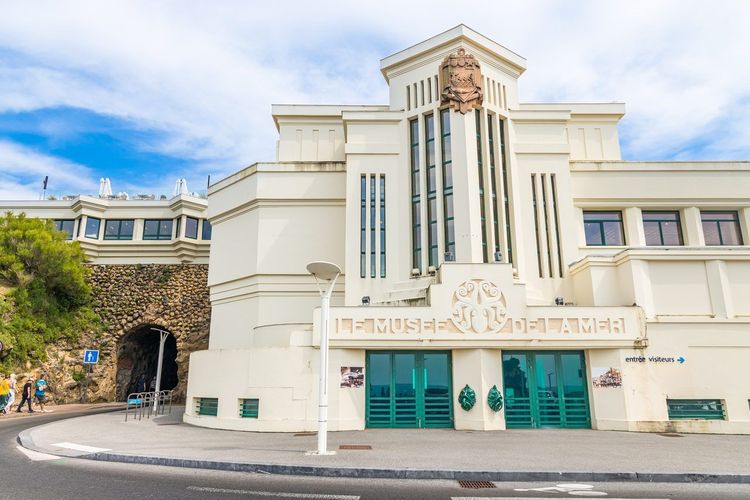
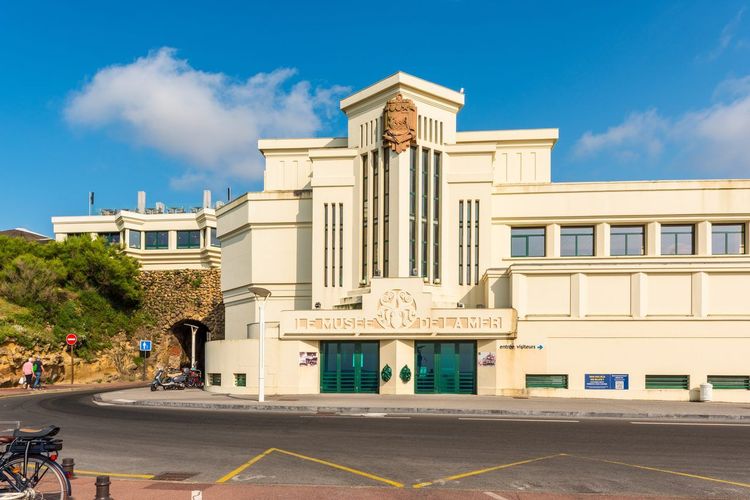
The Plateau de l'Atalaye, from the Basque word for a lookout post, was once used to spot whales offshore. Today it houses the Musée de la Mer, often called the Biarritz Aquarium, set in a 1933 Art Deco building where shark tanks and a seal terrace share the visit.
A few minutes' walk away, the Cité de l'Océan (1 Avenue de la Plage, 64200 Biarritz, rated 4/5 on Google from 5,671 reviews) offers a more recent, interactive approach centered on marine science and surf culture. With children, choosing between the two mostly comes down to live fish versus digital experiences, with the Cité de l'Océan complementing a visit already rich in marine animals at the neighboring museum.
On this stretch, the Ryo audio guide stops follow one another from the plateau to the rock: the anecdote about the building of the footbridge triggers just as you set foot on the metal.
3:30 p.m.–4:30 p.m.: Port-Vieux, Villa Belza and Grande Plage
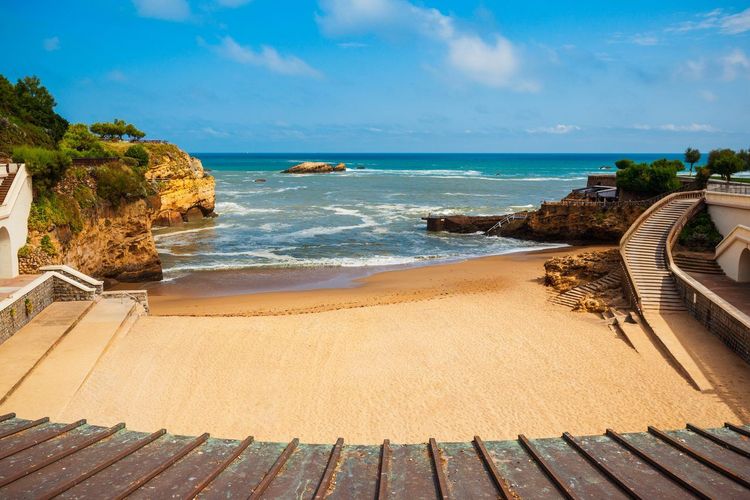
The Port-Vieux and the Villa Belza
The Port-Vieux was Biarritz's first fishing port before the town turned to seaside tourism. Sheltered by two natural breakwaters, its small beach remains the calmest in town, lifeguarded in season and appreciated by families with young children for wave-free swimming.
On the cliff closing the bay to the south stands the Villa Belza, with its neo-medieval keep and pepper-pot turret, built between 1880 and 1895 for Ange Du Fresnay, a Parisian insurance company director, to plans by architect Alphonse Bertrand. Local legend gives it a ghost, but it remains above all one of the most photographed settings on the Basque coast, visible from the path leading toward the Côte des Basques.
The Grande Plage and Its Promenade
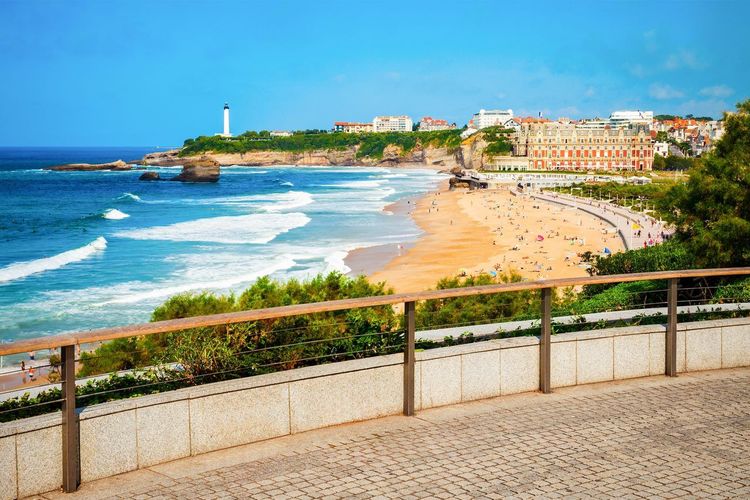
Head back toward the center for the Grande Plage (Boulevard du Général de Gaulle, 64200 Biarritz, rated 4.3/5 on Google from 779 reviews), a wide crescent of sand lined by a Belle Époque promenade and its striped bathing huts, a tradition dating back to the Second Empire. This is where swimming draws the biggest crowds in summer, between families and regular swimmers.
Take time for an ice cream while walking along the Grande Plage promenade; kiosks are plentiful between the casino and the Hôtel du Palais. This Ryo audio-guided sub-tour, the queen of beaches and the beach of kings runs along the Port-Vieux and the Grande Plage for 4.5 kilometers: 16 audio clips and 1h50 of Biarritz sea-bathing history, at your own pace.
4:30 p.m.–6 p.m.: Sunset at the Côte des Basques
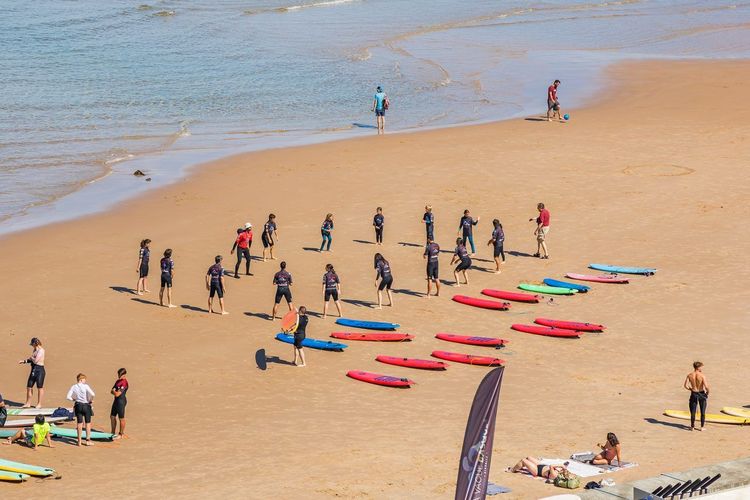
The last stop of the day heads south, where the coast opens onto a wilder beach.
The Surfers and the Cradle of French Surfing
The Côte des Basques (Boulevard Prince de Galles, 64200 Biarritz, rated 4.7/5 on Google from 3.9K reviews) is considered the cradle of surfing in Europe: it was here in 1957 that American screenwriter Peter Viertel first put his board in the water on French soil, inspiring a whole generation of Biarritz surfers. The waves are regular and accessible, making it one of the busiest spots on the coast today, from beginners to experienced riders.
Settle on the wooden steps built at the top of the cliff to watch the surfers without getting wet: it is free, and the view of the silhouettes gliding over the waves with the Pyrenees as a backdrop is well worth a twenty-minute pause.
Alternative: Take a Surf Lesson
If you feel like trying rather than watching, several schools set up at the bottom of the beach offer ninety-minute lessons, board and wetsuit included, for around forty euros. Book the same morning or the day before; late-afternoon slots go fast in season.
It is also the ideal time for the sunset. Several audio stops on the Ryo tour tell the story of the birth of surfing in Europe: stories to listen to seated on the steps, while waiting for the sky to light up behind the Pyrenees.
Bonus Must-Sees If You Have a Little More Time
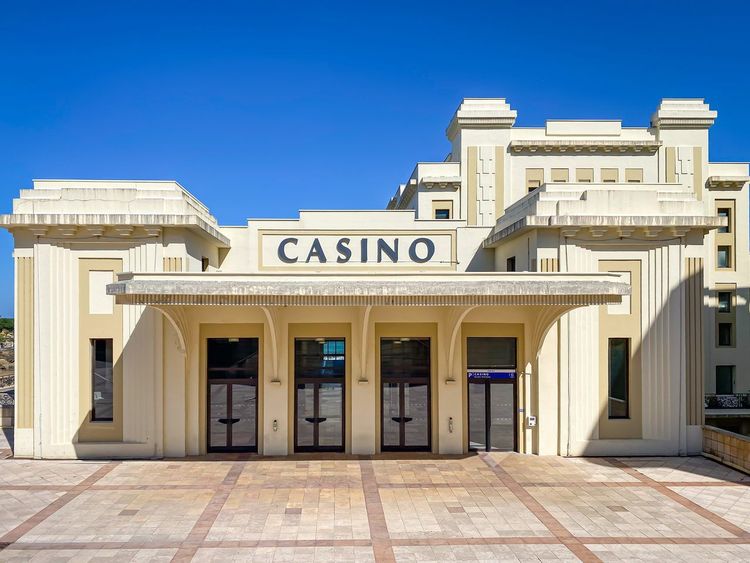
The Casino Municipal and the Imperial Chapel
The Casino Municipal, an Art Deco building raised in 1929 by architect Alfred Laulhé facing the Grande Plage, deserves a look even if you do not gamble: its white façade and terraces give a good idea of the fashionable Biarritz of the Roaring Twenties.
A few streets away, the Imperial Chapel, commissioned by Napoleon III for Eugénie in 1864, blends Byzantine influences and gilded decor, a style rarely found elsewhere on the coast. Opening hours remain limited, so check with the tourist office before going.
Lac Marion, the Offbeat Nature Break
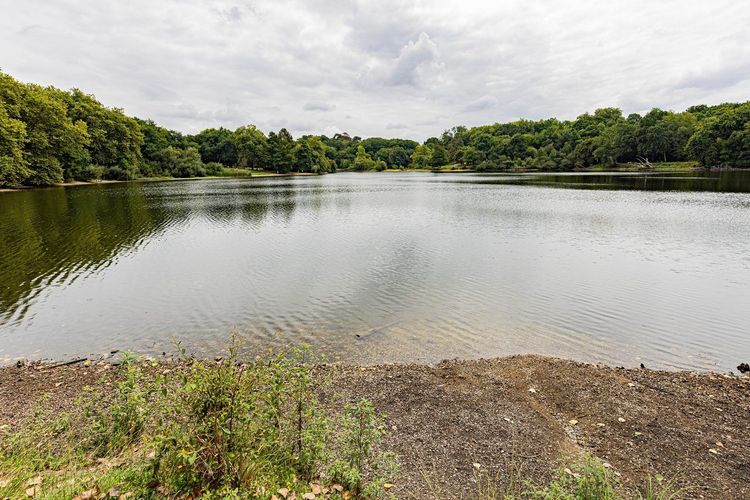
Less known to day visitors, Lac Marion (Avenue du Lac Marion, 64200 Biarritz, rated 4.6/5 on Google from 899 reviews) is hidden behind the Côte des Basques, surrounded by a wooded path where locals come to picnic or run away from the crowds on the beaches. It is the place to choose if you want a real contrast with the seaside, fifteen minutes on foot from the waterfront.
What to Do in Biarritz When It Rains or to Extend Your Stay to 2–3 Days
Sheltered Options: Covered Market, Aquarium, Imperial Chapel
Rain is not rare on the Basque coast, even in summer. If the day's plans are washed out, the covered market stays open all morning, the Musée de la Mer and the Cité de l'Océan offer several hours of indoor visiting, and the Imperial Chapel lends itself well to a short cultural break.
For a more complete list of indoor activities, this Ryo article on rainy days in Biarritz details options by neighborhood, useful if you are stuck for a whole afternoon.
Extending Your Stay to 2 or 3 Days
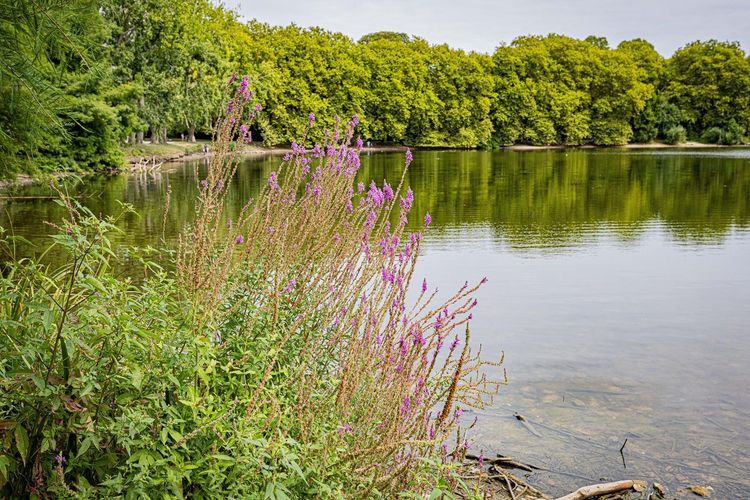
Visiting Biarritz in 2 days lets you add a morning surf lesson, an afternoon at Lac Marion and a stroll through the residential streets of Beaurivage, away from the seafront crowds. Over three days, many visitors include a full day in Saint-Jean-de-Luz or in the villages of the Basque hinterland so that what to do in Biarritz in 3 days is not limited to the seafront.
In any case, keep a free slot at the end of your stay: it is often the moment when you return to the beach or spot that left the strongest impression, with no set route to follow this time.
When to Visit Biarritz: The Best Time of Year and Day
Choosing Your Season
To visit Biarritz in 1 day in good conditions, May, June and September make the winning trio: the days are long, the water starts to warm up and the terraces of the Port des Pêcheurs fill up without overflowing. July and August bring the buzz of the summer holidays, but also queues at the lighthouse, packed parking lots and rising hotel rates. If you come in those two months, arrive before 9 a.m. and favor walking over driving.
Winter has its fans. The low light, the big swells exploding against the Rocher de la Vierge and the almost empty beaches give a different image of the town, a rawer one. The Musée de la Mer and Les Halles stay open, which lets you keep a full program even between showers.
Working with the Tides and the Light
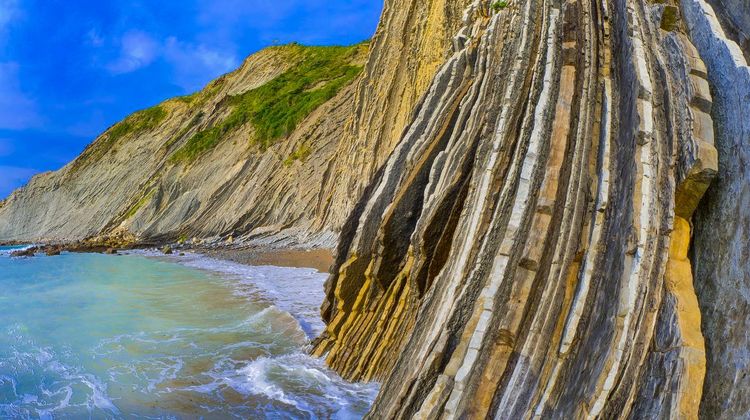
Check the tide times the day before. At low tide, the Côte des Basques reveals a wide strip of sand and its rocks, ideal for walking to the foot of the cliffs. At high tide, the water laps the seawall and the beach almost completely disappears: you are better off enjoying the show from the steps. For photos, the lighthouse and the Empress's Viewpoint suit the morning, while the Villa Belza and the Côte des Basques take on their best colors at the end of the day.
Practical Tips: Transport, Where to Stay and a Stop in Bayonne
Getting Around on Foot, by Bike or by Bus
Biarritz is very easy to explore on foot: allow roughly 5 kilometers of total walking to link the stops of this day, coastal paths included, so visiting Biarritz on foot is no trouble at all. For longer trips or when you are tired, the Txik Txak bus network (formerly Chronoplus) links the main neighborhoods, and self-service bikes complete the offer for those who prefer to pedal along the seafront.
Where to Stay for Every Budget
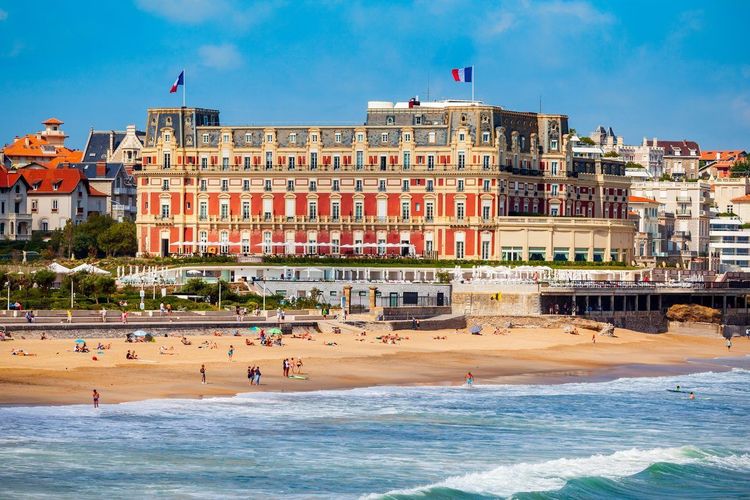
For a stay with a view, the hotels around the Grande Plage and the Hôtel du Palais remain the reference addresses, at prices to match. The Halles and town-center districts offer a good price-location compromise, ten minutes on foot from all the stops on this Biarritz sightseeing circuit. On a small budget, the hostels near the Côte des Basques mostly attract a surfer clientele, with a more relaxed atmosphere.
Bayonne, the Complementary Stop Nearby
If your itinerary leaves you time, Bayonne is less than fifteen minutes away by train or bus, and is easily visited in half a day: a half-timbered old town, a Gothic cathedral and chocolate-makers' workshops along the Nive. Many travelers combine the two towns rather than choosing between visiting Bayonne in 1 day and Biarritz: each naturally complements the other.
FAQ
What are the absolute must-sees in Biarritz in one day?
The Rocher de la Vierge, the Biarritz Lighthouse and the Côte des Basques form the trio most visitors remember, complemented by a stop at Les Halles for lunch and the Grande Plage for a late-afternoon stroll.
What walking route should you follow to visit Biarritz in 1 day?
The most logical loop starts at the lighthouse in the north, heads down to Les Halles and the Port des Pêcheurs in the center, crosses the Plateau de l'Atalaye to the Rocher de la Vierge, then follows the coast south via the Port-Vieux, the Grande Plage and finally the Côte des Basques.
What is the most beautiful neighborhood in Biarritz?
The Port-Vieux and Villa Belza area is often a local favorite, along with the lighthouse district, for their ocean views and a more intimate feel than the Grande Plage seafront.
What are the offbeat places to visit in Biarritz?
Lac Marion behind the Côte des Basques, the Rocher du Basta reached by its small footbridge, and the Chapelle Impériale with its limited opening hours are among the stops that many day visitors miss.
How much time do you really need to visit Biarritz?
One day is enough for the major highlights at the pace described in this itinerary, but two to three days let you add surfing, Lac Marion and a trip to Bayonne without rushing.
What is the best spot to watch the sunset in Biarritz?
The wooden steps at the top of the Côte des Basques remain the locals' favorite viewpoint, with the silhouette of the Pyrenees standing out behind the surfers at the end of their session.
A day in Biarritz stays in your mind as much as in your legs: a morning lighthouse, a rocky plateau at lunchtime, a legendary beach for surfing at sunset. If you want to keep your hands free and have the commentary in your ear rather than the map in your pocket, the Ryo audio-guided tour of Biarritz follows this same thread, step by step, and can be paused at any moment of the day.
À lire également