© Shutterstock
 Votre guide Ryo
Unusual Visit to Biarritz: 30 Off-the-Beaten-Path Experiences in 2026
In Biarritz, classic guides send you straight to the Rocher de la Vierge and the Grande Plage. An unusual visit to Biarritz starts somewhere else: on a surfboard that pitches without a drop of water, before a Romano-Byzantine chapel dedicated to a Mexican Virgin, or at the foot of a neo-medieval villa where Cossack choirs sang for the Prince of Wales. The Ryo audio-guided tour of Biarritz connects several of these places along a 4.5 km loop with 17 audio stops, to enjoy at your own pace between each stage.
On the programme of this guide: a casino dating from 1858 that became a conference centre, a suspended footbridge more than 150 metres above the Holzarte gorges, a wine aged 15 metres underwater in the bay of Saint-Jean-de-Luz, and a private campervan for cruising along the Basque coast without touching a steering wheel. Some experiences can be enjoyed on foot in an hour; others require pushing on to Bayonne, Ciboure, or the mountains of Soule. At the end of this article you will also find estimated prices, the best season, and car-free options to help you build your own itinerary, neighbourhood by neighbourhood and cave by cave.
The Cité de l'Océan, the Must-See Immersive Experience
The Cité de l'Océan (1 Avenue de la Plage, 64200 Biarritz, rated 4/5 on Google based on 5,662 reviews) holds a special place in Biarritz's cultural landscape. Inaugurated in June 2011 in the Milady district, on the southern edge of the city, it bears the signature of American architect Steven Holl, who designed its double-wave roofline. Inside, there are no dusty display cases: across three floors and some 3,500 m², the circuit relies on multimedia and interactivity to make visitors feel the ocean rather than simply explain it with information panels.
The highlight of the visit is called 'Surf Sensation 5D': surfing without getting wet at the Cité de l'Océan, quite literally. Standing on the board, facing the screen, you adjust your balance in real time as the swell rolls past. Children cling on laughing; adults generally discover they are far less steady on their feet than they imagined.
Other experiences deepen the immersion: a 360° virtual-reality dive, a face-to-face encounter with sharks in '700 Sharks', a polar expedition aboard the 'Bathyscaphe', and a 4D animated film about marine life. Leave plenty of time, as the venue estimates an average visit of around three hours, and most of the interactive features are suitable for visitors aged 6 and over.
Tickets for the Cité de l'Océan are best booked online, especially in July–August and on overcast days when the whole coastline flocks to indoor activities. Prices vary by season: check the official rate card before you go. A combined ticket with the Aquarium de Biarritz, located about 3 km above Port-Vieux, reduces the overall cost if you plan to visit both.
In the Footsteps of Empress Eugénie: the Chapelle Impériale and the Second Empire Heritage
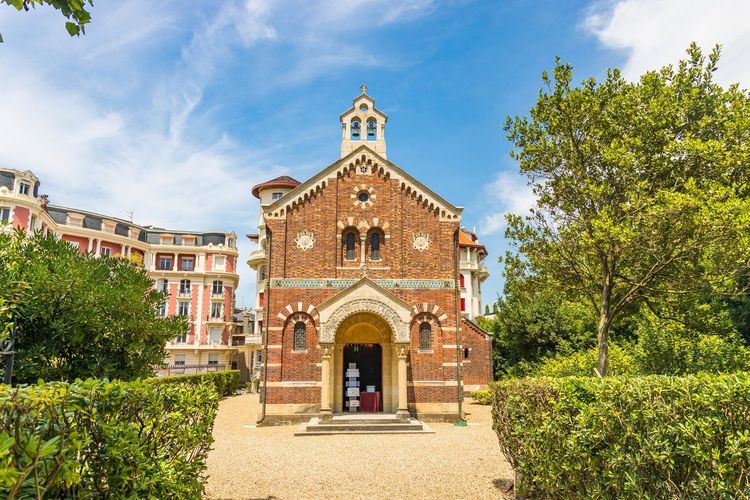
Biarritz owes its fashionable reputation to a couple: Napoleon III and Empress Eugénie, who had their summer residence, the Villa Eugénie, built here from 1854. Now the Hôtel du Palais, it has been extensively transformed since. The Chapelle Impériale (Avenue de la Reine Victoria, 64200 Biarritz, rated 4.5/5 on Google based on 320 reviews), built between 1864 and 1866 by architect Émile Boeswillwald, remains the only surviving built vestige of that imperial retreat. Its eclectic style, blending Romano-Byzantine and Hispano-Moorish influences, stands in sharp contrast to the surrounding seaside villas, and its dedication is even more surprising: Notre-Dame de Guadalupe, the Black Virgin of Mexico.
One detail worth knowing before you visit: the interior only opens during the tourist office's guided tours. Some are conducted in Spanish, a nod to the empress, who was born in Granada. The building has been listed as a historic monument since 1981, and its mosaics and azulejos alone justify making a reservation.
The story of the arrival of the railway in Biarritz completes this picture and is the subject of a dedicated flash visit. In the early 1860s, the line from Bayonne reached the station at La Négresse, away from the town centre. It was not until 1911 that a Compagnie du Midi line served Biarritz-Ville and its former Gare du Midi, since converted into a performance venue. In the meantime, the Parisian bourgeoisie and then European aristocracy had transformed the former whaling port into a sought-after resort.
When Coco Chanel opened her couture house in Biarritz in 1915, in the Villa Larralde, she took advantage of the wealthy clientele settled far from the front. The tour 'Coco Chanel in Biarritz, the Birth of a Style', one of the tourist office's new offerings, revisits the chapter in which soft jerseys and streamlined silhouettes found their first seaside audience.
Want to connect these places without depending on a fixed tour slot? Headphones on, follow the Ryo audio-guided tour, which stops at the Chapelle Impériale, the neighbouring Orthodox church, and the Hôtel du Palais: three audio stages that let you read the Second Empire in stone.
Legends and Shady Haunts: Villa Belza, Casino Bellevue, and Port-Vieux
Between the Grande Plage and la Côte des Basques, these three addresses tell a side of Biarritz more intriguing than any postcard, and can be reached from one another in about fifteen minutes on foot.
Perched on its rock facing the ocean, Villa Belza was built between 1880 and 1895 by architect Alphonse Bertrand for Ange Du Fresnay, director-general of the Le Phénix insurance company, who named it after his wife, Marie Belza. The legends practically wrote themselves: 'beltza' means 'black' in Basque, and the villa stands near the 'Trou du Diable' (Devil's Hole), a fissure where waves crash thunderously on stormy days. That was more than enough to fuel tales of a haunted house.
Its real history is more than a match for the myths, however. In 1923, Grégoire Beliankine, Igor Stravinsky's brother-in-law, opened a Russian restaurant here called 'Le Château basque'. Themed galas, Cossack choirs, and endless nights: the Prince of Wales, the future Edward VIII, was a frequent guest. Requisitioned during the Second World War and then devastated by two fires, including one in 1974, the villa was converted into apartments in the 1990s. It can therefore only be admired from the outside, which takes nothing away from its Gothic-set silhouette.
The Bellevue, a casino dating from 1858, occupies a strategic position facing the Grande Plage. It has seen generations of gamblers and bathers come to enjoy sea bathing, then prescribed by doctors. The tourist office's flash visit traces its four major transformations, right up to the conference and exhibition centre it houses today.
Then head down to Port-Vieux (Rue Port Vieux, 64200 Biarritz, rated 4.6/5 on Google based on 3,100 reviews), from whale hunting to regattas: it was in this cove sheltered by rocks that Biarritz's history began. Basque fishermen watched for whales here from the Middle Ages, before the cetaceans became scarce in the gulf. In the 19th century, the seaside resort took over and the port shifted towards swimming, leisure sailing, and regattas — a transformation that mirrors that of the city as a whole, which moved from working the sea to enjoying it.
To string these three stages together without hunting for signs, the 17-stop audio loop of the Ryo tour passes by Villa Belza, the Port-Vieux beach, and place Bellevue, then continues to the Rocher de la Vierge and the Musée de la Mer, totalling 1 hour 50 minutes of walking.
The Biarritz Lighthouse and the Grande Plage: Reading the Landscape from a New Angle
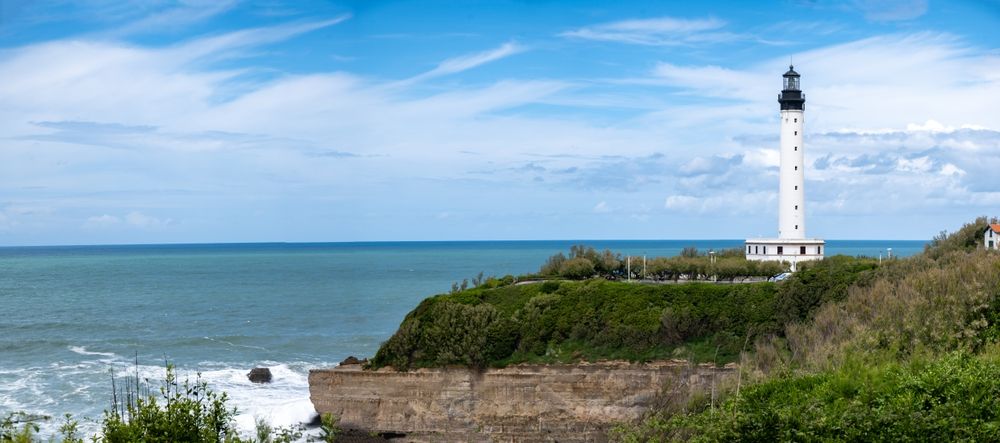
Everyone looks at the city from the beach. The idea here is to do the opposite: climb to the top of the Biarritz Lighthouse and look down at the Grande Plage (Boulevard du Général de Gaulle, 64200 Biarritz, rated 4.3/5 on Google based on 777 reviews) from above. Built between 1830 and 1832 and lit for the first time in 1834, this 47-metre white tower projects its beam 75 metres above the sea. Its 248 steps must be earned, but the reward is immediate.
Biarritz seen from the lighthouse becomes a landscape-reading experience in its own right, and the tourist office has turned it into a flash visit: the panorama sweeps from the Pyrenees to the Landes beaches. In a single glance, you can make out the full arc of the Grande Plage, the municipal casino, the Hôtel du Palais, and the line of surfers dotting the shoreline.
These seasonal visits change throughout the year: in spring they linger on the natural landscapes, while other one-off events mark Halloween or the year-end illuminations. Check the dates before you go. And if you make your way up independently, aim for late afternoon: the raking light on the ocean and the rooftops completely transforms the view.
Workshops and Artisan Crafts in Biarritz
Biarritz nurtures a quiet crafts scene, far from the standardised souvenir shops.
On the creative workshop side, an introduction to pottery throwing in Biarritz lets you leave with a piece shaped by your own hands, in a session of around 1.5 to 2 hours led by a local ceramicist. Another option, more colourful, is the azulejos decoration workshop in Biarritz, where you paint these glazed tiles yourself — cousins of those adorning the Chapelle Impériale. Budget a few dozen euros per person depending on the workshop and its duration.
On the traditional crafts side, two objects tell the story of the Basque Country better than any long speech. Espadrilles, with their braided rope soles, are still hand-sewn in several workshops across the region, and their striped canvas uppers are easy to find in the town-centre boutiques. The chistera, the long wicker basket mounted on a chestnut frame that extends the pelota player's arm, represents an even rarer craft: only a handful of artisans still make it by hand.
The makhila completes the trio. This Basque walking stick, made from medlar wood carved while still standing and then dried for years before being decorated with silver or brass, is traditionally given as a mark of honour or respect. Every piece is made to measure, fitted to its owner's height. In Larressore, about twenty minutes away by road, a family workshop keeps this craft alive — a visit that will make you look at the canes in shop windows very differently.
Gourmet Experiences and Immersion in Basque Culture
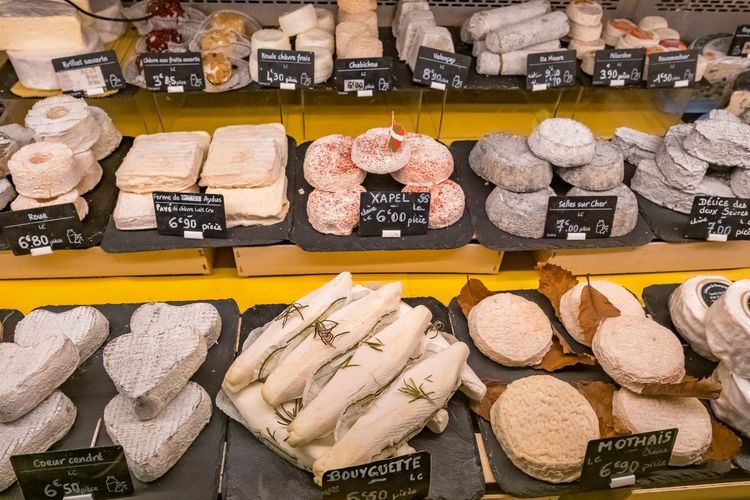
Discovering Biarritz through food rather than monuments: that is the principle behind the No Diet Club food tour in Biarritz. The walk, narrated by a guide, threads through the Halles, patisseries, and counters over a few hours, with a tasting at every stop. Basque cake, Bayonne ham, Espelette pepper, and sheep's cheese follow one another along the route. Book ahead in high season, as group sizes are kept deliberately small.
Another way to immerse yourself in local culture: a game of pelota basque to dive into its cultural heritage. This age-old sport comes in several disciplines, from bare-handed play to grand chistera. Organisations such as Ona Pilota offer introductory sessions open to complete beginners, led by players who explain the rules before letting you strike the ball. It is loud, physical, and one of the few Basque sports you can genuinely try on holiday rather than watch from the stands.
To continue exploring the flavours, the Ryo article on the culinary specialities of Biarritz details where to find these products once the tasting is over.
Thrills in Biarritz and Its Immediate Surroundings
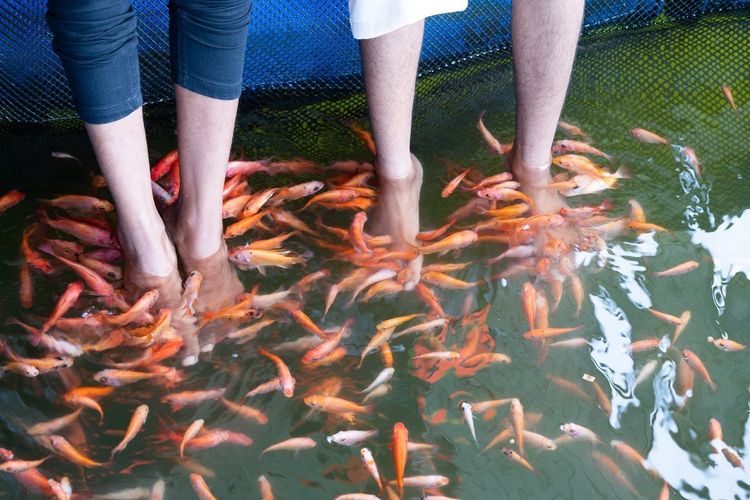
In Biarritz itself, the strangest sensation starts at your feet: having your feet nibbled by small fish in a fish spa tank where garra rufa munch away at dead skin. Several beauty institutes in the city offer short sessions. On the seafront, water-based activities take on a more energetic feel: water jumping, paddleboarding, and wave skiing are available as introductory lessons or hire sessions depending on the spot and the season.
Within a 30-minute drive, the choice expands considerably. Giant electric scooters in the great outdoors wind through the trails of the Pignada forest in Anglet — a great way to cover ground effortlessly among the pines. In Saint-Pée-sur-Nivelle, a paramotor introductory flight takes you over the Basque countryside and the Atlantic coast, with sessions ranging from 10 to 60 minutes starting from around €50. Right next to it, outdoor axe throwing is open from age 10, in 30- to 60-minute sessions starting from around €9 — a supervised activity that appeals equally to groups of friends and families with teenagers.
In Saint-Jean-de-Luz, a one-hour sidecar ride — ocean side or mountain side — puts you in the passenger basket while a driver negotiates the bends, starting from around €95 per sidecar. For a more leisurely format, a trip along the Basque coast in a private vintage campervan departs from Biarritz for 3.5 hours of retro road-tripping via Guéthary, Saint-Jean-de-Luz, and Hendaye, starting from around €365 per vehicle.
Raining outside? In Bayonne, the 'Shipwrecked' escape room gives you 60 minutes to solve the puzzles as a team, starting from around €20 per player.
Day Trips from Biarritz: Caves, a Vertiginous Footbridge, and Underwater Wine
This is where Biarritz becomes a base camp for gems that most guides forget to connect to the city.
Less than an hour away by road, in the Arberoue valley, the Isturitz and Oxocelhaya caves put you on the trail of our ancestors. Two superimposed cavities, two distinct atmospheres: a major prehistoric site where humans left behind tools, engravings, and paintings, and a cave filled with spectacular formations. A small museum and a workshop dedicated to prehistory round out the visit, making it an excellent outing for curious children.
Further east, allow around two hours by road to relive the discovery of the Verna cave, near Sainte-Engrâce, presented as the largest underground chamber open to the public in the world. Three options are available: a secured route accessible to visitors with reduced mobility, a more adventurous option with a panoramic view of the chamber, and a guided speleological hike led by an explorer. Check the opening periods, which vary by season.
Not afraid of heights? Cross the Holzarte footbridge (Gorges d'Holzarte, 64560 Larrau, rated 4.7/5 on Google based on 2,295 reviews), near Larrau, about two hours from Biarritz. Perched more than 150 metres high, it spans the Holzarte and Olhadubi gorges. The approach requires effort: a steep one-hour climb from the Logibar car park, or a much longer and gentler loop of about five hours. Hiking boots are essential, and avoid windy days.
Closer to the coast, taste a wine aged underwater at Egiategia, in Ciboure. The estate has developed an underwater vinification method, at 15 metres depth in the bay of Saint-Jean-de-Luz, where the stable temperature and the gentle movement of the swell influence the wine's development. The tasting that follows will give you plenty to talk about at your next dinner party.
Finally, two sea outings complete the picture. Departing from Hendaye, about forty minutes from Biarritz, catamaran trips go in search of the dolphins that frequent the bay — though sightings are never guaranteed, as nature dictates. In Saint-Jean-de-Luz, the historic centre of tuna fishing, full-day deep-sea fishing trips are organised with professional crews: allow a full day at sea and bring your sea legs.
Walks and Cycling Paths Along the Basque Coast
For cycling enthusiasts, La Vélodyssée — a cycle route of more than 1,000 km linking Brittany to the Basque coast — passes through Biarritz. The section from Biarritz to Saint-Jean-de-Luz heads south with glimpses of the ocean, while the stretch towards Bayonne follows the Adour upstream. La Vélosud from Biarritz to Urt heads inland along the Adour for a more rural atmosphere. Locally, greenways connect the city to Bidart to the south and to Milady.
For a morning outing, the Biarritz Lakes Loop links Lac Marion and Lac Mouriscot, two Natura 2000 lakes roughly 700 metres apart. A cycle path leads from the Kléber district to Lac Marion (Avenue du Lac Marion, 64200 Biarritz, rated 4.4/5 on Google based on 150 reviews), whose flat circuit is perfect for a skate, children's bike, scooter, or pushchair outing.
On foot, the clifftop promenade is the most spectacular walk in the city: from the plateau de l'Atalaye to the Rocher de la Vierge and then towards la Côte des Basques, the path overlooks the ocean almost the entire way. For an effortless option, the Txu Txu little train does a circuit of the town centre — handy with young children or for visitors with reduced mobility.
If this coastline appeals to you, the Ryo audio-guided tour follows these very cliffs, from the Atalaye to the Rocher du Basta, with commentary at every viewpoint. And for more seasoned walkers, the Ryo article on hikes around Biarritz on the Basque coast details further routes.
Musée Historique de Biarritz and Themed Flash Guided Tours
To set the scene before heading out to explore, the Musée Historique de Biarritz (Rue Broquedis, 64200 Biarritz, rated 4/5 on Google based on 190 reviews) is housed in the former Saint-Andrew Anglican church on Rue Broquedis. Photographs, posters, and period objects trace the transformation of a fishing village into a glamorous seaside resort. Opening days vary: check with the tourist office before making the trip.
Alongside the museum, each guided tour of Biarritz offered by the tourist office can be booked online at fixed time slots: the chapel, Villa Belza, Bellevue, the lighthouse, the railway, or even the imperial afternoon with Eugénie's tea at the Hôtel du Palais. The open-air exhibition 'The Evolution of Biarritz from 1952 to 2024' offers a photographic reading of the modern city; ask the welcome desk for its location and dates. Are you familiar with Imagine Biarritz? The tourist office will keep you up to date on its current programming.
If fixed time slots don't fit your schedule, the Ryo audio-guided tour works as a self-guided tour: 17 audio stages, from place Georges-Clemenceau to the Halles, to start whenever you like, with no reservation required.
Practical Information for Planning Your Unusual Visit to Biarritz
When to visit Biarritz? Spring (April to June) and the shoulder season (September–October) offer the best compromise: mild temperatures, manageable crowds, and most outdoor activities already or still open. July–August guarantees drier weather but also queues at the Cité de l'Océan and fully booked outdoor activity slots.
Getting around Biarritz without a car works very well in the centre: the Chapelle Impériale, Grande Plage, Bellevue, Port-Vieux, and Villa Belza are all walkable, and the lighthouse is about a twenty-minute walk from the Grande Plage. Local buses serve Milady and the Cité de l'Océan, and La Vélodyssée lets you cycle to Anglet or Bidart. However, Isturitz, the Verna, Holzarte, and even Saint-Pée-sur-Nivelle require a hire car or an excursion with transport included.
When it comes to activity budgets, the range is wide. Allow around fifteen euros per adult for the Cité de l'Océan (confirm on the official website), from €9 for axe throwing, €20 for the escape room, €50 for a paramotor introductory flight, €95 for a sidecar ride, and €365 for a shared private campervan. The tourist office's flash visits and creative workshops fall somewhere in between.
Several nearby towns allow you to extend your programme: Bayonne is about ten minutes away, Anglet is directly adjacent, Saint-Jean-de-Luz and Ciboure are around 25 minutes away, and Hendaye is right on the Spanish border. For family activities, prioritise the Cité de l'Océan (from age 6), the Isturitz caves, the little train, the Lac Marion loop, and axe throwing for children over 10. The Ryo article on Biarritz with the family sets out a complete programme tailored to younger visitors.



FAQ
What are the most original things to visit in Biarritz?
The Cité de l'Océan for its 'Surf Sensation 5D' simulator, the Chapelle Impériale for its Hispano-Moorish décor, and the trio of Villa Belza, Casino Bellevue, and Port-Vieux for their seafront legends form the essential core. Add the climb up the lighthouse and a ceramics or azulejos workshop if you have an extra half-day.
How much time should I allow for an unusual visit to Biarritz?
Two days are enough for the city centre, including the Cité de l'Océan (about three hours on its own). Allow three to five days if you want to add the Isturitz caves, the Verna, or the Holzarte footbridge, each of which requires half a day to a full day.
What budget should I plan for these activities in Biarritz?
Smaller activities start at around €9 to €20 (axe throwing, escape room), the Cité de l'Océan costs around fifteen euros per adult, and thrilling experiences add up quickly: €50 minimum for a paramotor flight, €95 for a sidecar ride. For a weekend combining two or three paid experiences, a budget of €150 to €250 per person is realistic.
What is the best time to discover Biarritz differently?
April to June and September–October offer the best balance between pleasant weather and manageable crowds. Summer guarantees sunshine but also queues and fully booked activities, while some mountain caves reduce their opening hours outside the season.
Can you explore Biarritz without a car?
Yes for the centre: the Chapelle Impériale, Port-Vieux, Villa Belza, Bellevue, and the lighthouse can all be visited on foot, and the Cité de l'Océan is reachable by bus or bike. However, the caves, the Holzarte footbridge, and the activities around Saint-Pée-sur-Nivelle require a car or an organised excursion.
What original things can families do in Biarritz?
The Cité de l'Océan (from age 6), the Isturitz caves, the Txu Txu little train, and a skating stroll around Lac Marion are all well suited to children. Axe throwing is accessible from age 10; save the Holzarte footbridge and paramotor for sporty teenagers or adults.
A City Best Discovered on Its Own Terms
An unusual visit to Biarritz can be enjoyed at several different paces: a morning is enough for the Villa Belza, Bellevue, and Port-Vieux trio, half a day for the Cité de l'Océan, and a proper stay is needed to push on to the caves and the Holzarte footbridge. Come with a shortlist rather than an overloaded itinerary: the city lends itself far more to leisurely exploration than to sprinting.
To connect the town-centre stages without depending on fixed timetables, the Ryo audio-guided tour of Biarritz remains a solid foundation: 1 hour 50 minutes of walking, from the Chapelle Impériale to the Atalaye cliffs. And to extend the stay, the Ryo article on a weekend in Biarritz usefully completes the programme.
À lire également