© Shutterstock
 Votre guide Ryo
The 15 Most Beautiful Beaches of the Basque Country to Explore in 2026
The Basque Country has barely 30 kilometres of French coastline, yet this stretch concentrates a diversity of beaches that would make many more generously endowed coastal regions envious. From sweeping half-moon beaches framed by Belle Époque villas to coves battered by world-class waves, the Basque coastline blends glamour, the raw power of the Atlantic, and surfing traditions in a way found nowhere else in France. Before diving into the list, the audio-guided tour of Biarritz, La Reine des Plages offers 17 episodes to discover the coast's most iconic resort in a way that goes far beyond ordinary sightseeing.
The most beautiful beaches of the Basque Country appear in this selection from two angles: the quality of the natural setting, and what each beach reveals about Basque culture. You will find here the Côte des Basques where modern surfing first arrived in France in September 1956, the Grande Plage of Saint-Jean-de-Luz sheltered since the 17th century by two breakwaters built to save the town from flooding, the Cénitz beach accessible only on foot from Guéthary, and a beach at Hendaye from which Spanish medieval ramparts are visible to the naked eye. On the Spanish side, Bilbao and its world-renowned museums are just over an hour's drive from these shores.
1. The Grande Plage of Biarritz
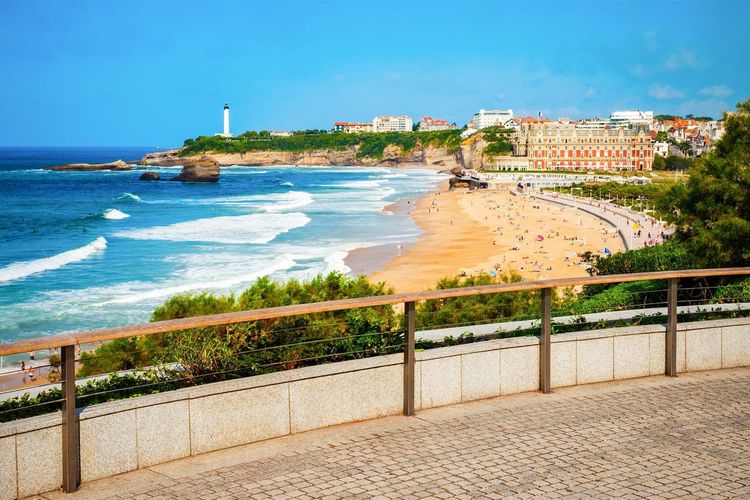
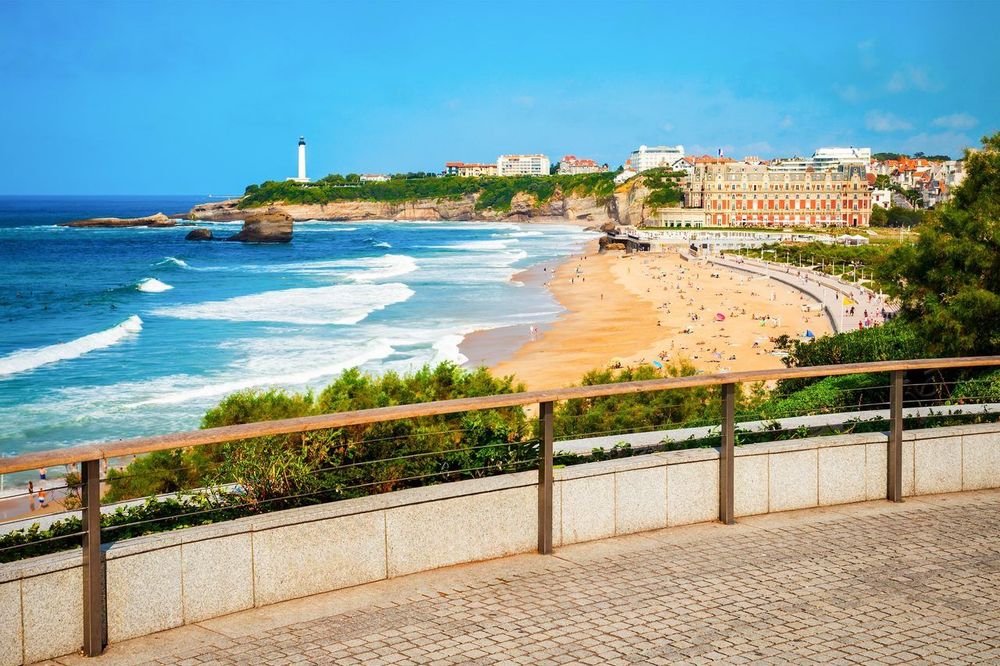
The Grande Plage of Biarritz (Place Bellevue, 64200 Biarritz, rated 4.5/5 on Google from 9,135 reviews) is the most photographed face of the Basque Country, and arguably its most deceptive. You might expect a sedate resort beach framed by the Grand Hôtel du Palais and the municipal Casino; what you discover is a space where currents can be violent, ground swells sometimes exceed two metres in autumn, and lifeguards intervene dozens of times on a single summer day. This contrast between the elegance of the promenade and the raw power of the Atlantic is what makes the Grande Plage truly unforgettable.
Napoleon III and Empress Eugénie helped launch Biarritz's fashionable reputation from 1854 onwards, the year the Villa Eugénie — now the Palais — was built on the seafront. Since then, the Grande Plage has retained its social vocation: the seafront terraces fill up from June, the nineteen lifeguard posts are manned by professional rescuers from June to September, and the painted wooden beach huts are subject to a waiting list of several years for local residents. The beach measures approximately 1.8 kilometres long by 150 metres wide at low tide — enough to absorb summer crowds without the atmosphere becoming oppressive.
The presence of the Rocher de la Vierge just to the north deserves a special mention. Connected to the mainland by a metal footbridge in the style of Eiffel, inaugurated in 1887, this rocky promontory offers a bird's-eye view of the entire bay and allows you to appreciate the power of the waves crashing against the rocks below. Going down to watch the sunset from there is one of the most striking natural spectacles on the French Atlantic coast. Best of all, access is entirely free and open year-round.
Practical tip: in July and August, the Grande Plage is divided into clearly marked supervised swimming zones and surf zones indicated by flags. Arrive before 10 a.m. to secure a good spot in the central section, the most sought-after. The car park at the fishermen's harbour to the north is far less congested than the town-centre car parks and helps avoid the queues of cars that stretch as far as the Boulevard du Général de Gaulle from 11 a.m. during peak season.
2. The Côte des Basques (Biarritz)
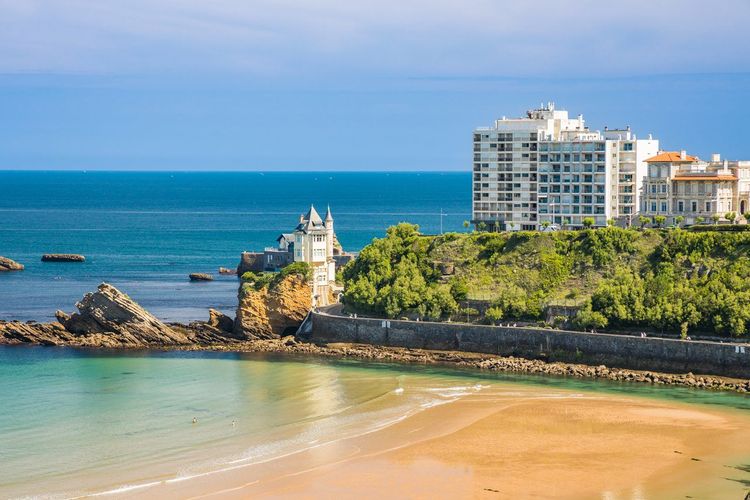
Just 800 metres south of the Grande Plage, the Côte des Basques is another world entirely. No casino, no flowered promenade: a steep cliff covered in vegetation, a switchback path leading down to the sand, and long, perfectly peeling waves rolling over a sand and rock bottom. This is where modern surfing arrived in France. In September 1956, during the filming of the movie "The Sun Also Rises", American writer Peter Viertel came down to this beach with a board brought from California and attempted one of the very first surf sessions ever practised on the French coastline.
The Côte des Basques stretches for approximately 1.3 kilometres of fine sand bordered to the west by rocks that create several distinct peaks: the central peak, the left peak, and the cliff peak, each with its own behaviour depending on the direction and size of the swell. The best sessions occur on an incoming tide, two to three hours before high water, when the wave gains in length and power. Outside the bathing season, locals reclaim the spot and share it with a few walkers who descend from the clifftop path.
The cliff itself deserves attention: eroding at an estimated rate of 30 centimetres per year, it has been subject to a geotechnical stabilisation programme since the 2000s. Protective netting has been installed in sections to prevent rockfalls, which explains why certain areas of the beach are sometimes marked as dangerous after heavy rain. This does not prevent the Côte des Basques from being the most popular surf spot in the French Basque Country, and one of the most accessible for beginners in small swell. To go further, our Ryo guide to the best surf spots in Biarritz details the conditions at each peak by season.
3. The Grande Plage of Saint-Jean-de-Luz
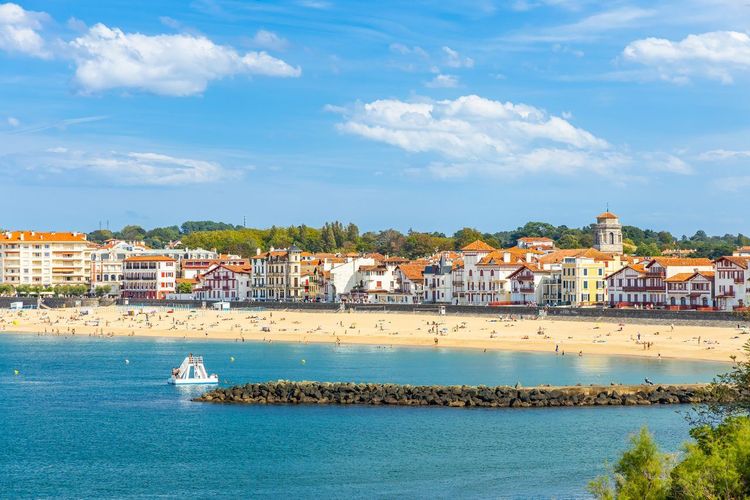
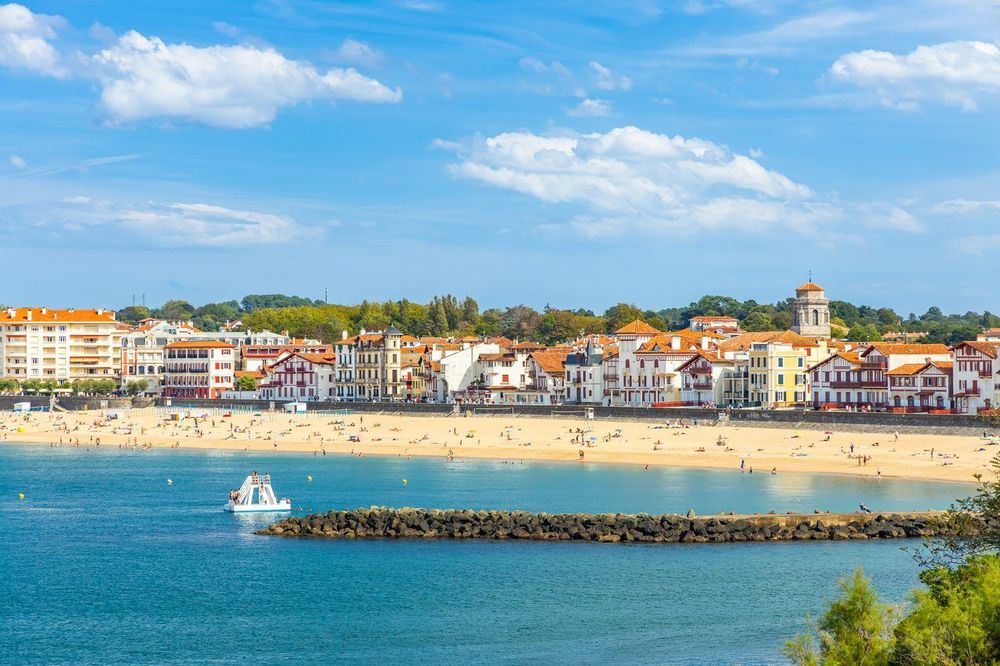
The bay of Saint-Jean-de-Luz is one of the few naturally sheltered bays on the Basque coastline. Two breakwaters built in the 17th century — the Sainte-Barbe dyke and the Crêtes dyke — tamed the bay's entrance to give the local fishing fleet calm waters. The direct result: the Grande Plage of Saint-Jean-de-Luz (Place Maurice Ravel, 64500 Saint-Jean-de-Luz, rated 4.6/5 on Google from 1,057 reviews) is the quintessential family beach of the French Basque Country, with waves that almost never exceed one metre even in bad weather.
The beach measures 1.5 kilometres long with a maximum width of 120 metres at low tide. The sandy bottom shelves gradually with no sudden drop-offs or hollows, making it a safe swimming spot for children aged four or five and above. The water reaches 22 to 24 °C in July and August — noticeably more inviting than the Normandy coast, though the Atlantic remains cooler than the Mediterranean.
On the town side, the seafront promenade is lined with shops selling Basque specialities, ice-cream parlours, and restaurants serving the traditional ttoro: a fish and shellfish soup that rivals bouillabaisse for the richness of its broth. Don't leave without ordering a bowl. It is one of those culinary specialities that alone justifies spending a few days in Saint-Jean-de-Luz rather than simply driving through.
4. The Erretegia Beach (Bidart)
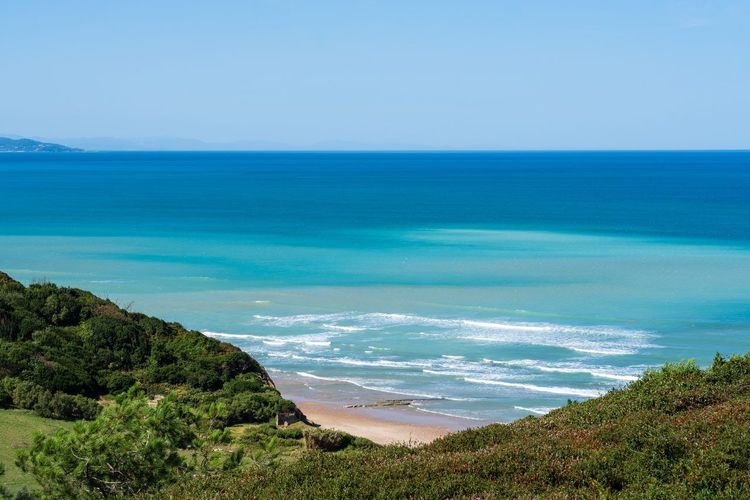
Bidart is a village halfway between Biarritz and Saint-Jean-de-Luz, and it is home to some of the wildest beaches in the French Basque Country. The Erretegia beach is the most spectacular example: a narrow cove enclosed by red sandstone cliffs, accessible from the village via a ten-minute footpath. At high tide, the beach shrinks to a thin strip of sand; at low tide, it widens to reveal seaweed-covered rocks and natural rock pools teeming with sea urchins and anemones.
Erretegia's popularity owes as much to its photogenic quality as to the quality of its surf. The red cliffs reflect the light in the late afternoon, creating ochre and brick hues that make every photograph look almost unreal. The beach's north-north-west orientation allows it to capture Atlantic swells without filtering them entirely: the waves are consistent, suitable for competent surfers without being out of reach for intermediates. Crowd levels remain manageable compared to Biarritz, partly because the walk down discourages comfort seekers, and partly because there is no car park directly adjacent to the beach.
Practical tip: come by bicycle from Biarritz via the Basque Coast cycle path, which runs along the coastline for about twenty kilometres. You will avoid the July-August traffic jams and enjoy the views from the heights before descending to Erretegia.
5. The Socoa Beach (Ciboure)
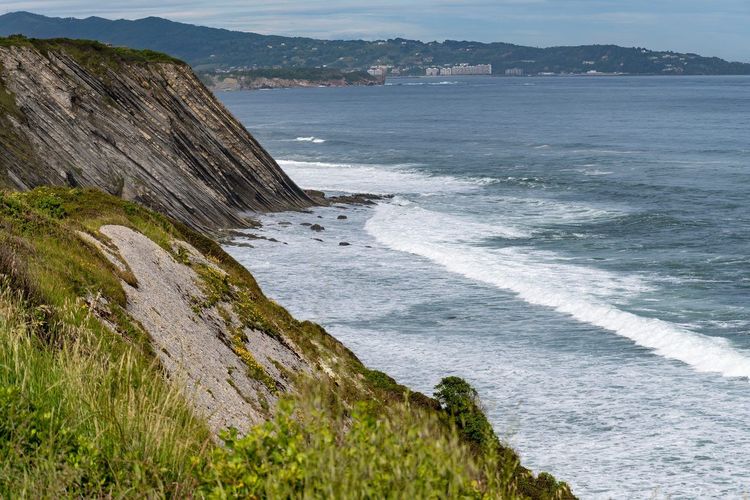
At the entrance to the bay of Saint-Jean-de-Luz, on the Ciboure side, the beach of Socoa derives its character from a military structure. The Fort de Socoa, built in the 17th century on the orders of Richelieu and later reinforced by Vauban, dominates the beach from a rocky promontory. The red fort of Socoa towers over colourful fishing boats against a backdrop of white sand — a visual composition that resembles a Basque watercolour more than an ordinary seaside beach.
The beach measures approximately 400 metres long and is regularly clean and well equipped in high season. Guided tours of the fort are organised by the Saint-Jean-de-Luz tourist office during the summer months. Snorkelling in the rocky crevices around the fort is excellent when the swell is low, with generally clear water and rich marine life on the seabed. The Socoa neighbourhood behind the beach is lined with typically Basque half-timbered houses and a handful of fish restaurants where fishing families have been lunching for generations — an atmosphere that the larger seaside resorts on the coast have generally lost.
6. The Grande Plage of Hendaye
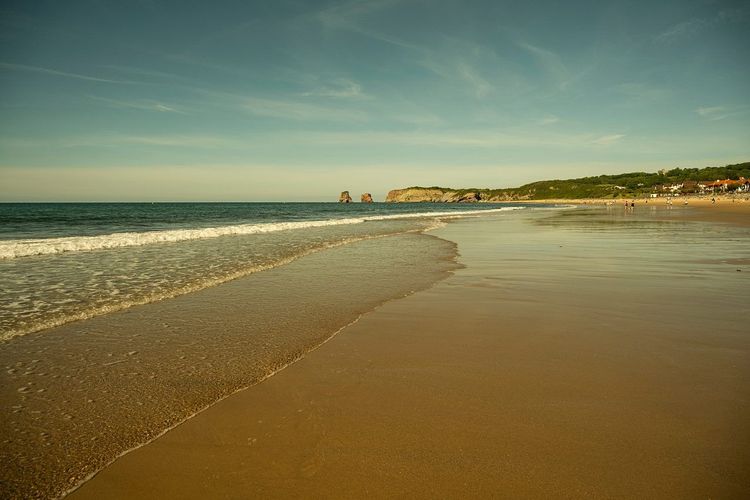
The Grande Plage of Hendaye (Boulevard de la Mer, 64700 Hendaye, rated 4.7/5 on Google from 1,784 reviews) is the largest sandy beach in the entire French Basque Country: 3.5 kilometres of fine sand in a near-perfect half-moon bay that also forms the natural border with Spain. The Bidassoa, the river marking the boundary between the two countries, flows into the sea at the southern end of the beach, and in clear weather you can distinctly make out Hondarribia on the other side, its colourful medieval ramparts rising straight from the water just a few hundred metres away.
Hendaye is the preferred seaside destination for families with young children: the water is shallow over a wide stretch of shoreline, the waves are less powerful than at Biarritz thanks to the bay's configuration, and the seafront promenade is entirely pedestrian and cycle-friendly. Supervised swimming signage covers a central zone several hundred metres wide, separated from the surf and kiteboard zones located at the northern and southern ends of the beach.
Above the coastline, Château Abbadia is worth a stop. A neo-Gothic 19th-century edifice built by explorer and linguist Antoine d'Abbadie, it commands the Basque corniche from an unassailable position. The view from its cliffs over the Spanish coast and the Hendaye beaches below is one of the widest on the entire Basque coastline. And for culture lovers, Bilbao and its world-renowned museums are approximately 125 kilometres away — just over an hour's drive — making for a perfect day trip from Hendaye to alternate between beach and museums.
7. The Cénitz Beach (Guéthary)
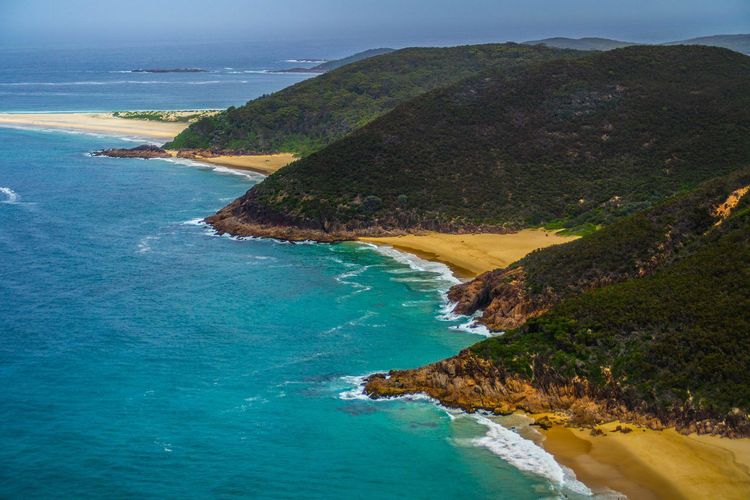
Guéthary is listed among the most beautiful villages in France, and the Cénitz beach is its most discreet jewel. Accessible only on foot from the village via a steep 15-minute path, it has no car park, no restaurant, no lifeguard post — and that is precisely what has earned it the devotion of those in the know. At low tide, Cénitz reveals a succession of limestone rocks polished by the waves, forming natural pools of remarkable clarity.
Cénitz is also one of the most serious surf spots on the coastline. During the powerful autumn swells, a deep and powerful wave breaks over an unforgiving rocky bottom — territory reserved for experienced surfers who know the seabed. The same swell that deters beginners produces perfect barrels for those who know the spot. Out of the water, the view from the descent path over the bay and the verdant cliffs gives the impression of being somewhere between Brittany and Wales, far from the overcrowded seaside resorts of the main coast.
8. The Sables d'Or Beach (Anglet)
Anglet is often dismissed as a dormitory town between Bayonne and Biarritz, but its 11 kilometres of consecutive beaches make it one of the most generous seafronts on the Atlantic coast. The Sables d'Or beach (Boulevard des Plages, 64600 Anglet, rated 4.6/5 on Google from 272 reviews), along with La Madrague, Le Club, Les Cavaliers and Azurki, form an almost continuous sequence of golden sand separated by jetties and wooden groynes. This entire stretch is backed by a pine forest that descends to the first dunes and fills the air with a characteristic resin scent in high summer.
The Sables d'Or beach is the busiest in Anglet, the closest to Biarritz (barely 2 kilometres along the seafront), and one of the best for intermediate surfers. The sandy breaks produce consistent waves with few rocks at high tide, and lateral currents remain manageable most of the time. Lifeguard supervision runs from June to mid-September.
For non-surfers, the Anglet beaches offer a coastal cycle path that extends northward to the mouth of the Adour. Before or after the beach, a walking visit to Bayonne is a must: the Ryo audio-guided tour of Bayonne lets you explore the medieval streets of Grand Bayonne and Petit Bayonne in 1 hour 20 minutes, with 22 audio episodes tracing the city's origins back to Gallo-Roman times.
9. The Lafitenia Beach (Saint-Jean-de-Luz)
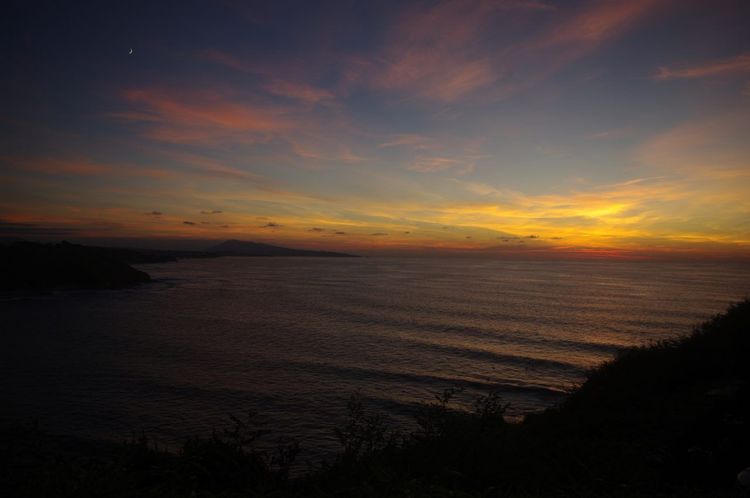
North of Saint-Jean-de-Luz, halfway between the town and Bidart, the Lafitenia beach is known to virtually every surfer who has ever opened a French surf magazine. This is where one of the longest waves in the Basque Country breaks: in a good north-west swell, the right-hander at Lafitenia offers rides of 150 to 200 metres over a shallow rocky bottom. The beach is not among the most beautiful in a purely aesthetic sense, but its energy — wetsuits lined up in the water at dawn, dolphins occasionally passing in the background — makes it captivating even for spectators on dry land.
Outside surf sessions, the Lafitenia beach (Route d'Erretegia, 64500 Saint-Jean-de-Luz, rated 4.5/5 on Google from 261 reviews) remains pleasant for a swim in calm conditions. The rocky layout creates relatively sheltered areas at low tide, and the view of the Bidart cliffs to the north is superb in the late afternoon. Avoid swimming across the zones occupied by surfers during swell periods — boards represent a real hazard that bathing flags do not always signal clearly enough. Back in Biarritz, our audio-guided tour follows the same coastline from the streets just above it.
10. The Ilbarritz Beach (Bidart)
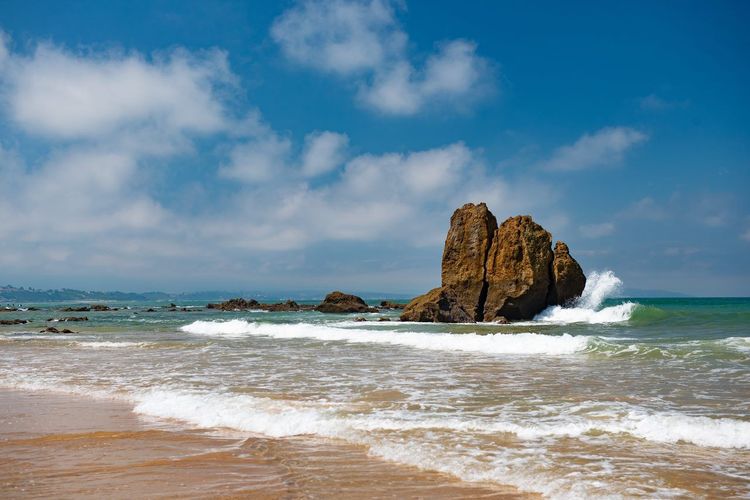
The Ilbarritz beach stretches between Bidart and Biarritz, in the sector where the coast begins to change character: less urban than Biarritz, not yet as wild as Erretegia. Its most distinctive feature is a coastal lagoon, the Étang d'Ilbarritz, which runs along the northern edge of the beach and constitutes a listed natural habitat sheltering egrets, herons, and numerous species of wild duck. The beach itself, approximately 500 metres long, has fine sand that is regularly clean.
Lifeguard supervision is provided in summer, and the surf spot, facing due west, receives good-quality waves during moderate swells. The presence of the lagoon makes Ilbarritz an interesting destination for nature lovers: a combined swimming and birdwatching outing is perfectly feasible with a pair of binoculars.
11. The Parlementia Beach
Parlementia, at Guéthary, is world-famous in big-wave surfing circles. When a powerful north-west swell breaks over the rocky bottom of this beach, the waves can reach 8 to 10 metres face height — an exceptionally rare configuration in France. Big-wave surf competitions have been held here during exceptional conditions, and the spot has built an international reputation among giant wave hunters.
Outside big-swell days, Parlementia is a rocky beach poorly suited to swimming, but superb to observe from the heights above. The clifftop path offers one of the most dramatic panoramas on the entire Basque coastline, with an unobstructed view from Biarritz in the north to the Spanish coast in the south.
12. The Deux Jumeaux Beach (Hendaye)
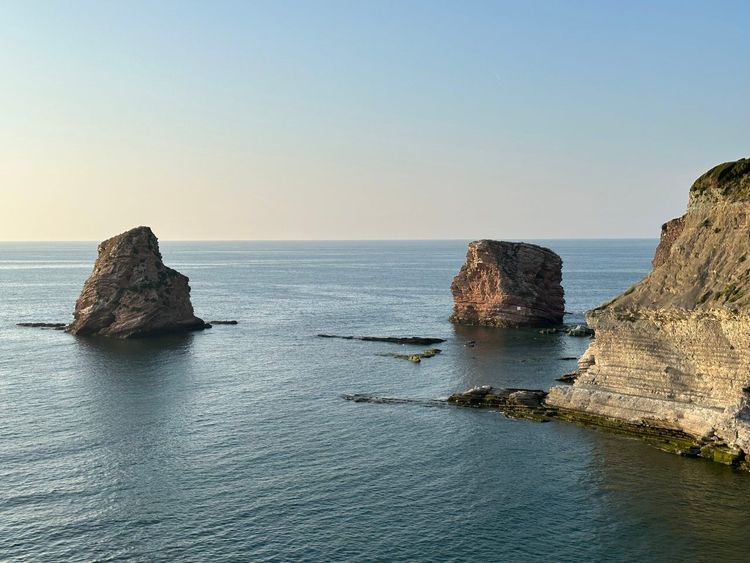
At the southern end of the Grande Plage of Hendaye, just before the Spanish border, the Deux Jumeaux beach (Avenue des Deux Jumeaux, 64700 Hendaye, rated 4.7/5 on Google from 36 reviews) takes its name from two twin rocks that emerge from the sand at low tide. Less exposed than the rest of the Hendaye coastline, it offers calm waters and active lifeguard supervision in July and August — an ideal alternative for families who find the main Grande Plage too busy.
The Hendaye municipal campsite borders it directly to the north, making it a convenient option for motorhome or tent stays. The view of the Spanish coast and the Cabo Higuer lighthouse, just a few kilometres across the Bidassoa, is particularly clear in fine weather.
13. The Port Beach of Guéthary
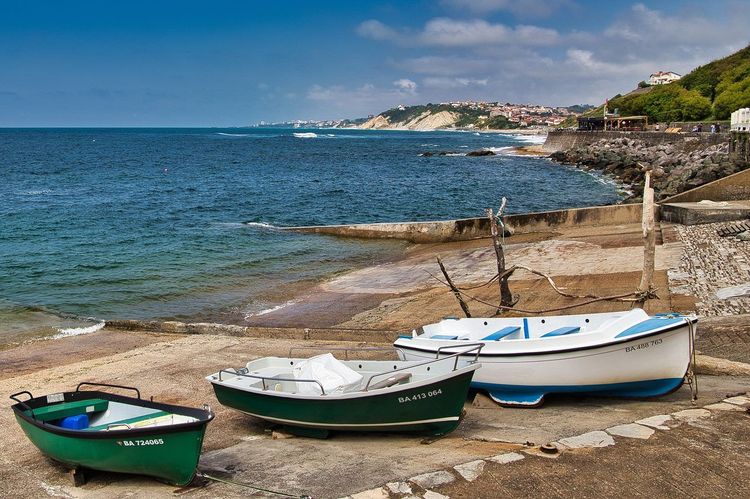
The port of Guéthary (Guéthary, 64210 Guéthary, rated 4.5/5 on Google from 142 reviews) is the smallest fishing harbour in the Basque Country, and the beach surrounding it recreates on a small scale that end-of-the-world atmosphere. A concrete jetty marks the boundary of the fishing boat mooring area; behind it, a strip of pebbles and sand coexists with rocks that have served as natural diving platforms for the village children for generations.
This is not a beach for building sandcastles. It is rather a place to watch the boats come back to port in the late afternoon, have a drink on the terrace of the neighbouring restaurant, and appreciate what sets Basque seaside tourism apart from its more developed neighbours. Guéthary is listed among the most beautiful villages in France, and the Port beach is one of its most understated reasons.
14. The Port Vieux Beach (Biarritz)
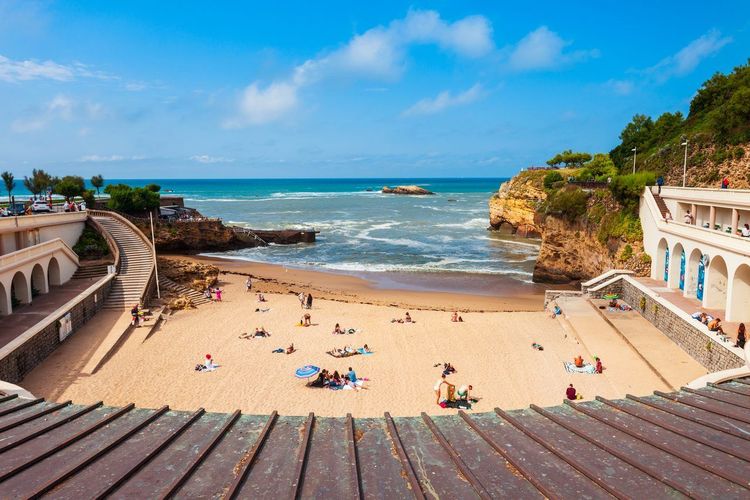
The Port Vieux beach (Rue du Port Vieux, 64200 Biarritz, rated 4.6/5 on Google from 330 reviews) is Biarritz's secret hideaway. Tucked between the rocks of the Vierge promontory and the cliff of old Biarritz, it measures only 300 metres long and almost completely disappears at high tide. Its east-facing orientation and natural shelter confer two rare advantages on the Atlantic coast: an almost wave-free sea and exceptional morning sunshine.
This is the historic beach of Biarritz, the one that bathers frequented before the Grande Plage was developed in the 19th century. It retains its character as a sheltered lagoon — precious for families or anyone who wants to swim without battling the Atlantic. The descent via the stone staircase carved into the cliff face is itself a moment of architectural discovery.
15. The Uhabia Beach (Bidart)
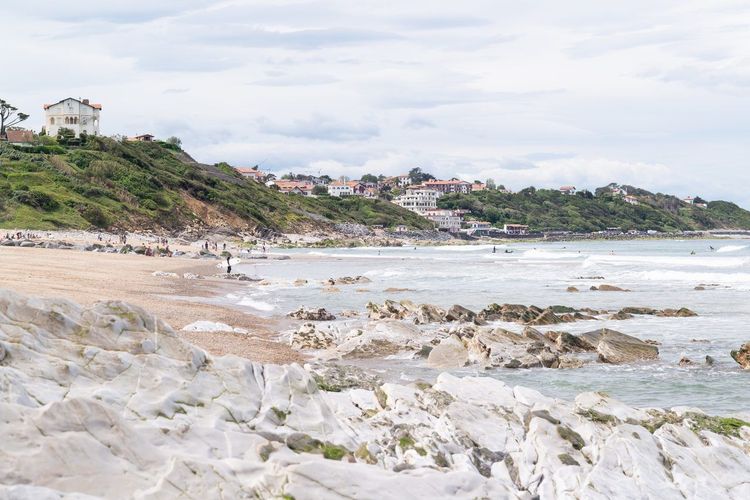
South of the village of Bidart, the Uhabia beach lies in a coastal meander formed by the stream of the same name, which flows through a small valley before emptying into the Atlantic. This geographical configuration creates a beach modest in size but strong in character: sunsets facing the ocean, green cliffs on either side, and a versatile surf spot that works at all tidal states when the swell is consistent.
The mouth of the Uhabia stream at low tide sometimes forms a small shallow lagoon suitable for young children. Like all exposed beaches at Bidart, lifeguard supervision is not guaranteed outside high season. Outside July and August, Uhabia reverts to a wild character and draws mainly surfers and photographers in search of raking light on the red cliffs of the coastline. To plan a full stay in the region, the Ryo guide What to Do in the Basque Country lists the best activities beyond the beaches.
FAQ
Which is the most beautiful beach in the Basque Country?
The Grande Plage of Biarritz is the most famous, but the answer depends on your criteria. For historical grandeur and summer buzz, choose Biarritz. For tranquillity and family swimming, Saint-Jean-de-Luz. For an unspoilt natural setting, the Cénitz beach at Guéthary or Erretegia at Bidart offer red-cliff scenery that is hard to match.
Which Basque Country beach is best suited for families with young children?
The Grande Plage of Saint-Jean-de-Luz is the benchmark: the bay is sheltered by two breakwaters built in the 17th century, the waves remain small year-round, the water is shallow over a wide stretch of shoreline, and lifeguard supervision is reinforced in summer. The Deux Jumeaux beach at Hendaye and the Port Vieux beach at Biarritz are excellent alternatives for calm swimming.
What is the best time to visit the beaches of the Basque Country?
From mid-June to mid-September to benefit from lifeguard supervision and a lively atmosphere. July and August offer the warmest waters (22–24 °C) but the beaches are crowded. September is often the ideal month: the sea remains warm, the first autumn swells arrive for surfers, and the summer crowds gradually disperse. Out of season, the atmosphere is that of a wild, wind-swept coastline.
Are the Basque Country beaches suitable for beginner surfers?
Several beaches are particularly welcoming for beginners: the Côte des Basques at Biarritz in small surf, the Sables d'Or at Anglet, and the Grande Plage at Hendaye. By contrast, Parlementia and Cénitz at Guéthary, as well as Lafitenia in heavy swell, are reserved for experienced surfers. Many surf schools offer group lessons at the Côte des Basques and the Anglet beaches from June to September.
Are there beautiful beaches on the Spanish Basque Country side?
Absolutely. Hondarribia, just across the Bidassoa from Hendaye, has a beautiful sandy beach facing the Cantabrian Sea, backed by a remarkably well-preserved medieval centre. Zarautz, 30 kilometres to the east, is one of the most popular seaside resorts on the Spanish Basque coast. To explore the culture of the Spanish Basque Country, the Ryo audio guide for Bilbao features 21 episodes recounting the spectacular transformation of the former industrial capital, less than an hour from the Spanish Basque beaches.
The Basque coastline often defies expectations. You come for the waves and stay for the atmosphere — that singularly Basque way of blending the ruggedness of the Atlantic, the gentleness of half-timbered villages, and a gastronomy that tolerates no mediocrity. Whether you are a surfer, a swimmer, a photographer, or simply looking for a place to watch the horizon from a grassy knoll, these shores always find a beach to match your mood. To extend the experience through cultural discovery, the audio walking tour of Biarritz — 17 episodes over 4.5 kilometres along the seafront — is the best way to add historical depth to what would otherwise be just a lovely walk in the sun.
À lire également