© Shutterstock
 Votre guide Ryo
Cool Neighborhoods in Marseille to Explore in 2026
"Cool neighborhood Marseille" - that's probably what you typed before landing here, looking for a spot to drop your bags or wander around one afternoon without a program. The Phocaean city is unlike any other French city. Not because it's Mediterranean, nor because it's noisy and luminous, but because each of its neighborhoods seems to belong to a world apart. Le Panier unfolds narrow streets of murals just steps from the ancient port founded 2,600 years ago. Cours Julien brings together dozens of terraces each evening between giant frescoes that change with the seasons. Prepare your visit with the Ryo audio guide tour of Marseille, which covers 24 points of interest over 7.3 km in about 3 hours.
This guide reviews the city's most appealing neighborhoods, from the most historic to the most contemporary. Whether you're looking for a cool neighborhood in Marseille for a weekend, a seaside neighborhood or a hip spot to have a drink, you'll find here what you need to compose your itinerary. You'll come across Vallon des Auffes, this tiny fishing port wedged under a viaduct, painted boats pressed against each other like on a postcard. You'll discover Noailles, the permanent market that smells of cumin and orange blossom, as well as la Joliette converted into a contemporary architecture district. And you'll understand why Notre-Dame-du-Mont has become, in ten years, one of the addresses most sought after by Marseillais themselves.
Le Panier, the Oldest Neighborhood in Marseille
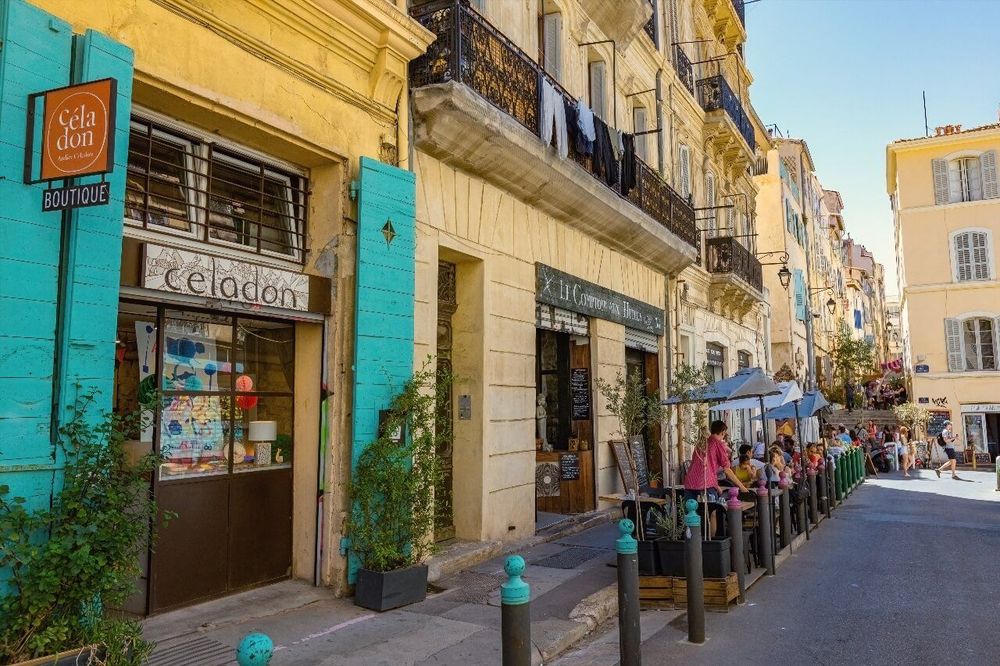
This is where it all began. The Le Panier district occupies the hill north of the Vieux-Port, where the Phocaean Greeks laid the first stones of Massalia around 600 BC. Its narrow streets climb and descend without apparent logic, facades crumble elegantly, and residents' voices mingle with the rustling of sheets drying at windows. Le Panier is both the oldest and one of the most lively districts in the city.
The Place des Moulins is its geographical and symbolic summit. From there, the view over the rooftops and the blue of the Mediterranean is striking. Going down towards the port, you'll encounter the Vieille Charité, a former 17th-century hospice converted into a cultural center and museums. Its baroque architecture, three levels of galleries around a central chapel topped with an elliptical dome, makes it one of Marseille's most remarkable buildings.
Le Panier is also a playground for artists. Murals adorn many walls, some commissioned by the City, others arising from artists' spontaneous initiative. Rue du Refuge and Rue Fontaine-de-Caylus concentrate some of the finest achievements. Take time to look up: details on shutters, planters overflowing with geraniums and cats sleeping on doorsteps form countless living tableaux.
When to visit Le Panier? The morning, before 10am, still belongs to the residents. Tourists gradually arrive after. In the evening, in summer, some streets come alive with passing musicians. Avoid the central hours of weekends in July-August if you're looking for neighborhood atmosphere rather than crowds. For many visitors, Le Panier remains the coolest neighborhood in Marseille, the one to start with.
The Vieux-Port, the Beating Heart of the City
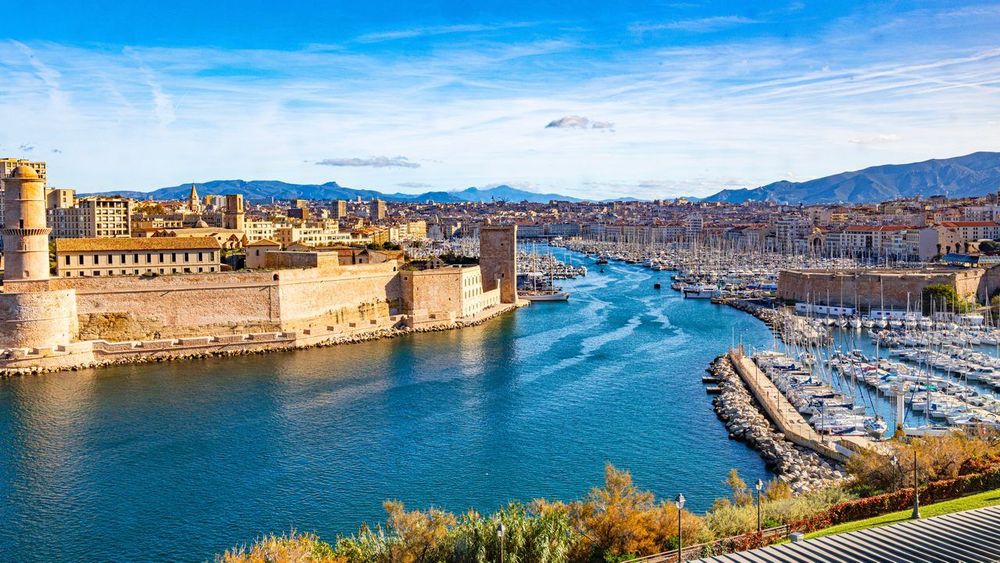
Nothing discreet happens on the Vieux-Port. In the morning, fishermen unpack their goods on the Rive-Neuve quay before 8am: sea bream, rascasse, john dory, everything needed for a bouillabaisse. In the afternoon, cafés spill onto the sidewalks. In the evening, the silhouettes of Fort Saint-Jean and the MuCEM are outlined in the sunset from the Port quay.
The MuCEM, Museum of Civilizations of Europe and the Mediterranean, deserves a dedicated article. Its honeycomb concrete facade, placed on the water like a contemporary fortress, has become the architectural image of 21st-century Marseille. Its footbridge directly connects Fort Saint-Jean, a 17th-century fortress whose hanging gardens offer a 360° view of the port and the sea. To prepare your visit in detail, consult our article about the MuCEM.
To gain height, the Cathédrale La Major (Place de la Major, 13002 Marseille, rated 4.7/5 on Google for 19,689 reviews), nearby, is one of the largest cathedrals in France. Built between 1852 and 1893, it culminates at 70 meters under its domes. The interior is majestic, entrance is free, and crowded hours remain reasonable outside Sunday services.
The Vieux-Port is a good base, provided you know how to leave it. Avoid the Canebière shopping side: prefer going up to the quai des Belges to witness departures of shuttles to the Frioul islands or to Château d'If. To learn everything about this emblematic excursion, our Château d'If guide lists practical information and crossing schedules.
Cours Julien, the Bohemian and Street Art District
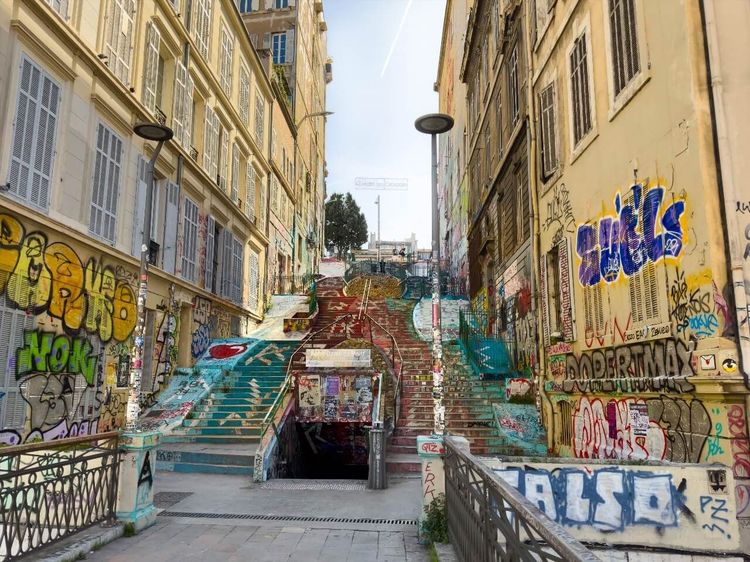
If Le Panier is the historic district, Cours Julien is undoubtedly the liveliest neighborhood in Marseille for an evening or creative afternoon. Here, in the 6th arrondissement, second-hand bookstores neighbor concert halls, vegetarian cafés share sidewalks with neighborhood groceries, and murals tell stories on several floors of facade. It's Marseille's boho district par excellence, the haunt of urban art lovers.
Cours Julien itself, a long paved esplanade surrounded by plane trees, regularly hosts creative markets, free concerts and street festivals. The organic market on Wednesday and Saturday mornings attracts both neighborhood residents and curious passersby: local products, herbs from Provence, goat cheeses, seasonal vegetables. Arrive between 8am and 10am to choose before the best pieces disappear.
Rue des Trois-Mages and Rue Vian concentrate most art galleries and independent shops. This is where you'll find local ceramicists, renowned tattoo studios and record stores that have survived everything. The atmosphere changes according to the hour: studious in the morning, relaxed at noon on terraces, lively in the evening when bars open their doors. The Marseille audio-guided tour passes through this area and integrates several artistic points of interest from the neighborhood into its 25 audio guides.
Street art is everywhere, impossible to miss. Local and international artists have transformed blind walls into open-air galleries. One of the most impressive frescoes represents a Mediterranean world map over several dozen square meters. No need for a map or app to explore: let yourself be guided by what you see around each street corner.
Notre-Dame-du-Mont, the Bobo Soul of the 6th Arrondissement
The 6th arrondissement of Marseille was long the discreet residential district of Marseillais bourgeois families. Then Notre-Dame-du-Mont, or more precisely the eponymous square and its adjacent streets, became in a few years the hotspot of nightlife and alternative gastronomic scene in the city.
In the evening, the square fills with bistro chairs and tables. Craft beers and glasses of Provence rosé circulate between conversations. The atmosphere is resolutely local: many young working Marseillais, students from nearby universities, artists and some tourists who had the good reflex to leave classic itineraries. Rue Francis-de-Pressensé concentrates about ten bars and small restaurants that regularly change their menu according to season.
For eating, look for tables offering market cuisine, menus change twice a week, rather than restaurants with tourist storefronts. The proximity of Cours Julien market guarantees fresh products. Arrive at 8:30pm for a table without reservation on weekdays; on weekends, better to anticipate by at least one day.
The Notre-Dame-du-Mont church itself is worth a look: built in the 19th century, its neo-gothic facade contrasts with the popular animation that reigns on the square in front of it. A typically Marseillais coexistence, without staging and without apparent effort.
La Plaine (Place Jean-Jaurès), Authentic Neighborhood Life
Place Jean-Jaurès (Place Jean-Jaurès, 13005 Marseille, rated 4.4/5 on Google for 5,600 reviews), which everyone calls "la Plaine," is the popular square par excellence. Vast, lively, a bit disorderly, it sums up the spirit of Marseille: pétanque players under plane trees, packed terraces at all hours, a market that occupies the entire square on Tuesday, Thursday and Saturday.
The market at la Plaine is one of the city's largest open-air markets. Seasonal fruits and vegetables, spices from around the world, African fabrics, second-hand books and improvised flea market mix on the stalls. You hear several languages spoken, prices are negotiated good-humoredly, retirees and high school students cross paths in the same aisle. It's noisy, lively, and perfectly representative of the cultural melting pot that makes Marseille's richness.
Beyond the market, the streets that branch off from la Plaine shelter world cuisine restaurants at very reasonable prices. Lebanese, Senegalese, Comorian: la Plaine is a gastronomic world tour within sidewalk reach. Rue Consolat and Rue d'Aubagne are the two densest axes in addresses to try.
Noailles, the Belly of Marseille
Noailles is called the "belly of Marseille," and it's not too generous a compliment. This district of the 1st arrondissement, around Rue Longue-des-Capucins, is the heart of the city's popular commerce. Spices, legumes, oriental pastries, medicinal plants, dried fish: everything Mediterranean cuisine demands is found here, often in bulk and at unbeatable prices.
Noailles is animated from dawn until nightfall, seven days a week. Vendors call out to passersby with accents from the Maghreb, Turkey, Somalia. The scents of cumin, ras el-hanout and orange blossom form a unique atmosphere. For quick meals, caterers offer bricks, samosas and pastillas for less than two euros. It's one of Marseille's densest and most authentic neighborhoods, and one of the least touristy.
To discover the city's emblematic culinary specialties, our guide to the best Marseillais specialties covers what you absolutely must taste, around Noailles as in other neighborhoods.
Vallon des Auffes, the Southern Postcard
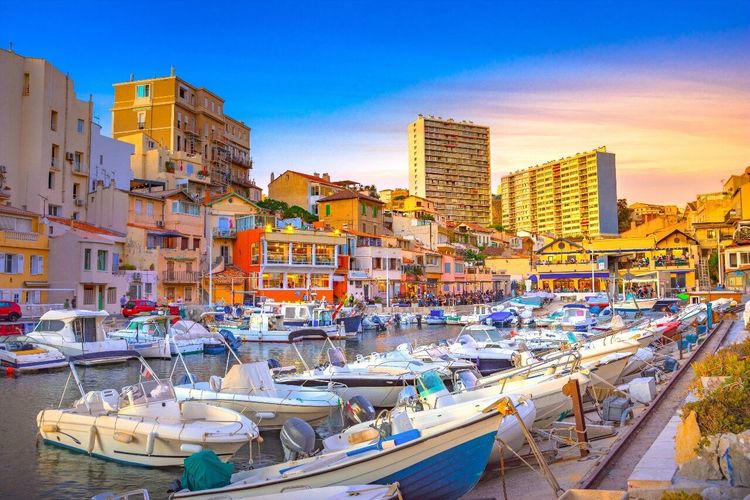
Imagine a tiny fishing port nestled under a highway viaduct, a ten-minute walk from Corniche Kennedy. This is Vallon des Auffes: about twenty colorful boats on a tiny body of water, a few fishermen's huts, two or three restaurants including one among the most sought-after in Marseille for traditional bouillabaisse. If you're looking for the coolest seaside neighborhood in Marseille, the most photogenic, this is probably it.
The place is timeless. The Corniche viaduct passes overhead in a continuous rumble, but in the valley hollow, it doesn't seem to exist. Fishermen still repair their nets in the morning sun, a few sailboats wait in calm water, and neighborhood cats doze on the rocks. In summer, restaurant Chez Fonfon (140 Vallon des Auffes, 13007 Marseille, rated 4.2/5 on Google for 3,652 reviews), founded in 1952, is fully booked weeks in advance for its bouillabaisse. Make a reservation or settle for a stroll and pastis at the counter.
Vallon des Auffes is reached from Corniche Kennedy by going down a small staircase at the level of avenue des Auffes. You can also access it on foot from the Vieux-Port by following the waterfront for about 1.5 km, a pleasant walk in good weather.
L'Estaque, Marseille's Painting Side
L'Estaque is a neighborhood that art history has made famous. Cézanne, Braque, Derain, Dufy: all painted these white houses clinging to the hill, these factory chimneys and this particular light that falls on the gulf. The neighborhood, located northwest of Marseille, maintains an independent village atmosphere with its marina and a few fish restaurants.
Promenade de la Plage runs along the sea for a few hundred meters, restaurant tables overlook the Gulf of Marseille, and the morning light on the water alone justifies the detour. An open-air museum, the Chemin des Peintres, connects the viewpoints chosen by early 20th-century artists. Plaques reproduce paintings painted from these same locations: an original and free way to stroll through art history. L'Estaque (Place de l'Estaque, 13016 Marseille, rated 4.4/5 on Google for 3,800 reviews) is reached in 20 minutes from Saint-Charles station by regional train. Back in the center, our audio walking tour of the Phocean City picks up the story on foot.
La Joliette and Euroméditerranée, the New Marseille
Since the 2000s, the la Joliette district has transformed radically. What was a disused industrial port space has become the symbol of contemporary Marseille: glass office towers, cultural spaces, renovated apartments and public facilities follow one another around the old port warehouses.
The Docks de Marseille, 19th-century warehouses converted into offices and shops, form the district's backbone. Their red brick architecture contrasts nicely with the surrounding new constructions. Tour La Marseillaise (135 meters) and the FRAC (Regional Contemporary Art Fund) complete an urban landscape still under construction. La Joliette will mainly interest contemporary architecture and urbanism enthusiasts.
Les Goudes, Marseille's End of the World
At the southeastern tip of Marseille territory, les Goudes is a hamlet that seems to have forgotten it's part of a metropolis of 900,000 inhabitants. A handful of fishermen's houses, a tiny port, huts clinging to the cliff and the sea as far as the eye can see.
Access is by bus or car from the 8th arrondissement, allow 40 minutes from the Vieux-Port. Once there, swimming in rocky coves, hiking to Cap Croisette or simply lunching on a terrace facing the sea are enough to justify the trip. Les Goudes (Impasse des Goudes, 13008 Marseille, rated 4.7/5 on Google for 6,200 reviews) is also an ideal starting point for exploring the most beautiful calanques of Marseille and Cassis.
Mazargues and the Cité Radieuse
The 8th arrondissement houses one of the major architectural works of the 20th century: Le Corbusier's Cité Radieuse, built between 1947 and 1952. This "housing unit" of 337 apartments over 18 floors was designed as a self-sufficient vertical city, with integrated shops, school and daycare. It has been listed since 2016 as a UNESCO World Heritage site, along with sixteen other Le Corbusier achievements.
The visit doesn't require an entrance ticket for the lobby and common areas. The hotel and restaurant at the top (Le Ventre de l'Architecte) are open to the public and offer a panoramic view of Marseille from the rooftop terrace. If you want to know everything before coming, our article about the Cité Radieuse details practical information and schedules. The surrounding Mazargues neighborhood is calm and residential: a green break 20 minutes from the center.
Les Cinq-Avenues, Residential and Endearing District
The Cinq-Avenues district (4th arrondissement) is one of those places that residents love and tourists haven't discovered yet. It owes its name to the five major arteries that cross it, including boulevard de la Libération and avenue des Chartreux. Around Plateau Longchamp, neighborhood cafés align their terraces under plane trees, artisan bakeries open early and producers' markets animate weekend mornings.
Palais Longchamp (Boulevard du Jardin Zoologique, 13004 Marseille, rated 4.6/5 on Google for 19,977 reviews), a monumental 19th-century water tower surrounded by a park, is its green heart: families, joggers and students gather there as soon as good weather arrives. It's the ideal type of place for those who want an authentic residential experience, far from the crowds of the historic center. The surrounding shopping streets and their local designer boutiques complete the picture. A neighborhood to explore on foot, without a precise program, letting terraces decide your itinerary.
Practical Tips for Exploring Marseille's Neighborhoods
Marseille is a city to explore in several stages, and each neighborhood has its own rhythm. Here are some reference points to organize your visit and find the cool Marseille neighborhood that suits you.
Transportation: the RTM network (metro, tram, bus) covers all central neighborhoods. Metro line 1 connects the Vieux-Port, la Plaine, Notre-Dame-du-Mont in less than 20 minutes. For les Goudes, l'Estaque or the calanques, bus or car are more practical. Vélo'v (bike-sharing) works well for local travel in central arrondissements. A single ticket costs €1.70, a book of 10 tickets €13.40.
The Right Rhythm: Marseille lives later than Paris. Restaurants don't start filling up until 8pm, markets close at 1pm. Plan your museum visits in the morning to avoid groups, and reserve your tables at least the day before for popular addresses.
Weather: Marseille is one of France's sunniest cities, 300 sunny days per year on average. The mistral can blow hard in winter and spring; bring a light jacket even in April. In summer, temperatures regularly exceed 35°C: leave early in the morning for outdoor walks and seek shade in early afternoon.
The Ryo Audio Guide: to explore Le Panier, the Vieux-Port and historic neighborhoods with context and local anecdotes, the Ryo audio guide of Marseille offers 24 audio guides on a 7.3 km route. Whatever cool Marseille neighborhood you choose to explore, it places each street in its historical and cultural context.
FAQ
Which Is the Coolest Neighborhood in Marseille?
The answer depends on the visitor's profile. Le Panier is the favorite for heritage lovers and historic neighborhood atmosphere enthusiasts. Cours Julien attracts bohemian types, street art fans and nightlife lovers. For a more local and less touristy atmosphere, Place Jean-Jaurès (la Plaine) and Noailles are the most authentically Marseillais neighborhoods. If you can only choose one, start with Le Panier in the morning and finish with Notre-Dame-du-Mont in the evening.
Is the Vieux-Port Really Worth Visiting?
Yes, as long as you don't limit yourself to it. The Vieux-Port is a good starting point: fish market in the morning, MuCEM visit, walk to Fort Saint-Jean. But you absolutely must venture into adjacent neighborhoods (Le Panier, Joliette, Noailles) to grasp the true texture of Marseille. The Vieux-Port is the gateway, not the final destination.
How to Get Around Between Marseille Neighborhoods?
For central neighborhoods (Le Panier, Vieux-Port, Noailles, Cours Julien, Notre-Dame-du-Mont, la Plaine), everything is accessible on foot or within 10 minutes by metro from Vieux-Port or Noailles station. Les Goudes and l'Estaque require bus or car. The tram serves la Joliette from the center in less than 15 minutes.
Can You Visit Marseille in a Single Day?
One day allows you to cover the essentials: Le Panier in the morning, Vieux-Port and MuCEM in early afternoon, Cours Julien in late afternoon, Notre-Dame-du-Mont in the evening. Two days open access to les Goudes, l'Estaque and the Cité Radieuse. For the calanques, allow an extra half-day outside the city.
What Are the Best Markets in Marseille?
The fish market at the Vieux-Port (every morning until 1pm) is unmissable. The market at la Plaine (Tuesday, Thursday, Saturday) is the largest neighborhood market. The organic market at Cours Julien (Wednesday and Saturday morning) is the meeting point for local produce lovers. And the Noailles market, which operates every day, is the most colorful and densest.
Is Marseille a Good Weekend Destination?
Excellent. A two-night weekend allows you to cover Marseille's main cool neighborhoods, take a trip to the Frioul islands or Château d'If, and taste local specialties (bouillabaisse, navettes, panisse). The city is well served by TGV from Paris in 3h20 and from Lyon in 1h45.
Marseille doesn't reveal itself at first glance. It's a city that requires you to stop, sit on a terrace, let conversation begin with the locals. Each neighborhood has its own personality, residents, rituals and secrets. From Le Panier to l'Estaque, from Cours Julien to les Goudes, you won't be exploring the same city from one end to the other.
To miss nothing during your visit, download the Marseille audio walking tour on the Ryo app: 25 audio guides, 3 hours of route, anecdotes and history behind every street and monument, enough to transform a simple walk into a real discovery.
À lire également