© Shutterstock
 Votre guide Ryo
The Most Beautiful Villages around Nantes to Discover in Autumn 2026
Nantes is fascinating, but its surroundings hold surprises the city itself cannot offer: medieval alleyways, breathtaking panoramas over the Loire, fishing ports forgotten by the crowds. The most beautiful villages around Nantes concentrate, within an 80 km radius, a diversity of landscapes and characters that you would never suspect from the city centre. Trentemoult, just 6 km to the west, lines its sailors' houses painted lemon yellow and teal along the banks of the Loire. Clisson recreates a French Tuscany with its romantic bridges. Guérande has watched over its salt marshes from its 15th-century ramparts. And Champtoceaux unfolds a natural viewpoint 70 metres above the river, a position that even postcards struggle to do justice. To explore the region even further, the Ryo audio guide to Nantes is an ideal starting point before venturing out to the surrounding villages. In this article, you will find eleven destinations within driving distance, with for each one what is truly worth the detour, and the pitfalls to avoid.
Trentemoult, the Fishing Village with Mediterranean Colours
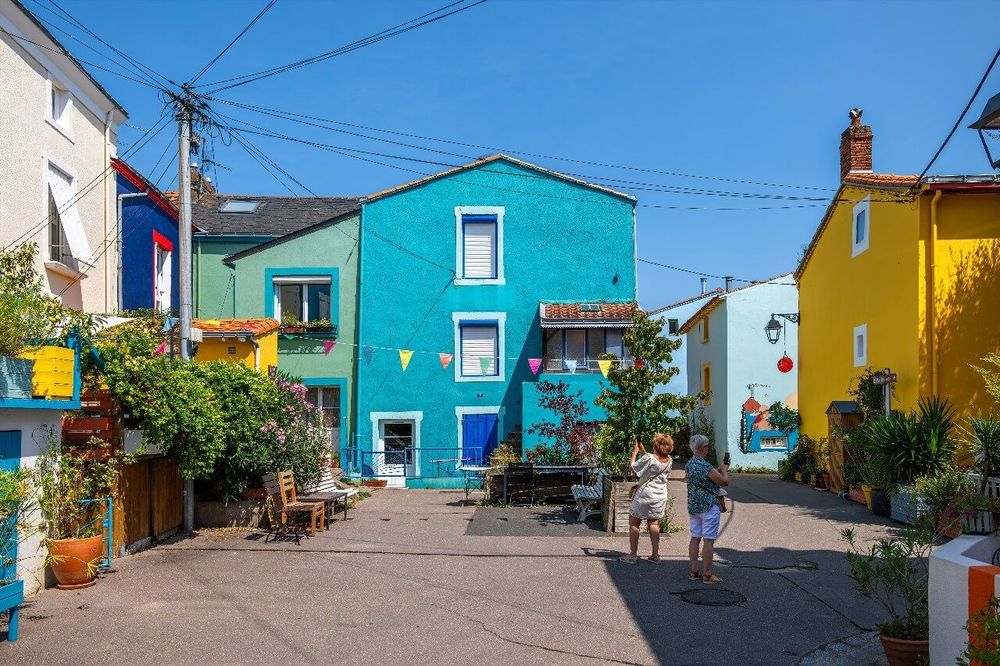
Just 6 km from the centre of Nantes, Trentemoult feels like a secret that the people of Nantes jealously keep to themselves. This mariners' village, nestled within the commune of Rezé, is only accessible from the right bank by a river shuttle that crosses the Loire — and it is precisely this constraint that has preserved it from cars and concrete.
The houses, pressed tightly against one another, display shades you would not expect to find here: burnt ochre, faded turquoise, powdery pink. It was the fishermen who once painted their façades with the leftover paint from boat hulls. The Rue des Mariniers runs along the riverbank for barely 200 metres, lined with restaurant terraces serving moules-frites at the hour when the raking light sets the façades ablaze. Autumn is the best season to visit: the summer tourists have gone, the terraces empty out, and the owners of the colourful houses reclaim their alleyways.
Soak up the village spirit at one of its small waterfront addresses: regulars, Loire wine by the glass, and a direct view over the river. If you extend the day towards the Muscadet vineyards, the Musée du Vignoble Nantais in le Pallet is well worth the detour. To reach Trentemoult without a car, take the Navibus shuttle from the Quai de la Fosse: the crossing takes about ten minutes and costs the price of a bus ticket on weekdays, and is free at weekends.
A dedicated article on Trentemoult on Ryo details the best addresses and the history of the village if you want to plan your visit in more depth.
Clisson, the Vendée Tuscany 25 km from Nantes
Clisson is not only one of the most beautiful towns in the Nantes region: it is an architectural anomaly that few French towns can match. At the end of the 18th century, following the ravages of the Wars of the Vendée, sculptor François-Frédéric Lemot and the Cacault brothers undertook to rebuild the town in an Italianate style, importing Roman tiles, loggias and pergolas to the banks of the Sèvre Nantaise and the Moine.
The Château de Clisson (Place du Minage, 44190 Clisson, rated 4.5/5 on Google with 4,185 reviews) has dominated the confluence of the two rivers since the 12th century. In ruins since the Revolution, it has the intelligence not to try to hide itself: its gutted towers are silhouetted against the autumn sky with an almost dramatic beauty. Admission costs around €4 (free for under-18s), and the upper terrace offers a panorama over the two valleys that alone justifies the trip.
Below, the Domaine de la Garenne Lemot is a landscaped park dotted with neo-classical follies: an Italian villa, antique statues, shaded pergolas. Admission is free and its 13 hectares follow the river through woodland and clearings. Clisson also hosts the Hellfest festival every summer, the second largest festival in France: metal fans know the town better than most tourists, but in autumn it regains its serenity as a Tuscan village lost in Loire-Atlantique.
Allow at least half a day. The Friday morning market is a good reason to start early: local goat's cheese, Muscadet wines, seasonal vegetables. The restaurants on the Place de la Trinité offer lunch menus for under €15 with a view of the bridges.
Oudon, the Medieval Tower at the Mouth of the Loire
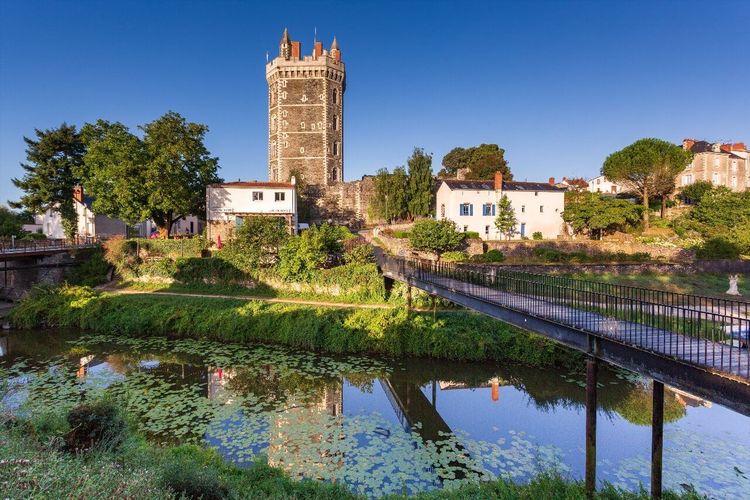
Oudon is a village of 4,500 inhabitants perched 25 km east of Nantes on the right bank of the Loire. Its Tour d'Oudon (Place du Château, 44521 Oudon, rated 4.4/5 on Google with 911 reviews) is one of the finest medieval towers in western France: a 14th-century brown sandstone octagon rising to 24 metres, once used by river boatmen as a landmark on the Loire.
The climb up the steps is steep but rewarding: at the top, the view takes in the Loire for several kilometres, with golden sand islands emerging in autumn as the water level drops. Open from April to October, admission around €3. Beyond the tower, the village retains a partly restored 16th-century château used for temporary exhibitions.
The Port d'Oudon deserves a stop: it is a quiet pleasure harbour with a pontoon restaurant. Autumn is particularly photogenic there, when the poplars along the banks turn yellow and the morning mist lingers over the river. Allow 30 minutes by car from Nantes via the D723, or 25 minutes by TER train from Nantes station.
If you have a passion for the history of the Loire, the Ryo audio guide to the Châteaux de la Loire naturally extends this day trip towards the royal castles of the valley.
Champtoceaux, the Forgotten Viewpoint over the Loire
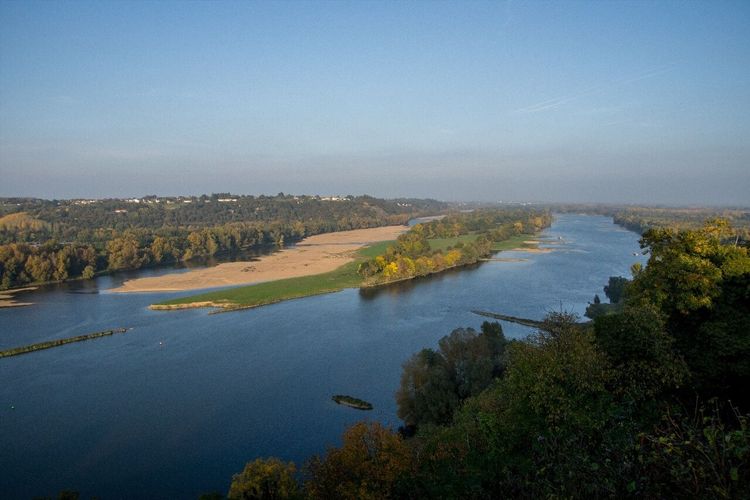
Champtoceaux is a well-kept secret, even among regulars in the Nantes region. This village of 2,000 inhabitants stands 50 km east of the city, overlooking the Loire on the Maine-et-Loire side, and offers from its terraced gardens one of the most spectacular panoramas in the Val de Loire.
The Promenade de Champalud (Champtoceaux, 49270 Champtoceaux, rated 4.7/5 on Google with 675 reviews), a listed site since 1935, runs along the top of the cliff 70 metres above the river. The Loire here is wide, slow, scattered with islands covered in willow groves frequented by kingfishers. In autumn, the spectacle is twofold: the maples and oaks on the banks turn russet, and the late-morning mist rises from the river. It is also one of the rare viewpoints from which you can make out the old Loire levees used by boatmen since the Middle Ages.
The village itself conceals the ruins of the medieval citadel of Champtoceaux, a fortress once larger than Carcassonne, dismantled in 1420 by the Duke of Brittany; only a few sections of wall remain, overgrown with vegetation and freely accessible year-round. A marked trail connects the viewpoint to the port of Varades in 45 minutes of walking along the Loire. Allow half a day to fully enjoy the site without rushing.
Montjean-sur-Loire, the Mining Soul of the Riverbanks
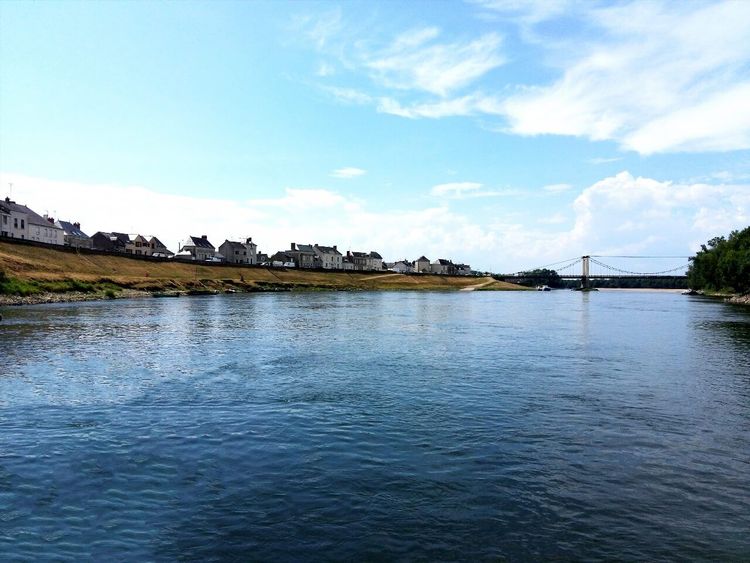
Less well known than Champtoceaux, Montjean-sur-Loire (Maine-et-Loire, 49570 Montjean-sur-Loire, rated 4.3/5 on Google with 420 reviews) is nonetheless one of the most singular villages in the area around Nantes. Built on a hillside along the banks of the Loire, 55 km from Nantes, this village of 3,000 inhabitants owes its character to a mining and maritime history that few of its neighbours share.
The Musée de la Géologie et des Mariniers traces the exploitation of local coal mines and the life of the boatmen who made their way up the Loire loaded with lime and goods until the 19th century. The main street slopes gently down to the Port de Montjean, a restored landing stage with a fine view over the Loire and the hillsides on the opposite bank.
Autumn makes Montjean-sur-Loire particularly endearing: the vines on the hillsides turn red and orange, the café terraces empty out, and the village regains its usual rhythm as a Loire riverside town. Local gastronomy revolves around beurre blanc nantais and river fish; the Loire fry-up remains a speciality still found in the few inns of the village.
Saint-Florent-le-Vieil, the Cliff of the Wars of the Vendée
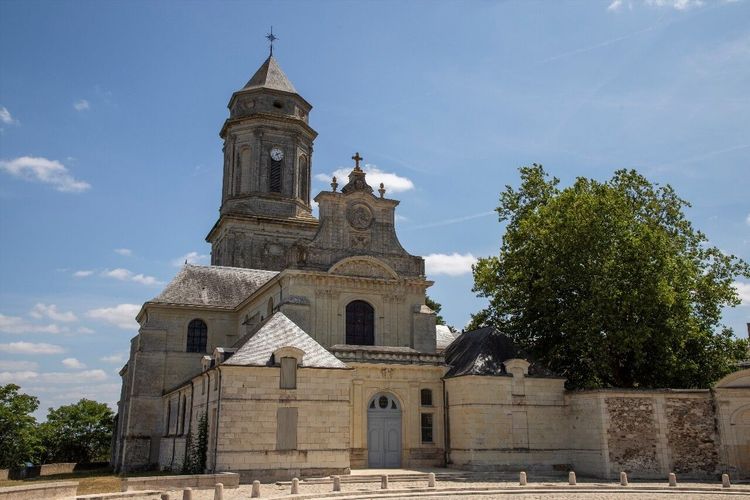
Saint-Florent-le-Vieil is one of the villages in the Nantes region that leaves the strongest impression. Listed as a Petite Cité de Caractère, this village of 2,600 inhabitants clings to a cliff above the Loire, 60 km east of Nantes. Its history is dense and dramatic: it was here that tens of thousands of Vendéens in flight crossed the Loire on 18 October 1793, the day after the defeat at Cholet, marking the beginning of the Virée de Galerne, an episode that profoundly shaped the identity of the entire region.
The Abbaye Saint-Florent dominates the village. It houses the mausoleum of Vendée leader Bonchamps, sculpted by David d'Angers in 1825, and offers from its forecourt a view over the meanders of the Loire that appears on hundreds of postcards of the region. It was on his deathbed, at Saint-Florent, that Bonchamps pardoned the thousands of Republican prisoners held in the abbey, among them the father of sculptor David d'Angers. The adjoining municipal museum traces the War of the Vendée with collections of paintings and period documents.
Beyond its history, Saint-Florent-le-Vieil is an excellent base. A 12 km stretch connects Saint-Florent to Ingrandes along the Loire levees, with permanent views over the river. The nearby Anjou vineyard cellars offer tastings of regional wines at very reasonable prices.
Guérande, the Ramparts and the Salt Marshes
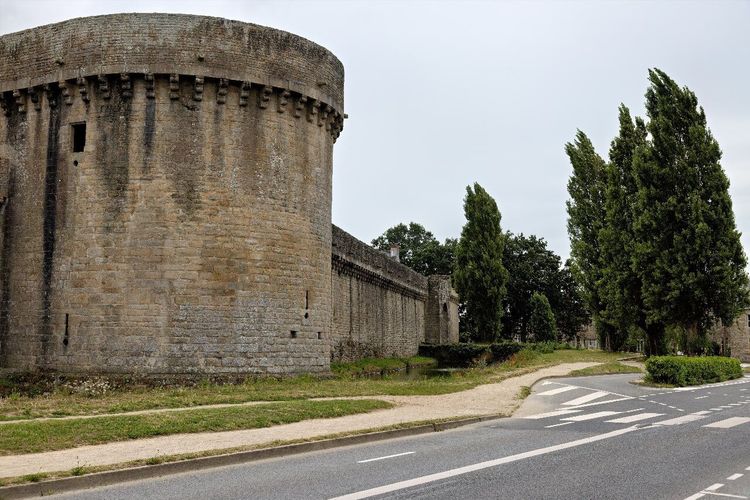
Guérande is in a category of its own among the towns around Nantes. Not technically a village: the town has more than 16,000 inhabitants. But its intact medieval ramparts, its grey granite streets and its salt marshes stretching as far as the eye can see make it a destination that no selection of the region can do without. At 75 km from Nantes, it is the furthest away on this list.
The Remparts de Guérande (Place du Marché au Bois, 44350 Guérande, rated 4.6/5 on Google with 2,634 reviews) stretch nearly 1,300 metres of curtain walls punctuated by towers, virtually intact since the 15th century: it is the most complete medieval urban enclosure in Brittany. Four gates give access to the walled town, including the Porte Saint-Michel, a former gatehouse lodge built around 1450, which today houses the museum dedicated to the history of the city and its salt. Walking the ramparts is free; allow around €4 for the museum.
The Salt Marshes of Guérande extend over some 2,000 hectares between the town and La Baule. In autumn, after the harvest, the basins take on shades of pink and mauve that the waterfowl, present in large numbers on the site, seem to appreciate as much as photographers do. Guided tours of the marshes are organised by local salt harvesters from April to September; outside the season, the discovery trails remain freely accessible. Guérande salt, in particular the hand-harvested fleur de sel, is available directly from producers at prices lower than those in shops. On the city side, Nantes unfolds over 6.4 km of commentary, should you extend the weekend.
Piriac-sur-Mer, the Hidden Peninsula
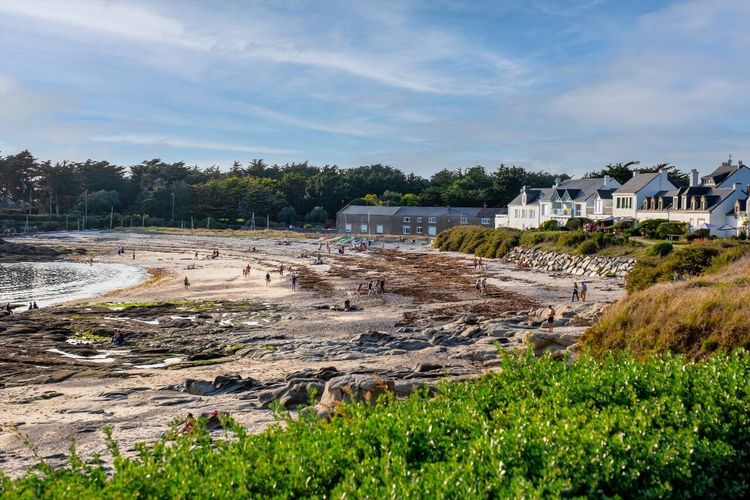
Piriac-sur-Mer is worth the detour if you push on to the coast. This fishing village of 2,500 inhabitants, 80 km from Nantes, occupies the northern tip of the Guérande peninsula and retains a historic centre that property developers only just spared.
The Port de Piriac is surrounded by low granite houses, some dating from the 17th century. The main beach offers an unobstructed view of the islands in the bay, with on a clear day the silhouette of Belle-Île on the horizon. Maupassant loved Piriac: he stayed there at the end of the 19th century and evoked the village in his writings. The town still cultivates this literary memory along its alleyways.
In autumn, Piriac regains its identity as a fishing village: nets dry on the quays, seafood restaurants offer daily specials at reasonable prices, and the coastal paths of the GR34 are walkable without crowds. The loop around the Pointe du Castelli, the most prominent headland of the Guérande peninsula, ranks among the finest coastal walks in Loire-Atlantique.
Les Moutiers-en-Retz, the Discreet Estuary
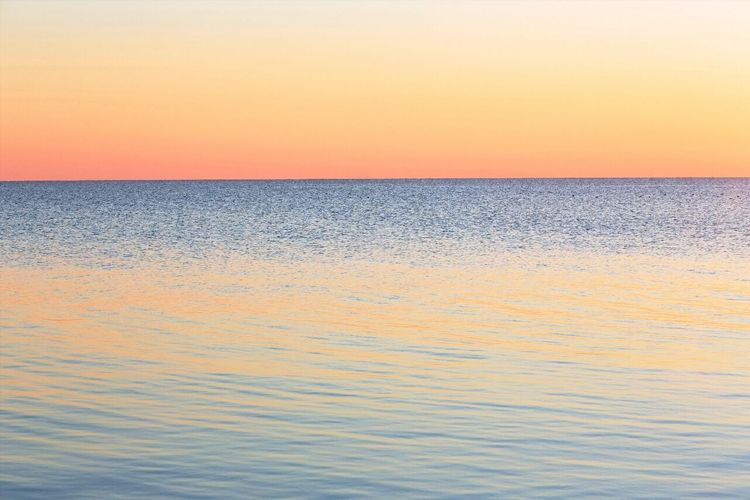
Les Moutiers-en-Retz (Loire-Atlantique, 44760 Les Moutiers-en-Retz, rated 4.2/5 on Google with 310 reviews) is the most under-the-radar village in this selection. Located 45 km south-west of Nantes, on the edge of the Baie de Bourgneuf, this village of 3,500 inhabitants attracts few passing tourists — which is precisely its strength.
The Plage des Moutiers is a large fine sandy beach facing south-west, well exposed in autumn when the wind turns westerly. The seafront promenade stretches 2 km with views over the bay and, on a clear day, the outline of the île de Noirmoutier. The village itself has a Romanesque church, the Collégiale Saint-Pierre, whose ancient features merit a few minutes' attention. Allow half a day, ideally combined with a visit to Pornic, just to the south.
Liré, the Village of Joachim du Bellay
For lovers of literature, Liré is a pilgrimage. It is the birthplace of Joachim du Bellay, poet of the Pléiade who wrote « Heureux qui comme Ulysse » thinking of these gentle hills of Anjou. Some 45 km from Nantes, on the heights above the Loire, Liré remains an agricultural village of 3,000 inhabitants that its literary fame has not transformed into a tourist attraction.
The Musée Joachim du Bellay (Liré, 49530 Liré, rated 4.8/5 on Google with 4 reviews) traces the life and work of the poet through manuscripts and early editions. Open mainly in season (admission around €3), it closes for part of the winter but the village remains pleasant to explore. The view from the heights of Liré over the meanders of the Loire matches that of Champtoceaux in quality, with far fewer visitors.
How to Organise Your Getaway: Practical Tips
Most of these destinations are easy to visit from Nantes by car, within a radius of 30 to 80 km. A car remains the most flexible option, but a few alternative transport choices are worth knowing about.
By train, Clisson is accessible from Nantes station in under 30 minutes (TER Nantes–Cholet), and the Nantes–Angers line serves several communes along the Loire axis. Saint-Florent-le-Vieil and Montjean-sur-Loire are not served by rail: a coach or a car is needed. For Trentemoult, the Navibus shuttle from the Quai de la Fosse is the most practical and most enjoyable option.
Autumn is objectively the best season for these day trips: the summer crowds have gone, the Loire landscapes are at their most beautiful with autumn foliage, and temperatures remain mild through October and November. Several of these destinations can easily be combined in a single day: Clisson and Trentemoult to the south, Champtoceaux, Montjean-sur-Loire and Saint-Florent-le-Vieil along the eastern Loire axis, Guérande and Piriac-sur-Mer on the Atlantic coast.
If you wish to extend your exploration to Nantes itself, the Nantes audio-guided tour offers 31 audio stops to discover the city on foot over 6.4 km, a fine complement to a day out.
For more ideas of things to do in the département, also check out our article on activities in Loire-Atlantique and our selection of the most beautiful villages in the Pays de la Loire.



FAQ
Which villages closest to Nantes are worth visiting?
Trentemoult is the closest, just 6 km from the centre of Nantes, reachable in about ten minutes by the Navibus river shuttle from the Quai de la Fosse. Oudon (25 km) and Clisson (25 km) are next, both easily accessible by car or TER train from Nantes station in under 30 minutes.
Which village around Nantes is worth visiting in autumn?
In autumn, Champtoceaux and Saint-Florent-le-Vieil are particularly impressive: the russet foliage along the banks of the Loire creates a setting that rivals the most beautiful regions of France at this time of year. Trentemoult also reclaims its authentic village atmosphere once the summer tourists have left.
Is Clisson worth visiting? Absolutely. Clisson is unique in France for its Italianate architecture and the simultaneous presence of a spectacularly ruined medieval castle and a free landscaped park, the Domaine de la Garenne Lemot. Allow at least half a day, ideally on a Friday to enjoy the morning market. At 25 km from Nantes, it is the most transporting day trip in the Nantes region.
Are there villages around Nantes accessible without a car?
Yes. Trentemoult is accessible by the Navibus river shuttle from Nantes. Clisson and Oudon are served by TER trains from Nantes station. For the other villages (Champtoceaux, Montjean-sur-Loire, Saint-Florent-le-Vieil), a car remains the most convenient option, although regional coaches do exist with limited timetables.
How do you visit Guérande and the salt marshes?
Guérande is best explored on foot from the car park located outside the walls. Walking the ramparts takes around forty minutes. The salt marshes are ideally visited with a local salt harvester: guided tours are organised from April to September by several producers. Outside the season, the discovery trails around the basins remain freely accessible, and the colours of the salt pans are often more spectacular than in midsummer.
The villages around Nantes have nothing to envy from the more widely publicised destinations of western France. Trentemoult, Clisson, Champtoceaux or Saint-Florent-le-Vieil — each offers a distinct experience, often more authentic than what you find in tourist brochures. Autumn is the perfect season to explore them. And if you want to prepare your visit to Nantes before venturing out to the surrounding villages, the Ryo audio guide to Nantes with its 30 stops and 2h30 of walking is an excellent introduction to the city and its history.
À lire également