© Shutterstock
 Votre guide Ryo
The Most Beautiful Lighthouses of Brittany to Discover
Brittany, with its 1,100 kilometers of jagged coastline and tumultuous waters, is home to more than a third of France's lighthouses. These sentinels of granite and stone, standing tall against the Atlantic Ocean, tell the maritime history of this emblematic region. From the imposing Eckmühl lighthouse to the mythical Ar-Men, passing by Europe's tallest lighthouse on Île Vierge, discover these sea giants that have fascinated and protected navigators for centuries.
1. Eckmühl Lighthouse in Penmarch: The Giant of South Finistère
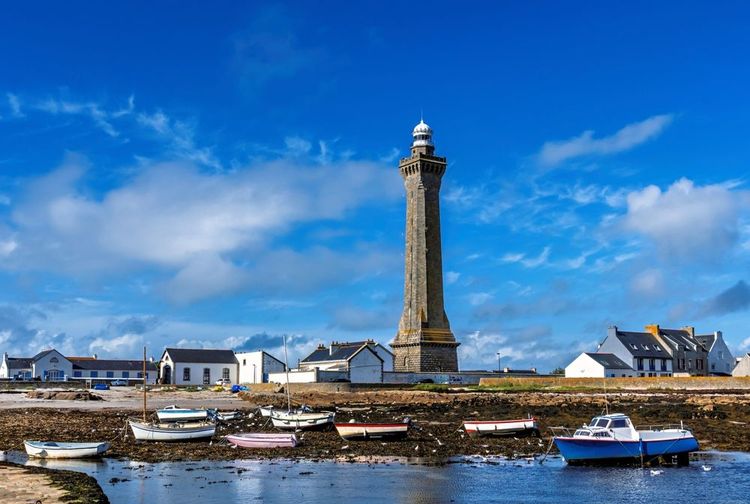
It's impossible to talk about Brittany's lighthouses without mentioning the majestic Eckmühl lighthouse. Located in Penmarch in South Finistère, this 65-meter-high colossus has stood proudly since 1897. Its funding came from the bequest of the Marquise de Blocqueville, daughter of Marshal Louis-Nicolas Davout, Prince of Eckmühl.
This lighthouse requires climbing 307 spiral steps to reach its summit and admire an exceptional panorama over Audierne Bay. An annual competition brings together the most daring athletes to determine who can climb these steps the fastest! The Eckmühl lighthouse (Rue du Phare, 29760 Penmarch, open April to November, 06 07 21 37 34) remains one of Brittany's most visited lighthouses.
2. Île Vierge Lighthouse in Plouguerneau: Europe's Tallest
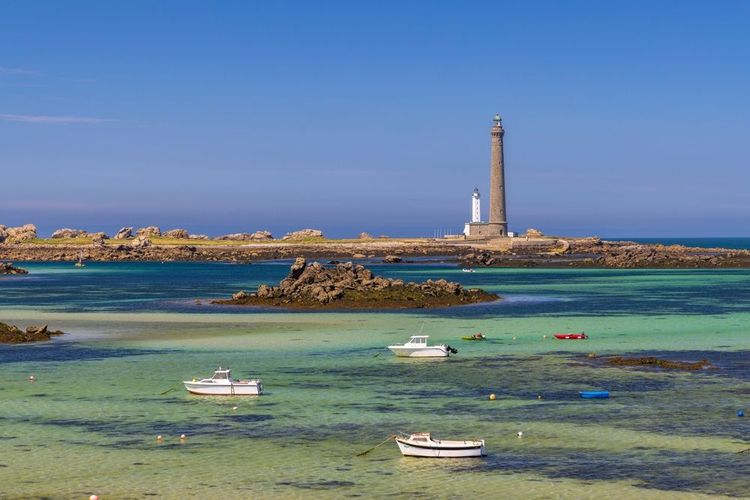
A true European record, the Île Vierge lighthouse reaches 82.5 meters high, making it Europe's tallest lighthouse and the world's tallest lighthouse built of dressed stone. Constructed between 1897 and 1902 on Île Vierge in Plouguerneau, this exceptional lighthouse requires climbing 365 steps to reach its summit.
Its spiral staircase, surrounded by opalescent walls, offers an ascent as spectacular as the panoramic view from its walkway. The lighthouse illuminates the horizon with a white flash every 5 seconds over nearly 42 kilometers. Access is only by boat from the vedettes des Abers, which adds to the exceptional character of this visit.
3. Cap Fréhel Lighthouse: Sentinel of the Emerald Coast
Perched on the pink sandstone cliffs of Cap Fréhel in Plévenon in the Côtes-d'Armor, this 33-meter-high lighthouse offers one of the most spectacular panoramas in Brittany. Built between 1946 and 1950 to replace previous lighthouses, it dominates the sea from its 85-meter altitude.
Its 145 steps provide access to an exceptional viewpoint over the Emerald Coast. The Cap Fréhel lighthouse (22240 Plévenon, open April to November, 02 96 41 43 06) is accessible via paid parking and is a must-see to discover the wild beauty of the Côtes-d'Armor.
4. Saint-Mathieu Lighthouse in Plougonvelin: Guardian of Finistère Point
Download the audio-guided circuit to discover Brest on foot and independently
Explore the capital of the oceans with our complete Brest itinerary that will take you through 27 points of interest, from Vauban's fortifications to the medieval castle, passing through the Explorers' gardens. This 8.2 km route will immerse you in the exceptional maritime history of this emblematic Breton city.
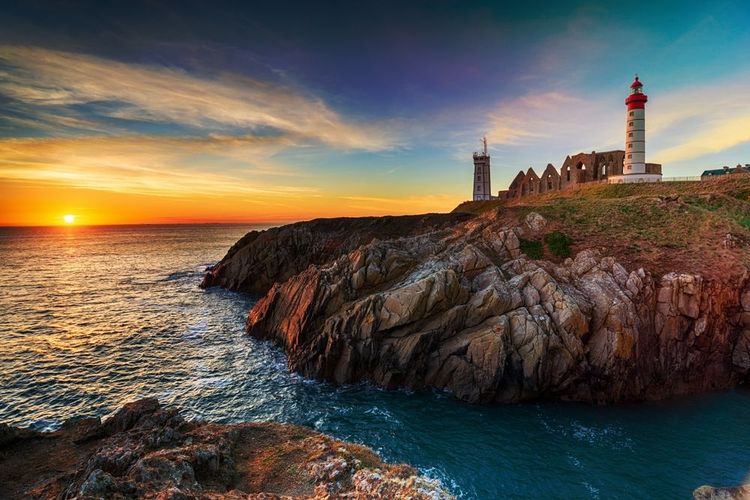
The Saint-Mathieu lighthouse, located at the eponymous point of Plougonvelin, has the unique particularity of being built in the ruins of an ancient abbey. Inaugurated in 1835, this red and white lighthouse of 37 meters high reaches 58 meters above sea level.
Its 163 steps lead to a 360° panorama over the Sea of Iroise, allowing observation of the islands of Molène and Ouessant. The Saint-Mathieu lighthouse (Place Saint-Tanguy, 29217 Plougonvelin, 06 82 02 05 95) crosses its beam over more than 40 kilometers thanks to its Fresnel lenses. Visitors can also discover the Brest tour circuit which includes numerous remarkable maritime sites.
5. Petit Minou Lighthouse in Plouzané: Jewel of Brest Harbor
Backed against the Vauban military fort of the same name, the Petit Minou lighthouse is one of the most photographed sites in Brittany. This 26-meter-high lighthouse, which reaches 34 meters above sea level, marks the entrance to Brest harbor with the Portzic lighthouse.
Access to the lighthouse is via a romantic stone bridge that crosses the fort's moats. Built between 1839 and 1848 by architect Léonce Reynaud, this lighthouse is inspired by the towers of Breton castle forts. The Petit Minou site (Rue du Fort du Minou, 29280 Plouzané) also offers a magnificent beach accessible at low tide and remains of historic bunkers.
6. Mean Ruz Lighthouse in Ploumanac'h: The Harmony of Pink Granite
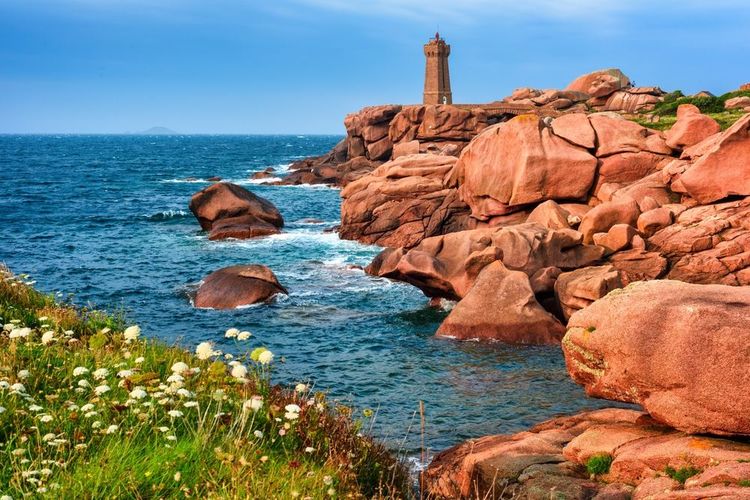
On the famous Pink Granite Coast, the Mean Ruz lighthouse in Ploumanac'h has the remarkable particularity of being built with the same pink stones as those that litter the surrounding coastline. This perfect harmony between architecture and natural landscape gives this lighthouse absolutely unique beauty.
Built in 1946, this 15-meter-high lighthouse stands in the middle of an exceptional granite chaos. From its surroundings, one can observe the Costaérès castle located on a small island offshore. The Mean Ruz lighthouse constitutes an ideal starting point to explore the customs officers' trail that winds between the pink granite rocks sculpted by the elements.
7. Ouessant Lighthouses: The Island of Five Lighthouses
Stiff Lighthouse: The Dean of Breton Lighthouses
Built in 1695 by Vauban, the Stiff lighthouse holds the title of dean of Breton lighthouses still in operation. This 32-meter-high lighthouse, located at the northeast point of Ouessant, has guided navigators for more than three centuries.
Créac'h Lighthouse: One of the Most Powerful in the World
Lit in 1863, the Créac'h lighthouse is among the most powerful lighthouses in the world. Its exceptional light range of 60 kilometers makes it an essential landmark for navigation in this particularly dangerous area of the Sea of Iroise.
La Jument Lighthouse: The Hell of the Seas
Built between 1904 and 1911 on the Ar-Gazeg reef (La Jument in Breton), this 47-meter-high lighthouse represents one of the most impressive architectural challenges in maritime signaling history. Located in open sea southwest of Ouessant, it belongs to the 'Hell' category due to its total isolation and extreme weather conditions.
This octagonal lighthouse signals with three red flashes every fifteen seconds. Its construction, financed by a bequest from a member of the Paris Geographical Society, required seven years of work in perilous conditions. Classified as a historic monument since 2017, La Jument lighthouse remains inaccessible to the public but remains one of the most photographed lighthouses in the world, especially during winter storms that create spectacular water sprays. Before or after heading out to sea, Rennes is worth a listen too: our audio-guided tour runs 26 stops there, from the Portes Mordelaises to the Place des Lices.
8. Ar-Men Lighthouse: The Hell of Hells
Nicknamed 'the hell of hells', the Ar-Men lighthouse constitutes the ultimate challenge of French maritime engineering. Located on a wave-battered rock off Île de Sein, this 37-meter lighthouse represents the westernmost point of continental France.
Its construction, begun in 1867, required fourteen years of titanic work in inhuman conditions. Workers could only work a few hours per year, only during rare lulls. Twenty-three keepers succeeded each other in just thirty-five years, testifying to the extreme psychological isolation of this post. Automated in 1990, Ar-Men continues to guide ships in this particularly dangerous area of the Sein causeway.
9. Morbihan Lighthouses: Guardians of the Gulf
Download the audio-guided circuit to discover Vannes on foot and independently
Discover the medieval city of Vannes with our guided Vannes route which takes you through 18 major points of interest, from medieval ramparts to Saint-Pierre cathedral, passing by the famous couple 'Vannes and his wife'. Let yourself be guided through this pearl of Morbihan which holds so many architectural treasures.
Port-Navalo Lighthouse: The War Survivor
Located in Arzon on the Rhuys peninsula, the Port-Navalo lighthouse has a particular history linked to World War II. This 32-meter-high lighthouse nearly was dynamited in 1944 by German troops, but was saved thanks to the intervention of engineer Le Net who convinced the occupiers of its strategic utility for guiding ships in the Gulf of Morbihan.
Today, this lighthouse marks the entrance to the Gulf of Morbihan and offers an exceptional view of Locmariaquer and the Quiberon peninsula. Visitors can also take advantage of the proximity to visit Vannes and discover the riches of this preserved Breton region.
Pen-Men Lighthouse on Groix Island
On Groix island, the Pen-Men lighthouse dominates the west coast from its privileged position of 64 meters high. It is a house-lighthouse, meaning that the lighthouse functionality is integrated into a habitable building. With its light range of 54 kilometers, it constitutes Morbihan's most powerful lighthouse.
Pen-Men point also houses an ornithological reserve where numerous marine species come to nest in the cliff crevices. This exceptional situation between maritime heritage and biodiversity makes this site a must-see on Groix island.
10. Inaccessible Lighthouses: Observing These Sea Giants from Afar
Certain Breton lighthouses remain inaccessible to the public due to their situation in open sea or their dangerousness. These 'Hells' fascinate as much as they impress by their isolation and the extreme conditions they face daily.
The Tévennec lighthouse, nicknamed the 'haunted lighthouse', saw 23 keepers succeed each other in just 35 years. Legends tell that voices and ghosts haunt this isolated tower, driving some keepers mad. Similarly, the Four lighthouse in Porspoder imposes by its stature as a granite giant planted on its rock in open sea.
These open-sea lighthouses can nevertheless be observed from the coast, particularly from the points and capes that line the Breton coastline. On stormy days, they offer striking spectacles when waves come crashing against their granite bases.
Planning Your Breton Lighthouse Route
To discover these stone sentinels in the best conditions, favor the period from April to October, when most lighthouses are open for visits. Finistère concentrates the largest number of remarkable lighthouses, from Penmarch to the north up to Ouessant.
Start your journey with Brest, a true maritime capital that will allow you to reach the Petit Minou, Saint-Mathieu lighthouses and access the islands of Molène and Ouessant. Continue south with the Eckmühl lighthouse in Penmarch, then head north to the Côtes-d'Armor to discover Cap Fréhel and Mean Ruz.
Don't hesitate to consult local tourist offices for opening hours and weather conditions, particularly important for crossings to the islands. Each lighthouse tells a part of Breton maritime history and deserves the detour for its exceptional situation and unique architectural heritage.
In conclusion, Brittany's lighthouses constitute an exceptional maritime heritage that testifies to the know-how and courage of men facing the elements. From the imposing Eckmühl lighthouse to the mythical Ouessant lighthouses, passing by the European record of Île Vierge, these granite giants continue to fascinate visitors from around the world. Their discovery represents an extraordinary journey through French maritime history, where each lighthouse reveals its secrets and legends. For a complete exploration of this exceptional maritime region, don't hesitate to follow the Brest tour route which will immerse you in the heart of the Breton lighthouse universe.
FAQ
What is the tallest lighthouse in Brittany?
The Île Vierge lighthouse in Plouguerneau is Brittany's tallest lighthouse at 82.5 meters. It also holds the record for Europe's tallest lighthouse and the world's tallest dressed stone lighthouse.
How many lighthouses can be visited in Brittany?
About ten Breton lighthouses are open to the public for visits, mainly from April to October. The most accessible are those of Eckmühl, Cap Fréhel, Saint-Mathieu, and Île Vierge (accessible by boat).
What is a 'Hell' lighthouse?
'Hell' lighthouses are those built in open sea on isolated rocks, like Ar-Men or La Jument. This name comes from the extreme living conditions of the keepers who lived there, often confronted with isolation and storms.
What is the best period to visit Breton lighthouses?
The ideal period extends from April to October, when most lighthouses are open to the public and weather conditions allow crossings to islands like Ouessant or Île Vierge.
À lire également