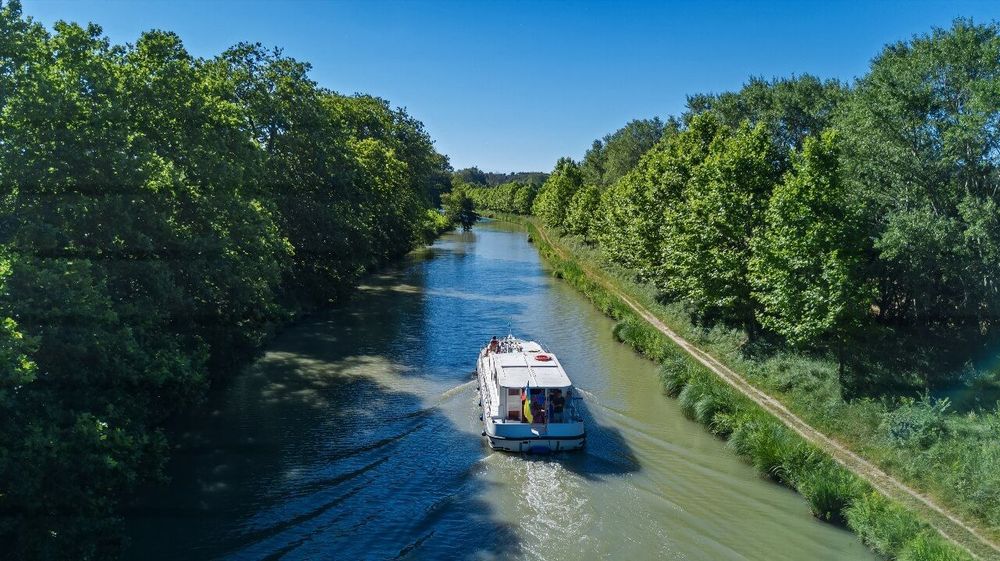
© Shutterstock
 Votre guide Ryo
Canal du Midi by Motorhome: Stopovers, Itineraries and Practical Tips (2026)
The Canal du Midi by motorhome means 240 kilometers of freedom between Toulouse and the Mediterranean: waterside stopovers, itineraries you put together yourself, and tips you need to know before getting behind the wheel. A UNESCO World Heritage route punctuated by 63 locks, Languedoc vineyards and fortified villages that Pierre-Paul Riquet would barely recognize, so little have they changed since the 17th century. What sets this journey apart is its pace: barges move at 8 km/h and the motorhome naturally falls into the same rhythm, stopping while a lock does its work, lingering two nights in places where tour buses park for only twenty minutes.
Along this route you will discover a staircase lock with eight chambers at Béziers that allows boats to overcome a 21.5-metre drop in just a few hundred metres, a round lock unique in the world at Agde allowing navigation in three different directions, and Castelnaudary, the ancestral home of cassoulet, whose Grand Bassin reflects centuries-old plane trees at sunset. At the journey's end, the étang de Thau resembles an inland sea full of oysters, and Sète awaits with its inner canals and the legacy of Georges Brassens. Our Ryo guide to the Canal du Midi accompanies you in detail through every cultural and historical stop. This guide gives you reliable stopovers, the rules to know before taking the wheel, and a complete itinerary from Toulouse to Sète, with variants depending on how much time you have.
Why the Canal du Midi Is Perfect for a Motorhome Trip
A motorhome is not simply convenient along the Canal du Midi: it is almost ideal for this type of route. The main reason lies in the geography. The canal is not a motorway. It winds through villages that sometimes have only one hotel, or none at all. Traditional campsites do not line the entire route. Municipal motorhome stopovers, on the other hand, have been developed in most of the towns along the canal, often at the water's edge or a short distance from the towpath.
The second advantage, less obvious, is scheduling flexibility. The canal's locks close in the evening (generally around 7:30 pm in summer) and the barges congregate at the same times. If you are following the canal by car and have to book a hotel in advance, you are locked into a programme. By motorhome, the day's plan is decided each morning based on the weather, mood and how your legs feel.
The canal was built between 1667 and 1681 by Pierre-Paul Riquet, a self-taught engineer whose project was financed by Louis XIV. The work mobilised up to 12,000 workers at its peak and cost a fortune that Riquet never managed to repay in his lifetime. Designated a UNESCO World Heritage Site in 1996, the canal is today managed by VNF (Voies Navigables de France) and welcomes thousands of leisure boats every year between April and October.
The basic route, from Toulouse to Sète, covers around 240 km by the road that runs alongside the canal. With stops at the locks and visits to towns, allow 8 to 14 days comfortably for a first exploration.
How Long to Travel the Canal du Midi by Motorhome
The distance between Toulouse and the étang de Thau is around 240 km by the road closest to the canal. By car, that is under 3 hours. By motorhome, with stops and secondary roads to navigate, the duration depends entirely on your pace.
Trip durations by traveller profile:
- 5 to 6 days: brisk pace, long stages, main sites (Carcassonne, Fonsérannes). For those with limited time.
- 8 to 10 days: comfortable pace, village exploration, a few half-days by bike. The right balance for a first visit.
- 12 to 15 days: slow pace, detours into the Corbières or the Minervois, swimming in rivers. The ideal trip if you do not want to miss anything.
Most motorhome travellers do Toulouse–Sète in 8 to 10 days on a first visit. If you already know the region, you can focus on specific sections: the Minervois stretch between Homps and Capestang, or the Béziers section with the Fonsérannes lock.
Some motorhome travellers do the round trip: Toulouse to Sète, then back to Toulouse via a different route through Nîmes and Montpellier, which allows for varied scenery and a chance to discover the Camargue along the way.
The Detailed Itinerary: from Toulouse to the Étang de Thau
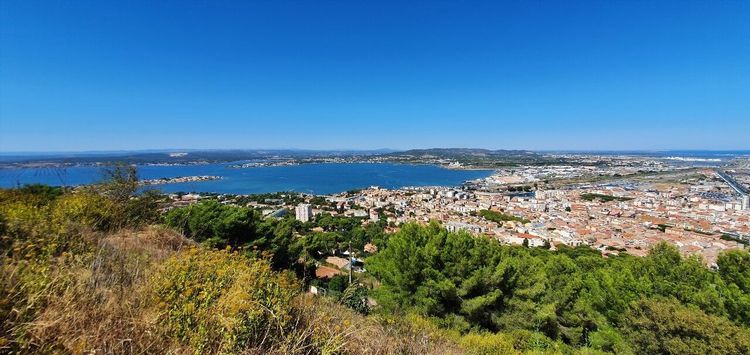
The classic route follows the canal from Toulouse to the étang de Thau, using the D813 then the D6113 as the main axes. Here is a breakdown into stages for a 10-day trip.
Stages 1–2: Toulouse (1 to 2 nights)
La Ville Rose is the logical starting point. The Port de l'Embouchure (Place de la Confluence, 31000 Toulouse, rated 4.2/5 on Google from 26 reviews) marks the official start of the Canal du Midi, where it meets the Garonne via the Canal de Brienne. This is where the sightseeing barges depart. Make the most of Toulouse to visit the Basilique Saint-Sernin, the place du Capitole and the Victor Hugo market before hitting the road.
Stage 3: Castelnaudary (1 night)
Castelnaudary lies 47 km from Toulouse. The Grand Bassin de Castelnaudary is one of the most beautiful stops on the canal: a perfectly calm stretch of water with barges lined up and plane trees in the background. The municipal motorhome stopover sits right on the basin.
Stages 4–5: Carcassonne (1 to 2 nights)
From Castelnaudary to Carcassonne, allow 45 km. Arriving in Carcassonne along the canal road, with the medieval Cité rising up from the hilltop, is one of the highlights of the entire journey. Set aside at least half a day for the Cité (ramparts, château comtal, Basilique Saint-Nazaire) and keep time for the lower town.
Stage 6: Trèbes, Homps or Capestang (1 night depending on preference)
This stretch between Carcassonne and Béziers is the quietest and least visited. The villages of Trèbes, Homps and Capestang offer peaceful motorhome stopovers, often beside the canal, with few other visitors. The bridge at Capestang is one of the most photographed viewpoints in the Aude section.
Stages 7–8: Béziers (1 to 2 nights)
Béziers deserves two nights. The Fonsérannes lock, 3 km from the town centre, is the most spectacular hydraulic monument on the entire canal. In town, the Cathédrale Saint-Nazaire dominates the plain from its hilltop. The covered market (place Pierre Sémard) is worth a visit on weekday mornings.
Stage 9: Agde and the Cap d'Agde
Agde is a surprise to first-time visitors: founded by Greek settlers in the 6th century BC, the town is built from dark grey-black volcanic basalt stone. The round lock at Agde is unique in the world.
Stage 10: Sète and the Étang de Thau
Sète is the ideal conclusion. The town built on a promontory between sea and lagoon brings together the oysters of the étang de Thau, Paul Valéry's marine cemetery, inner canals and a lively gastronomic scene. This is where the 240 km of the Canal du Midi come to an end.
Toulouse: La Ville Rose to Start Your Itinerary
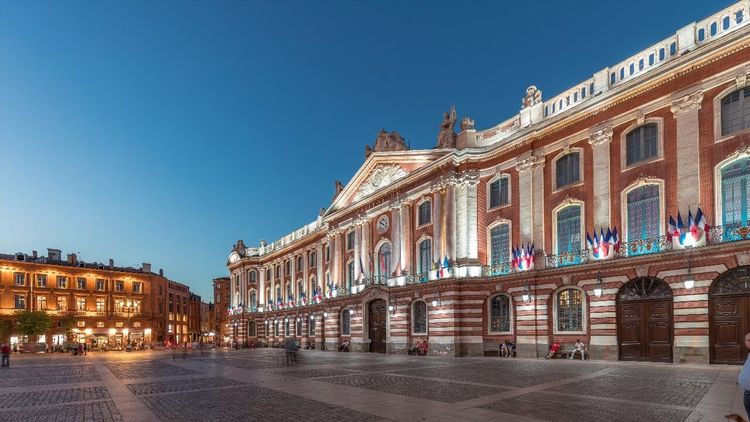
Toulouse has enough to see to justify two nights before setting off along the canal. The city is stacked with Romanesque monuments (the Basilique Saint-Sernin is the largest Romanesque church in Europe), a place du Capitole that many rank among the finest in France, and a Victor Hugo market that alone makes a Saturday morning stop worthwhile for its stalls of regional cheeses and charcuterie.
The old town of Toulouse is explored on foot, and that is where the Ryo audio guide really comes into its own: the streets of the historic centre, between the place du Capitole and the banks of the Garonne, are too rich in history to be content with just a map. The Ryo app walks you through the pink-brick alleyways and tells the story of the Cathars, of Viollet-le-Duc, and of Pierre-Paul Riquet's mad plan to one day connect the Atlantic to the Mediterranean by an artificial canal.
For motorhome travellers, the Port de l'Embouchure deserves a short walk before moving on. This is where the Canal de Brienne meets the Canal du Midi, a hydraulic junction that symbolically marks the start of the route. The most convenient motorhome stopover in Toulouse is the camping municipal de la Ramée (avenue du Parc, 5 km from the centre), well served by metro line A from the Arènes station.
A few practical tips for Toulouse by motorhome:
- Avoid driving a large vehicle into the city centre. Park on the outskirts and take the metro.
- The Victor Hugo market closes at 1:30 pm; arrive before 11 am to see the covered halls at their best.
- The Place de la Daurade, on the banks of the Garonne, offers one of the finest sunset views over the Garonne and the Pont-Neuf.
- Toulouse can also serve as a base for a day trip to Albi (75 km, Sainte-Cécile cathedral and Toulouse-Lautrec museum, UNESCO-listed city) if you have a spare day.
Castelnaudary: Cassoulet and the Grand Bassin
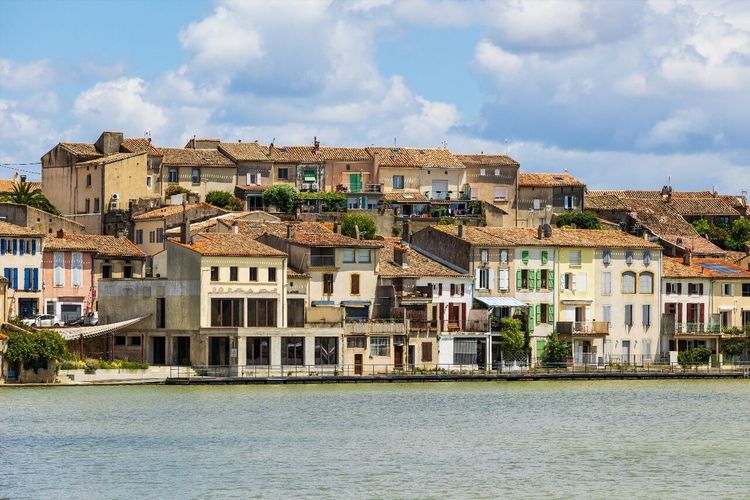
Castelnaudary is the first logical stop after Toulouse, 47 km away via the D813 that runs alongside the canal. The town is synonymous with cassoulet: the dish in question (lingot white beans, duck confit, Toulouse sausage and pork rind slow-cooked for several hours) is served in virtually every restaurant around the place de la République.
The Grand Bassin (Quai du Port, 11400 Castelnaudary, rated 4.8/5 on Google from 4 reviews) is the centrepiece of the town: a 7-hectare stretch of water where barges moor for the night. The sight of the sunset over the basin, with the reflections of the boats on the still water, is worth the stopover in itself. The municipal motorhome stopover is just steps from the basin, with grassy pitches and direct access to the towpath. Expect to pay 6 to 8 euros per night, with water and electricity available for an additional fee.
From the motorhome, take the time to walk along the canal to the four locks of Saint-Roch (2 km from the centre along the towpath, accessible by bike). These four successive locks perfectly illustrate the mechanics of the canal: each chamber advances the boats a metre or two along the overall gradient between Toulouse and the Mediterranean. Watching a barge pass through all four locks, you begin to understand why the construction of the canal was considered an engineering feat in the time of Louis XIV.
Carcassonne and the Cathar Aude
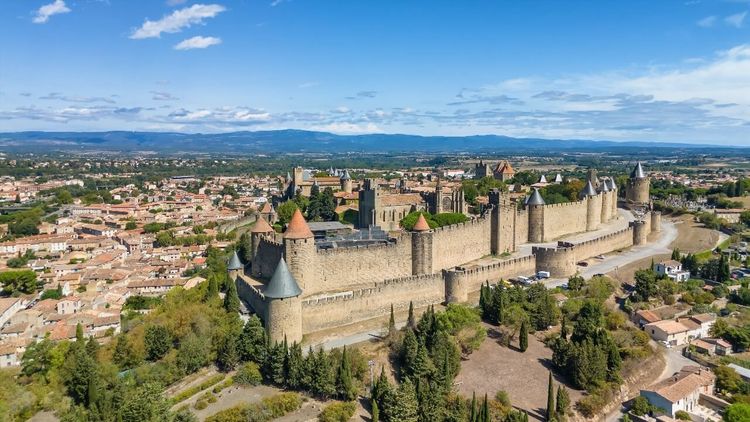
Carcassonne is the stop everyone looks forward to. The medieval Cité, with its 3 km of ramparts and 52 towers, is one of the best-preserved medieval fortresses in Europe. Viollet-le-Duc restored it in the 19th century, which sometimes draws criticism (the grey slate roofs on the towers would have been more characteristic of northern regions), but the visual impact remains striking, especially at sunrise before the tourists arrive.
From the canal, the Cité rises on its hill as you approach the town. It is one of the highlights of the entire route. For motorhome travellers, the Cité motorhome stopover (route de Montréal) is a 10-minute walk from the ramparts and has room for around thirty vehicles, with water and waste disposal service. In high season (July–August), expect to pay 8 to 10 euros per night.
The lower town, the "bastide Saint-Louis" built in the 13th century, also deserves exploration. The covered market on place Carnot, the cafés on place Gambetta and the banks of the Aude offer a lively alternative to the tourist Cité, with far more reasonable restaurant prices.
Carcassonne is also a great base for exploring Cathar country. The château de Lastours (four Cathar castles on a rocky spur, 20 km to the north) is accessible by motorhome on wide departmental roads. The château de Peyrepertuse (in the Corbières, 65 km to the south) is also worth a detour if you have a spare half-day.
Between Carcassonne and Béziers, the canal winds through the vineyards of the Minervois. The D610 road follows the canal for several dozen kilometres, allowing you to stop at the locks without leaving the bank. The Marseillette lock and the Puichéric lock are particularly photogenic in the late afternoon, when the low-angle light catches the plane trees and the canal water.
When leaving Carcassonne heading east, take the small road through Trèbes and Homps rather than rushing along the D6113. You will follow the canal for several kilometres and discover locks that most hurried motorhome travellers never see.
Béziers, the Fonsérannes Lock and the Minervois
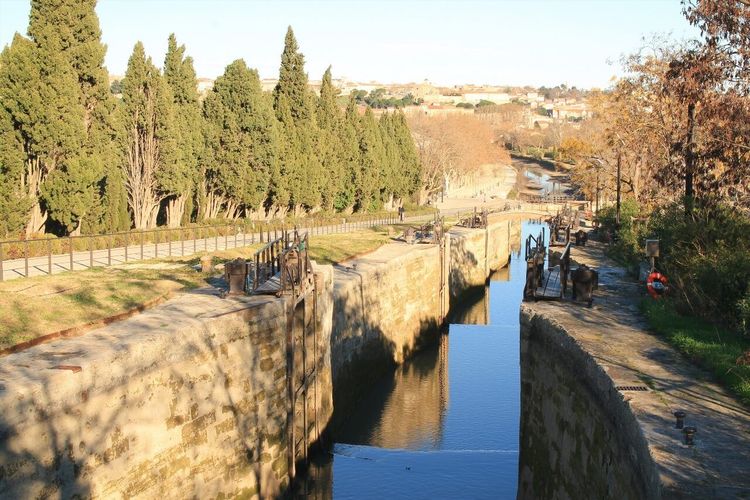
Béziers marks the start of the canal's final section, before the great opening onto the Mediterranean. The town is less touristy than Carcassonne, but it holds two major assets that many travellers underestimate: the Fonsérannes lock (Route de Fonsérannes, 34500 Béziers, rated 4.5/5 on Google from 15,094 reviews) and a cathedral that has dominated the entire Hérault plain from its hilltop for centuries.
The Fonsérannes lock is located 3 km west of Béziers town centre. It is a staircase of eight successive chambers that allows boats to overcome a 21.5-metre drop in barely 300 metres. Passing a barge through takes between 45 minutes and 1.5 hours depending on the direction of travel. You can watch the manoeuvre from the banks, sitting on a bench in the sun with a coffee in hand. Entry is free and the show is ongoing. In high season, several barges follow one another in succession, turning the lock into a true hydraulic ballet.
The Cathédrale Saint-Nazaire et Saint-Celse of Béziers commands its hilltop with an almost military silhouette. The interior is worth a visit: the choir's stained-glass windows and the Gothic nave are remarkable. From the forecourt, the view over the vineyards and the canal below is exceptional, especially in the evening when the lights of the plain begin to come on.
Between Béziers and Agde, the canal crosses the Orb river via an aqueduct bridge built in the 19th century (one of the first of its kind in France). The village of Portiragnes and its lagoons make a beautiful stop before the Mediterranean outlet. The Portiragnes stopover, beside the canal, is often quieter than the one in Béziers in the height of summer.
Agde, Sète and the Étang de Thau
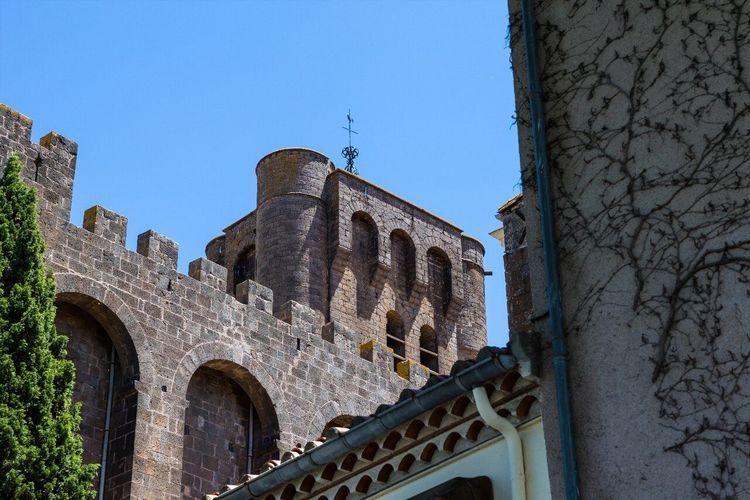
Agde is a genuine surprise for those who do not know it. Founded by Greek settlers in the 6th century BC, it is one of the oldest towns in France. The historic centre, built from dark grey-black volcanic basalt quarried from the nearby Agde volcano, stands in stark contrast to the typical Languedoc villages of pale limestone. The Cathédrale Saint-Étienne looks more like a fortress than a religious building: its arrow slits and thick walls bear witness to a historical context in which even places of worship needed to be able to defend themselves.
The round lock at Agde is one of the rare circular locks in the world: a round basin allowing boats to choose between three directions — continuing along the Canal du Midi towards Béziers, heading down the Hérault river towards Agde and the Mediterranean, or heading up towards the étang de Thau (Route de la Corniche, 34200 Sète, rated 4.6/5 on Google from 5.8K reviews). Watching it operate in full season, with several barges manoeuvring simultaneously within its roughly 30-metre diameter, is fascinating.
Sète, 20 km east of Agde, is the natural conclusion of the journey. Built on a promontory between the étang de Thau and the Mediterranean, the town is known for its Languedoc jousting tournaments (water jousting in August), the legacy of poet Georges Brassens and its marine gastronomy. The Bouzigues oysters, produced in the étang de Thau, are enjoyed at small restaurants on stilts in Mèze or Bouzigues, a few kilometres from Sète.
The étang de Thau marks the terminus of the Canal du Midi. Many motorhome travellers continue towards Montpellier, Nîmes or the Camargue from Sète. The region offers more than enough options to extend the trip by an additional week without ever travelling the same road twice.
Motorhome Stopovers Along the Canal du Midi: Where to Park
This is the most practical question for motorhome travellers planning the trip. The Canal du Midi is generally well equipped with stopovers, but quality and availability vary by season and location. Here are the main reliable stopovers with their key features.
Toulouse
The Camping Municipal de la Ramée (avenue du Parc, 31400 Toulouse) is the most common option. Located 5 km from the city centre, it is served by metro line A (Arènes station). Rate: approximately 14 to 18 euros per night with electricity. Open year-round.
Castelnaudary
The municipal stopover at Castelnaudary is situated directly on the Grand Bassin (quai du Port). Around thirty pitches, water and waste disposal service point, rate around 8 to 10 euros per night. In high season, arrive before 3 pm to find a spot.
Carcassonne
Two options depending on your priorities:
- Aire de la Cité (route de Montréal): the closest to the ramparts, around thirty spaces, 6 to 10 euros in high season. Convenient for visiting the Cité on foot early in the morning.
- Camping de la Cité (chemin de la Croix d'Achille): three-star campsite a 10-minute walk from the Cité, better equipped and more shaded.
Trèbes
The Trèbes stopover is one of the highest-rated between Carcassonne and Béziers. Situated beside the canal, free outside the season and around 6 euros in summer. Quiet, shaded, towpath right at your doorstep for cyclists.
Homps
A wine-growing village in the heart of the Minervois. The Homps stopover is accessible for large vehicles (up to 10 m), with water and waste disposal. Rate: 5 to 7 euros. Direct views of the canal and vineyards.
Capestang
The Capestang stopover (place du Moulin à Vent) is well shaded with full services. Rate: 8 to 10 euros. The medieval village, with its 13th-century collegiate church, is worth an hour's walk from the stopover.
Béziers
- Aire de la Croisette (route de Pézenas): 50 pitches, well equipped, shuttle to the centre in July–August, 8 to 12 euros.
- Otherwise, several campsites 5–8 km from the centre for those who prefer more facilities.
Agde
The Agde motorhome stopover (avenue du 8 Mai 1945) is convenient for visiting the historic centre and the round lock. The nearby Cap d'Agde has several large campsites open from April to October for those who want to enjoy the sea.
Sète
The Halte Camping-Car de Sète stopover (corniche de Neuburg) is well positioned but often full in July–August. Have an alternative in mind at Vic-la-Gardiole (10 km) or at Grau-d'Agde if you arrive late. In Toulouse, where the canal begins, our audio-guided loop circles the Pink City over 6.5 km.
General tips for stopovers along the canal:
- In July–August, most stopovers are full by 5 pm. Arrive early or use the Camping-Car Park app to check availability.
- Some stopovers impose a maximum parking duration (48 or 72 hours). Check before settling in.
- Stopovers that are free off-season become paid in June–September.
- Free parking on VNF-managed banks is theoretically prohibited. In practice, lock car parks often allow a stop of a few hours, but not an overnight stay.
Traffic Rules and Driving Tips
Driving a motorhome along the Canal du Midi requires a few specific precautions. The main roads that run alongside the canal are not expressways, and the secondary lanes along the banks have tight bends and tree-lined stretches that reduce visibility.
Height and vehicle dimensions
The main risk for a motorhome is height. The main roads (D813, D6113, D610) generally allow standard motorhomes to pass (under 3.20 m). However, the small canalside lanes and the narrow streets of historic village centres (in particular inside the Cité de Carcassonne (Route de Minervois, 11000 Carcassonne, rated 4.7/5 on Google from 92,258 reviews)) must be strictly avoided with any vehicle over 3.5 tonnes.
Always check your vehicle's height, including with the satellite dish folded down, and programme your GPS to exclude low-clearance roads. If in doubt, turning around is always better than getting stuck under a bridge.
Speed limits
The maximum speed on the secondary roads alongside the canal is generally 80 km/h in open countryside and 50 km/h in built-up areas. With a loaded motorhome, and especially if you are towing a light vehicle, your speed limit may be reduced to 80 km/h even on national roads depending on the total weight of the combination. Check your registration document and the regulations applicable to your configuration before departure.
Toll roads
If you are coming from Paris or Lyon, you will use the A61 motorway (the Autoroute des Deux Mers) between Toulouse and Narbonne. Toll rates for a motorhome vary by category:
- Category 1 (under 2 m in height): standard car rate
- Category 2 (2 m to 3 m in height): surcharge of approximately 30 to 40%
- Category 3 or 4 (over 3 m or with trailer): heavy goods vehicle rate
For a Paris–Toulouse journey in a category 2 motorhome, budget between 60 and 90 euros in tolls depending on exits.
Parking in towns
Historic town centres (Carcassonne, Béziers, Sète) are largely off-limits to motorhomes over 3.5 tonnes. Always park in dedicated stopovers or peripheral car parks and reach the centre on foot or by shuttle. In Béziers, a free shuttle connects the Aire de la Croisette to the town centre in July and August.
Fuel and services
Petrol stations with LPG or CNG pumps are mainly found in the larger towns: Toulouse, Carcassonne and Montpellier. For waste disposal and water refills, service points are available at all the stopovers listed above. Plan to fill up with fuel in Toulouse, Carcassonne and Béziers rather than counting on the smaller intermediate towns, which do not always have stations suited to large vehicles.
Budget for a Motorhome Trip Along the Canal du Midi
The Canal du Midi is one of the most affordable motorhome routes in France, mainly because stopover accommodation is inexpensive and the main attractions (locks, footpaths, villages) are free.
Indicative budget for two people over 10 days:
| Item | Estimated amount | |------|------------------| | Stopovers and campsites (10 nights) | €60 to €140 | | Fuel (approx. 1,500 km) | €250 to €350 | | Tolls (round trip from Paris) | €100 to €160 | | Food and restaurants | €400 to €600 | | Cultural admissions (Carcassonne, museums) | €40 to €80 | | Miscellaneous (gas, laundry, unexpected costs) | €50 to €100 | | Total | €900 to €1,430 |
That is 45 to 72 euros per person per day, well below the cost of an equivalent hotel stay on the same route.
To cut costs, travelling outside the summer season (April–June or September–October) gives access to free or very cheap stopovers. Cooking in the motorhome rather than eating out every evening also makes a real difference over 10 days. The Cité de Carcassonne has the highest paid admission on the route: 13 euros per adult for the château comtal (access to the ramparts and the wall walk remains free). The Fonsérannes lock, Agde Cathedral and the Minervois villages are all freely accessible.
If you do not yet have a motorhome and are looking to hire one for this trip, our Ryo guide to motorhome rental helps you choose the right vehicle and provider for your budget.
The Motorhome and Bike Combo: the Ideal Combination
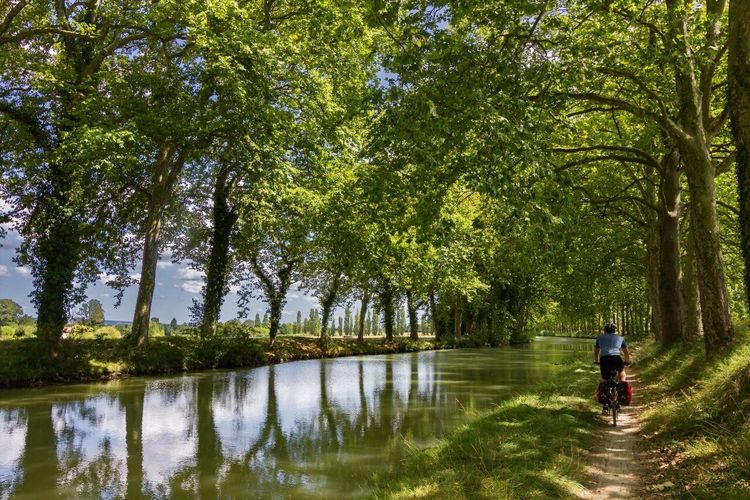
The Canal du Midi is part of the EuroVelo 8 network (the Mediterranean cycling route), and the towpath is cyclable along virtually all 240 km. Combining the motorhome with bikes is the smartest way to explore the canal: you park the motorhome at a stopover, take the bikes, cover 15 to 30 km along the towpath, and return to the motorhome at the end of the day.
The surface of the towpath varies by section. Between Toulouse and Castelnaudary, it is well-maintained compacted gravel. Between Carcassonne and Béziers, some sections have ruts and tree roots. An e-bike is recommended so you are not limited by distance or fitness level.
Recommended cycling sections by profile:
- Toulouse to Castelnaudary (47 km): flat, well maintained, several villages for resupplying.
- Homps to Capestang (25 km): the quietest section, Minervois vineyard landscapes, few other cyclists.
- Béziers to Agde (30 km): fine crossing of the Orb aqueduct bridge, varied scenery.
For families with children, the Castelnaudary–Trèbes segment (30 km) can be done in a relaxed day with children aged 8 and over. The adults pedal, the bikes are dropped at the Trèbes stopover at the end of the day and the motorhome is waiting.
For more cycling itinerary ideas, our Ryo guide to cycling routes in Paris offers similar formats in an urban context, applying the same principles of combining soft mobility with cultural discovery.
When to Go: Choosing the Best Time for a Motorhome Trip Along the Canal
The best time for the Canal du Midi by motorhome is not summer. That answer may be surprising, but July–August temperatures regularly reach 38 to 42 °C in the Languedoc, making sightseeing and cycling uncomfortable during the middle of the day. Add to that the saturation of stopovers, the glut of barges at the locks and waiting times that can stretch to several hours at the busiest locks.
Spring (April to June): the best period without question. Mild temperatures (20 to 28 °C), vineyards starting to turn green again, wildflowers on the banks. The morning light on the canal is exceptional. Stopovers are not yet packed and prices are often lower.
Autumn (September to October): almost as good as spring. The harvest is under way in the Minervois and the Languedoc: you will see tractors loaded with grapes passing through the villages, and cooperative wineries often open their doors to passing travellers. The autumn light is warmer and the vines are beginning to turn colour.
Summer (July to August): possible, but it requires careful organisation. Arrive at stopovers before 3 pm, take the bikes out in the morning (before 9 am), rest during the hottest hours. Night markets and village festivals add a lively atmosphere that makes up for the heat.
Winter (November to March): some stopovers close and the canal is quiet. But the villages without tourists have a special charm, and prices are at their lowest.
Equipment and Gear to Pack for the Trip
The journey along the Canal du Midi does not require any equipment beyond the standard motorhome kit, but a few additions make a real difference over 10 days.
Bikes: essential. Ideally two e-bikes so you are not limited by distance. Bring quality locks and a rear bike rack suited to the weight of electric bikes.
Ventilation or air conditioning: with Languedoc summers reaching 38–40 °C, a rooftop air conditioner or a good ceiling fan is almost essential for sleeping comfortably between June and September.
Navigation apps: Park4Night and Camping-Car Park are the two go-to references for finding stopovers with up-to-date service data (water, waste disposal, electricity). Google Maps handles points of interest and locks well.
Extra water reserve: between two stopovers, you may cover 60 to 80 km without a service point. A 20-litre spare container removes the stress on isolated stretches.
Binoculars: wetland birds (herons, egrets, shoveler ducks) are plentiful along the canal, especially around the étang de Thau. A worthwhile investment, particularly in spring and autumn during migration.

FAQ
Can you camp directly on the banks of the Canal du Midi in a motorhome?
Parking directly on the banks of the Canal du Midi is prohibited by VNF (Voies Navigables de France), the body that manages the canal. In practice, lock parking areas often allow visitors to stop for a few hours to watch the boats, but not to spend the night. Municipal motorhome stopovers located in close proximity to the canal are the legal and recommended solution: they are well distributed along all 240 km of the route, in most of the towns along the way.
How long does it take to travel the Canal du Midi by motorhome?
Between 5 and 15 days depending on the pace chosen. A minimum of 8 days is recommended for a first visit, in order to have enough time to properly explore Toulouse, Castelnaudary, Carcassonne, Béziers and Sète without rushing. Motorhome travellers who want to combine cycling with detours into the Corbières or the Minervois tend to plan for 12 to 14 days. Travellers in a real hurry can complete the journey in 5 to 6 days by focusing on the main stops, but choices will have to be made.
What are the best motorhome stopovers along the Canal du Midi?
The highest-rated stopovers among users are the Trèbes stopover (quiet, canalside, direct towpath access), the Homps stopover (direct water views, peaceful outside summer), and the Capestang stopover (well shaded, medieval village just steps away). For larger towns, the Cité stopover in Carcassonne remains the most popular despite heavy footfall in high season, thanks to its proximity to the ramparts.
What budget should you plan for 10 days by motorhome along the Canal du Midi?
For two people over 10 days, budget between 900 and 1,430 euros in total, including accommodation at stopovers, fuel, food, cultural admissions and miscellaneous expenses. It is an economical trip compared to a hotel stay: the main attractions are free (locks, towpath, villages), and stopovers rarely cost more than 12 euros per night. Travelling off-season (May–June or September), the budget can drop below 800 euros for two.
Can you combine the Canal du Midi by motorhome with cycling?
Absolutely, and it is even the recommended combination. The Canal du Midi towpath is cyclable along virtually all 240 km. An e-bike is advised as the surface is not always paved and distances can be long depending on the section. The classic strategy: park the motorhome at a stopover, cycle 20 to 30 km along the towpath, and return to the motorhome at the end of the day. On certain sections, you can also do point-to-point rides if a second person can move the vehicle.
What is the best time of year to travel the Canal du Midi by motorhome?
Spring (April to June) and autumn (September to October) are the ideal periods. Temperatures remain pleasant for cycling and sightseeing, stopovers are not yet saturated and prices are often lower. Summer is possible but requires managing the heat (up to 42 °C in the Languedoc) and the overcrowding of stopovers in July and August. Winter remains an option for those who enjoy peace and quiet, provided you check that the stopovers on your route are open.
Conclusion
The Canal du Midi by motorhome is one of the most accessible, most affordable and most coherent routes in France for exploring a UNESCO heritage site at your own pace. 240 km, ten days, 63 locks and as many opportunities to stop where others simply pass through.
Ryo accompanies you through the cultural and historical highlights of this route. Find our complete Ryo guide to the Canal du Midi for details on every monument, every village and every architectural curiosity along the route. For those who want to continue the motorhome adventure elsewhere in Europe, our Ryo guide to the Italian lakes by motorhome and our Ryo guide to a campervan road trip in Brittany offer comparable formats applying the same logic of itineraries, stopovers and local discovery.
Load the bikes on the back, fill up the tank in Toulouse, and let the locks set the pace.
À lire également