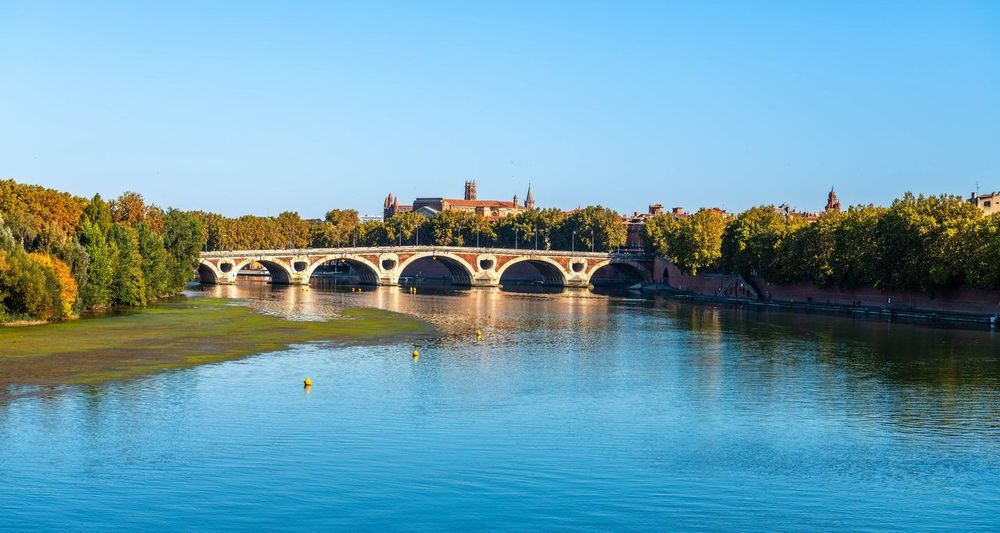
© Shutterstock
 Votre guide Ryo
The 7 Most Beautiful Villages Around Toulouse to Visit in 2026
Just leave the Pink City by any road and you'll discover that the most beautiful villages around Toulouse are hiding within an hour's drive. The Tarn, Tarn-et-Garonne, Haute-Garonne, and Gers form an arc of territories where medieval bastides perched on promontories sit alongside villages labelled 'Les Plus Beaux Villages de France' with a density that surpasses any other region. Seven villages stand out for their distinct character: a city suspended in the clouds, a stone triangle above the Tarn, a pastel-strewn belvedere, a white village on the road to Santiago. Before setting off on the roads of Occitanie, if you haven't yet explored our audio-guided tour of Toulouse with its 26 audio tracks and 6.5 km of narrated heritage, that is the logical starting point. This guide then takes you to seven day trips that are well worth the detour — or the full day.
Cordes-sur-Ciel: the Suspended City of the Tarn
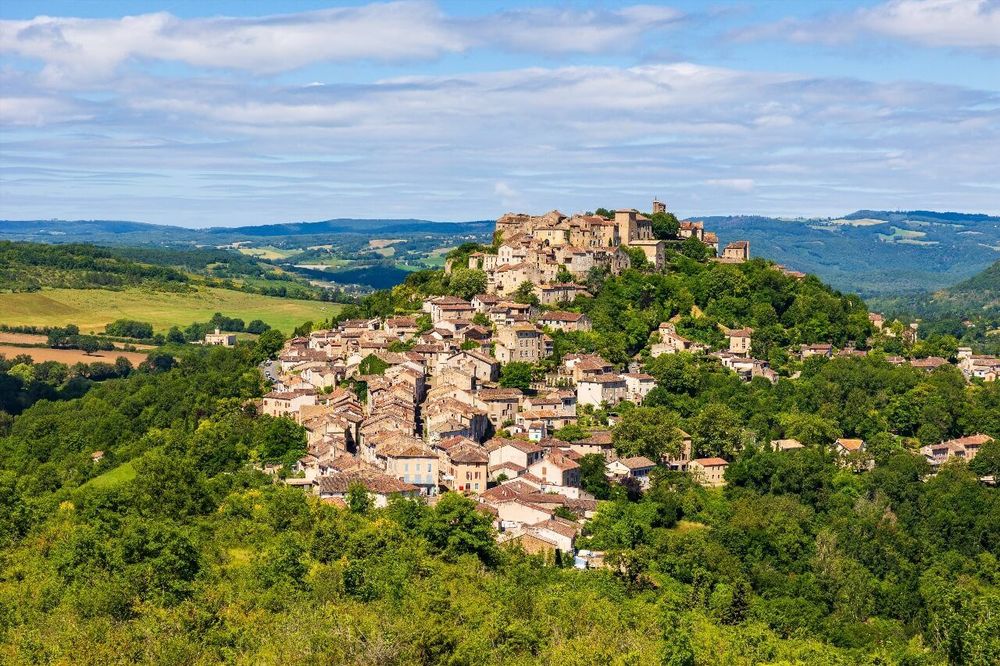
Some 80 km north-east of Toulouse, Cordes-sur-Ciel (Place de la Bride, 81170 Cordes-sur-Ciel, rated 4.6/5 on Google from 80 reviews) is one of those places that single-handedly justifies the reputation of medieval Occitanie. Listed among the 'Les Plus Beaux Villages de France', the village was founded in 1222 by Count Raymond VII of Toulouse and spreads across a rocky outcrop at 279 metres above sea level. On misty mornings, the rooftops emerge above a blanket of white cloud — it is from this image that the village takes its name, meaning 'sky'.
The rue Droite (officially Grand-Rue Raymond-VII) forms the backbone of the village. It climbs gently between Gothic townhouses whose sculpted facades compete in detail: falconry scenes, banquets, mythological tableaux. Four fortified gates follow one another: the Porte de la Jane, the Porte Peinte, the Porte des Ormeaux, and the Porte du Vainqueur. Each marks an additional century of the bastide's expansion.
The Musée Charles Portal displays medieval collections housed in the village's former prison. Right next door, the Maison du Grand Fauconnier boasts the most photographed facade in Cordes: a gallery of ogival windows adorned with birds of prey in high relief. Inside, it houses the town hall and a museum dedicated to Surrealist artist Yves Brayer, whose studio was here.
For opening times and access, note that the village has two levels: the lower town accessible by car, and the upper town which is largely pedestrianised. A funicular (paid, a few euros) connects the two levels from April to October. Outside those months, walk up: the climb takes 15 minutes and the steep lanes are part of the experience. The ideal is to arrive early in the morning, before 10am in summer, to walk rue Droite before the tourist crowds arrive. Allow at least half a day, a full day if you plan to visit the museums.
Cordes-sur-Ciel also hosts a makers' market on Sunday mornings from June to September, with craftspeople who have been established in the shops along rue Droite for decades: ceramics, goldsmithing, textiles dyed with madder. A living context that tourist photos never truly capture.
Auvillar: the Magic Triangle of Tarn-et-Garonne
Some 70 km north-west of Toulouse, Auvillar (Place de la Halle, 82340 Auvillar, rated 4.6/5 on Google from 1,800 reviews) sits on a molasse cliff above the Garonne. The village is listed as a 'Plus Beau Village de France' and features on the Camino de Santiago route — two distinctions that together ensure particular care is taken of the public space.
Its emblem: the circular grain hall from the 18th century. In almost all bastides in the South-West, market halls are rectangular. Auvillar's is round, built on sixteen brick columns with a slate roof sheltering a central space where a Sunday morning market still takes place. The triangular square surrounding it reinforces the sense of uniqueness: there is no other public square of this shape combined with a circular hall anywhere in France.
The Tour de l'Horloge, a former fortified gate converted into a bell tower in the 18th century, provides access to the upper town. From there, a walk along the chemin de ronde follows the southern rampart and offers a sweeping view over the Garonne valley, the river's meanders, and, on clear days, the first Pyrenean foothills. At the foot of the cliff, the port retains a few buildings from the era when Auvillar was an important stopping point for river traffic on the Garonne.
The Musée du Vieil Auvillar, housed in the former prison, preserves collections of Auvillar faience — a flourishing local production in the 17th and 18th centuries, identifiable by its blue floral patterns on a white ground. Enthusiasts of antique ceramics will find rare documentation here on a technique that has almost disappeared.
For pilgrims on the Camino de Santiago, Auvillar represents the first iconic stage of the Vézelay route after crossing through Lot-et-Garonne. But even without a backpack, the village deserves two to three hours of leisurely wandering. Come on a Sunday for the market if possible — the circular hall in full swing is a sight in itself.
Saint-Félix-Lauragais: the Pastel Belvedere
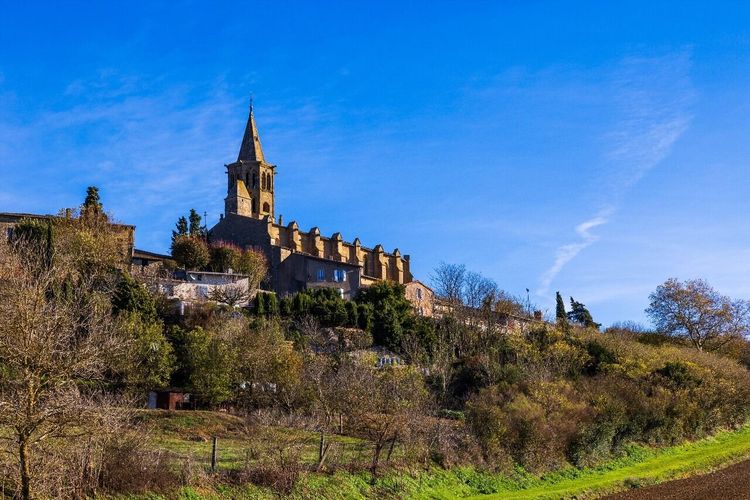
Some 40 km south-east of Toulouse, Saint-Félix-Lauragais (Place du Barry, 31540 Saint-Félix-Lauragais, rated 4.6/5 on Google from 13 reviews) is the closest village to the Pink City in this selection, and one of the least known despite its exceptional setting. Perched on a hill at 360 metres, it overlooks a landscape of gentle slopes where pastel once grew — the plant that supplied a precious blue dye to Europe's weavers and made Toulouse's fortune in the 15th and 16th centuries.
The Place du Barry forms the heart of the village: an esplanade lined with elm trees, flanked by a 19th-century wooden market hall, with a 180-degree view over the Lauragais hills. On clear days, the Montagne Noire is visible to the north-east and the Pyrenees to the south. It was here that the Lévis family established its stronghold at the heart of the Cathar Lauragais — a historical detail recalled soberly by commemorative plaques.
The Église Saint-Félix, in the southern Gothic style, preserves high-quality Baroque furnishings: gilded altarpieces, carved woodwork, and a 15th-century polychrome wooden Virgin. Adjacent to the church, the château (private property, not open to visitors) dates from the 14th and 15th centuries, but its square towers are visible from the square.
For a richer visit, combine Saint-Félix with Revel (15 km to the south-east), another medieval bastide with a large covered market hall from the 14th century, and the Lac de Saint-Ferréol (18 km), a great dam built in the 17th century to supply the Canal du Midi. This circuit of under 50 km from Toulouse makes for a coherent and varied full day. If the Canal du Midi appeals to you, our article on the visit to the Canal du Midi details the best stops along the way.
Lautrec: Pink Garlic and Windmills
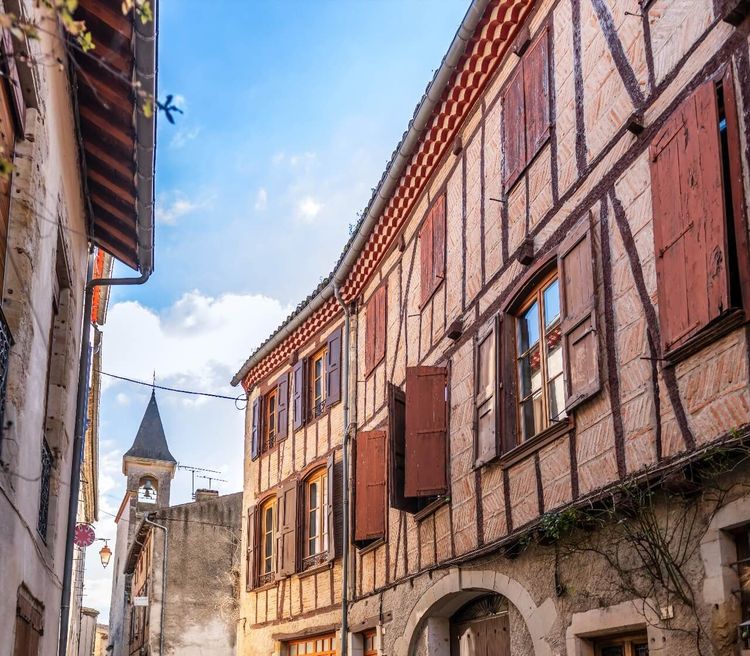
Some 75 km east of Toulouse, Lautrec is known throughout France for an unexpected agricultural speciality: Lautrec pink garlic, protected by a Label Rouge since 1966 and by a PGI since 1996. Also listed as a 'Plus Beau Village de France', this medieval village perched on a rocky spur in the Tarn produces several hundred tonnes each year of a garlic that is milder in flavour and longer-lasting than standard varieties. Pink garlic cultivation still shapes the surrounding agricultural landscape, with its densely planted rows visible from the road.
But Lautrec is more than garlic. The old town concentrates several remarkable architectural features: the Moulin à Vent de la Salette, restored and fully operational, dominates the village from its promontory and is its emblematic image. Below it, the Collégiale Saint-Rémy (14th century) contains a particularly expressive white marble pietà, along with a goldsmith's treasury displayed in the sacristy.
The village's lanes follow the topography of the spur: red-brick staircases connect the different levels, and covered passageways (known as 'andrones') pierce the houses at mid-height — a medieval circulation system found in very few other Occitan villages. The Porte de la Caussade, a fortified gate-tower from the 14th century, marks the main entrance to the town.
Every Friday morning from July to October, the garlic market allows you to buy directly from producers. Outside those months, the village's grocery shops stock pink garlic in braids or heads. The Lautrec garlic braid is, moreover, a recognised emblem of Occitan gastronomic heritage. Allow an hour and a half for the visit, two hours including the village museum.
Bruniquel: the Village of Two Castles and a Prehistoric Cave
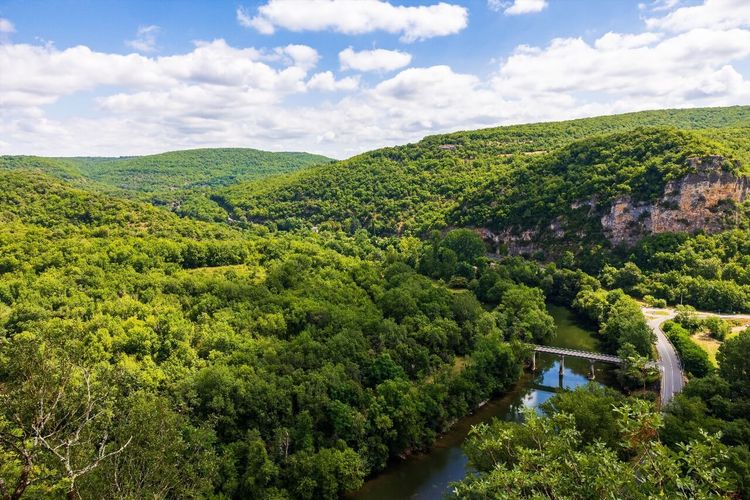
Some 90 km north-east of Toulouse, Bruniquel (Village de Bruniquel, 82800 Bruniquel, rated 4.6/5 on Google from 2,400 reviews) boasts assets that go well beyond the aesthetics of a medieval village. Listed as a 'Plus Beau Village de France', it clings to a rocky promontory at the confluence of the Aveyron and the Tarn, and is primarily known for its two adjacent castles — the 'Old' and the 'Young' — built by two branches of the same family who did not see eye to eye.
The old castle dates from the 12th century, the young castle from the 15th. Both are open to visitors and form a coherent ensemble whose terraces offer a sweeping view over the confluence of the Aveyron and the Vère. The descent to the river through cobblestone lanes and half-timbered houses reveals a village that remains intact, free from discordant tourist additions.
But the real surprise lies beneath the village. The Bruniquel cave, whose entrance was cleared in 1990, contains circular structures built by Neanderthals 176,500 years ago — the oldest known constructions ever made by any member of the human lineage. Some 400 sections of broken stalagmites arranged in deliberate circles were precisely dated using the uranium-thorium method, upending theories about the cognitive capabilities of Neanderthal man. The cave is only accessible on a guided tour with a very limited daily quota; advance booking is mandatory, several weeks ahead during high season.
The village itself can be visited in an hour and a half, including the castles. With the cave, allow a half day. Bruniquel pairs easily with Puycelsi (20 km to the south), also listed as a 'Plus Beau Village de France', and Castelnau-de-Montmiral for a loop through the Tarn without any repetition of scenery.
Castelnau-de-Montmiral: the Tarn's Fortified Gem
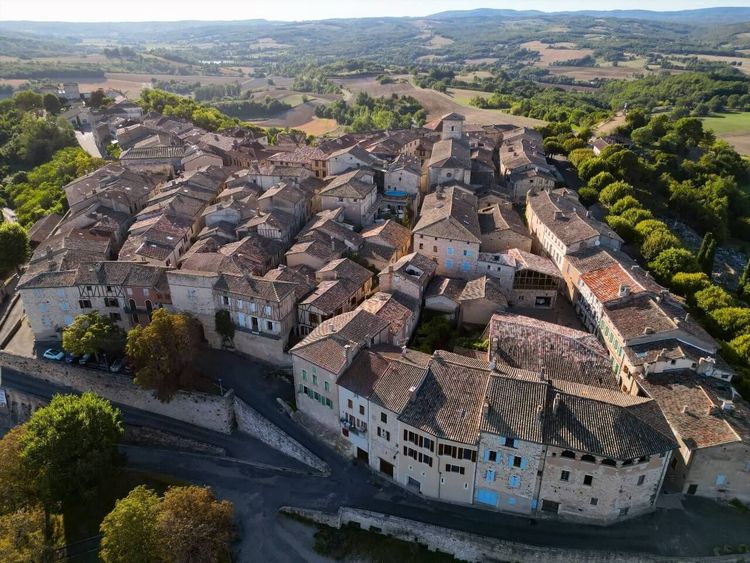
Some 80 km north-east of Toulouse, Castelnau-de-Montmiral (Place des Arcades, 81140 Castelnau-de-Montmiral, rated 4.5/5 on Google from 1,300 reviews) is perhaps the best-preserved bastide in the entire Tarn département. Also listed as a 'Plus Beau Village de France' and founded in 1222 by the Count of Toulouse (the same year as Cordes-sur-Ciel, the same founder), it has retained its central arcaded square, its orthogonal streets, and its Gothic townhouses in an exceptional state of preservation.
The Place des Arcades concentrates most of the heritage: 13th- and 14th-century arcaded houses in brick and white stone frame a gently sloping square where a Sunday morning market still takes place. The Église Saint-Pierre-et-Saint-Paul preserves a 13th-century enamelled gold reliquary, the Saphir des Armagnac, and Renaissance furnishings of rare quality for a village of this size.
Around the village, the Gaillac (AOC) vineyards produce dry whites, tannic reds, and lightly sparkling perlé wines that are a source of local pride. Several wine estates welcome visitors within a 10 km radius. If you'd like to explore the vineyards of Occitanie more broadly, our article on the vineyards of Occitanie offers a map of the main appellations.
Castelnau-de-Montmiral can be visited in one to two hours. The terrace at the end of the Place des Arcades reveals a view over the vineyards and, in the distance, the Forêt de Grésigne — the largest state-managed forest in the Tarn, covering 4,000 hectares of sessile oaks. Back in Toulouse, our audio-guided tour of the Pink City strings together twenty-six stops along 6.5 km.
Lauzerte: the White Village on the Road to Compostela
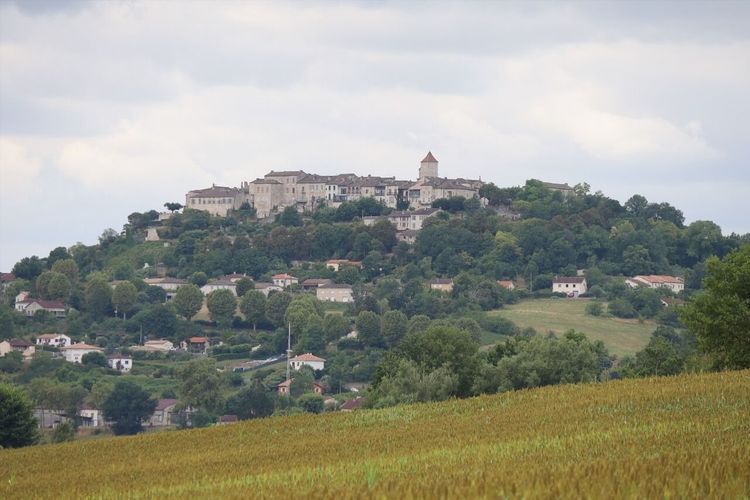
Some 100 km north-west of Toulouse, Lauzerte (Place des Cornières, 82110 Lauzerte, rated 4.6/5 on Google from 1,600 reviews) is the most distant village in this selection, yet one of the most striking. Perched on a limestone spur at 224 metres, the white village of the Quercy Blanc overlooks a countryside of clay soils and wooded hills. Listed as a 'Plus Beau Village de France', it is also a major stop on the Camino de Santiago via Moissac.
The Place des Cornières is the centre of gravity of Lauzerte: a medieval arcaded square where the white limestone houses contrast sharply with the pink brick of the Tarn villages. Beneath the arches, craft workshops and a few discreet restaurants occupy the ground floors. The whole ensemble is small — the village has only around 1,500 permanent residents — but possesses a rare architectural coherence.
The Église Saint-Barthélémy (13th century) houses a 14th-century stone Virgin and Child and 15th-century frescoes discovered beneath a layer of whitewash during a recent restoration. The chemin de ronde running around the former ramparts offers panoramic views over the Quercy hills and, on certain autumn days, towards the Pyrenees.
Lauzerte is ideally visited in combination with Moissac (25 km to the south-west), whose Abbaye Saint-Pierre houses a 12th-century Romanesque cloister considered one of the finest in France. The two villages make for a full day's exploration of Tarn-et-Garonne, with a pilgrimage route logic that gives the itinerary real meaning.
How to Plan Your Day Trips from Toulouse
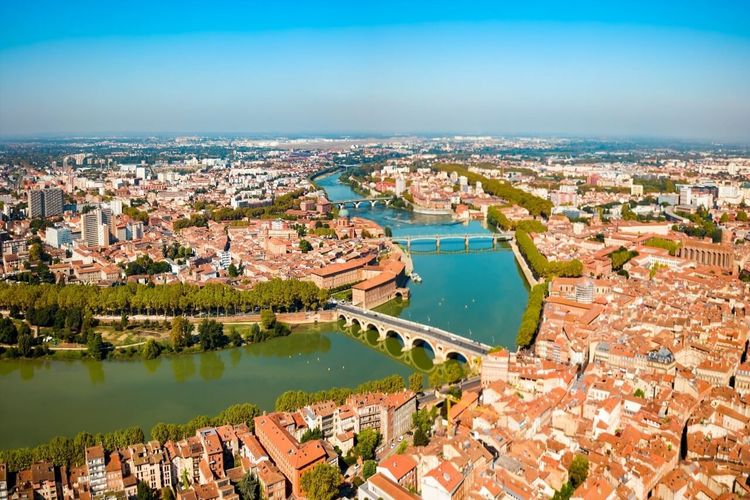
The seven villages in this selection are spread within a radius of 40 to 100 km around Toulouse, which calls for different visiting strategies depending on your base.
For villages under 50 km away — Saint-Félix-Lauragais in particular — a half-day is sufficient, combined with another stop on the way back. For villages beyond 80 km (Cordes-sur-Ciel, Bruniquel, Lauzerte), a full day is needed, or even an overnight stay in high season to enjoy the village in the morning before the tour coaches arrive.
The departmental roads are often faster than GPS suggests for these destinations: the D622 towards Lautrec and Castelnau-de-Montmiral, the D11 towards Auvillar from the A62, the road towards Bruniquel from Montauban. Check museum and castle opening hours before you set off — several close on Mondays outside the season. To round out your knowledge of the region, our guide on Discovering Occitanie covers the must-sees beyond the bastides alone.
In terms of seasonality, spring (April–June) and autumn (September–October) offer the best conditions: golden light, mild temperatures, and moderate crowds. Summer is still possible but requires more careful planning, especially for visits to the Bruniquel cave and the markets. Here too, extending the experience with the Ryo audio guide to Toulouse allows you to connect these day trips with the discovery of the Pink City itself.
Practical Information
Distance from Toulouse: from 40 km (Saint-Félix-Lauragais) to 100 km (Lauzerte). All villages are accessible by car; some have bus connections from Toulouse or Albi, but with limited frequency that is not suitable for a full-day visit.
Average budget: museum and castle entry fees between €4 and €8 per adult. The Bruniquel cave exceeds €12 due to its rarity and limited capacity. Beyond entrance fees, factor in fuel and a meal on site.
Accommodation: each of these villages has at least one bed and breakfast or small hotel. Cordes-sur-Ciel and Auvillar have the most developed offering, with several establishments across different price ranges. To connect these day trips with a deeper exploration of Toulouse itself, the Ryo audio guide to Toulouse lets you discover the Pink City entirely at your own pace, with 23 commented stops over 6.5 km.
For hikers: several GR long-distance trails pass through these villages — the GR46 runs through Bruniquel and Lauzerte on the Camino de Santiago. Our article on hiking around Toulouse highlights routes that can be done as a day trip from the city.
FAQ
Which is the most beautiful village to visit in a day from Toulouse?
Cordes-sur-Ciel remains the most complete choice for a full day: the village is large, the museums are plentiful, and the architectural richness of rue Droite easily fills four to five hours. For a half-day, Saint-Félix-Lauragais is the most accessible (40 km) with an exceptional view over the Lauragais.
Are the villages around Toulouse accessible without a car?
With difficulty. Most are connected to Toulouse by regional bus lines, but with frequencies of only two to three services per day and timetables that are not well suited to a full visit. The train serves Cordes-sur-Ciel from Toulouse via Albi (approximately 1h30), but without a direct link to the village itself, a taxi or bicycle is needed from Vindrac-Alayrac station. A car remains the most practical means for these day trips.
Which village should I choose to discover Lautrec's pink garlic?
Lautrec, of course — the birthplace of the label. The Friday morning market (July–October) is the best opportunity to buy directly from farmers. Outside market season, local grocery shops and cellars stock pink garlic in braids or heads all year round.
Which villages near Toulouse are labelled 'Les Plus Beaux Villages de France'?
Six of the seven villages in this selection carry the national label: Cordes-sur-Ciel, Lautrec, Castelnau-de-Montmiral (Tarn), Auvillar, Lauzerte, and Bruniquel (Tarn-et-Garonne). Puycelsi (Tarn) also features in the area. Only Saint-Félix-Lauragais does not belong to the association, but it remains a top-tier destination for its views over the Lauragais.
Can you visit the Bruniquel cave freely?
No. The Bruniquel cave is only accessible on a guided tour, with a very limited daily quota to preserve the Neanderthal structures. Booking is mandatory and must be made several weeks in advance in summer. Check the Bruniquel town hall website or the Quercy Vert tourist office for exact details.
Conclusion
From the hills of the Lauragais to the cliffs of Tarn-et-Garonne, these day trips map out a territory of surprising diversity within a 100 km radius. Each village has its own logic: the altitude and Gothic castles of Cordes, the circular hall of Auvillar, the pink garlic of Lautrec, the Neanderthal prehistory of Bruniquel. These villages do not replace Toulouse — they extend it. Before hitting the road, or on your return, the Ryo audio guide to Toulouse lets you explore the Pink City with 23 audio commentaries covering its unmissable monuments and neighbourhoods — a way to make sure you miss nothing, in the city or beyond.
À lire également