© Shutterstock
 Votre guide Ryo
Waterfalls Swimming in Occitanie: The Most Beautiful Natural Spots (2026)
Occitanie is one of France's richest regions for waterfalls accessible for swimming. Searching for the best waterfall swimming spots in Occitanie means discovering Pyrenean torrents, limestone gorges and secret pools nestled in wooded valleys, where the water stays at 15–18°C even during heatwaves. Not just the famous tourist highlights, but also dozens of hidden spots that this guide will help you find. This guide lists the best waterfall swimming spots in Occitanie department by department, from the Pyrenean torrents of Ariège to the rivers of the Cévennes in the Gard, taking in the schist-carved basins of Lozère and the Cathar gorges of the Aude.
A few figures to set expectations: the region covers 72,724 km² and stretches from sea level to over 3,000 metres altitude in the Pyrenees. This diversity of terrain explains the variety of waterfalls: from monumental falls like that of the Cirque de Gavarnie (422 metres high, the tallest in Western Europe) to the secret pools of Lozère reachable after a 20-minute walk, as well as the limestone potholes of the Gard where around ten drownings have been recorded since 2000. For more cultural days, the Ryo audio-guided tour of Toulouse lets you explore the Pink City before heading to the gorges. For more swimming spots around the Occitan capital, this article on swimming spots around Toulouse complements this guide.
Ariège: Pyrenean Waterfalls Accessible to All
Ariège is undoubtedly the department that concentrates the most waterfall swimming spots in Occitanie for a reasonable difficulty level. The massifs of the pays de Foix and the Couserans are home to dozens of torrents that tumble over granite or schist rocks, forming natural pools sometimes several metres deep.
The cascade d'Ars, near Aulus-les-Bains, is the department's most iconic waterfall. It unfolds over 246 metres in total, in three successive steps, within a wooded cirque that the inhabitants of the Garbet valley have been visiting for generations. The hiking trail from the village of Aulus-les-Bains climbs steadily over 4.5 km before reaching the first pools — allow 1h30 one way. The water, fed by high-mountain snowfields, is cold even in July (10–12°C at best), but the mid-trail pools offer more accessible swimming than the basins at the foot of the main drop.
About thirty kilometres to the north-east, the village of Roquefort-les-Cascades lives up to its name. Located in the Arget valley, it is surrounded by several waterfalls that tumble directly along the edge of the village. The falls, fed by karstic springs, are accessible on foot within a few minutes from the car park. The ideal season for swimming here runs from mid-June to mid-September: before that, the flow is too powerful; after that, the water level drops too much to form deep pools. The site remains little known outside Ariège, meaning it is almost deserted on weekdays even in the middle of August.
More secluded still, the waterfalls of the vallée de l'Orlu (Réserve naturelle de l'Orlu, 09110 Ax-les-Thermes, rated 4.7/5 on Google with 51 reviews), above Ax-les-Thermes, reward hikers willing to walk 7 km to reach the first basins. The national nature reserve of l'Orlu protects this area: no vehicles beyond the refuge, no tourist facilities. In return, the pools you find at the end of the trail rank among the clearest in the entire Pyrenean range. The bottom is visible at 3–4 metres depth, a rarity for mountain waters.
Ariège remains a lightly visited department compared to the central Pyrenees, which explains why its waterfall swimming spots in Occitanie remain well preserved even in August. For days when the weather turns, the Ryo guide to Pyrenees must-sees offers cultural and historical alternatives throughout the range.
Hautes-Pyrénées: the Breathtaking Cirque de Gavarnie
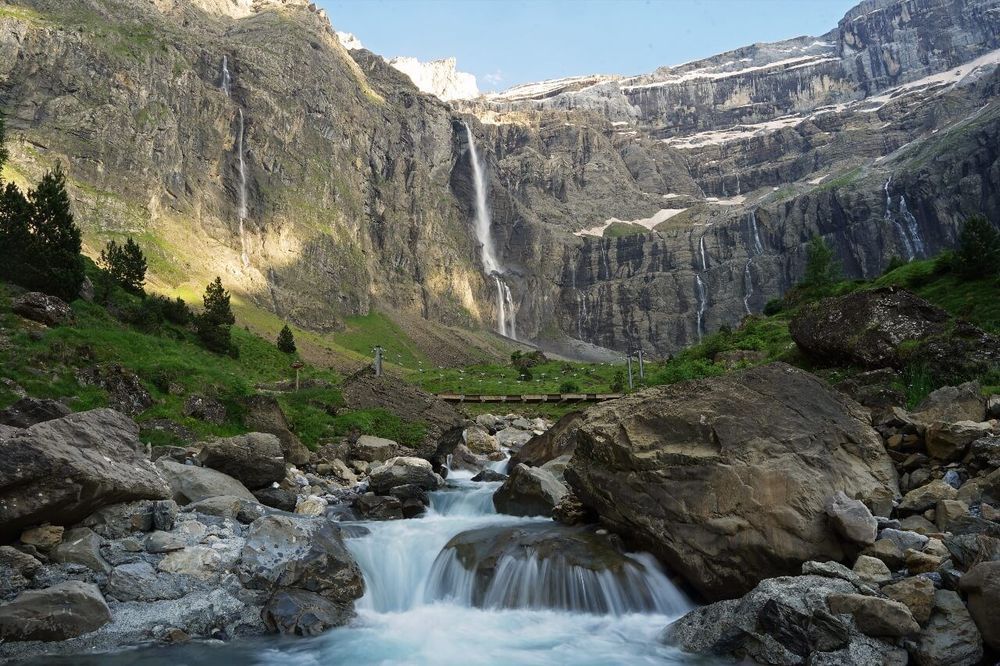
The waterfall of the Cirque de Gavarnie (Cirque de Gavarnie, 65120 Gavarnie, rated 4.8/5 on Google with 1,808 reviews) is alone a sufficient reason to cross the whole of Occitanie. With its 422-metre free fall, it holds the title of the tallest waterfall in Western Europe — a fact the people of Gavarnie are fond of telling their visitors, but which the cloud of mist at the foot of the falls makes even more impressive than the numbers suggest.
Access is from the village of Gavarnie (listed among the most beautiful villages in France) via a flat trail of 4.2 km one way, suitable for families with children from age 6. The site has been a UNESCO World Heritage Site since 1997 as part of the Parc national des Pyrénées. An important note: swimming at the foot of the main waterfall is not recommended — the current from glacial melt is unpredictable and rocks regularly fall from the cirque walls. However, the gave de Gavarnie that flows through the meadow upstream from the cirque offers calmer swimming spots with water at 8–12°C.
The Hautes-Pyrénées massif offers several other waterfalls with easier swimming areas. In the neighbouring valley of Gèdre, waymarked GR trails following the gave de Gavarnie reveal pools sheltered from the mountain wind, slightly warmer in the late afternoon when the sun catches the dark rocks.
For experienced hikers, the brèche de Roland (2,807 metres) towers over the cirque from the Spanish side. The ascent from the Bellevue plateau offers plunging views of the waterfall from above — a radically different perspective from the floor of the cirque. Allow a full day and hiking boots suited to persistent snow, even in July.
Among the waterfall swimming spots in Occitanie, those in the Hautes-Pyrénées are best explored by combining nature and culture. From Gavarnie, Lourdes is 50 km away, and Toulouse 2 hours by motorway. For cultural stopovers in the foothills, the towns of inland Occitanie are covered by Ryo audio guides available offline.
Gard: the Sautadet Potholes and the Cévennes Gorges
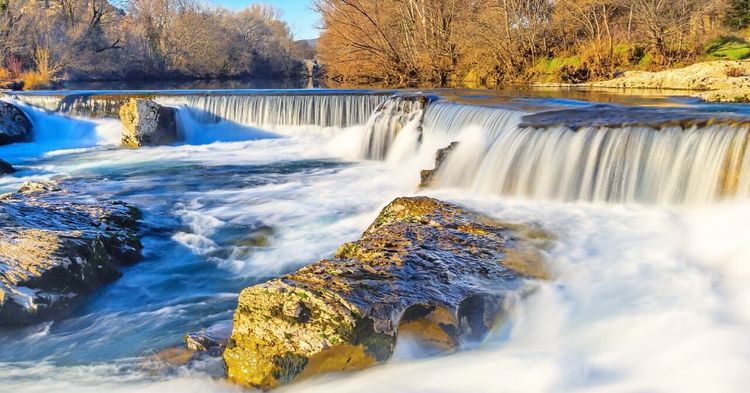
The cascades du Sautadet, in the commune of La Roque-sur-Cèze, are among the most photographed waterfall swimming spots in Occitanie. Yet a large proportion of travellers visiting Nîmes or Avignon don't know they exist less than an hour's drive away.
The Cèze has carved into the Urgonian limestone a succession of potholes and tiered waterfalls stretching over several hundred metres. Some potholes reach 3–4 metres in depth, deep enough to jump from the adjacent rocks — something locals do every summer. The Sautadet is nicknamed the 'Grand Canyon of the Gard' in regional guides, a slightly exaggerated metaphor but one that captures the striking effect of the limestone gorges on visitors.
Warning: the site has seen many serious accidents linked to slippery rocks and hidden currents in the potholes. Avoid the red-marked zones, respect the safety signs, and never swim alone. In the event of a sudden flood (possible even in fine weather if storms have occurred upstream), the water can rise several metres in a few minutes.
Visitor numbers at the Sautadet surge between July and August. To avoid the crowds, arrive before 9:30 am or after 5 pm. The paid car park at the entrance to the village of La Roque-sur-Cèze is the only option available; budget €2–3 depending on the season.
Still in the Gard, the cascade de Saint-Laurent-le-Minier (Saint-Laurent-le-Minier, 30440 Saint-Laurent-le-Minier, rated 4.4/5 on Google with 6,221 reviews) attracts a different clientele: mostly families and hikers looking for a less demanding site than the Sautadet.
The village of Saint-Laurent-le-Minier, clinging to the foothills of the Cévennes in the Vis valley, is crossed by a stream that flows into a natural basin surrounded by old plane trees. The waterfall itself is modest — a drop of around 8 metres — but the setting is remarkable and the water particularly gentle compared to the Pyrenean torrents. Families with young children find an ideal spot here: gentle current, accessible floor, bordered by a naturally shaded area.
For Roman heritage enthusiasts, Nîmes is only 55 km to the east. The Ryo audio-guided tour of Nîmes (26 audios, 2h45 of walking, 6 km) lets you discover the arenas, the Maison Carrée and the jardins de la Fontaine — an ideal cultural half-day to complement a morning of swimming in the Cévennes of the Gard.
Tarn: Forest Waterfalls and Jade-Coloured Rivers
The Tarn is the most underrated department for waterfall swimming in Occitanie. Its forested massifs, between the Sidobre and the Montagne Noire, hide several remarkable sites that standard tourist circuits overlook in favour of bastide towns and museums.
The cascade du Saut de la Truite, in the Montalet forest, is one of these well-kept secrets. It lies in a beech-fir forest at altitude, at around 1,000 metres altitude, on the northern flank of the Montagne Noire.
The main drop measures around 12 metres and plunges into a rocky basin of a deep green — the colour comes from the tannins of the conifer forests that filter the water from the Espinouse plateau. The access trail from the hamlet of Anglès is short (1.2 km one way) and waymarked. The water is remarkably cool: expect 14–16°C in the height of August. No facilities on site — bring your own supplies and take your waste with you.
At the other end of the department, the cascade des Baumes (Saint-Pons-de-Thomières, 34220 Saint-Pons-de-Thomières, rated 4.5/5 on Google with 123 reviews), near Saint-Pons-de-Thomières, has a different character: a multi-veil fall cascading through Mediterranean garrigue vegetation. Access is easier than for the Saut de la Truite, with a 2 km trail from the car park at the hamlet of Baumes. The pools are wider, the water slightly warmer (16–18°C in July), and the soundscape — cicadas rather than mountain wind — radically changes the atmosphere.
The Agout river and its tributaries offer several complementary swimming spots throughout the Tarn. At Lacaune and Brassac, the rivers descend from the monts de Lacaune forming rapids and natural pools appreciated by local families. The Agout crosses landscapes of granite plateaux little touched by mass tourism.
The city of Albi, the Tarn's departmental capital, is 80 km from the department's main aquatic spots. The Albi audio walking tour (27 audios, 1h40 on foot) makes an ideal cultural stopover the day before or after a waterfall day. To complete your discovery of the Tarn and its surroundings, this article on the surroundings of Albi presents other points of interest around the red city.
Aveyron: Secret Gorges and Swimming in the Heart of the Massif Central
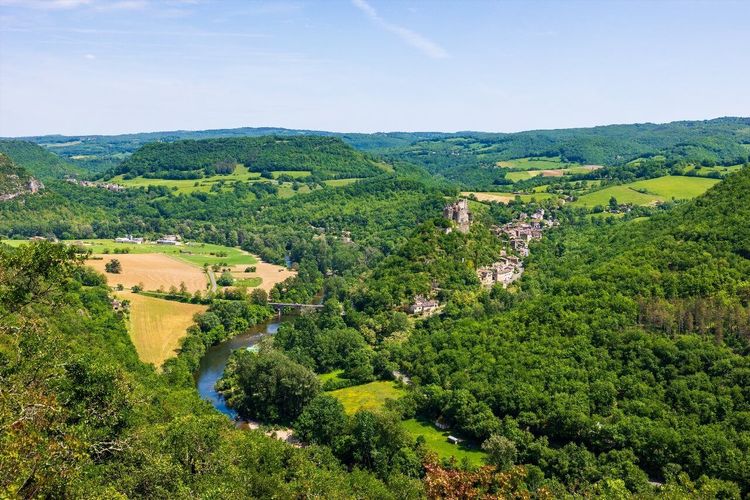
Aveyron is a department that must be earned: the roads are winding, distances deceptive, and mobile coverage unreliable in the gorges. In return, you will find some of the most unspoilt waterfall swimming spots in Occitanie in the whole of southern France.
The cascade d'Agen d'Aveyron, on the Comtal plateau about fifteen kilometres from Rodez, is one of the region's most accessible lowland waterfalls. The stream that feeds it descends from the limestone plateau in a drop of 15–20 metres before flowing into a sizeable natural pool surrounded by ash and willow trees.
The gorges de la Dourbie (Millau, 12100 Millau, rated 4.7/5 on Google with 47 reviews), in the east of the department, are among the most visited waterfall swimming spots in Occitanie in Aveyron during summer. The Dourbie descends from the Aveyronnais Cévennes through a limestone canyon 25 km long, with waters that stay cool (16–18°C) thanks to the altitude and depth of the gorges. Millau is the natural starting point for exploring this area — the viaduc de Millau, visible in the background from the gorge viewpoints, adds an unexpected architectural dimension to the landscape.
Aveyron shares with neighbouring Lozère several swimming sites in the gorges du Tarn — the river rises in the Cévennes and crosses both departments before joining the Lot. The most accessible swimming areas lie between Ispagnac (Lozère) and Millau (Aveyron), along approximately 80 km of river.
Lozère: Three Hidden Waterfalls in the Back Country
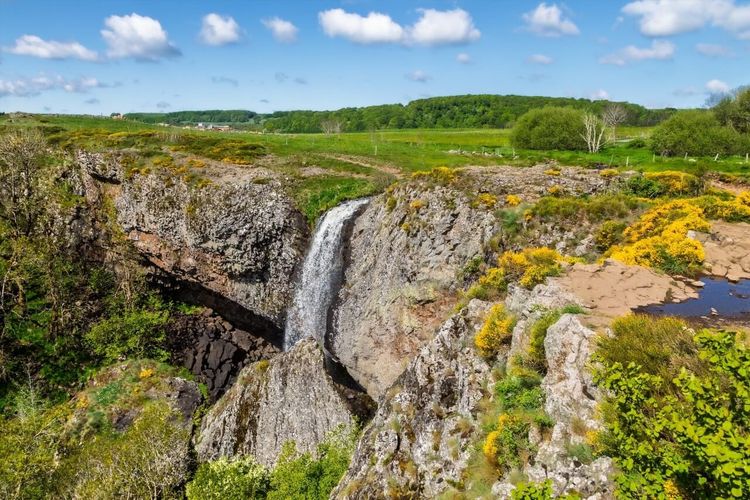
Lozère is the least populated department in metropolitan France — 76,000 inhabitants spread over more than 5,000 km² — and that is precisely what makes its waterfall swimming spots in Occitanie so appealing. No 200-vehicle car parks, no queues to access the pools.
The cascade du Déroc, in the Truyère valley on the Aubrac plateau, is often the first that travellers discover on the road between Espalion and Nasbinals.
It drops 32 metres into a pool of black basalt — the volcanic lava of the Aubrac gives the water a particularly dark hue that contrasts with the white foam of the fall. Swimming is possible in the main pool, but the water is cold even in summer (12–14°C) due to the altitude (1,100 metres). Access from the departmental road is short: 800 metres on foot from the Déroc car park, less than 10 minutes for the quickest walkers.
The cascade de Rûnes, in the east of the department, is a more intimate discovery. It lies in a wooded valley on the foothills of the Lozère Cévennes, accessible via a 2 km trail from the hamlet of Rûnes. The drop is around 20 metres and feeds a pool where swimming is possible from around 1 July to 15 September. The final 500 metres of access are unmarked — it's best to go with someone who knows the terrain or use a GPS.
The cascade du Martinet (Mont Lozère, 48190 Le Bleymard, rated 4.7/5 on Google with 1,364 reviews), in the upper Lozère, is the hardest of the three to reach. Located at 1,400 metres altitude on the high plateaux between Florac and Le Bleymard, it requires a 5 km hike through a landscape of moorland and peat bogs not unlike the Scottish Highlands. The reward: a drop of around 25 metres in a near-pristine environment, with only the griffon vultures soaring over the Lozère Cévennes for company, since their reintroduction in the 1980s.
Lozère is 2h30 by car from Nîmes. If you pass through the Gard on the way, the Ryo audio guide of Nîmes (6 km of city walking) will keep you occupied for half a day before heading to the gorges du Tarn.
Aude: Between Cathar Gorges and Corbières Torrents
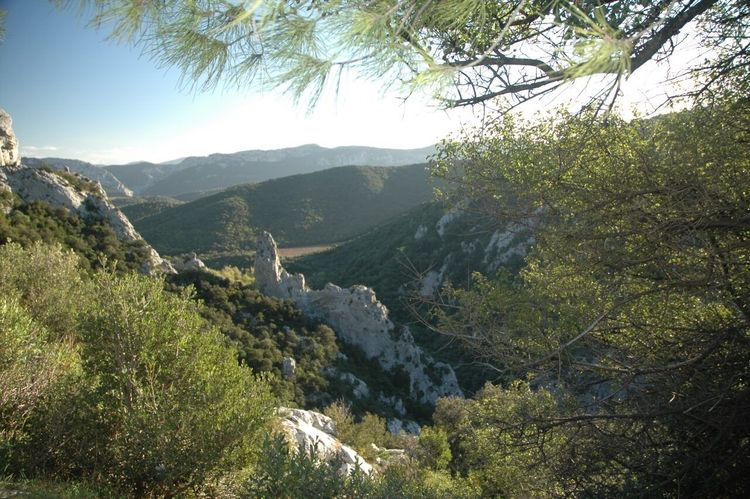
The Aude brings together two radically different landscapes: the Audois Pyrenees to the south (the Madres massif, the valleys of the Aude and the Rebenty), and the Corbières to the north, a land of garrigue and vines where limestone gorges carve vertiginous canyons. Waterfall swimming spots in Occitanie are spread across both zones, with very distinct characters.
The cascades de Duilhac, in the heart of Cathar country, lie a few kilometres from the château de Peyrepertuse, one of the best-preserved medieval fortresses in Occitanie.
The stream that flows through the village of Duilhac-sous-Peyrepertuse tumbles down several rocky tiers before reaching the plain, forming a succession of small waterfalls and shaded pools that are particularly pleasant in summer. The water comes from the limestone springs of the Corbières and stays at 17–19°C in July — an ideal temperature for a long swim. The site is quiet on weekdays, busier at weekends, and remains noticeably calmer than the Sautadet or the gorges de l'Hérault.
The cascades de la Nielle, in the Corbières massif, are an even more secluded site. Accessible from the village of Durban-Corbières, they flow through a wooded ravine of holm oaks and junipers. The access hike (3 km one way) crosses a garrigue landscape that contrasts with the dampness of the ravine — the sudden and spectacular change in vegetation occurs less than 50 metres from the first pools.
The Aude is also home to the gorges du Galamus (Saint-Paul-de-Fenouillet, 66220 Saint-Paul-de-Fenouillet, rated 4.8/5 on Google with 5,090 reviews), a canyon where the Galamus has carved at times less than 5 metres between its walls. Swimming is possible in the Galamus itself, downstream from the gorges, from Saint-Paul-de-Fenouillet.
Carcassonne, 50 km north of Duilhac, is the natural logistical base for exploring the waterfalls of the Aude. The Ryo audio-guided tour of Carcassonne (27 audios, 2h30, 5.7 km) covers the medieval city, the porte Narbonnaise and the château comtal — a half-day visit before heading to the gorges. For medieval history enthusiasts, the Ryo guide to the Cathar castles of Occitanie presents the full circuit of the region's fortresses.
Hérault: Limestone Rivers and Stone Villages
Hérault is the department that best combines waterfall swimming in Occitanie with cultural heritage. The medieval village of Saint-Guilhem-le-Désert (listed among the most beautiful villages in France) stands at the entrance to the gorges de l'Hérault, a limestone canyon 25 km long and sometimes 300 metres deep.
The Hérault river itself is the department's main swimming axis. It offers spots for all levels, from family pools to rapids reserved for kayakers. The most frequented areas are concentrated around Gignac, Aniane and Clermont-l'Hérault. The water reaches 20–22°C in July–August in the lowland stretches — a rare warmth for a river in a mountainous region.
The Vis river is Hérault's little-known gem among waterfall swimming spots in Occitanie. It rises in the Gard, flows through the gorges de la Vis for about thirty kilometres, and joins the Hérault at Ganges. The stretch between Madières and Saint-Laurent-le-Minier concentrates the finest pools, accessible on foot via waymarked trails along both banks.
The gorges de l'Orb, in the north of the department, offer a lesser-known alternative to the gorges de l'Hérault. The Orb descends from the monts de l'Espinouse and passes through Hérépian, Bédarieux and Roquebrun (Roquebrun, 34460 Roquebrun, rated 4.4/5 on Google with 890 reviews) — this last village, nicknamed 'the little Saint-Tropez of the Hérault' by its residents, has a pebble beach and particularly warm water thanks to its full south-facing exposure.
Montpellier, 40 km from Ganges, is a good base for the gorges de l'Hérault. The Ryo audio guide of Montpellier (21 audios, 1h30, 3.5 km) covers the historic centre and the Place de la Comédie — perfect for an evening in the city after a day of swimming in the gorges. On the way back, the short version of our Toulouse audio walking tour fits into 14 stops and 4.1 km.
Pyrénées-Orientales: the Canigou and its Torrents
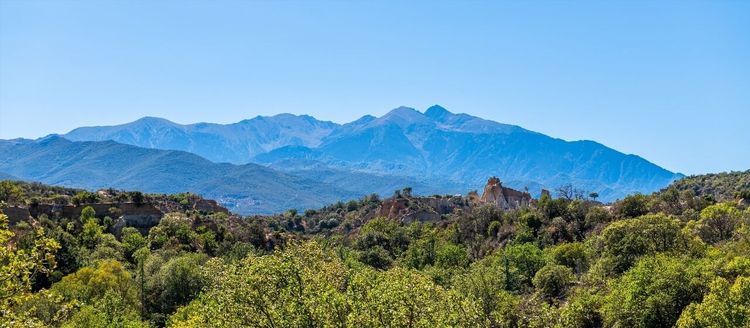
In the popular tourist imagination, the Pyrénées-Orientales are often reduced to their Catalan beaches and the lanes of Collioure. This overlooks the fact that the department possesses one of the most spectacular mountain massifs in the French Pyrenees: the Canigou (2,784 metres), the sacred mountain of the Catalans, whose slopes feed some fifteen torrents that rank among the finest waterfall swimming spots in Occitanie.
The cascade de Nyer (Nyer, 66360 Nyer, rated 5/5 on Google with 3 reviews), in the Têt valley, is the most accessible in the massif.
It drops 30 metres into a pool of black granite, reachable in 45 minutes on foot from the village of Nyer. Flow is at its peak in June (snowmelt) and decreases gradually until September. In July–August, the pools are at their best for swimming: sufficiently full, moderate current, water at 14–16°C.
The Tech, the main river of the Pyrénées-Orientales, offers several swimming spots between Arles-sur-Tech and Céret. The gorge de la Guillère, above Arles-sur-Tech, concentrates successive pools reached via a botanical trail that follows the Tech for 4 km. The water is particularly clear thanks to the granite rocks that filter it.
Perpignan, the Catalan capital and gateway to the department, is 45 minutes from the gorges via the A9. The Perpignan audio-guided tour (20 audios, 1h, 2.4 km) lets you discover the Palais des rois de Majorque and the Saint-Jacques quarter — a cultural morning before heading up to the Canigou torrents.
Occitanie's Iconic Gorges to Complete Your Stay
Beyond the waterfall swimming spots in Occitanie proper, the region has several gorges where river swimming rivals waterfalls in popularity. These sites deserve a mention as they are often adjacent to the waterfalls described above and can easily be included in the same itinerary.
The gorges du Tarn, between the causse Méjean and the causse du Sauveterre (Lozère and Aveyron), form the great French canyon — 50 km long, with vertical limestone walls exceeding 400 metres in height. The pebble beaches between Sainte-Énimie and La Malène are the most visited swimming areas, accessible by kayak or on foot from the gorge-floor villages. The water of the Tarn here is surprisingly warm in summer (20–22°C) despite the altitude of the caussenard plateau.
The gorges de la Jonte (Le Rozier, 48150 Le Rozier, rated 4.5/5 on Google with 225 reviews) (Lozère–Aveyron), less well known than the gorges du Tarn, offer similar conditions with far fewer visitors. The Jonte joins the Tarn at Le Rozier in a classified site of great beauty — the two gorges meet at a confluence point frequented by ornithologists watching the griffon vultures reintroduced in the 1980s.
Practical Tips for Waterfall Swimming
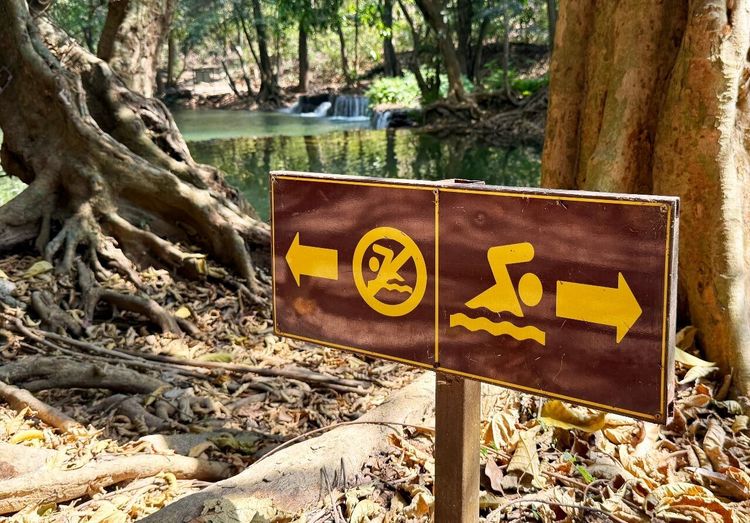
Safety: the Non-Negotiable Rules
Fatal accidents at waterfall swimming sites in Occitanie are recorded every summer, often linked to predictable behaviour. A few simple rules can prevent tragedies.
Never dive into a pool without first checking the depth by hand. Waterfalls shift pebbles and rocks with each flood — a deep basin in June can be shallow in August, and vice versa. Check the depth on every visit, not just the first.
Strictly avoid zones where swimming is prohibited. In Occitanie, local bans (red signs, safety ropes) are based on past accidents in zones with hidden currents or rockfall risk. The Sautadet (Gard) is the most well-documented example.
Check the weather upstream, not just above you. A storm 30 km upstream on the plateau can trigger a flash flood in the gorges below, even when the sky above you is clear. Check the flood alert service Vigicrues before every outing.
Bring something to warm up with. Even in high summer, getting out of 12°C water in a shaded, windy ravine can cause mild hypothermia if you have no dry clothing to hand. A survival blanket weighs 80 grams and could make all the difference.
Recommended Equipment
For high-altitude Pyrenean waterfalls: waterproof hiking boots (avoid flip-flops on any trail longer than 1 km), a dry change of clothes in a waterproof bag, a basic first aid kit. A telescopic walking pole helps negotiate wet rocky sections.
For limestone gorges (Gard, Hérault, Aude): water shoes with non-slip soles — wet limestone is treacherous, far more so than granite. Biodegradable sunscreen (limestone watercourses are fragile ecosystems), a hat (the gorges offer little shade between noon and 3 pm in high summer).
For family sites: armbands or swimming vests for children, even in shallow water, as pool currents can unbalance a child who has not yet mastered swimming.
Environmental Rules
The majority of waterfall swimming spots in Occitanie are located in or near Natura 2000 zones, nature reserves or regional natural parks (Parc national des Pyrénées, Parc national des Cévennes). Picking plants, fishing without a permit, making campfires and wild camping are prohibited in most of these areas. All waste must leave with you — no natural site in Occitanie has bins beside its pools.
The protected species found in these environments include the European otter (present in the rivers of Lozère), the white-throated dipper (nesting on the banks of Pyrenean torrents) and several endemic dragonfly species. Avoid turning over stones in watercourses: they shelter the larvae of aquatic insects and the white-clawed crayfish, an endangered species found in the Cévennes.
When to Go and How to Plan
The Ideal Season
June is the best compromise for mountain waterfall swimming in Occitanie (Ariège, Hautes-Pyrénées, Pyrénées-Orientales): flows are at their peak thanks to snowmelt, the vegetation is lush, and the pools are full. The water is cold (10–14°C at altitude) but the experience is spectacular. Visitor numbers are still reasonable compared to summer.
July and August are the hottest and busiest months. The lowland waterfalls (Gard, Hérault, Aude) are at their best for swimming, with water reaching 18–22°C in low-altitude pools. However, expect full car parks before 10 am at the most popular sites (Sautadet, Saint-Guilhem, gorges de l'Hérault).
September is the connoisseur's month. The crowds depart, the water remains relatively warm in the lowland gorges, and the forests of Aveyron and Lozère begin to turn. The Pyrenean waterfalls drop in flow but remain fed by the first autumn rains.
Planning a Waterfall Circuit in Occitanie
To discover all the waterfall swimming spots in Occitanie, allow 10 to 14 days and a vehicle — public transport does not serve the majority of natural sites mentioned in this guide. A logical loop from Toulouse could follow this order:
Toulouse → Ariège (2 days) → Hautes-Pyrénées (2 days) → Aude and Corbières (2 days) → Hérault and Gard (2–3 days) → Lozère (2 days) → return via Aveyron.
Toulouse is Occitanie's aviation hub, with direct flights from all major French cities. For a cultural stopover at the start or end of your trip, the Ryo audio-guided tour of Toulouse covers the historic centre in 2h40 (26 audios, 6.5 km). Narbonne is another good base for the Aude–Hérault area, to discover with the Ryo audio guide of Narbonne (21 audios, 1h40, 4 km).



FAQ
What Is the Tallest Waterfall in Occitanie?
The waterfall of the Cirque de Gavarnie (Hautes-Pyrénées) is the tallest waterfall in Occitanie and in metropolitan France, with a main drop of 422 metres. It is also considered the highest waterfall in Western Europe. It is easily accessible from the village of Gavarnie (flat trail of 4.2 km one way), suitable for families with children. Swimming at the base of the falls is not recommended due to glacial currents and rockfalls from the cirque walls; calmer swimming spots exist in the gave de Gavarnie, upstream from the cirque.
Where Can You Swim in Waterfalls with Children in Occitanie?
The best spots for family swimming with young children are:
- Saint-Laurent-le-Minier (Gard): shallow pool, gentle current, abundant natural shade
- Roquefort-les-Cascades (Ariège): waterfalls accessible on foot from the village car park, varied pools
- Roquebrun on the Orb (Hérault): pebble beach by the river, warm water in summer
- Sainte-Énimie in the gorges du Tarn (Lozère): pebble beaches, calm water, village with shops nearby
Avoid the Sautadet (Gard) with young children due to the danger of the potholes and the extremely slippery rocks.
Is the Sautadet Dangerous for Swimming?
The Sautadet ranks among the most dangerous swimming sites in Occitanie, with several fatal accidents recorded. The potholes carved into the limestone can reach 4 metres in depth, internal currents are unpredictable, and the rocks are extremely slippery. Swimming is officially discouraged in the red-marked zones. It is still possible to swim in the authorised areas, provided you never go alone, check weather and flood alerts (Vigicrues) before your visit, and never dive without first checking the depth.
Which Waterfalls in Occitanie Are Accessible Without a Long Walk?
Several waterfall swimming spots in Occitanie can be reached in under 20 minutes on foot from a car park:
- Cascade du Déroc (Lozère): 800 metres from the Déroc car park, about 10 minutes
- Cascades de Roquefort-les-Cascades (Ariège): direct access from the village centre
- Cascades du Sautadet (Gard): 5 minutes from the La Roque-sur-Cèze car park
- Cascade de Saint-Laurent-le-Minier (Gard): a walk through the village (10 minutes)
For more remote waterfalls — the cascade du Martinet in Lozère and the vallée de l'Orlu in Ariège — allow at least 1h30 of walking one way.
When Do the Waterfalls in Occitanie Have the Highest Flow?
Maximum flow varies depending on geographic location:
- Pyrenean waterfalls (Ariège, Hautes-Pyrénées, Pyrénées-Orientales): peak in May–June during snowmelt. The torrents are spectacular at this time, but sometimes too powerful for safe swimming.
- Cévennes waterfalls (Gard, Hérault, Lozère): fed by autumn rainfall and karstic springs, they can show high flow until July.
- Corbières waterfalls (Aude): Mediterranean regime with a peak in March–April and severe low water in August–September.
The period that combines good flow and pleasant swimming is generally June–July for the whole region. This is the window ### Can You Wild Camp Near the Waterfalls of Occitanie?
Wild camping is prohibited in almost all sites near waterfall swimming spots in Occitanie, particularly in Natura 2000 zones, nature reserves and national parks (Parc national des Pyrénées, Parc national des Cévennes). A few exceptions exist in high mountain areas (bivouac more than one hour's walk from a road, one night only), but rules vary by municipality and mountain range. The simplest solution is to consult the departmental tourist offices — Ariège Tourisme, Hautes-Pyrénées Tourisme or Lozère Tourisme — to find out the precise rules for each area before you leave.
Conclusion
Few French regions can match the density of waterfall swimming spots and river bathing sites found in Occitanie. From the near-deserted Lozère to the busy summer Gard, via the glacial torrents of the Ariège Pyrenees, there is something for every taste and every level of fitness. The key is to choose your department based on your tolerance for crowds and your physical condition, and to arrive early at the most popular sites. Whatever your destination, the waterfall swimming spots of Occitanie offer a playground of rare variety.
To round off your days in nature with cultural evenings, the Ryo audio-guided tours cover the main cities of Occitanie: Toulouse, Nîmes, Carcassonne, Albi, Montpellier, Perpignan, Narbonne and more. Download the Ryo app before you leave — it works offline, a precious advantage in the deep valleys where mobile signal disappears.