© Shutterstock
 Votre guide Ryo
Cathar Castles in Occitanie: the Must-See Sites to Visit in 2026
Cathar castles in Occitanie are unlike anything you've seen before. Perched at 700, 900, sometimes 1,200 meters on rocky outcrops that geologists call "pogs", they are neither palaces nor symbols of power: they are refuges, the last strongholds of a destroyed civilization. The Albigensian Crusade (1209–1229), launched by Rome to eradicate the Cathar heresy, transformed these fortresses into places of memory that nothing can replace. Before heading up to the ridges, the Ryo audio guide of Carcassonne provides a remarkable introduction: 27 audio tracks about the city that was the first stronghold of the Crusade.
This guide takes you to the 15 main sites, from Peyrepertuse (800 meters, the largest Cathar castle in the region) to Montségur where 220 parfaits were burned at the stake in March 1244, by way of the Musicians' Hall at Puivert, unique in medieval France. Opening hours, prices, access, and ascent times: everything is here to help you plan a coherent itinerary. Allow between a weekend for 2 or 3 sites and ten days for a full circuit. A car is essential.
The Cathars and Their Fortresses: What You Need to Know Before You Go
The term "Cathar castle" is a tourist construction, adopted by the Aude department in the 1990s to unite a scattered heritage under a common identity. The historical reality is more nuanced: Peyrepertuse, Quéribus, Aguilar, and Puilaurens were Aragonese or French royal fortresses. They only served as refuges for Cathar parfaits sporadically, between 1229 and 1255, during the period of repression that followed the Crusade.
The Cathars, also known as the Albigensians, preached a dualist Christianity rejected by Rome as a radical heresy. Their influence was strong throughout medieval Languedoc, particularly in Albi, a city whose Sainte-Cécile Cathedral — a red-brick fortress erected after the Crusade to proclaim the Catholic victory — still dominates the landscape with insolent splendor. The Ryo audio guide of Albi in 26 audio tracks retraces this history from the lanes of the episcopal city to the banks of the Tarn.
Geographically, the sites are concentrated in three areas: the Corbières (Aude), the Ariège Pyrenees south of Foix, and the Haute-Vallée de l'Aude between Carcassonne and Spain. These three zones form an arc of roughly 200 km — the backbone of a 5-to-7-day itinerary. What guides don't always mention: several castles are very close together and can be combined in a single day, while others require a round trip from the nearest base.
Château de Peyrepertuse: the Colossus of the Corbières
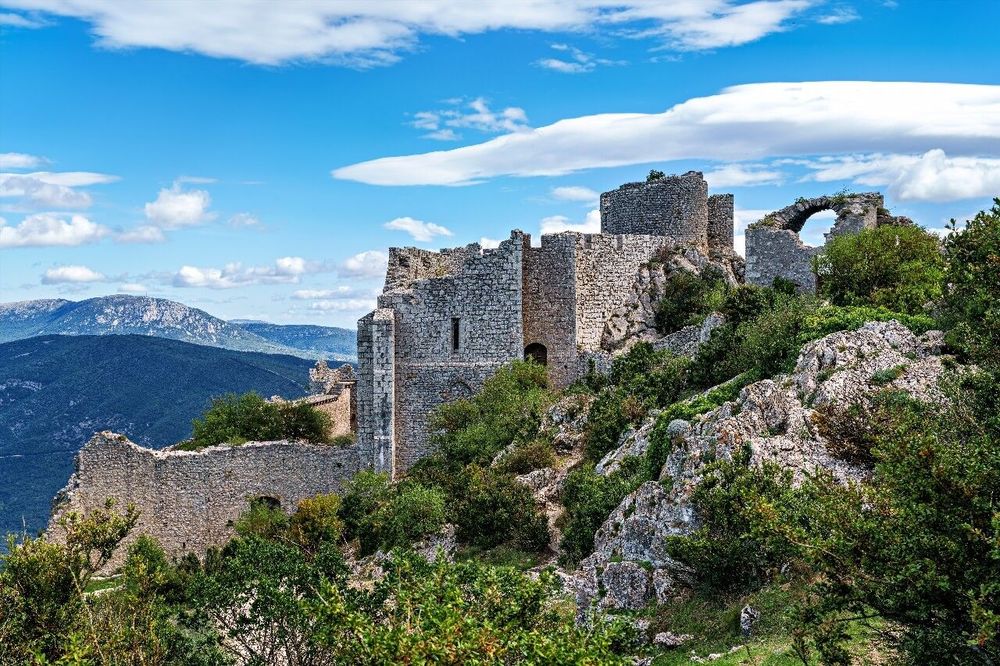
If you could only visit one, it would be this one. The Château de Peyrepertuse (Route de Peyrepertuse, 11350 Duilhac-sous-Peyrepertuse, rated 4.7/5 on Google with 5,299 reviews) rises at 800 meters above sea level on a ridge that resembles a spine of stone. From the valley, the walls blend into the rock — the effect is striking. Up close, the castle reveals two distinct enclosures: the lower castle (11th century) and the Château Saint-Georges, built under Louis IX after the site was captured in 1240, perched 20 meters higher still on the ridge.
The visit takes an average of 2.5 to 3 hours for anyone who truly explores the whole site. Access from the car park is on foot along a stony, steep path: allow 20 to 30 minutes of climbing. Closed-toe shoes are mandatory; water and a windbreaker are recommended. The wind on the ridge can be fierce even in the height of July.
What makes Peyrepertuse unique is its character as a fortress-town: inside the ramparts, you can still make out streets, houses carved into the rock, and cisterns hewn from stone. At the summit, the view over the Pyrenean range and the Roussillon plain is one of the finest in southern France. No one leaves disappointed.
Practical information: open year-round (9am–6pm in high season, 9am–5pm off-season). Adult admission: €8, reduced rate €7, free for children under 6. Booking strongly advised from mid-July to end of August. From Carcassonne, allow 1h15 via the D613 through Cucugnan. No public transport.
Château de Quéribus: the Last Stand
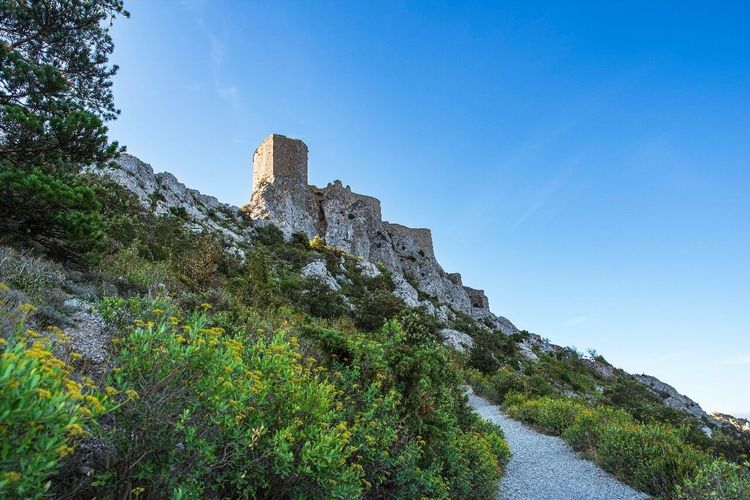
Just 11 km east of Peyrepertuse, the Château de Quéribus (Route du Château, 11350 Cucugnan, rated 4.6/5 on Google with 4,721 reviews) stands at 728 meters on an isolated rocky outcrop overlooking the Corbières and the Roussillon plain. Its destiny is one of resistance: the last castle to hold out against the French royal armies, it surrendered in 1255, eleven years after the fall of Montségur — the final act of armed Cathar resistance. Its name resonates like an epitaph.
More compact than Peyrepertuse, Quéribus concentrates its interest in its Gothic keep: the central hall is covered by a ribbed vault resting on a single pillar — a remarkable architectural feat for such a constrained space. The climb from the car park takes 15 to 20 minutes along a well-maintained path.
Combine both castles in a single day: Peyrepertuse in the morning (larger, more tiring), Quéribus in the afternoon. The village of Cucugnan, with its restored windmill and inns, makes a pleasant lunch stop between the two. A combined ticket for Peyrepertuse + Quéribus is available for around €14 per adult — a worthwhile saving if you visit both sites.
Opening hours and prices: open April to November and during the Christmas holidays. Adult €8, reduced €5.
Château de Montségur: at the Peak of the Cathar Tragedy
Montségur is the most emotionally charged castle in the entire Pays cathare. Perched at 1,207 meters on an almost vertical pog, it was the last collective refuge of the Cathar parfaits. In March 1244, after ten months of siege, the besiegers finally obtained the surrender. 220 Cathars refused to renounce their faith: they descended from the rock and were burned at the stake, at the place known as the "Camp des Crémats" that you will see below the village.
The climb from the village takes 45 minutes along a steep, stony path. It is physically demanding, especially in intense heat. The panorama from the ramparts is exceptionally vast: on a clear day, you can see the Pyrenees from Ariège all the way to the Canigou. The castle visible today is a later construction — the current building was rebuilt by the Capetians after 1244. The true Cathar fortress was razed stone by stone.
Before or after the climb, the Musée du Souvenir de Montségur in the village is essential. It contextualizes the Albigensian Crusade and the tragedy of 1244 with archaeological objects from excavations of the pog. Nowhere else will you better understand what life was like for the last parfaits: their eating habits, their commercial exchanges, their discreet religious practices.
What guides don't always make clear: the trail is genuinely difficult for people unaccustomed to mountain walking and for children under 7 or 8. Allow at least 3 hours on site (ascent + visit of the ramparts + descent + museum). Trekking poles are a real asset. In strong winds, the site may be partially closed.
Practical information: open April to November (closed in winter outside school holidays). Adult admission: €5, child €2.50. Paid parking in the village (€3). From Foix, 35 km via the D9, about 45 minutes.
Château de Puilaurens and the Catalan Pyrenees
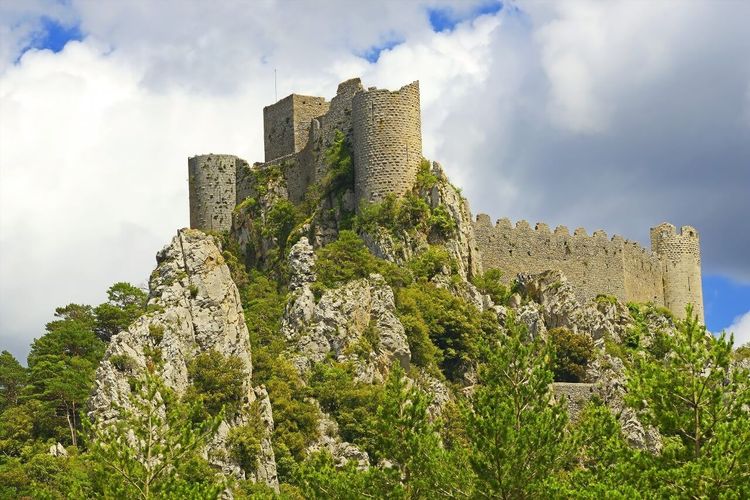
At the southwestern tip of the Corbières, the Château de Puilaurens (Lieu-dit Puilaurens, 11140 Lapradelle-Puilaurens, rated 4.6/5 on Google with 1,598 reviews) stands watch at 697 meters above the gorges of Saint-Antoine and dense beech forests. Less visited than Peyrepertuse or Montségur, it is one of the best-preserved castles in the Pays cathare: its four round towers and its enclosure are virtually intact — remarkable for a building of this era.
Puilaurens held out until 1256 before falling into the hands of the King of France, who turned it into a surveillance stronghold on the Aragonese border. Local legends attribute to it the guardianship of the "Cathar treasure", but no excavation has ever confirmed anything. The climb from the car park takes 20 minutes along a shaded forest path, far less exposed than Peyrepertuse — ideal for families with children or in hot weather.
Prices: adult €5, child €3. Open April to November.
The Castles of Lastours: Four Fortresses at a Single Glance
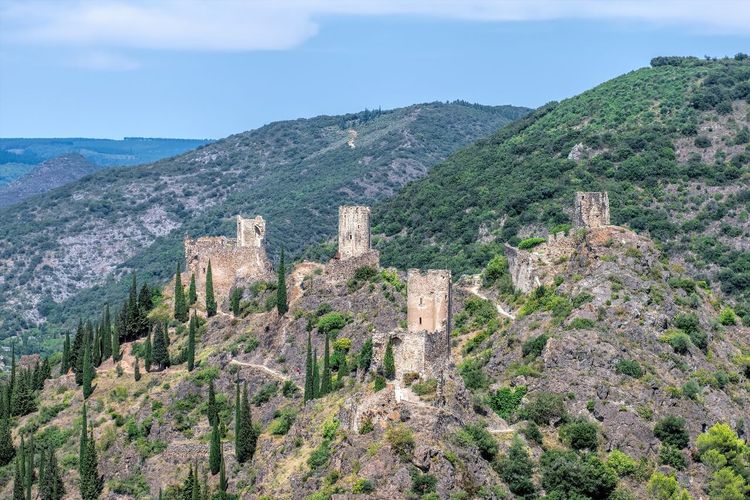
Unique in the entire Pays cathare, Lastours groups four castles on a rocky ridge overlooking the village: Cabaret, Surdespine, Quertinheux, and Tour Régine. The first three are medieval (11th–12th centuries); Tour Régine was added by Saint Louis after the Crusade. Together, they formed a defensive system that had withstood Simon de Montfort — the lord of Cabaret was as well known for protecting troubadours and heretics as for his military skill.
Two ways to discover them. The first: the hiking trail from the village car park — 45 minutes of ascent for a complete loop of 2.5 to 3 hours including a visit to all four castles. The second: the purpose-built belvedere on the southern side, accessible by car, which offers the most photographed view of the four fortresses lined up along their ridge. The belvedere is free to access and suitable for people with reduced mobility.
The archaeological excavations at Lastours are among the most extensively documented in medieval Languedoc. The site has yielded a large quantity of everyday objects from the 11th to 13th centuries — ceramics, tools, jewelry — now preserved in the Carcassonne museum. If you have already visited the Cité, this concrete link between the two sites considerably enriches the experience.
Practical information: adult €5, reduced €3. Open February to November. From Carcassonne, 25 km north via the D111, 30 minutes by road.
Termes, Aguilar, Villerouge-Termenès: the Forgotten Castles of the Corbières
These three castles of the central Corbières rarely top recommendation lists, but they are worth the detour — especially if you want to avoid the crowds at Peyrepertuse in August. All three can be visited in a single day from Narbonne.
Château de Termes
The Château de Termes overlooks the Termenet gorges at 484 meters, its golden ochre sandstone ramparts beautifully crafted. Termes held out against Simon de Montfort for four months in 1210 before surrendering — not through military defeat, but due to a dysentery epidemic within the garrison. This detail speaks volumes about how difficult it was to take these fortresses by force.
Château d'Aguilar
Some 26 km east of Termes, the Château d'Aguilar perched at 245 meters is one of the most accessible sites in this article: the climb from the car park takes only 10 minutes. Two concentric enclosures, 13th-century round towers, and a Romanesque chapel are well preserved. It is the ideal Cathar castle for families with young children.
Château de Villerouge-Termenès (Village, 11330 Villerouge-Termenès, rated 4.4/5 on Google with 990 reviews)
The Château de Villerouge-Termenès (11th–14th century) is probably the best-preserved castle in the entire Pays cathare: its four towers and wall-walk are still complete. It houses a permanent exhibition on medieval life with detailed reconstructions. Its historical significance is immense: this is where Guillaume Bélibaste, the last known Cathar parfait, was burned at the stake in 1321 — seventy-seven years after the fall of Montségur.
Prices: Termes €5, Aguilar €5, Villerouge €6. All open April to November. Allow around 80 km of driving from Narbonne for all three sites.
Foix, Lordat, and Roquefixade: Cathar Ariège
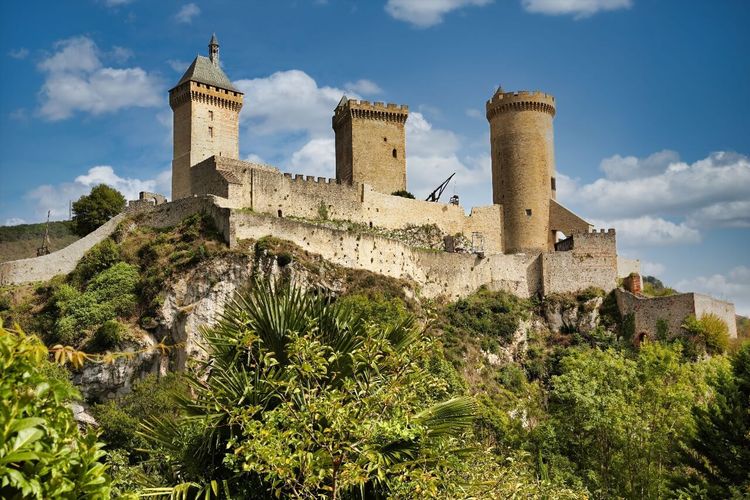
Ariège is the second great territory of Occitan Catharism. While Montségur is its symbolic heart, three other castles in this Pyrenean department are well worth a detour.
Château de Foix
The Château de Foix is the most accessible castle in this article: it stands in the heart of the town of Foix, visible from the train station, and reachable on foot in 15 minutes. Its three towers of white limestone have dominated the Ariège basin since the 10th century. The Count of Foix was one of the most ardent protectors of the Cathars, which earned him the persistent hostility of the Capetian crown.
The castle houses the Musée départemental de l'Ariège, with strong collections on the Middle Ages (weapons, ceramics, jewelry, coins). Open year-round. Adult admission: €6.
Château de Lordat
Some 25 km east of Foix on the heights of the Ariège valley, the Château de Lordat reaches 935 meters. Its high-perched ruins are striking in their scale, as are the views over the Pyrenean summits. Drive to the halfway point, then follow a 20-minute trail.
Château de Roquefixade (Lieu-dit Roquefixade, 09300 Roquefixade, rated 4.5/5 on Google with 664 reviews)
Some 10 km west of Montségur, the Château de Roquefixade (1,150 m) is among the least documented but most photogenic on the list: its ruins stand out against snow-capped peaks in winter and an intense blue sky in summer. The trail from the village takes 30 minutes. Back in Toulouse, Ryo's The Pink City audio-guided tour is a good way to explore the historic centre on foot.
Foix is 1h30 from Toulouse via the A20 and N20, making it a convenient base for a stay combining city and Ariège castles.
Saissac and Puivert: Two Castles, Two Atmospheres
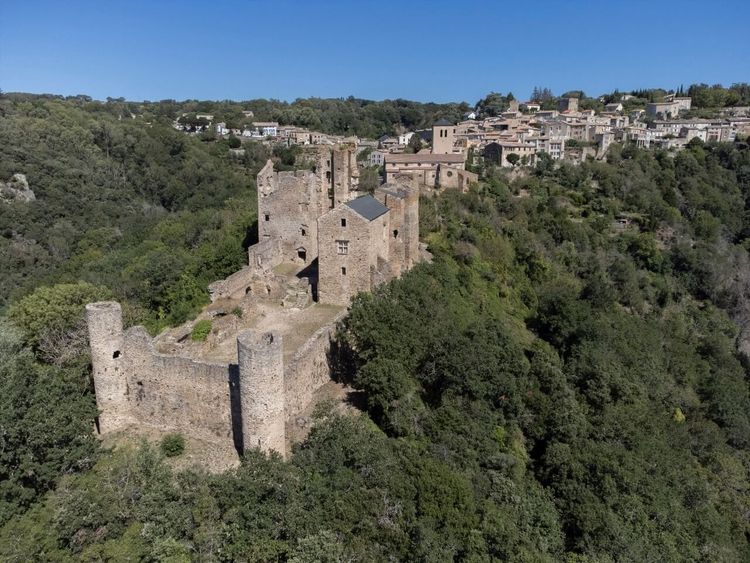
Château de Saissac
Perched at 680 meters on the Montagne Noire, the Château de Saissac offers a magnificent view over the Lauragais plain with the Pyrenees as a backdrop. The ruins are less well preserved than those of the major Aude sites, but the medieval village surrounding it — with its cobblestone streets and half-timbered houses — makes for a pleasant and off-the-beaten-track stop. Free access to the ruins from the village.
Château de Puivert (Domaine du Château, 11230 Puivert, rated 3.6/5 on Google with 1,107 reviews)
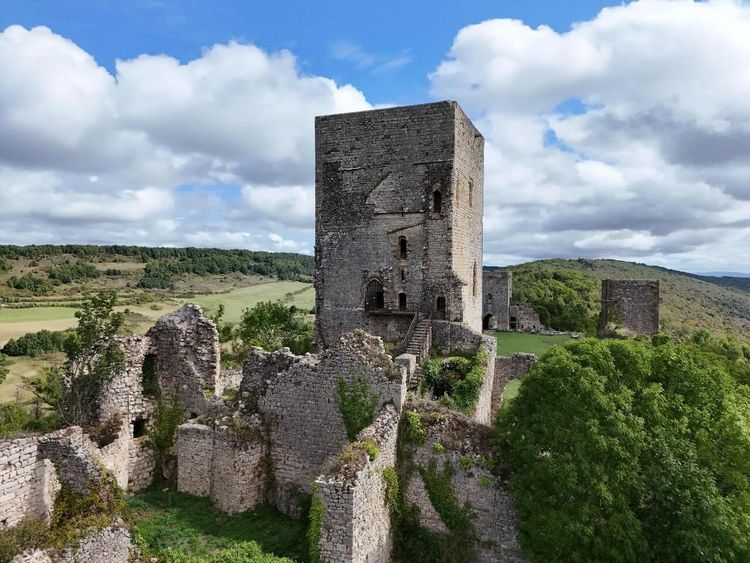
At the eastern end of the Aude Pyrenees, the Château de Puivert is an exception among the fortresses on this list: well preserved with its four towers still standing, it was not strictly a war fortress. Its Musicians' Hall, decorated with sculptures depicting eight troubadours playing the lute, gittern, and tambourine, is unique in medieval France. Puivert was a place of courtly culture as much as a defensive stronghold.
Price: adult €5. Open April to November. The lake at Puivert, visible from the ramparts, adds an unexpected scenic touch.
The Cité de Carcassonne: the Largest Medieval Fortress in France
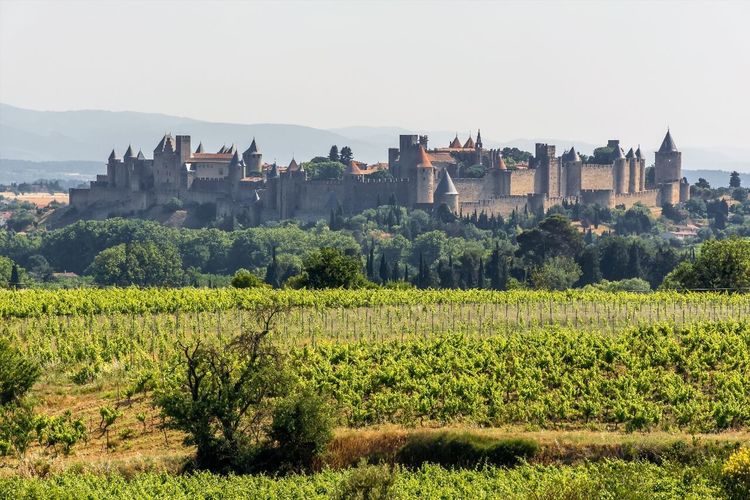
With more than 3 million visitors per year, the Cité de Carcassonne (Cité Médiévale, 11000 Carcassonne, rated 4.7/5 on Google with 92,258 reviews) is one of the most visited medieval monuments in France. It is not strictly a Cathar castle: it is a double fortified enclosure with 3 km of ramparts and 52 towers, whose earliest stones are Roman (4th century) and whose latest are 19th-century restorations by Viollet-le-Duc.
But Carcassonne is at the heart of Cathar history. In 1209, during Simon de Montfort's first campaign, the besieged city capitulated within fifteen days. Viscount Raimond-Roger Trencavel, protector of the Cathars and Jews of the region, was arrested and died in prison a few months later. The Cité then became the seat of royal repression throughout Languedoc.
Entry to the medieval streets and the outer ramparts is free. The inner Château Comtal is paid (€10 adult, guided tour included), with booking advised from July to August. In high season, the Cité can be overwhelmed with tourists from 10am: come before 9am or after 6pm for a completely different atmosphere.
The Ryo audio guide of Carcassonne offers 27 audio tracks over 5.7 km, covering the medieval Cité and the lower town in 2h30. It is one of the best tools for untangling the successive historical layers of the site: Roman, Visigothic, medieval, Capetian, and then Viollet-le-Duc.
Planning Your Stay in the Pays cathare
How many days?
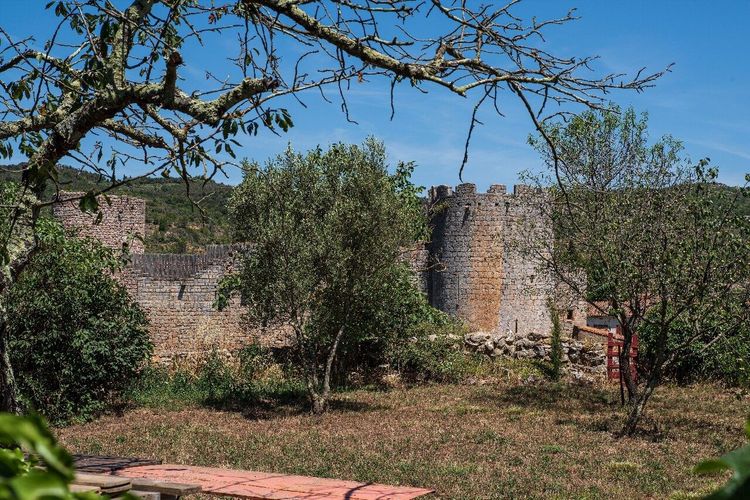
A 3-day weekend is enough for 3 or 4 sites within a small radius: Peyrepertuse and Quéribus on the first day, Lastours and the Cité de Carcassonne on the second. To cover the Corbières and Cathar Ariège (Montségur, Foix), allow 5 to 7 days. A complete tour of all 15 sites in this guide requires 8 to 10 days.
The Best Bases
Carcassonne is the ideal base for exploring the Corbières. Well served by TGV from Paris (3h20) and Marseille (1h30), it allows easy day trips to Peyrepertuse (1h15), Quéribus (1h), Lastours (30 min), Termes (40 min), and Puilaurens (55 min). Accommodation ranges from €50 to €120 per night depending on category.
Toulouse is the natural entry point if you are arriving by plane or combining castles with city life. The Ryo audio-guided tour of Toulouse — 26 audio tracks over 6.5 km — is an opportunity to discover the Pink City before heading off to the medieval fortresses. From Toulouse, Foix is 1h30 away, Carcassonne 45 minutes, and Montségur 2 hours.
Perpignan is the right option if you are arriving from Spain or want to pair the castle circuit with the Catalan coast. The Ryo audio guide of Perpignan lets you discover the French Catalan capital in 1 hour before heading to Quéribus or Peyrepertuse (about 1 hour's drive).
Narbonne suits the central Corbières: Termes, Aguilar, and Villerouge-Termenès are 50–80 km away. The Ryo audio-guided tour of Narbonne in 21 audio tracks and 4 km covers the historic center around the cathedral and the Archbishop's Palace — a fine introduction to the history of the Aude before heading out to the castles.
Transport and Budget
A car is essential: no major site is accessible by public transport year-round. Seasonal shuttles from Carcassonne serve Lastours and sometimes Peyrepertuse in July and August, but the schedules are restrictive.
Budget per site: between €5 and €10 adult admission. A "4 castles" pass for the Pays cathare (Peyrepertuse, Quéribus, Aguilar, Puilaurens) is sold for around €28. Off-season (November to March), accommodation is 30 to 50% cheaper and the sites are virtually empty.
To extend your stay, our Ryo guide to the must-see experiences in Occitanie lists other experiences to combine with your medieval circuit.
When to Visit the Cathar Castles
April to June is the ideal period. Sites reopen from April, the vegetation is green, temperatures are mild (15–22°C), and crowds are still light. In May, some castles offer historical events: medieval reenactments, falconry, jousting.
July–August: peak tourist season. Peyrepertuse can receive more than 2,000 visitors per day. Montségur is packed from 10am. Come early in the morning or in the late afternoon. The wind on the Corbières ridges remains strong even in the height of summer: bring a windbreaker.
September–October may be the best period of all: superb light for photography, pleasant temperatures (18–25°C), and the Corbières grape harvest as a bonus. Crowds thin out noticeably after mid-September.
November to March: several sites close (Peyrepertuse, Quéribus, and Montségur are generally closed from January to mid-March). The château de Foix and the Cité de Carcassonne remain open year-round. Winter is inadvisable for high-altitude sites (ice, slippery paths), but accommodation is twice as cheap.
FAQ
What is a Cathar castle?
The term "Cathar castle" refers to fortresses in Occitanie linked to the history of medieval Catharism (12th–14th centuries). Some were properties or refuges of lords who protected the Cathars, such as Lastours-Cabaret or Montségur. Others were Aragonese or French royal fortresses that simply served as last refuges for persecuted parfaits after the Crusade — as is the case with Peyrepertuse, Quéribus, and Puilaurens. The "Pays cathare" label, created by the Aude department in the 1990s, brings together around ten listed sites under this shared historical identity.
Which is the most beautiful Cathar castle?
The answer depends on what you're looking for. For panoramas and a sense of grandeur, Peyrepertuse is hard to beat: the largest, the highest, the most spectacular. For emotion and historical weight, Montségur is unmatched. For architectural preservation, Puivert and Villerouge-Termenès are the best preserved. For a family visit with young children, Aguilar or the château de Foix are the most suitable thanks to their easy access.
Can you visit the Cathar castles without a car?
It is very difficult, except for Carcassonne and Foix, which are accessible by train. From Carcassonne, seasonal shuttles serve Lastours and sometimes Peyrepertuse in July and August, but the schedules are often inconvenient. To visit the Corbières and Ariège, a car remains essential. Local agencies offer guided day excursions from Carcassonne to Peyrepertuse and Quéribus: this is a valid alternative for travelers without a vehicle.
How long does it take to visit all the Cathar castles?
A complete tour of the 15 sites in this guide requires 8 to 10 days, factoring in driving time and ascents (some take 45 minutes one way). For a quality overview in 4 days, focus on the "ace quartet": Peyrepertuse in the morning and Quéribus in the afternoon (day 1), Lastours in the morning and Carcassonne in the afternoon (day 2), Montségur (day 3), Foix and the Ariège museum (day 4). This circuit covers the most significant sites without exhaustion.
Are the Cathar castles accessible to people with reduced mobility?
Most are partially or entirely inaccessible due to steep paths and mountain trails. Exceptions include the Lastours belvedere (car access, view without climbing), the château de Foix (partially accessible, prior contact recommended), and the streets of the Cité de Carcassonne (free access to main routes, no major obstacle). The Château Comtal in Carcassonne is more restrictive. Contact each site directly for information on specific accessibility arrangements.
Can you combine the Cathar castles with other visits in Occitanie?
Absolutely. The Pays cathare combines naturally with the Mediterranean coast from Narbonne and Perpignan, with the Ariège Pyrenees (hiking, skiing at Ax-les-Thermes), and with the UNESCO-listed Canal du Midi from Carcassonne. The historic cities of Occitanie — Albi, Toulouse, Narbonne, Perpignan — are all rich bases for gastronomy and culture to include in a wider itinerary.
Conclusion
The Cathar castles of Occitanie form one of the most singular medieval heritages in Europe. Fortresses built not to govern, but to survive — and which failed to save their occupants while themselves surviving, almost intact, on their ridges. From Peyrepertuse to Montségur, from the Corbières to Ariège, each site tells a different facet of a history that has profoundly shaped the Occitan identity.
Before heading up to the ridges, start with the cities that lived through these events from the inside: the Ryo audio guide of Narbonne, the one for Albi, and the one for Carcassonne each offer a vivid introduction to Cathar history, from the streets of cities that have kept its lasting traces.
À lire également