© Shutterstock
 Votre guide Ryo
Florence Neighborhoods: Complete Guide to Choosing the Right One in 2026
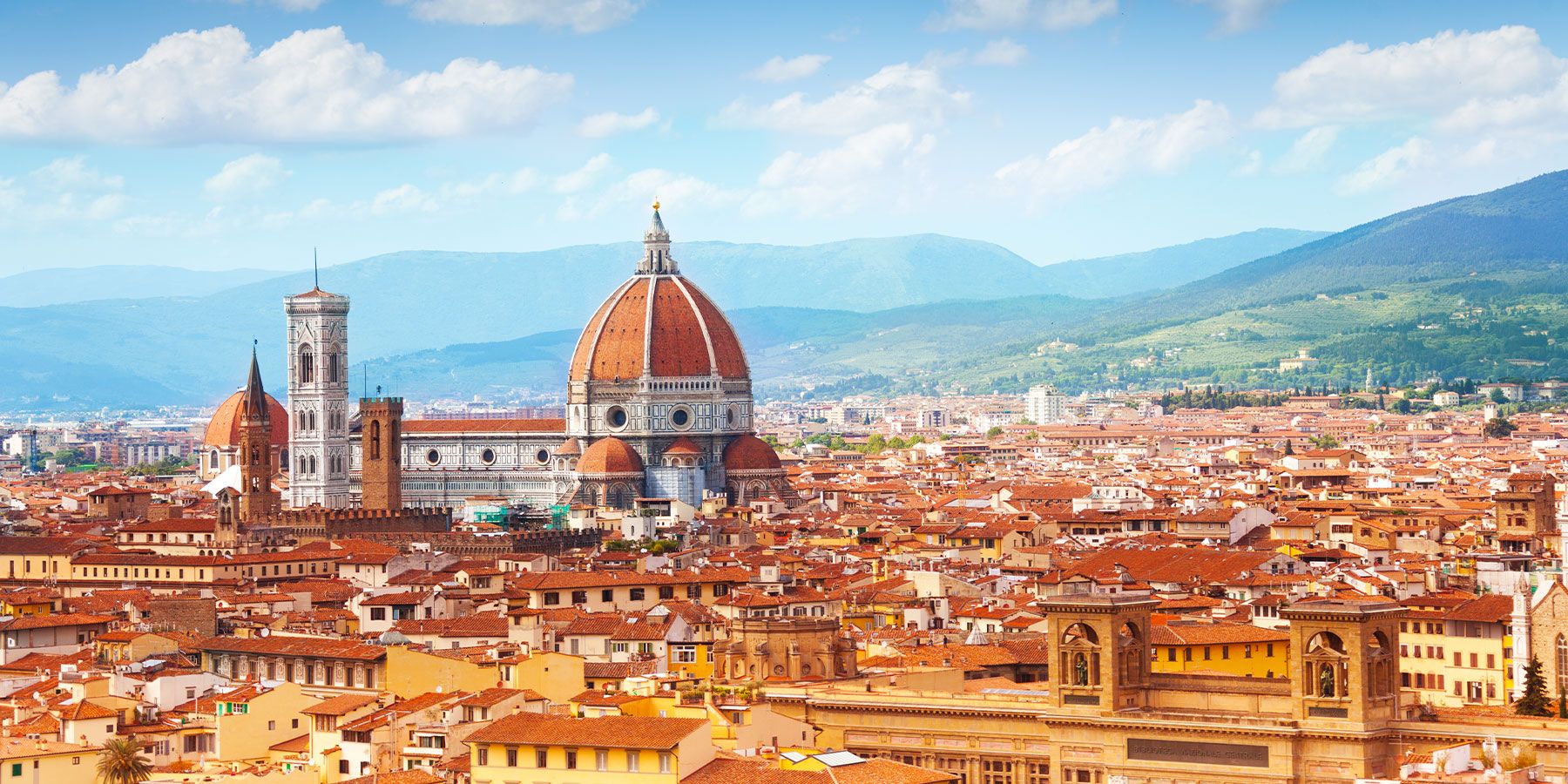
Planning a trip always starts with the same question: which Florence neighborhoods should you stay in, dine in, and wander through? Florence fits into a small pocket: its historic center can be crossed on foot in under thirty minutes, yet every street seems to change its character every five hundred meters. Understanding the neighborhoods of Florence is the key to choosing where to set down your suitcase, where to have dinner without queuing alongside tour groups, and where to simply stroll without a set plan. Between the red-brick dome that dominates San Giovanni, the leather workshops of Santa Croce, the rationalist facades of the train station in Santa Maria Novella, and the cobbled lanes of the Oltrarno on the other side of the Arno, the city divides into zones with radically different atmospheres.
This guide covers the seven Florence neighborhoods you need to know, their must-see landmarks (the Duomo, the Ponte Vecchio, the Palazzo Pitti), the points to watch out for near the train station, and the best area to stay depending on your traveler profile. You will also find the historic map of the four official Florence neighborhoods, inherited from the 14th century and still used to designate the teams of the calcio storico every summer. Enough to build a coherent itinerary before you even open the Ryo app and its Ryo audio tour of Florence.
San Giovanni: Around the Duomo and Piazza della Signoria
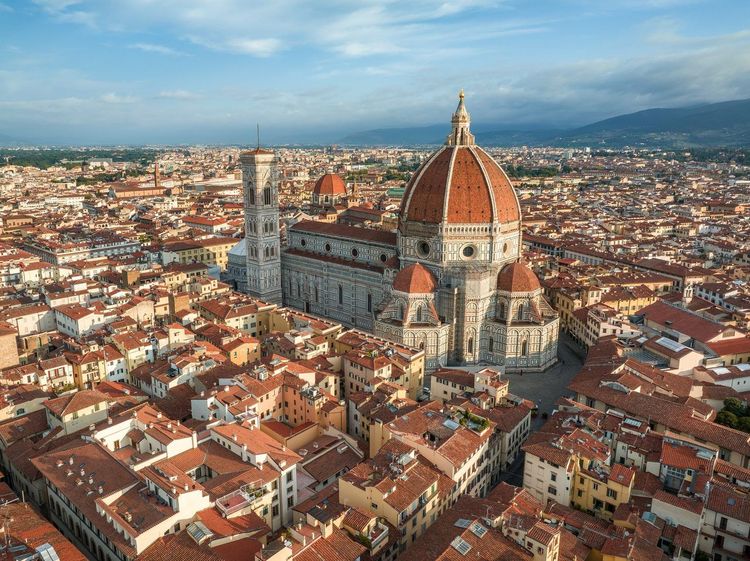
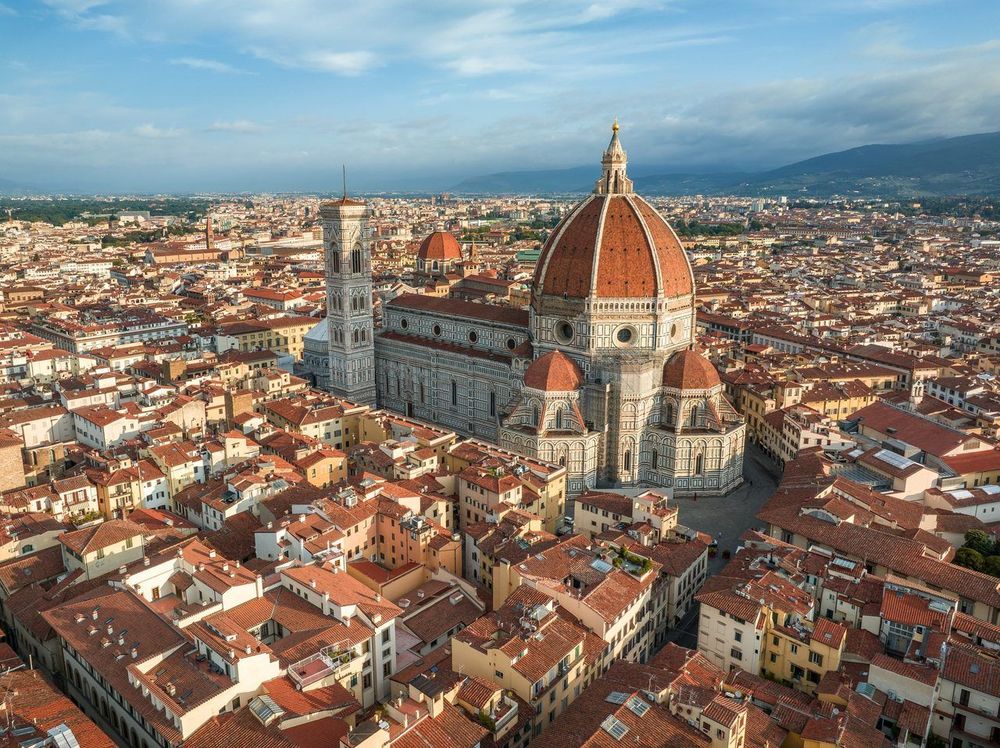
San Giovanni is the neighborhood everyone pictures when they think of Florence, the one defined by the red-brick dome visible from the surrounding hills. The name comes from the Baptistery dedicated to Saint John the Baptist, patron of the city, whose bronze doors have weathered six hundred years without losing their luster. The Cattedrale di Santa Maria del Fiore, completed in 1436 thanks to the dome designed by Filippo Brunelleschi, still dominates the skyline: no building in the historic center is permitted to exceed it.
Climbing the 463 steps of the dome remains the neighborhood's most sought-after experience, but the ticket office requires a fixed-time reservation, sometimes three weeks in advance during peak season. If you miss your slot, the Campanile di Giotto offers an almost equally sweeping panorama with fewer crowds, and a reservation is generally possible on the same day.
Five minutes on foot away, the Piazza della Signoria resembles an open-air museum. The Palazzo Vecchio (Piazza della Signoria, 50122 Firenze, rated 4.7/5 on Google based on 25,747 reviews), the former seat of Medici power, is recognizable by its asymmetrical crenellated tower; just in front, a copy of Michelangelo's David marks where the original stood before its transfer to the Accademia. The Loggia dei Lanzi displays monumental sculptures free of charge, including Cellini's Perseus brandishing the head of Medusa — a great way to see Florentine art without queuing.
Don't stop at the square itself: the Via dei Calzaiuoli, entirely pedestrianized, connects the Duomo to the Signoria in ten minutes and is lined with the most bustling shops in the center. To avoid the crowds that pack it from 10am onward, cross the neighborhood before 8:30am, when shopkeepers are barely raising their shutters and the low light still grazes the ochre facades.
Tucked against the corner of the Uffizi, the fortified church of Orsanmichele preserves its 14th-century frescoes inside a former grain warehouse converted into a place of worship. Many hurried visitors overlook it, making it a cool, quiet respite between two queues.
The Galleria degli Uffizi, whose entrance slips into the U-shaped courtyard of the palace, regularly sells out from opening time in summer. Booking a timed entry online remains the only reliable way to avoid a two-hour queue under the Tuscan sun, as the walk-up line can exceed 90 minutes in July.
Just behind the Uffizi, the Museo Galileo occupies the Palazzo Castellani and extends the scientific story of the Renaissance with astronomical and navigational instruments that once belonged to the Medici. Our article on the Galileo Museum details its collection, often overlooked in favor of its more famous neighboring museums.
Heading back down toward the Arno along Via Por Santa Maria, the Mercato Nuovo is home to the bronze statue of the Porcellino, a boar whose snout has been polished smooth by generations of tourists seeking good luck. It is also the point where San Giovanni gives way to the Santa Croce neighborhood — an invisible boundary that no tourist map marks but every Florentine knows by heart. For a broader overview of the city's history-laden sites, our article on the historic squares of Florence usefully complements this first introduction.
Santa Maria Novella: Train Station, Basilica, and Luxury Shopping
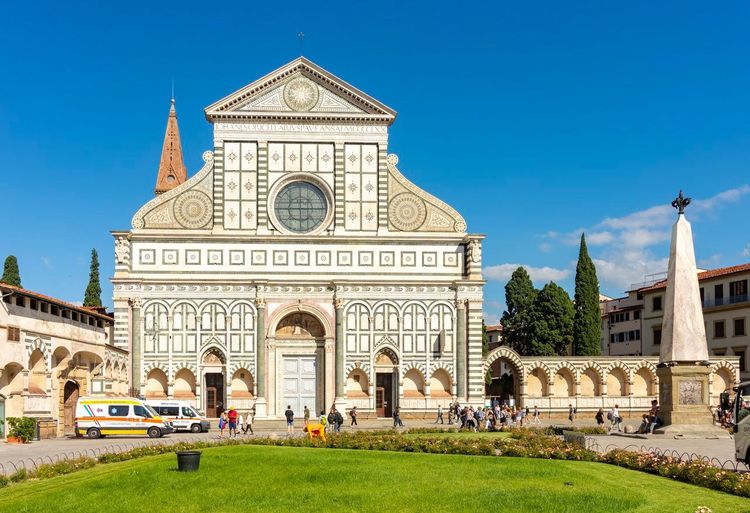
The neighborhood takes its name from the imposing Dominican basilica that faces the central train station, itself named Santa Maria Novella in echo. The green and white marble facade, designed by Leon Battista Alberti in 1470, applies the mathematical proportions of the Renaissance to a religious building for the first time — an architectural manifesto before it is a church.
Inside, the fresco of the Trinity painted by Masaccio around 1425 is considered one of the first rigorous applications of linear perspective in the history of Western art. The frescoes of the Tornabuoni Chapel, painted by Ghirlandaio, are equally worth a detour, often bypassed by visitors rushing to reach the Uffizi.
The train station itself deserves a look: its rationalist architecture from the 1930s, designed by a collective of Tuscan architects, deliberately contrasts with the rest of the historic center. It is the arrival point for the majority of high-speed trains from Rome or Milan, which explains the concentration of hotels and budget hostels in the surrounding streets.
If you are looking for affordable accommodation, this area is hard to beat on price, but avoid the lanes directly behind the station after 10pm: the atmosphere there is more urban and less polished than the rest of the neighborhood, though not dangerous.
At the opposite end of the spectrum, Via de' Tornabuoni is lined with Italian luxury boutiques, from Gucci, born in Florence in 1921, to Ferragamo, which also has its museum here. The Officina Profumo-Farmaceutica di Santa Maria Novella, founded by Dominican friars in the 13th century and still in operation, offers a historic pharmacy setting worth visiting even if you buy nothing.
This is one of the most practical Florence neighborhoods for travelers who prioritize logistics: bags dropped within minutes of stepping off the train, before heading out to explore the rest of the city on foot. Families with young children also appreciate the proximity of the T2 tram line, which connects directly to Peretola airport in about twenty minutes.
Allow a good hour for the basilica alone and the adjoining cloister, the Chiostro Verde, whose frescoes by Uccello are worth looking up at despite the fatigue that builds after a morning of walking.
San Lorenzo and the Mercato Centrale
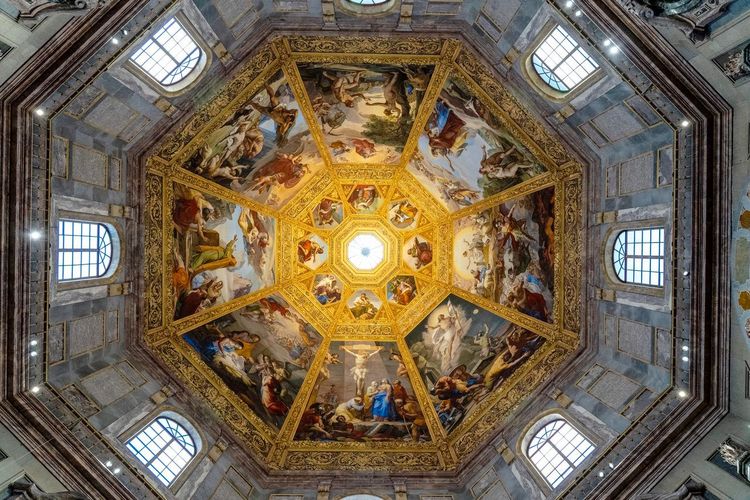
San Lorenzo takes its name from the basilica of the same name, the Medici's parish church for three centuries, recognizable by its rough stone facade that was never clad in marble despite a design by Michelangelo that remained on paper.
The adjoining Cappelle Medicee house the tombs sculpted by Michelangelo himself for Lorenzo and Giuliano de' Medici, with the allegories of Day and Night counted among his most studied works after the Sistine Chapel.
Just opposite, the Mercato Centrale (Piazza del Mercato Centrale, 50123 Firenze, rated 4.4/5 on Google based on 58,405 reviews) occupies a 19th-century iron-and-glass pavilion. The ground floor remains a traditional market of fruit, vegetables, and Tuscan charcuterie; the upper floor, renovated in 2014, has been transformed into a food hall open until midnight — a great option for a late dinner without a reservation.
The leather goods stalls surrounding the open-air market give a first taste of the artisan craftsmanship you will find more fully developed in Santa Croce. To explore the local specialties in depth before sitting down to eat, our top 10 culinary specialties of Florence covers the classics, from bistecca alla fiorentina to lampredotto served as a street sandwich.
The neighborhood remains lively but less touristy than neighboring San Giovanni, with the majority of shops catering to residents rather than passing visitors. It is also a good base for budget stays, five minutes on foot from both the train station and the Duomo.
Santa Croce: Craftsmanship and National Memory
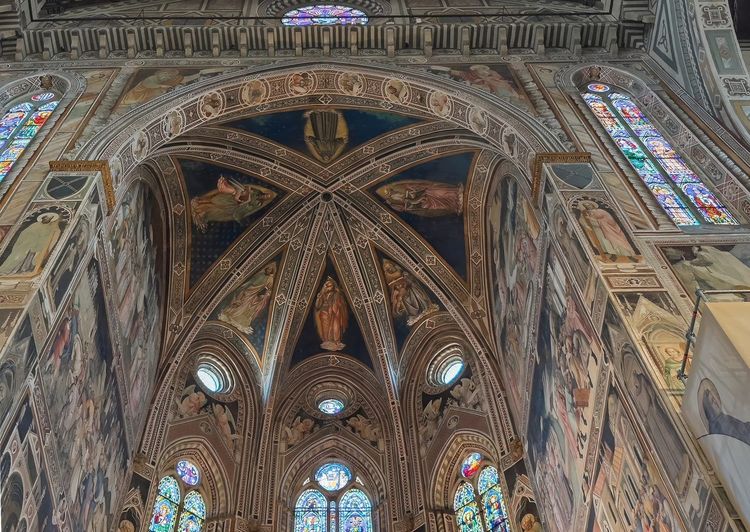
Santa Croce is organized around the Franciscan basilica of the same name, nicknamed the Pantheon of Florence for the number of illustrious tombs it contains: Michelangelo, Galileo, and Machiavelli all rest here beneath funerary monuments sculpted between the 16th and 19th centuries.
The flooding of the Arno in November 1966 submerged the basilica under more than four meters of water, severely damaging the crucifix painted by Cimabue in the 13th century. The event also triggered an international wave of restoration that trained an entire generation of art conservation specialists, many of whom are still active in Florence today.
Behind the apse, the Scuola del Cuoio occupies former Franciscan monks' dormitories where artisans still hand-craft leather, a trade that has defined the neighborhood's reputation since the Middle Ages. You can watch the work in progress free of charge before browsing the nearby workshops on Via San Giuseppe.
Every year in June, the Piazza Santa Croce is covered with sand to host the calcio storico, a rough blend of medieval football and wrestling in which four teams representing Florence's historic neighborhoods compete before a passionate crowd. If your stay coincides with these dates, book your tickets several weeks in advance: the temporary stands sell out quickly.
The neighborhood has grown in popularity over the past fifteen years without losing its artisan character: wine bars, bookbinding workshops, and Florentine stationery shops coexist with a few more tourist-oriented businesses near the main square. Allow about 20 minutes on foot from the Duomo to reach Santa Croce via Borgo dei Greci.
Continuing southwest, Via dei Neri is home to a handful of quick-service eateries popular with locals — a good refueling stop before crossing the Arno toward the Oltrarno.
The area is also one of the best served by small weekly-rental apartments, an alternative to the historic center hotels that are often fully booked or expensive during peak season.
San Marco and Fortezza da Basso: Art and University Life
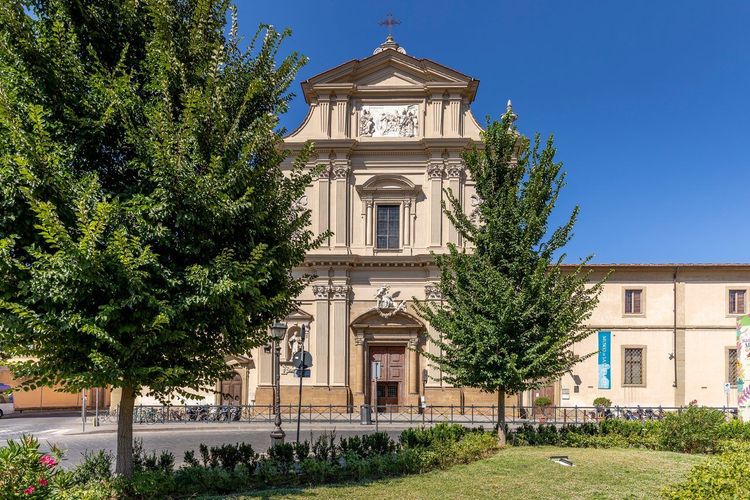
San Marco owes its artistic reputation to the Dominican convent converted into a museum, where the monk-painter Fra Angelico covered the cells with frescoes intended for meditation rather than public display. The prior Savonarola lived here before meeting his end at the stake in 1498 in Piazza della Signoria.
Two minutes' walk away, the Galleria dell'Accademia houses the original David by Michelangelo, carved between 1501 and 1504 from a single block of Carrara marble that other artists had deemed flawed. The walk-up queue can exceed one hour from 9am onward during high season.
The Piazza della Santissima Annunziata, right next door, remains surprisingly quiet despite its proximity to these two museums. The Spedale degli Innocenti that borders it, an orphanage built by Brunelleschi in 1419, is considered by art historians to be the first truly Renaissance building in Florence, predating even the dome of the Duomo.
The neighborhood also moves to the rhythm of the university, whose faculties occupy several historic palazzi nearby: expect to encounter more local students than tour groups, and dining prices that are slightly gentler than in the historic center.
Further north, the Fortezza da Basso (Viale Filippo Strozzi 1, 50129 Firenze, rated 4.4/5 on Google based on 5,863 reviews), a Renaissance fortress built by the Medici in 1534 to keep watch over their own subjects as much as any outside threat, now serves as an exhibition center and hosts the Tuscan fashion trade shows twice a year.
Oltrarno: The Other Bank, Artisans, and Local Life
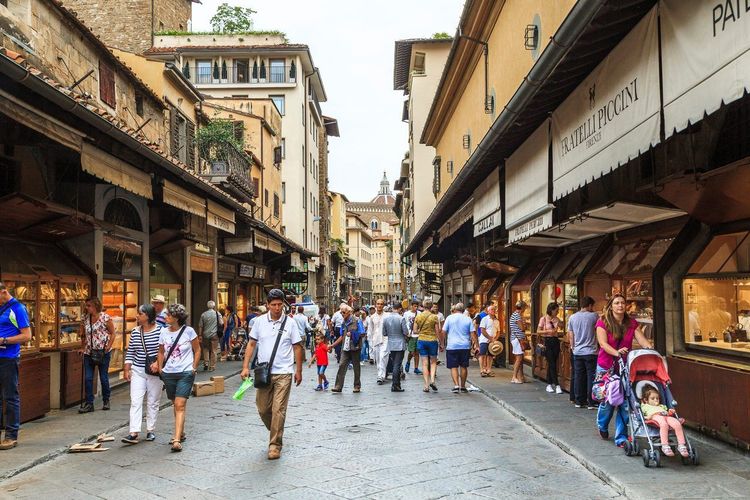
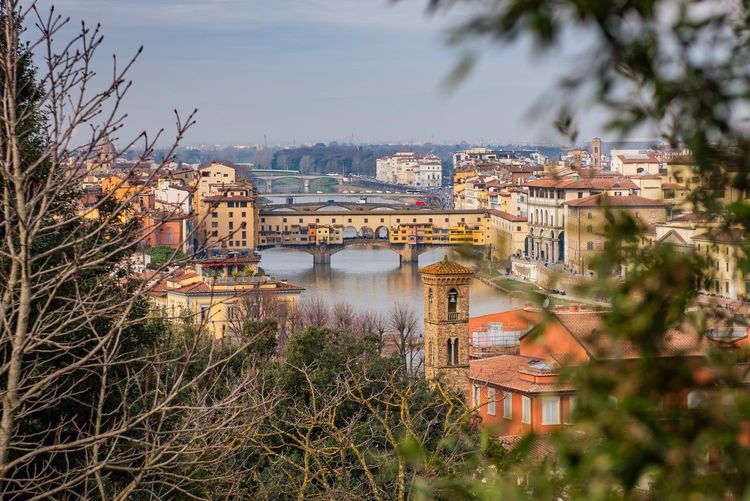
Crossing the Arno over the Ponte Vecchio immediately changes the atmosphere. The medieval bridge, the only one in Florence spared from German destruction in 1944, has been lined since the 16th century with goldsmiths' shops installed on the orders of Grand Duke Ferdinand I, who found the previous butchers and tanners too malodorous for his taste.
Above the shops, the Corridoio Vasariano connects the Palazzo Vecchio to the Palazzo Pitti over nearly a kilometer — a secret passage designed in 1565 to allow the Medici family to move around without mingling with the public. Closed in 2016 for restoration, the corridor reopened to the public in late 2024 and can once again be visited by reservation, with limited numbers.
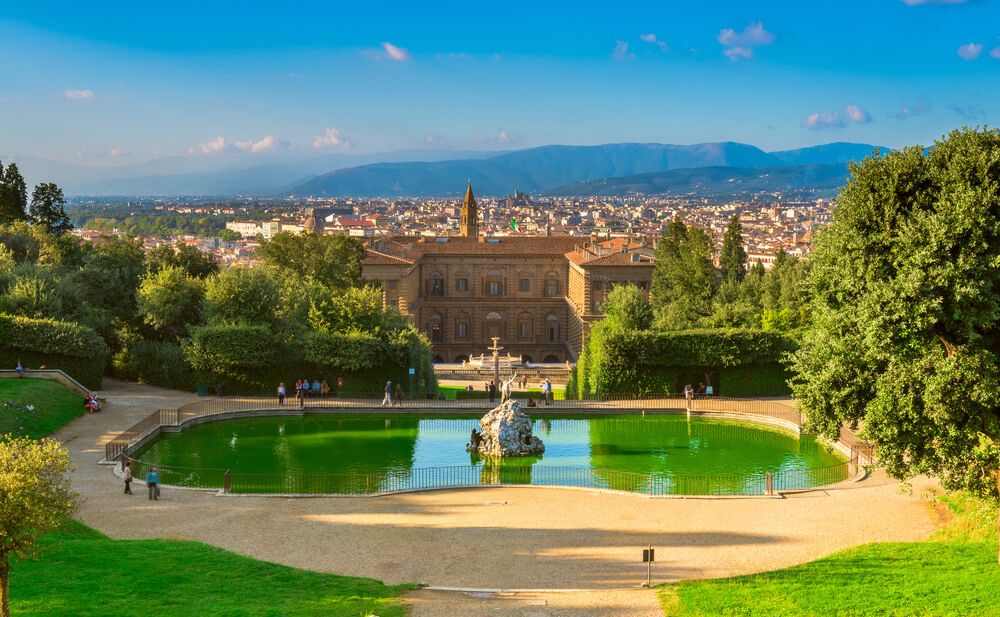
The Palazzo Pitti, residence of the Medici and later the House of Habsburg-Lorraine, now groups five museums under one roof, from the Galleria Palatina to the Costume Gallery. Behind the palace, the Giardino di Boboli (Piazza de' Pitti 1, 50125 Firenze, rated 4.2/5 on Google based on 30,668 reviews) unfolds terraced levels, grottoes, and antique statues, conceived as an open-air theater for Medici festivities.
To plan your visit to the garden in detail, our article on the Boboli Gardens highlights the viewpoints not to miss and the best time slot to avoid the afternoon heat.
Further into the neighborhood, the Piazza Santo Spirito captures the most local atmosphere in the historic center: a morning market, aperitivo terraces from 6pm onward, and a basilica designed by Brunelleschi whose deliberately bare facade surprises after so much ornamentation elsewhere in the city. This is where many Florentines themselves recommend dining, far from the multilingual tourist menus of the center.
The sub-neighborhood of San Frediano, more residential in feel, still lines dozens of workshops specializing in furniture restoration, gilding, and bookbinding — a craft tradition passed down from generation to generation since the post-war years. Some artisans welcome curious visitors who push open the door during working hours, a rare opportunity to observe gestures that are disappearing elsewhere in Europe.
Among Florence's neighborhoods, the Oltrarno suits most those who are returning for a second or third visit, or who prefer to come home in the evening to an area less saturated with tourists while still being fifteen minutes on foot from the Ponte Vecchio.
San Niccolò and San Miniato al Monte: The Hill and Its Viewpoints
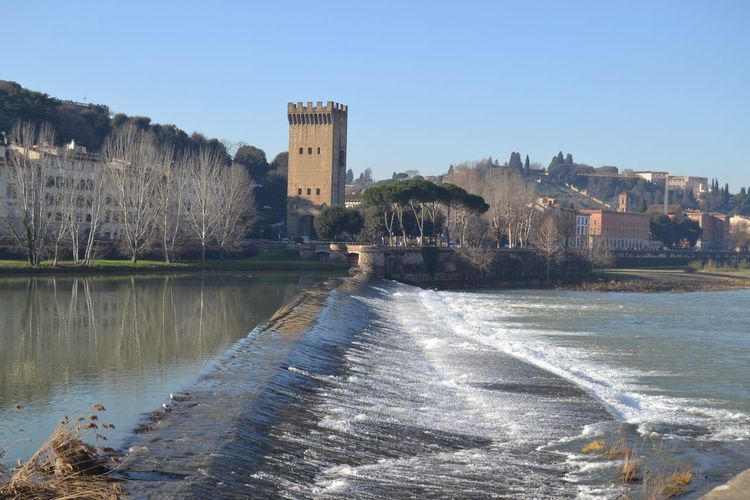
The San Niccolò neighborhood, nestled between the Arno and the hillside, remains one of the least visited Florence neighborhoods in the historic center despite its immediate proximity to the Ponte Vecchio. The Porta San Niccolò, a 14th-century watchtower, marks the former boundary of the city walls and now houses a small exhibition space open on weekends.
From the gate, a flight of steps or the Via di San Salvatore al Monte climbs toward the Piazzale Michelangelo, laid out in 1869 by the architect Giuseppe Poggi to offer an unobstructed panorama over the entire city. Allow 15 to 20 minutes to walk up, or take bus 12 from the train station if the heat or fatigue makes the climb less appealing.
A bronze copy of the David has stood at the center of the square since its inauguration, turned toward the historic center as if watching over the original housed at the Accademia. The sunset draws a dense crowd in summer, with amateur photographers and street vendors in equal measure; arriving an hour before the announced time still secures a front-row spot at the balustrade.
A hundred meters higher, the Basilica di San Miniato al Monte (Via Monte alle Croci, 50125 Firenze, rated 4.8/5 on Google based on 6,554 reviews) is worth the extra effort. Its 11th-century green and white marble facade directly inspired that of Santa Maria Novella two centuries later, and the Olivetan monks who still occupy it chant Gregorian plainchant in the late afternoon — a rare moment of silence after the bustle of the Piazzale, a stop that Florence's audio-guided tour conveniently links to the nearby Oltrarno viewpoints.
Neighborhoods to Avoid and Points of Vigilance
Florence has no truly dangerous neighborhood in the sense understood in some large European cities: it is a medium-sized city, heavily visited and generally safe by day and by night throughout the historic center.
The only points of vigilance concern pickpocketing, concentrated wherever crowds gather: around Santa Maria Novella train station, in the queues at the Uffizi and the Duomo, and at the San Lorenzo market during peak hours. Keep bags and pockets closed in these specific spots rather than avoiding an entire neighborhood.
The Cascine park, to the west of the city along the Arno, changes in character after dark and is not recommended for a solo walk late at night, in contrast to its family-friendly daytime atmosphere.
Where to Stay Based on Your Traveler Profile
Choosing, among Florence's neighborhoods, where to sleep depends above all on the length of your stay and the pace you are looking for. For a first visit of two or three nights, San Giovanni remains the safe bet: everything is reachable on foot in under twenty minutes, even if accommodation costs a little more than elsewhere.
Travelers on a tighter budget naturally gravitate toward San Lorenzo or the streets near the station in Santa Maria Novella, where guesthouses and hostels offer rates 20 to 30% lower than the strict historic center, without sacrificing walking access to the Duomo.
If you are returning to Florence after a first visit focused on museums, opt for the Oltrarno: evenings there feel more like local life than tourist terraces, and apartment rentals are often more spacious for an equivalent budget.
Families with young children generally appreciate San Marco, which is quieter in the evenings than the historic core, with direct access to the major museums without the outsized queues found near the Duomo at peak times.
For a stay more attuned to romance or sunsets, the handful of addresses around San Niccolò offer a good compromise: close enough to the Ponte Vecchio on foot, yet far enough removed to return each evening away from the bustle.
Whatever neighborhood you choose, bear in mind that Florence's historic center fits within a radius of roughly 2 kilometers: no choice truly isolates you from the rest of the city, which makes exploring on foot via a Ryo audio tour particularly well suited to covering several neighborhoods in a single day.
Those planning day trips to Pisa, Siena, or the Chianti will benefit from choosing accommodation close to Santa Maria Novella train station, the departure point for most regional trains into Tuscany — avoiding a fully-laden crossing of the city early in the morning.
Neighborhood Map: The 4 Historic Neighborhoods of Florence
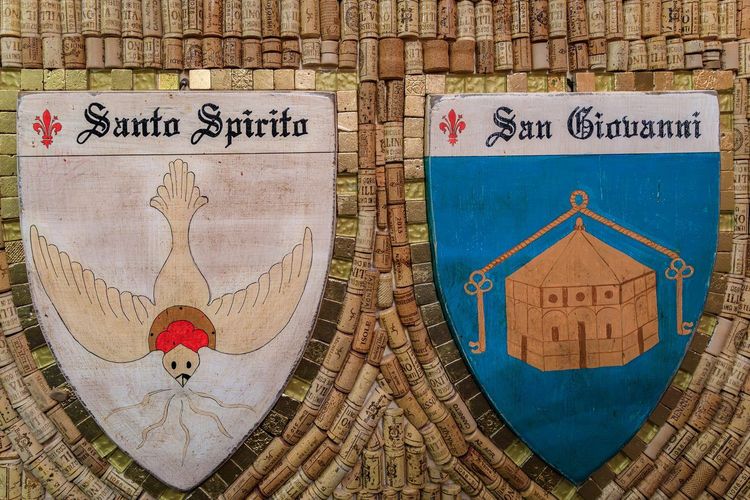
Beyond the tourist zone names used throughout this guide, Florence preserves a far older administrative division. After the construction of the final city walls in the early 14th century, the city was redrawn into four official quartieri — the 4 neighborhoods of Florence still cited today — each named after its main church: San Giovanni, Santa Croce, Santa Maria Novella, and Santo Spirito.
This seven-century-old map of Florence's neighborhoods still serves as a point of reference today: it determines the four teams that face each other every June during the calcio storico, identifiable by their colors — blue for Santa Croce, green for San Giovanni, red for Santa Maria Novella, and white for Santo Spirito.
To place the zones described above onto this historic map: San Marco and San Lorenzo both belong to the quartiere of San Giovanni, while San Niccolò and the Oltrarno fall under Santo Spirito, the only one of the four neighborhoods located on the south bank of the Arno.
In everyday conversation, Florentines readily mix the two scales: they refer to their home neighborhood in the tourist sense (Oltrarno, Santa Croce) rather than the medieval administrative quartiere, except when talking football or summer traditions.
Getting Around Between Neighborhoods
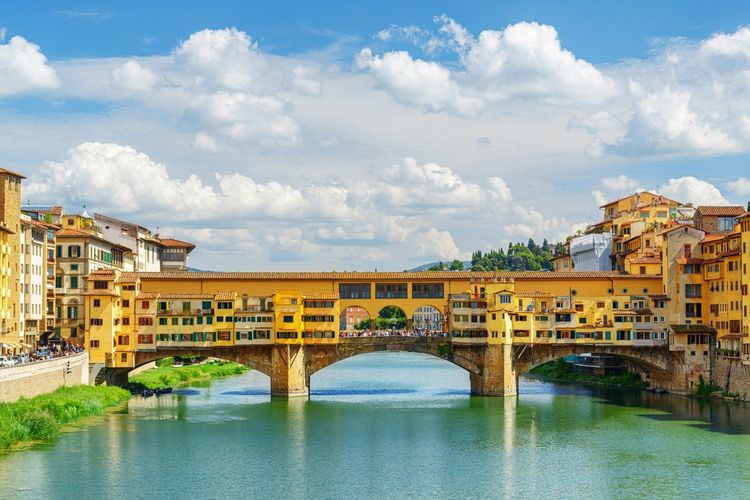
Moving between Florence's neighborhoods is unusually straightforward for a city of art: everything is done primarily on foot. From the Duomo to the Ponte Vecchio, allow barely 10 minutes; to the Piazzale Michelangelo, about half an hour including the climb. None of the seven neighborhoods described above is more than 35 minutes on foot from another.
The tram network, currently made up of lines T1 and T2 (with new lines under construction), serves mainly the outskirts and Peretola airport rather than the historic center, which has been largely pedestrianized. For longer journeys, such as reaching the Cascine or certain out-of-center hotels, ATAF buses effectively complement the options.
If you are renting a car to explore Tuscany, be aware that the historic center enforces a limited traffic zone (ZTL) monitored by cameras: a simple routing error can result in a fine arriving months later. It is far better to park in an outlying car park and reach the neighborhoods on foot or by shuttle.
For a wider selection of activities to combine with this neighborhood-by-neighborhood exploration, our top 7 things to do in Florence usefully completes this itinerary.
FAQ
What is the best neighborhood to stay in Florence?
It largely depends on the length of your stay. For a first trip of two or three nights, San Giovanni, around the Duomo, remains the most practical choice since everything is reachable on foot in under twenty minutes. For a longer stay or a return visit to Florence, the Oltrarno offers a more local atmosphere, with often more spacious accommodation. Travelers on a tight budget generally gravitate toward San Lorenzo, close to the train station and the central market, while still within walking distance of the main landmarks.
What are the 4 historic neighborhoods of Florence?
The city has been officially divided since the 14th century into four administrative quartieri: San Giovanni, Santa Croce, Santa Maria Novella, and Santo Spirito, each named after its main church. This ancient map still serves as a reference for the calcio storico, the medieval tournament held every summer at Piazza Santa Croce, where each neighborhood fields its own team identifiable by a distinctive color.
Is there a neighborhood to avoid in Florence?
No, not in any strict sense: Florence remains a safe city throughout its historic center, by day and by night. Points of vigilance relate mainly to pickpocketing in heavily crowded areas, such as around the train station or in museum queues, rather than any entire neighborhood to avoid. The Cascine park is simply best avoided when alone after dark.
Is the Santa Croce neighborhood a pleasant place to stay?
Yes, Santa Croce combines an authentic artisan atmosphere with a central location, about twenty minutes on foot from the Duomo. It is a good compromise for travelers who want to stay close to the museums while avoiding the peak tourist density of San Giovanni. The neighborhood has become livelier in the evenings over the past few years, with numerous wine bars and small local eateries.
What is the difference between San Marco and Santa Maria Novella?
San Marco, to the north of the center, is home to major museums such as the Accademia and the Museo San Marco, and moves at the rhythm of the university, with a quieter atmosphere in the evenings. Santa Maria Novella is organized around the central train station and the luxury shopping of Via de' Tornabuoni, a more convenient neighborhood for train arrivals and departures but also denser in hotels and budget hostels.
How do you get around between Florence's neighborhoods?
Walking remains the most effective way: no neighborhood in the historic center is more than 35 minutes on foot from another. The tram and ATAF buses complement the offer for reaching the outskirts or the airport. By car, beware of the limited traffic zone that covers most of the historic center and penalizes unauthorized entries.
How much time should you allow to visit all the neighborhoods of the historic center?
Allow three to four full days to explore San Giovanni, Santa Maria Novella, San Lorenzo, Santa Croce, San Marco, the Oltrarno, and San Niccolò at a relaxed pace, museum reservations included. Two days are enough for a highlights overview, but leave little room for detours into less touristy neighborhoods like San Frediano or San Niccolò.
Understanding Florence's neighborhoods before you leave fundamentally changes the way you experience your stay. Rather than letting the city dictate your pace through queues, you consciously choose where to sleep, where to eat away from tourist menus, and in what order to take in the must-sees without crossing the same square three times. The historic center — seven neighborhoods and four centuries of administrative history combined — fits into a space compact enough to explore on foot in three or four days, from the Duomo to the hill of San Miniato.
To turn this mental map into a concrete itinerary, the Ryo audio tour of Florence offers 26 audio tracks spread across just over 3 hours of walking, from the historic center to the viewpoints of the Oltrarno. A simple way to rediscover, neighborhood by neighborhood, the places and stories mentioned here, without having to pull out this guide at every street corner. Open the Ryo app before you leave, and let the audio walking tour of Florence connect each neighborhood.