© Shutterstock
 Votre guide Ryo
Things to Do in Vientiane in 2026: Temples, Markets and Nightlife of Asia's Most Peaceful Capital
Wondering what to do in Vientiane means accepting a slower pace: Laos's capital, nestled in a bend of the Mekong, is best explored without rushing. On the backpacker map, the city is often treated as a stopover to tick off between two bus rides rather than a destination in its own right. That's a mistake: it cultivates such a tranquil rhythm that it has earned the unofficial title of Southeast Asia's most peaceful capital. Here, you climb to the top of a concrete triumphal arch built with cement originally intended for an airport runway, you discover 2,000 Buddhas tucked into the niches of a 19th-century cloister, you haggle over hand-woven silks in a covered market that has been trading since the 1960s, and you end the day on the riverbanks watching the sun disappear behind the Thai shore.
From the great golden stupa of Pha That Luang to the haunting remnants of the secret war displayed at the COPE Visitor Centre and the lively banks of the Mekong, this guide covers the must-sees, the best places to eat, the nightlife and the surrounding area, complete with prices, opening hours and all the practical information you need to plan your stay. Laos doesn't yet have its own Ryo audio-guided tour: in the meantime, this guide follows the same step-by-step commentary logic through the streets of the capital.
1. Patuxai, the Triumphal Arch of Vientiane
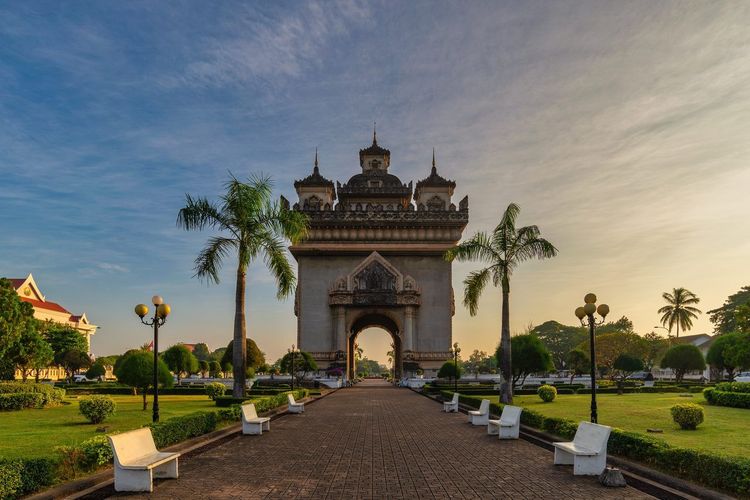
Its silhouette dominates Lan Xang Avenue so completely that you can spot it from almost anywhere in the city centre. Patuxai (Lan Xang Avenue, Vientiane, rated 4.4/5 on Google across 12,610 reviews) — literally "victory gate" — was built between 1957 and 1968 to commemorate the fighters who fell during Laos's struggle for independence from France. The anecdote that amuses local guides: the cement used for its construction had been donated by the United States to build a new runway at Vientiane's airport. The Lao government diverted part of it to erect this monument, earning it the nickname "the vertical runway" to this day.
Seen from a distance, the arch recalls its Parisian cousin, but the architecture is distinctly Lao and Khmer. Its five towers, which evoke both Buddhist precepts and the principles of peaceful coexistence between peoples, the bas-reliefs carved with kinnaris (half-woman, half-bird creatures) and nagas, and the scenes drawn from the Ramayana tell a very different story from its European counterpart. Beneath the ground-floor vault, frescoes depict Vishnu, Brahma and Indra — a reminder of the Hindu influence on Lao culture.
For just a few thousand kip — less than a euro — you can climb the seven flights of narrow stairs up to the panoramic galleries at the top, passing through several floors occupied by small souvenir and craft shops. Aim for late afternoon: the light is softer and the view stretches along the entire length of Lan Xang Avenue — laid out as an echo of the Champs-Élysées — all the way to the government buildings leading towards Pha That Luang. A telescope installed on the upper platform helps you pick out distant monuments. Allow about thirty minutes for the climb and the full visit.
The site is open every day, generally from 8am to 5pm, with a midday break depending on the season. The square surrounding the monument, with its fountains and lawns, is an informal gathering place: joggers at dawn, families in the late afternoon, street vendors selling skewers and sugar-cane juice. Even without climbing, the view from the base is worth a stop.
2. Pha That Luang, the Great Golden Stupa and Symbol of Laos
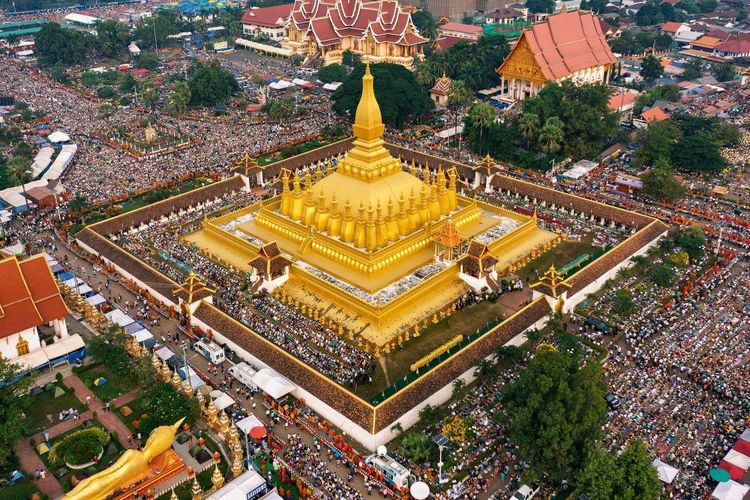
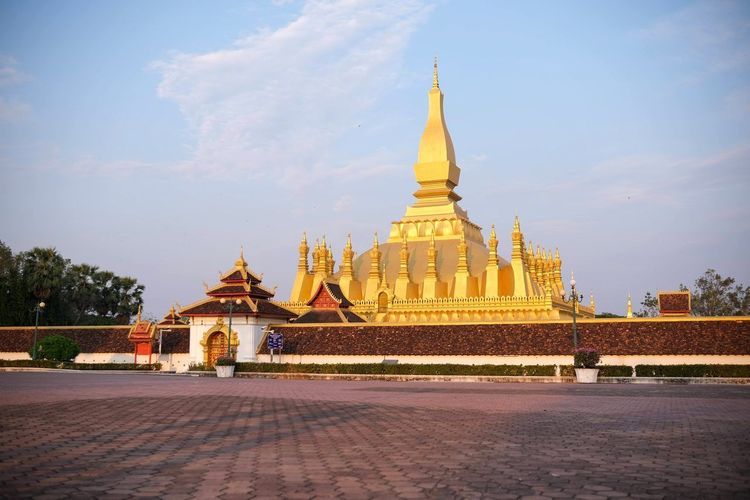
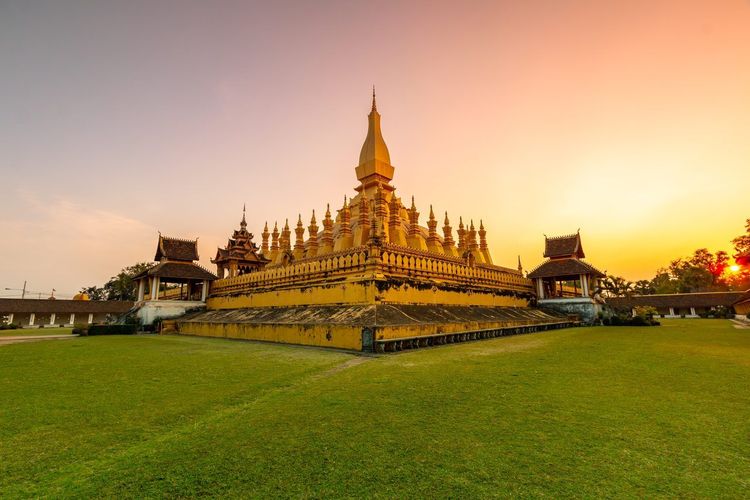
If a single monument were to sum up Laos, this would be it. Pha That Luang (That Luang Road, Vientiane, rated 4.5/5 on Google across 7,587 reviews) appears on banknotes, the national seal and a large proportion of the country's tourist posters. According to legend, Buddhist missionaries erected a first stupa on this site as early as the 3rd century BCE to house a fragment of the Buddha's sternum. The current structure, 45 metres tall and covered in gold leaf, dates from the 16th century: it was commissioned by King Setthathirath after he transferred the capital of the Lan Xang kingdom to Vientiane.
A statue of King Setthathirath, sword resting on his knees, stands guard at the main entrance. The central stupa, shaped like a lotus bud, is surrounded by a square cloister and thirty smaller satellite stupas representing, according to the monks, the thirty virtues of the Buddha. The complex has been destroyed and rebuilt several times — notably after the city was sacked by Siamese armies in 1828 — before being restored under the French administration in the 1930s.
Come in the late afternoon: the low sun makes the gilding literally blaze, and the light is far softer for photographs than the crushing heat of midday. The enclosure is open from 8am to 5pm, with a frequent midday break, and entry costs around 10,000 kip. Wear clothing that covers your shoulders and knees, and bring small change: large-denomination notes rarely work at the ticket window.
The site takes on a completely different dimension once a year, at the November full moon, during the That Luang Festival (described later in the festivals section): thousands of pilgrims converge on the stupa for a candlelit procession that illuminates the entire esplanade.
3. Wat Si Saket and Haw Pha Kaeo, the Two Historic Temples of the City Centre
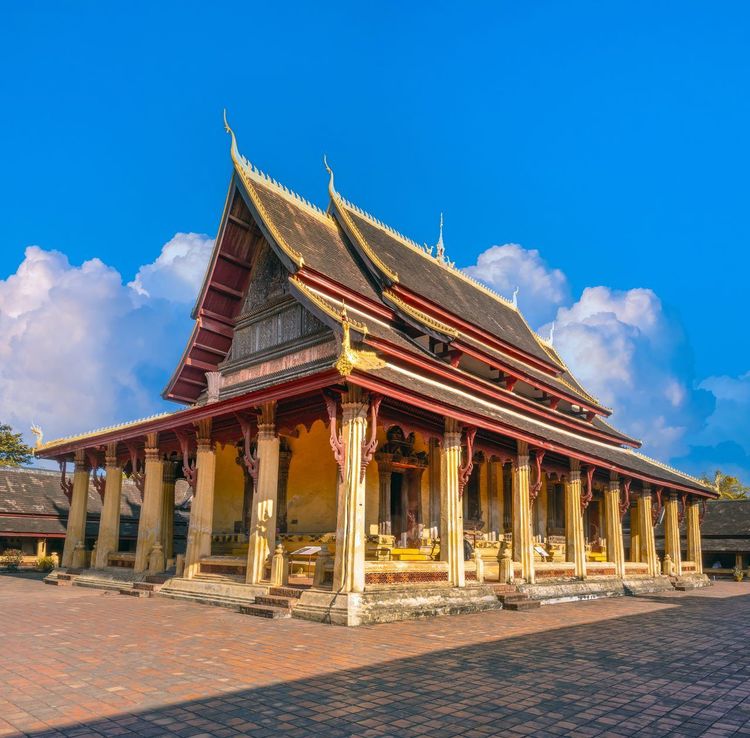
These two temples face each other on either side of Setthathirath Street, a few hundred metres from Patuxai. Their proximity makes them a natural stop at the start or end of a stroll through the city centre, and their shared history — the religious memory of the capital — complements rather than repeats itself.
Wat Si Saket, the Oldest Temple in the Capital
Built in 1818 on the orders of King Anouvong, Wat Si Saket is the only major temple in the city centre to have survived intact when Siamese troops sacked Vientiane ten years later, in 1828. The invaders, believing they recognised an architecture similar to that of neighbouring Siam, reportedly spared it.
The cloister surrounding the inner courtyard is pierced with more than 2,000 small niches, each housing a Buddha statuette in wood, bronze or stone, some dating back to the 16th century. A library on stilts once stored sacred manuscripts written on palm leaves.
Entry costs 5,000 kip, with opening hours from 8am to 4pm and a break of roughly an hour at noon: arriving at 11:45am means waiting on the forecourt. The resident monks are used to visitors and readily accept a polite greeting with hands pressed together, as long as you avoid photographing them too closely without their consent. The main sanctuary, with its coffered painted ceiling, takes 20 to 30 minutes to visit.
Haw Pha Kaeo, the Former Royal Temple Turned Museum
Directly opposite, Haw Pha Kaeo (Setthathirath Street, Vientiane, rated 4.3/5 on Google across 1,360 reviews) has a more turbulent history. Built in the 16th century to house the Emerald Buddha (Phra Kaeo) — the most sacred statue in Lao Buddhism — it was looted by the Siamese in 1779, who carried the relic off to Bangkok, where it still resides today at the Wat Phra Kaeo in the Grand Palace.
Rebuilt to the original design in the 1940s, the building now functions as a national museum of religious art: bronze Buddhas from every era, engraved stelae, and a collection of carved wooden doors considered one of the finest in the country. Entry costs around 10,000 kip, with opening hours aligned with those of its neighbour across the road, making it easy to combine both visits in a half-day. The outer courtyard, planted with frangipani trees, offers a welcome moment of calm after the heat of the street.
4. Buddha Park (Xieng Khuan), the Open-Air Sculpture Garden
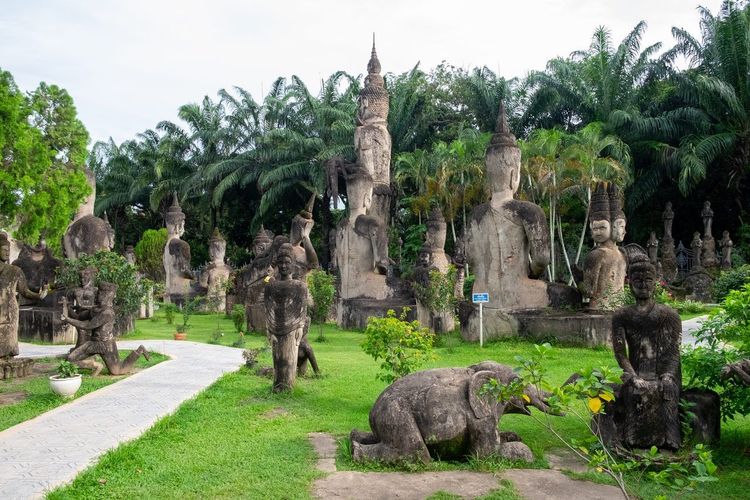
Some 24 kilometres southeast of the city centre, along the road that follows the Mekong to the Thai border, Buddha Park (also known as Xieng Khuan, "the city of spirits") brings together more than 200 reinforced-concrete statues, Hindu and Buddhist alike. The site was created in 1958 by Bunleua Sulilat, a self-taught artist and shaman-priest who claimed to have studied under a Hindu hermit in a cave in Vietnam.
The statues, disproportionate and sometimes frankly bizarre, narrate the personal cosmology of Sulilat — a private syncretism between Buddhism and Hinduism. You encounter a multi-armed Shiva, grimacing demons, three-headed elephants, and above all two centrepieces: a 40-metre reclining Buddha, and a giant three-storey pumpkin-shaped structure that you can explore from the inside by climbing a narrow staircase.
Inside the pumpkin, each level represents one of the three realms of Buddhist cosmology: hell, earth and heaven. You need to crouch and sometimes crawl through certain passages, so avoid tight-fitting clothing. The top offers an unobstructed view over the entire park and the Mekong.
Entry is around 15,000 kip, with a small surcharge if you bring a camera. Allow roughly 45 minutes to an hour of travel each way from the city centre by tuk-tuk or rented scooter, and plan for a half-day including the return journey. The most economical option is the local bus that departs from the bus station next to Talat Sao market and reaches the park in just over an hour, including stops. Some visitors combine the trip with lunch by the river, with the Thai bank visible directly across the water. Transport details and fares are covered in the practical section below.
5. Wat Si Muang and Wat Sok Pa Luang, Two Temples with Very Different Atmospheres
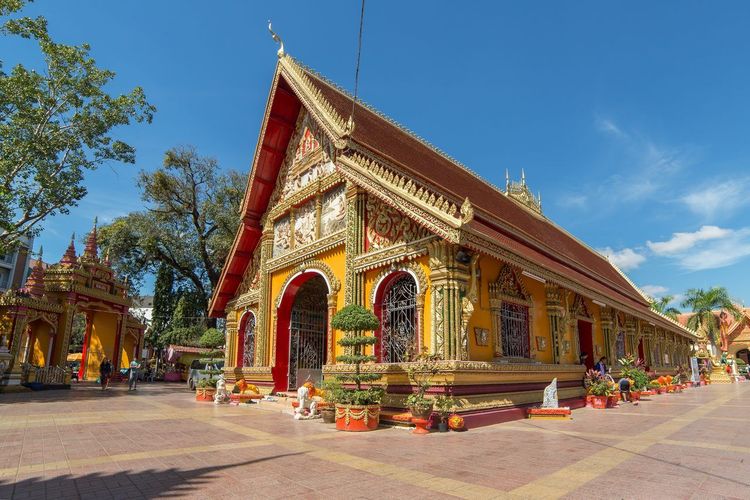
Beyond the major historic sites, two other temples are worth visiting for almost opposite reasons: one for its popular fervour, the other for its tranquillity.
Wat Si Muang, the Most Vibrant Temple in Vientiane
Built on the foundations of an ancient Khmer sanctuary, Wat Si Muang houses the city's founding pillar, the sao lak muang. Legend has it that a young pregnant woman threw herself into the pit as the pillar was being lowered into it, as an offering to protect the city. Locals continue to come in large numbers every day of the week to pray, seek a prediction or have a marriage blessed.
It is without doubt the liveliest temple in the capital, far removed from the heritage atmosphere of the sites above: lotus flower and incense stick offerings, families arriving with baskets of fruit, monks blessing visitors with holy water. Entry is free, with a simple donation customary. The most widely observed ritual involves lifting a small Buddha statue resting on a cushion three times while making a wish: if it feels light, the wish is said to come true. Visit late morning to see local devotion at its peak.
Wat Sok Pa Luang, the Wellness Retreat and Traditional Massage Sanctuary
Away from the centre, in a more residential neighbourhood, Wat Sok Pa Luang (Sok Pa Luang Street, Vientiane, rated 4/5 on Google across 28 reviews) cultivates a radically different atmosphere. This forest temple has offered a traditional herbal sauna and Lao massage sessions for decades — an activity the monks themselves helped popularise to fund the upkeep of the site.
The sauna, heated by a decoction of local herbs (lemongrass, tamarind, guava leaves), is taken in lightweight clothing provided on-site, usually in the late afternoon once the heat of the day has eased. Budget a modest amount — a few tens of thousands of kip — for the combined sauna and massage.
6. That Dam, the Mysterious Black Stupa
Wedged between two avenues on Bartholomie Street off Samsenthai, just a short walk from the US Embassy, That Dam (Bartholonie Avenue, Vientiane, rated 4.6/5 on Google across 30 reviews) — "black stupa" — stands in sharp contrast to the riot of gilding found on the city's other religious monuments. This small brick stupa, never restored or repainted, owes its dark colour to centuries of moss and erosion rather than any deliberate aesthetic choice.
Local legend has it that a seven-headed naga sleeps beneath the mound and woke to protect the inhabitants during the Siamese invasion of 1827. Others say it continues to watch over the city from below, unseen.
The site is freely accessible at all hours and takes only a few minutes to visit, but it combines easily with a walk through the centre between Patuxai and the surrounding residential streets, well away from tour groups. A local tip: avoid the roundabout after dark — a few stray dogs tend to linger there and can be unwelcoming.
7. Vientiane's Markets: Crafts and Street Food
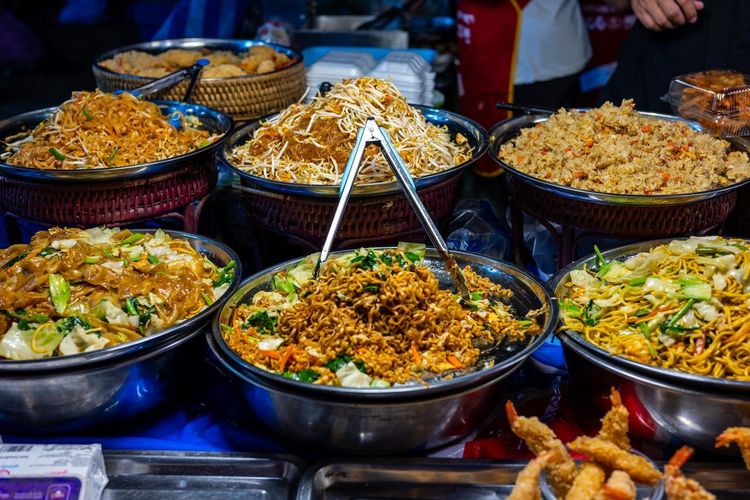
Shopping in Vientiane is above all an experience lived in its covered markets and street stalls, where hand-woven silks, organic produce from the surrounding countryside and improvised street-food stands all come together as soon as night falls.
Talat Sao, the Great Morning Market
Talat Sao (Lan Xang Avenue, Vientiane, rated 3.9/5 on Google across 6,899 reviews) — literally "morning market" — despite its name, stays active throughout the day, roughly from 9am to 4pm. This covered market, trading since the 1960s, brings together hundreds of stalls selling silver and gold jewellery, hand-woven silk fabrics, clothing and electronic goods.
An air-conditioned shopping centre has been built right next door, offering a more modern and cooler escape from the heat. The best deals on silks are found in the traditional aisles of the historic market rather than in the adjacent mall. The main bus station, adjoining the market, also makes it the departure point for local buses to Buddha Park and the outskirts of the city.
Vientiane Organic Market and the Farmers' Markets
At weekends, several farmers' markets bring the city to life, including the best-known one, the Vientiane Organic Market, which brings together small local producers and a clientele mixing expats and Lao families in search of pesticide-free vegetables and freshly baked bread.
The atmosphere is noticeably more relaxed than in the covered markets of the centre, often with live music and coffee stalls. Arrive early: by 10am, a good portion of the vegetable baskets and fresh loaves have already sold out.
Talat Khua Din and Talat Thong Khan Kham, the Neighbourhood Markets
Less featured in guidebooks, Talat Khua Din and Talat Thong Khan Kham remain neighbourhood markets frequented primarily by locals — the first near the central bus station. You'll find fresh fruit and vegetables, Mekong fish, bulk spices and cheap noodle stalls.
If you want to understand the daily food habits of Vientiane's residents rather than shop for souvenirs, these are the markets to explore early in the morning, between 6am and 8am, before the heat melts the crushed-ice displays.
On the night-market front, Vientiane plays on two levels: the craft and clothing stalls that line the Mekong riverbanks in the evening, and the small Ban Anou night market to the north of the centre, known for its skewer and noodle stalls among the cheapest in the city. Both are covered in the sections on the riverfront and nightlife below.
8. The Mekong Riverbanks and Chao Anouvong Park
In the late afternoon, the landscaped promenade along the Mekong becomes the city's informal meeting point: joggers, impromptu aerobics groups, families picnicking, vendors of grilled skewers and spicy green mango. The river, more than a kilometre wide at this point, separates Laos from Thailand, whose lights on the Nong Khai side are clearly visible as night falls.
Chao Anouvong Park (Fa Ngum Quay, Vientiane, rated 4.2/5 on Google across 6,879 reviews), laid out along the central stretch of the riverbanks, takes its name from the gilded statue of the eponymous king that stands there, one arm extended towards the river. Chao Anouvong remains a respected yet controversial figure: the last king of Vientiane, he rose up against the Siamese kingdom in 1827 before being defeated, captured and executed — an episode that hastened the destruction of the capital.
In the evening, especially at weekends, a lively fair takes over the riverbanks with food stalls, games and sometimes open-air karaoke stages. It's one of the best moments to sample local street food without worrying about finding the right address: just follow the smell of the grills and settle on one of the benches facing the sunset.
9. Nightlife in Vientiane
Vientiane remains a quiet capital compared to Bangkok or Hanoi, and it's worth adjusting expectations accordingly: there's no Khao San Road equivalent here. But for those who know where to look, the question of what to do in Vientiane at night is far from unanswerable, with riverside bars and lively karaoke venues to choose from.
Bars and Rooftops Facing the Mekong
Several terrace bars along the river make the most of the sunset view, often accompanied by a draught Beerlao — the local beer that appears on every table in the city. Some rooftops offer fusion cuisine so you can turn aperitif hour into dinner without changing venue.
Prices remain reasonable by Western standards, but climb noticeably at the most popular spots on weekends. Booking a terrace table in the late afternoon, before sunset around 6pm, guarantees the best seats.
Karaoke and Lao-Style Barbecue Evenings
Karaoke is an integral part of local nightlife, often combined with a Lao barbecue (sindat) — a grill on an individual charcoal brazier served with broth and vegetables to cook yourself at the table. These evenings, hugely popular with groups of friends and families, can easily stretch over several hours around a shared table.
Clubs, Nightclubs and Evening Night Markets
Nightclubs are concentrated in a handful of well-known venues in the centre, drawing a mixed crowd of locals and expats, with Thai pop and Western music. The atmosphere is decent, but Vientiane closes early: most establishments observe an informal curfew around midnight, a legacy of older, stricter regulations.
For a quieter evening, the Mekong riverbank night market (see previous section) and the Ban Anou market — which sets up at dusk along a few streets north of the centre — offer the most local alternative: you can dine on grilled meat and sticky rice for the equivalent of two or three euros, elbow to elbow with the residents.
10. Museums and Memorial Sites for Understanding Laos's History
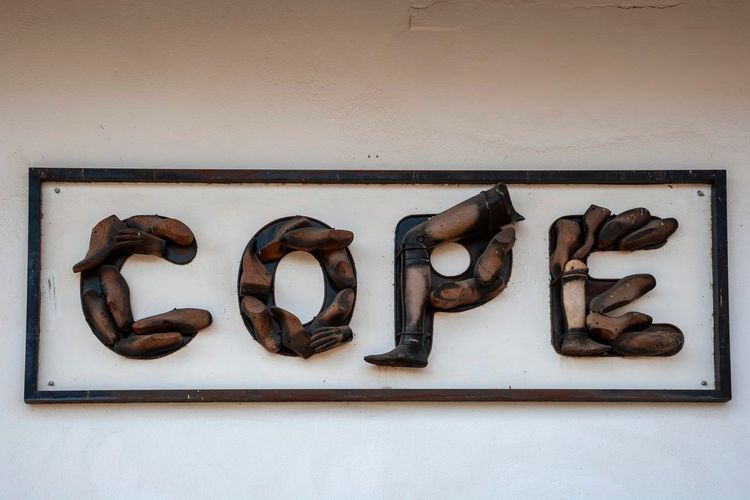
Vientiane bears the marks of a recent history shaped by war. Three sites, often absent from standard itineraries, allow you to understand this past with far greater depth than a simple visit to the temples.
The COPE Visitor Centre, a Memorial to War and Unexploded Ordnance
The COPE Visitor Centre documents the consequences — still very real today — of the American bombing campaign that targeted Laos between 1964 and 1973 during the Vietnam War. Per capita, the country remains one of the most heavily bombed territories in history.
The exhibition, free and open continuously from 9am to 6pm, presents locally made prosthetics for victims of unexploded cluster munitions (UXO), filmed testimonies and art installations created from war debris. A small café and a solidarity shop — whose proceeds fund the prosthetics — extend the visit. Allow an hour: this is one of the most affecting sites in the city, far removed from the usual tourist folklore.
UXO Center by MAG and the World Peace Gong
Nearby, the information centre of MAG (Mines Advisory Group), a British demining NGO, completes the visit with a more technical approach: maps of still-contaminated zones, an explanation of ongoing demining work, and figures on victims still recorded every year — more than fifty years after the end of the bombing. Entry is also free, and explanations are given in English by deminers trained in the field.
A little further on, the World Peace Gong was cast from shell casings and bomb debris as a symbol of peaceful conversion. It echoes a practice now common throughout Laos: transforming bomb casings into flower planters, canoes or decorative objects sold to tourists.
The Lao National Museum
Housed in a French colonial building on Samsenthai Street, the Lao National Museum (Samsenthai Street, Vientiane, rated 3.8/5 on Google across 451 reviews) traces the country's history from prehistory through to the 1975 revolution, taking in the Lan Xang kingdoms and the colonial period along the way.
The collections, somewhat dated in their presentation, are nonetheless useful for placing the monuments you visited earlier in the day within their historical context: the connections between Pha That Luang, the Setthathirath dynasty and the expansion of the Lan Xang kingdom are set out in detail with maps and scale models. Entrance for foreign visitors is around 30,000 kip, compared to 5,000 for Lao nationals, and a thorough visit takes about an hour. Check opening hours at the reception desk on the day: the museum sometimes closes without notice for renovation work or national public holidays.
11. Things to Do around Vientiane
Beyond the city limits, the Lao countryside offers an immediate contrast to the relative hustle of the city centre. Two day trips let you step well off the beaten track.
Ang Nam Ngum Lake, between Islands and Fishing Villages
About 90 kilometres north of Vientiane, Ang Nam Ngum Lake is a vast artificial reservoir created in 1971 by the construction of a hydroelectric dam. The landscape, dotted with wooded islets and hilltops breaking the surface of the turquoise water, is a striking contrast to the more urban image of the capital.
Boat excursions organised from the lakeside villages allow you to reach several islands, some of which host fish farms and small fishing communities. Allow a full day including the return journey, with a grilled fish lunch — caught that same morning — served on one of the lake's floating platforms.
The area remains little visited by foreign tourists and is more popular at weekends with Vientiane families in search of fresh air, making it an authentic excursion well away from standard organised tours.
Don Xing Xou Island and Its Forest, a Nature Escape
Closer to the centre, the small island of Don Xing Xou, sitting in the Mekong, offers a green retreat reachable in half a day. You get there by dugout canoe from the bank, for a walk through dense bamboo and mango tree vegetation.
The island has a handful of rustic stilted cafés where you can linger over the water with an iced Lao coffee, far from the noise of traffic. It's a good option for an hour or two of nature without leaving the city entirely. Be careful during the rainy season: the river level rises quickly and dugout crossings are sometimes suspended at a moment's notice.
12. Festivals and Events Not to Miss
The Lao calendar, largely aligned with the Buddhist cycle and the harvest, shapes life in Vientiane far more than any Western public holiday. Two highlights are worth planning your trip around.
Pimaï, the Lao New Year
Celebrated in mid-April, Pimaï (the Lao New Year) transforms the city into a massive water fight for three days, in a tradition that symbolically washes away the sins of the past year. The streets fill with water, flour and good cheer, with processions of Buddha statues doused in perfumed water.
If you visit during this period, bring clothes you don't mind getting soaked and protect your phone in a waterproof pouch: no one escapes the water jets, tourists included. Also book your accommodation and transport well in advance — the entire country moves to be with family during these three days.
The That Luang Festival and the Boat Races
In November, at the full moon, the That Luang Festival draws thousands of pilgrims from across the country to the great golden stupa described earlier. The celebration lasts several days, with a giant market, traditional performances and a candlelit procession that illuminates the esplanade after dark.
At the end of the rainy season, traditional boat races also take place on the Mekong, pitting crews of rowers from across the country against each other to the cheers of crowds massed on the riverbanks — one of the most photogenic spectacles of the year in Vientiane.
13. Where to Eat in Vientiane: Lao Cuisine and the Best Food Spots
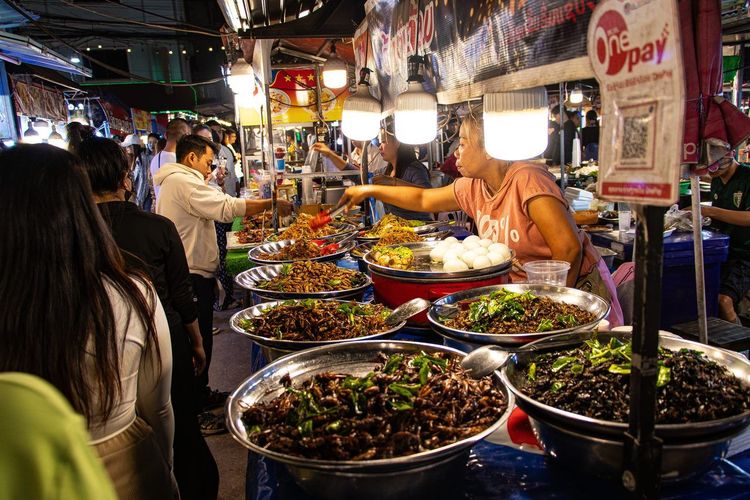
Lao cuisine remains underrated compared to its Thai and Vietnamese neighbours — unfairly so: Vientiane concentrates a food scene that deserves several dedicated meals.
Must-Try Lao Restaurants and Street Food
Laap (a chopped meat salad seasoned with lemongrass, mint and chilli), tam mak hoong (pounded green papaya salad) and sticky rice (khao niaw), eaten by hand, form the backbone of any traditional Lao meal. Khao piak sen — a thick rice noodle soup in pork or chicken broth — makes an excellent local breakfast, far more substantial than coffee and a croissant.
The best restaurants in Vientiane for Lao cuisine are often far from the most touristy streets, in sign-less local eateries identifiable by the number of scooters parked outside. Don't hesitate to venture in, even without an English menu: pointing at your neighbour's plate works perfectly well.
Where to Have a French-Style Breakfast
A legacy of the colonial era, Vientiane retains a surprising baking tradition: crusty baguettes, butter croissants and French-style coffee can be found at several spots in the city centre, often run by long-established expats.
This contrast between Lao cuisine and French café culture sums up the identity of the capital rather well: a city that has kept its Southeast Asian soul while retaining, almost by accident, some habits from the colonial era — visible too in the architecture of the streets around Setthathirath.
14. Practical Information: Transport, Accommodation, Budget and Visa
The final stretch before planning your trip in earnest: here is everything you need to know about getting to Vientiane, getting around, finding a place to stay and managing your budget.
How to Get to Vientiane and Get Around Once There
Vientiane's international airport, still known to locals as Wattay (code VTE), receives direct or connecting flights from the main cities of Southeast Asia (Bangkok, Hanoi, Kuala Lumpur, Singapore), just fifteen minutes from the city centre by tuk-tuk or taxi. From Thailand, it is also possible to reach Vientiane overland by crossing the Thai-Lao Friendship Bridge at Nong Khai by bus or train: this is the country's busiest border crossing.
The railway line linking Vientiane to the Chinese border via Vang Vieng and Luang Prabang has been in service since December 2021 and has transformed journey times to the north of the country: Luang Prabang can now be reached in around two hours, for a ticket costing between $12 and $22 depending on class, compared to a full day on mountain roads by bus before. Book several days in advance during high season — seats sell out quickly.
Once there, the city centre is easily covered on foot or by bicycle, as the distances between the main sites are short. For longer trips (Buddha Park, the airport), tuk-tuks are negotiated at a fixed price upfront, or the local ride-hailing app Loca spares you constant bargaining. Renting a scooter, very common among visitors, is a practical option but requires vigilance on sometimes unpredictable local roads.
Where to Stay on Any Budget
Vientiane's accommodation offer covers every budget, from family guesthouses at around $10–15 a night to charming hotels housed in former colonial villas, with a growing range of boutique hotels in the area around Setthathirath Street.
Choosing accommodation within the central grid, between the Mekong and Patuxai, lets you visit the essentials on foot and keep tuk-tuk trips to a minimum. More outlying neighbourhoods, while cheaper, mean depending more on transport to reach the main sites.
Visa, Daily Budget and Good Practices
Most nationalities — including French, Belgian and Canadian travellers — can obtain a visa on arrival at the airport or at land border crossings, valid for 30 days, for $40 payable in cash with one passport photo. Swiss nationals benefit from a short-stay visa exemption, as do several Asian countries. An e-visa can also be applied for online before departure, avoiding the queue on arrival. Pay in dollars where possible: payment in kip often comes with a surcharge at the window, and a nominal supplement applies outside office hours at certain border crossings.
The daily budget varies considerably depending on your travel style: budget around $20–25 per day travelling on a shoestring (guesthouse, street food, local transport), and $50–70 for a more comfortable stay including a mid-range hotel and a few organised excursions. Always carry cash: ATMs are plentiful in the centre but cap withdrawals, and many eateries and tuk-tuks do not accept cards.
For more complex excursions such as Ang Nam Ngum Lake or onward stages elsewhere in Laos, going through a local agency simplifies logistics, particularly for transport in rural areas where services are less standardised than in the capital.
15. Getting Your Bearings in Vientiane: How Long to Stay and When to Go
Vientiane stretches along the left bank of the Mekong, in the centre-west of Laos, facing the Thai city of Nong Khai. Good news for anyone who hates maps: the tourist heart fits within a rectangle barely two kilometres across, bounded by Fa Ngum Quay along the river, Lan Xang Avenue running towards Patuxai and then Pha That Luang, and the parallel streets Setthathirath and Samsenthai where temples, museums, cafés and hotels are concentrated. Once you have these three axes in mind, you won't get lost.
There remains the question that comes up constantly among travellers pressed by the rest of their Lao itinerary: how many days should you really dedicate to the capital? Two full days are enough to cover the essentials without rushing.
In a single day, focus on the central triangle: Patuxai, Pha That Luang, Wat Si Saket and Haw Pha Kaeo, rounded off with a stroll along the Mekong riverbanks in the evening. Two to three days allow you to add Buddha Park, the markets, a memorial site such as the COPE Visitor Centre, and possibly a day trip to Ang Nam Ngum Lake.
What truly sets Vientiane apart from other capitals in the region is the absence of tourist pressure: unlike Bangkok or Hanoi, you can wander without a strict itinerary, drift down a back lane without ever feeling overwhelmed by crowds — which explains its reputation as Southeast Asia's most peaceful capital.
As for the best season, aim for November to March — the cool dry season — with temperatures that most often range between 20 and 28°C. Avoid March to May if possible, the hot season when the thermometer regularly exceeds 35°C, as well as the monsoon from June to October, which brings sudden but brief downpours.
FAQ
How Long Does It Take to Visit Vientiane?
Two full days are enough to cover the must-sees in the city centre (Patuxai, Pha That Luang, historic temples, Mekong riverbanks). Allow three days if you want to add the Buddha Park, a memorial site and a day trip to Ang Nam Ngum Lake.
What Is the Nicest Neighbourhood in Vientiane?
The central grid around Setthathirath Street and the Mekong riverfront concentrates most of the restaurants, cafés and bars, with a livelier atmosphere in the evenings than elsewhere in the city, while remaining within walking distance of the main temples.
What Is the Most Beautiful Part of Laos?
It depends on your tastes: Luang Prabang charms with its UNESCO-listed heritage and an even more tranquil atmosphere, while Vientiane offers a more authentic, less touristy capital where local life is more visible on a daily basis.
Is Vientiane Worth Visiting?
Yes, if only for the richness of its temples, its memorial scene unique in Southeast Asia and its pace of life that sets it apart from other regional capitals. Many travellers, rushing to reach Luang Prabang, underestimate it — mistakenly.
What Is There to Do in Vientiane at Night?
Enjoy the bars and rooftops along the Mekong for sunset, then head to a Lao barbecue dinner (sindat) or a karaoke evening, a hugely popular local activity. The night markets on the riverbanks and at Ban Anou round off a relaxed evening, with meals for two or three euros.
What Budget Should I Plan for a Stay in Vientiane?
Budget around $20–25 per day travelling on a shoestring (guesthouse, street food, local transport), and $50–70 for a more comfortable stay with a mid-range hotel and a few organised excursions. Entrance fees to sites are minimal: 5,000 to 30,000 kip depending on the monument.
How Do You Get around Vientiane without a Car?
The city centre is easily covered on foot or by bicycle. For longer distances, tuk-tuks (negotiate the fare before you go) and the local ride-hailing app Loca are the simplest options, without needing to rent a scooter.
Vientiane, the Capital You Leave with Regret
Between the gilded splendour of Pha That Luang, the 2,000 Buddhas lined up in the cloister of Wat Si Saket and the grills smoking on the Mekong riverbanks at sunset, Vientiane has more than enough to fill two to three days of travel — without ever making you feel as though you're racing through a checklist. It is precisely this pace, inherited from its status as Southeast Asia's most peaceful capital, that wins over travellers who are ready to slow down rather than dash from site to site.
Laos doesn't yet have its own Ryo audio-guided tour, but the app is steadily expanding its coverage: make a habit of opening Ryo at your next stop in a city with its own audio-guided tour, and you'll find the same step-by-step commentary approach waiting for you. In the meantime, this guide remains your best roadmap for organising a relaxed stay in Vientiane.