© Shutterstock
 Votre guide Ryo
Amsterdam by Bike: 6 Routes to Ride Like a Local in 2026
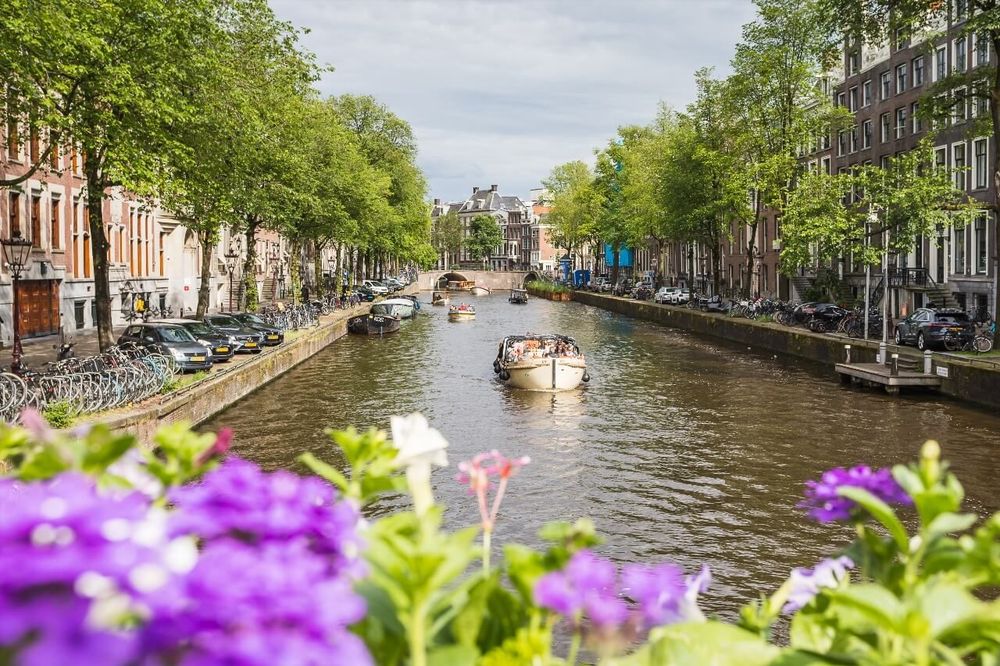
A bike ride in Amsterdam is without doubt the simplest way to experience the city differently. Among the 800,000 bikes that circulate here every day, yours is not yet one of them. Here, cycling is not a tourist activity: it is the way locals traverse three centuries of history in twenty minutes of pedaling. Canals glide past at handlebar height, gabled houses lean slightly over the water, and cycle paths take you to places no bus ever stops.
This guide offers six routes to explore Amsterdam by bike in 2026: from the historic center with its canals and Golden Age houses to the windmills of Zaanse Schans 15 kilometers from the center, taking in the fishing villages of Waterland, the galleries of the Rijksmuseum and the alleyways of the Jordaan. You will also find the best places to rent a bike at a good price, the traffic rules nobody tells you about on arrival, and tips to avoid the classic mistakes of the first few days. To enrich each place you pass through with anecdotes and historical context, the Ryo Amsterdam audio tour is perfect to listen to while pedaling: it is the most natural way to combine exploration and cultural discovery.
Amsterdam and Cycling: a Few Mind-Blowing Numbers
Amsterdam has 900 kilometers of cycle paths in a city barely 20 kilometers across. The number of bikes exceeds the number of inhabitants: 1.2 million bicycles for 925,000 Amsterdammers. Every year, roughly 15,000 bikes end up in the canals, which explains those peculiar crane barges that regularly dredge the bottom of the Herengracht.
The Netherlands has invested heavily in cycling infrastructure since the 1970s, and Amsterdam is the most visible result. Traffic lights include a dedicated phase for cyclists, intersections have their own cycling rules, and the underground bike park at the central station can hold 7,000 bicycles at once, making it one of the largest in Europe.
For visitors, all of this translates into one concrete reality: Amsterdam is one of the few major cities in the world where cycling is genuinely enjoyable, regardless of your level. The terrain is completely flat, distances are short and the infrastructure has been designed for everyone. Ryo's audio-guided tour of Amsterdam covers several of these iconic routes, with audio commentary on the most significant sites in the historic center.
Renting a Bike in Amsterdam: the Best Options
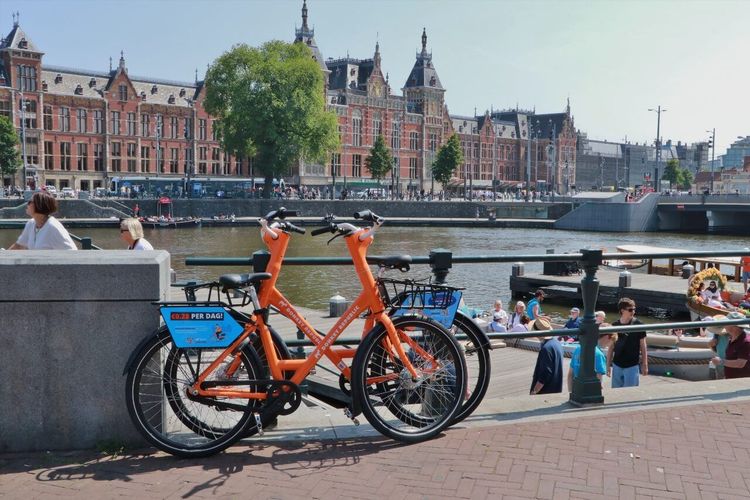
Several options are available depending on the length of your stay and your budget. For a day or more, independent rental shops generally offer the best rates. MacBike is the best known, with four locations in the city, including one directly opposite the central station. Indicative price around €17.50 per day for a standard bike. The brand is reliable and its bikes are well maintained, though its prices are slightly higher than those of local competitors.
MacBike
Black Bird Bikes often receives better online reviews and more competitive rates, around €10 to €12 per day. The staff speak English and the bikes are in good condition. For electric bikes, Renting Amsterdam (Damrak 247, 1012 ZJ Amsterdam, rated 4.8/5 on Google from 1,308 reviews) offers a solid fleet at €25 to €35 per day, ideal for longer excursions to Zaanse Schans or Waterland.
Black Bird Bikes
Renting Amsterdam
If you are traveling with Dutch public transport, the OV-fiets is the cheapest option: €4.80 per day from train stations, with a rechargeable OV-chipkaart available at NS ticket counters. Handy for taking the train to Zaandam and cycling back, or for a day trip to Waterland from the central station.
A few things to check before leaving the shop: the front and rear brakes, the saddle height, and the condition of the tires. Always take two locks: one for the frame, one for the front wheel. Bike theft is endemic in Amsterdam and most reputable rental shops include them or offer them for an extra €1 to €2. One last tip: avoid bikes offered by strangers on the street, particularly around the central station. They are often stolen, and riding one would put you in breach of the law.
Route 1: The Historic Center, Between Canals and Gabled Houses
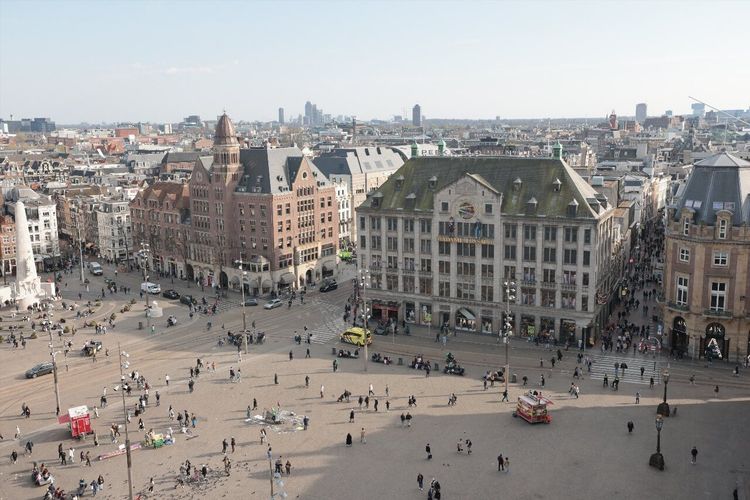
Amsterdam Centraal is the natural starting point for any bike ride in the city. The underground car park opposite accommodates several thousand bikes across multiple levels: a foretaste of what lies ahead. Cross the Damrak toward the Dam square, the historic heart of Amsterdam, dominated on the left by the Royal Palace and flanked by the Nieuwe Kerk, the coronation church of Dutch monarchs since the 15th century.
Amsterdam Centraal
Dam
From the Dam, head toward the Begijnhof along the Kalverstraat or the small parallel streets. This béguinage founded in the 14th century, tucked away behind a large wooden door, is one of Amsterdam's most unexpected places. Rows of Dutch houses surround a green lawn and a clandestine Catholic chapel dating from the Protestant Reformation. The exterior gives absolutely nothing away about this inner sanctuary.
Begijnhof
Continue to the Herengracht, the Gentlemen's Canal. The stretch between the Brouwersgracht and the Leidsestraat is known as the 'Golden Bend': the gabled houses here are the grandest and most opulent in Amsterdam, built by the merchants who made their fortune during the Golden Age. An amusing detail: many of these facades lean slightly forward toward the street. This is not the result of age — it was intentional. The protruding beams were used to hoist furniture through the windows, as the interior staircases were too narrow to move wardrobes.
Herengracht
Make a detour to the Nieuwmarkt and its medieval weigh house, the Waag, which dates from 1488. This building with a complex past served successively as a city gate, the headquarters of the surgeons' guild (Rembrandt painted The Anatomy Lesson here in 1632, depicting a dissection carried out in the building itself) and a café. Today the square hosts an organic market every Saturday morning.
Nieuwmarkt
Head next to the Westerkerk, a large 17th-century Protestant church whose blue and gold tower dominates the neighboring Jordaan. The tower is open for visits on certain days; the view from the top takes in the entire canal belt. Anne Frank mentioned the carillon of this very tower in her diary, which she could hear from the hiding place in the house next door.
Westerkerk
End this loop along the banks of the Prinsengracht (Prinsengracht, 1015 DW Amsterdam), the Princes' Canal. This is where houseboats converted into permanent residences are most numerous: Amsterdam has around 2,500 houseboats across its canals, and the Prinsengracht has a fine concentration of them. The total distance for this central route is around 8 to 10 kilometers depending on your detours, taking 2 to 3 hours including a few stops. This is the best first encounter with Amsterdam on two wheels: well-marked paths, limited motor traffic and varied enough scenery that time passes without you noticing. Ryo's Along the Canals audio-guided tour also passes through this stretch of the historic center, stopping by the Royal Palace and Dam Square.
Prinsengracht
Route 2: The Amstel, from City Banks to Dutch Countryside
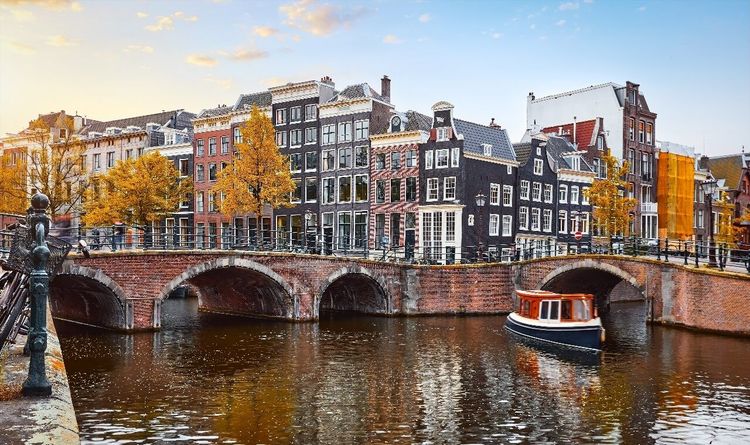
The Amstel gives the city its name: Amsterdam literally means 'dam on the Amstel'. Cycling along this river means understanding where the city came from and seeing what the Dutch countryside looks like just one hour of pedaling from the center.
Start at the Waterlooplein and its flea market, one of Amsterdam's oldest open-air markets. The square takes its name from the Battle of Waterloo and hosts dozens of antique dealers, vintage clothing sellers and craftspeople offering all manner of curious objects every day.
Waterlooplein
A few hundred meters further stands the Magere Brug, the 'Skinny Bridge', a white wooden drawbridge dating from 1691. Its 1,200 light bulbs illuminate it in the evening, making it one of the most photographed bridges in Amsterdam. The counterweight mechanism is still in service: wait a few minutes and you may see it slowly open to let a barge through.
Magere Brug
Head down to the Albert Cuyp Markt, the largest street market in the Netherlands with its 300 stalls stretching over 600 meters. The De Pijp neighborhood you pass through here is Amsterdam's quintessential bohemian district: alternative cafés, Surinamese grocery stores, artisan cheese shops and a dense, cosmopolitan street life that passing tourists rarely discover. It is the ideal spot for a quick, affordable lunch before continuing south.
Albert Cuypmarkt
The Amstelpark welcomes you a little further on with its 46 hectares of greenery, rose gardens, sculpture trail and decorative windmills. A good place to catch your breath before pushing into the countryside. Beyond the ring road, the landscape changes dramatically: rows of houses give way to meadows lined with canals, Dutch cows and old farmhouses.
Amstelpark
Ouderkerk aan de Amstel (Dorpsstraat, 1191 JC Ouderkerk aan de Amstel, rated 4.6/5 on Google from 3,500 reviews), about 8 kilometers from the center, is the first village on this route. Its 14th-century church and historic Jewish cemetery, one of the oldest in the Netherlands, make it a memorable stop. The road along the river is perfectly flat and lightly trafficked. The round trip from the center is roughly 22 kilometers, taking 2.5 to 3 hours in total. For ideas on additional activities during your stay, the article on things to do in Amsterdam at the weekend lists the best options according to your interests.
Ouderkerk aan de Amstel
Route 3: Vondelpark and the Museum Quarter
The Vondelpark is Amsterdam's green lung: 47 hectares, some 10 million visitors a year and an atmosphere that blends street musicians, picnicking families, skaters and joggers. On a bike, you follow the main paths while avoiding the pedestrian zones marked on the ground. The park also contains the Rose Garden, a rose garden created in 1936 that brings together more than 70 varieties of roses, and an open-air theater active from June to August.
Vondelpark
Enter from the north side via the Leidseplein and exit to the south to emerge directly onto the Museumplein, the large esplanade that brings together three of the most visited museums in the Netherlands. The Rijksmuseum immediately impresses with its neo-Gothic facade and its 8,000 works on display, including Rembrandt's Night Watch and Vermeer's The Milkmaid. Even without going inside, the exterior architecture justifies a stop. The tunnel running beneath the building, reserved exclusively for cyclists and pedestrians, is one of the city's most iconic perspectives.
Rijksmuseum
The Van Gogh Museum is right next door, with more than 1.5 million visitors a year and the largest collection of the artist's works in the world: more than 200 paintings and 500 drawings. The queue can exceed two hours without a reservation in high season. Always book online — time slots sell out several days in advance in July and August.
Van Gogh Museum
Heading north from the Museumplein, you pass the Stedelijk Museum (Museumplein 10, 1071 DJ Amsterdam, rated 4.4/5 on Google from 15,326 reviews), dedicated to modern art and contemporary design, with collections by Mondrian and Malevich and a permanent gallery devoted to the history of Dutch design. Continue to the Leidseplein, the square of cafés and theaters, to complete this loop. Allow 10 to 12 kilometers from the center, taking 2 to 3 hours depending on time spent in the museums.
Stedelijk Museum
Route 4: The Jordaan and the Nine Streets
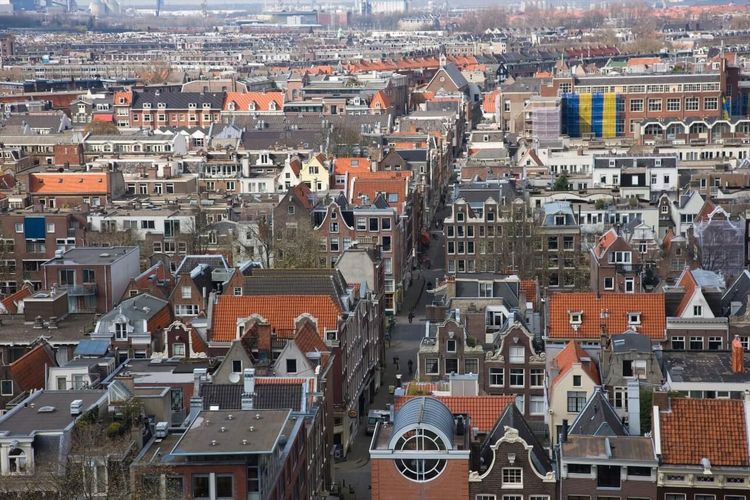
The Jordaan is without doubt Amsterdam's most photogenic neighborhood. Built in the 17th century to house workers and Huguenot refugees fleeing France after the revocation of the Edict of Nantes, it was long one of the city's most working-class areas. Gradually rehabilitated from the 1980s onward, it has become the bohemian residential heart of the Dutch capital: narrow streets, red-brick facades, art galleries and niche boutiques attract a creative and international clientele.
Start at the Westerkerk and head north along the Prinsengracht. To your left opens the Jordaan proper, a maze of alleyways some of which are less than two meters wide. The Brouwersgracht (Brouwersgracht, 1013 GH Amsterdam) (the Brewers' Canal) marks the northern boundary of the neighborhood. It is one of Amsterdam's quietest canals, less busy than the Herengracht or the Prinsengracht, with its 17th-century warehouses converted into characterful apartments commanding some of the city's highest rents.
Brouwersgracht
Head back south through the Nine Streets, nine small streets running perpendicular to the canals that form a dense network of independent boutiques, secondhand bookshops and tucked-away cafés. You will find Dutch designers, vintage clothing stores and artisan cheese shops offering tastings with no obligation to buy. It is one of the most pleasant areas to explore on two wheels. Remember to lock your bike to an authorized fixed point: illegal parking is fined, even for tourists.
De Negen Straatjes
The Noordermarkt, every Saturday morning, transforms the square at the foot of the Noorderkerk into an organic market, and into a flea market on Mondays. The Noorderkerk itself (1623) is one of the first Protestant churches built in the Netherlands after the Reformation. If you are passing through on a Saturday, this is the unmissable stop before cycling on.
Noordermarkt
To complete this route, follow the Singelgracht (Singelgracht, 1017 XK Amsterdam), the outermost canal of the historic belt, and return to the center. This bike ride covers around 7 to 8 kilometers for 1.5 to 2 hours of leisurely cycling. It is probably the best introduction to the Jordaan: the neighborhood is quiet in the morning, terraces start opening around 9:30 am and the light on the canals is among the finest the city has to offer. For more ideas around Amsterdam, see the article on activities in Amsterdam and the surrounding area.
Singelgracht
Route 5: Waterland and the Fishing Villages
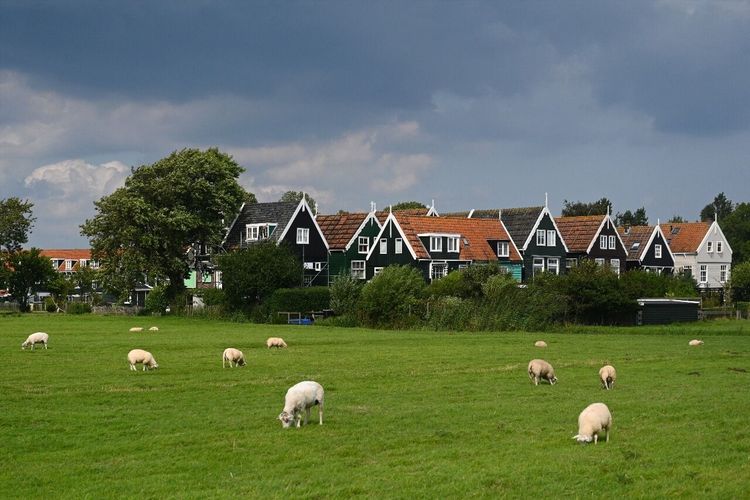
Just north of Amsterdam, barely beyond the harbor and a branch of the IJ crossed for free by ferry, another world begins. Waterland is a region of polders, canals and narrow dikes that has barely changed since the 17th century. The villages that make it up are accessible in 30 to 45 minutes by bike from Amsterdam Centraal, with no car and no train.
Take the free ferry behind the central station (north side, IJ bank) to Buiksloterweg. From there, marked cycle paths guide you northward through landscapes of reed-lined canals, meadows grazed by sheep and thatched farmhouses still in use.
IJ Ferry (Buiksloterweg)
Durgerdam is the first village on this route: a single street running along the dike, wooden houses painted green and white, the IJ on one side and the polders on the other. The dike protects land that sometimes lies below sea level. The silence here is almost complete at certain hours of the morning.
Durgerdam
Broek in Waterland is perhaps the most picturesque village on the excursion. Its pastel-painted wooden houses are listed monuments. As early as the 18th century the village attracted wealthy Amsterdam burghers who built their country residences here. Napoleon stopped here in 1811 during his tour of Holland and reportedly wanted to purchase the entire village — a local anecdote that residents have been passing down for two centuries.
Broek in Waterland
Monnickendam (Haven, 1141 AK Monnickendam, rated 4.3/5 on Google from 340 reviews), a little further on, offers the chance to have lunch overlooking the water at one of its fish restaurants. The town retains its medieval clock tower and its eel-smoking workshops, a Dutch culinary tradition that few travelers get the chance to taste on the spot. Allow 35 to 40 kilometers round trip for the full route to Monnickendam, making for half a day in the saddle. To plan your food stops around this excursion, the article on Amsterdam's culinary specialties will give you some good recommendations.
Monnickendam
Route 6: Zaanse Schans and the Windmills
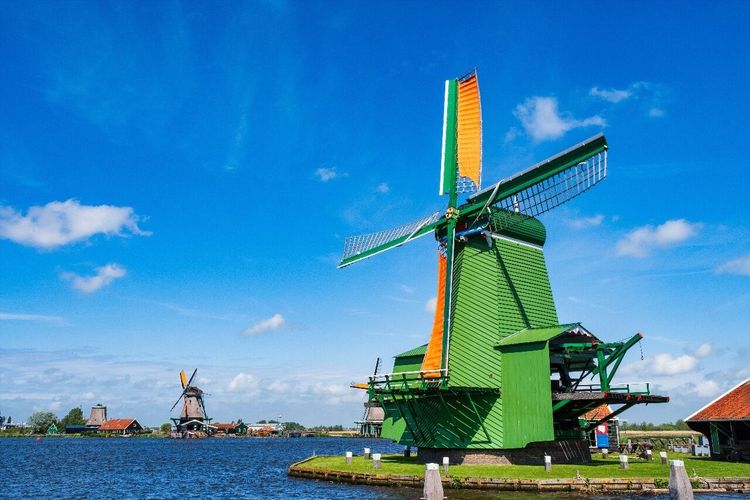
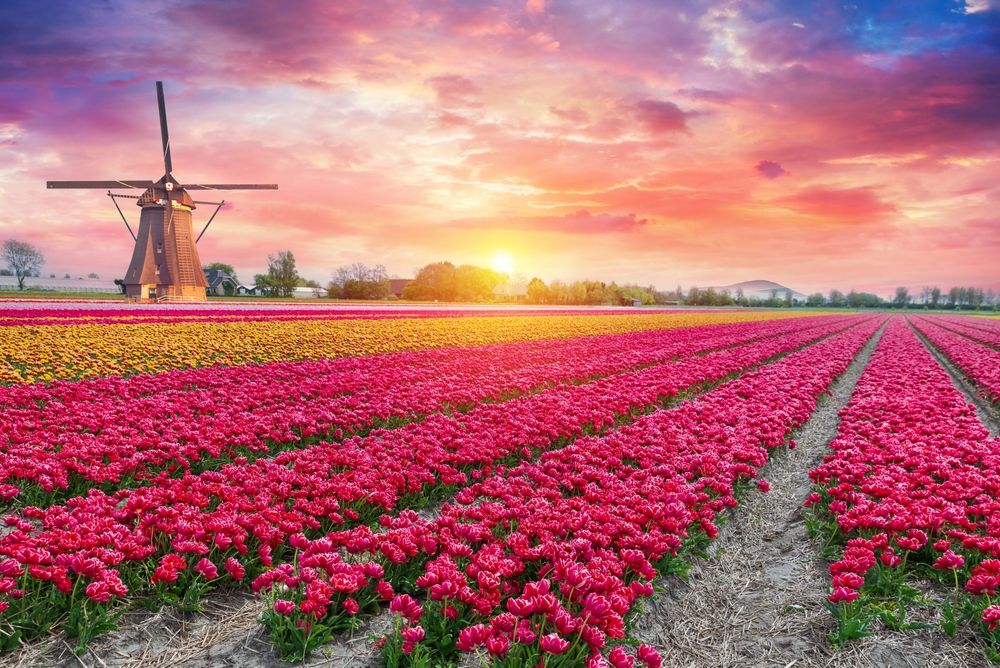
Zaanse Schans is the most visited tourist site in the Amsterdam area, and for good reason: it is one of the only places in the world where windmills still operate within a preserved architectural setting, just 15 kilometers from the city center. The cycling route to get there is among the most beautiful in the region.
From the central station, head west along the IJ, then north through Zaandam (Gedempte Gracht, 1506 CJ Zaandam). The cycle path follows the Zaan river with a few zigzags through residential areas in the northern suburbs. Allow 1 hour to 1 hour 15 minutes on a standard bike, or 45 minutes on an electric bike.
Zaandam
On arrival, Zaanse Schans welcomes you with its working windmills, wooden houses painted in the characteristic green of North Holland, cheese makers and clog carvers working in plain sight. Entry to the site is free: only the interior visit of each windmill is paid (around €4 per windmill). The De Kat mill, the world's only working wind-powered paint mill, and De Gekroonde Poelenburg, a 17th-century sawmill, are particularly worth your time.
Zaanse Schans
One tip that genuinely transforms the visit: arrive early. From 10:30 am onward, coach loads of tourists arrive in their dozens and the atmosphere changes completely. Between 8:30 and 9:30 am, the site belongs to cyclists and the residents of the neighboring village. The morning light on the windmills and the Zaan river, sometimes with a little mist on the water, is one of the most powerful images you will bring back from the Netherlands.
Molen De Kat (Kalverringdijk 29, 1509 BT Zaandam, rated 4.7/5 on Google from 925 reviews)
On the return, take if possible the route along the east bank of the Zaan, quieter and just as photogenic with its 19th-century industrial warehouses. Allow around 30 kilometers round trip from the center for a full day including the visit. On an electric bike, fatigue is minimal and you can follow up with a stop in Zaandam or a detour to one of the region's cheese farms. If you want to combine windmills and tulips, the guide to visiting the Keukenhof from Amsterdam offers a complementary itinerary suited to the spring season.
Cycling Traffic Rules in Amsterdam
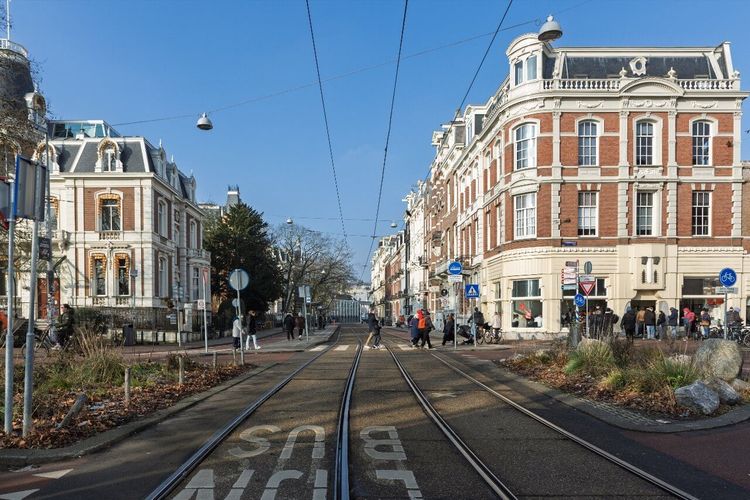
In Amsterdam, cyclists have priority in most traffic situations, but this comes with specific rules. Cars yield to bikes on marked cycle paths. Trams, however, have absolute priority in all cases. Never stop on the rails, and always cross them perpendicularly, never diagonally, or risk your wheel getting caught.
Cycle paths are indicated by red or blue road markings and signs showing a white bicycle on a blue background. Cycling on the pavement is prohibited and can result in a fine. Front and rear flashing lights are mandatory at night: Dutch police officers enforce this rule on tourists and residents alike, with fines that can exceed €60.
At intersections, give-way-to-the-right applies unless otherwise indicated. The fietspaden (cycle paths) that cross junctions are sometimes poorly respected by motorists, and pedestrians tend to cross them without looking in tourist areas, particularly around the Dam and the Leidseplein.
Using a phone while cycling is prohibited, with a fine of €95. Alcohol is subject to the same threshold as for drivers: 0.5 g/L in the blood. In practice: always exercise caution at intersections, lights are mandatory from dusk, and cross any rail you encounter perpendicularly.
Our Practical Tips for Your Bike Ride
The weather. Amsterdam receives sudden and unpredictable showers throughout the year, including in summer. Rental shops generally offer lightweight waterproofs: take one even if the sky is perfectly clear when you set off. The Dutch say there is no such thing as bad weather, only bad clothing.
Theft. The city has one of the highest bicycle theft rates in Europe. Always use two locks: one for the frame, one for the front wheel. Always lock to an authorized fixed point (a ground-level metal ring or dedicated post). Never leave a rental bike without a lock, even to pop in for a coffee.
Trams. Their rails are smooth and your front wheel can get caught if you approach them at a shallow angle. Always cross perpendicularly, at reduced speed.
Timing. The city center is noticeably quieter before 9 am and after 6 pm. Between noon and 4 pm, the main junctions (Dam, Leidseplein, Museumplein) are congested. For a first stress-free bike ride, set out early in the morning.
Navigation. Google Maps offers a cycling mode with Amsterdam's official cycle paths. To enrich each place you cycle through with historical anecdotes about the canals, houses and neighborhoods, the Ryo Amsterdam audio guide can be listened to while pedaling without needing to stop to read.
FAQ
Where can I rent a bike in Amsterdam?
The main rental shops are MacBike (several locations in the city, rates around €17.50/day, reliable and well-established), Black Bird Bikes (best value for money, around €10 to €12/day, good online reviews) and Renting Amsterdam for electric bikes (€25 to €35/day). For a short stay, shops near the central station are the most convenient. Travelers with a Dutch OV-chipkaart can use the OV-fiets from train stations for just €4.80/day.
How much does it cost to rent a bike in Amsterdam?
A standard bike costs between €10 and €20 per day depending on the shop and the rental plan chosen. An electric bike costs €25 to €35/day. Discounts are generally available from the second consecutive day. Some hotels offer bikes on loan or at preferential rates for their guests: ask at the front desk before heading to a rental shop.
Is Amsterdam suitable for beginner cyclists?
Yes, it is one of the most accessible cities in the world for cyclists of all levels. The terrain is completely flat, the cycle paths are well marked and separated from motor traffic for the vast majority of routes. The only real challenge is the density of traffic in the center, particularly around tram lines and major intersections. Outside the center, routes toward Waterland, the Amstel and the Vondelpark require no special training or prior experience of urban cycling.
Can you cycle to Zaanse Schans from Amsterdam?
Yes. Zaanse Schans is about 15 kilometers from the center of Amsterdam, roughly 1 hour to 1 hour 15 minutes by standard bike. The route follows the IJ westward and then the Zaan river northward. An electric bike is recommended if you want to arrive fresh for the windmill visit. The round trip is approximately 30 kilometers in total.
What traffic rules should cyclists follow in Amsterdam?
Front and rear lights are mandatory at night, holding a phone while cycling is prohibited (€95 fine), tram tracks must be crossed perpendicularly, and trams always have absolute priority. Cars are required to yield to cyclists on marked cycle paths. The legal blood alcohol limit is the same as for drivers: 0.5 g/L in the blood.
What is the best time of year for a bike ride in Amsterdam?
May and June offer the best conditions: long days (up to 17 hours of daylight), mild temperatures and tulips still visible in the region. The Keukenhof is open from mid-March to mid-May: see our article on visiting the Keukenhof from Amsterdam to combine both. September and October offer beautiful autumn light with noticeably fewer crowds. Summer (July–August) is lively but very busy on all central routes. Winter is cold and windy, but cycling through Amsterdam in the snow remains a singular experience that few travelers have had.
Amsterdam is best discovered by bike. Not because it is 'typical', but because it matches the city's pace: slow enough to see everything, fast enough to cover it all in a day. From the 17th-century canals to the windmills of Zaanse Schans, from the fishing villages of Waterland to the collections of the Rijksmuseum, each route in this guide gives you access to a version of Amsterdam you won't see from a bus or a canal cruise.
To put every bridge, house and neighborhood you cycle through into context, the Ryo Amsterdam audio tour is designed to be listened to on the move. The best possible combination: two wheels, one day, and a city to understand.
À lire également