© Shutterstock
 Votre guide Ryo
Things to Do in Faro in 2026: 15 Experiences to Discover the Algarve Differently
In Faro, the question of what to do often arises right outside the airport, just fifteen minutes from the historic city center. Far from its reputation as a mere gateway to the beaches of the Algarve, the regional capital conceals a 13th-century walled old town, a protected lagoon where flamingos nest, and a sandy island accessible only by boat. Before heading off to explore the cobbled lanes of the Cidade Velha, open the Ryo app: a Ryo audio-guided tour recounts the history of every façade, without needing to book a human guide.
Some details surprise even seasoned Algarve visitors. Storks nest each spring at the top of the Arco da Vila, right in the city center. A chapel lines its walls with the bones of more than twelve hundred Carmelite monks. A covered market sells the day's catch every morning just meters from café terraces. A wild island, the Ilha Deserta, is reached in ten minutes by water taxi and remains virtually empty outside July and August. Resident dolphins cruise the lagoon year-round, and Roman ruins two thousand years old can be visited less than ten kilometers from the center. Here are fifteen experiences that give Faro a character all its own, enough to fill a one-day stopover or a full week's stay.
1. The Cidade Velha, the Walled Historic Heart
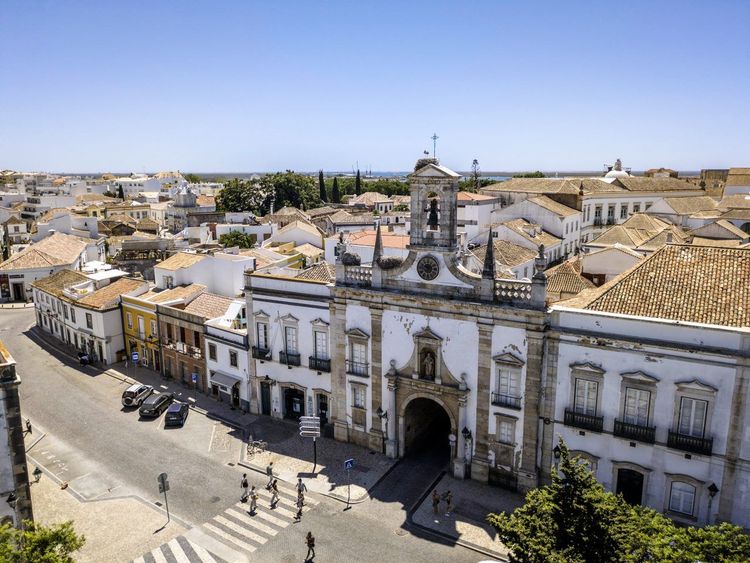
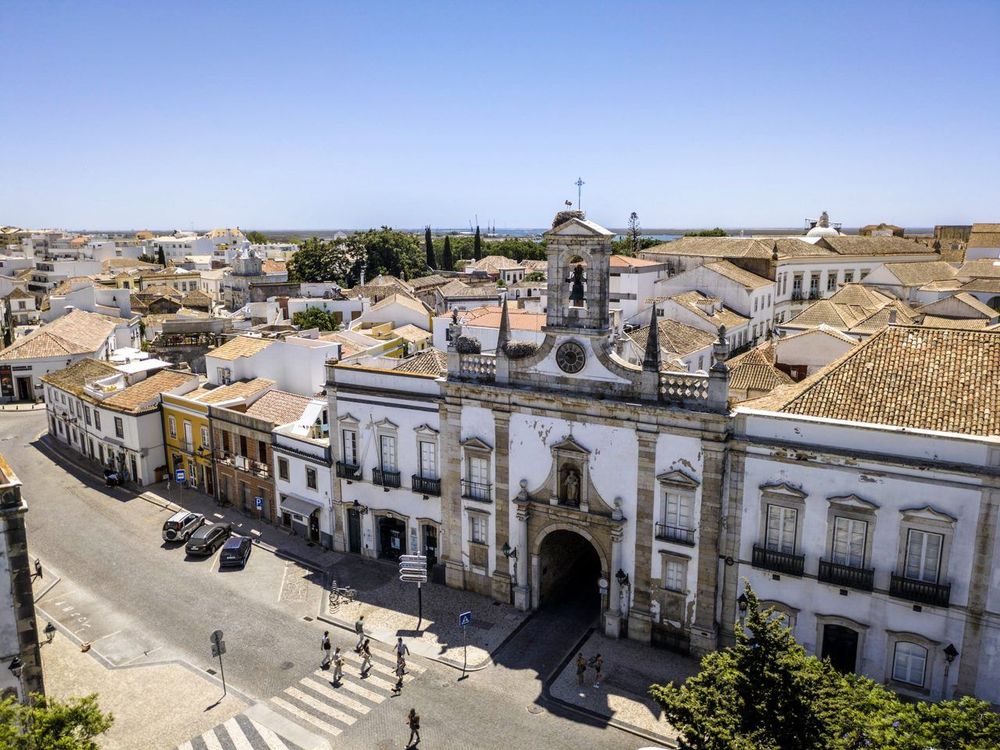
The Cidade Velha is Faro's medieval nucleus, encircled by ramparts of Moorish origin that were modified over the centuries. You enter through the Arco da Vila, exit through the Porta Nova, and between the two stretches a maze of cobbled lanes, azulejo-tiled façades and little squares shaded by bitter orange trees.
The neighborhood has retained the layout of a fortified town: the ramparts still encircle the cathedral, the bishop's palace and several convents. The local limestone, lighter than the sandstone more common elsewhere in the Algarve, gives the walls an almost white hue in the late-afternoon sun. Many visitors pass through the Cidade Velha in a rush before heading for the beach; they miss the essential, for it is here that virtually all of the city's built heritage is concentrated.
Beyond the cathedral square, take the time to push on to the Igreja da Misericórdia and the former quarter known as Vila Adentro, literally 'the city within', where a few restored houses now shelter artisans' workshops, guesthouses and a handful of small restaurants with no noisy terrace. The neighborhood cats bask on warm stone doorsteps and laundry dries at the windows: the atmosphere remains resolutely residential, a world away from the commercial streets of the new town. It is also in these alleyways that you encounter the fewest people, even when a cruise ship has disembarked its passengers onto the marina.
You can follow the Ryo audio-guided tour from the Arco da Vila to the cathedral: the commentary details the successive layers of the city, from the Roman occupation to the reconstruction after the 1755 earthquake. Allow an hour and a half for the full loop at a leisurely pace, more if you stop to photograph the façades. The best time to visit remains early morning, before 10 a.m., when the raking light sculpts the stone reliefs and the cruise groups have not yet disembarked.
On the practical side, everything is walkable from the train station and the center: the airport is less than ten minutes away by car or bus, and the regional train connects Faro to Tavira, Olhão or Lagos for just a few euros, making the city an excellent car-free base. The Cidade Velha is entirely navigable on foot — flat shoes are recommended on the rounded cobblestones — and you can leave your vehicle in the seafront car parks rather than attempt the narrow lanes.
The ramparts themselves can be walked on the outside, particularly on the marina side, where a pedestrian path offers an overall view of the towers and battlements. It is also from this vantage point that one best understands why Faro was a stronghold contested between Christians and Muslims until the 13th century, before its definitive reconquest by King Afonso III in 1249, which made it one of the last towns in the Algarve to return to Christian rule.
2. Faro Cathedral, between Gothic, Renaissance and Baroque
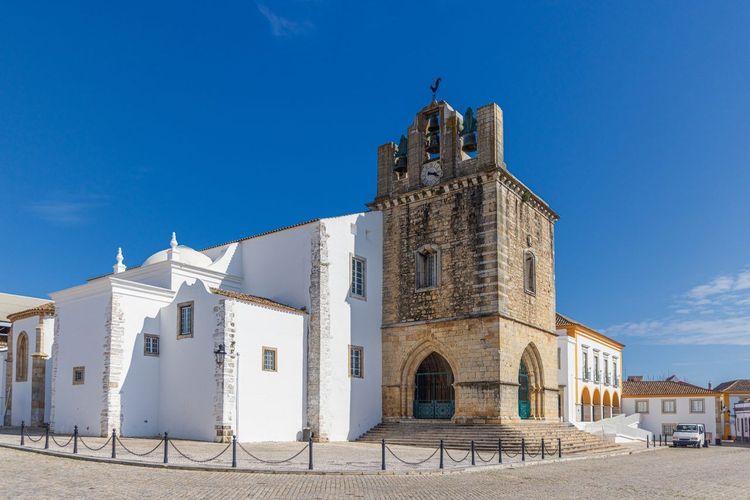
The Sé Catedral de Faro (Largo da Sé, 8000-138 Faro, rated 4.4/5 on Google across 6,124 reviews) occupies the site of a former mosque, itself built on the remains of a Roman temple. The current building blends styles: the tower and main portal date from the 13th century, the nave was rebuilt after the city was sacked by the Earl of Essex in 1596, and the interior features Baroque decoration added in the 18th century.
The main attraction is not limited to the nave. Climb the narrow spiral staircase of the bell tower: the terrace offers a 360-degree view over the orange rooftops of the old town, the Ria Formosa lagoon and, on a clear day, the barrier islands offshore. Few visitors make the effort to climb up, which often leaves the terrace nearly deserted even in high season.
Inside, the 17th-century azulejos covering the choir deserve a moment's attention, as does the red-and-gold Baroque organ of German craftsmanship installed in the 18th century and still used during concerts, its painted case decorated with Oriental motifs that bear witness to Portugal's commercial ties with Asia at that time. The entrance ticket, around 3.50 euros, includes access to the bell tower, the small exterior bone chapel and the adjoining sacred art museum. The cathedral is generally open from 10 a.m. to 6 p.m. on weekdays and closes on Sunday mornings for services — a detail many visitors only discover on arrival. Plan for a visit of around forty-five minutes, a little more if you go up the tower and linger in the orange garden along the south side of the building.
A word about that famous Earl of Essex, whose name keeps coming up in Faro's history. In July 1596, an English fleet commanded by Robert Devereux, Earl of Essex, landed and sacked the city for several days, in the midst of the war between England and Spain at a time when Portugal was under Spanish rule. This episode explains why a large part of Faro's medieval heritage had to be rebuilt afterwards, with the cathedral first among them.
3. The Arco da Vila and Its Nesting Storks
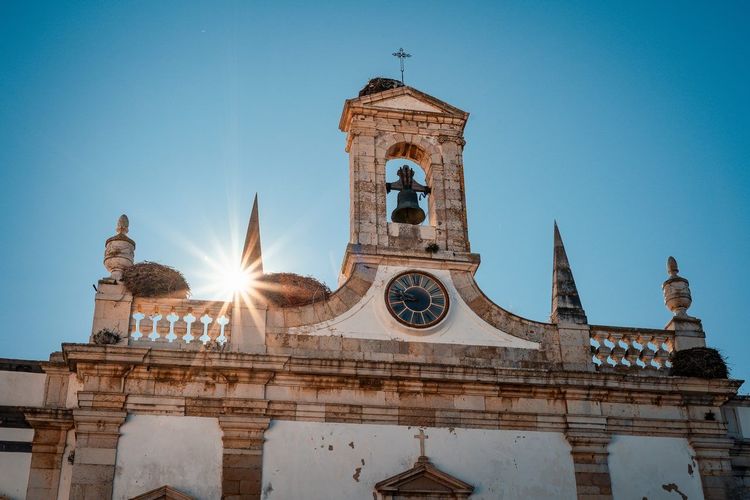
The Arco da Vila (Rua do Arco, 8000-138 Faro, rated 4.4/5 on Google across 1,606 reviews) marks the main entrance to the Cidade Velha from the modern center. Built on Moorish foundations, the current arch was rebuilt in an Italian neoclassical style in the early 19th century, commissioned by Bishop Francisco Gomes do Avelar, who entrusted the project to Genoese architect Francisco Xavier Fabri.
A curious detail: white storks nest every year on the cornices of the arch and neighboring towers, a rare spectacle right in the urban center. The nesting season runs from February to June, the ideal period to observe the comings and goings of couples and hear the characteristic clapping of their bills. As you pass under the vault, look up: the niche above the passageway houses a marble statue of Saint Thecla, patron saint of the city, and one can still make out, embedded in the inner wall, a horseshoe-shaped door inherited from the original Arab rampart — one of the few Moorish vestiges still visible in Faro. Walk through the arch slowly rather than at a quick pace: it is the symbolic threshold between the merchant city and the episcopal city.
Sit for a moment at one of the terraces of the Jardim Manuel Bivar, just opposite, to take in the arch as a whole with its perched nests: it is one of the most photographed viewpoints in Faro, and the late-afternoon light gives the façade a beautiful cream hue. The storks, for their part, supremely ignore the comings and goings of passersby.
4. The Capela dos Ossos, the Chapel of Bones
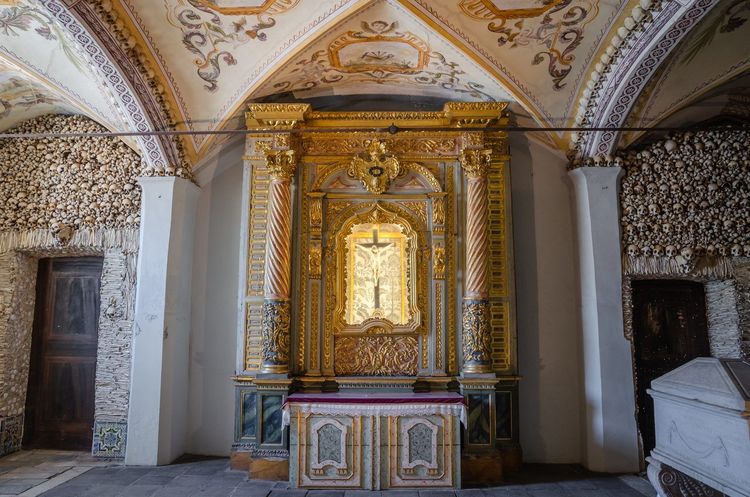
Adjoining the Igreja do Carmo (Largo do Carmo, 8000-303 Faro, rated 4.4/5 on Google across 3,396 reviews), the Capela dos Ossos entirely lines its walls and vault with the skulls and bones of more than 1,245 Carmelite monks, exhumed in the 19th century to free up space in the convent cemetery. The ensemble, completed in 1816, belongs to the tradition of Baroque funerary chapels also found in Évora.
The subdued light and silence of the place create a particular atmosphere, far from any gratuitous macabre effect: the original intention was meditative, a memento mori intended for the monks themselves. An inscription carved above the entrance invites the visitor to stop and reflect, summed up by the phrase 'Stop here and consider that you too will come to this state.' The chapel visit is almost always paired with that of the Igreja do Carmo, whose gilded Baroque interior contrasts sharply with the austerity of the adjacent crypt. Both can be visited in about thirty minutes, for a ticket of around 2 euros paid at the church entrance. Avoid school groups in the late morning on weekdays: the chapel is tiny and fills up quickly, to the point where it is sometimes difficult to fit more than ten people inside.
5. The Museu Municipal de Faro, between Cloister and Archaeology
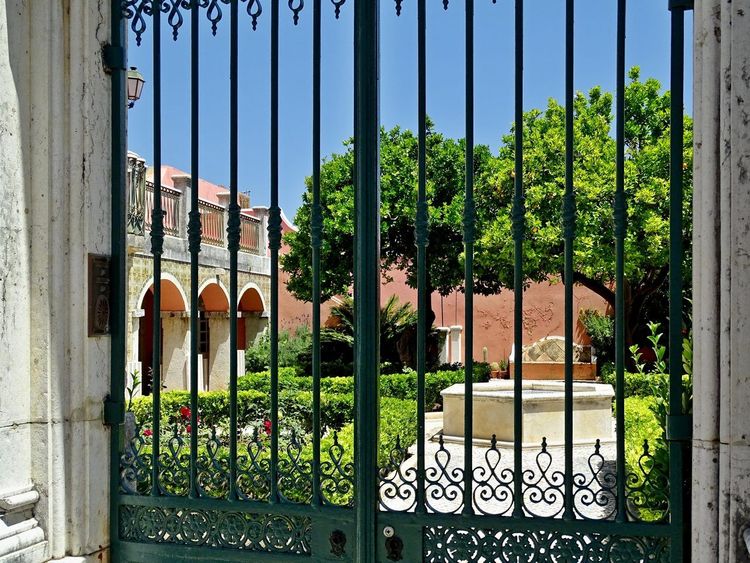
Housed in the former Convento de Nossa Senhora da Assunção, a 16th-century Renaissance convent founded under the patronage of Queen Catherine of Austria, the Museu Municipal de Faro (Praça Dom Afonso III 14, 8000-176 Faro, rated 4.4/5 on Google across 1,668 reviews) holds one of the finest archaeological collections in the Algarve.
The centerpiece is the Roman mosaic known as the Ocean mosaic, a 3rd-century pavement discovered during excavations in Faro itself, depicting a bearded face surrounded by sea creatures and several meters in length. The two-story cloister with its Manueline arcades is worth the visit on its own: it is one of the few surviving examples of this architecture in the region and regularly hosts concerts and temporary exhibitions in summer. The following rooms trace the city's history from the Iron Age to the Islamic period, with ceramics and architectural elements recovered from former sites. Allow an hour for a full visit, less if you focus on the cloister and the mosaic. Admission, around 2 euros, is one of the cheapest in the city — a good complement after the nearby cathedral. The museum is generally closed on Mondays; check before you go.
6. The Ria Formosa, Protected Lagoon of Channels and Sandbanks
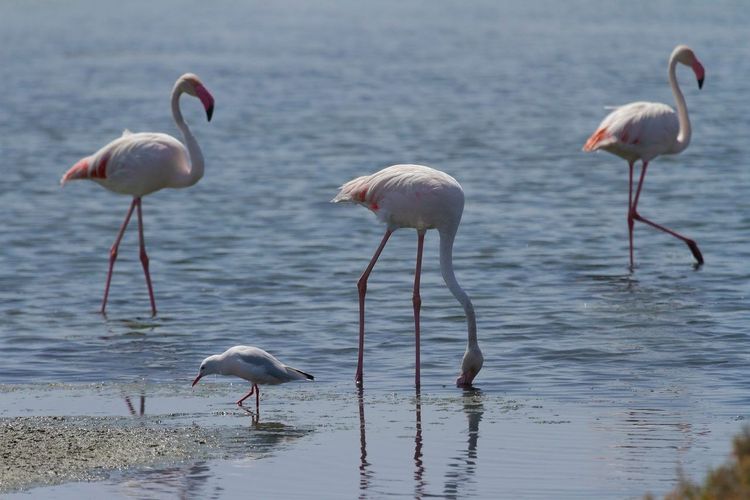
The Ria Formosa is a natural park of more than 18,000 hectares, a system of lagoons, channels and barrier islands stretching some sixty kilometers of coastline from the Faro area to Cacela Velha. Faro sits literally at the lagoon's edge: the city's marina provides direct access to this shifting landscape of sandbanks that are redrawn with every tide.
The ecosystem shelters more than 200 bird species, including flamingos in winter, avocets, black-winged stilts and the purple swamphen with its blue plumage — the park's emblem, present year-round. Boat trips departing from the marina allow visitors to navigate the channels, land on isolated sandbanks and observe wildlife at close range. Most excursions last between two and three hours and often include a stop on an island or in a traditional fishing village such as Farol or Culatra.
The lagoon also sustains an age-old human activity: salt pans still in operation and above all shellfish farming, as this stretch of coast supplies a large share of Portugal's clam production. At low tide, you can see mariscadores gathering shellfish by hand on the exposed mudflats, a skill passed down from generation to generation. The Ria Formosa's designation as one of Portugal's seven natural wonders in 2010 raised its profile without, fortunately, disrupting its tranquility.
You can also explore the Ria Formosa by kayak, a quieter option that allows you to reach areas where larger boats cannot go. The Ryo app offers audio commentary on the history of the lagoon and these traditional shellfish-gathering techniques. Early morning remains the best time to observe birds, before the wind picks up and boat traffic intensifies. In high season, book your trip the day before: boats sell out by early afternoon.
7. Praia de Faro, the City Beach
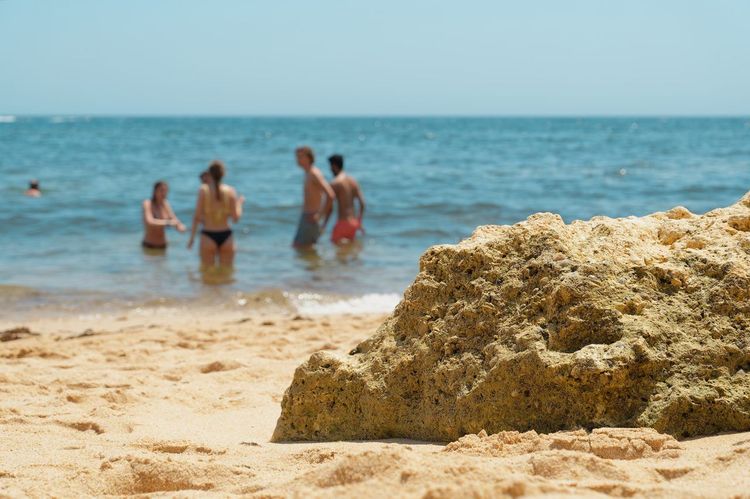
The Praia de Faro (8005-520 Faro, rated 4.4/5 on Google across 8,500 reviews) stretches along a sandbar on the barrier island of the same name, connected to the mainland by a road bridge a few minutes from the center. The fine sand and shallow waters make it a family-friendly beach, very different from the rocky coves further west in the Algarve.
On the lagoon side, at the back of the beach, the calm and shallow water is perfectly suited to children and paddle board enthusiasts. On the ocean side, the swell is moderate but enough for bodyboarding in the late afternoon. A regular bus, line 16, which also serves the airport, connects the city center to the beach in about twenty minutes — a practical alternative if you are not renting a car. The grilled fish restaurants lined up along the promenade often serve the day's catch, making them a good stop for lunch after a swim.
At the eastern tip of the peninsula, a wooden boardwalk crosses the Ludo wetlands and former salt pans: this is one of the best spots to observe flamingos and storks around Faro, best done on foot or by bike in peace, away from the beach bustle. In July and August, arrive before 10 a.m. to find parking close to the main entrance, as the single access road quickly becomes congested.
8. The Ilha Deserta, the Wild Island off Faro
As its name suggests, the Ilha Deserta (8000 Faro, rated 4.7/5 on Google across 157 reviews), also known as Ilha da Barreta, has no permanent inhabitants and remains the southernmost of the Ria Formosa's barrier islands. It is accessible exclusively by water taxi from Faro's marina, a crossing of approximately twenty minutes.
The island unfurls several kilometers of virgin beach, with no buildings other than a single restaurant, Estaminé, renowned for its seafood and unobstructed ocean views. Outside July and August, it is not uncommon to have several hundred meters of sand entirely to yourself. Its southern tip, the Cabo de Santa Maria marked by a small lighthouse, is the southernmost point of mainland Portugal — a detail that draws enthusiasts of quirky geography. A boardwalk trail crosses the dunes from one end of the island to the other and allows visitors to tour it without trampling the fragile vegetation.
Water taxis generally run every hour in season and less frequently at other times of year; it is best to check the return times before disembarking so as not to be stranded. There is no natural shade on the island apart from the restaurant terrace: sunscreen, a hat and water are essential, especially between June and September. Some visitors combine the crossing with birdwatching along the channels, where little egrets prove particularly unafraid of humans.
9. Watching the Resident Dolphins of the Lagoon
A colony of bottlenose dolphins lives year-round in the waters off Faro and the Ria Formosa, making sightings possible almost any time of year — unlike other destinations where trips depend heavily on the season.
Boat excursions departing from the marina generally last between one and a half and two hours, with a sighting rate quoted by local operators at around 90% in mid-season. Dolphin groups typically number between five and fifteen individuals, sometimes accompanied by calves born in the lagoon. Some skippers cut the engine on approach to minimize disturbance — a practice worth seeking out when choosing your operator: several local companies display a responsible tourism charter that limits speed and approach distance.
You can also try your luck from the shore, particularly near the Praia de Faro, where dolphins sometimes come close to the waterline in the late afternoon. For nature lovers, some trips combine dolphin watching with a stop at the Ilha Deserta — a practical way to make the most of a half day. Bring a windbreaker even in fine weather, as the air cools quickly once the boat picks up speed offshore, and book preferably in the late morning when the sea is generally calmer and visibility better.
10. The Palácio Episcopal, the Pink Façade of Religious Power
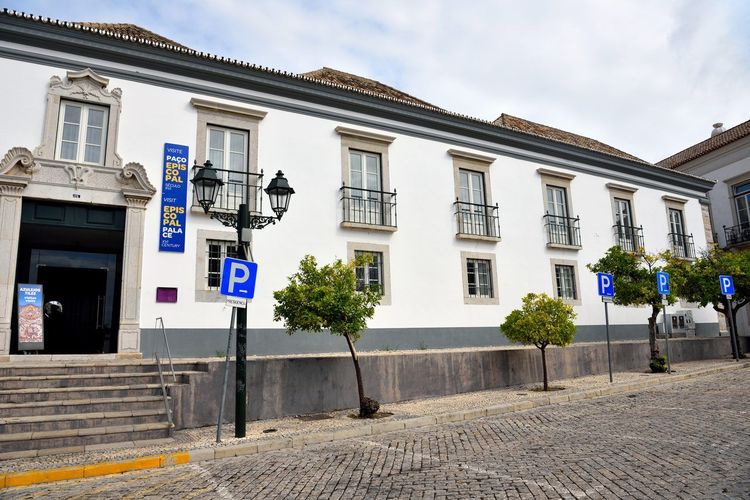
Adjoining the cathedral, the Palácio Episcopal de Faro (Largo da Sé, 8000-138 Faro, rated 3.5/5 on Google across 55 reviews) displays a pale pink 16th-century façade remodeled after the 1755 earthquake. The historic residence of the Bishops of the Algarve, it is not open to the public inside, but its courtyard and gardens can sometimes be glimpsed during occasional cultural events organized by the diocese.
This palace conceals a little-known historical anecdote. In 1596, during the sack of Faro by the troops of the Earl of Essex, the bishop's rich library — one of the most important in Portugal at the time — was entirely looted. Four years later, the earl donated the roughly two hundred volumes taken to Thomas Bodley, founder of the Oxford library. Some of these works, including several that had belonged to the humanist Jerónimo Osório, are still held today in the collections of the Bodleian Library, and the diocese of Faro has called for their restitution more than four centuries later.
The building closes off the cathedral square on its eastern side, forming with the Sé and the ramparts one of the most photogenic architectural ensembles in the Cidade Velha, particularly in the late afternoon when the stone takes on a golden hue.
11. The Mercado Municipal, Faro's Covered Market
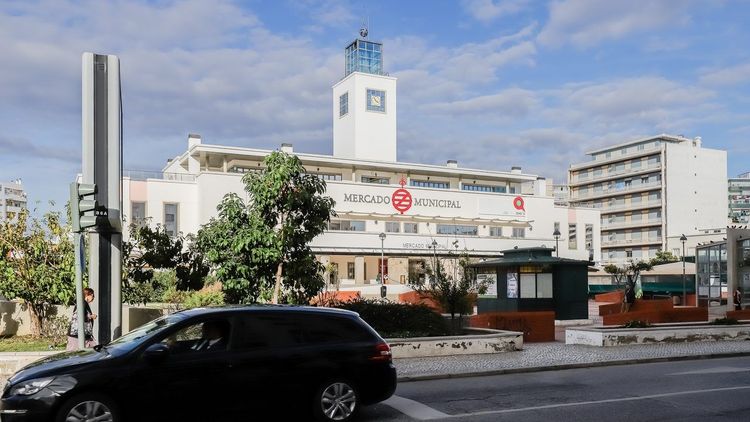
The Mercado Municipal de Faro (Largo Dr. Francisco Sá Carneiro, 8000-151 Faro, rated 4.3/5 on Google across 5,136 reviews), a modern building opened in 2007 on the marina front, replaced the former mid-20th-century market that was demolished in the early 2000s. It houses fishmongers, greengrocers, butchers and a few fast-food stalls, spread between a traditional market hall and a more recent commercial gallery.
The market opens early in the morning, generally from 7 a.m., and the bulk of the activity is concentrated before noon, when local restaurateurs come to stock up on freshly landed fish. The fish hall, with its stalls of sea bream, tuna and Algarve crustaceans, remains the highlight of the visit. The dried fruit, fig and almond stalls reflect the produce of the Algarve hinterland well, and you will also find honey, sheep's cheese and salt from the Ria Formosa. A stop at the food counter for a coffee and a pastry makes a good start before setting off to explore the old town, five minutes away on foot. Unlike markets reconstituted for tourists, this one remains above all the local pantry: it is the ideal place to observe daily life in Faro without any staging, and to put together a picnic before heading out on the lagoon.
12. Tasting Cataplana and the Flavors of the Algarve
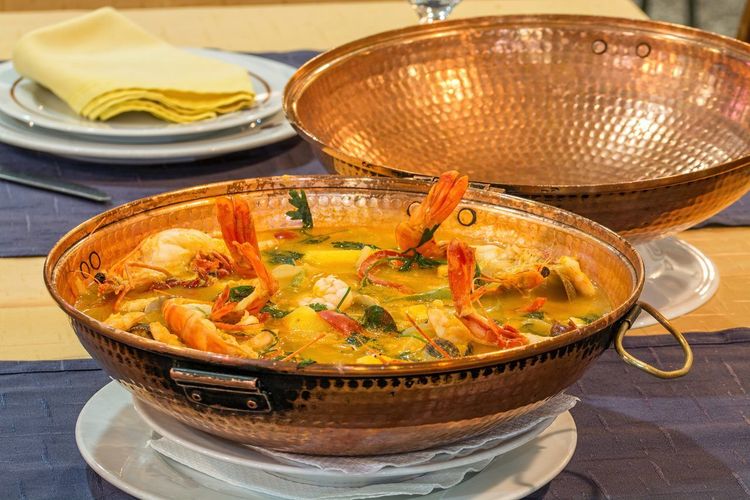
Faro's gastronomy revolves largely around fish and seafood, prepared according to recipes handed down through generations of fishing families. The cataplana — a slow-cooked dish of clams, prawns and sometimes chorizo, cooked in a hermetically sealed copper shell-shaped vessel — remains the region's culinary signature. The utensil itself, inherited from the Arab occupation, works like a sealed pot that concentrates the aromas and is generally served for two people, to be shared directly from its domed container placed in the center of the table.
Clams à la Bulhão Pato, cooked with garlic, lemon and coriander, are a classic starter in almost every restaurant in the center. You will also find xarém, a cornmeal porridge often served with clams or bacon — a direct legacy of the Algarve's peasant cooking — as well as arroz de marisco, a shellfish rice served good and soupy. Restaurants around the marina and in the lanes of the old town charge very different prices: it is worth moving away from the terraces on the Rua Conselheiro Bivar to find better value in the side streets, where locals have lunch.
For dessert, dom rodrigo, made with egg yolks and almonds, and cakes based on dried figs can be savored in almost every traditional pastry shop. Do not leave without tasting medronho, the arbutus berry eau-de-vie distilled in the hinterland of the serra, served as a digestif. Wine lovers will find local labels from Algarve vineyards, less well known than those of the Douro but showing clear quality improvement over the past decade. Reserve your table for dinner in high season: the best addresses in the old town are fully booked from 8 p.m. in July and August.
13. A Day Trip to Olhão, the Fishermen's Town
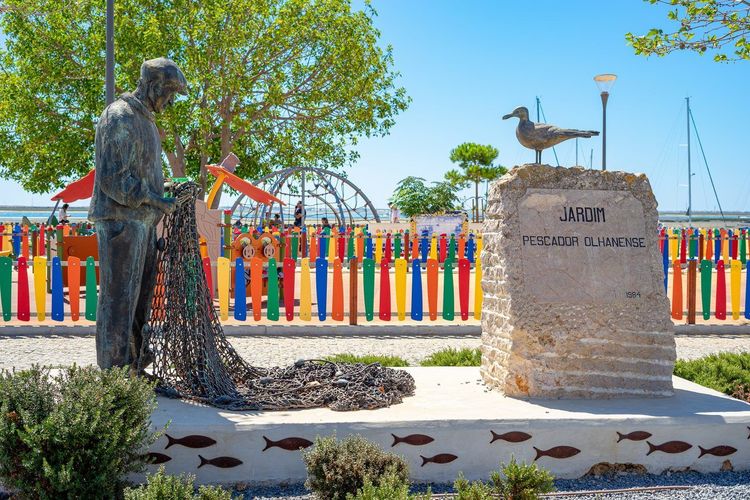
About ten minutes from Faro by train or car, Olhão retains a far more working-class and authentic character, well off the standard tourist trail. The town developed in the 18th century around fishing, and its white cubic architecture — flat-roofed houses with square chimneys influenced by trade with North Africa — gives it a unique look in the region.
The Mercado de Olhão (Av. 5 de Outubro, 8700-349 Olhão, rated 4.5/5 on Google across 9,276 reviews), made up of twin brick-and-iron halls built between 1912 and 1916 facing the harbor, remains one of the liveliest markets in the Algarve. The fish hall opens at dawn, when the boats have just returned from the night's fishing, while the neighboring building brings together fruit, vegetables and dry goods. Built on stilts reclaiming land from the Ria, these twin halls are among the oldest surviving examples of metal architecture in Portugal. The market visit ends ideally with lunch at one of the seafront marisqueiras, renowned for their reasonably priced seafood platters.
From Olhão's harbor, boats also serve the islands of the Ria Formosa, notably Armona and Culatra — two inhabited barrier islands where time seems to have stopped in the 1980s, with no cars and no paved roads. Half a day is enough to combine the market, lunch and a crossing to one of these islands, a fine complement to a Faro visit focused on urban heritage.
14. The Roman Ruins of Milreu, near Estoi
About ten kilometers north of Faro, the Ruínas Romanas de Milreu (Estrada de Milreu, 8005 Estoi, rated 4.1/5 on Google across 1,977 reviews) rank among the best-preserved archaeological sites in southern Portugal. The site corresponds to the remains of a Roman villa occupied from the 1st to the 6th century, comprising baths, a temple and mosaics still visible in situ.
The most celebrated mosaic, depicting stylized fish, once adorned the basin of the villa's private baths. The adjoining temple, dedicated to a water cult and later converted into an early Christian church, illustrates the continuity of religious occupation on the site over several centuries: it is one of the few Roman nymphaeum temples still standing in Portugal. Excavations carried out since the 1970s continue to regularly reveal new features, including drainage systems and annexe rooms still under study.
A small interpretation center at the site entrance helps to place the remains in their historical context — useful, since few detailed information panels line the route itself. A full visit takes around forty-five minutes. You can combine Milreu with a stop at the Palácio de Estoi, a pink 19th-century Rococo palace five minutes away by road, now converted into a pousada with terraced gardens adorned with azulejos and statues, open to the public free of charge. Together they make for a pleasant half-day off the beaten coastal path.
15. The Jardim Manuel Bivar and Evening Life by the Marina
The Jardim Manuel Bivar (Praça Dom Francisco Gomes, 8000-078 Faro, rated 4.3/5 on Google across 2,398 reviews), a square planted with century-old palm trees on the marina's edge, serves as a natural gathering point from late afternoon onwards. A bandstand, shaded benches and café terraces make it a mandatory stopping point between the old town and the waterfront.
Faro's nightlife remains modest compared to more touristy towns like Albufeira, but it does exist around this garden and the adjacent streets. Several bars regularly host fado concerts — that melancholic Portuguese song carried by the guitarra portuguesa — in a more intimate setting than the shows tailored for tourist groups. Nearby, the Teatro Lethes, an Italian-style theater inaugurated in 1874 in a former Jesuit college, programs concerts and plays throughout the year and is worth a look for its red-and-gold auditorium alone. The marina terraces fill up mostly after 9 p.m., when the heat subsides and the moored boats light up.
A sunset walk between the garden, the marina and the illuminated ramparts of the Cidade Velha offers one of the city's most beautiful nocturnal vistas, with no reservation required. You can round off the evening with a last drink at one of the spots on the Rua do Prior, a neighborhood livelier and more frequented by locals than by passing tourists.



FAQ
What to Do in Faro in 1 Day?
Focus on the Cidade Velha: the cathedral, Arco da Vila and Capela dos Ossos, then finish at the marina and Jardim Manuel Bivar at sunset. If time allows, add a short boat trip on the Ria Formosa in the late morning. One day is enough to take in the highlights of the historic center, provided you start early and grab a light lunch on the go at the Mercado Municipal.
What to Do in Faro in 2 Days to Explore the City?
Add to the previous day a full trip to the Ilha Deserta or a dolphin-watching excursion, as well as a visit to the Museu Municipal. The second day also lends itself well to a trip to Olhão to discover its market and islands. Visiting Faro over 2 days leaves time to alternate urban heritage with breathing space by the lagoon, without ever having to rush.
What to Do in Faro in 3 Days?
Spread urban heritage over the first day, nature and the lagoon over the second (Ria Formosa, Ilha Deserta or dolphins), then take a land excursion on the third day to the ruins of Milreu and the palace of Estoi, finishing in Olhão if time permits.
What to Do in Faro in 4 Days?
With four days, add a full beach day at Praia de Faro and explore more of the Ria Formosa by kayak. It is also the perfect opportunity to take your time trying several cataplana restaurants at a leisurely pace, and perhaps even push on to Tavira, about thirty minutes away by train.
What to Do in Faro for 1 Week?
A week allows you to range more widely across the Algarve from Faro: Tavira to the east, the islands of Armona and Culatra via Olhão, and the beaches of the west coast, while keeping two or three days for the city itself and its lagoon. Faro then makes an excellent base, well served by the regional train and close to the airport.
What to Do in Faro for Free?
The Cidade Velha, the ramparts, the Arco da Vila, the Jardim Manuel Bivar and the gardens of the Palácio de Estoi can all be visited without an entrance ticket. Birdwatching from the banks of the Ria Formosa or along the Ludo trail is also free, and a simple sunset stroll along the marina remains one of the most beautiful experiences in the city.
What to Do in Faro in the Evening?
The Jardim Manuel Bivar and the marina are the heart of the nightlife, with several bars offering fado concerts and the program at the Teatro Lethes. The illuminated Cidade Velha is also well suited to a quiet after-dinner stroll.
Faro, Much More than an Arrival Airport
Faro deserves far better than its status as a mere arrival airport for the Algarve. Between medieval ramparts, wild lagoon, an island reachable only by boat and Roman ruins within driving distance, the city and its immediate surroundings offer a diversity of landscapes and atmospheres rarely found in such a small area. Whether you have a single day's stopover or a full week, there is always something to fill the time without ever resorting to the easy option of one beach alone.
To prepare your visit, bear in mind that the best way to discover the Cidade Velha is to get lost in it without a strict itinerary, even if that means retracing your steps. Download the Ryo audio guide before you leave: the Ryo audio-guided tour works offline and accompanies you through the lanes without depending on a mobile signal — a real asset in the narrowest alleyways of the old town, where the connection can sometimes be unreliable.