© Shutterstock
 Votre guide Ryo
The Gothic Quarter of Barcelona: 12 Historic Buildings to Discover in 2026
The historic buildings of Barcelona's Gothic Quarter hide a richness that hurried visitors barely scratch: Roman columns from the 1st century BC buried beneath medieval palaces, a cathedral whose choir dates from 1298 but whose facade was only completed in 1913, a bridge with a medieval appearance built in 1928 by a disciple of Gaudí. Before venturing into the lanes of the Barri Gòtic, the Ryo audio-guided tour of Barcelona will give you the keys to deciphering every facade, every patio and every coat of arms you encounter along the way.
In this guide, we have selected twelve buildings: the cathedral and its cloister with thirteen white geese, the four Roman Corinthian columns buried nine metres below the current street level, the royal palace where Christopher Columbus is said to have met the Catholic Monarchs in 1493, and several gems that classic circuits gloss over without stopping. Some hide behind doors that passers-by never push open.
Barcelona Cathedral: Seven Centuries at the Heart of the Barri Gòtic
The Barcelona Cathedral (Pla de la Seu, s/n, 08002 Barcelone, rated 4.5/5 on Google with 43 reviews) -- officially the Cathedral of the Holy Cross and Saint Eulalia -- stands as the most visited monument in the Barri Gòtic, and rightly so: its history spans seven centuries in a way that is not always legible from the esplanade. The foundation stone of the current building was laid in 1298, during the reign of James II of Aragon. Construction of the choir and naves was completed in 1448, but the Neo-Gothic facade, with its pinnacles and rose window, was only finished in 1913 based on a design drawn up in 1408 -- left pending for five centuries.
This distinction between the original 14th-century Gothic and the 20th-century facade is important for understanding the Barri Gòtic as a whole: a large part of the "Gothic" you see is not medieval, but Neo-Gothic, shaped in the late 19th and early 20th century in a deliberately medieval style.
The cathedral has 28 lateral chapels, including the Chapel of the Blessed Sacrament, which houses the crucifix from the Battle of Lepanto (1571). The figure of Christ is tilted to one side: according to tradition, it dodged a cannonball during the battle. But it is perhaps the cloister that surprises visitors most -- a garden sheltered from the noise of the street, where 13 white geese roam freely, symbolising the youth of Saint Eulalia, martyred at the age of 13.
The crypt houses the remains of Saint Eulalia, co-patron of Barcelona alongside the Virgin of Mercy. She died in 303 AD during the Diocletian persecutions and was subjected to thirteen different tortures -- a number that recurs throughout the symbolism of the cathedral. The chapter house, converted into a museum, displays a pietà by Bartolomé Bermejo (1490), one of the first oil paintings produced in Spain.
Entry remains free during worship hours, early in the morning and during services: you can then enter the nave to pray, but without access to the tourist circuit. The full cultural visit -- cloister, choir, museum and rooftop terraces included -- costs €19 in 2026. From the terraces, the open view over the neighbourhood's tiled rooftops offers a very different perspective from the ground level.
The Temple of Augustus: When Rome Sleeps beneath Barcelona
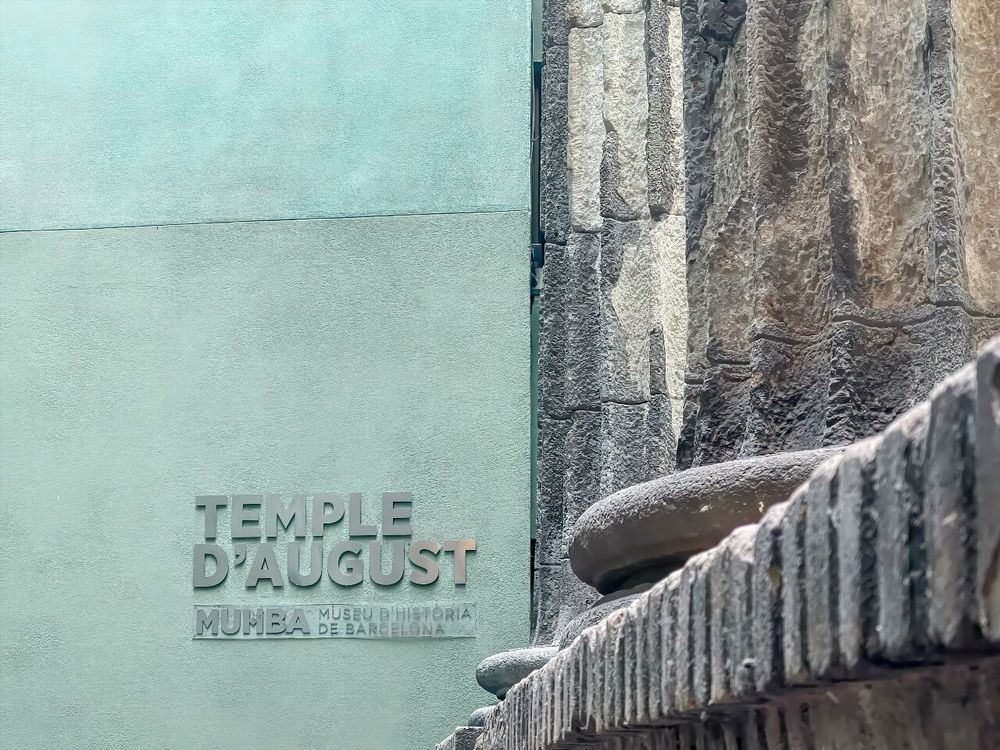
Two hundred metres from the cathedral, in the inner courtyard of the Centre Excursionista de Catalunya, four Corinthian columns rise in the dimness of a basement room. These are the remains of the Temple of Augustus, erected in the late 1st century in honour of the first Roman emperor, deified after his death.
The columns stand 9 metres tall and their state of preservation is remarkable: they were buried within the structures of the medieval palace built on top of them, then uncovered and restored at the turn of the 20th century, when architect Lluís Domènech i Montaner designed the inner courtyard that houses them today. The temple occupied the highest point of the Roman colony of Barcino -- the ground you would walk on to see them is therefore nine metres below the current street level.
This difference in level is itself a lesson in urban history: each civilisation built on the ruins of the previous one, progressively raising the ground. Access to the temple is free, with hours generally 10am–7pm Tuesday to Sunday (check according to the season). Do not look for a grand entrance: a discreet door on Carrer del Paradís leads to the inner courtyard. A detail few visitors notice: the street name, Paradís, is said to derive from the Latin paradisus, a term used in late Antiquity to refer to a garden space surrounding an important building -- perhaps an allusion to the esplanade that once surrounded this temple.
The Pont del Bisbe: A Controversial Neo-Gothic Bridge
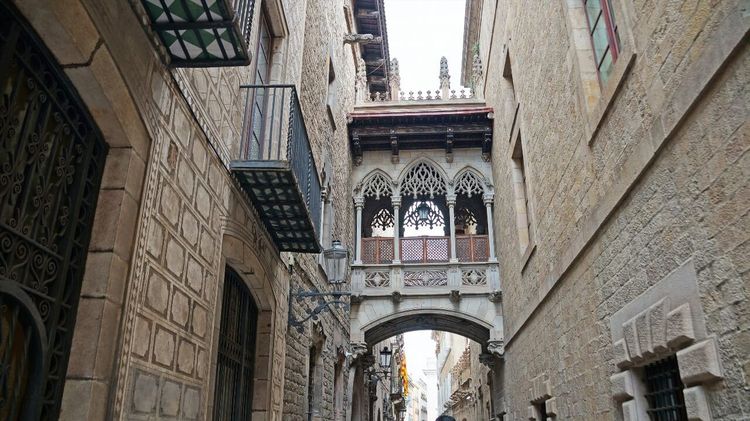
At first glance, the Pont del Bisbe (Bishop's Bridge) appears perfectly medieval: its flamboyant arches, gargoyles and sculpted coat of arms at the centre evoke the Gothic footbridges of Venice or Prague. In reality, it was built in 1928 by architect Joan Rubió i Bellver, one of Gaudí's disciples.
This bridge spans the Carrer del Bisbe and connects the Palau de la Generalitat to the Casa dels Canonges (the House of Canons), now the official residence of the President of the Generalitat of Catalonia. Its construction was controversial at the time: some felt that this deliberate Neo-Gothic style was distorting the authentic medieval fabric; others saw it as an aesthetic success fully integrated into its surroundings.
Today, the Pont del Bisbe is one of the most photographed sights in Barcelona. The best light for photographing it is late morning, when the sun directly illuminates the sculptures without creating overly harsh shadows. On the underside of the central arch, a sculpted skull pierced by a dagger intrigues attentive passers-by: several legends surround it, some seeing it as a curse cast by the architect against those who had rejected his grand Neo-Gothic remodelling plan for the neighbourhood.
Plaça de Sant Jaume: Two Palaces Facing Each Other Since the Middle Ages
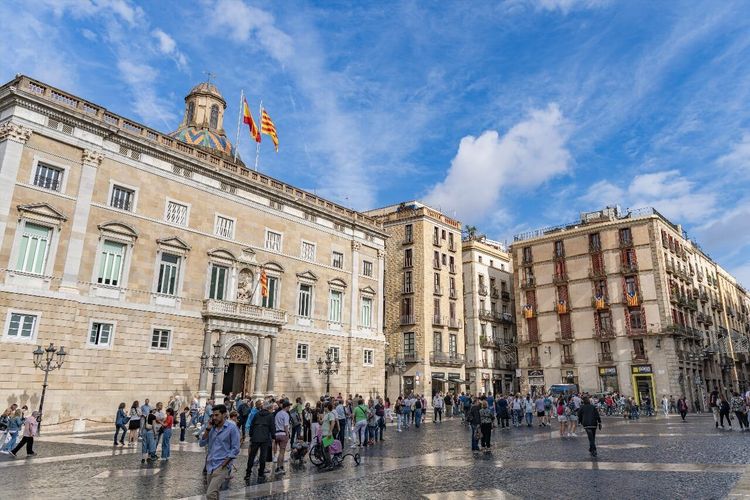
The Plaça de Sant Jaume (Plaça de Sant Jaume, 08002 Barcelone, rated 4.6/5 on Google with 533 reviews) is one of the most politically charged spaces in all of Catalonia. Two buildings have faced each other here for several centuries: the Casa de la Ciutat (Barcelona's city hall) and the Palau de la Generalitat (seat of the Catalan government). Once a Roman forum, the square has been the nerve centre of the city's municipal and regional power since the Middle Ages.
The Casa de la Ciutat, whose construction dates back to the 14th century, has a 19th-century Neoclassical facade that conceals a remarkable Gothic interior. The Saló de Cent (Hall of the Hundred) with its twisted columns and Catalan vaults, and the Sala de la Reina Regent, are open to the public on Saturday and Sunday mornings (free entry). The Saló de Cent was built between 1369 and 1402 to house the city council, composed of precisely one hundred members -- a democratic conciseness that modern institutions have not always managed to preserve.
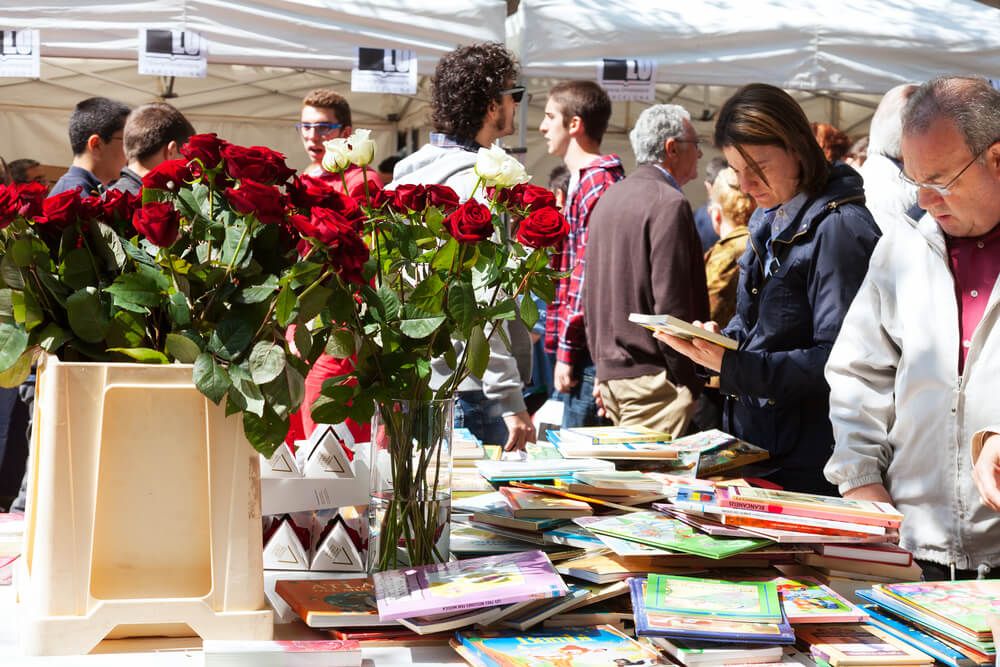
Opposite, the Palau de la Generalitat dates from the 15th century. Its main Gothic facade faces the Carrer del Bisbe, but it is the Renaissance facade on the Plaça de Sant Jaume, added in the 16th century, that you will see first. The interior, including the Chapel of Sant Jordi and the orange tree courtyard, is accessible during open-door days -- generally on 23 April for Sant Jordi, and on certain weekends throughout the year. Saint George's Day, patron saint of Catalonia, is one of Barcelona's most colourful celebrations: roses and books are exchanged throughout the neighbourhood on that day.
The square itself is often the stage for political gatherings and popular celebrations. The Castellers (human towers) and the Sardana (traditional Catalan dance) are performed here regularly on Sundays, in a blend of civic fervour and intangible heritage that is unlike anything else in Europe.
The Plaça del Rei and the Palau Reial Major
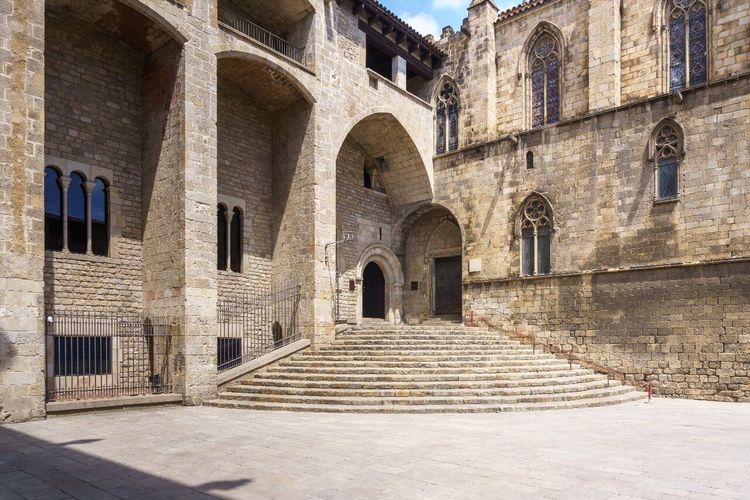
If one space in the Barri Gòtic crystallises the medieval grandeur of Barcelona, it is the Plaça del Rei (Plaça del Rei, 08002 Barcelone, rated 4.7/5 on Google with 226 reviews). Surrounded on three sides by preserved medieval facades, it is one of the best-preserved squares in Europe from the medieval period. No café terraces, no souvenir shops: just stone and the relative silence that the surrounding lanes carefully filter.
The dominant building is the Palau Reial Major, the residence of the kings of Aragon in Barcelona from the 12th century onwards. Its most spectacular element is the Saló del Tinell, an immense 14th-century Gothic reception hall, with its diaphragm arches spanning 17 metres -- a structural feat that eliminated intermediate columns and provided a grand, unobstructed monumental space. It was in this hall -- or on the steps of the square, depending on the account -- that Christopher Columbus is said to have been received by Ferdinand and Isabella on his return from the first American voyage, in 1493.
The square also features the Torre del Rei Martí (Tower of King Martin), a 15th-century belvedere tower with five open storeys, and the Capella Reial de Santa Àgata, the 14th-century royal chapel. The interior of the chapel houses the Altarpiece of the Epiphany (1465) by Jaume Huguet, considered one of the pinnacles of Catalan Gothic painting.
Beneath the square and the adjacent buildings lies the Museu d'Història de Barcelona (MUHBA), which allows visitors to walk through 4,000 square metres of underground Roman remains -- the streets, mosaics and production facilities of Barcino. The combined ticket (MUHBA + chapel) costs €7 in 2026 and represents one of the best introductions to the deep history of the city.
Santa Maria del Pi: The Great Gothic Lady
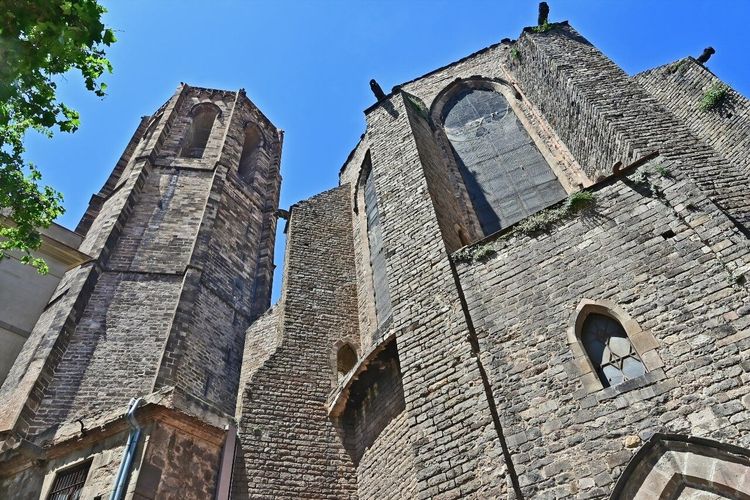
A few streets to the west of the cathedral, the Basilica of Santa Maria del Pi (Our Lady of the Pine) occupies one of the most pleasant squares in the neighbourhood: the Plaça del Pi, lined with terrace bars and an old stone pine that gave its name to the whole area.
Built between 1322 and 1453, this church perfectly illustrates Catalan Gothic in its purest form: a single, very wide nave (18-metre span) without side aisles, massive pillars integrated into the walls, and a rose window 8.15 metres in diameter that was, upon its completion, one of the largest in Europe. The light the rose window casts on the tiled floor in the late afternoon is worth the visit on its own.
The bell tower of Santa Maria del Pi rises to 54 metres and can be climbed (paid access, around €5) for a panoramic view over the Barri Gòtic -- a perspective oriented towards the neighbourhood's lanes rather than towards the Eixample, and therefore very different from that offered by the cathedral.
Like many of Barcelona's churches, Santa Maria del Pi was set on fire during the events of July 1936. The majority of the original artworks were destroyed; what you see today is largely a post-war restoration, except for the oldest stained-glass windows in the ambulatory, which were partially saved.
The Plaça de Sant Felip Neri and Its Wartime Scars
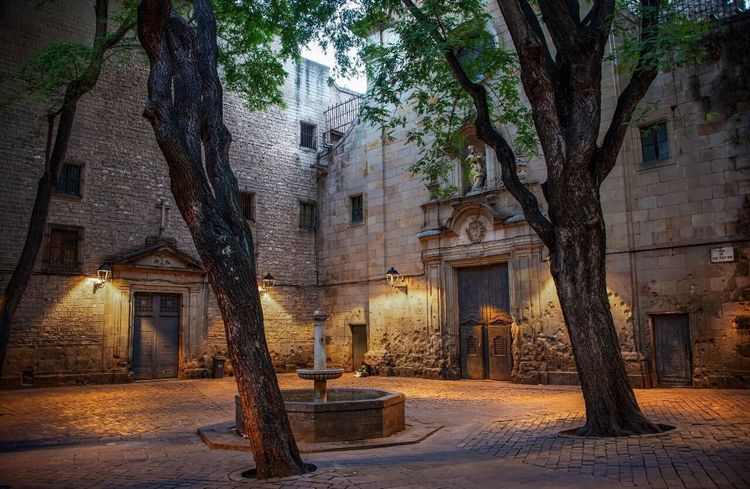
The Plaça de Sant Felip Neri (Plaça de Sant Felip Neri, 08002 Barcelone, rated 4.7/5 on Google with 6K reviews) is one of the most contemplative squares in the Barri Gòtic. Small, cobbled, surrounded by sober facades and a central fountain, it often draws painters and photographers for its timeless atmosphere.
Look carefully at the walls of the facades facing the square: they are pitted with rounded marks. Two interpretations coexist. The first attributes these impacts to the bombing of 30 January 1938, carried out by Italian fascist aircraft allied to Franco: around forty people died, including some twenty children who had taken refuge in the church crypt, which had been converted into a shelter. The second, supported by some historians, suggests the marks date from executions after the Civil War and that the bombing narrative is partly a memorial construction. This debate itself is revealing of the tensions that still surround the memory of the Civil War in Catalonia.
The church of Sant Felip Neri, adjoining the square, is an 18th-century Baroque construction -- an exception in a neighbourhood dominated by Gothic. It is generally open during Mass times. Our audio walking tour of Barcelona winds through these same Gothic lanes.
The Palau de la Generalitat: The Catalan Institution in Gothic Stone
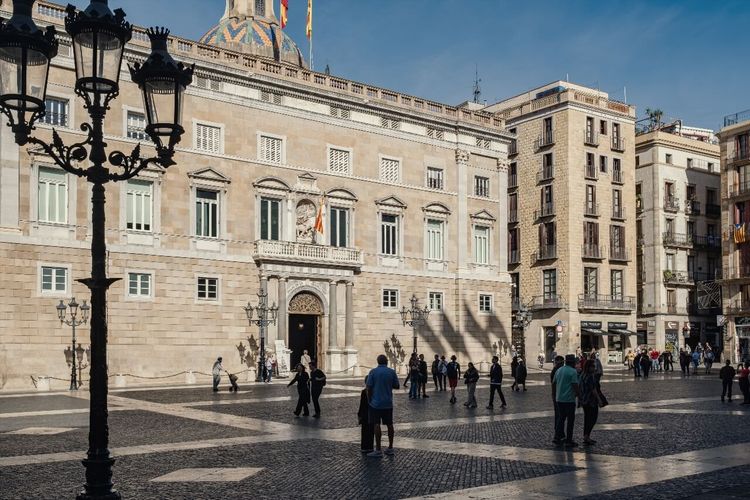
The Palau de la Generalitat de Catalunya (Plaça de Sant Jaume, 4, 08002 Barcelone, rated 4.5/5 on Google with 1,211 reviews) stands as one of the rare Gothic palaces in Europe still in use as a seat of government. Its construction spans the 15th to the 17th century, across several architectural campaigns that layered Gothic, Renaissance and Baroque in a surprisingly coherent stylistic whole.
The main facade on the Plaça de Sant Jaume is Renaissance (16th century), but the entrance on the Carrer del Bisbe reveals the original Gothic: a flamboyant early 15th-century portal featuring a medallion of Saint George slaying the dragon. Inside, the Pati dels Tarongers (orange tree courtyard) is a highly elegant example of late Catalan Gothic -- an open gallery, slender columns and orange trees whose fragrance in April is unforgettable.
Access is limited to open-door days (Sant Jordi on 23 April, the second and fourth Sunday of each month) and official guided tours. Check the calendar on the Generalitat's website before your visit.
The Church of Sant Just i Pastor: Barcelona's Oldest Parish
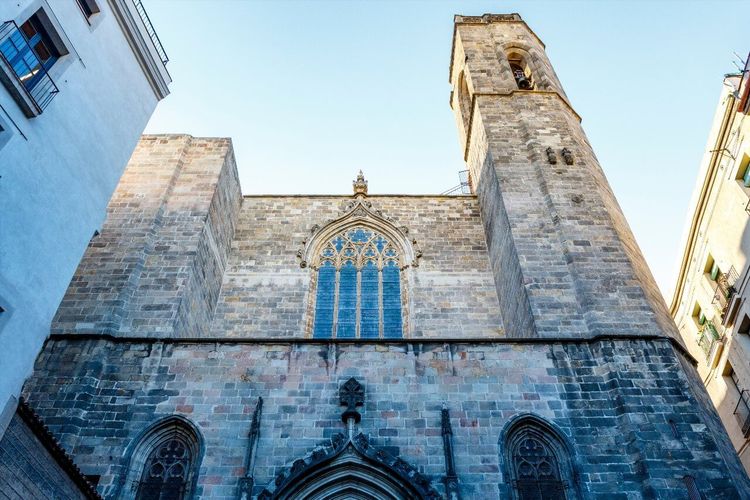
Tucked behind the Plaça de Sant Jaume, the Església de Sants Just i Pastor (Plaça de Sant Just, 5, 08002 Barcelone, rated 4.6/5 on Google with 877 reviews) claims the title of Barcelona's oldest parish, with origins attested as far back as the 9th century. The current building dates mainly from the 15th century, in a sober and austere Gothic style typical of medieval Catalonia.
What sets this church apart from the others in the neighbourhood is its relative tourist discretion: the cathedral's queues are nowhere to be found, and the atmosphere is more contemplative. A Romanesque portal survives on the left flank of the building -- one of the few pre-Gothic elements visible in the Barri Gòtic. In the small adjacent square, the Font de Sant Just, a two-tiered Gothic fountain bearing the date 1367, is one of the oldest fountains still in place in Barcelona.
The church is linked to a unique medieval privilege: until the 19th century, its parishioners could swear an oath a cautela (a cautionary oath) with legal force, without going through a notary -- a right granted by the kings of Aragon that had no equivalent anywhere else in Europe.
The Roman Walls of Barcino: 2,000 Years in Stone
The Barri Gòtic literally rests on the foundations of Barcino, the Roman colony founded around 15 BC under Augustus. The best-preserved sections of the walls that once encircled this colony are visible at several points in the neighbourhood, but the most impressive stretch stands at the Plaça de Ramon Berenguer el Gran.
These walls were erected in the 3rd and 4th centuries AD, during a phase of fortification linked to barbarian incursions. They reached up to 12 metres in height, with cylindrical towers of 18 metres placed roughly every thirty metres. At the Plaça de Ramon Berenguer, you can see the wall integrated into the facade of the Palau Reial Major -- medieval builders simply constructed against the Roman walls, reusing them as a foundation without demolishing them.
Other sections of the walls can be spotted at the corner of the Carretera de la Vila and around the Capella Reial de Santa Àgata. Setting out to find them will lead you into corners of the neighbourhood that hurried visitors never see. To accompany this walk with detailed explanations about each stone, the Ryo audio guide to Barcelona offers 26 audio commentaries spread across 6.4 km of audio-guided route through the city.
Visiting the Barri Gòtic in Barcelona in 2026: Practical Tips
Getting there: the Barri Gòtic is served by the metro stations Jaume I (line 4, yellow), ideal for the Plaça del Rei and the cathedral, and Liceu (line 3, green), closer to Santa Maria del Pi and the Plaça del Pi. The two stations are five minutes apart on foot, crossing through the neighbourhood.
Hours and crowds: tourist pressure is heaviest between 10am and 2pm, especially in July and August. An early morning visit (before 9am) or late afternoon (after 5pm) offers a radically different atmosphere in the lanes. At certain dawn hours, the neighbourhood is deserted -- a privilege reserved for early risers.
Budget: from €0 to around thirty euros depending on the monuments chosen. The MUHBA (€7) is the only truly unmissable ticket for access to the Roman underground. The cultural visit to the cathedral costs €19, but entry remains free during services. The Temple of Augustus is free. Most squares and exterior facades can be admired without a ticket.
Footwear: the lanes are paved with rounded cobblestones (empedrat) that become slippery in wet weather. Shoes with non-slip soles are essential. The neighbourhood is entirely pedestrianised, and the distances between monuments can be covered in five to ten minutes on foot.
FAQ
Is the Barri Gòtic in Barcelona free to visit?
Access to the neighbourhood and its squares is entirely free. The exterior facades of all buildings can be visited without a ticket. Some interiors are paid -- MUHBA: €7, cultural visit to the cathedral: €19, Santa Maria del Pi bell tower: around €5 -- while others remain free, such as the Temple of Augustus or entry to the cathedral during services. With good planning, you can see the essentials for around twenty euros.
How long does it take to visit the Barri Gòtic?
Allow half a day (3 to 4 hours) for a quick visit of the exteriors and one or two interiors. A full day is needed if you want to include the MUHBA, the cathedral with its cloister, and wander without time constraints. Ryo's audio-guided tour of Barcelona offers a 2h30 route covering the key highlights of the neighbourhood with audio commentary on each monument.
What is the difference between genuine medieval Gothic and the neighbourhood's Neo-Gothic?
A large part of the Barri Gòtic was remodelled between 1880 and 1930 in a deliberately medieval style. The Pont del Bisbe (1928) and the cathedral facade (1913) are the most striking examples. Authentic medieval Gothic from the 14th and 15th centuries can be found in the Saló del Tinell, the interior of the cathedral, Santa Maria del Pi, the Palau de la Generalitat and the church of Sant Just i Pastor. These two layers coexist in the same streets -- which is what makes the neighbourhood both fascinating and sometimes disorienting.
Can you visit Barcelona Cathedral for free?
Entry is free during worship hours, early in the morning and in the evening: you can then enter the nave to pray or attend a service, but the full tourist circuit is not accessible at those times. The cultural visit -- cloister, choir, museum and rooftop terraces included -- is paid (€19 in 2026). Opening hours vary depending on services and the season: it is best to check on the day before you arrive.
Is the Barri Gòtic safe at night?
The Barri Gòtic is busy at night, particularly around the Ramblas and the main pedestrian routes. As in any densely touristed neighbourhood of a large Mediterranean city, vigilance against pickpockets is advisable in the narrow passages and around the Ramblas. The secondary side streets away from the main axes are generally quiet but poorly lit -- a charged phone is your best ally for exploring them after 10pm.
The historical richness of the Barri Gòtic in Barcelona lies precisely in these layers: Rome, the Middle Ages, the Catalan Renaissance, 19th-century Neo-Gothic nationalism and the scars of the 20th century coexist within a few hundred square metres. Every stone carries a date, every facade tells a political or artistic story.
And if you wish to extend your exploration beyond the historic neighbourhood, our guide on walks to discover Barcelona on foot or on things to do in Barcelona and its surroundings will open up new perspectives on a city that never ceases to surprise.
To make sure you don't miss any of the details that make the difference between a simple stroll and a genuine discovery, the Ryo audio-guided tour of Barcelona accompanies you building by building, with 26 audio commentaries spread across 6.4 km, to explore at your own pace.
À lire également