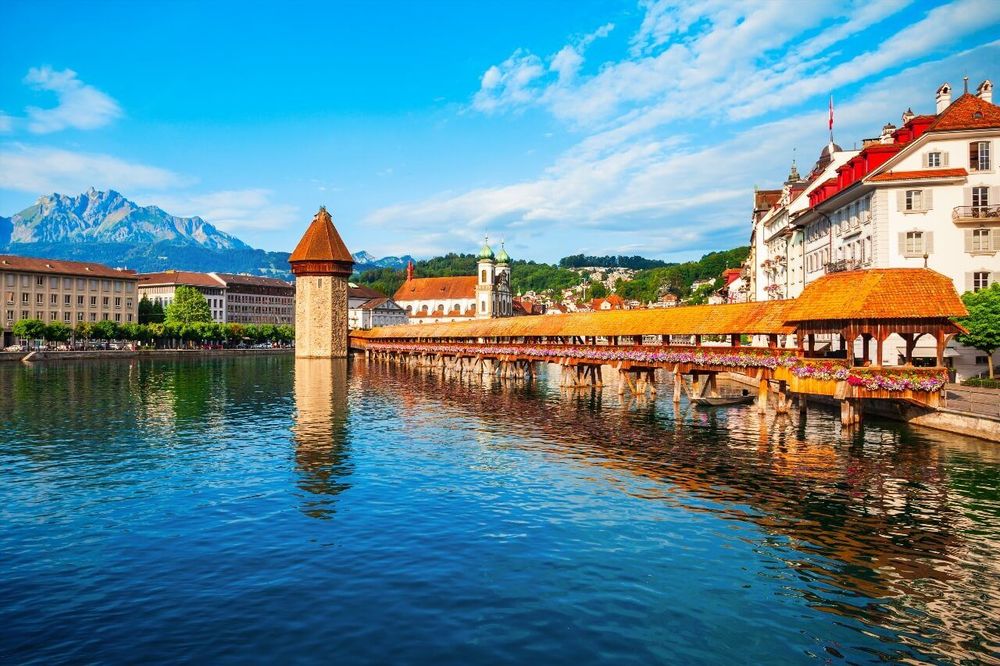
© Shutterstock
 Votre guide Ryo
Weekend in Lucerne 2026: Old Town, Lake and Mountains in 48 Hours
While most travelers rush off to Zurich or Geneva, Lucerne waits quietly beside its lake, ringed by peaks that change color with every hour of the day. A weekend in Lucerne is built differently from elsewhere in Switzerland: the old town can be covered on foot in a good half-day, and the rest of your stay belongs to paddle steamers, funiculars and café terraces beside the Reuss. The Ryo audio-guided tour of Lucerne suits exactly this kind of pace, one that leaves time to stop on a bridge without feeling the pressure of a group already moving on to the next stop.
Behind the postcards lie a few details that surprise almost every first-time visitor. Europe's most famous wooden bridge largely burned down in 1993 before being rebuilt identically, and only around thirty of its painted panels could be saved. A lion carved straight into the rock mourns the Swiss guards who fell in 1792, just minutes from the historic center. About an hour from the station, a funicular climbs a 110% slope, the steepest in the world for this type of machine. And high on Pilatus, legend has it that a winged dragon still sleeps beneath the rock. Between medieval bridges, mountain excursions and lakeside strolls, here is enough to fill two full days in Lucerne, an hour-by-hour plan, and plenty of ideas to stretch your stay if the weather allows.
Lucerne's Old Town and the Chapel Bridge
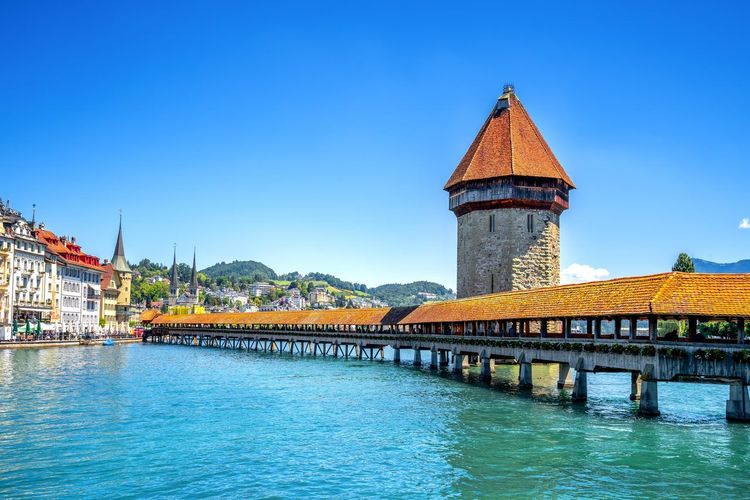
Lucerne's old town is best explored on foot, with no complicated itinerary: the cobbled lanes, painted façades and the two wooden bridges spanning the Reuss all fit within a radius of 800 meters. It is also the natural starting point for your weekend in Lucerne, since the rest of the city (station, lake, quays) is organized around this historic core, itself protected by the ramparts overlooking the neighboring hill. Allow a good half-day to explore it without rushing, museums included.
The Chapel Bridge (Kapellbrücke) and the Water Tower
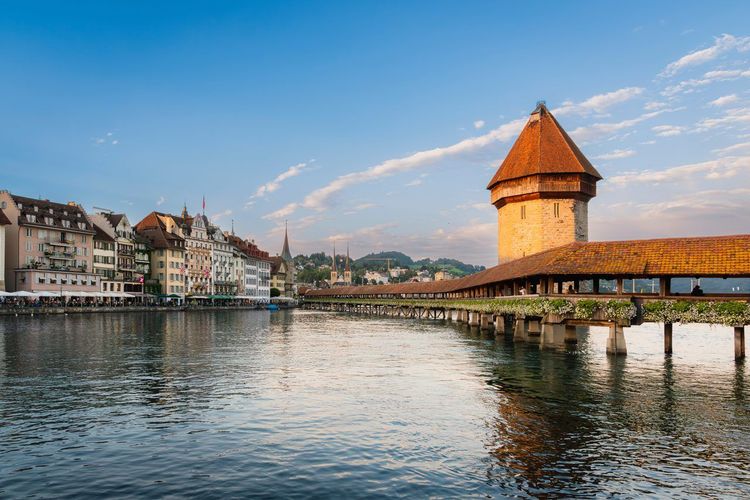
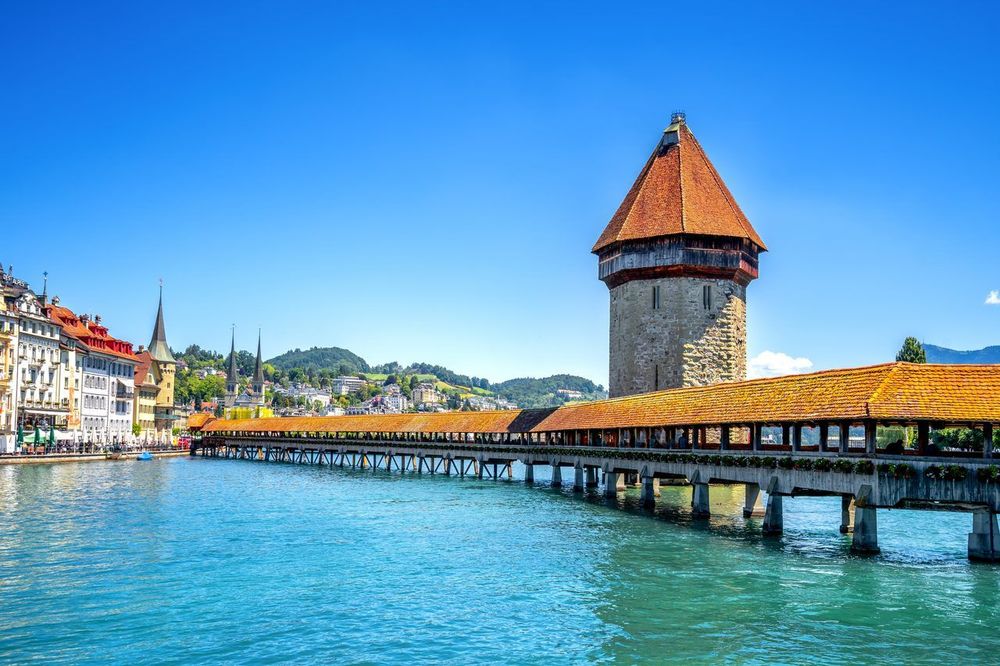
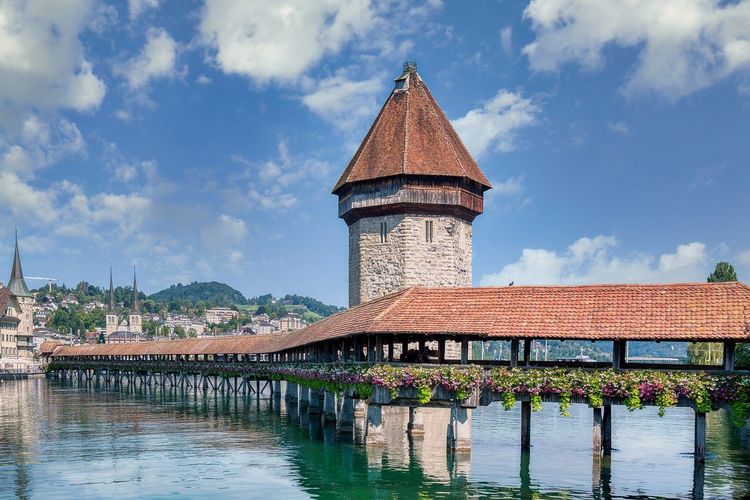
Built in the 14th century (around 1365 according to historians, 1333 according to local tradition), the Chapel Bridge (Kapellbrücke) is considered the oldest covered wooden bridge in Europe. It crosses the Reuss diagonally, giving it its instantly recognizable silhouette and making it the most photographed motif in central Switzerland. Its roof once held 111 panels painted in the 17th century, telling the story of the city and the lives of its patron saints; the fire of August 1993 destroyed 78 of them, and only around thirty could be restored and rehung.
Attached to the bridge, the Water Tower (Wasserturm) is an octagonal tower built around 1300, before the bridge itself, which has served in turn as a prison, an archive room and a municipal treasury. It cannot be visited, but it photographs wonderfully early in the morning, before the groups arrive, when the light still skims the surface of the water and the swans glide alone beneath the arches.
It is one of the first stops on the Ryo audio guide to Lucerne: you hear the story of the panels painted in the 17th century and why the city chose to rebuild its bridge identically after the fire rather than modernize it.
The Spreuer Bridge (Spreuerbrücke) and Its Dance of Death
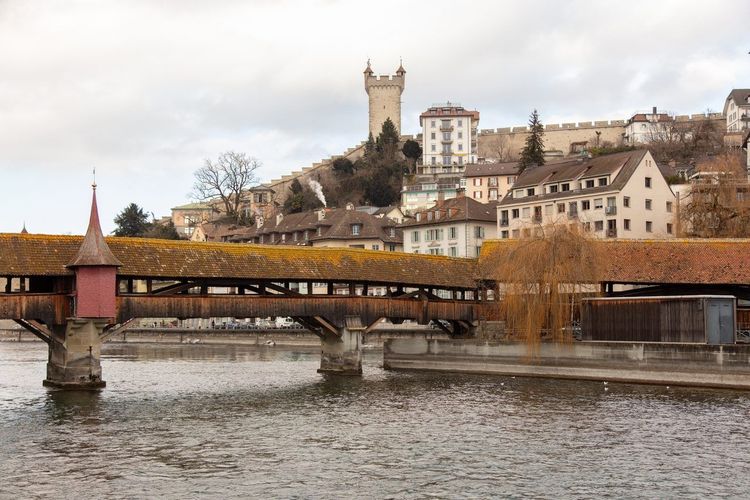
Less photographed than its neighbor, the Spreuer Bridge (Spreuerbrücke) dates from the early 15th century and owes its name to the right millers once had to throw chaff (Spreu) into the river from it, which was forbidden everywhere else in town. Its roof carries a series of panels painted in the 17th century by Kaspar Meglinger depicting a dance of death, a medieval theme in which death sweeps all social classes into its round, from pope to beggar.
Allow about ten minutes' walk from the Chapel Bridge along the quay. The bridge is open to pedestrians all year, and the evening light there is often lovelier than on the main bridge, with far fewer people to share it.
Weinmarkt and Mühlenplatz Squares, the Historic Heart
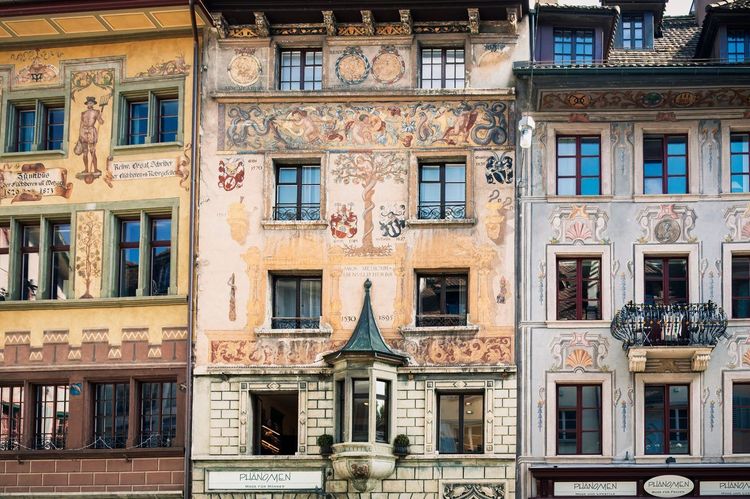
Just steps from the bridges, Weinmarkt Square (Weinmarkt, 6004 Lucerne, rated 4.6/5 on Google from 1.2K reviews) features some of the city's most colorful painted façades, relics of former merchant guilds whose signs still adorn the walls. Right behind it, Mühlenplatz recalls the time when mills harnessed the current of the Reuss; café terraces have settled against the old stone walls.
You can take in both squares in under 15 minutes on foot, especially late in the morning when the Tuesday and Saturday market still enlivens the Reuss quays. Take the time to look up: the painted façades read like a historical comic strip, coats of arms and guild scenes included.
The Lion Monument, the Glacier Garden and the Bourbaki Panorama
Ten minutes' walk from the old town, a single neighborhood brings together three sites that each tell, in their own way, a defining episode of Swiss history. Nothing obliges you to visit them in order: they are all within five minutes of one another.
The Lion Monument (Löwendenkmal)
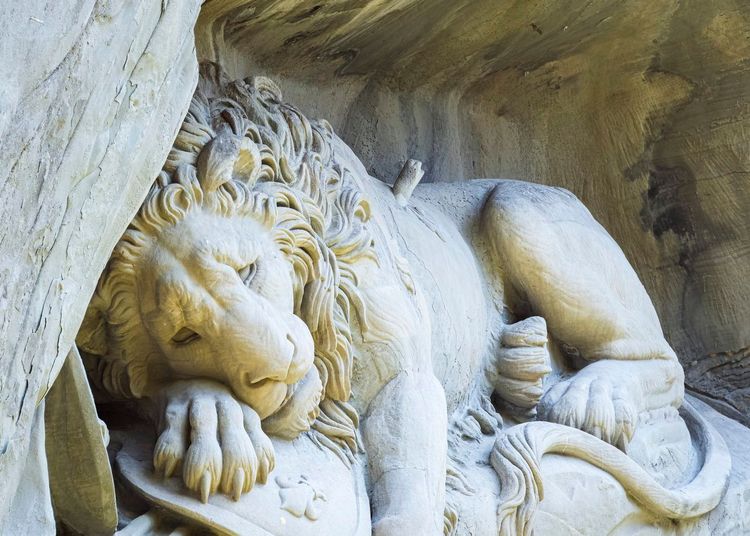
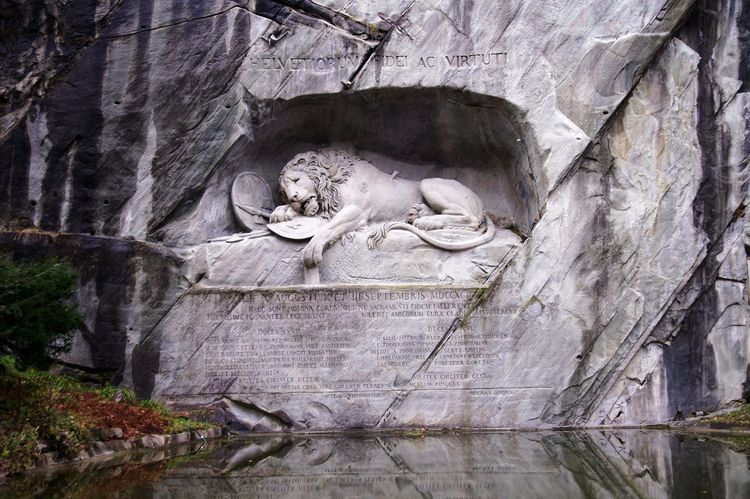
Carved directly into a sandstone wall in 1821, the Lion Monument (Löwendenkmal) depicts a dying lion with a broken spear in its flank, protecting with its paw a shield bearing the fleur-de-lis. The monument pays tribute to the Swiss guards killed defending Louis XVI during the storming of the Tuileries on August 10, 1792. Mark Twain described it as "the saddest and most moving piece of stone in the world." Access is free, day and night.
The Ryo audio-guided tour in fact pauses in front of the dying lion to tell the story of the Swiss guards massacred in 1792 and how this small mountain country long sold its soldiers to the courts of Europe.
The Glacier Garden (Gletschergarten)
Right next door, the Glacier Garden (Gletschergarten) protects glacial potholes carved by meltwater from the last ice age, about 20,000 years ago, in rock that itself holds fossils of shells and palm trees 20 million years old. The site was discovered by chance in 1872, while a cellar was being dug. It also includes a Moorish-style mirror maze, brought from the Geneva National Exhibition of 1896, and General Pfyffer's relief model of central Switzerland, an 18th-century model among the oldest of its kind.
Plan on about an hour and a half on site, ideally right after the Lion, which remains free.
The Bourbaki Panorama
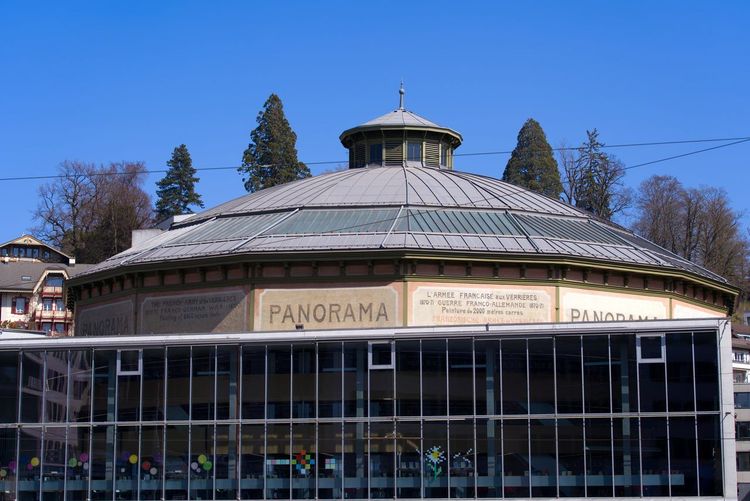
Five minutes' walk away, the Bourbaki Panorama (Löwenplatz 11, 6004 Lucerne, rated 4.5/5 on Google from 1,147 reviews) presents a circular canvas about 112 meters long painted in 1881 by Édouard Castres, depicting the internment of General Bourbaki's French army in Switzerland in February 1871. The effect of depth, achieved with real objects placed in front of the canvas (earth, carts, mannequins in uniform), still surprises visitors who step closer before realizing where the real set ends.
Ramparts, Jesuit Church and Walks Along the Reuss
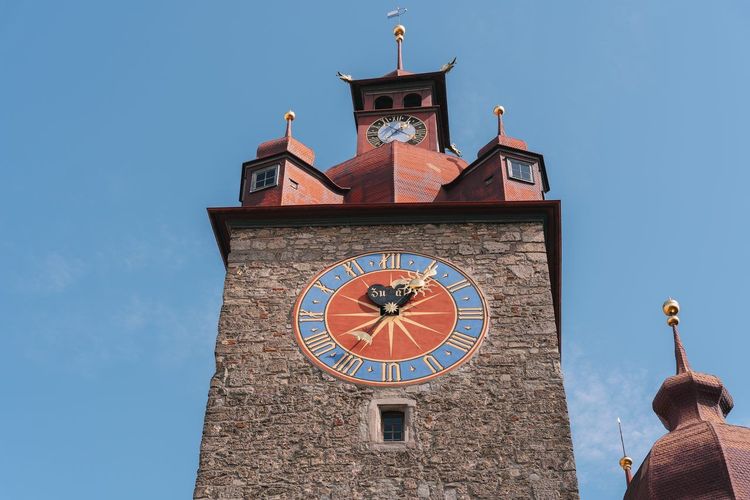
This part of the historic center can be explored as a single walking itinerary, in a loop from the bridges: you climb, come back down to the river, then follow the water to the lake.
Lucerne's Ramparts (Museggmauer) and Their Towers
The Lucerne ramparts (Museggmauer), built starting in the late 14th century, still have nine towers along nearly 870 meters of wall. Four of them can be visited free of charge from April to early November, including the Clock Tower (Zytturm), whose 1535 clock has the privilege of striking one minute before all the others in the city.
The climb from the center takes 10 to 15 minutes on foot, with a modest but real elevation gain; wear sturdy shoes, as the tower stairs remain narrow and steep. From the wall walk, the view plunges straight down onto the old town's rooftops and both bridges at once, an angle you will not find anywhere else.
The Jesuit Church (St. Francis Xavier)
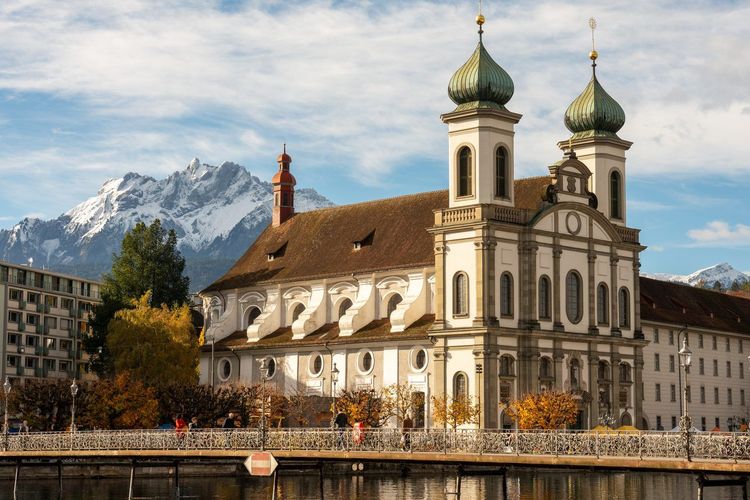
On the way back down to the Reuss, the Jesuit Church (Bahnhofstrasse 11a, 6003 Lucerne, rated 4.6/5 on Google from 2,224 reviews) (St. Francis Xavier Church), completed in 1677, is considered the first major Baroque church in Switzerland north of the Alps. Its sober façade contrasts with an interior richly laden with stucco, pink faux marble and gilding. Entry is free outside services, making it a cool pause between two bridges on hot days.
Terraces and Walks Along the Reuss and the Lake
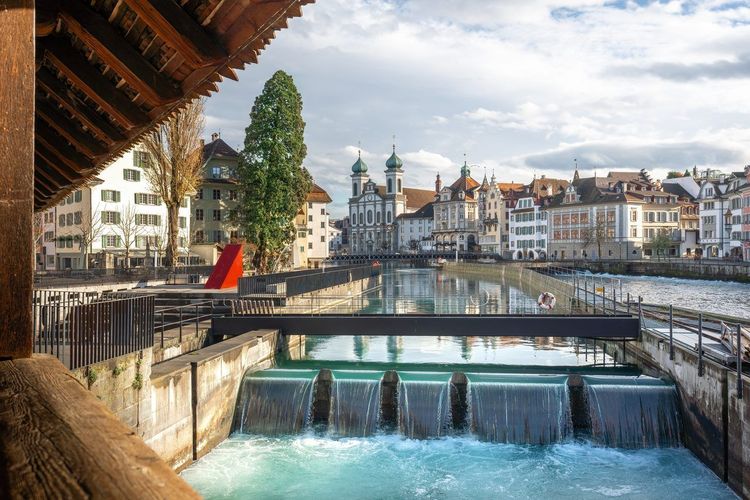
Further down, the needle dam (Nadelwehr) has regulated the level of Lake Lucerne since 1860 using wooden beams that are removed or added by hand, a technique still used today. You can lean on the parapet to watch the mechanism, then follow up with a drink on a terrace on one of the Reuss quays, where tables extend almost to the water's edge in summer.
Continuing east, the promenade turns into a stroll along Lake Lucerne, following the Nationalquai lined with centuries-old trees, with views of the Rigi and Pilatus framing the bay. The route is flat, stroller-friendly, and perfect in late afternoon.
Between the ramparts and the Reuss riverbank, the Ryo audio tour of Lucerne follows this same stretch and slips in a few legends attached to the old town's houses, to be enjoyed with headphones on, at your own pace.
KKL, Museums and Contemporary Architecture
Next to the station, a contemporary hub contrasts with the old town and deserves a separate half-day, especially on rainy days.
The KKL by Jean Nouvel
Inaugurated in 1998 for its concert hall, the KKL (Kultur- und Kongresszentrum Luzern) was designed by French architect Jean Nouvel. Its immense flat roof extends about 45 meters over the water, catches the reflections of the lake and seems to bring the landscape into the building. The hall, renowned for its acoustics, hosts the Lucerne Festival every summer, founded in 1938. Even without a concert ticket, the lobby and outdoor terraces can be explored freely.
The Lucerne Art Museum (Kunstmuseum)
Housed on the top floor of the same building, the Lucerne Art Museum (Kunstmuseum) presents collections of Swiss art, with paintings by Ferdinand Hodler and Robert Zünd, as well as temporary contemporary art exhibitions. Allow a good hour, ideally at the end of the day, when light streams through the windows overlooking the lake.
The Swiss Museum of Transport (Verkehrshaus)
About fifteen minutes away by bus or on foot along the lake, the Swiss Museum of Transport (Lidostrasse 5, 6006 Lucerne, rated 4.6/5 on Google from 14,967 reviews) (Verkehrshaus) is the most visited museum in the country, with halls devoted to rail, aviation, automobiles and navigation, plus a planetarium and a large cinema. It is the quintessential family stop of a weekend in Lucerne: allow half a day if you are traveling with kids eager to climb into a locomotive or cockpit, and arrive at opening time in high season to avoid school groups.
Cruising and Swimming on Lake Lucerne
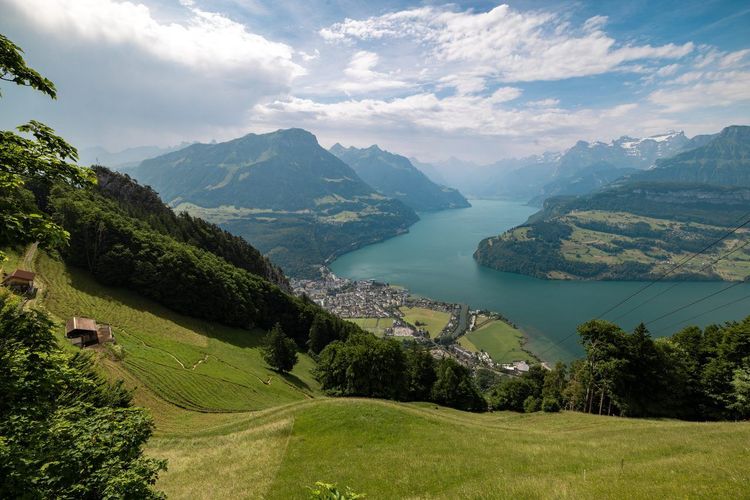
Paddle Steamer Cruise on the Lake
The Lake Lucerne Navigation Company (SGV) still operates five steam-powered paddle steamers linking Lucerne to villages such as Weggis, Vitznau or Flüelen. A one- to two-hour cruise is enough to understand the lake's French name, "Four Cantons": its arms, bordered by the four historic cantons of Lucerne, Uri, Schwyz and Unterwalden, change scenery dramatically at every bend, between meadows and rock walls plunging straight into the water.
Departures leave from the landing stage in front of the station, with no mandatory reservation in low season, but arrive 20 minutes early to pick a seat on the upper deck. The Swiss Travel Pass covers regular SGV boats, and the Swiss Half Fare Card halves the price, which noticeably lightens the bill on a short stay.
Beaches and Swimming Around Lucerne
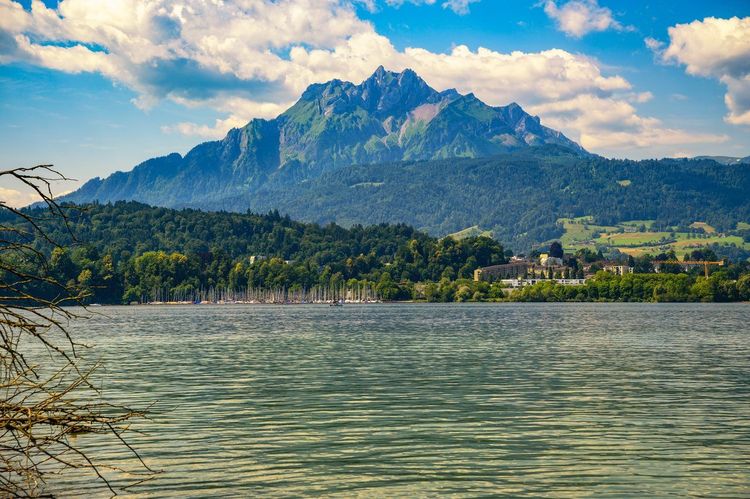
Contrary to popular belief, you can absolutely swim in the lake in summer: the Lucerne Lido, near the Verkehrshaus, offers lawns, a diving board and a long sandy beach. Other, more discreet spots can be found near Tribschen, close to Richard Wagner's former home, now a museum devoted to the composer.
Several rental companies also offer paddleboards and pedal boats from the central quays, a different way to see the historic bridges. If your stay stretches to three days, the article Things to Do in Lucerne details more waterside ideas.
Mountain Excursions: Pilatus, Rigi and Unusual Funiculars
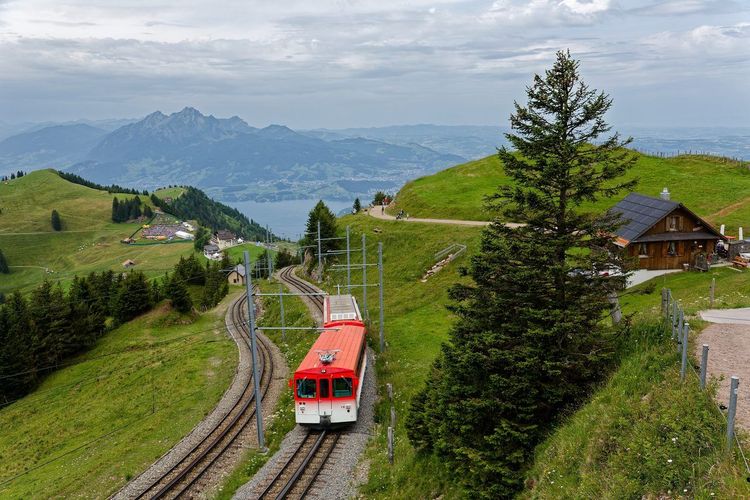
No weekend in Lucerne is truly complete without an excursion to high altitude: the city is surrounded by peaks reachable in half a day, each with its own historic means of transport.
Mount Pilatus, the Dragon Mountain Above Lucerne
The Mount Pilatus (Pilatus-Kulm, 6010 Kriens, rated 4.6/5 on Google from 1,385 reviews) peaks at 2,128 meters and is reached from Alpnachstad by the steepest cogwheel railway in the world, opened in 1889, with a maximum gradient of 48%. Legend has it that a dragon once lived there, and Lucerne still displays a "dragon stone" it supposedly dropped while flying over the region; a belief that long dissuaded locals from venturing onto its slopes.
In clear weather, the summit offers a panorama over dozens of Alpine peaks. The classic route, called the "Golden Round Trip," combines a boat to Alpnachstad, the cogwheel train on the way up, then cable cars to Kriens and a bus back to town. Leave early: clouds often envelop the summit in the afternoon in summer. Note that the cogwheel train only runs in season (roughly May to November); in winter, only the cable car ascent from Kriens remains possible.
The dragon legend is in fact one of the stories you will find in the Ryo audio guide to Lucerne: listen to it from the quays before boarding, with Pilatus right in front of you.
The Rigi and Europe's Oldest Cogwheel Railway
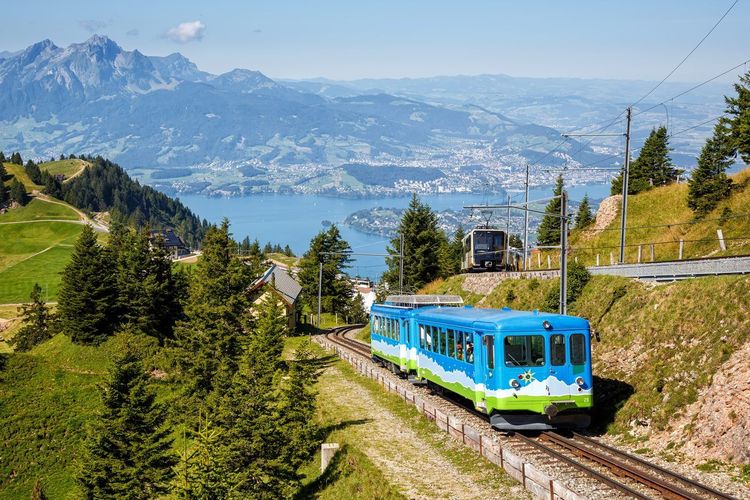
On the opposite shore, the Rigi (1,798 meters) is reached from Vitznau by Europe's first mountain railway, opened in 1871, nearly twenty years before the Pilatus one. Nicknamed "the Queen of the Mountains," it attracted Mark Twain and Queen Victoria, who visited in 1868.
The Rigi combines easily with the lake: boat to Vitznau, cogwheel train to Rigi Kulm, then a cable car descent to Weggis before taking the boat again. Allow a full day if you walk down one section, and bring good shoes.
Stanserhorn, Bürgenstock and Unusual Funiculars
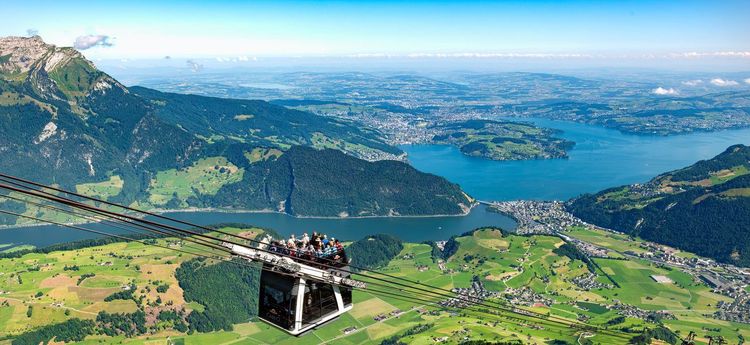
Less well known, the Stanserhorn is climbed partly aboard the CabriO, a double-decker cable car whose upper deck is open-air, unique in the world; allow a little under an hour from Lucerne (train to Stans, historic funicular, then CabriO), and note it is open only in the good season.
On the south shore, the Bürgenstock plateau is reached by boat then funicular from Kehrsiten. Up there, the Hammetschwand outdoor elevator, the highest in Europe, climbs a 153-meter cliff for a dizzying panorama. On the opposite shore, near Meggen, Meggenhorn Castle, a 19th-century neo-Renaissance folly surrounded by a park open to the public, remains one of the lake's least crowded gems, as does the Rooterberg hike, a wooded ridge reachable in half a day northeast of the city.
For thrill seekers, the Stoos funicular, about an hour from Lucerne, claims the title of steepest in the world with a 110% gradient and round cabins that rotate to stay level. More discreet, the Sonnenberg funicular in Kriens has climbed since 1902 to a viewpoint over the city.
Shopping, Food and Local Life
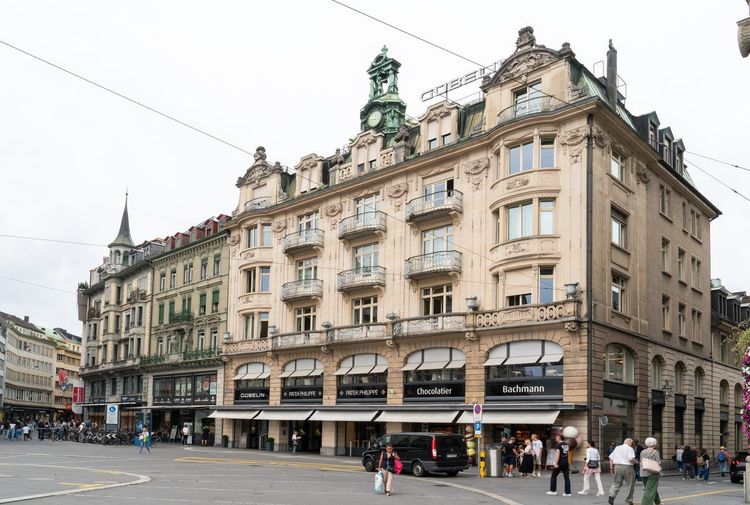
Between visits, the old town concentrates most of the shopping: watches, pocket knives and chocolate share the windows of Schwanenplatz and Hertensteinstrasse, with a few designer boutiques tucked among the international brands. The Bachmann confectionery (Schwanenplatz 7, 6004 Lucerne, rated 4.4/5 on Google from 2,060 reviews), a Lucerne family business, remains a safe bet for taking home pralines or pastries without going through a tourist shop.
On the plate, the specialty to try is Lozärner Chögelipastetli, a vol-au-vent filled with veal, mushrooms and creamy sauce, served in most traditional restaurants along the Reuss. The quayside terraces often offer a lunchtime set menu that is more affordable than the evening menu, a useful tip for a weekend on a tight budget. At the end of the day, you will gladly enjoy an aperitif facing the sunset over the lake, and if your visit falls in February, the Fasnacht turns the old town into a giant carnival, complete with Guggenmusik brass bands.
Ideal Itinerary for a Weekend in Lucerne in 48 Hours
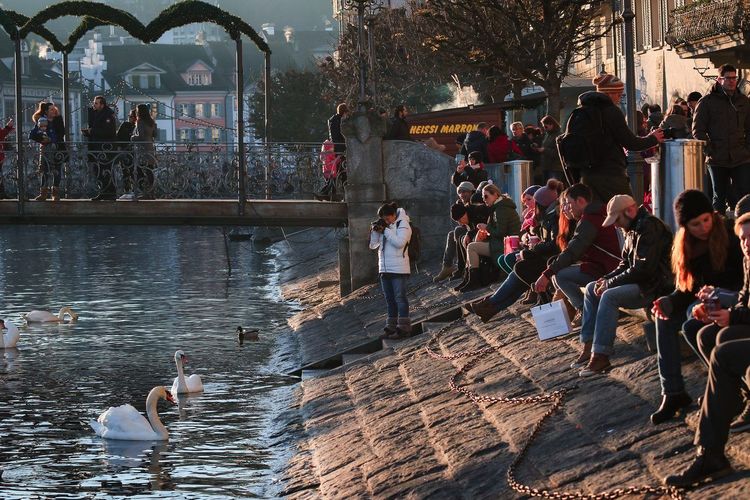
Not sure about the order of visits? Here is a tested plan for a weekend in Lucerne without a car, from Friday evening to Sunday evening, leaving some margin for the weather.
Day 1: Bridges, Ramparts and Sunset on the Lake
Start early at the Chapel Bridge and the Water Tower, before 9 a.m., when the quays are still empty. Then head up to Weinmarkt and Mühlenplatz, cross the Spreuer Bridge, then climb the Museggmauer ramparts for the view over the rooftops. After lunch on a terrace beside the Reuss, spend the afternoon on the trio of the Lion, the Glacier Garden and the Bourbaki Panorama, grouped in the same neighborhood. At the end of the day, come back down via the Jesuit Church and the needle dam, then follow the Nationalquai to the KKL to watch the sunset over the lake. This day follows almost point by point the stops of the Ryo audio-guided tour of the city, which saves you from juggling maps and brochures.
Day 2: Pilatus or Rigi, Then a Cruise
The second day belongs to the mountains. If the sky is clear, devote the morning to the Pilatus Golden Round Trip; if it is hazy on the Pilatus side, the Rigi, often clearer, makes a good alternative. In both cases, the return by boat doubles as a cruise. Save the late afternoon for the Verkehrshaus if you are traveling as a family, or for a swim at the Lido in summer. In bad weather, simply swap: the KKL, Kunstmuseum and Verkehrshaus easily fill a rainy day.
Who a Short Stay in Lucerne Suits
This two-day format particularly suits couples, families with children (Verkehrshaus, Lido, mirror maze) and travelers linking several Swiss cities by train. Seasoned hikers will want to add a third day for a second summit, while classical music lovers should aim for the festival period, in August and September.
Where to Stay in Lucerne
Staying in the Historic Center, Close to the Bridges
Staying in Lucerne's historic center lets you walk to the Chapel Bridge, Weinmarkt and Mühlenplatz squares, and the station in under ten minutes. It is the most convenient option for a short stay without a car, at the price of a higher budget and lanes that can be lively in the evening; book several weeks in advance if your weekend falls during the summer Lucerne Festival, when rooms quickly become scarce.
Staying on the Shores of Lake Lucerne
Around the Nationalquai and toward Tribschen, lakefront hotels offer more calm and often a direct view of the water and peaks, for about fifteen extra minutes' walk to the bridges. This area suits a family stay well, with the Lido and the Verkehrshaus right nearby.
Château Gütsch, an Unusual Night in a Castle Above the City
Perched on a hill overlooking the old town, Château Gütsch (Kanonenstrasse, 6003 Lucerne, rated 4.4/5 on Google from 1.6K reviews), now a hotel, is reached by the Gütschbahn, a public inclined elevator integrated into the Lucerne transport network. Built in the late 19th century in a slightly theatrical neo-medieval style, it offers one of the most spectacular views over Lucerne's rooftops and the lake, a memorable option for anyone seeking a night different from a standard hotel, even if it means being a bit farther from the bridges.
Practical Info: Getting There, Budget, Length of Stay and Season
How to Get to Lucerne (Train, Plane, Car)
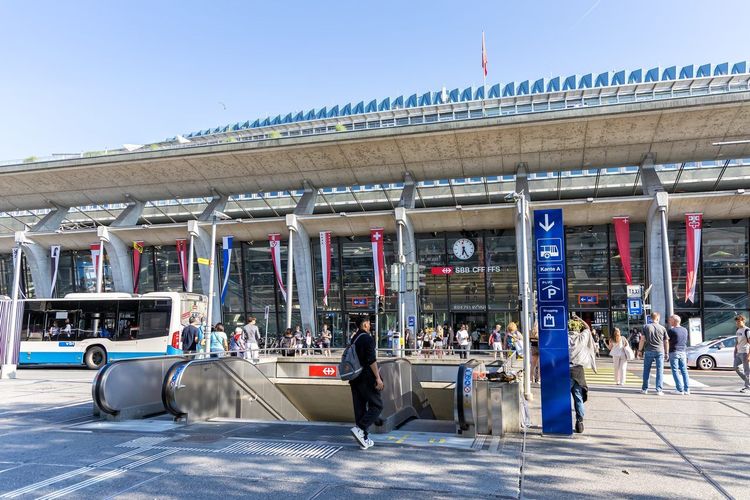
Lucerne is easily reached by train from Zurich (about 45 minutes) or Geneva (a little under three hours), with a central station steps from the Chapel Bridge. The nearest airport is Zurich, linked to Lucerne by rail in a little over an hour. By car, the city is accessible via the A2 motorway, but parking in the city center is limited and expensive, which makes the train more practical for a simple weekend.
How Many Days to Plan and What Budget
Two full days are enough to cover the old town, the Lion Monument of Lucerne and a mountain excursion; three or four days allow you to add a full cruise and a second summit such as the Rigi or the Stanserhorn. As for budget, Switzerland remains expensive: between accommodation, mountain tickets and meals, a comfortable weekend for two people generally costs between 500 and 900 Swiss francs, not including the train to get there. Mountain tickets weigh the heaviest: compare combined deals before booking each excursion separately.
Which Season to Choose and the Lucerne Visitor Card
From May to September, you enjoy full access to the summits and boats, with long days ideal for lakeside strolls; winter remains pleasant for the old town, but several lifts close or reduce their hours. The Lucerne Visitor Card, sent by your accommodation to all guests staying overnight, gives free access to buses and trains in zone 10 (the city), excluding boats, as well as discounts on mountain lifts, museums and excursions in the region.
Around Lucerne, other day trips complete a short stay, toward Interlaken, Zug or the lake villages. Before leaving, download the Ryo audio guide to Lucerne in the app: it guides you from the moment you step off the train, with no network connection needed once you are there.



FAQ
How many days do you need to visit Lucerne?
Two full days are enough to cover the old town, the two historic bridges, the Lion Monument and a mountain excursion such as Pilatus. With three or four days, add a full cruise on Lake Lucerne and a second summit such as the Rigi or the Stanserhorn.
What is the best time to visit Lucerne?
From May to September, the funiculars and boats run at full capacity and the long days leave time to combine the old town with the mountains. Winter is still pleasant for the old town and its Christmas market, but the Pilatus cogwheel railway is closed and some excursions run on a reduced schedule.
Do you need to stay overnight in Lucerne to visit the surrounding area?
Yes, staying in town makes early-morning excursions to Pilatus, the Rigi or the lake easier, and entitles you to the Visitor Card. The historic center and the lakefront are the two most convenient options, linked on foot in under twenty minutes.
How do you visit Mount Pilatus from Lucerne?
The Golden Round Trip combines a boat to Alpnachstad, the steepest cogwheel railway in the world up to the summit, then cable cars down to Kriens and a bus back to Lucerne. Allow half a day to a full day, from May to November; in winter, only the ascent via Kriens operates.
Is the Lucerne Visitor Card worth it?
Yes: provided free of charge by your accommodation, it covers city buses and trains in zone 10 for your entire stay (14 days maximum) and offers discounts on mountain lifts and museums. Boats are not included.
What is there to do around Lucerne outside the city?
The Rigi, the Stanserhorn and the Bürgenstock are among the most popular day trips, each reached by a different historic means of transport. Lake villages such as Weggis or Vitznau make for a quieter stop, as does a day in Interlaken or Zug.
What budget should you plan for a weekend in Lucerne?
Between accommodation, mountain excursions and meals, a comfortable weekend for two people generally costs between 500 and 900 Swiss francs, not including transport to get there. The Visitor Card, lunchtime set menus and combined tickets help reduce the bill.
Conclusion: Planning Your Weekend in Lucerne
At the end of these two days, Lucerne leaves the impression of a human-scale city, where the wooden bridges, the dying lion and the unusual funiculars are discovered without ever racing against the clock. The secret to a successful weekend in Lucerne comes down to a few things: get to the bridges early, keep an eye on the weather before choosing your mountain, and leave an evening for the lake.
Whether you stay two days or push on to a week in central Switzerland, you can link all these places with the Ryo audio-guided tour, bridge after bridge, listening to the stories the façades don't tell.