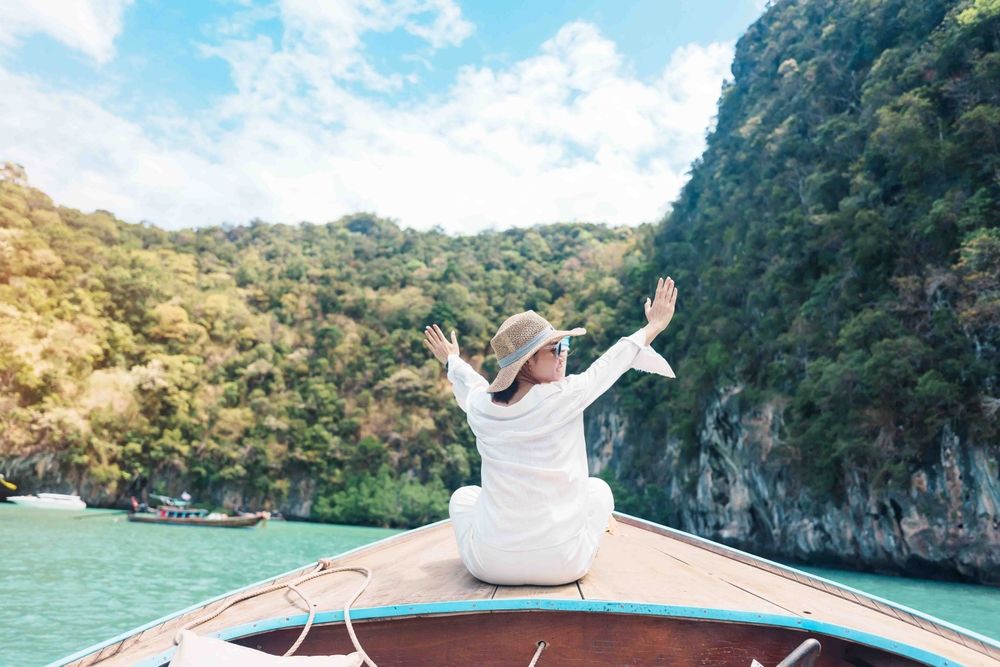
© Shutterstock
 Votre guide Ryo
Things to Do in Bangkok in 2026: 20 Experiences to Discover the Thai Capital
In Bangkok, a porcelain-covered temple sits next to a floating market, a traditional boxing ring, and a rooftop 314 meters high — often within thirty minutes of each other by tuk-tuk. This density makes the question of what to do in Bangkok almost dizzying for a first-time visitor: the Thai capital packs a royal palace, 19th-century canals, and a massive weekend market onto a territory split in two by the Chao Phraya river. To navigate it without racking up unnecessary trips, the Ryo Bangkok audio guide traces a thread between the historic neighborhoods and a few lesser-known addresses.
Here are twenty experiences that make up a complete stay in the city: a 46-meter reclining Buddha entirely covered in gold leaf, a weekend market with more than 15,000 stalls, a traditional massage school with knowledge carved in stone nearly two centuries ago, and a stadium that still hosts the country's oldest Muay Thai bouts. From golden temples and vertiginous rooftops to floating markets, each neighborhood tells a different side of Bangkok.
1. The Grand Palace and Wat Phra Kaew
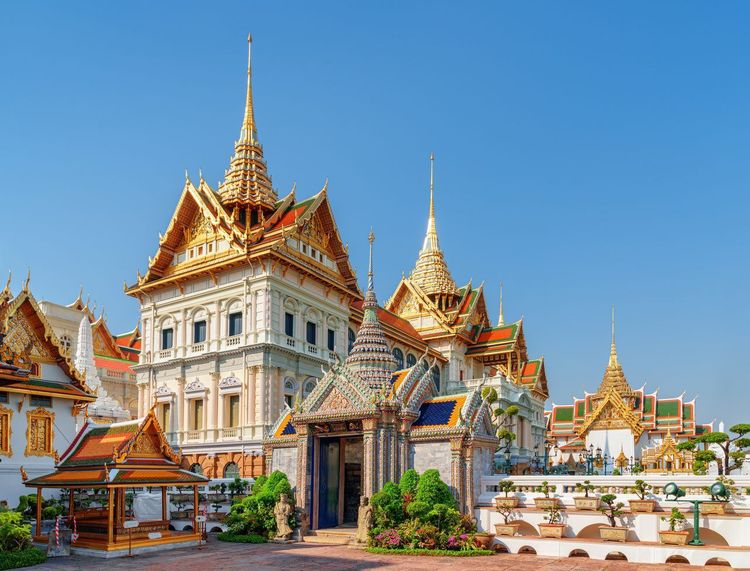
The Grand Palace (Na Phra Lan Road, 10200 Bangkok) served as the official residence of the kings of Siam from 1782, the year Bangkok was founded as the capital by Rama I. The complex spans 218,400 m² and blends architectural styles: Thai rooftops with glazed tiles, facades inspired by 19th-century European architecture, and gilded stupas recalling Khmer influence. The complex is still used today for certain royal ceremonies, even though the current king no longer resides there permanently.
Within the walls stands Wat Phra Kaew, the Temple of the Emerald Buddha. The statue itself is only 66 cm tall, carved from a single block of green jade, but its significance far exceeds its size: it is considered the protective talisman of the kingdom, and only the king has the right to change its sacred garments, a ritual performed three times a year according to the seasons. The galleries surrounding the temple are covered in murals of the Ramakien, the Thai version of the Indian Ramayana, painted and repainted since the reign of Rama I.
The dress code is strict and enforced without exception: shoulders and knees must be covered, no flip-flops. Sarongs are lent free of charge at the entrance if your outfit is unsuitable, but the queue for this loan can add twenty minutes to your visit. It is better to dress appropriately from the start. Arrive at opening time, 8:30 am: the site welcomes several thousand visitors a day and the heat becomes difficult to bear after 11 am, on a marble floor that reflects the sun with no shade.
Allow about two hours for a full visit, including the royal treasury rooms displaying crowns, textiles, and jewelry belonging to various sovereigns. The entrance ticket costs 500 baht for foreign visitors and includes access to the royal textile museum, often overlooked even though it offers insight into the evolution of court costumes over more than two centuries.
One last useful reflex at the entrance: politely ignore anyone on the Na Phra Lan sidewalk who tells you the palace is "closed today for a ceremony." The scam is as old as tourism in Bangkok and invariably ends with a tuk-tuk dropping you off at a partner jewelry store. The official ticket office is inside the first courtyard, never on the street.
2. Wat Pho and Its Reclining Buddha
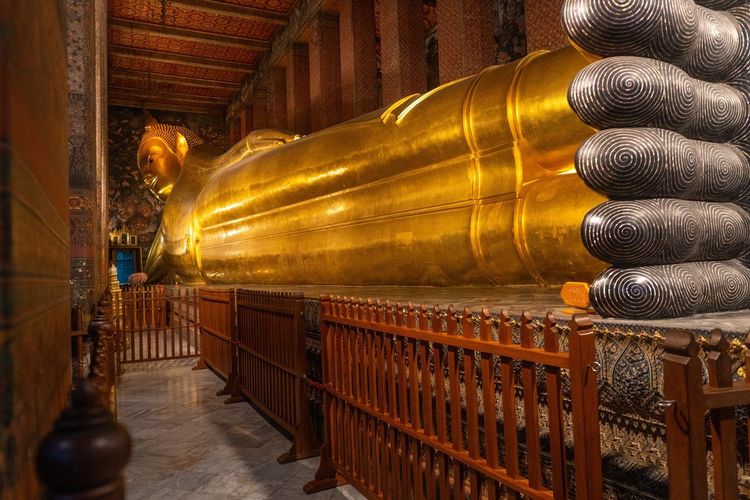
A few minutes' walk from the Grand Palace, Wat Pho is home to Thailand's largest reclining Buddha: 46 meters long and 15 meters high, entirely covered in gold leaf, with feet inlaid with mother-of-pearl depicting the 108 auspicious signs of Buddhism. The statue occupies a hall so narrow that it is impossible to take it in at a glance: the visit involves walking alongside the structure, a detail that often surprises first-time visitors used to wide-angle photographs.
The temple is also the oldest and largest in Bangkok: it existed before the city became the capital and was completely rebuilt from 1788 under Rama I, then considerably expanded under Rama III. It has 91 small chedis (bell-shaped stupas), plus four monumental chedis dedicated to the first four kings of the Chakri dynasty, along with a thousand Buddha statues spread across its various courtyards. Many visitors stop at the reclining Buddha without exploring the rest of the complex, even though the rear gardens and smaller side sanctuaries offer a much more peaceful atmosphere.
Wat Pho is also considered the birthplace of traditional Thai massage. Under Rama III, the kingdom's medical knowledge was engraved on marble plaques and illustrated by statues of ascetics showing the pressure points of the human body: this corpus was inscribed in 2008 on UNESCO's Memory of the World register. The school of traditional medicine and massage that carries on this heritage was founded in 1955 within the temple grounds and claims to have trained more than 200,000 practitioners, now established in some 145 countries. You can leave with a foot or full-body massage right on site, in a dedicated pavilion within the temple grounds — a different experience from a simple street massage parlor.
Budget around 300 baht for the entrance ticket, including a bottle of water, and bring cash: the nearest ATMs are outside the site. The temple opens at 8 am, which leaves plenty of time to continue to the neighboring Grand Palace in the same morning, provided you start with whichever of the two matters most to you.
3. Wat Arun, the Temple of Dawn
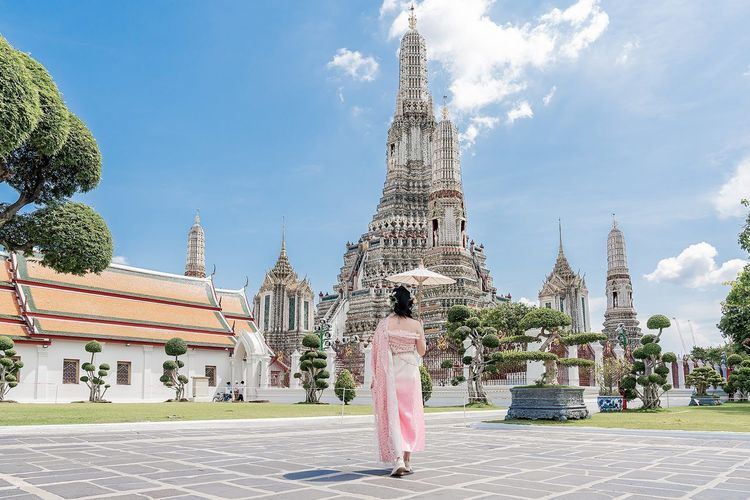
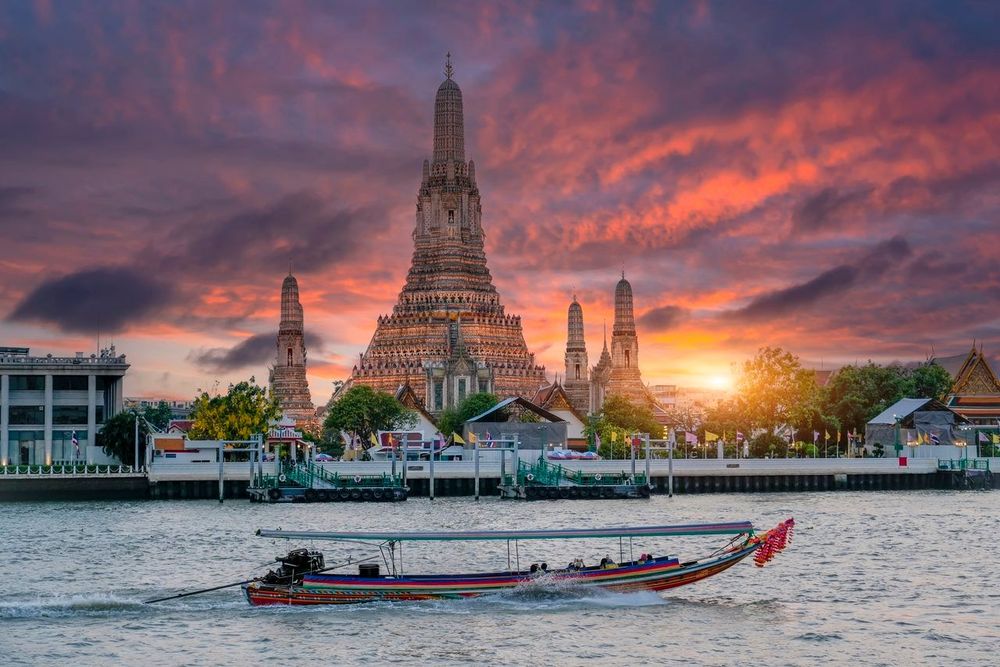
On the west bank of the Chao Phraya, Wat Arun takes its name from Aruna, the Hindu deity of dawn, charioteer of the sun god Surya. Its central prang, a Khmer-style tower, rises to more than 70 meters according to the most common measurements, and is distinguished by an entire cladding of Chinese porcelain shards and shells embedded in the stucco. These fragments came from the ballast of Chinese merchant ships that sailed upriver in the 19th century: nothing was wasted, not even the ballast. Seen from a distance, the whole structure appears almost pearlescent depending on the light.
The best time to appreciate it is at sunset, from the opposite bank where Wat Pho stands: the temple is silhouetted in gold against the sky, one of the city's most reproduced images, but also one that lives up to its promise in person. To cross the river and climb the terraces of the prang itself, a ferry connects the Tha Tien pier to the Wat Arun pier for just a few baht in a five-minute crossing.
The steps that allow you to climb halfway up are steep and narrow, best tackled in closed shoes rather than flip-flops. The climb offers an open view of the river and the Chinatown neighborhood in the background. This detour, often treated as a simple photo opportunity from the other bank, deserves a good hour on site. Admission is 200 baht for foreign visitors. The Ryo Bangkok audio guide devotes a chapter to this temple and its history tied to the founding of the city by Rama I, who briefly installed the royal palace on this bank before moving it eastward.
4. A River Cruise or Long-Tail Boat Ride on the Chao Phraya
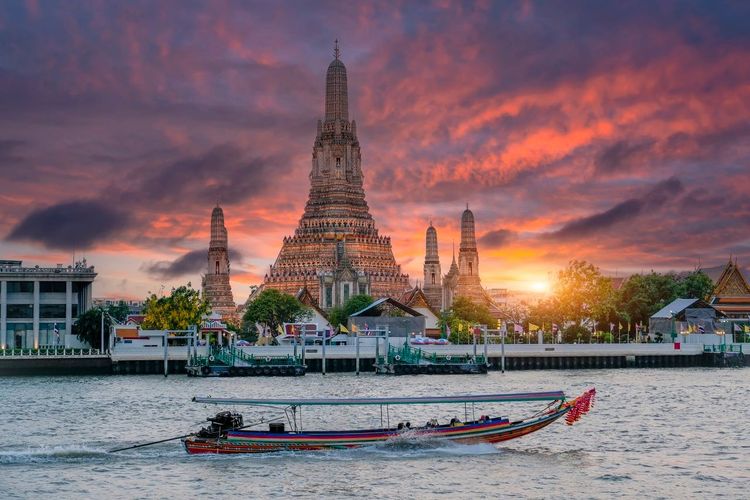
The Chao Phraya river shapes the entire geography of Bangkok, separating historic old Bangkok (east bank) from Thonburi, the former capital (west bank). The simplest way to explore it is the Chao Phraya Express Boat, recognizable by its orange flag: this river-bus service stops at around thirty piers between the north and south of the city for a flat fare of about fifteen baht on this, the most frequent line. Green- or yellow-flag boats, faster but less frequent, charge by distance and skip some stops.
For a more immersive experience, long-tail boats (reua hang yao) allow you to venture into the canals (khlongs) of Thonburi, a network that earned Bangkok the nickname "Venice of the Orient" before most of the city center's canals were filled in during the 20th century to build roads. You can still find houses on stilts, isolated temples accessible only by water, and floating street vendors.
An evening dinner cruise, with views of the illuminated Wat Arun, is a pleasant option for a last night in Bangkok, especially from the piers near Sathorn. Book in the late afternoon: prices rise sharply for sunset slots reserved on the same day, and the best companies sell out by midday during peak tourist season — a fitting way to close out a day spent following Wat Arun and the Chao Phraya on Bangkok's audio-guided tour.
5. Khao San Road, the Legendary Backpacker Strip
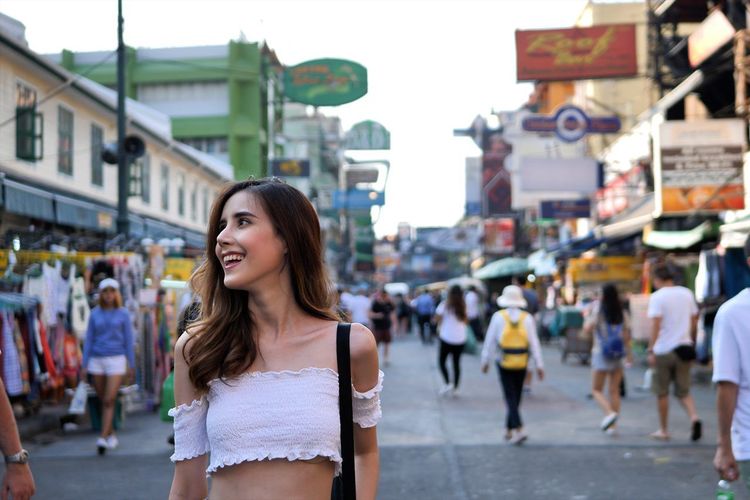
Made famous by the novel and then the film The Beach, Khao San Road has been the gathering point for long-haul travelers in Southeast Asia since the 1980s. The street itself is only 400 meters long, but it packs bars, street food stalls, tattoo parlors, budget travel agencies, and fake university diploma vendors into an atmosphere unlike anything else in the city.
By day, the area remains relatively calm and is a good place to pick up cheap clothes or try a freshly made pad thai for around thirty baht. At nightfall, the street changes character entirely: traffic is cut off, bar speakers blare music into the early hours, and fried scorpions sit alongside cocktails served in plastic buckets — an image that has become almost a knowingly embraced tourist cliché.
You do not have to stay there to enjoy it: many travelers based elsewhere simply come for an evening, particularly to compare the vibe with the more relaxed atmosphere of the rest of the city. Keep an eye on your belongings in the dense crowds, though the area is not generally considered dangerous.
6. Chinatown and Yaowarat Avenue
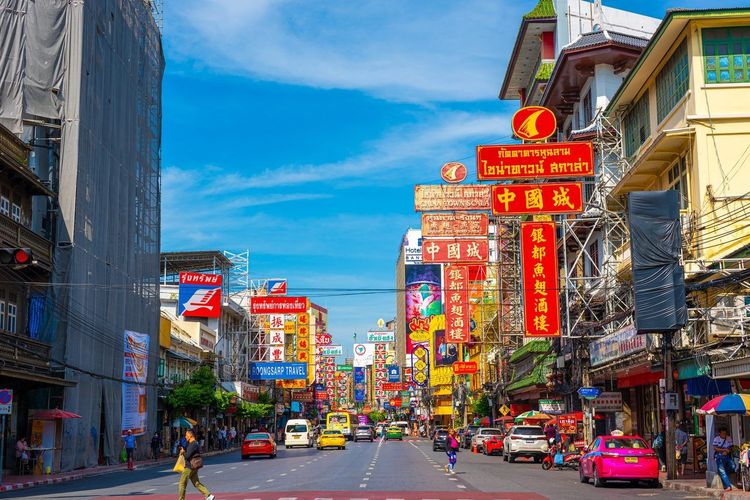
The Chinatown neighborhood, centered on Yaowarat Road (10100 Bangkok), developed after Bangkok was founded, when the Chinese community was relocated from the site chosen for the Grand Palace to this then-peripheral area. Two centuries later, it has become one of the largest Chinatowns in the world, with red and gold neon signs and Chinese herbalists still selling dried remedies and ginseng by weight.
At the heart of the neighborhood hides Wat Traimit (661 Charoen Krung Road, 10100 Bangkok, rated 4.6/5 on Google with 22,345 reviews), which houses the world's largest solid-gold Buddha: approximately 5.5 tonnes of gold, revealed by accident in 1955 when the statue was accidentally dropped during its transfer to a new building, cracking the stucco coating that had concealed it for generations, probably to protect it from looting during Burmese invasions. Before that fall, nobody knew such a treasure lay beneath a simple plaster surface. The Sukhothai-style statue has been displayed in a mondop open to the public since 2010, with two exhibition rooms dedicated to its history and that of the Sino-Thai community of the neighborhood.
In the evening, Yaowarat Road transforms into a vast open-air street market: grilled seafood stalls, noodle soups, and vendors with pyramids of mangosteens. You can easily spend three hours wandering between the stalls without eating the same thing twice. On weekends, the density of the crowd slows walking to a crawl, but the atmosphere is well worth it.
7. An Immersion in Street Food Culture
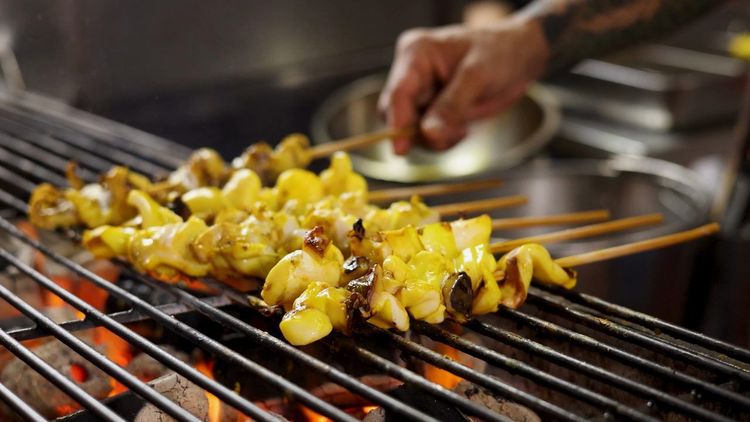
Bangkok's street food has earned its reputation well beyond Thailand: the Michelin Guide has recognized several stalls, including that of Jay Fai, a starred cook since 2018, known for her crab omelette prepared in a wok over charcoal, with several hours of queuing for a table. But the richness of Bangkok's street food scene goes far beyond a few celebrated addresses: it is lived on every street corner, at stalls that sometimes exist solely for one dish, perfected over decades.
The Or Tor Kor Market (101 Kamphaeng Phet Road, 10900 Bangkok), regularly cited as one of the world's best food markets, offers out-of-season tropical fruits, mango with sticky rice prepared in front of you, and yellow curry served in individual portions in a tied plastic bag, ready to take away for an impromptu picnic.
Among the dishes you absolutely must try: pad krapow moo saap (minced pork stir-fried with Thai basil, served with a fried egg and rice), khao soi (coconut milk noodle curry, more common in the north but found in certain neighborhoods), tom yum goong in its spiciest version, and grilled pork skewers (moo ping) sold from dawn outside BTS stations during rush hour. Each neighborhood has its own unwritten specialty, passed on more by word of mouth among locals than by tourist guides.
To explore the subject further before your trip, the Ryo article on Bangkok's culinary specialties lists ten dishes to look out for at the stalls, with their regional variations. A practical tip: choose stands where locals are already queuing — a far more reliable indicator than online reviews for judging the freshness of the ingredients used.
Night markets have shifted considerably in recent years due to real estate developments. The former Train Markets of Ratchada and Srinakarin have closed, replaced by the Jodd Fairs, including the one near Rama 9 and the one set up in DanNeramit Park in the north of the city. They offer the same mix of food trucks, vintage bric-a-brac, and container bars, with an atmosphere closer to a festival than a traditional market. The signature dish at these spots, leng saap (slow-braised pork ribs drenched in chili and lime juice), is ordered as a large plate to share, never as an individual portion.
8. Chatuchak Weekend Market
The Chatuchak Market (Kamphaeng Phet 2 Road, 10900 Bangkok), open only on Saturdays and Sundays, brings together more than 15,000 stalls spread across 27 themed sections: vintage clothing, artisan ceramics, plants and bonsais, pets, antiques, and teak furniture. The total area is close to 14 hectares — getting lost in the alleys is almost part of the experience. The market has existed since 1942 and has occupied its current location, at the end of the BTS and MRT lines, since 1975.
It is best to arrive early, at opening time at 9 am: the heat under the corrugated iron awnings quickly becomes stifling, and the midday crowds slow movement considerably in the narrowest alleys. Bring cash in small denominations: bargaining is part of the game, especially for decorative items and clothing, where a 20 to 30% discount on the listed price is perfectly common.
Beyond shopping, the market is also a food destination in its own right, with stalls serving regional cuisine from northeast Thailand (Isaan), spicier and less well known to visitors than the central Bangkok cuisine. Section 26, dedicated to young local designers, is a good place to find unique pieces far from tourist-oriented production. Allow a full half-day to browse at a leisurely pace, and keep in mind that no map is entirely reliable: even regulars get lost here.
9. Floating Markets Around the City
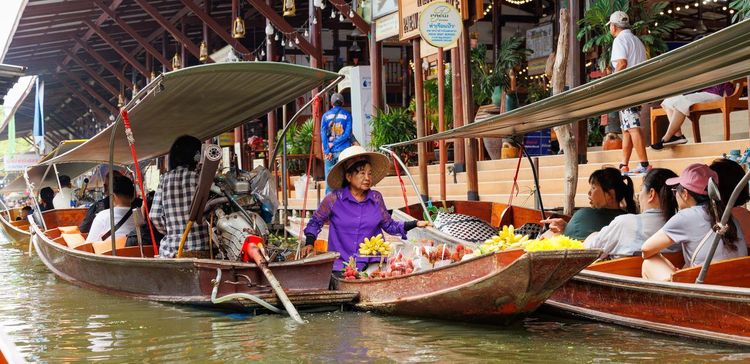
About a hundred kilometers to the southwest, the floating market of Damnoen Saduak remains the most iconic image of Thai floating markets: vendors in conical hats, sitting in boats loaded with fruit and curries, navigating a network of canals dating from the 19th century. The place is today largely organized for tour groups, with prices adjusted accordingly, but the spectacle remains striking for anyone who has never seen this type of floating commerce.
For a more authentic version and considerably closer to the city center, the floating market of Taling Chan (Chak Phra Road, 10170 Bangkok), only about thirty minutes away, opens only on weekends and draws mostly a local crowd who come to have lunch with their families on floating pontoons set directly on the canal.
Dishes are prepared to order directly from the boats, with grilled fish and stir-fried noodles served on wooden tables floating on the water. This more modest format suits those who want an off-the-beaten-track morning without devoting an entire day to the round trip to Damnoen Saduak.
Two other options are worth knowing about. Khlong Lat Mayom, a few kilometers from Taling Chan and also open on weekends, is best visited for its food stalls set up on land, in a village-fair atmosphere. Amphawa, about 80 kilometers to the southwest, works in reverse: the market comes alive in the late afternoon and evening, from Friday to Sunday, with seafood barbecues on boats and night-time boat trips organized to spot fireflies in the mangroves. If you only have time for one floating market and want to avoid tour buses, this is probably the one to aim for.
10. Treating Yourself to a Traditional Thai Massage
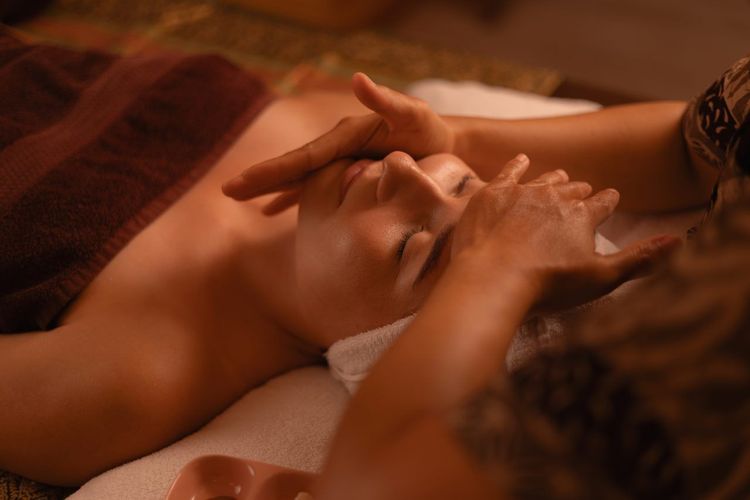
Traditional Thai massage draws its origins from Indian Ayurvedic medicine, introduced to Thailand more than two thousand years ago by Buddhist monks. Unlike the Western relaxation massage, it combines assisted stretches, pressure on specific points, and joint manipulation, performed fully clothed on a futon rather than a table.
A half-hour foot massage typically costs between 300 and 400 baht at a decent street parlor, and a full two-hour body massage runs around 500 to 600 baht — a modest price compared to Western standards. Licensed parlors usually display a visible certificate in the window, a useful marker for avoiding lower-quality establishments that primarily target passing tourists.
A word on intensity, since that is what surprises first-timers most: the practitioner may work with elbows, knees, and sometimes feet, and some stretches at the end of the session can crack your vertebrae. A simple "bao bao" (gently) is enough to ease the pressure, and no one will take offence. Wear loose clothing, avoid eating right beforehand, and leave a tip of 50 to 100 baht, which is standard practice in neighborhood parlors. If the experience appeals to you enough to want to understand the technique, several schools in Bangkok, including that of Wat Pho, offer introductory courses of a few days open to travelers, with a certificate upon completion.
11. A Drink at the Top of Bangkok's Rooftop Bars
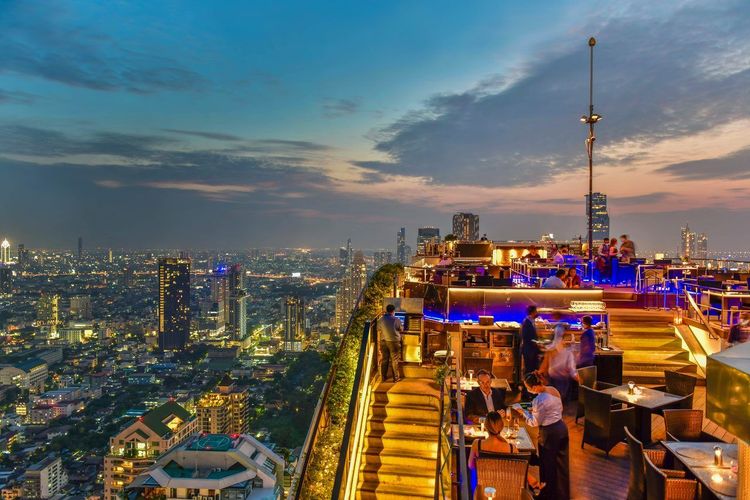
Bangkok is among the cities in the world with the highest concentration of elevated bars, driven by a skyscraper skyline built in just a few decades. The Sky Bar at the Lebua State Tower (1055 Silom Road, 10500 Bangkok), made famous by a scene in the film Hangover 2, overlooks the city from the 63rd floor, with a circular illuminated bar set right at the edge of the terrace.
The Mahanakhon SkyWalk (114 Naradhiwas Rajanagarindra Road, 10500 Bangkok, rated 4.7/5 on Google with 415 reviews) goes further with a glass platform suspended at 314 meters, where you can literally see the void beneath your feet. The bravest visitors lie down directly on the glass for the photo — a ritual that has become almost obligatory since the site opened in late 2018.
Other options take a more discreet approach: the Three Sixty bar offers a panoramic view over the river, while the Vertigo, perched at the top of the Banyan Tree Bangkok, occupies the site of a former helipad. Always book a table before sunset: most of these venues charge an entrance fee or a minimum spend, and the best spots are snapped up from 5 pm in high season.
One last detail that can ruin an evening: the dress code is genuinely enforced at the most sought-after venues. Shorts, tank tops, and flip-flops will be turned away from the lift, even when temperatures still exceed 30°C in the evening. A light shirt and closed shoes are sufficient. Also keep an eye on the weather between June and October: a tropical downpour can close the terrace in minutes, and bars then move their guests to an indoor floor that is far less spectacular.
12. A Break in Lumpini Park
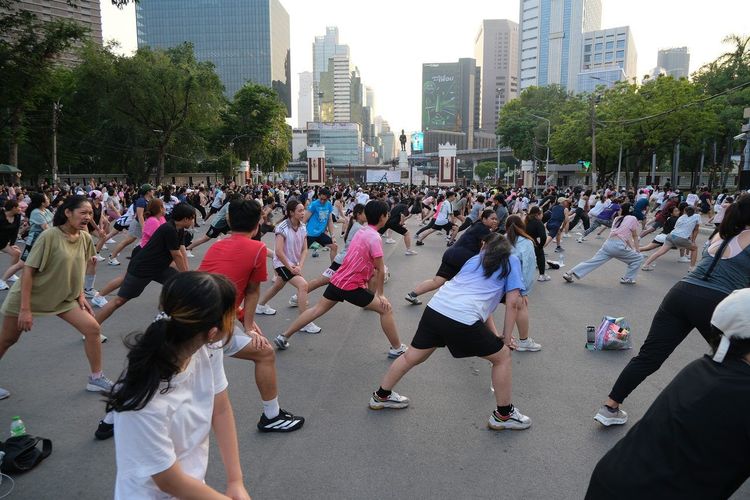
The green lung of the city center, Lumpini Park (192 Rama IV Road, 10330 Bangkok) covers 57.6 hectares and takes its name from the birthplace of the Buddha in Nepal. From dawn, groups practice tai chi among the tropical trees, while local joggers circle the artificial lake before the heat becomes unbearable.
The park is also known for housing several giant monitor lizards, sometimes over a meter long, which swim calmly in the lake to the amused curiosity of passersby. Renting a pedal boat for about thirty minutes remains an inexpensive way to escape the urban bustle, especially in the late afternoon.
Created during the reign of Rama VI, whose statue still watches over the south entrance, the park remains above all a neighborhood gathering place. Around 6 pm, group aerobics sessions spring up on the open plazas, open to everyone and free of charge, with the music turned up full and an instructor in fluorescent gear: no one will bat an eye if you slip in at the back. Since 2022, a pedestrian and cycling bridge has connected Lumpini to Benjakitti Forest Park, developed on the site of a former tobacco factory, making it possible to walk between the two green spaces without crossing a single road.
13. The Jim Thompson House
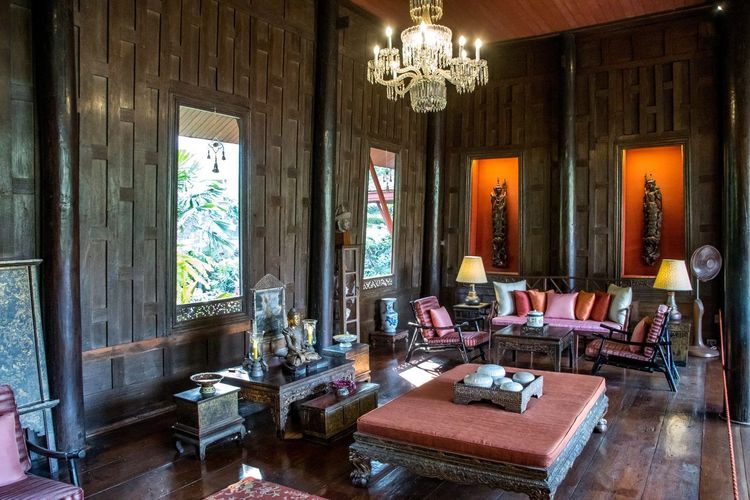
An American entrepreneur who settled in Thailand after the Second World War, Jim Thompson is credited with relaunching the Thai silk industry on an international scale, before mysteriously disappearing in the Cameron Highlands in Malaysia in 1967, with no explanation ever confirmed. His house-museum (6 Soi Kasemsan 2, Rama I Road, 10330 Bangkok) brings together six traditional teak houses, dismantled from different regions of the country and reconstructed piece by piece on this plot of land at the edge of a canal.
The interior preserves his personal collection of Asian art, Chinese porcelain, and ancient Buddhist statues, set within dense greenery that contrasts sharply with the bustle of the nearby Siam shopping district. The guided tours, included in the entrance fee, recount the man's life with a level of detail often absent from the city's other museums. To continue discovering lesser-known spots in the capital, the Ryo article on things to do in Bangkok lists other addresses off the most well-trodden paths.
14. Wat Saket and the Golden Mount
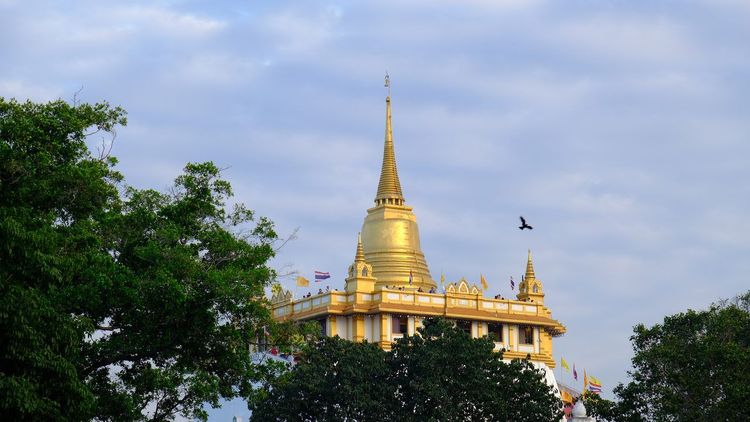
Built on an artificial hill during the reign of Rama III, Wat Saket, better known as the Golden Mount (344 Thanon Chakkraphatdi Phong, 10100 Bangkok), is climbed via a spiral staircase of more than 300 steps, lined with bells that visitors ring as they pass.
At the top, a gilded chedi is said to house a Buddha relic offered by India in the early 20th century. The reward of the climb lies above all in the 360-degree view over old Bangkok, particularly spectacular at sunset when the raking light makes the rooftops of the surrounding temples shimmer. In November, the temple hosts a traditional fair over several days, with lantern processions and live Thai music.
The climb is gentle despite the number of steps, with shaded landings, small artificial waterfalls, and drums you can strike halfway up. The ticket costs around a hundred baht to access the summit terrace, and the early opening at around 7:30 am allows you to make the climb before the heat sets in. The history of the site is darker than its postcard image suggests: in the 19th century, as the city faced cholera epidemics, Wat Saket served as a public crematorium, earning it the nickname "temple of vultures" for a long time. A discreet plaque at the foot of the hill recalls this, far from the bustle of the groups who come for the view. The Ryo Bangkok audio guide places this neighborhood in the context of old Rattanakosin's history, between vanished ramparts and canals still visible today.
15. Siam Square and the Major Shopping Malls
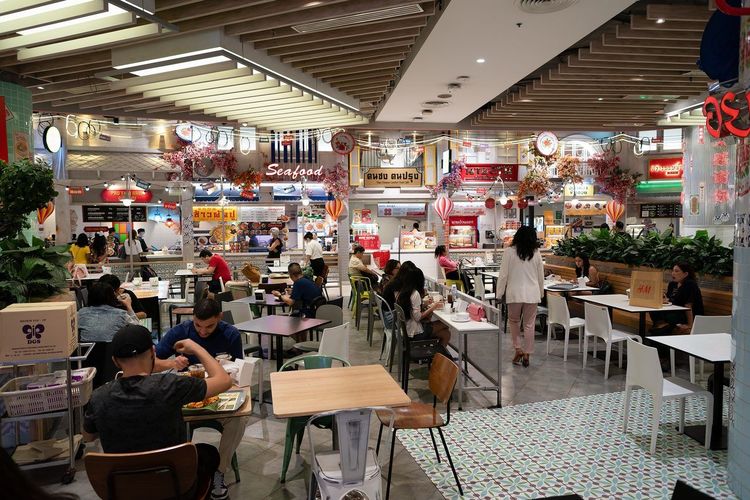
The Siam Square neighborhood concentrates Bangkok's most prestigious brands around Siam Paragon, which houses, among other things, a vast aquarium — SEA LIFE Bangkok Ocean World — spread across several basement levels. Bangkok residents often come here simply to enjoy the air conditioning, a social use of shopping malls that often surprises Western visitors.
On the Thonburi bank, ICONSIAM (299 Charoen Nakhon Road, 10600 Bangkok, rated 4.7/5 on Google with 58,882 reviews) claims the title of Southeast Asia's largest shopping center, with an entire floor called SookSiam recreating a covered floating market where artisans and cooks from every Thai region take turns at wooden stalls. The center also organizes fountain and projection shows on its riverside facade, visible for free from the outdoor riverside promenade in the evenings.
A free ferry connects ICONSIAM to BTS Saphan Taksin station — a practical detail that saves you paying for a tuk-tuk to cross the river.
16. MBK Center for Budget Shopping
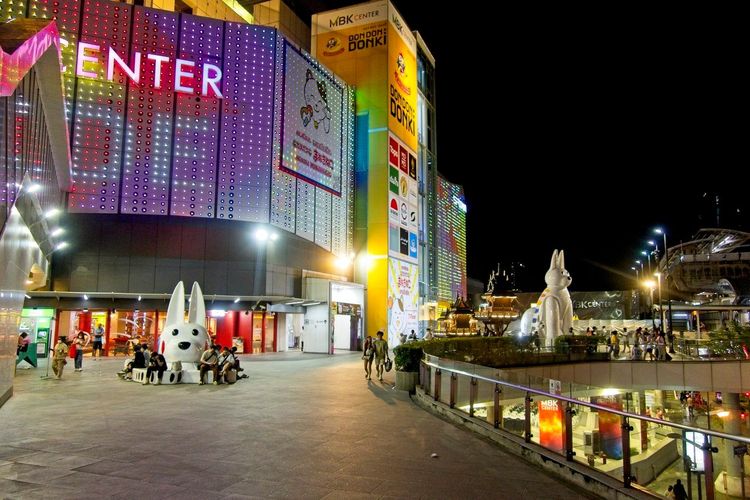
Less flashy than its upscale neighbors, MBK Center (444 Phaya Thai Road, 10330 Bangkok, rated 4.5/5 on Google with 62,095 reviews) remains a go-to destination for budget shopping: eight floors and more than 2,000 independent shops selling refurbished electronics, clothing, and souvenirs at negotiable prices.
Bargaining is almost universal here, and it is not uncommon to get 15 to 20% off the listed price simply by striking up a conversation with the vendor. The basement has a particularly affordable food court, ideal for a lunch break between shopping sessions.
A few pointers to avoid going round in circles across these eight levels: the fourth floor concentrates phones, accessories, and all kinds of repairs, with workshops able to replace a screen in an hour; the middle floors line up luggage and clothing, handy for buying an extra suitcase when purchases overflow; and several tailors on site offer made-to-measure shirts or suits delivered in two to three days. A covered walkway connects the center directly to BTS National Stadium station, which means you can avoid crossing Phaya Thai Road on foot in the monsoon rain.
17. The Erawan Shrine and Its Traditional Dancers
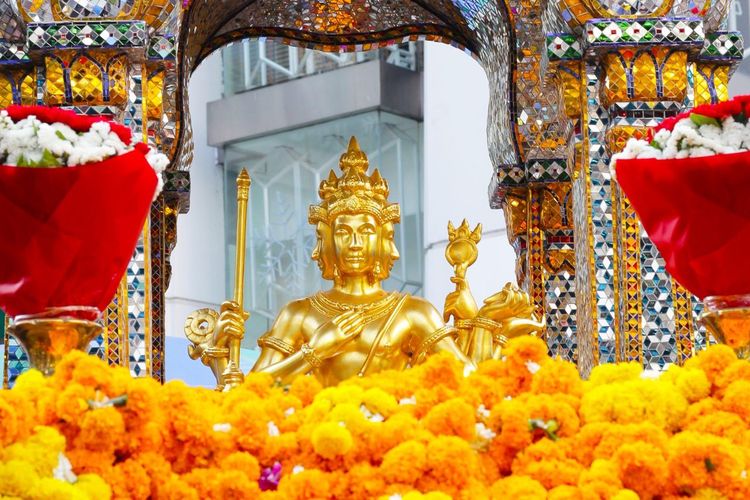
Located at the corner of the Ratchaprasong intersection, the Erawan Shrine (494 Ratchadamri Road, 10330 Bangkok, rated 4.7/5 on Google with 6,900 reviews) was erected in 1956 after a series of accidents during the construction of the adjacent Erawan Hotel, which workers attributed to the incorrect laying of the foundation stone of the planned shrine on the site.
The shrine is dedicated to Phra Phrom, a four-faced Hindu deity locally identified with Brahma. Devotees regularly hire traditional dancers to perform choreographed offerings in exchange for a granted wish — a free spectacle accessible at any time of day, in the middle of one of the city's busiest intersections.
The ritual follows a precise logic: at the entrance you buy a set of incense sticks, candles, and yellow marigold garlands, then walk around all four faces of the statue, making an offering at each one. The wooden elephants lined up around the base are left by those whose wish has been granted. The shrine survived a bombing in August 2015 and reopened two days later, almost immediately becoming the daily waypoint it had never ceased to be. Take the time to stand to one side for ten minutes: the contrast between the incense smoke, the intersection's horn blasts, and the luxury storefronts encircling the shrine captures Bangkok rather well.
18. Bang Krachao, the Green Lung by the River
Nicknamed Bangkok's green lung, Bang Krachao occupies a bend in the Chao Phraya just south of the city center, in the neighboring province of Samut Prakan. The area stands out for its near-total absence of motor traffic, replaced by a network of elevated concrete walkways winding through mangroves, orchards, and small isolated temples.
To get there, a ferry connects the Khlong Toei pier to the Bang Krachao landing in just a few minutes for a handful of baht. Once on the other side, renting a bicycle is the most enjoyable way to explore the area, particularly around Sri Nakhon Kuen Park, designed in the shape of a turtle when seen from above and planted with local species. On weekends, the Bang Nam Phueng floating market provides an extra reason to cross: coconut desserts, grilled skewers, and wooden pontoons set above the canal, with an almost entirely Thai clientele.
The contrast with the downtown bustle is striking: you encounter more free-range chickens than scooters, and the quiet comes as a surprise after a few days in the noise of Sukhumvit or Silom. A full afternoon is enough to take it all in, ideally toward the end of the week when some canal-side cafés serve freshly pressed fruit juices. To place this escape in relation to the historic neighborhoods, the Ryo Bangkok audio guide gives an overview of the river and its two banks.
19. Watching a Muay Thai Fight
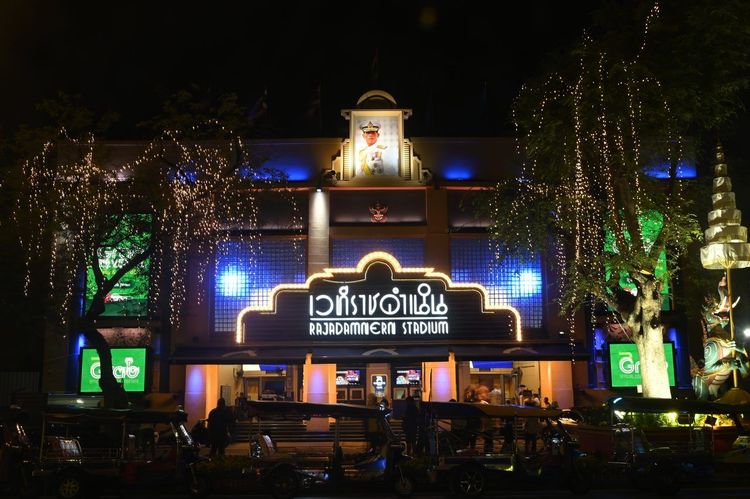
Muay Thai, Thailand's national martial art, has been practiced in dedicated stadiums since the early 20th century. Rajadamnern Stadium (8 Ratchadamnoen Nok Road, 10100 Bangkok), inaugurated in 1945, remains the oldest still in operation and hosts fight nights several times a week, preceded by a ritual called wai khru — a ceremonial dance performed by each boxer to live sarama music (flute and drums).
The atmosphere in the standing sections, where local bettors shout their wagers between rounds, contrasts sharply with the more sedate tourist seating. Book your seats in advance online: prices vary considerably by proximity to the ring, and the most anticipated bouts sell out several days ahead. An evening typically features around ten bouts, with young boxers opening the program and the main events taking place mid-evening, around 9 pm. To explore more similar local traditions, the Ryo article on things to do in Bangkok details other cultural experiences accessible to passing visitors.
20. Experiencing Loy Krathong and Seasonal Festivals
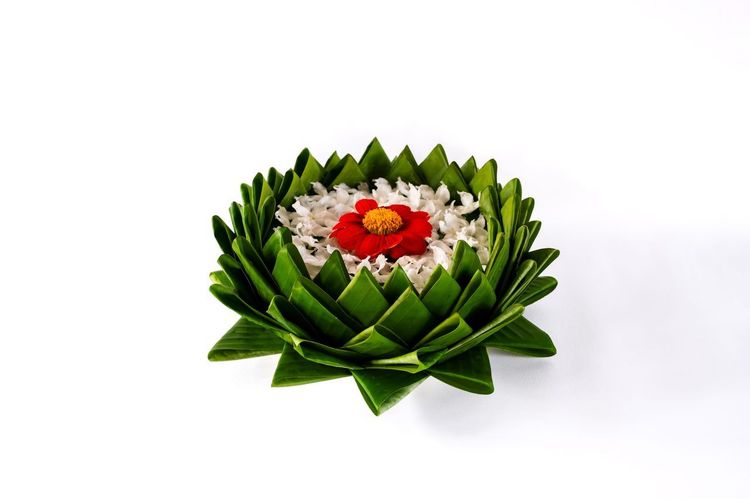
Each year, at the full moon of the twelfth lunar month (generally in November), the Loy Krathong festival transforms the banks of the Chao Phraya into a spectacle of small floating vessels made of banana leaves, flowers, and candles, released onto the water as a sign of purification and gratitude to the goddess of the waters, Phra Mae Khongkha.
The best vantage points are along the riverside promenades around Asiatique The Riverfront (2194 Charoen Krung Road, 10120 Bangkok, rated 4.4/5 on Google with 74,530 reviews), where concerts and fireworks traditionally accompany the evening.
If your stay falls in April, Songkran, the Thai New Year, turns entire streets into a giant water fight lasting several days — a radically different experience but just as memorable for those who accept getting soaked without reservation. Checking the festival calendar before booking your ticket often makes it possible to time a trip with one of these exceptional events. Two practical reflexes then apply: book accommodation well in advance, as prices rise sharply during these periods, and protect your phone and documents in a waterproof pouch during Songkran — no one is spared, tourists included.
FAQ
How many days do you need to visit Bangkok?
Three to four days are enough to cover the must-sees (Grand Palace, Wat Pho, Wat Arun, Chatuchak on weekends) without rushing. A week gives you time to add Bang Krachao, a floating market, and several shopping districts in depth.
What is the best time to visit Bangkok?
The dry season, from November to February, offers the most bearable temperatures, around 30°C with little rain. March to May remains very hot and humid, while the rainy season (June to October) brings short but intense showers in the late afternoon.
What can you do in Bangkok for free?
The Erawan Shrine, strolling through Chinatown, Lumpini Park, the Chao Phraya riverside, and the ICONSIAM fountain shows in the evening are all accessible without spending a baht. Only certain major temples such as the Grand Palace or Wat Pho charge an admission fee.
What can you do in Bangkok in one day?
Focus on the Grand Palace, Wat Pho, and Wat Arun triangle, connected on foot or by ferry in one morning, then finish with a street market and a rooftop bar in the evening for a panoramic view of the city.
What budget should you plan per day in Bangkok?
A budget traveler can get by on around 1,200 to 1,500 baht per day by staying in a guesthouse, eating street food, and getting around by BTS and boat. Budget 3,000 to 4,000 baht for a comfortable hotel, a few restaurants with views, and admission to major sites. Temples and museums are the most predictable expense: between 100 and 500 baht per site.
Where should you stay in Bangkok for easy sightseeing?
The Silom and Sathorn neighborhoods offer quick access to transport and rooftop bars. Around Rattanakosin, near the Grand Palace, you stay in the heart of historic Bangkok but farther from the BTS lines.
How do you get around Bangkok?
The BTS Skytrain and MRT cover most of the modern city center, while Chao Phraya Express Boat ferries serve old Bangkok. Tuk-tuks and taxis are useful for short trips off the public transport lines. In a taxi, always insist the meter is started rather than agreeing to a price upfront.
Is Bangkok a safe city for tourists?
Bangkok is generally safe for visitors, with normal vigilance recommended in heavily touristed areas like Khao San Road at night. The most common scams involve tuk-tuks offering tours of closed temples or commission-based jewelry stores, which should always be avoided.
Bangkok is rarely discovered in a single visit: between the golden temples of the old quarter, the markets that shift mood from day to night, and the rooftops that reshape the skyline, the city always keeps an experience in reserve for a next trip.
Whether you have three days or two weeks, it is better to choose a few neighborhoods to explore in depth rather than chasing every address on this list. Bangkok rewards slowness as much as curiosity, between a bowl of noodles found by chance down an alley and a temple discovered far from the crowds. To build a coherent itinerary across these twenty experiences, the Ryo Bangkok audio guide is a good starting point: the stops follow on from each other while minimizing travel, with the historical context narrated on location, at the foot of each monument.