

Walk
When the Minotaur meets the Venetians
Iraklio, Grèce
Walk
When the Minotaur meets the Venetians
Iraklio, Grèce
Distance
4.2 kmDurée
1h50Audios
19Parcours
Loop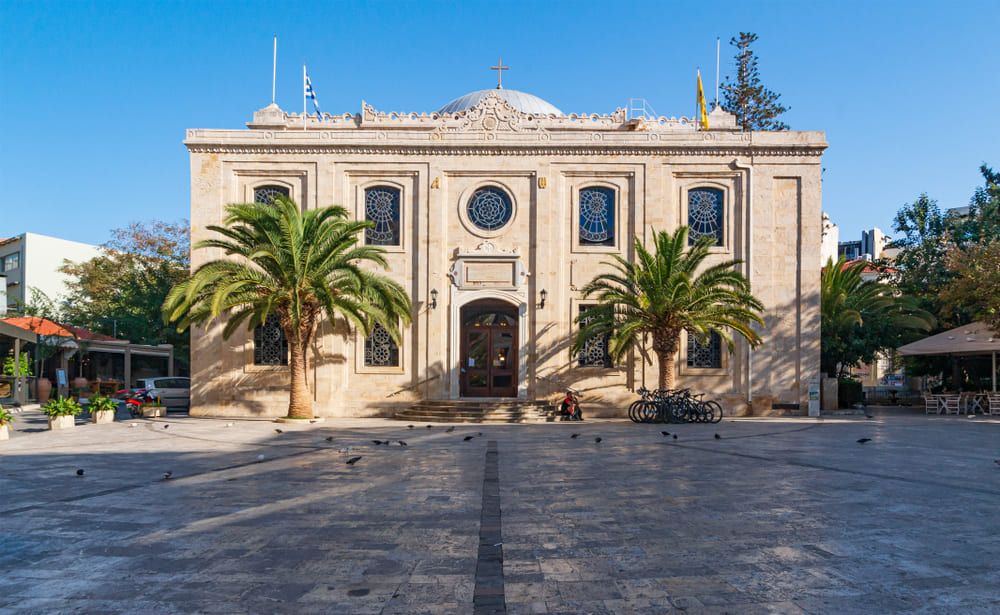
Shutterstock
The beautiful stained-glass windows in front of you belong to the Church of Saint Titus. And despite the historic appearance of the building, what you see today is actually relatively recent. Its turbulent past mirrors the story of Heraklion itself almost perfectly. The origins of the site go all the way back to the Byzantine period, a key chapter in understanding the city’s beginnings. Between the 4th century and the year 824, Heraklion was known as Castro — not Candia yet, that name would only come later under Venetian rule. At the time, it was still a fortified port town, but already an important strategic and religious centre in the Mediterranean. Then came the Arab conquest in the 9th century, when the city became known as Chandax — yet another name in its long history. In 961, the Byzantines reconquered the city entirely, marking a new beginning. Heraklion was rebuilt, strengthened, and gradually regained its major role on the island. Later, during the Venetian era, a large Latin church dedicated to Saint Titus was built here. After the Ottoman conquest in 1669, it was converted into a mosque. Then, in 1856, a devastating earthquake destroyed the structure. The building standing before you today was rebuilt in 1869, still serving as a mosque at the time. Only in 1925 did it once again become a church — this time an Orthodox one — and it has remained so ever since. Quite a journey for a single building. The church is dedicated to Saint Titus, a figure of special importance in Crete, as he is traditionally regarded as the island’s first bishop. Inside, the church preserves a major religious relic: the skull of Saint Titus himself, returned from Venice in 1966. For many Cretans, this makes the church a place of deep spiritual significance. And before moving on, take a moment to look at the architecture. The large central dome, supported by four massive pillars, immediately draws the eye. The building combines Byzantine and Ottoman influences, almost like an open history book revealing the many layers of the city’s past.
Aucun avis pour le moment