
Walk
When the Minotaur meets the Venetians
Iraklio, Grèce
Walk
When the Minotaur meets the Venetians
Iraklio, Grèce
Distance
4.2 kmDurée
1h50Audios
19Parcours
Loop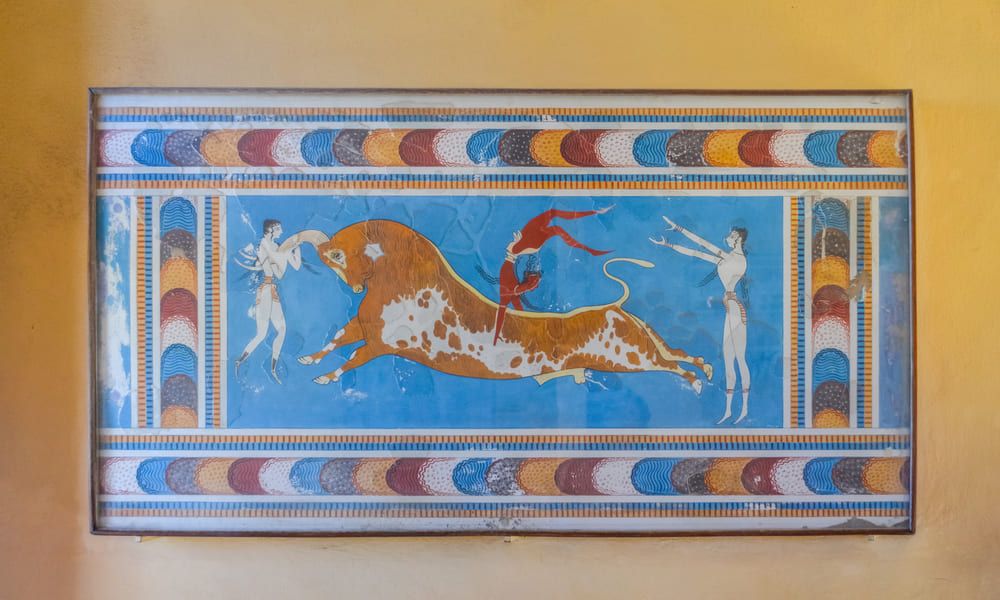
Shutterstock
When people speak about mythology in Heraklion, the story quickly leads beyond the city itself to the Palace of Knossos, just a few kilometres from here. According to Greek tradition, this palace was the home of King Minos, one of the central figures of Cretan mythology. As the son of Zeus and Europa, Minos represents both royal authority and the connection between gods and mortals. And it all begins with the abduction of Europa. Zeus, having fallen in love with the Phoenician princess, transformed himself into a magnificent white bull to approach her unnoticed. Captivated by the animal’s beauty, Europa climbed onto its back. At that moment, Zeus plunged into the sea and carried her all the way to Crete. Once they arrived, he revealed his true identity, and from their union several children were born, including Minos. But becoming king was not enough on its own — Minos still needed to prove that he had the favour of the gods. He asked Poseidon for a sign, and the god answered by sending a sacred bull rising from the sea. Minos promised to sacrifice the animal, but once he saw its beauty, he could not bring himself to do it. As punishment for this broken promise, Poseidon caused Minos’ wife, Pasiphaë, to fall hopelessly in love with the bull. From this unnatural union came the Minotaur, the terrifying creature half man and half bull. To hide the monster, Minos turned to Daedalus, who built the famous Labyrinth — a place so complex that no one could ever find the way back out. The Minotaur remained imprisoned there until the arrival of the hero Theseus. With the help of Ariadne, Minos’ own daughter, Theseus managed to kill the creature and escape using the famous thread she gave him to retrace his path through the maze. Quite a cast of characters already — and the story doesn’t even end there. What matters most is that these myths are closely connected to the very real Minoan civilisation that flourished here between 2000 and 1450 BC. Knossos itself is considered the centre of Minoan civilisation and the capital of Minoan Crete. And it’s impossible to speak about Knossos without mentioning another famous tale linked to Daedalus: the story of his son, Icarus. After the death of the Minotaur, Minos sought to prevent anyone from escaping the island and weakening his power. Since the sea was under his control, Daedalus imagined a daring solution — escape through the sky. He crafted wings made of feathers and wax for himself and his son. But once airborne, Icarus became intoxicated by the feeling of freedom. He flew higher and higher, ignoring his father’s warnings, until he came too close to the sun. The heat melted the wax, the wings fell apart, and he plunged into the sea below — now known as the Icarian Sea. Here in Crete, mythology never feels far away. It remains woven into the island’s identity itself.
Aucun avis pour le moment