




Walk
Tuscany’s hidden surprise
Pistoia, Italy
Walk
Tuscany’s hidden surprise
Pistoia, Italy
3 km
Distance
1h20
Durée
23
Audios
Loop
Parcours
Shutterstock
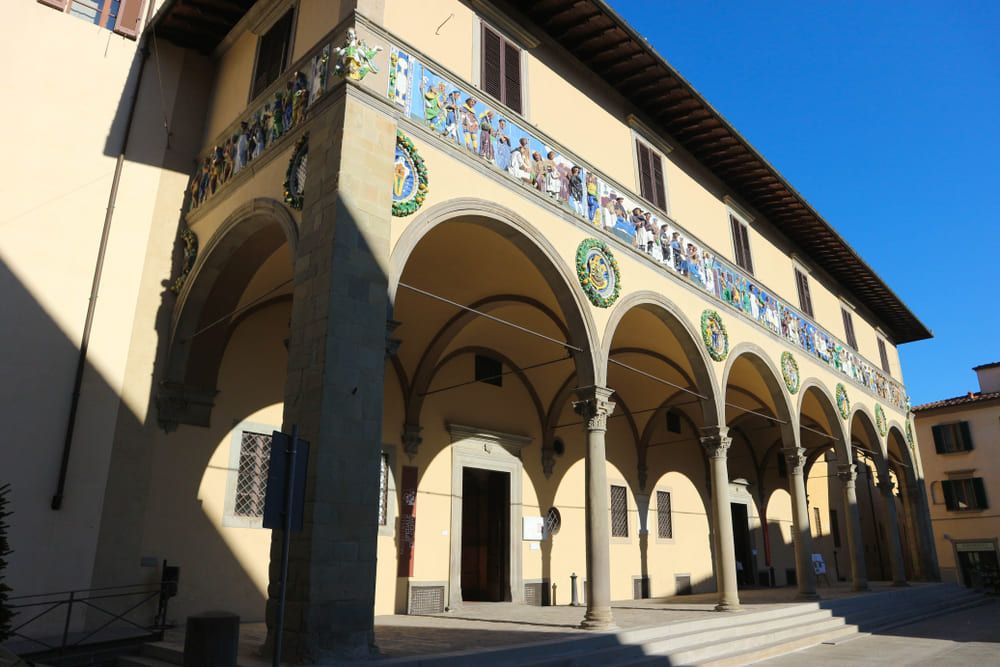
In front of you stands the Ospedale del Ceppo, one of the most distinctive buildings in Pistoia. Founded in 1277 by a charitable brotherhood, it was created to welcome and care for the poor. Its name, “Ceppo,” meaning “tree trunk,” comes from a local legend: a dry old trunk is said to have suddenly blossomed right here, seen as a divine sign to build a hospital on this spot.
Over the centuries, the building grew and adapted to the city’s needs. In the 15th century, it was redesigned by Michelozzo, one of the leading architects of the Florentine Renaissance, and in the early 16th century, the arcaded portico you see today was added, clearly inspired by Florentine style. But what really catches the eye is the colorful frieze running above the portico.
This is the famous Robbian frieze, created around 1525 by the workshops of the Della Robbia family. Made of glazed terracotta, it’s typical of the Tuscan Renaissance, with bright colors that have remained vivid over time. Step a little closer and look at the scenes: they represent the seven works of mercy, the key acts of compassion in Christian tradition.
Each panel shows a concrete gesture, feeding the hungry, giving drink to the thirsty, clothing the poor, welcoming pilgrims, visiting the sick, visiting prisoners, and burying the dead. It’s a visual summary of the building’s purpose, told through images. Today, the hospital is no longer in use.
It closed in 2013 after more than seven centuries of service and has since been turned into a museum. Inside, the visit traces the history of medicine in Pistoia, with a collection of historical surgical instruments, some of them quite fascinating. You can also see a small 17th-century anatomical theatre, where doctors studied the human body around a marble table, with students seated in tiers observing dissections.
Beneath your feet, there’s another, lesser-known feature: a network of underground galleries. As early as the 12th century, a stream called the Brana was channeled beneath the city as part of its defenses. The hospital was built above it and used the water to carry away waste, creating an early form of sewer system at a time when microbes were still unknown to us.
Even without going inside, take a moment to enjoy the façade, try to match each scene to the action it represents. Your turn to play.
Aucun avis pour le moment
