




Walk
Tuscany’s hidden surprise
Pistoia, Italy
Walk
Tuscany’s hidden surprise
Pistoia, Italy
3 km
Distance
1h20
Durée
23
Audios
Loop
Parcours
Shutterstock
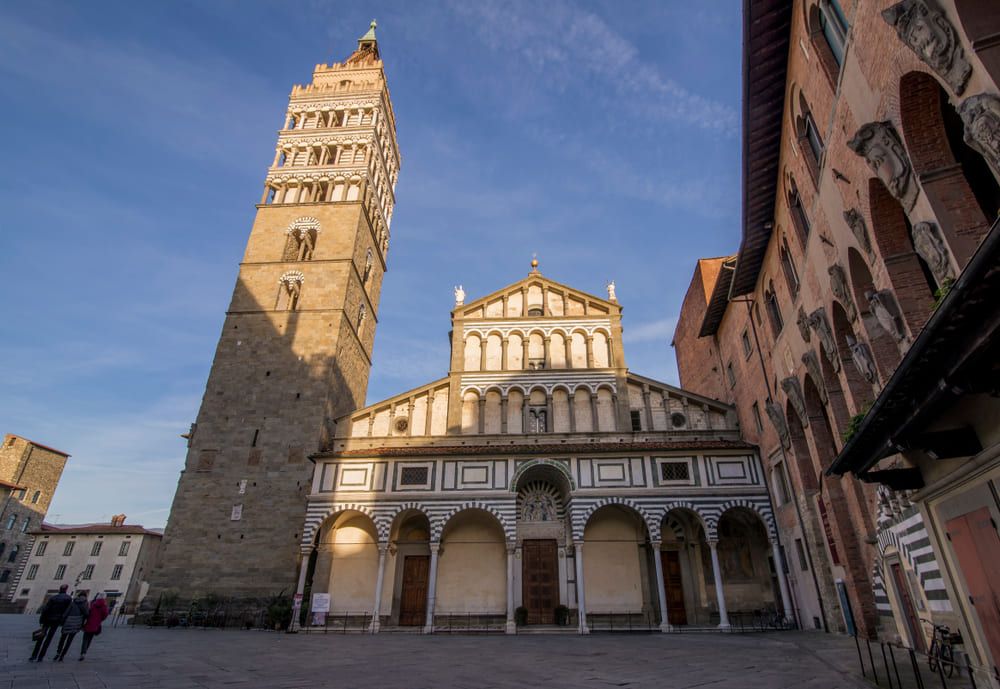
Now it’s time to discover San Zeno Cathedral, a place with over a thousand years of history. A first church likely stood here as early as the early Christian period, but what you see today is the result of several reconstructions after fires and an earthquake. Take a moment to look at the façade: it’s a great example of Tuscan Romanesque style, with alternating bands of white and green marble, rows of small columns inspired by Pisa, and a Gothic portico added later.
Above the main entrance, the glazed terracotta by Andrea della Robbia adds a softer, more colorful touch. As you step inside, the atmosphere becomes more understated, almost restrained, and your attention is naturally drawn to the Chapel of San Jacopo and its remarkable Silver Altar. Begun in 1287 and enriched over nearly two centuries, it brings together the work of many artists.
Entirely made of silver, it features more than six hundred figures illustrating scenes from the Old and New Testaments, as well as the life of Saint James. This altar is closely linked to the relic it protects. In 1145, Bishop Atto placed here a fragment of the skull of the apostle Saint James, brought back from Santiago de Compostela.
The story is quite striking: two envoys from Pistoia were sent to Galicia to obtain a relic, perhaps hoping to bring back a simple lock of hair, but they returned instead with a small piece of the skull. This changed the city’s destiny. Pistoia became an important pilgrimage site in Italy, attracting those who could not travel to Spain, and it even earned the nickname “Little Santiago.” Centuries later, this relic played an unexpected role.
In Spain, the remains of Saint James had been hidden to protect them from attacks, and when they were rediscovered, doubts arose about their authenticity. The fragment kept here in Pistoia helped confirm it, as it matched a missing part of the skull. This link between the two sites further strengthened Pistoia’s importance within one of Europe’s most famous pilgrimage routes.
But the Silver Altar is also tied to a darker story. In 1293, a man named Vanni Fucci, born in Pistoia, broke into the cathedral and stole precious objects linked to the cult of Saint James. He blamed an innocent man, who was executed in his place, while Fucci escaped justice during his lifetime.
The story left a deep mark, and was later immortalized by Dante Alighieri in The Divine Comedy. In the Inferno, Dante places him among the thieves, condemned to a violent punishment: attacked by serpents, his body turns to ashes, then reforms, only to suffer again. Dante portrays him as brutal and defiant, even challenging God from the depths of Hell, and through him, he harshly criticizes Pistoia.
Between sacred relics and darker stories, San Zeno Cathedral is not a place you forget easily.
Aucun avis pour le moment