





Walk
Japan’s lively and food-loving scene
Osaka, Japan
Walk
Japan’s lively and food-loving scene
Osaka, Japan
4 km
Distance
1h45
Durée
19
Audios
Loop
Parcours
Shutterstock
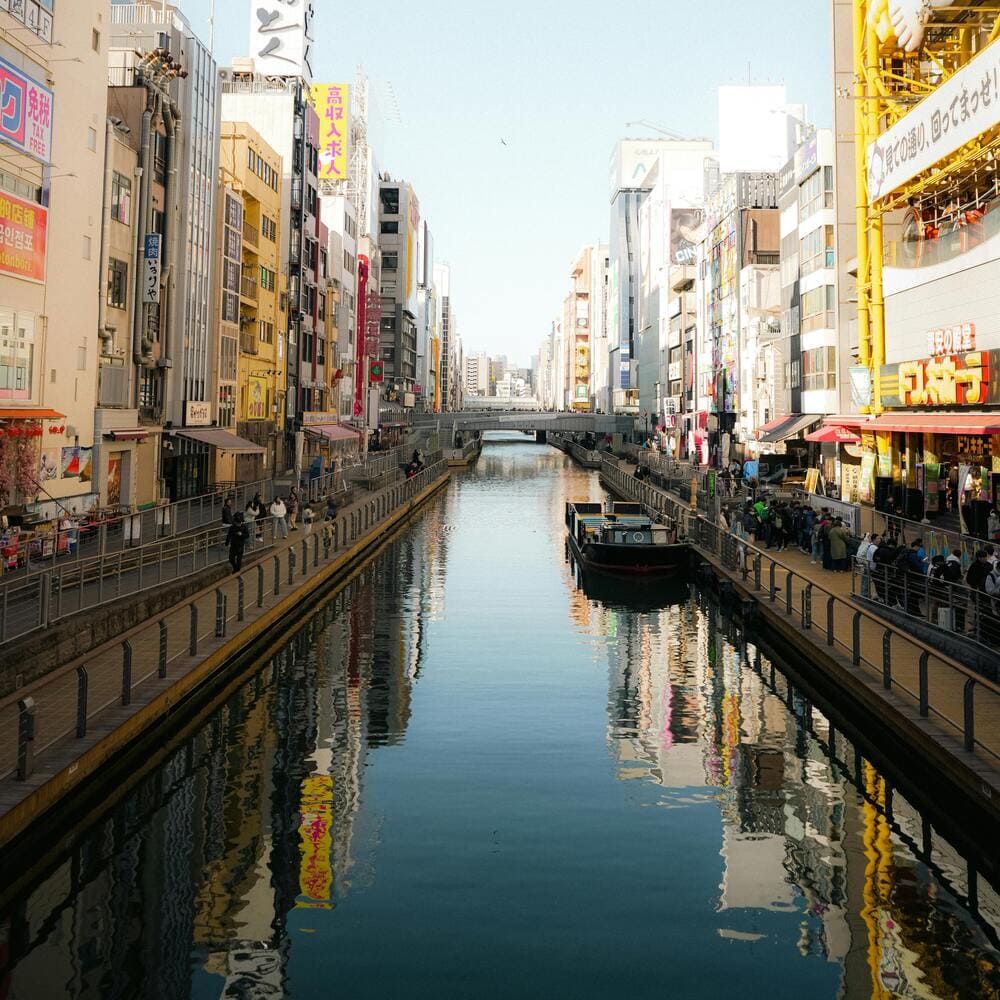
The Osaka audio-guided tour follows the Dōtonbori canal, the guiding thread of one of the liveliest districts of Japan. Dug between 1612 and 1615, it is today the symbol of gourmet and popular Osaka.
The canal was dug at the initiative of Nariyasu Dōton, a wealthy merchant who financed the project with his own funds around 1612, in order to bring river traffic, commerce and entertainment to an undeveloped area. The work was interrupted by the siege of Osaka in 1615, during which Dōton was killed; his associates completed the structure, named Dōtonbori in his honour. The victory of the Tokugawa marked the beginning of a long period of stability, and the district officially became that of entertainment, giving birth to the spirit of kuidaore, that Osaka passion for the pleasure of the table.
Along the canal are lined inns, restaurants and stalls, under a profusion of giant signs and neon lights that are reflected in the water, especially at nightfall. Cruise boats glide under the bridges, offering another perspective on the district. The effervescent heart of Osaka, the canal embodies the culture of leisure and gastronomy that makes the reputation of the city.
The Dōtonbori canal crosses the district of the same name, in the heart of Osaka. Its banks can be walked freely on foot at all hours and on the level. The cruises on the canal follow their own hours and conditions; the atmosphere is particularly spectacular in the evening, when the neon lights come on.
Between 1612 and 1615, at the initiative of the merchant Nariyasu Dōton, to whom it owes its name.
An Osaka expression meaning "to ruin oneself by eating", which sums up the city's relationship to the pleasure of the table.
Aucun avis pour le moment
