





Walk
The rebellious city on the water
Valladolid, Mexico
Walk
The rebellious city on the water
Valladolid, Mexico
4.6 km
Distance
2h00
Durée
17
Audios
Loop
Parcours
Shutterstock
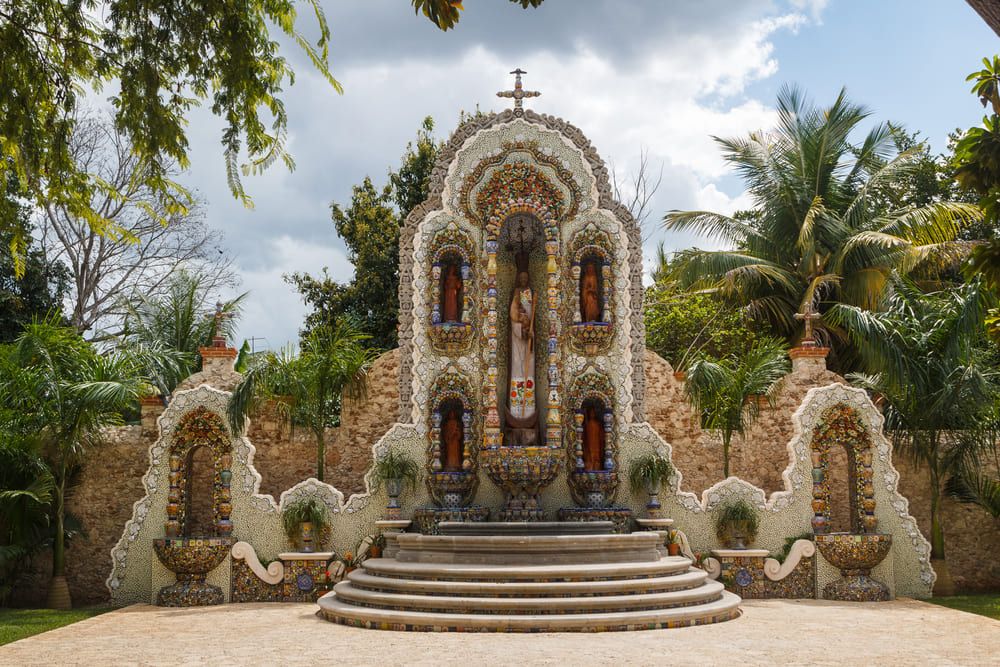
If the large wooden door of the restaurant La Casona de Valladolid is open, don’t hesitate to step inside and take a look at the inner courtyard—you might be surprised. This patio hides a real treasure: a fountain-altar dedicated to the Virgen de la Candelaria, inaugurated in 2012. Standing more than 9 meters high and over 6 meters wide, it was created by five artisans from the Xcaret Cultural Workshop after nearly a year of production and five months of installation.
Dedicated to the patron saint of Valladolid, it pays tribute to the city’s spiritual and cultural identity. The structure brings together three major influences: a façade entirely covered with multicolored Talavera ceramics, a design inspired by a colonial Baroque altar, and a Virgin dressed in a traditional embroidered Yucatecan huipil, symbolizing the meeting of Catholic heritage, Maya culture, and Mexican craftsmanship. The choice of Talavera to decorate this fountain is no coincidence.
Franciscan monks were the ones who introduced this technique to Mexico in the 16th century to decorate their convents. Talavera is a glazed ceramic of Spanish origin, recognizable by its white background and its vivid colors such as cobalt blue, yellow, green, and orange. Each piece is shaped by hand, fired twice, and decorated with natural mineral pigments before being glazed, a traditional craft now recognized as part of UNESCO’s Intangible Cultural Heritage.
Around the Virgin stand figures of San Bernardino de Siena, Santa Lucía, San Juan, and San Servacio, saints closely linked to the city. Freely visible even without dining at the restaurant, this fountain perfectly reflects the blend of influences that defines Valladolid. Each year, the city honors it during a twelve-day celebration that reaches its peak on February 2.
On that day, Candlemas becomes tamales day. According to tradition, whoever found the figurine—not in a cake but in the Rosca de Reyes in January—must offer tamales to family and friends. Tables are then filled with Yucatecan tamales cooked in banana leaves and filled with turkey, chicken, or pork, usually served with tomato sauce and habanero chili.
Between the blessing of candles and Child Jesus figurines in family homes, solemn masses filled with incense, and a caravan procession through the neighborhoods with decorated cars and traditional fireworks announcing the Virgin’s passage, it is a unique opportunity to experience the traditions of Valladolid.
Aucun avis pour le moment
