





Walk
A City Worth Its Weight in Gold
Zurich, Switzerland
Walk
A City Worth Its Weight in Gold
Zurich, Switzerland
4.3 km
Distance
1h45
Durée
21
Audios
Loop
Parcours
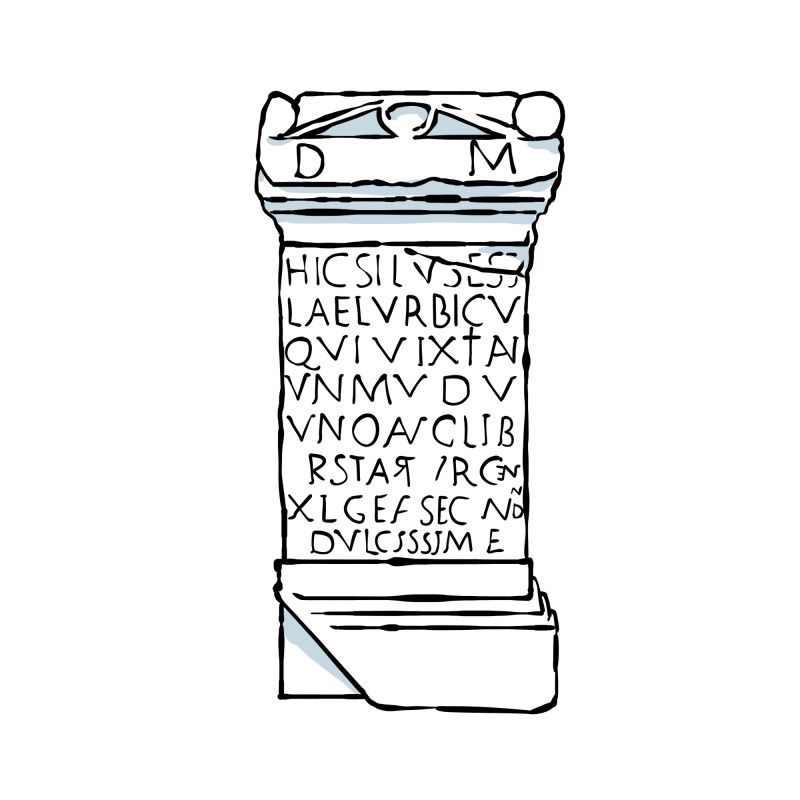
The Roman vestige of the Lindenhof is a discreet stele backed against a wall, the tombstone of Lucius Aelius Urbicus, dating from the second century. The Zurich audio-guided tour stops here, with respect, to evoke this tomb of a very young child, precious because it bears the first known mention of the Latin name of Zurich, in the form 'Turicum'.
The Roman vestiges of the Lindenhof could pass completely unnoticed if you do not pay attention. Look, on your left, at the little stele backed against the wall: it is the tombstone of Lucius Aelius Urbicus, dating from the second century of our era. It is fitting to stop there with respect and contemplation, because this stone honours the memory of a very small child, who died at a young age. This tomb, discovered in 1747, is precious for another reason: it bears the first known mention of the Latin name of Zurich, in the form of the adjective Turicen. There is little chance that you can decipher Latin, so let me translate the inscription for you, imbued with a painful tenderness: 'Here rests Lucius Aelius Urbicus, who lived one year, five months and five days. Unio, freedman of the emperor and head of the Zurich customs post of the Gallic customs, and Aelia Secundina, the parents, to their cherished son.' These few words, engraved nearly two thousand years ago by grieving parents, cross the centuries with an intact emotion, and testify both to the Roman presence in Zurich and to the universality of grief. The stele you see is a reproduction, the original being kept sheltered, at the National Museum of Zurich. An ancient vestige and a moving memory, the Roman vestige of the Lindenhof is discovered with respect.
Here you discover, with respect, a discreet stele backed against a wall of the Lindenhof, the tombstone of Lucius Aelius Urbicus, a child who died at a young age in the second century; discovered in 1747, it bears the first known mention of the Latin name of Zurich, and its moving inscription honours the memory of this cherished son. The visible stele is a reproduction, the original being at the National Museum. The Roman vestige of the Lindenhof is an ancient memory of Zurich. It is a stop to be discovered with respect.
The Roman vestige is on the Lindenhof square, backed against a wall, in the old town of Zurich, reachable on foot. It is a stele in free access in the public space, to be discovered with respect; the original is kept at the National Museum of Zurich, which can be visited according to its own hours. You discover it during a walk on the hill.
Because this tombstone of the second century, that of a child who died at a young age, Lucius Aelius Urbicus, to be honoured with respect, bears the first known mention of the Latin name of Zurich, in the form Turicen; discovered in 1747, its moving inscription, engraved by grieving parents, testifies to the Roman presence. The visible stele is a reproduction, the original being at the National Museum.
On the Lindenhof square, backed against a wall, in the old town of Zurich, in Switzerland.
Aucun avis pour le moment