© Shutterstock
 Votre guide Ryo
19 Things to Do in Sarajevo in 2026
What to do in Sarajevo when a single downtown street brings together an Ottoman mosque, a Catholic cathedral, a synagogue, and an Orthodox church, all within a few minutes' walk of one another? The Bosnian capital long carried the nickname "Jerusalem of Europe" — a somewhat grandiose shortcut, but one that captures something true about the cultural density of its alleyways. You walk on Ottoman cobblestones that give way, without transition, to Austro-Hungarian sidewalks, then to Yugoslav facades still marked by shrapnel. If you have already explored another capital through a Ryo audio-guided tour, headphones on and narration in your ear, you know how much that kind of sonic context transforms an ordinary stroll into a living scene. Sarajevo lends itself particularly well to this exercise, as every neighborhood tells a different layer of its history.
In the pages that follow, we climb to the Yellow Fortress for a sunset, descend into an 800-meter tunnel dug by hand beneath an airport runway, visit a library that burned with nearly two million manuscripts in a single August night in 1992, and ride a cable car up to an Olympic bobsled track now covered in graffiti. Between visits, a Bosnian coffee served in a copper džezva imposes itself almost by reflex. Whether you are visiting Sarajevo for 1 day during a layover or staying for 3 days to explore the surrounding area as well, these 19 experiences cover the essentials of what makes the city so singular.
1. Wander the Alleyways of Baščaršija
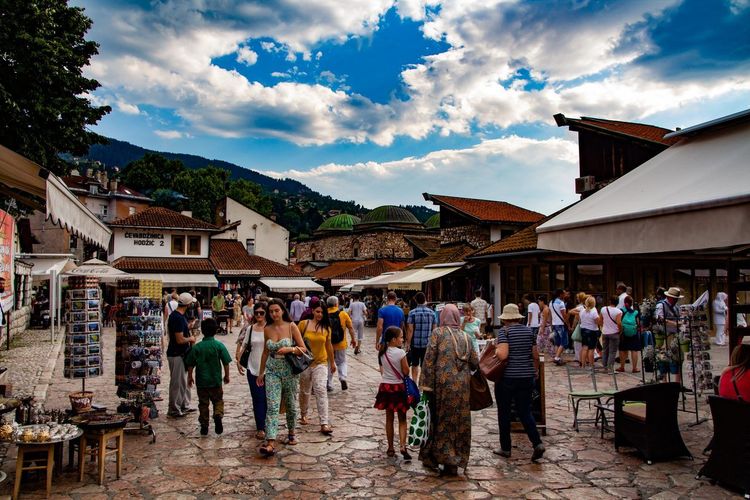
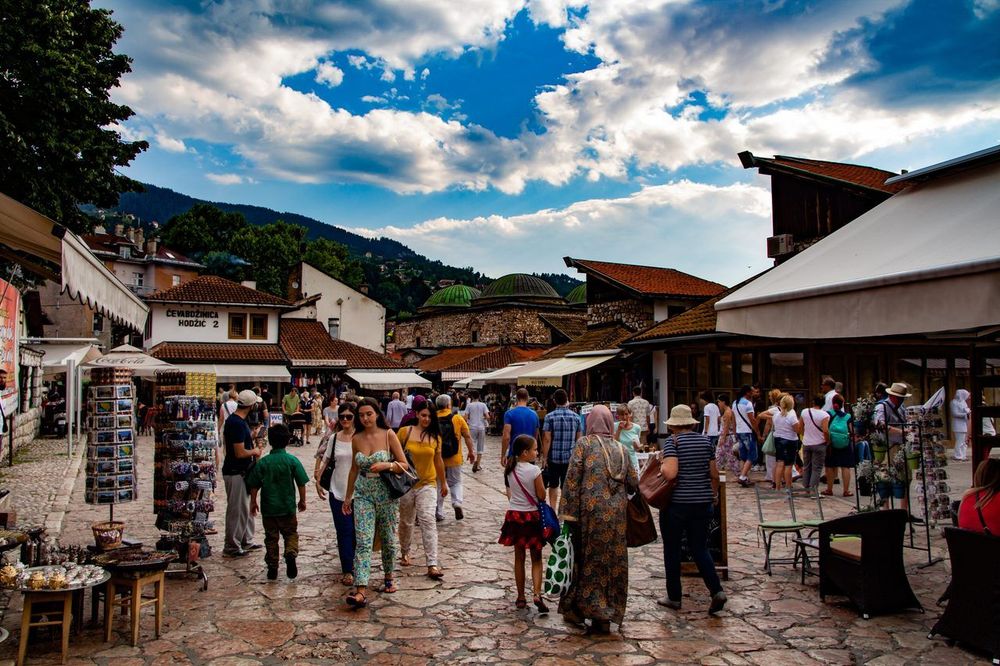
The Baščaršija district (Baščaršija, 71000 Sarajevo, rated 4.8/5 on Google with 24,555 reviews) is the almost obligatory starting point for any visit: it is Sarajevo's Ottoman heart, founded in 1462 by Governor Isa-beg Ishaković barely two years after the city's conquest. You enter through a cobbled square where dozens of pigeons compete for the crumbs of passersby, surrounded by low wooden shops, tiled rooftops, and grill smoke drifting from the eateries.
The coppersmiths' street, Kazandžiluk, encapsulates the soul of the neighborhood on its own: the hammering of copper still rings out as it did five centuries ago, even if the remaining artisans can now be counted on one hand. Some of them fashion objects more unusual than simple coffee trays: shell casings and bullet sleeves recovered during the siege, hammered and polished into pens, vases, or keychains. This recycling of war into tourist craft sometimes unsettles visitors, but it also says something about the way the city has learned to live with its scars rather than hide them.
The other streets of the neighborhood still bear the name of their original guild: Kujundžiluk for the goldsmiths, Sarači for the saddlers, Terzije for the tailors. Most of the current shops have little to do with those ancient trades, replaced by souvenir stores or travel agencies, but the toponymy has survived almost intact since the Ottoman era — a fact rare enough to be worth noting.
The Morića Han, a 16th-century caravanserai where merchants and their horses once lodged, has been restored and now houses terrace tables. You can stop there for a Bosnian coffee without breaking the bank: rarely more than 2 to 3 KM (around 1 to 1.50 euros) per cup, served with a piece of Turkish delight. Plan to spend at least an hour there, ideally in the late afternoon when the slanting light illuminates the ochre facades and the carpet sellers begin to pack up their stalls.
In the evening, Baščaršija changes its face. Tourist groups give way to locals who come to smoke a hookah or drink mint tea on the low cushioned seats of the kafanas. Vendors of leather slippers, silver filigree jewelry, and kilim rugs lower their prices as night falls — a good moment to negotiate if you are looking for a souvenir beyond the typical fridge magnet.
2. Photograph the Sebilj Fountain
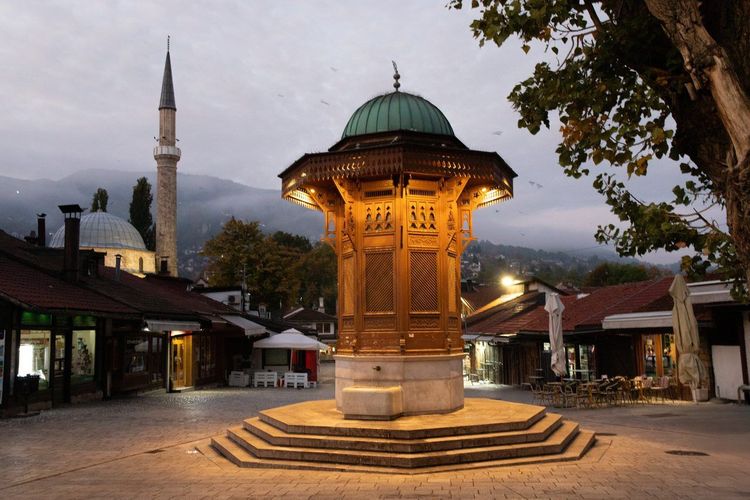
You can't miss the Sebilj fountain (Baščaršija bb, 71000 Sarajevo, rated 4.7/5 on Google with 11,314 reviews), at the center of Baščaršija's main square: this pseudo-Moorish wooden kiosk, built in 1891 by architect Alexander Wittek, has become almost despite itself the postcard symbol of Sarajevo.
Local legend has it that drinking from its fountain guarantees you will one day return to the city — a convenient way to keep the groups rotating for their photo opportunity. The water flowing today is no longer strictly potable, but the gathering of pigeons around the basin has remained intact for generations.
3. Visit the Gazi Husrev-beg Mosque
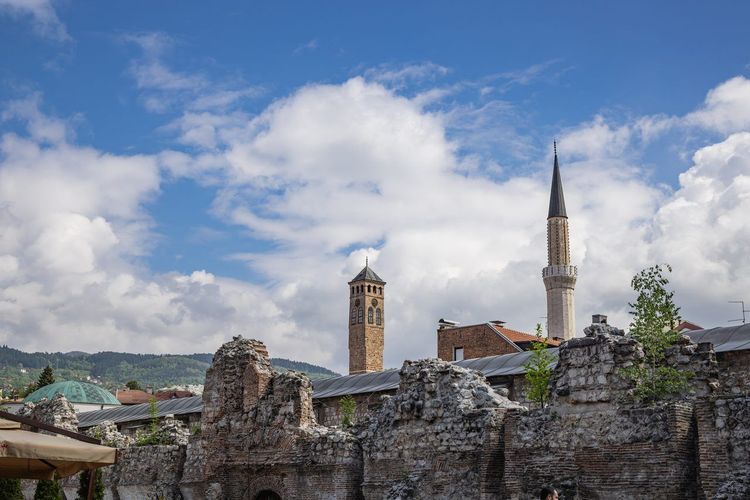
Built in 1531 by architect Adjem Esir Ali on the orders of Ottoman governor Gazi Husrev-beg, this mosque remains the largest and most richly decorated in the historical Balkans. Its central lead dome dominates the Baščaršija roofline, visible from almost every high point in the city.
Admission costs around 5 KM (2.50 euros) for non-practicing visitors, and grants access to a shaded inner courtyard with a centuries-old plane tree and a marble ablution fountain at its center. Remove your shoes before entering the prayer hall and cover your shoulders: headscarves are lent at the entrance for visitors who need one.
The five daily calls to prayer still punctuate the life of the neighborhood, amplified through the minaret's loudspeakers. If you visit during one of these times, it is best to wait outside or observe discreetly from the back of the courtyard: the prayer hall remains above all an active place of worship, visited daily by neighborhood residents, long before it became a tourist attraction.
Despite the siege bombardments, which damaged the minaret and part of the adjacent library, the building was restored with particular care after the war, thanks in part to funding from Turkey and Saudi Arabia. The Gazi Husrev-beg Library, just next door, holds one of the most significant collections of Ottoman and Arabic manuscripts in Europe, with more than 10,000 documents, some dating back to the 15th century.
4. Discover the Four-Religion Quarter
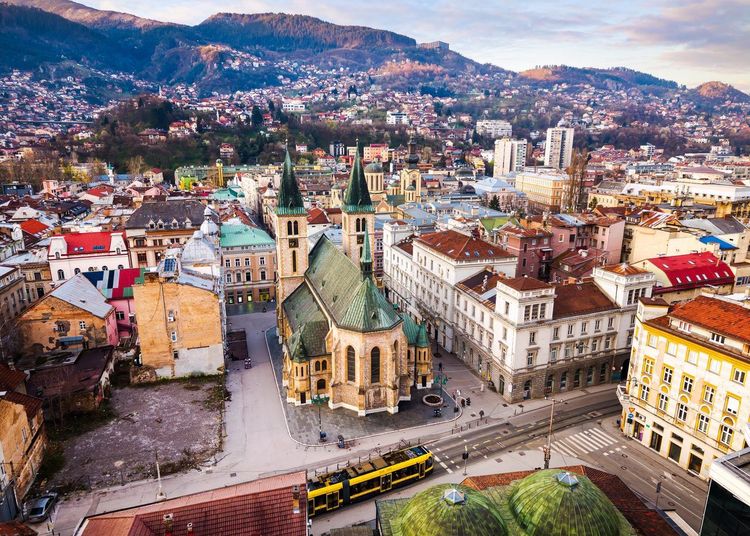
A few hundred meters from the mosque, a triangle of streets brings together a Catholic cathedral, an Orthodox church, and a synagogue — which is what earned Sarajevo its nickname as the city of four faiths. The Sacred Heart Cathedral, built in 1889 in a neo-Gothic style inspired by Notre-Dame de Paris, still serves as the seat of the Catholic Archdiocese of Bosnia-Herzegovina.
Nearby, the Old Orthodox Church (Stara Pravoslavna Crkva), dedicated to the Archangel Michael, is estimated by some sources to date from the 16th century, making it one of the oldest religious buildings still in use in the city. Its dark interior, laden with gilded icons, contrasts sharply with the simplicity of its facade.
The National Museum of Bosnia-Herzegovina, a little further along the boulevard, holds the famous Sarajevo Haggadah, an illuminated 14th-century Hebrew manuscript saved twice from destruction: first from the Nazis by a Muslim curator who hid it in a mountain village, then again during the 1990s siege, concealed in a bank vault. The Ashkenazi synagogue, in Moorish-Hungarian style, completes this interfaith picture, a testament to a Sephardic community that was once among the most significant in the Balkans.
5. Pause at the Latin Bridge
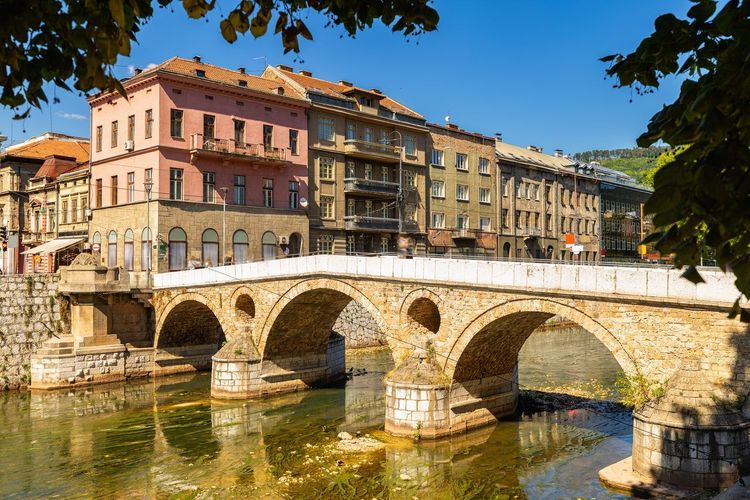
The Latin Bridge (Latinska ćuprija), a modest 16th-century stone arch spanning the Miljacka, could have remained just another bridge among many had history not made it one of the most significant sites of the 20th century. It was here, on 28 June 1914, that Gavrilo Princip fired the shots that killed Archduke Franz Ferdinand and his wife Sophie, triggering the diplomatic chain reaction that led to the First World War.
Nothing in the bridge's appearance hints at this historical weight: it looks like any small pedestrian bridge, and that is precisely what strikes most visitors. A discreet plaque, replaced several times over successive political regimes, recounts the facts without grandiloquence.
Just across the street, the small Sarajevo 1878–1918 Museum occupies the building from which Princip emerged after the assassination. Across two floors, the exhibition traces the Austro-Hungarian occupation and the circumstances of the killing, with period photographs and a few personal belongings of the main figures. Allow around 30 to 40 minutes; admission is around 4 KM.
You can then follow the Miljacka east or west: the river, enclosed between low quays lined with plane trees, runs through the entire city and serves as a natural thread connecting several of the sites on this list on foot. Upstream, several historic bridges follow one another, including the Emperor's Bridge (Careva ćuprija), older still than the Latin Bridge.
6. Go Down into the Sarajevo Tunnel
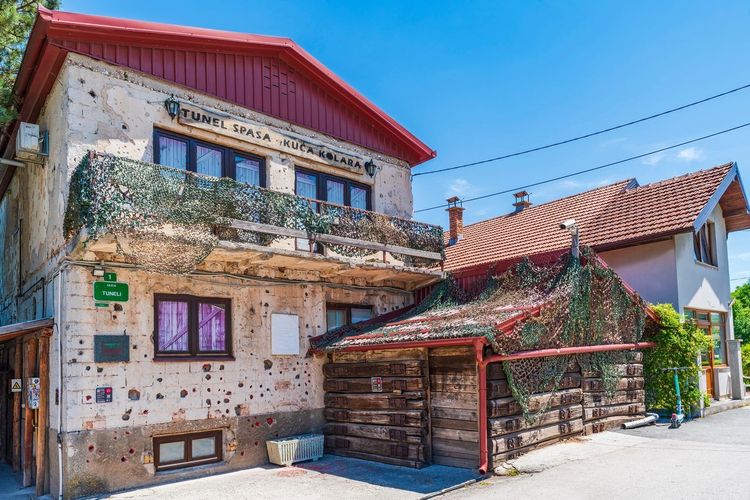
The Sarajevo Tunnel (Tunel spasa, literally "tunnel of salvation") is without doubt the city's most moving experience. Dug by hand between March and July 1993, in the midst of the siege, it connected the Butmir neighborhood, under Bosnian control, to the rest of the besieged city by passing beneath the airport runway held by the United Nations. Eight hundred meters long and barely 1.60 meters high in places, it enabled the transit of food, ammunition, the wounded, and sometimes political leaders — including President Alija Izetbegović himself — under the helpless gaze of UNPROFOR soldiers stationed above.
Today, only around twenty meters of the original tunnel are accessible to the public, inside a private house converted into a museum by the Kolar family, who owned the land during the war. You walk bent over, along the same cart rails used to haul sacks of flour, listening to the accounts of those who dug it at night, without machinery, by hand with picks and shovels.
The adjoining museum displays uniforms, improvised weapons manufactured in local factories for lack of outside supply, and photographs of daily life during the 1,425 days of siege — the longest endured by a European capital since the Second World War. A light-up map traces the exact path of the tunnel under the airport runway, helping visitors grasp the logistical scale of the operation.
Allow a good hour on site, including travel from the center: the site is located in Kotorac, in the Ilidža district, about fifteen minutes by car or by tram (line 3) then taxi. Admission is around 10 KM (5 euros). Many visitors combine this outing with Vrelo Bosne, situated just a little further along the same route, making the journey worthwhile.
Several local agencies offer combined excursions departing from Baščaršija, with minibus transport and a French- or English-speaking guide, for a budget of around 25 to 30 euros for a half-day. If you prefer independence, the taxi drivers stationed near the Sebilj fountain all know the route and offer fixed fares to be agreed before getting in. Wear closed-toe shoes: the tunnel floor remains uneven, sometimes damp depending on the season, and the lighting has been deliberately kept minimal to preserve the original atmosphere.
This kind of site illustrates well why a simple generic audio guide doesn't always suffice: context, dates, and proper nouns accumulate quickly. A Ryo-style narrated tour, where each stop triggers a structured account rather than a pile of information panels, changes the way you absorb such a dense history in a single visit.
7. Visit the War Childhood Museum
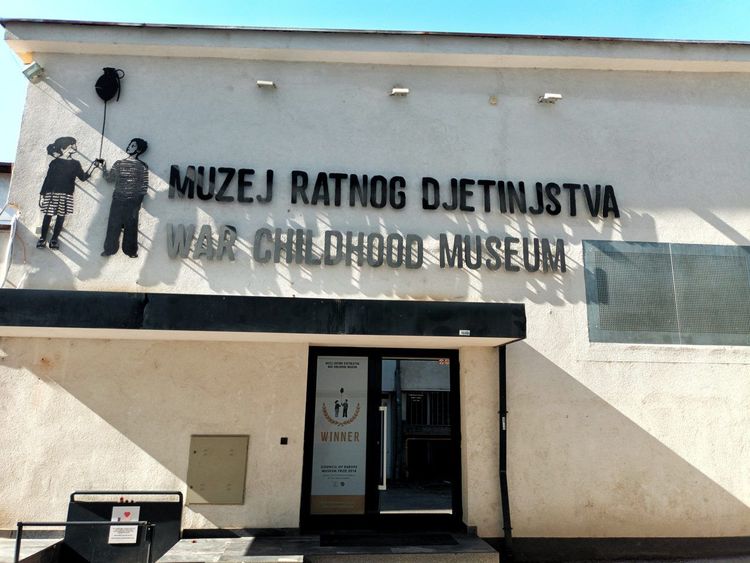
Opened in 2017, the War Childhood Museum (Logavina 32, 71000 Sarajevo, rated 4.8/5 on Google with 1,324 reviews) began as an editorial project before becoming a physical space: its founder, Jasminko Halilović, was ten years old at the start of the siege and collected, years later, hundreds of testimonies from former wartime children across the former Yugoslavia.
The museum displays personal objects — a toy, a notebook, a pair of ice skates — each accompanied by a short handwritten testimony from its former owner, now an adult. This minimalist approach, without large explanatory panels or spectacular reconstructions, makes the visit surprisingly intimate: you read a sentence, look at an ordinary object, and the whole thing hits harder than many far more ambitious exhibitions.
The museum received the Council of Europe Museum Prize in 2018, awarded as part of the European Museum of the Year Awards — a rare distinction for an institution so young and so modest in its means. Allow 45 minutes to an hour; admission is around 10 KM. Avoid the after-school rush in the late afternoon if you want the calm needed to read the testimonies without being jostled.
8. Explore the History Museum of Bosnia-Herzegovina
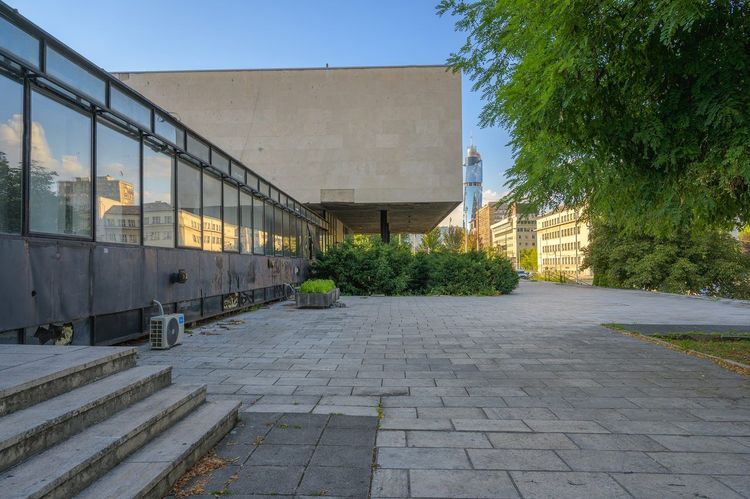
Less well known than the tunnel or the War Childhood Museum, the History Museum of Bosnia-Herzegovina (Historijski muzej BiH) is nonetheless worth a visit for its permanent exhibition "Sarajevo Under Siege," housed in a modernist building from 1963 whose Brutalist architecture has itself aged poorly, in an almost documentary sense.
Inside you will find reconstructions of apartment interiors during the siege, with makeshift stoves cobbled together from oil cans, windows sealed with plastic sheeting stamped with the UNHCR logo, and recreated queues for water or bread. An entire room is devoted to newspapers and posters from the period, often printed by hand due to unreliable electricity.
The museum stands on what was nicknamed Sniper Alley during the siege — that straight boulevard flanked by residential towers that gave snipers hidden in the surrounding hills a direct line of sight on civilians crossing in the open. The yellow Holiday Inn across the street was home to international war correspondents at the time, with a front-row view of a conflict they covered from their own windows. The avenue carries a more neutral official name today, but the wartime designation remains in every local memory.
The museum remains underfunded, which shows in the worn condition of some display cases, but it is precisely this austerity that gives the visit an authenticity that more polished exhibitions might have diluted. Allow 40 minutes; admission is modest (around 5 KM).
9. Admire the Vijećnica, Former City Hall and National Library
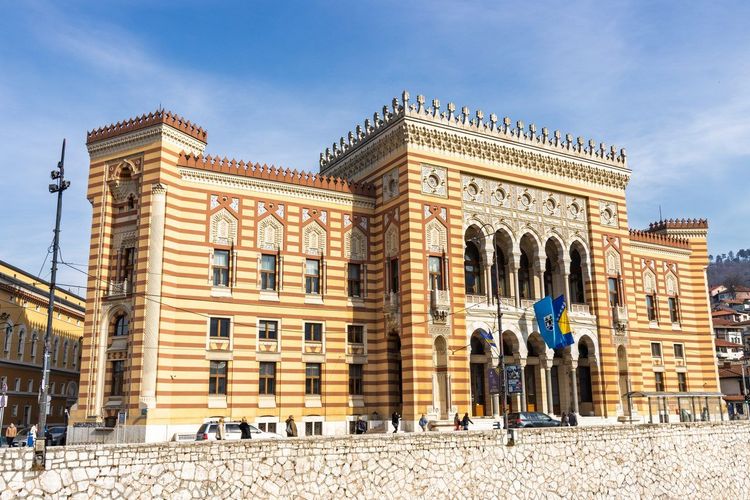
Hard to miss the Vijećnica (Obala Kulina bana, 71000 Sarajevo, rated 4.7/5 on Google with 5,492 reviews), with its yellow and red striped facade inspired by Egyptian Moorish architecture, built in 1896 under Austro-Hungarian administration to serve as city hall. The building changed function in 1949 to become the National and University Library of Bosnia-Herzegovina, eventually housing more than two million books, manuscripts, and regional archival documents.
On the night of 25–26 August 1992, Serbian artillery fire set the building ablaze. The fire burned for three days; librarians and residents tried to save as many volumes as possible by forming human chains under fire, but nearly 90% of the collection was lost to the flames — around 1.5 million books according to the most cited estimates. This destruction remains one of the most cited symbols of the siege, alongside the tunnel and Markale.
The reconstruction, funded in part by the European Union, Austria, and Spain, stretched over more than twenty years before an official reopening in 2014, for the centenary of the assassination of Franz Ferdinand. The interior, with its central geometric stained-glass skylight and monumental staircase, has regained a splendor close to the original, even though the library itself never moved back: the building now serves as an exhibition hall and municipal event venue.
Admission is around 10 KM and gives access to two floors, with a permanent exhibition on the building's history and photographs of the 1992 fire that convey the scale of the disaster. Climb to the dome if access is open on the day of your visit: the view over the Baščaršija rooftops and the surrounding hills justifies the visit on its own.
The Vijećnica illustrates on its own the pace of Sarajevo's reconstruction: some buildings reclaimed their pre-war splendor within a few years, while others still bear, thirty years on, bullet holes never plastered over on their facades. On the way out, look up at the neighboring buildings along the Miljacka to spot these marks, often deliberately left visible as collective memory rather than neglect.
10. Spot the Sarajevo Roses and the Markale Market
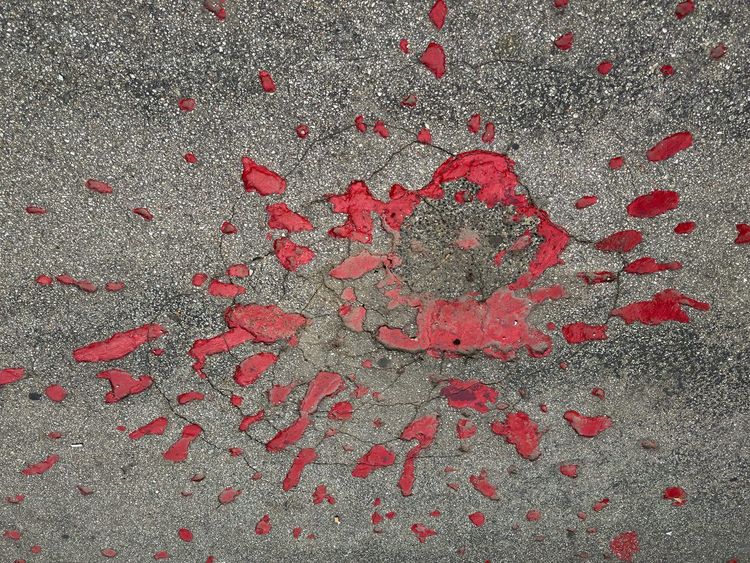
The Sarajevo Roses are the shell craters in the ground, filled with red resin, that still mark certain city sidewalks in memory of the civilians killed on the spot by mortar fire during the siege. A handful remain in the center, most of them unmarked, which encourages you to walk a little more slowly and watch where you step.
The Markale market, a few streets from the cathedral, was the scene of two deadly bombings — in February 1994 and then August 1995 — that together killed more than a hundred people and precipitated NATO's intervention.
The market operates normally today, with its stalls of fruit, local cheeses, and honey, without any prominent plaque drawing attention to its past: it is often the residents themselves who tell the story of the place to visitors who ask.
11. Watch the Sunset from the Yellow Fortress
The Yellow Fortress (Žuta tabija), an 18th-century fortified bastion built under Ottoman rule to defend the city, offers one of Sarajevo's most sought-after viewpoints, especially at sunset.
This fortress was part of a larger defensive system built from 1727 onward to protect the city from Austrian incursions, with several bastions linked by a perimeter wall of which only scattered fragments remain today, swallowed up by the urban expansion of the Vratnik neighborhood. Spotting these remnants of the wall as you climb gives the walk another dimension, beyond the viewpoint itself.
During Ramadan, a cannon is still fired here each evening to announce the hour of iftar — a tradition dating back to the Ottoman era that the city has maintained despite the upheavals of the 20th century. The rest of the year, the atmosphere is more relaxed: locals climb up with a beer or a takeaway coffee to sit on the stone walls and watch the minarets light up one by one as the muezzin calls to prayer.
Walk up from Baščaršija, allowing 15 to 20 minutes of uphill walking through the Vratnik residential neighborhood: the ascent is steep in places but manageable without special equipment. Arrive around 30 minutes before the official sunset to find a seat on the walls, which fill up quickly in high season.
12. Climb up to the White Fortress
A little higher up and more off the beaten track than its yellow counterpart, the White Fortress (Bijela tabija) is part of the same Ottoman defensive system that once encircled the old city. Less frequented, it requires a longer walk — about 30 to 35 minutes from Baščaršija — on paths that are sometimes unpaved.
The reward: an unobstructed view over the entire valley where Sarajevo spreads out, with the peaks that hosted the 1984 Olympic events in the background. Wear good shoes and bring water — there are no shops along the way — and avoid going up alone after dark, as street lighting becomes scarce past the last row of houses.
13. Ride the Mount Trebević Cable Car
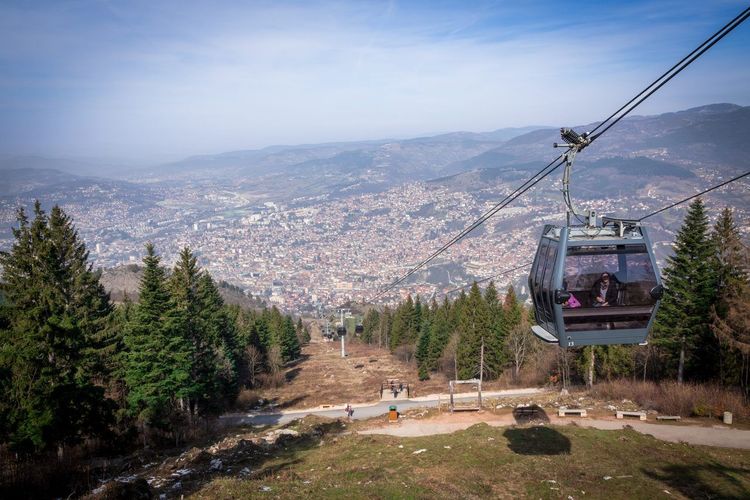
Destroyed during the war, the Trebević cable car, which had connected the city center to the mountaintop since 1959, reopened in 2018 after more than twenty years out of service, funded largely by private donations and a crowdfunding campaign. The ten-minute ride climbs to over 1,160 meters in altitude and offers a gradual panorama of the entire city unfolding as the cabin gains height.
The round-trip ticket costs around 20 KM (10 euros), and the queue can exceed 30 minutes on weekends in high season: opt for a weekday or early morning arrival if you want to avoid the crowds.
Once at the top, the walk to the former Olympic bobsled track, built for the 1984 Games, takes about ten minutes. Abandoned and damaged during the siege — when it was used as an artillery position by the besieging forces due to its commanding view over the city — it has in recent years been covered in colorful graffiti by local and international artists, making it one of the most unusual and most photographed sites around Sarajevo.
You can descend the track on foot, by bike, or even by scooter on certain sections, zigzagging between the banked curves covered in murals. The contrast between the site's past military use, its original sporting vocation, and its new artistic life sums up rather well the way Sarajevo recycles its war-marked places rather than leaving them in total abandonment.
Allow half a day for the round trip by cable car and the walk to the bobsled track, more if you push on to the higher viewpoints on Mount Trebević, where some marked hiking trails lead toward Poljine. Bring water: there is no catering at the top beyond a small seasonal kiosk.
A Ryo audio-guided tour, if one existed for Sarajevo, would find it hard to find a better setting than this mountain: the cable car, the bobsled run, the military remains, and the viewpoints follow one after another on the same hillside, each with its own layer of history. For now, a local guide or a little advance research on the key dates (1959, 1984, 1992–1995, 2018) is enough to give the walk real depth.
14. Go up to the Top of the Avaz Twist Tower
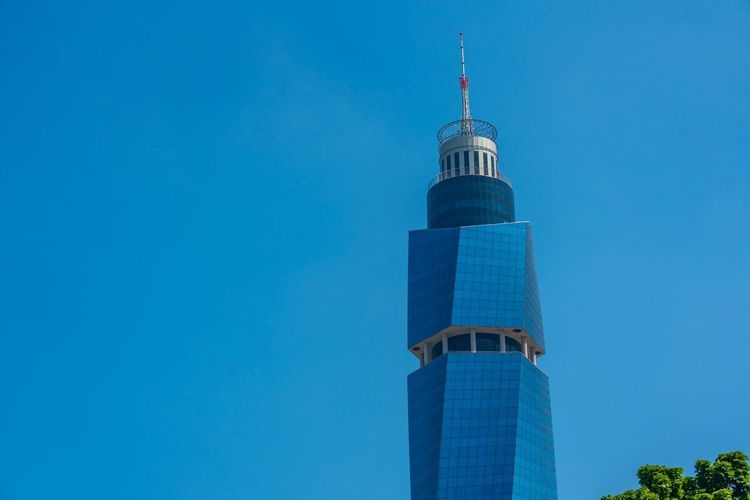
At 172 meters and around forty floors, the Avaz Twist Tower (Bulevar Meše Selimovića 26, 71000 Sarajevo, rated 4.6/5 on Google with 5,791 reviews), completed in 2008 to house the headquarters of the Avaz media group, long claimed the title of tallest building in the Balkans.
Its panoramic observation deck, at the very top of the tower, offers a 360-degree view that lets you spot most of the sites on this list at a glance: Baščaršija below, Mount Trebević in the background, and the narrow valley that explains why the city was so difficult to resupply during the siege. Admission is around 6 KM; the lift is fast, but the queue can grow long at the end of the day, when the sunset light is most in demand.
15. Stroll through Vrelo Bosne Park
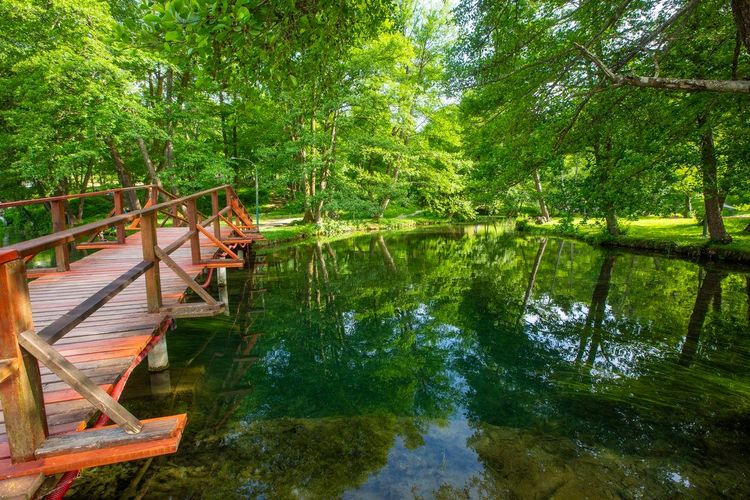
About twenty minutes from the center, in the spa district of Ilidža, Vrelo Bosne park (Ilidža, 71000 Sarajevo, rated 4.7/5 on Google with 17,200 reviews) marks the source of the Bosna river, at the foot of Mount Igman. The place is a radical contrast to the bustle of Baščaršija: a long avenue of centuries-old plane trees, planted during the Austro-Hungarian era to connect the spa center to the spring, leads to a network of small canals, wooden bridges, and pools where turquoise water wells up directly from the karst bedrock.
You can walk the main avenue (about 3.5 km round trip), take a horse-drawn carriage for around 20 KM, or cycle — several rental shops are located at the Ilidža entrance to the park. On summer weekends, the spot draws many Sarajevo families who come to picnic in the shade, making it a good place to observe local life away from strictly tourist circuits.
The clear pools are home to a small trout farm, visible from the wooden walkways, and regularly attract grey herons fishing at the water's edge with little fear of passersby. The water temperature, constant year-round at around 10 degrees due to its underground karst origin, accounts for this stable wildlife even in the depths of winter, when the rest of the landscape is covered in frost.
Entry to the park is free on weekdays; a modest fee (around 2 KM) is sometimes charged on weekends for upkeep. Allow half a day if you combine the visit with the Sarajevo Tunnel, located a few minutes away by car, or an hour and a half if you limit yourself to the main walk and the ducks in the pools.
16. Explore the Olympic Mountains of Bjelašnica and Jahorina
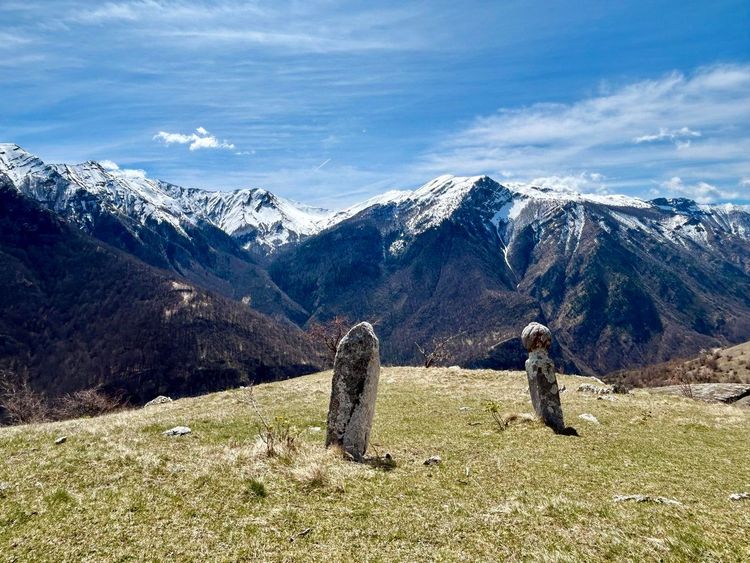
Sarajevo remains the only former Yugoslav capital to have hosted the Olympic Games: the 1984 Winter Games, whose skiing events took place on the Bjelašnica (Bjelašnica, 71000 Sarajevo, rated 4.7/5 on Google with 1,044 reviews) and Jahorina massifs, respectively 30 and 25 kilometers from the city center.
Bjelašnica, which hosted the men's alpine skiing events, retains a rustic charm with its stone hamlets and slate rooftops, notably the village of Umoljani, a popular starting point for hikers in summer. In winter, the slopes — less crowded than the major Alpine resorts — attract mainly local and regional visitors, with daily ski passes noticeably cheaper than in Western Europe.
Jahorina, which hosted the women's events, is today the most developed resort in the country, with more than 20 kilometers of runs and a surprisingly lively nightlife for a resort of its size, driven in large part by a substantial regional clientele. For Olympic history enthusiasts, a few remnants of the 1984 installations are still visible near the main lifts.
For skiing, a day pass at Jahorina generally costs between 45 and 60 KM (23 to 30 euros) in high season — a rate that remains significantly lower than Western Alpine resorts, which explains the influx of skiers from neighboring countries for extended weekends. In summer, the same lifts sometimes operate for downhill mountain biking, an activity still niche but growing fast on both massifs.
Allow a full day for each of these excursions, travel included (1 to 1.5 hours by road depending on traffic). Outside the ski season, roughly November to March, both massifs lend themselves very well to summer hiking, with mountain huts where you can eat simply for around ten KM.
17. Immerse Yourself in Bosnian Coffee Culture and Cuisine
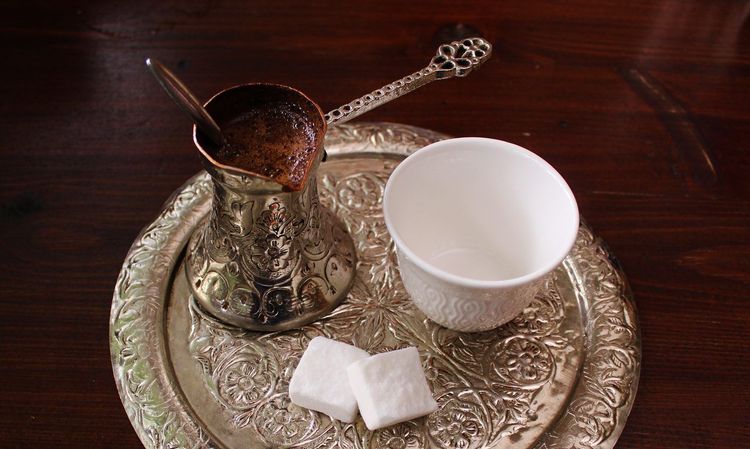
The Bosnian coffee (bosanska kafa) is not simply a local espresso: it is a social ritual that still structures a good part of the Sarajevo day. Served in a small copper pot called a džezva, it is always accompanied by a piece of Turkish delight (rahat lokum) and a lump of sugar to dip in the cup before biting into it — a precise custom that locals love to explain to curious visitors.
The kafanas, these traditional cafés with low cushioned benches and hammered copper tables, are concentrated mainly in Baščaršija, but the best addresses are sometimes tucked into secondary alleyways rather than on the main square, where prices rise with tourist footfall. Rarely more than 2 KM for a coffee, whatever the establishment — a price that has remained remarkably stable for years.
On the food side, ćevapi stand out as the city's signature dish: small grilled beef or lamb sausages served in a soft somun flatbread with raw onions and a fresh cream called kajmak. Ćevabdžinica Željo (Kundurdžiluk 19, 71000 Sarajevo, rated 4.5/5 on Google with 12,017 reviews), in Baščaršija, claims the title of the city's finest historic address and regularly shows a queue at lunchtime — a good sign of its popularity with locals as much as tourists.
The burek, filo pastry filled with minced meat and rolled into a spiral, is traditionally enjoyed with a liquid yogurt called kiselo mlijeko, said to aid digestion. Purists distinguish the true burek (meat-filled) from its vegetable or cheese-filled cousins, technically renamed sirnica or zeljanica — a vocabulary nuance that always amuses Sarajevans when a visitor orders "a cheese burek."
For something sweet, the local baklava, less syrupy than its Turkish or Greek cousins, and tufahija — a whole poached apple stuffed with walnuts and topped with whipped cream — complete a repertoire inherited directly from Ottoman cuisine. Leave room in your stomach: a full Bosnian meal — starter, main, and dessert — rarely exceeds 15 to 20 KM (7 to 10 euros) per person at popular spots, one of the best value-for-money arguments the city has to offer.
If you are looking for a slightly more unusual experience, some Baščaršija bars still offer hookah on their terraces — a more recent import from the Arab world that has grafted itself effortlessly onto the already well-established coffee culture. Locals linger there in the evening, often long after the shops have closed, making it a good indicator of the neighborhood's real nightlife, far from the organized groups that desert the area as soon as darkness falls.
18. Plan a Day Trip from Sarajevo
If you are wondering what to do around Sarajevo once the downtown must-sees have been ticked off, three day trips stand out clearly from the rest, each for very different reasons.
Mostar, about 130 kilometers and 2 hours' drive to the south, remains the most popular destination for a day out. Its Stari Most (Stari Most, 88000 Mostar), a 16th-century Ottoman bridge rebuilt to the original design after its destruction during the 1993 war, has been a UNESCO World Heritage Site since 2005. Local divers still regularly leap from its 24-meter height for a few euros collected in their hat — a spectacle that draws tourists throughout the day in summer.
Konjic, halfway between Sarajevo and Mostar, hides one of the country's most unusual sites: the D-0 ARK anti-nuclear bunker, built in total secrecy between 1953 and 1979 on Marshal Tito's orders to shelter up to 350 people in the event of nuclear conflict. Classified until 1997, it never served its original purpose, but since 2011 it has hosted a contemporary art biennial that fills its more than 6,000 m² of underground corridors. The guided tour, which is mandatory, lasts about an hour and costs around 15 KM.
Srebrenica, about 3 hours' drive to the east, offers a day trip of an entirely different nature. The Potočari memorial, where more than 6,000 identified victims of the July 1995 genocide rest, is visited in a silence that bears no resemblance to any other stop on this list. It is not an outing in the conventional tourist sense, but a place that many travelers consider, in retrospect, the most profound experience of their stay in Bosnia-Herzegovina, as it helps to understand the decades that followed the Sarajevo siege itself.
To organize these excursions, several agencies in Baščaršija offer air-conditioned minibuses with a guide, best booked the day before in high season. Budget around 40 to 50 euros for Mostar with a stop at Konjic on the return — a frequent and logical combination given the geography. If you prefer the freedom of a rental car, Bosnia's mountain roads, winding but generally well maintained, can be driven without any particular difficulty with an international license.
For a shorter half-day outing, the Igman plateau — the scene of fierce fighting during the siege and a former cross-country skiing venue at the 1984 Games — lends itself to a hike or a simple drive to the summit, with an open view over the entire Sarajevo valley. It is a good option if time is short for pushing as far as Mostar or Srebrenica, while still getting out of the urban center for half a day.
19. Find the Cultural Meeting Line and the City's Unusual Street Art
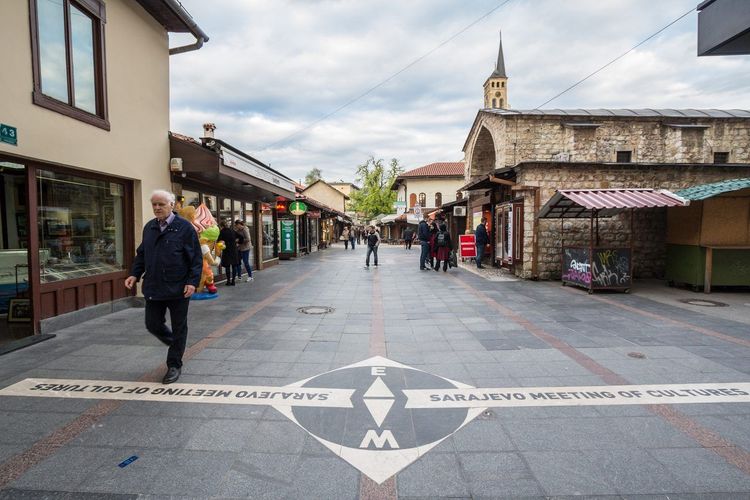
On Ferhadija Street, at the junction between Baščaršija and the more Austro-Hungarian city center, an inscription embedded in the pavement quietly announces "Sarajevo Meeting of Cultures" (Ferhadija, 71000 Sarajevo, rated 4.7/5 on Google with 456 reviews). On either side of this symbolic line, the architecture shifts almost overnight: low wooden facades on the Ottoman side, Haussmann-style buildings and Art Nouveau on the Austrian side, built in barely four decades following the 1878 annexation.
This kind of detail, easy to miss if you walk with your head down, captures better than any museum the way Sarajevo has layered its influences rather than replacing one with another.
Even more unusual: a Bruce Lee bust, installed in 2005 in the small Trg Slobode park, at the initiative of a local cultural collective that wanted to honor a figure admired by all the city's ethnic communities precisely because he belonged to none of them. The symbol, presented as a gesture of post-conflict reconciliation, has since been vandalized several times — which has not prevented the statue from remaining in place and becoming a regular stop for visitors in search of alternative stories.
If this kind of unusual detail speaks to you, know that it is exactly the material Ryo seeks to bring to life in its urban audio-guided tours: less the expected grand monuments than the small anomalies that tell a city differently. Sarajevo, with its density of overlapping histories compressed into a few square kilometers, would lend itself to this particularly well.
FAQ
How much time should you plan for visiting Sarajevo?
Two full days are enough to cover Baščaršija, the Vijećnica, the Sarajevo Tunnel, and a viewpoint such as the Yellow Fortress or Mount Trebević. With a third day, add Vrelo Bosne and a day trip to Mostar or Konjic. Travelers who also want to explore Bjelašnica, Jahorina, or push as far as Srebrenica would do well to plan four to five days on the ground, not counting air travel time, which is often longer than to other European capitals.
What to Do in Sarajevo in 1 Day?
Focus on Baščaršija, the Sebilj fountain, the Gazi Husrev-beg Mosque, and the Latin Bridge in the morning, then the Vijećnica and a sunset from the Yellow Fortress in the late afternoon. It's a packed but realistic itinerary on foot, as the historic center is compact. You'll have to skip the Sarajevo Tunnel and Vrelo Bosne, both located on the outskirts, each requiring a separate half-day.
What to Do in Sarajevo in 2 Days?
Add to the one-day itinerary the Sarajevo Tunnel and Vrelo Bosne, both grouped in the same Ilidža area, as well as the War Childhood Museum and the Trebević cable car with the bobsled track. This still leaves a little room to wander without a fixed schedule in Baščaršija at the end of your stay — often the most memorable moment once the must-sees have been ticked off.
What to Do in Sarajevo in 3 Days?
The third day lends itself ideally to a day trip to Mostar, with a stop at the Konjic bunker on the way back, or to a more contemplative outing to the Srebrenica memorial for travelers who want a deeper understanding of the country's recent history. Mountain lovers will prefer a day on Bjelašnica or Jahorina, hiking in summer or skiing in winter.
Is Sarajevo a Safe Destination for Tourists?
Yes: tourism in Sarajevo poses no particular danger related to the 1990s conflict, which ended more than three decades ago. Crime against visitors remains low, comparable to other Central European capitals. The only precaution recommended concerns remote rural areas where residual minefields remain, clearly marked by red signs: stay on marked trails when hiking outside urban areas.
What to Do around Sarajevo?
The three most popular day trips remain Mostar with its Ottoman bridge, the anti-nuclear bunker in Konjic, and the Srebrenica memorial for a more solemn moment. The Bjelašnica and Jahorina mountain ranges round out the options for outdoor enthusiasts, whether hiking or skiing. The Igman plateau, closer to the city, works well for a half-day outing.
What Is the Most Unusual Thing to Do in Sarajevo?
Walking or cycling down the old Olympic bobsled track on Mount Trebević, entirely covered in graffiti, probably tops the list, closely followed by a visit to Tito's secret nuclear bunker in Konjic. The Sarajevo Roses and the Bruce Lee bust in Trg Slobode park round out a list of urban oddities that is quite unique in Europe. To extend this type of discovery elsewhere, the Ryo app features similar routes in other cities.
Sarajevo cannot be reduced to any of its archival images. The city that survived 1,425 days of siege continues, thirty years later, to layer its strata rather than erase them: minarets and bell towers, Ottoman and Austro-Hungarian facades, concrete roses and café terraces, secret bunkers and bobsled tracks recycled as artists' canvases. It is this density, more than any single monument taken in isolation, that makes the city hard to leave after two or three days.
If this way of telling a city through its details resonated with you, keep the habit for your next destination: a Ryo audio-guided tour applies the same logic of historical layers to a narrated walk, available in a growing number of European cities. While waiting for Sarajevo to perhaps one day join that catalog, a notebook, a few key dates in mind, and a good pair of shoes are more than enough to explore the Bosnian capital as it deserves.