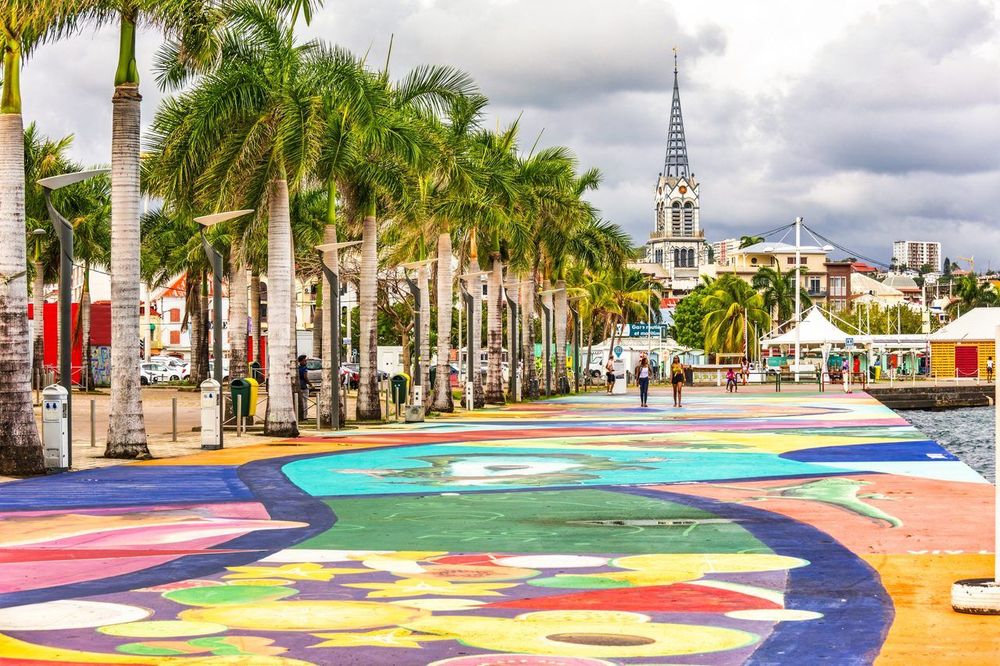
© Shutterstock
 Votre guide Ryo
Visiting Fort-de-France for the First Time: The Complete 2026 Guide
Visiting Fort-de-France for the first time often begins with a smell before an image: cloves and cinnamon drifting out of the Grand Marché couvert as early as seven in the morning, mingling with the salt of the nearby bay. The capital of Martinique is as disorienting as it is captivating, with its dense Creole city, its steep roads climbing towards the heights of Balata and its crumbling facades standing just steps from listed historic monuments. The Ryo audio guide tour of Fort-de-France follows precisely this contrast, from Fort Saint-Louis to the covered market, with the stories that no tourist sign ever tells.
This guide covers everything you need to know for a first stay: a tour of the historic centre around La Savane, a cathedral built entirely of metal designed to withstand earthquakes and hurricanes, a library assembled in Paris for the 1889 Universal Exhibition and then reconstructed here piece by piece, waterfalls less than thirty minutes from the city centre, and a complete one-day itinerary if that is all the time you have. We also address the most frequently asked practical questions: direct flights from France, time difference, neighbourhoods to stay in, and the best time to visit.
The Historic Centre of Fort-de-France: the Must-Sees
Every first visit worth the name starts here, in the triangle formed by the bay, the Savane and the main arteries of the city centre. It is a compact area, walkable in a morning, concentrating the essential colonial and Creole heritage of the city, where you can visit four major sites without getting back in the car.
La Savane and Fort Saint-Louis
The Savane is the first thing you see when arriving from the port: a vast public garden of lawns, palm trees and mango trees right in the city centre, formerly a parade ground for the garrison stationed at the foot of the fort. Today, the Foyalais come here to run in the morning, play dominoes in the shade in the late afternoon and stroll between the kiosks and benches. If you visit on a weekend, you will often come across craft stalls that are less tourist-oriented than those in the centre.
Look for the statue of Empress Joséphine and you will find only an empty plinth. Beheaded in 1991 because of the role attributed to Joséphine in the restoration of slavery in 1802, it was toppled and then destroyed by activists on 26 July 2020. This void speaks volumes about a memorial debate still very much alive in Martinique. The Savane remains the best landmark for getting your bearings before fanning out to the other sites in the centre.
Walking along the bay from the Savane, you reach Fort Saint-Louis, a 17th-century fortress built on a rocky promontory and still occupied by the French Navy, making it one of the rare active military fortifications open to the public. Guided tours run Tuesday to Saturday in the morning (with a few early-afternoon slots on weekdays), last about 1h15 and must be booked through the Terres du Centre tourist office on Rue Victor Hugo. They give access to the ramparts, the casemates and a viewpoint over the entire bay. Expect to pay around €8 per adult and €4 per child, and wear closed-toe shoes: the stone floors heat up quickly in the middle of the day.
The Saint-Louis Cathedral and the Bibliothèque Schoelcher
Ten minutes on foot, the Saint-Louis Cathedral surprises with its entirely metal structure, a choice by architect Pierre-Henri Picq designed to withstand earthquakes and hurricanes after the destruction of several earlier churches by fire, cyclones or tremors. The current building dates from 1895 and blends Romanesque, Byzantine and Gothic styles within a riveted framework contemporary with the Eiffel Tower, earning it the occasional nickname of the iron cathedral. Inside, linger for a few minutes in front of the stained-glass windows, even if you are not a believer.
Right next door, on the edge of the Savane, the Bibliothèque Schoelcher (Rue de la Liberté, 97200 Fort-de-France, rated 4.4/5 on Google from 301 reviews) tells an even more remarkable story. The building, also designed by Picq, was first assembled in the Tuileries garden in Paris for the 1889 Universal Exhibition, then dismantled, numbered and shipped by boat to Fort-de-France, where it opened its doors in 1893. It bears the name of Victor Schoelcher, one of the architects of the abolition of slavery in 1848, who had bequeathed his personal book collection to Martinique. Its polychrome facade, stained-glass windows and dome make it one of the most photographed monuments in the city. The interior can be visited freely during library opening hours, without a reader's card if you are simply coming to admire the architecture. The Ryo audio guide devotes several stops to this neighbourhood: the tour passes through the Savane, Fort Saint-Louis, the cathedral and then the library, with a story at each stage that you would never have time to read on a sign.
The Covered Market and the Creole Atmosphere of the City Centre
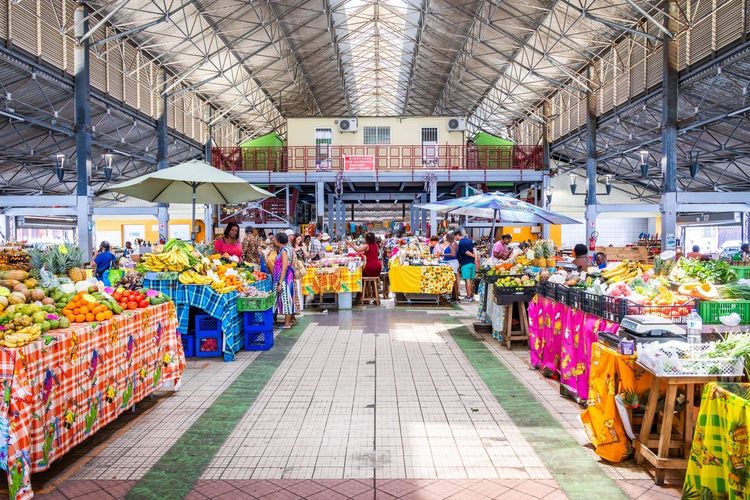
Once you have taken in the colonial heritage, the true pulse of Fort-de-France is felt in its commercial streets, among spice stalls and contemporary murals.
The Grand Marché couvert and Its Spice Stalls
The Grand Marché couvert occupies a metal hall erected at the turn of the 20th century, in the same architectural vein as the nearby library. You will find rum infused in artisan bottles, packets of colombo, cinnamon and vegetarian pepper, dried vanilla and baskets woven by craftswomen who have been here for decades. Prices are rarely negotiated but samples are willingly offered: ask before helping yourself, that is the local custom. For a first visit, compare two or three stalls before buying — prices for the same spices can vary twofold depending on whether the stand is targeting cruise passengers or not. The market slows down in the afternoon; it is better to visit before 11 a.m. to see it at its busiest.
Street Art and Wandering: the Cité Clarac and the Colourful Street
A few streets away, the Cité Clarac neighbourhood has been covered with murals in recent years — portraits of Martinican figures such as the writer Aimé Césaire and Creole scenes painted on facades that were once grey. It has become an essential stop for anyone looking for a different image of the city, far from beach postcards, and local artists regularly renew certain pieces. Nearby, an entire street has had its houses repainted in vivid colours in the style of a traditional Creole neighbourhood: take out your phone, as every door has its own shade, from bright yellow to turquoise blue.
For a more cultural pause, Tropiques Atrium (6 Rue Jacques Cazotte, 97200 Fort-de-France, rated 4.5/5 on Google from 195 reviews), Martinique's national stage that everyone simply calls l'Atrium, programmes exhibitions, concerts and theatre productions year-round in a contemporary building that stands in stark contrast to the rest of the historic centre. Even without a show ticket, take a look at the exhibitions by Martinican artists regularly presented in its spaces. This same neighbourhood flows naturally into the covered market and then the colourful street-art lanes in the Ryo audio guide tour, without needing to pull out a map to find your way.
The Museums of Fort-de-France: Understanding the History of Martinique
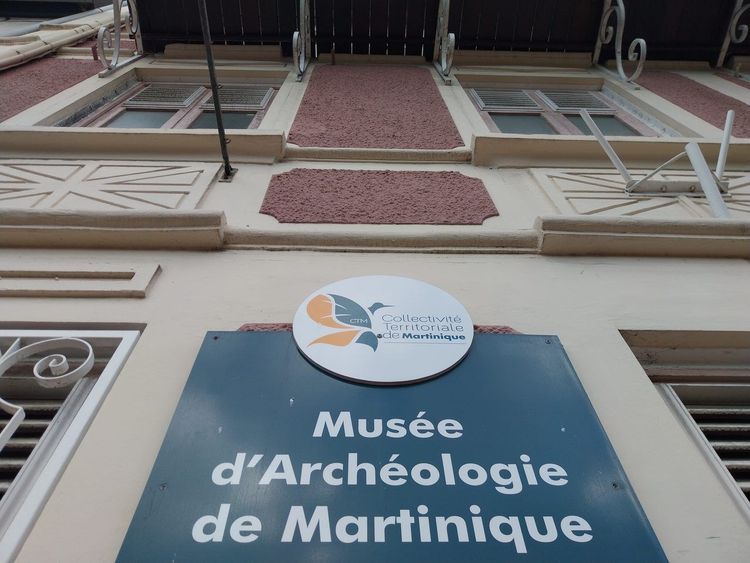
Two small museums, a few streets apart, give you in an hour and a half the context that the historic centre does not provide on its own.
Musée d'Histoire et d'Ethnographie
Housed in an elegant 1887 villa on the Boulevard du Général de Gaulle, the Musée d'Histoire et d'Ethnographie traces everyday Martinican life from the 18th to the 20th century: Creole costumes, traditional headdresses, gold jewellery and reconstructed plantation furniture. The building itself, with its veranda and louvred shutters, illustrates the prosperous Creole architecture of the late 19th century almost as much as the collections it houses. Admission costs a few euros and the visit takes about 45 minutes. Note the opening hours: the museum only opens in the afternoon on Tuesdays and in the morning only on Saturdays. It makes a good complement if you want some context before tackling the more monumental sites of the centre.
Musée d'Archéologie et de Préhistoire de Martinique
A few minutes' walk away, the Musée d'Archéologie et de Préhistoire de Martinique (Rue de la Liberté, 97200 Fort-de-France, rated 4.3/5 on Google from 85 reviews) reaches much further back in time, to the first Amerindian populations who arrived on the island long before colonisation. Pre-Columbian pottery, polished stone tools and ritual objects are displayed in a understated setting, with explanatory panels thorough enough to follow the visit without a guide. Few passing visitors stop here: take advantage of it for a peaceful break mid-morning if the historic centre is starting to fill up with groups. As both museums are close together, you can visit them one after the other before heading to the covered market for lunch.
The Bay of Fort-de-France and the Malécon
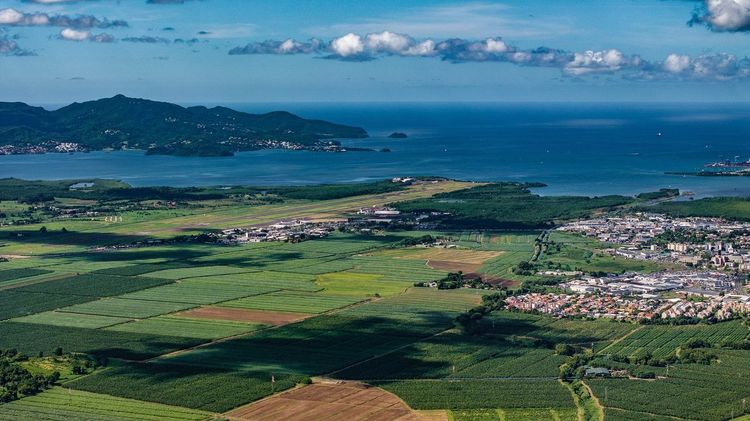
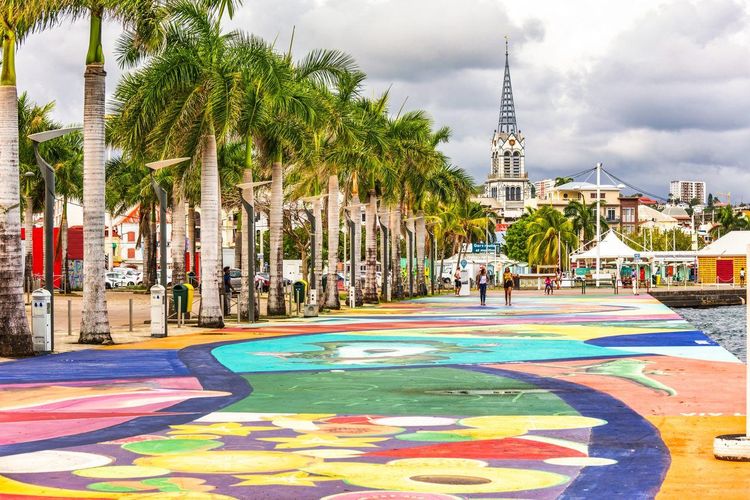
Between Fort Saint-Louis and the market, the waterfront deserves a slower pace. The bay of Fort-de-France, one of the largest in the Lesser Antilles, opens between the mornes of Schoelcher and Case-Pilote to the north-west and the Trois-Îlets peninsula to the south, and long served as the main port for the sugar and rum trade with metropolitan France. From the Malécon, the promenade laid out along the waterfront, you can watch the ferries setting off to connect the city centre to Trois-Îlets and Pointe du Bout: a crossing of about twenty minutes that avoids afternoon traffic jams and costs just a few euros, far cheaper than a taxi for the same journey by road.
It is also the place to watch the city settle into its evening rhythm: joggers, families enjoying the cool breeze, fishermen hauling in their lines from small wooden yoles. The sunset over the bay, between 5:40 p.m. and 6:30 p.m. depending on the season, remains one of the simplest pleasures of a first stay, and there is nothing to book.
Balata: Garden, Church and Panoramic Views
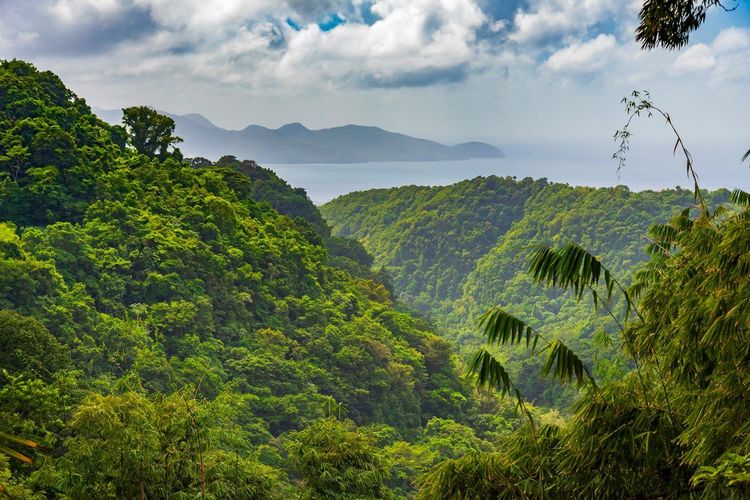
About ten minutes by car from the centre, the Balata road climbs towards the heights and the scenery changes completely: the city gives way to humid tropical forest, and the temperature drops noticeably as you ascend.
The Jardin de Balata
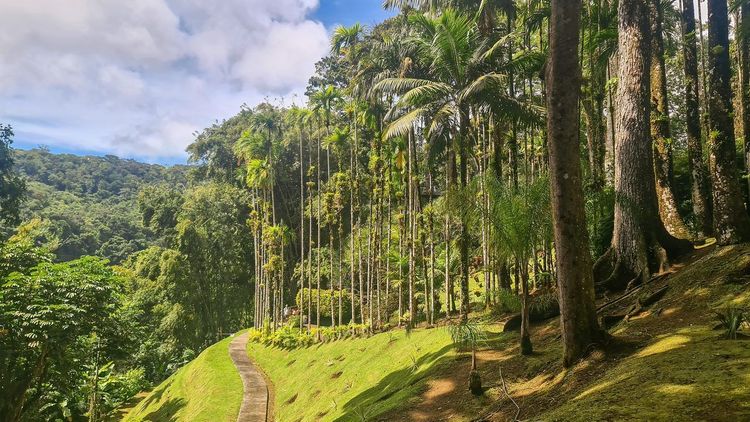
Created in the 1980s by landscape designer Jean-Philippe Thoze around a restored family Creole cottage, the Jardin de Balata brings together more than three thousand tropical species across around three hectares, with giant lily ponds, beds of heliconias and porcelain roses, and suspended walkways between the trees some fifteen metres above the ground. The hummingbirds are so accustomed to visitors that it is not unusual to encounter one just centimetres from your face. Allow a good two hours to walk through everything at a leisurely pace, with an entry fee of around €16 to €17 per adult (the rate is revised each year), and come early in the morning: the heat builds quickly under the tall trees. The garden is open every day, with last entry around 4:30 p.m.
The Sacré-Cœur de Balata Church and the Chapelle du Calvaire
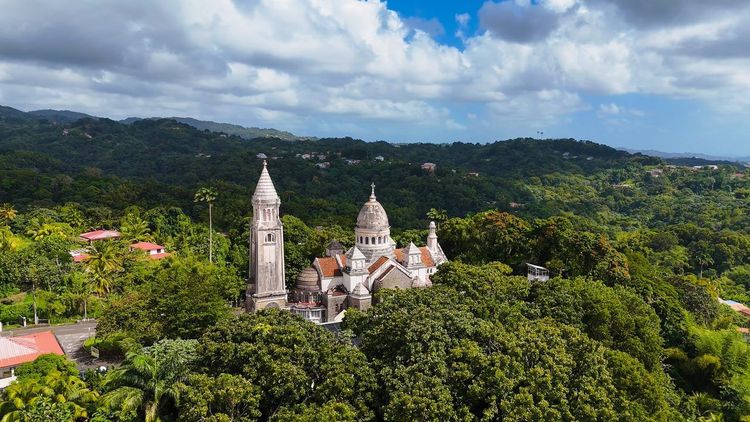
A little further down the same road, the Sacré-Cœur de Balata church (Route de Balata, 97200 Fort-de-France, rated 4.2/5 on Google from 806 reviews) is a scaled-down replica of the Sacré-Cœur basilica in Montmartre, hence its nickname of the "Martinican Montmartre". Built between 1923 and 1925 by Parisian architects Charles Wulffleff and Aloys Verrey, who combined reinforced concrete with local andesite stone, it is also a memorial to those who died in the First World War. Blessed on 9 August 1925 before more than 10,000 worshippers, it overlooks the valley and offers from its forecourt one of the most unobstructed views of Fort-de-France and its bay, particularly photogenic in the late afternoon. Nearby, the small Chapelle du Calvaire, often bypassed by organised groups, completes the walk if you want to climb a little higher. The neighbourhood also houses a modest mosque, a quiet sign of the island's religious diversity beyond the dominant Catholicism.
Before heading up, listen to the stages of the Ryo audio guide for Fort-de-France: the story of the lower city, its fires and its reconstructions, sheds light on what you will see in the heights, rather than discovering it summarised on a sign.
Nature Excursions Around Fort-de-France: Waterfalls and Hikes
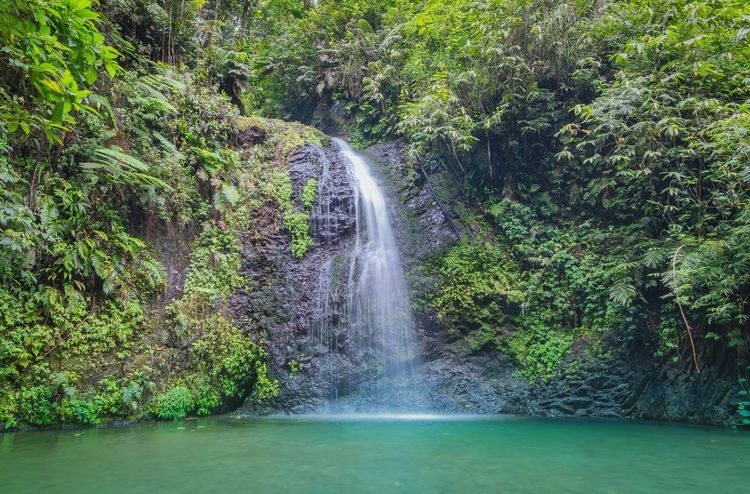
Few guides group these outings into a single clear section, yet they can easily be combined into a half-day from the city centre, provided you have a vehicle.
Cascade d'Absalon and the Cascades de Didier
About twenty minutes by road, along the Route de la Trace beyond Balata, the Cascade d'Absalon is reached via a thirty-minute trail through the undergrowth, with a natural pool to swim in on arrival. It is the most accessible nature excursion for a first visit, requiring no special equipment, making it a good family option; still, wear shoes with grip, as the roots and stones become slippery after rain. Even closer, on the heights of the Didier neighbourhood, the cascades de Didier (Didier, 97200 Fort-de-France, rated 4.4/5 on Google from 44 reviews) offer a less crowded alternative, favoured by Foyalais for a quick dip at the end of the day rather than as an organised excursion.
Towards the Montagne Pelée, the Windward Coast and the Southern Tip
If you extend your stay beyond Fort-de-France, the Montagne Pelée, the volcano tragically famous for the 1902 eruption that wiped out in minutes the town of Saint-Pierre and its roughly 28,000 inhabitants, lies just over an hour to the north. Its volcanoes and forests have been inscribed on the UNESCO World Heritage List since 2023, and several trails cater to all levels, up to the summit ascent which requires a full day and favourable weather. To the east, the windward coast, battered by trade winds and heavier waves, contrasts with the more sheltered leeward coast to the west, where the sea is often calm, while the southern tip, around Sainte-Anne and the Plage des Salines, is home to the island's most celebrated beaches. These excursions each require a full day: it is better to plan them separately rather than tacking them onto a first day already packed with the city centre.
The La Favorite Distillery: on the Rum Route
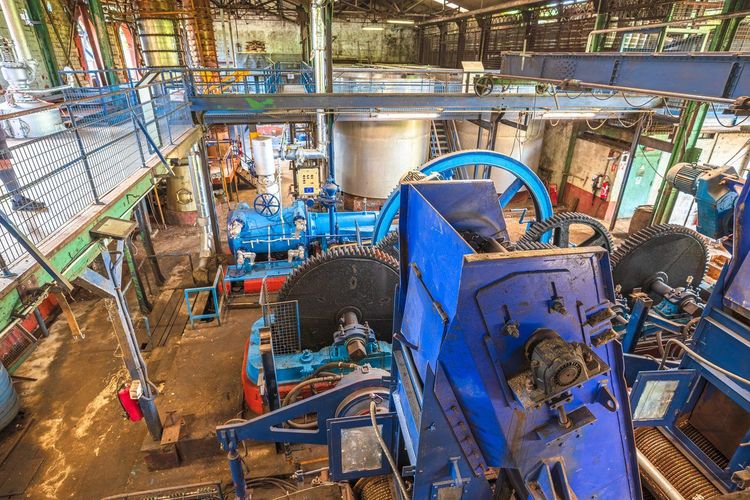
About ten minutes from the airport, in Lamentin, the La Favorite distillery (Le Lareinty, 97232 Le Lamentin, rated 4.3/5 on Google from 443 reviews) is one of the oldest still operating in Martinique: founded in 1842 under the name La Jambette and taken over in 1905 by Henri Dormoy, it still runs a 1906 steam engine that drives the mills crushing the cane. It produces an agricultural rum under the AOC Martinique designation. The self-guided visit is free and allows you to follow the entire process, from cane crushing through distillation and ageing, with a tasting at the end, Monday to Friday and Saturday mornings. Come preferably during the harvest season, roughly February to June: that is when the steam engine runs and the almost sweet smell of crushed cane fills the site. The adjoining shop lets you take home a few bottles at prices considerably lower than those in mainland France.
Where to Eat in Fort-de-France: the Best Food Addresses

Restaurants and Bars in the City Centre
Around the Savane and the market, small local eateries serve a complete Creole set lunch, often around €15 — chicken colombo or fish court-bouillon accompanied by rice, red beans and fried plantains. The pace is relaxed: you sit down, you wait, nobody rushes anyone, and you may well share your table with neighbourhood regulars on their lunch break. Cod accras, sold individually late in the morning near the market, remain the most economical snack for sampling local cuisine without committing to a full meal. In the evenings, several bars in the city centre serve ti-punch on request — white rum, lime and cane sugar in proportions that everyone claims as their own.
Galanga Fish Bar and Creole Cuisine
For a more refined experience, head up to the heights of Didier and the Galanga Fish Bar (31 Route de l'Union, 97200 Fort-de-France, rated 4.8/5 on Google from 1,399 reviews), on the Route de l'Union: creative, locally sourced cooking centred on locally caught fish, served notably in bowls, winning over regulars and visitors alike. The address works mainly at lunchtime on weekdays, with a few evening slots by reservation only: call ahead before making the trip. For a quick dessert, ice cream and sorbet vendors selling local fruit flavours — soursop, guava or passion fruit — set up along the waterfront.
Our Ideal Itinerary for Visiting Fort-de-France in One Day
If you only have one day to dedicate to the city, here is how to string together the essentials without rushing from one end to the other and without retracing your steps.
Morning: Historic Centre and Culture
Start at the Savane around 7:30 a.m. to enjoy the atmosphere before the heat and the cruise-ship crowds that typically arrive mid-morning. Then head to the Grand Marché couvert for spices and a short espresso drunk standing up, followed by the Saint-Louis Cathedral and the Bibliothèque Schoelcher, just minutes apart. Book a guided tour of Fort Saint-Louis for a late-morning slot (it lasts about 1h15). Allow three good hours for this loop, one more if you want to continue to the Musée d'Histoire et d'Ethnographie and the archaeology museum. Have lunch around 12:30 in a local eatery in the centre, before the best tables fill up.
Afternoon: Nature and Panoramic Views
After lunch, head to Balata by car or taxi, about twenty minutes away: the Jardin de Balata first (last entry around 4:30 p.m.), for roughly two hours of visiting, then the Sacré-Cœur church for the view over the bay in the late afternoon, when the raking light sculpts the landscape and the heat begins to ease. If you started early, push on to the Cascade d'Absalon, on the same road, for a swim before heading back down. End the day on the Malécon (Boulevard Alfassa, 97200 Fort-de-France, rated 4.3/5 on Google from 578 reviews) for the sunset, with a ti-punch in a city-centre bar as the perfect final note. This sequence closely follows the main Ryo audio guide route, whose commentary at each stop saves you from having to improvise an itinerary on the spot or constantly check a map on your phone.
Where to Stay and How to Get to Fort-de-France
How to Get to Fort-de-France
Aimé-Césaire International Airport, located in Lamentin about twenty minutes from the city centre, receives direct flights from Paris and several French cities, with a flight time of approximately eight and a half hours from Paris. Martinique runs on UTC-4: five hours behind metropolitan France in winter and six hours in summer, worth factoring in when planning your first days of sightseeing. No passport is required for French or European citizens carrying a valid identity card, as Martinique is a French overseas department, but keep a passport if your flight involves a stopover outside the European Union. On the ground, taxis serve the centre from the airport at fairly high fares (often more than €25), the Mozaïk bus network covers city journeys, and car rental remains the most practical solution for combining Balata, the waterfalls and the distillery without depending on buses that run infrequently outside peak hours.
Where to Stay: Neighbourhoods and Accommodation
For a first stay, sleeping in the city centre of Fort-de-France lets you reach the Savane, the market and the cathedral on foot, a real time-saver if you are not renting a car straight away. The commune of Schoelcher, just to the north, offers a quieter compromise with quick access to the sea, appreciated by travellers staying a week or more. Pointe du Bout and Trois-Îlets, connected to the Malécon by ferry in about twenty minutes, appeal to those who want the beach at their doorstep while retaining quick access to the historic centre. In the evening, avoid wandering alone in the deserted streets of the centre and certain outlying neighbourhoods — a common-sense precaution that does not undermine the city's general calm during the day.
When to Visit Fort-de-France: Climate and Best Time to Go
The dry season, locally known as the carême, runs from December to April and attracts the majority of visitors, with showers far less frequent than in summer. It also coincides with carnival, in February or early March depending on the date of Shrove Tuesday, which brings the city centre to life with parades right through to Ash Wednesday: a good reason to time your trip if you enjoy a festive atmosphere rather than tranquillity. The hurricane season, from June to November, brings more rainfall and a greater risk of disruption in August and September, but also lower accommodation prices and a less crowded city. For a first stay focused on Fort-de-France, two to three days are more than enough to cover the historic centre, Balata and a nature excursion, versus five to seven days if you plan to branch out across the rest of the island.
FAQ
How Much Time Should I Plan to Visit Fort-de-France?
Two full days are enough for the historic centre, the market and Balata. Add a half-day if you want to include a waterfall or the La Favorite distillery without rushing, and budget an extra day for an excursion to the Montagne Pelée or the southern tip.
How Do I Get to Fort-de-France from the Airport?
Aimé-Césaire Airport is about twenty minutes from the city centre. Taxis, hotel shuttles and car rental are the three main options, the last being the most practical for excursions to Balata or the waterfalls without depending on bus schedules.
Where Should I Stay in Fort-de-France for a First Visit?
The city centre remains the most convenient choice for exploring on foot. Schoelcher offers more peace and quiet for a longer stay, and Pointe du Bout or Trois-Îlets are better suited if you prioritise the beach, with a ferry crossing of about twenty minutes.
What Is the Best Time to Visit Fort-de-France?
The dry season, from December to April, offers the most stable climate and coincides with carnival. The hurricane season, from June to November, is still manageable for an urban stay focused on Fort-de-France, with lower accommodation prices.
Do I Need to Book the Jardin de Balata or the Distillery in Advance?
The La Favorite distillery is free to visit and requires no reservation. The Jardin de Balata also does not require advance tickets in low season, but booking online avoids queues during the busiest hours, late morning and school holidays. Only the guided tour of Fort Saint-Louis must be booked in advance, through the tourist office.
What Should I Do in Fort-de-France if I Only Have Half a Day?
Focus on the Savane, the Grand Marché couvert and the Bibliothèque Schoelcher, the three sites closest to one another. Allow about three hours for this loop at a leisurely pace, finishing if possible with a stroll along the Malécon.
Fort-de-France is more than a stopover before the southern beaches or northern hikes: it is a Creole capital in its own right, with its contrasts of colonial buildings and contemporary murals, its market fragrant with spices from dawn and its lush heights just minutes from the centre. A well-organised first stay, combining the historic centre, Balata and a nature break, is enough to understand why the city deserves more than a brief stop between two flights. To follow this itinerary step by step, with stories told at each stop rather than summarised on a sign, the Ryo audio guide tour of Fort-de-France is the simplest way to explore at your own pace, without depending on a guide's schedule or a group.