© Shutterstock
 Votre guide Ryo
Les Sables d'Olonne in 2026: the Vendée Town between Beach, Harbor, and Regattas
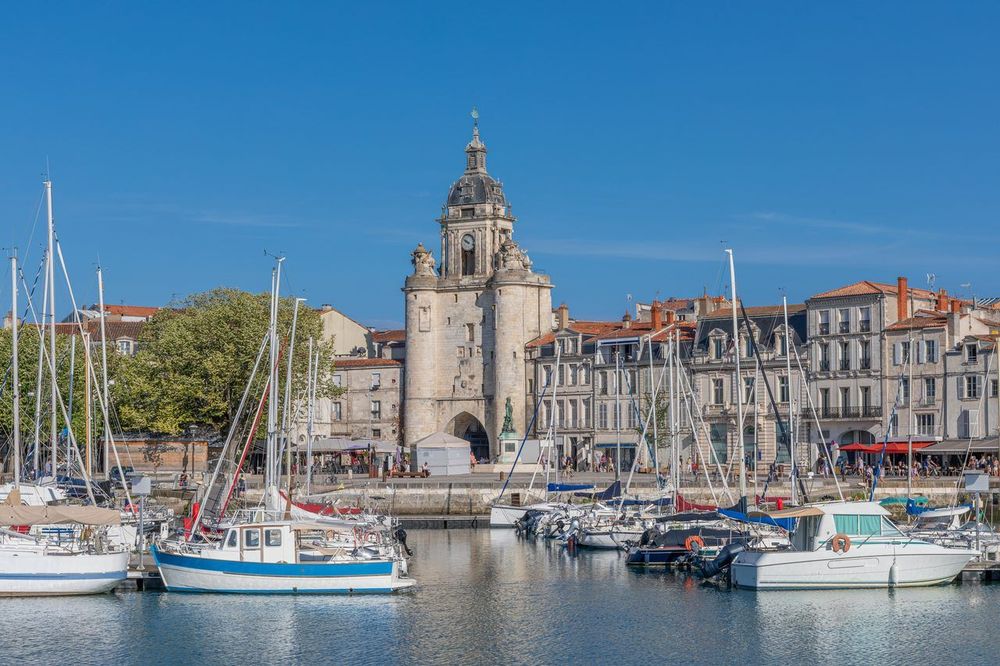
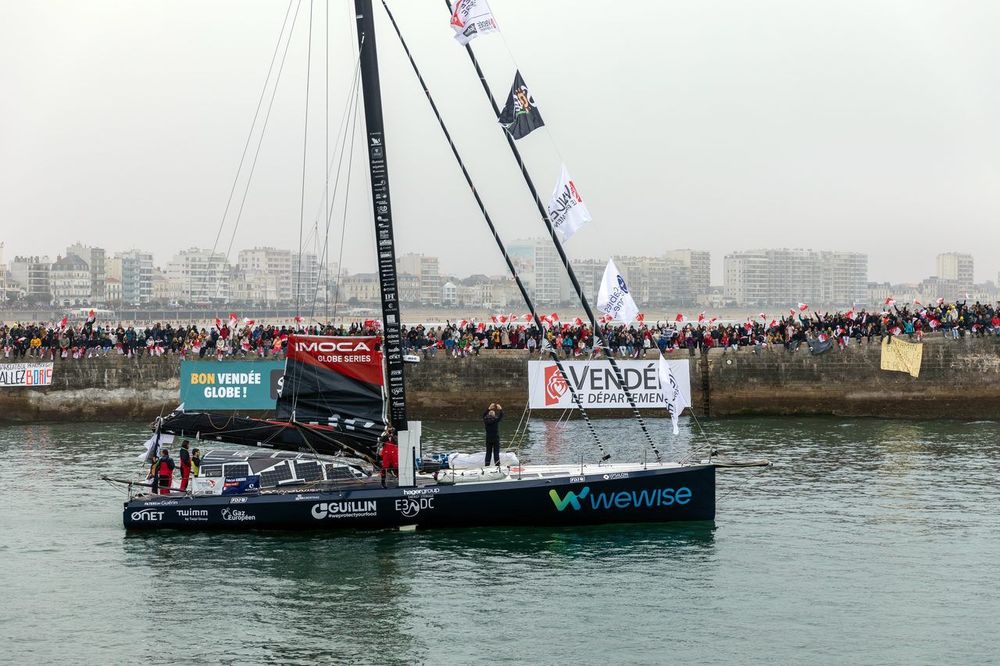
A salty breeze sweeps across the fine sand of the Remblai, yet it's not the sea that catches the eye first: it's the masts lined up in the harbor, ready to set sail on the ocean. Welcome to Les Sables d'Olonne: here, an elegant seafront promenade sits alongside a still-active fishing harbor and a town center of cobbled streets. Les Sables d'Olonne cultivates this dual identity, at once a major Vendée seaside resort and the world capital of ocean sailing.
Here, you can swim in the morning on the Grande Plage, stroll at noon through the covered market halls of the town center, and end the day over a seafood platter in La Chaume, the fishermen's quarter with its colorful facades on the other side of the channel. A funicular? No — a small boat called the passeur, which crosses the harbor in just a few minutes. With the Ryo app, you can follow a street-by-street audio tour, headphones on, without ever losing the thread of local history.
This guide covers the whole city: its geography, its neighborhoods, its past as a seaside resort and sardine port, the Vendée Globe that propels it onto the world stage every four years, its nearby beaches, its oceanic weather, and the practical details (postal code, population, transport) for planning a stay in Les Sables d'Olonne in 2026.
Where Is Les Sables d'Olonne: Geography and Getting There
Les Sables d'Olonne is located on the Atlantic coast of the Vendée department, in the Pays de la Loire region, where sand meets marshland and pine forests. On a map, the city forms a promontory into the ocean, sheltered by two jetties that flank the entrance to the harbor.
From Nantes, allow about an hour and fifteen minutes by road via the A83 motorway and then the expressway. La Rochelle is roughly the same distance to the south. From Paris, the city can be reached in just over four hours by car, or by train via Nantes with a connection — the Les Sables d'Olonne train station is just a few minutes' walk from the town center and the harbor.
The municipality covers a larger area than it might appear: since 2019, it has incorporated three neighboring former communes, which is why some neighborhoods still bear the names Olonne-sur-Mer or Château-d'Olonne on older maps.
A Brief History: from Fishing to Regattas
The city's name comes from the sand dunes that once bordered the mouth of the Olonne river, before a harbor was dug in the 13th century to shelter fishing boats. For centuries, the city lived off the sea: sardines, tuna, then deep-sea fishing brought wealth to the harbor, while the surrounding salt marshes fueled a thriving salt trade. Traces of this salt-harvesting past can still be read in local place names, where old marshes have sometimes given way to residential areas or protected nature reserves.
The seaside turning point came in the 19th century. Like many French coastal towns, Les Sables d'Olonne reinvented itself as a sea-bathing resort: first bathing huts on the Remblai, chic hotels, a casino. Wealthy Parisians discovered the Grande Plage and its fine, wide sand — broader than many neighboring beaches.
The 20th century brought two major shifts. First, the modernization of the fishing harbor, which remains one of the most active on the Atlantic coast for sole and langoustine. Then, in 1989, sailor Philippe Jeantot launched the Vendée Globe — a solo, non-stop, unassisted round-the-world yacht race, starting and finishing in Les Sables d'Olonne. This race, held every four years, transformed the city's image: it is no longer simply a holiday destination, but a world capital of ocean sailing.
More recently, in 2019, Les Sables d'Olonne, Olonne-sur-Mer, and Château-d'Olonne merged into a single new municipality, bringing their combined population to nearly 45,000 residents. This history explains the diversity of landscapes you discover within just a few kilometers today: a dense urban center, residential neighborhoods, forest, and marshland.
The Neighborhoods of Les Sables d'Olonne
On paper, the city breaks down into several clearly identifiable neighborhoods — useful information if you're looking for the right base for your stay.
The town center is home to shops, covered market halls, and pedestrian streets that run from the harbor up to the Remblai. This is where the market is held, in a 19th-century hall where the day's catch and local Vendée produce sit side by side beneath a metal roof structure.
The Remblai refers to the long seafront promenade that runs along the Grande Plage for nearly three kilometers. Stately apartment buildings, restaurant terraces, and the Casino des Atlantes line its length, offering the most iconic image of the city.
On the other side of the harbor channel, La Chaume is a world apart: narrow lanes, fishermen's houses with colorful facades, a village atmosphere within the city. It can be reached on foot via the bridge or in just a few minutes by boat on the passeur, a crossing that has become part of the local lore.
Further south, Château-d'Olonne occupies the residential heights of the municipality, with its villas, golf course, and rocky coastal road overlooking the ocean. To the north, Olonne-sur-Mer borders the forest and marshes — a greener, quieter face of the city.
Between the Remblai and Château-d'Olonne, the Tanchet area brings together campsites, holiday residences, and the Tanchet water park, popular for dinghy sailing and paddle boarding in a sheltered environment away from the surf. It is often the choice for families with young children, as the area stays calm and is close to local shops without being caught up in the summer bustle of the town center.
Ryo makes it easy to move from one neighborhood to another without losing your bearings: the audio guide tracks your position in real time and narrates the history of wherever you happen to be, whether on the Remblai or in the lanes of La Chaume.
The Remblai and the Grande Plage
The Remblai is the first image that stays with you from Les Sables d'Olonne: a seawall promenade nearly three kilometers long, lined with Belle Époque buildings and more recent villas, running the entire length of the Grande Plage.
The beach itself stretches in a wide crescent of fine sand, broad enough that you can always find a quiet spot even in the height of summer. The tide creates sandbanks that delight children at low tide, while stronger swimmers enjoy water that is generally more sheltered than the rocky beaches of the Corniche a little further south.
At one end of the Remblai, the Casino des Atlantes (Remblai, 85100 Les Sables d'Olonne, rated 3.9/5 on Google with 1,459 reviews) presents its white facade, built in the 1950s on the site of an earlier bathing establishment. Guests come to play, but also for its panoramic restaurant and, in summer, for the open-air shows held on the adjacent esplanade.
At the end of the day, the Remblai changes pace. Terraces fill up, joggers give way to strollers, and the sun drops over the ocean at an angle that, on clear evenings, sets the entire bay ablaze. Many visitors stumble upon this moment almost by accident, simply looking for somewhere to have dinner facing the sea.
On the practical side, the beach is supervised during the summer season and several rental stands offer boards, paddleboards, and catamarans by the hour. For families, beach clubs look after children while parents enjoy a peaceful swim or a nap on the sand. Public showers and toilets are available at regular intervals along the promenade — a detail that matters when you spend the whole day there with young children.
The promenade itself is worth taking time over just for its architecture. Between apartment blocks from the 1960s, you can still spot a few early 20th-century seaside villas with their bay windows and wrought-iron balconies — reminders of the era when wealthy Parisians came to spend the summer in Les Sables. A cycling path and a dedicated inline skating lane run the full length of the seawall, separated from motor traffic, making it a pleasant route on foot or by bike from the harbor to La Chaume without ever leaving the seafront.
In July and August, a night market sets up on some evenings along a section of the Remblai: local craftspeople, fishing nets repurposed as decorative objects, Vendée delicacies. It's also a chance to encounter a more local atmosphere than the town center, with free concerts and beach sports demonstrations. For visitors with reduced mobility, the beach provides free tiralo beach wheelchairs in summer, available on reservation through the lifeguard stations — a service rare enough to be worth mentioning.
The Harbor and La Chaume: the Soul of the Fishermen
Cross the channel and you step back in time. The Les Sables d'Olonne fishing harbor remains one of the most active on the Atlantic coast for sole, langoustine, and hake, landed every morning at the fish auction hall.
The trawlers return late in the morning, and it is not unusual to see fishmongers stocking up directly on the quay, a few hours before the fish reaches the stalls of the town center market halls. This closeness between harbor and plate partly explains the city's culinary reputation: very few kilometers separate the sea from the table.
Across the water, La Chaume occupies the other bank of the channel. The neighborhood long lived apart from the rest of the city, cut off by the harbor and turned toward its own fishing activity. Its narrow lanes, low houses with colorful shutters, and calm atmosphere contrast sharply with the bustle of the Remblai, just ten minutes away on foot via the bridge or two minutes by boat on the passeur, a small ferry that crosses the channel year-round.
At the tip of the headland, the Armandèche lighthouse (Rue du Puits d'Enfer, 85100 Les Sables d'Olonne, rated 4.5/5 on Google with 300 reviews), the last major lighthouse built in France, has watched over the harbor entrance since 1968. You can climb its steps to the lantern during open-day events held several times a year, for a 360-degree panorama over the bay, the harbor, and on clear days, the distant île d'Yeu.
The Ryo audio guide tells this story right at the foot of the sailboats, on the very quay from which the Vendée Globe sets off — a quick and vivid way to understand why this small Vendée harbor carries so much weight in the world of sailing.
On some mornings, the fish auction hall opens its doors to the public for guided tours: you discover the sorting of fish, the electronic auctions that have replaced the cries of fish merchants, and the scale of an industry that supports several hundred local families. Book these visits through the tourist office — places are limited and sell out quickly in summer.
For those who prefer to observe rather than consume, simply sitting on a bench on the quay in the late afternoon is enough: the trawlers return, seagulls circle above the nets being repaired on deck, and the harbor's regulars exchange a few words before heading home. It is a more authentic scene than the seafront, just a few hundred meters away.
Heritage and Museums to Visit
The heritage of Les Sables d'Olonne extends well beyond the sea. The abbaye Sainte-Croix, a former 17th-century Benedictine monastery, today houses a museum of modern and contemporary art, with a permanent collection devoted notably to outsider art and to artists who lived or stayed in the region.
The cloister, almost entirely intact, contrasts with the contemporary installations exhibited there in rotating cycles. Allow an hour and a half for a full visit, a little more if a temporary exhibition has been added to the permanent tour.
Not far away, the église Notre-Dame-de-Bon-Port (Place Navarin, 85100 Les Sables d'Olonne, rated 4.4/5 on Google with 431 reviews), whose construction began in the 17th century following the establishment of the parish at the behest of Richelieu, is a reminder that the city was also a military port before becoming a seaside destination. Its classical facade still overlooks one of the liveliest squares in the town center.
The town center itself can be explored as a small open-air museum: cobbled lanes, timber-framed houses, 19th-century iron market halls. A wander without any fixed itinerary, between a shop and a café, is often enough to capture the atmosphere of old Les Sables.
For maritime history enthusiasts, several points along the harbor and the Remblai are dotted with informational panels about local shipbuilding and the great storms that have marked the city, including the storm of 1924 that remains in the collective local memory.
The abbaye Sainte-Croix is open year-round except on Mondays, with an interesting combined ticket if you are also visiting other city-managed sites. Plan to visit in the early morning or late afternoon: the light filtering through the cloister changes completely from one hour to the next, and school groups, numerous in the mornings during term time, clear out by the end of the afternoon.
The Vendée Globe: World Capital of Sailing
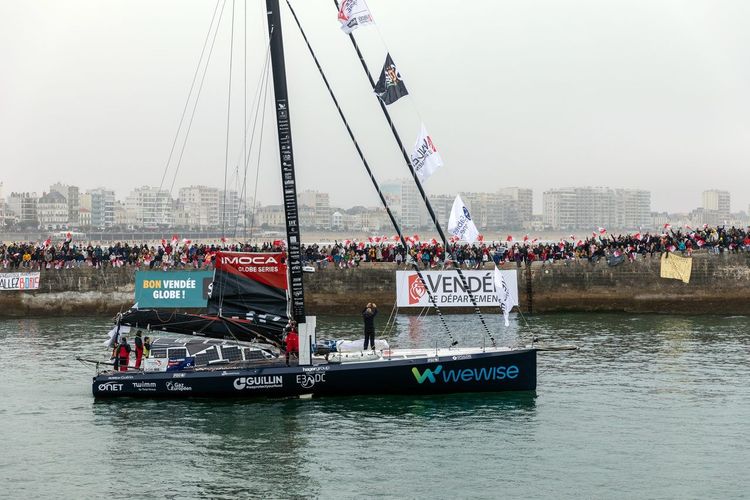
It is impossible to talk about Les Sables d'Olonne without mentioning the Vendée Globe. This solo, non-stop, unassisted round-the-world sailing race has started and finished here every four years since 1989. It is one of the toughest events in world sailing, and its starting and finishing line sits right in front of the harbor channel, at what is locally known as the quai Garcie-Ferrande (Quai Garcie-Ferrande, 85100 Les Sables d'Olonne).
In race years, the city is transformed weeks in advance: a race village is set up in the harbor, pontoons welcome the competition monohulls, and hundreds of thousands of visitors come to see the skippers before their great departure. The finish, around three months later, sometimes draws even larger crowds, in an atmosphere of jubilation that bears no resemblance to the usual quiet of the harbor out of season.
Even outside race years, the imprint of the Vendée Globe remains visible: statues and commemorative plaques along the quay, street names dedicated to former winners, specialist boatyards focused on building racing yachts established in the harbor. Several boat preparation teams based in Les Sables d'Olonne work on IMOCA monohulls as well as more modest sailing boats, making the city a recognized technical hub across the entire world of ocean racing.
The current solo round-the-world record stands at around 64 days at sea, set by Charlie Dalin in the 2024–2025 edition — a performance that would have seemed unthinkable in the early editions, when some competitors took over three months to complete the course. Between editions, skippers continue to train off Les Sables d'Olonne, and it is not unusual to spot a lone IMOCA skimming past the Remblai on a weekday morning, far from any official competition.
For visitors, several opportunities exist to get closer to this world outside of race years: boatyard visits by appointment, temporary sailing exhibitions, and simple walks along the pontoons to observe the boats moored at the quay.
Beaches around Les Sables d'Olonne
Beyond the Grande Plage, several other beaches dot the municipal coastline, each with its own character.
The plage de Tanchet, south of the Remblai, borders the Tanchet water park and attracts mainly families thanks to gentler waves and the proximity of the area's campsites. It is also the classic starting point for introductory dinghy sailing or paddleboarding lessons, with instructors making use of the sheltered water.
Further south still, the plage des Granges marks the beginning of the Vendée Corniche, the rocky coastline that stretches toward Talmont-Saint-Hilaire. Sand gradually gives way to rocks here, and the atmosphere turns wilder: fewer people, more surfers.
Also along this coastline is the Puits d'Enfer (Corniche vendéenne, 85100 Les Sables d'Olonne, rated 4.6/5 on Google with 5,403 reviews), a spectacular rocky cleft where the ocean surges in with a roar at every tide — particularly impressive in rough seas. A coastal path runs along the cliff edge and allows you to reach the site on foot from La Chaume, about an hour's walk depending on your pace.
If you're looking for peace and quiet, these southern beaches often offer an ideal compromise: close enough to the center to reach by bike, yet far enough to escape the summer crowds of the Remblai. Unlike the Grande Plage, some of them allow dogs year-round — a detail worth knowing if you're traveling with a four-legged companion. Parking is also easier there than in the town center, with free car parks outside the months of July and August.
Nature and Sport: Forest, Golf, and Water Sports
The territory of Les Sables d'Olonne is not limited to the seafront. To the north, the forêt d'Olonne (Route Bleue, 85340 Olonne-sur-Mer, rated 4.8/5 on Google with 69 reviews) stretches across several hundred hectares of pines and dunes between the ocean and the marshes. Cycling paths and marked trails allow you to cross it on foot or by bike, with a few viewpoints over the salt marshes restored as a nature reserve.
On the sporting side, the golf international des Sables d'Olonne in Olonne-sur-Mer offers a links-style course where the sea wind quickly becomes every player's main opponent. Booking is advised in high season, though the practice area remains accessible without a reservation on weekdays.
On the water, the city has built a genuine nautical tradition beyond the Vendée Globe: sailing schools for children and adults, surf spots on the Corniche on swelly days, paddleboard and kayak rental on the Tanchet water park. More experienced surfers often prefer the beaches further south, where the waves are more consistent than in the center.
For those who enjoy low-effort outings, a simple walk from the Remblai to the harbor and on through the forest covers the city's main landscapes in half a day, from dune to marshland via the fine beach sand. The city also hosts several sporting events each year — beach runs and regattas open to amateurs — which take place on the same playground used by Vendée Globe professionals. Local clubs also offer week-long courses for children during school holidays, a practical option if you want to keep the whole family busy without improvising a daily schedule, before heading to La Rochelle for Ryo's audio-guided tour The White City, for the more urban leg of the trip.
Where to Eat: Local Gastronomy in Les Sables d'Olonne

It is hard to visit a port city without talking about its food. In Les Sables d'Olonne, restaurant menus naturally revolve around fish and seafood, with a noticeable difference between the addresses on the Remblai — more touristy and often more expensive — and those in La Chaume or the town center, which are generally more affordable.
The central market halls remain the best starting point for discovering local produce: sole, langoustine, sardines in autumn, but also mogettes — those Vendée white beans traditionally served with ham — and the Vendée brioche, to take away for the next morning's breakfast.
On the Remblai, several terraces prioritize the view over the originality of their menus, which still makes for a good compromise for a simple lunch facing the Grande Plage. In La Chaume, small fishmonger-cum-restaurant spots often offer a daily set menu based on the fish landed that very morning — a quality-to-price ratio that is generally more attractive.
For those with a sweet tooth, several patisseries in the town center keep alive old local recipes, some of them featuring sea salt and caramel — a nod to the region's former salt-harvesting activity. Booking becomes necessary from June onward at the most popular addresses on the Remblai, especially at weekends, whereas in La Chaume it remains easier to find a table even in peak season, as long as you arrive early. Some restaurateurs deliberately limit their menu to four or five dishes based on the day's catch — generally a reliable sign of freshness rather than a lack of choice.
Where to Stay: Hotels, Campsites, and Rentals
Your choice of accommodation will depend largely on which neighborhood you're aiming for. On the Remblai, seafront hotels offer the most sought-after views, at rates that climb sharply in July and August.
In La Chaume, a handful of guesthouses and short-term rentals lean into the calm and charm of the fishermen's quarter, often just a few minutes' walk from the harbor without the seafront price tag.
Around Tanchet and the forêt d'Olonne, campsites dominate the accommodation offer, ranging from the most basic to the most fully equipped with pools and children's clubs — a popular choice for families coming for a full week rather than a weekend.
Finally, the town center remains a good base for those who want to do everything on foot: the market halls, the harbor, and the Remblai are all within ten minutes, with no need for a car once you're there. Book early if your stay falls during school holidays or a Vendée Globe departure year — the city fills up several weeks in advance during those specific periods.
Prices can vary noticeably from one street to the next: just a few hundred meters from the Remblai, without a direct sea view, the same level of accommodation can cost half as much. Comparing several neighborhoods before booking is often the best approach to balancing budget and location, especially if you plan to explore the city on foot rather than by car.
Day Trips from Les Sables d'Olonne
Once you've covered the essentials of the city, several day trips allow you to broaden your visit without traveling too far.
About twenty minutes to the south, Talmont-Saint-Hilaire preserves the ruins of an 11th-century medieval castle where Richard the Lionheart is said to have stayed, according to local tradition. The site can be visited in just under an hour, with some costumed activities in summer.
Further afield, about an hour and a half by road, the Puy du Fou theme park draws millions of visitors each year for its open-air historical shows. The distance makes it better suited to a full dedicated day, planned separately from the rest of your stay in Les Sables.
To the south, the Vendée Corniche continues beyond the Puits d'Enfer toward Jard-sur-Mer and its wilder beaches, popular with surfers and lovers of long coastal walks away from the Remblai crowds.
Ryo also offers audio tours in certain nearby towns — handy if you make it to Talmont-Saint-Hilaire or further along the coast during your stay: the same principle of contextual audio guidance applies from one destination to the next.
For nature lovers, the Marais poitevin is accessible in just under an hour's drive to the south — a complete alternative for a beach-free day, combining boat trips and birdwatching. These excursions pair well with a stay of a week or more in Les Sables d'Olonne: two or three days are generally enough to cover the city itself, leaving the rest of the trip for these further-afield escapes, especially if you're traveling with a family and looking to alternate beach time with cultural visits.
Weather and Best Season to Visit
Les Sables d'Olonne enjoys a temperate oceanic climate, with mild winters and summers that are rarely scorching, thanks to the proximity of the Atlantic. Summer temperatures generally hover around 22 to 25 degrees Celsius during the day, with seawater that stays cool even in midsummer compared to the Mediterranean.
Spring and early autumn are often underestimated: fewer people on the beaches, generally clement weather, and accommodation rates significantly lower than in July and August. May and September are particularly well suited to those who prioritize walking and heritage over swimming.
In winter, the city takes on a different face: the Remblai empties, the wind picks up along the Corniche, but the harbor keeps going and some businesses stay open year-round — unlike other seaside resorts that close completely out of season. It is also the period when skippers and boatyards are at their most active, preparing for the Vendée Globe.
Before you go, it's worth checking the local forecast closely rather than the regional weather: wind, which is very present on the coast, can shift the perceived temperature by several degrees from one hour to the next, especially on the Remblai directly exposed to the elements.
Practical Information: Postal Code, Population, and Transport
A few useful reference points for planning your visit. The postal code for Les Sables d'Olonne is 85100, valid across the entire new municipality since the 2019 merger.
In terms of population, the city currently has nearly 45,000 permanent residents — a figure that can triple or quadruple in the height of summer with the influx of holidaymakers, which explains the pressure on parking and accommodation in July and August.
To reach the city, Les Sables d'Olonne train station is served by direct trains or connections from Nantes, La Roche-sur-Yon, and Paris-Montparnasse depending on the season. By car, the A83 motorway and then the expressway connect the city to Nantes in just over an hour.
Once there, the town center, the Remblai, and La Chaume are easy to navigate on foot or by bike, with an urban bus network that supplements travel to more outlying neighborhoods such as Tanchet or Château-d'Olonne. In summer, cycling or walking is preferable for short trips: traffic becomes heavy on the roads leading to the Remblai.
The tourist office, located right in the town center just steps from the market halls, is the simplest place to pick up a paper map, book a tour of the fish auction hall or the lighthouse, or simply ask about tide times before a walk on the Corniche. Opening hours are extended in high season, with reduced hours for the rest of the year.
FAQ
What is the weather like in Les Sables d'Olonne?
The climate is oceanic and temperate year-round, with mild summers around 22 to 25 degrees Celsius and rarely harsh winters. Wind, which is frequent along the coast, can make temperatures feel cooler than the thermometer suggests, especially on the Remblai directly exposed to the ocean.
What is the postal code of Les Sables d'Olonne?
The postal code is 85100 for the entire municipality, which has included the former communes of Sables-d'Olonne, Olonne-sur-Mer, and Château-d'Olonne since 2019.
Where is Les Sables d'Olonne on the map?
The city is located on the Atlantic coast of the Vendée department, in the Pays de la Loire region, about an hour's drive from Nantes and La Rochelle.
What can families do in Les Sables d'Olonne?
The Grande Plage and the Tanchet water park are well suited to children thanks to calm waters, while the forêt d'Olonne offers easy cycling trails. The harbor and the passeur ferry between the Remblai and La Chaume are also very popular with younger visitors.
What are the neighborhoods of Les Sables d'Olonne?
The city is mainly divided between the town center, the Remblai seafront, La Chaume on the other side of the harbor, as well as Château-d'Olonne and Olonne-sur-Mer, two former communes now merged into the city.
What is the population of Les Sables d'Olonne?
The municipality has nearly 45,000 permanent residents, a figure that rises sharply during the summer season with the influx of holidaymakers.
How do you visit the harbor of Les Sables d'Olonne?
The fishing harbor can be walked freely along the quays, with guided tours of the fish auction hall organized on certain mornings through the tourist office. The quai Garcie-Ferrande, the starting point of the Vendée Globe, is just a few minutes' walk from the town center.
Les Sables d'Olonne: a City to Experience at the Rhythm of the Sea
Les Sables d'Olonne resists being summed up in a single image. You come for the beach and the Remblai, and you leave more often than not with the memory of the harbor, of La Chaume, or of a plate of sole shared after a day's walk on the Corniche. Few cities of this size combine such a firmly established seaside identity with such a concrete maritime roots — kept alive by a still-active fishing harbor and the prestige of the Vendée Globe.
Whether you come for a weekend or a full week, it's best to accept that you won't see everything: choose one neighborhood as your base, and explore another the next day, rather than trying to tick off every beach and museum in forty-eight hours. The city lends itself far more to a slow pace than to a tightly scheduled itinerary.
Before you set off, open the Ryo app: the audio tour guides you from the Remblai to La Chaume, one commentary at a time, and lets you understand as you walk what this guide can only summarize on paper. A way to turn a simple seafront stroll into a real lesson in local history — headphones on, sand underfoot.
À lire également