© Shutterstock
 Votre guide Ryo
Belleville in Paris: Complete Neighborhood Guide for 2026
At 128.5 meters above sea level, on an ordinary sidewalk on rue du Télégraphe, lies the highest point of all public space in Paris intra-muros. Not the Butte Montmartre, contrary to what the postcard image would have you believe, but the neighborhood of Belleville, straddling the 10th, 11th, 19th, and 20th arrondissements. Searching for "quartier Belleville Paris" in a search engine returns as many walking guides as questions about its Chinatown or its reputation as a rough neighborhood: this former village annexed in 1860 long existed on the margins of mainstream tourist circuits, shaped by successive waves of immigration — Armenian, Kabyle, Eastern European Jewish, then Chinese and Vietnamese — that made it one of the most diverse spaces in the capital.
Here, a park offers one of the finest free panoramas over Paris without ever appearing in mainstream guidebooks, an entire street serves as an open-air gallery for street artists, and a village of low, flower-draped houses survives, wedged between two boulevards, atop former gypsum quarries. This guide covers the must-see spots in the Belleville neighborhood, its history, its sometimes exaggerated reputation as a "rough neighborhood," and the best ways to explore it on foot. To extend your walk through the rest of the capital, the Ryo audio-guided tour of Paris connects Belleville to the city's great classics.
Belleville: the History of a Working-Class Neighborhood Turned Cosmopolitan
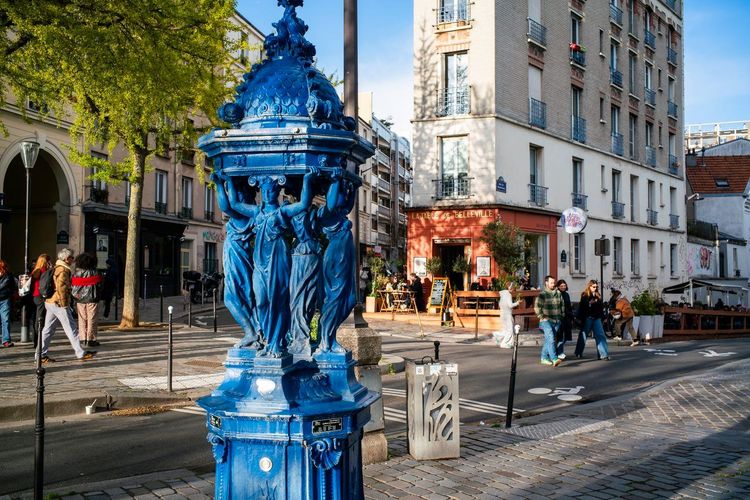
Before becoming part of Paris, Belleville was a village perched on one of the region's highest hills, surrounded by vineyards and open-air cafés where Parisians would come on Sundays to drink a glass of wine, away from the taxes on alcohol levied inside the city walls. The annexation of 1860 brought the commune of Belleville, along with Ménilmontant, into the capital: its territory was divided between the newly created 19th and 20th arrondissements, while common usage stretches the neighborhood's name to the edges of the 11th and 10th. The gypsum and plaster quarries that still run beneath the neighborhood supplied much of the building material for the neighboring Haussmannian Paris.
The 20th century transformed Belleville into an arrival point for several waves of migrants. Ashkenazi Jews fleeing pogroms in Eastern Europe settled around rue Julien-Lacroix as early as the 1900s. Survivors of the Armenian genocide followed in the 1920s. After Algerian independence in 1962, Sephardic and Kabyle families joined the neighborhood in turn. From the late 1970s onward, Teochew Chinese, Vietnamese, and Cambodian refugees fleeing the Khmer Rouge and the Vietnam War settled along rue de Belleville, giving rise to a Chinatown less well known than that of the 13th arrondissement but equally vibrant.
A persistent local legend holds that Édith Piaf was born on the sidewalk at 72 rue de Belleville on December 19, 1915, because there was no time to reach the hospital. A plaque commemorates the event, even though official records indicate a birth at the Hôpital Tenon, a few streets away. Whatever the exact version: the Môme became the embodiment of the réaliste chanson that told of poverty and pride in the Parisian faubourgs, and Belleville made it a lasting identity, still visible today in street names and local commemorations.
Since the 2000s, artists, students, and young professionals have moved in, drawn by rents that remain more affordable than in central Paris. This gradual gentrification coexists, sometimes uneasily, with immigrant communities that have been established here for decades. The result is one of the capital's least uniform neighborhoods, where a Chinese grocery store stands next to a natural wine bar and a local mosque, without any one of these worlds truly erasing the others. The area's schools display a diversity of backgrounds rarely seen elsewhere in Paris, a direct reflection of a century of successive arrivals.
To grasp this history for yourself, the best moment is a Tuesday or Friday morning, when the market is held on boulevard de Belleville. Piaf rests today in the Père-Lachaise cemetery, a few metro stops away: the audio-guided tour dedicated to Père-Lachaise lets you extend your visit to her grave, one of the most flower-laden in the cemetery.
Where Does Belleville Begin and End? Administrative Landmarks
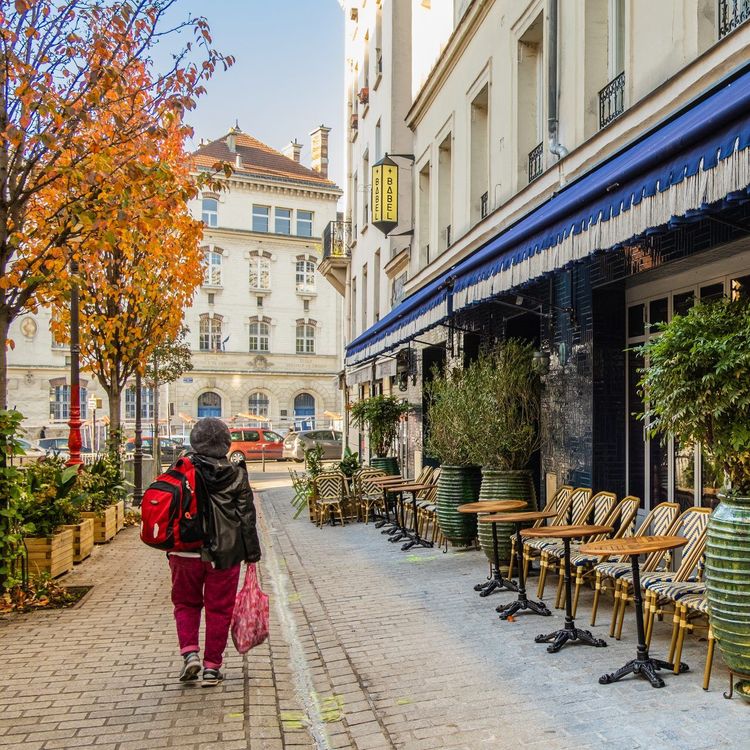
Unlike an arrondissement, Belleville has no single official boundary. Administratively, an "administrative quarter" of Belleville does exist, straddling the 19th and 20th arrondissements, but common usage expands the perimeter considerably. Boulevard de Belleville serves as the visual backbone, separating the 11th from the 20th, while rue de Belleville then climbs northeast into the 19th.
In practice, most Parisians place Belleville between the metro stations Belleville, Pyrénées, Jourdain, and Couronnes — a triangle that spreads well across four arrondissements (10th, 11th, 19th, 20th). This lack of a clear boundary explains why two residents of the neighborhood can good-naturedly disagree about whether they live "in" Belleville or simply "nearby."
The Parc de Belleville and Its Belvedere: the Finest Free Panorama in Paris
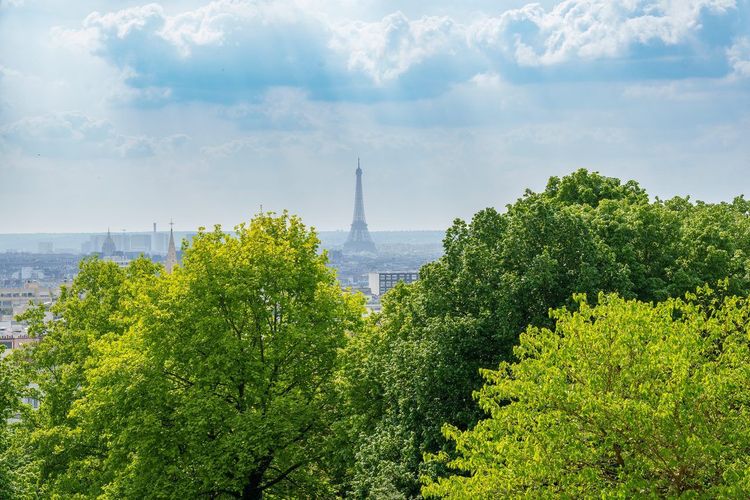
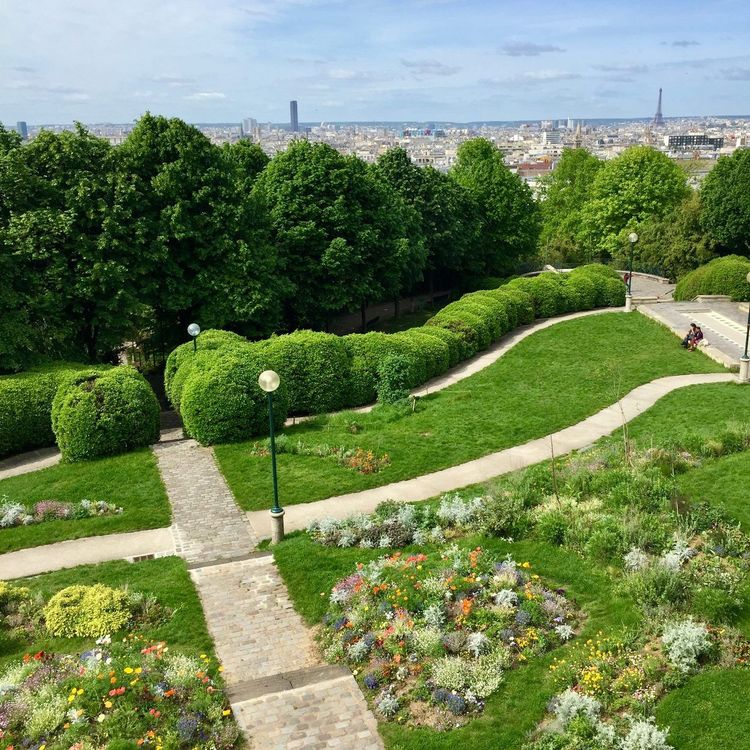
Opened in 1988 on the site of former quarries and 19th-century open-air cafés, the Parc de Belleville (Rue Piat, 75020 Paris, rated 4.2/5 on Google with 6,308 reviews) spreads its 4.5 hectares across a hillside so steep that its designers had to lay it out in successive terraces, connected by staircases and a cascade nearly a hundred meters long. The hilltop reaches 108 meters, one of the highest points in the neighborhood, surpassed only by the nearby rue du Télégraphe.
The belvedere at the top offers an unobstructed view over the rooftops of Paris and the Eiffel Tower in the distance. Unlike the Sacré-Coeur, there are no crowds or street vendors here: just a few benches, neighborhood joggers, and in the evening, groups picnicking as they watch the sun set over the capital. The spot retains the special status of a well-kept secret, even as it rivals the most photographed viewpoints in the city.
As you descend through the terraces, you will pass a small vineyard planted in 1992, a younger sibling of the one in Montmartre but far less famous. Around 140 pinot meunier vines produce a few dozen bottles of a neighborhood wine each year, harvested during a late-September festival in which residents take part as volunteers. The park also has a playground with a wooden village and ping-pong tables, an open-air theatre, and wide lawns open to the public from the first warm days.
If you can only visit one place in Belleville, make this park your priority. It encapsulates the neighborhood's identity on its own: working-class, hilly, overlooked by hurried visitors, yet infinitely generous to anyone who takes the time to climb up on foot from rue de Belleville.
Rue de Belleville: the Backbone of the Chinatown
Just over a kilometer long, rue de Belleville (Rue de Belleville, 75020 Paris) climbs from its junction with the boulevard of the same name up to the top of the neighborhood, near the Télégraphe metro station. It is the most commercially active artery in the entire area and the one with the strongest Asian presence in Belleville.
From the late 1970s onward, thousands of Teochew Chinese refugees from Cambodia, Vietnam, and Laos settled along this street and its surroundings, fleeing the Khmer Rouge and the aftermath of the Vietnam War. Unlike the Chinatown in the 13th arrondissement, organized around 1970s tower blocks, the one in Belleville nestled into the 19th-century fabric, making it less spectacular but often more surprising to discover for those who wander through without preconceptions.
You will find well-stocked Asian supermarkets, hair salons, traditional medicine practices, and a concentration of restaurants ranging from no-frills spots for under €15 to more polished Cantonese dining. The Chinese New Year, between late January and mid-February depending on the lunar calendar, brings a dragon and lion parade that is less publicized than the one in the 13th but equally colorful, with firecrackers, brass bands, and cultural associations processing up the street. Our Ryo article on events in Paris also lists the main dates not to miss in the capital.
Number 72 on the street bears the commemorative plaque marking Édith Piaf's birth, mentioned earlier: a reminder that this same artery has seen, within a century, the réaliste chanson of the faubourgs give way to the neon signs of Asian restaurants, without ever losing its working-class character.
For a first introduction to the neighborhood, walk up the street on foot from the Belleville metro station to the park of the same name: the real elevation gain is more than offset by the diversity of shop fronts you pass through in twenty minutes of walking.
Eating in Belleville: Asian Restaurants, Grocery Stores, and the Market
The Belleville market is held every Tuesday and Friday morning on the central strip of boulevard de Belleville, between the Belleville and Couronnes stations. It is one of the cheapest and most diverse markets in Paris: fruit and vegetable stalls at rock-bottom prices, fishmongers, Tunisian and Lebanese grocers, and stands selling knafeh or pastilla alongside clothing vendors.
On the restaurant front, Belleville's Chinatown is filled with addresses specializing in Teochew cuisine, Vietnamese pho soup, or Cambodian noodles. Prices remain well below the Parisian average, with a full meal rarely exceeding €13 to €15. Alongside these, a new generation of natural wine bars and neighborhood bistros has emerged in recent years around rue de la Villette and rue Rébeval, proof that Belleville now also draws a younger and more international clientele without having abandoned its working-class roots.
Street food lovers will find plenty to enjoy among the Vietnamese sandwich shops (banh mi) and Chinese pastry stalls selling steamed buns for a few euros. For a broader look at the capital's food scene, our Ryo article on Parisian culinary specialties makes a useful complement to this Belleville immersion.
One simple tip before you set off: come hungry and without a fixed plan. It is by wandering between the market stalls and restaurant fronts that Belleville reveals itself best, far more than in any guide.
Villas and Secret Passages: l'Ermitage, the Cité Leroy, and the Villa du Borrégo
Behind its ordinary facades, Belleville hides an entire network of cobbled alleyways, private villas, and workers' estates that most visitors never suspect even when walking past their entrances.
The Villa de l'Ermitage (Villa de l'Ermitage, 75020 Paris), which opens onto rue de l'Ermitage just steps from rue des Cascades, is perhaps the most photogenic. This cobbled lane lined with small one- or two-storey houses, often draped in ivy or Virginia creeper, has retained the atmosphere of a late-19th-century village, when it housed workers and craftspeople who had come to work in the nearby quarries.
Nearby, the Cité Leroy (Cité Leroy, 75020 Paris) lines up its low cottages behind iron gates, each facade competing in climbing plants and hanging flowerpots. The place remains year-round residential, which means a quiet, considerate manner is called for when visiting: observe, photograph with restraint, and do not linger in front of windows.
Further north, the Villa du Borrégo (Villa du Borrégo, 75020 Paris) completes this trilogy of hidden lanes. Less well known than the two previous ones, it takes its name — as does the neighboring street, named in 1864 — from the Battle of Cerro del Borrego won by French troops in Mexico in 1862, and retains its small individual houses with garden plots, an almost provincial urban form right in the heart of Paris intra-muros.
These three addresses share a common origin: built in the late 19th and early 20th centuries to house cheap labor on land from former quarries too unstable to support large buildings. They have since gentrified considerably, but their modest scale and irregular layout escaped the major Haussmannian works that standardized the rest of the capital.
You will have difficulty finding them without knowing their exact names: they often appear only as simple dead ends on mainstream maps. Allow about an hour to visit all three on foot, starting from the Jourdain station and descending toward Ménilmontant.
The Mouzaïa: the Village of Flowering Houses
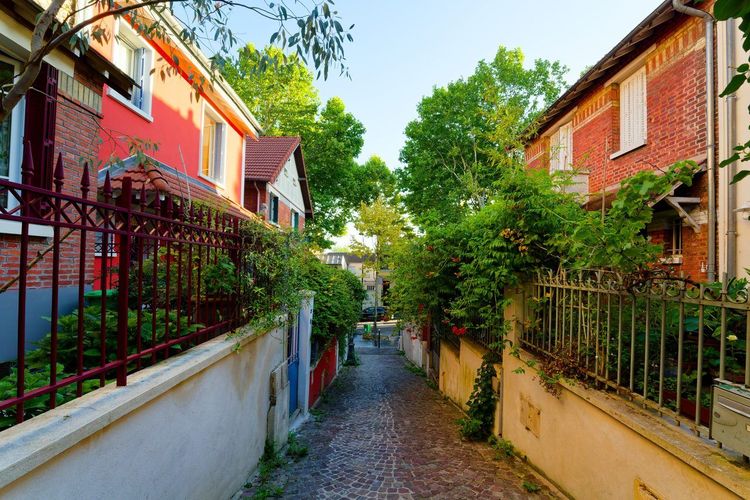
A little further northeast, in the 19th arrondissement, the Mouzaïa neighborhood takes this village-within-the-city idea even further. Its streets, several of which recall the military campaigns of the Second Empire beginning with rue de la Mouzaïa (Rue de la Mouzaïa, 75019 Paris) itself, are lined with small individual houses in millstone grit or brick, with garden plots and hollyhocks that spill over the pavement from May onward. Look in particular along rue de Bellevue, rue Miguel-Hidalgo, and the villas that branch off them like steps.
This type of housing exists here for the same reason as at l'Ermitage: the subsoil, riddled with former gypsum quarries, proved too fragile to support tall buildings after several collapses in the early 20th century. The city then authorized the construction of low houses — a decision that paradoxically protected the neighborhood from densification and gave it, a century later, a charm that has become highly sought-after on the Parisian property market.
The Mouzaïa is best visited on foot, wandering without a fixed route through lanes where car traffic is almost nonexistent. At weekends, do not be surprised to encounter more photographers than residents: the neighborhood has become a sought-after spot for wedding photo shoots and Instagram sessions, which in no way diminishes the pleasure of a weekday stroll, when the streets regain their quiet residential calm.
Rue Denoyez and Its Murals: the Capital of Parisian Street Art
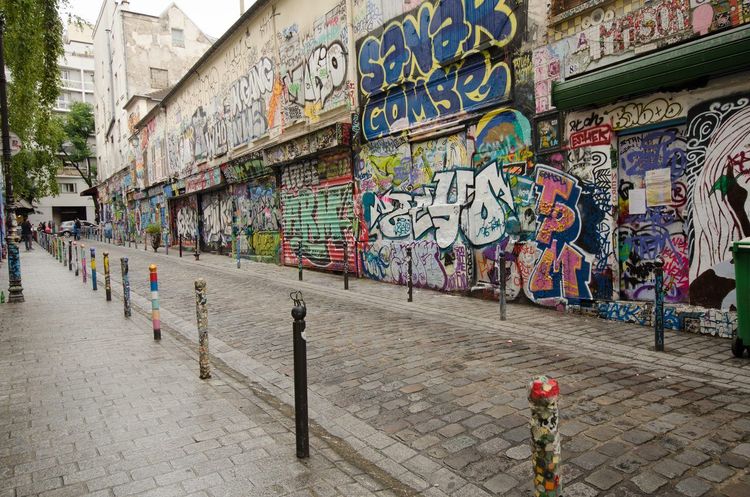
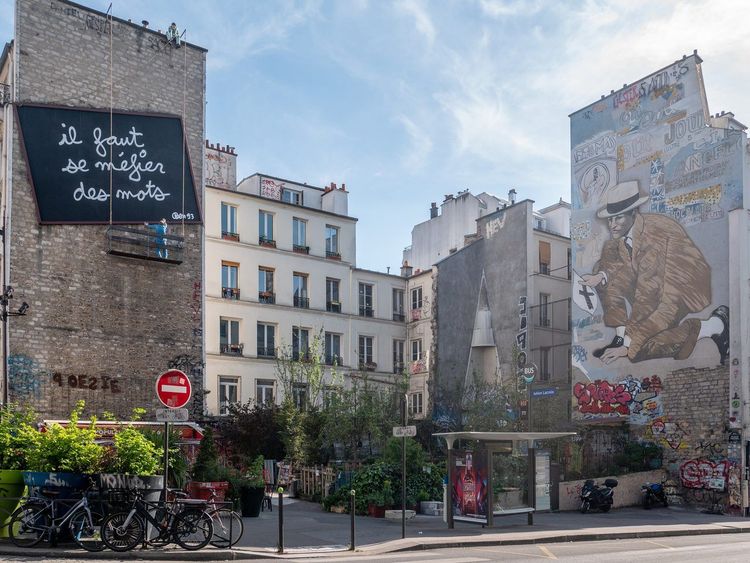
Rue Denoyez (Rue Denoyez, 75020 Paris, rated 4/5 on Google with 59 reviews), which runs from rue Ramponeau, a few meters from boulevard de Belleville, to rue de Belleville over barely 150 meters, functions as an open-air gallery in perpetual renewal. Every wall, every shutter, every garage door is covered in murals, tags, and stencils that change over the months, sometimes the weeks.
Unlike the commissioned, fixed murals found elsewhere in Paris, those on rue Denoyez operate according to a logic of layering: one artist paints over another's work, without authorization or schedule, making it virtually impossible to photograph exactly the same street twice. The collective of artists that animates the space occasionally organizes communal painting days, where any passerby with a spray can may, in theory, leave their mark.
The atmosphere deliberately contrasts with the calm of the neighboring villas: here, music drifts from windows, groups of friends settle on the pavements in the evening, and a few unmarked bars welcome a predominantly young crowd. The street is directly accessible from the Belleville and Couronnes metro stations, making it often the first stop on a visit to the neighborhood, before heading up to the park or along rue de Belleville proper.
If urban art interests you, note that Belleville organizes open artist studio tours every year — an additional opportunity to understand why this neighborhood remains one of the capital's most active creative hubs.
The Parc des Buttes-Chaumont: at the Gates of Belleville
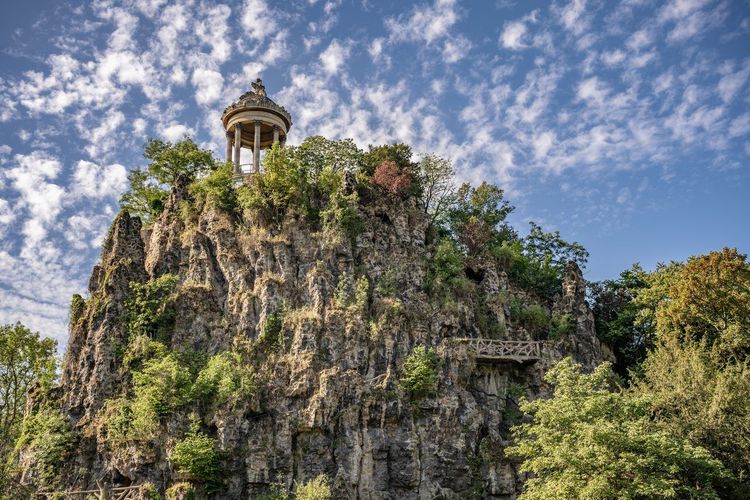
Although administratively part of the 19th arrondissement alone, the Parc des Buttes-Chaumont (Rue Botzaris, 75019 Paris, rated 4.6/5 on Google with 27,304 reviews) is fully part of any excursion to Belleville, bordering its northern boundary. At 25 hectares, it is one of the largest parks within Paris intra-muros and, for many neighborhood residents, their everyday garden.
Baron Haussmann and engineer Alphand laid it out for the Universal Exhibition of 1867, on a site that had accumulated poor reputations: former open-cast quarries and a knacker's yard. Alphand transformed this wasteland into a romantic landscape, with an artificial lake, a rocky island topped by the Temple de la Sibylle, inspired by the Temple of Vesta at Tivoli, and a suspension bridge overlooking an artificial grotto with a waterfall.
The sloping lawns, often packed from the first warm days, allow for picnicking with a backdrop of Montmartre and the Sacré-Coeur. The park also has a puppet theatre, several playgrounds, a climbing rock, and restaurants with terrace seating. Neighborhood joggers have made it their preferred training ground, thanks to sufficient elevation change to vary their pace without leaving Paris. If you are using the Ryo app during your visit to Paris, this stop naturally completes the audio-guided tour of Paris and its exploration of the capital's northeast.
Allow a good hour for a full leisurely loop, more if you climb up to the temple to enjoy the panorama. The main entrance on avenue Simon Bolivar is about ten minutes on foot from the Parc de Belleville, making it easy to chain both visits in the same afternoon.
The Butte Bergeyre: the Suspended Village
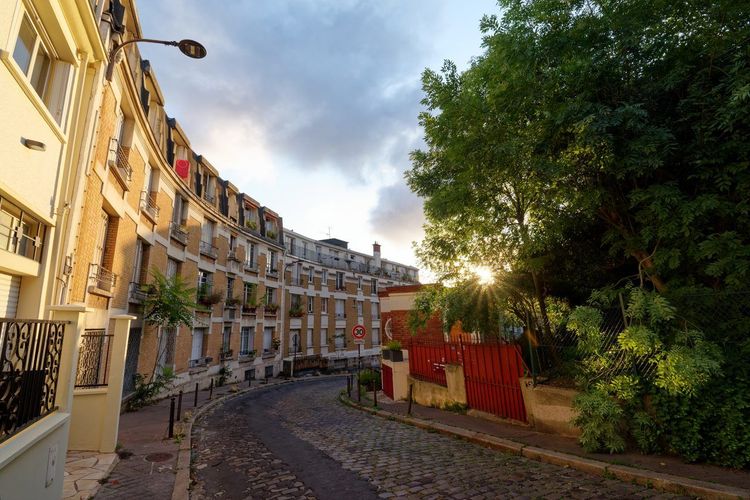
Perched above the Parc des Buttes-Chaumont, accessible via discreet staircases on rue Georges-Lardennois, avenue Simon-Bolivar, or rue Manin, the Butte Bergeyre (Rue Georges Lardennois, 75019 Paris, rated 4.4/5 on Google with 495 reviews) eludes virtually all visitors to Belleville, including those who think they know the area well.
Its name comes from the Stade Bergeyre, inaugurated in 1918 in honor of a rugby player killed during the First World War, then demolished as early as 1926 due to unstable ground. All that remains today is a handful of residential streets, a community garden created in 2002, and a vineyard — the clos des Chaufourniers — planted in pinot noir on a slope too steep to build on, producing around a hundred liters a year. From rue Georges-Lardennois, the view opens unobstructed onto the Sacré-Coeur and the Butte Montmartre, at eye level, without the crowds that permanently fill the basilica's forecourt.
The place remains above all a quiet residential neighborhood: you come here for the view and the silence, not for shops or street life, which are almost nonexistent. Half an hour is enough to explore it fully, making it a natural and quick extension of a visit to the Buttes-Chaumont, provided your legs are ready for the access staircase. Back in the heart of the capital, Paris's own audio-guided tour offers a livelier change of pace.
Churches and Places of Worship: Saint-Jean-Baptiste and Saint-Serge
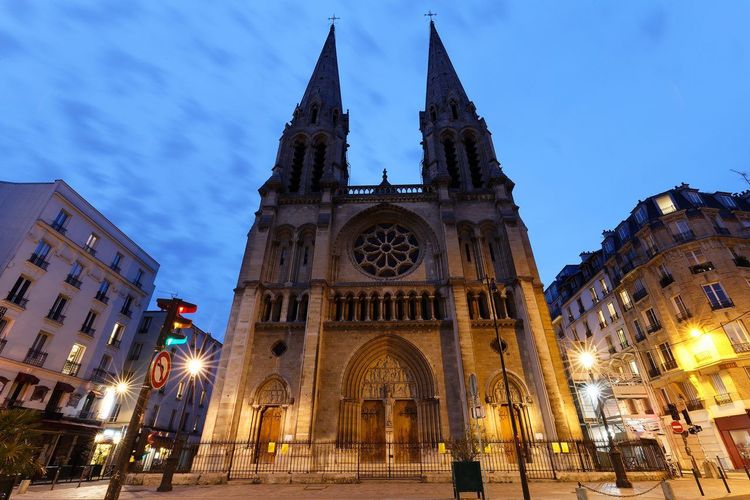
The église Saint-Jean-Baptiste de Belleville, built between 1854 and 1859 to designs by architect Jean-Baptiste Lassus in a neo-Gothic style, dominates the upper end of rue de Belleville with its two slender spires. It long served as a landmark for neighborhood residents before the installation of the major metro lines.
More discreet, the Orthodox church of Saint-Serge de Radonège (93 Rue de Crimée, 75019 Paris, rated 4.6/5 on Google with 114 reviews) occupies a former German Lutheran chapel from the 1860s, purchased at auction by Russian émigrés in 1924: the Saint-Serge Orthodox Theological Institute, the oldest in Western Europe, opened there the following year. Hidden in a sloping garden on rue de Crimée, with its wooden gallery and painted iconostasis, it ranks among the most distinctive places of worship in all of Paris.
Belleville at Night: Bars, Bistros, and Guinguettes
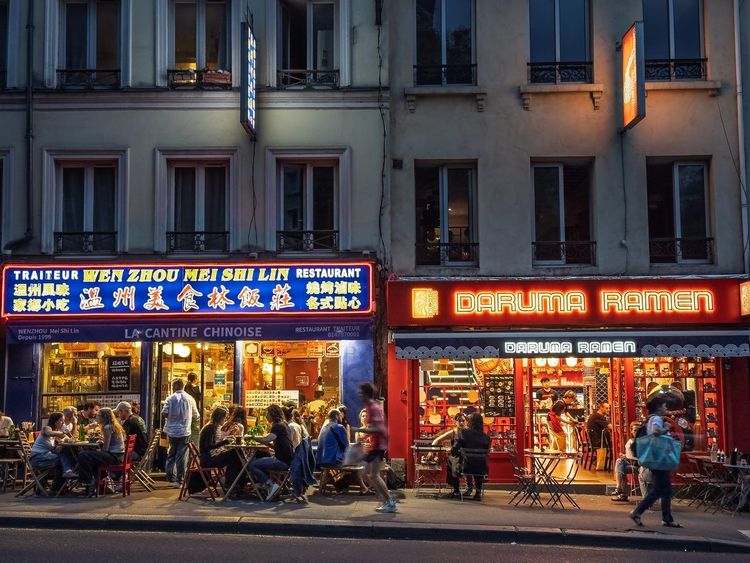
Once night falls, Belleville's energy shifts toward two main axes: rue Jean-Pierre-Timbaud, which extends the neighborhood toward Oberkampf, and the small streets around the Ménilmontant station.
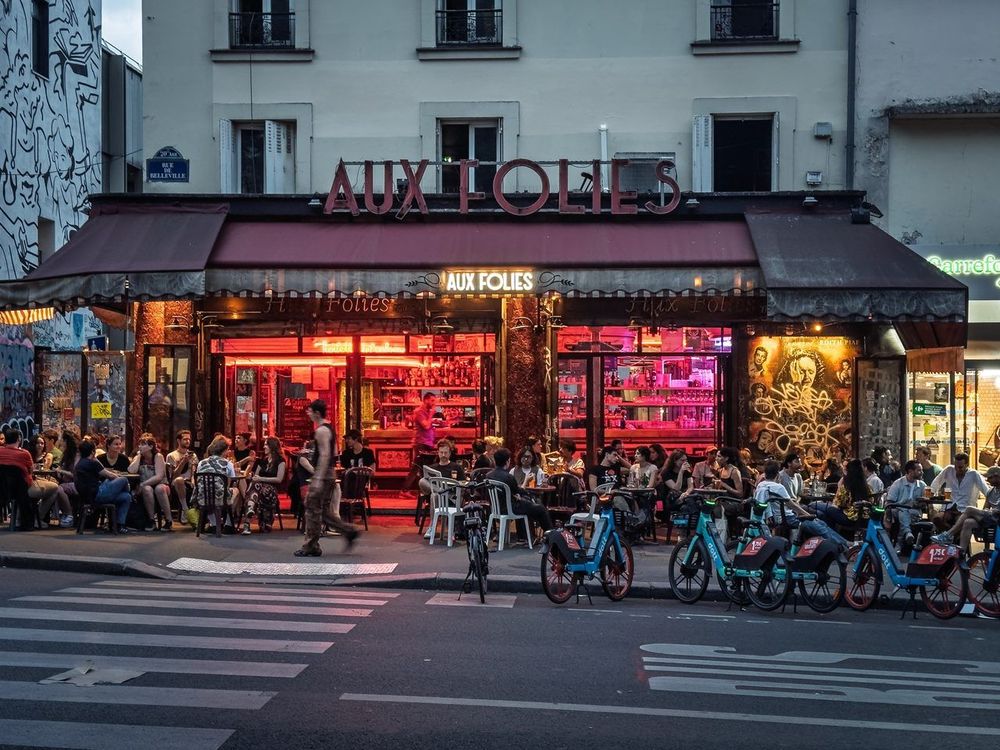
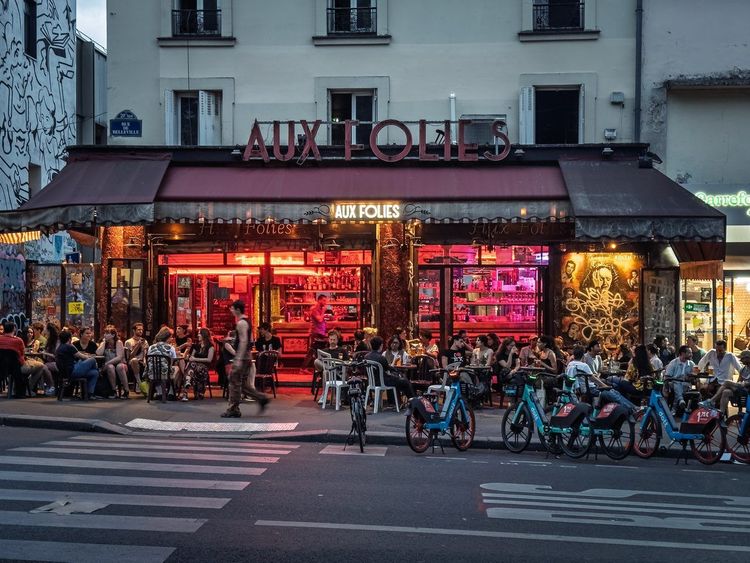
The bar Aux Folies, on the corner of rue de Belleville and rue Denoyez, has become over the decades an unmissable landmark: its terrace, always full from the first warm days, mixes long-standing regulars with newcomers drawn by prices still reasonable for Paris. A few minutes' walk away, a generation of natural wine bars and cocktail counters has developed without ever entirely displacing the older traditional cafés, giving the neighborhood's nightlife a character that is both rough-edged and convivial.
Music lovers will also find plenty to enjoy: several small associative concert venues and modestly sized clubs regularly host electro, jazz, and world music nights, in keeping with the area's cultural diversity. At weekends, the atmosphere remains more working-class and less touristy than the Marais or Oberkampf, with drink prices noticeably below the Parisian average. Some venues also put on impromptu midweek concerts, with no advance publicity, which you discover mainly by pushing the door open at the right moment.
One tip for enjoying this atmosphere without unpleasant surprises: stick to the busy streets already mentioned in the previous section, and avoid lingering alone late at night in some of the more out-of-the-way alleyways near rue de Tourtille. Nothing alarming, but the same common-sense precautions that apply anywhere in a large city apply here as much as everywhere else.
Shopping and Flea Markets: the Vintage Stores of Belleville
Beyond restaurants and bars, Belleville nurtures a scene of consignment shops and vintage clothing stores that has been drawing visitors from across Paris for a few years now. Rue Ramponeau and its surroundings concentrate several vintage clothing boutiques, often run by young designers who have set up in formerly vacant commercial premises.
On Sunday mornings, an informal flea market regularly sets up around boulevard de Belleville, where local residents and occasional dealers spread out old crockery, vinyl records, and second-hand clothing directly on the pavement. The atmosphere is relaxed, far from the Puces de Saint-Ouen and their tourist prices: here, bargaining still comes naturally and good finds are plentiful for anyone who takes the time to dig through.
A few craftspeople's workshops — ceramicists or upholsterers — have also taken advantage of the still-moderate commercial rents to set up in the neighborhood, often visible from the street through large windows open onto the workshop floor. This local economy, less visible than the restaurants or bars, usefully completes the picture of a neighborhood that has managed to preserve an artisanal activity that central Paris has largely lost.
Belleville in Culture: Chanson, Cinema, and Community Life
Beyond Édith Piaf, Belleville has nourished an entire strand of French réaliste and popular song. Charles Trenet was already singing "Ménilmontant" in the late 1930s, a neighboring and twin neighborhood to Belleville in the popular imagination.
Animated cinema has also paid it tribute: the film Les Triplettes de Belleville, released in 2003 and nominated for the Oscars, draws freely on the atmosphere and topography of the neighborhood, even if the city it depicts remains largely fantastical. More recently, several rap and urban music artists from the area claim Belleville as an identity marker in their lyrics, perpetuating in their own way the tradition of the faubourgs chanson.
The community fabric remains particularly dense for a neighborhood of this size: artist studios, neighborhood collectives, traders' associations, and heritage protection groups take turns throughout the year. The most anticipated event remains the Portes Ouvertes des Ateliers d'Artistes de Belleville (Open Studios of Belleville Artists), several days of free visits organized every spring since the early 1990s by the association of the same name, allowing visitors to enter studios that are normally closed to the public, often tucked away in former 19th-century craftsmen's premises.
This discreet cultural life, far from the museum institutions of central Paris, explains why Belleville continues to attract artists despite the gradual rise in rents observed over the past fifteen years.
Rough Neighborhood or Lively Neighborhood? What You Need to Know
The search query "belleville quartier chaud" (Belleville rough neighborhood) recurs regularly, the legacy of a reputation built up in the 1980s and 1990s, when the neighborhood concentrated more visible poverty and street-level dealing than it does today.
The current reality is considerably different. Belleville remains a working-class neighborhood, with a greater degree of social diversity than the Parisian average, but its safety indicators are not structurally different from those of neighboring areas in northeastern Paris. The points of vigilance most frequently cited by residents concern mainly the surroundings of certain metro stations late at night — as anywhere in a large metropolis — rather than any generalized danger specific to the neighborhood.
What strikes visitors more is the sometimes abrupt social contrast from one street to the next: a modern restaurant frontage can stand next to a local grocery store unchanged for thirty years. This juxtaposition, rather than a sign of danger, reflects the uneven gentrification of the neighborhood, more advanced near the Parc de Belleville and the Mouzaïa, more tentative around boulevard de Belleville and rue de Tourtille.
In practice, a daytime visit presents no particular difficulty, and the great majority of the places detailed in this guide — park, villas, market — can be visited in complete peace during normal opening hours. In the evening, simply stick to the busy streets already mentioned in the previous section — a precaution that applies in any working-class neighborhood of a large city.
How to Get to Belleville and Get Around
Three metro lines serve the heart of the neighborhood directly: Belleville (lines 2 and 11), Pyrénées and Jourdain (line 11), as well as Couronnes and Ménilmontant (line 2) on its edges. None of these stations is more than ten minutes' walk from the others, making walking entirely feasible for moving between the main points of interest.
A self-service bicycle remains a worthwhile option for climbing rue de Belleville without effort, as long as you accept the sometimes steep descent on the way back. Several bus lines usefully supplement the network for longer journeys toward central Paris, a practical alternative in rainy weather.
Where to Stay and When to Visit Belleville
Belleville has few upscale hotels but several decent addresses at moderate prices, particularly around the Ménilmontant station, as well as a growing supply of short-term rentals in the residential streets near the park. Staying here allows you to enjoy the neighborhood early in the morning and late at night, outside standard visiting hours.
Seasonally, spring (April to June) remains the most pleasant time to enjoy the Parc de Belleville and the Buttes-Chaumont in bloom, with still-moderate temperatures for climbing the hilly streets. Autumn, between mid-September and October, offers a particularly photogenic light on the park terraces and often coincides with the harvest of the neighborhood's small vineyard.
Avoid July and August if possible for midday walks, as the heat makes the neighborhood's elevation changes more grueling, and opt for the Tuesday or Friday morning market for a full immersion.
FAQ
Is Belleville Paris's Chinatown?
Belleville is home to one of Paris's two main Chinatowns, alongside the one in the 13th arrondissement. Established from the late 1970s onward, the Teochew Chinese, Vietnamese, and Cambodian community settled along rue de Belleville. More diffuse within the older buildings than in the 13th, it is equally lively with restaurants, grocery stores, and Lunar New Year celebrations every winter.
Is Belleville a Rough or Dangerous Neighborhood?
The reputation as a "rough neighborhood" dates mainly from the 1980s and 1990s. Today, Belleville is not structurally more dangerous than other working-class neighborhoods in northeastern Paris. A daytime visit presents no particular difficulty; in the evening, it is better to stick to busy streets like rue de Belleville or rue Jean-Pierre-Timbaud rather than isolated alleyways.
Which Arrondissement Is Belleville in?
Belleville does not belong to a single arrondissement: the neighborhood spans the 19th and 20th and slightly overlaps into the 11th and 10th. Boulevard de Belleville roughly marks the boundary between the 11th and 20th, while rue de Belleville then climbs toward the 19th, which explains the frequent confusion about its exact address.
What Is the Best Time to Visit Belleville?
Spring, from April to June, and early autumn, mid-September to October, offer the best conditions: moderate temperatures for climbing the hilly streets, parks in bloom or bathed in golden light, and an outdoor market that is pleasant to browse without intense heat or rain.
How Do You Get Around the Neighborhood and How Much Time Should You Allow?
The neighborhood is best explored on foot from the Belleville, Pyrénées, Jourdain, or Couronnes metro stations. Allow half a day for the highlights (Parc de Belleville, rue de Belleville, rue Denoyez) and a full day to add the Buttes-Chaumont, the Butte Bergeyre, and the Mouzaïa at a relaxed pace.
Is Belleville Worth a Visit?
Yes, as long as you do not expect a classic tourist neighborhood with signposted monuments. Belleville appeals most to visitors curious about real Parisian diversity, offering free panoramic views and a food scene accessible on a small budget.
What Should You See First in Belleville in Half a Day?
With only a few hours, focus on the Parc de Belleville and its belvedere, rue de Belleville down to the market, and rue Denoyez for the street art. These three stops connect naturally on foot in about two and a half hours, with no additional transport needed.
Belleville cannot be summed up in a single postcard. It is at once the highest point of public space in Paris, a discreet Chinatown, a village of flowering houses suspended above former quarries, and an open-air street art gallery that changes face every season. This layering of histories — working-class, migratory, artistic — makes it one of the rare Parisian neighborhoods where you can still get pleasantly lost without a fixed itinerary and stumble upon an unexpected discovery.
For a first visit, keep the essentials in mind: head to the Parc de Belleville at the end of the day for the panorama, walk along rue de Belleville on a market day for neighborhood life, and push on to the Buttes-Chaumont or the Mouzaïa if time allows. No reservation, no entrance ticket is needed for the vast majority of these stops, making it an excursion as rich as it is economical on the scale of Paris.
To extend your exploration beyond Belleville, the Ryo audio-guided tour of Paris connects the capital's great sites at a similar pace, with historical commentary throughout. Belleville, with its hidden alleyways and its past as an annexed village, ideally completes this panorama of a city that reinvents itself without ever turning its back on its margins.
À lire également