© Shutterstock
 Votre guide Ryo
Weekend in Siena: Complete 2-Day Itinerary Between Piazza del Campo, Duomo and Chianti (2026)
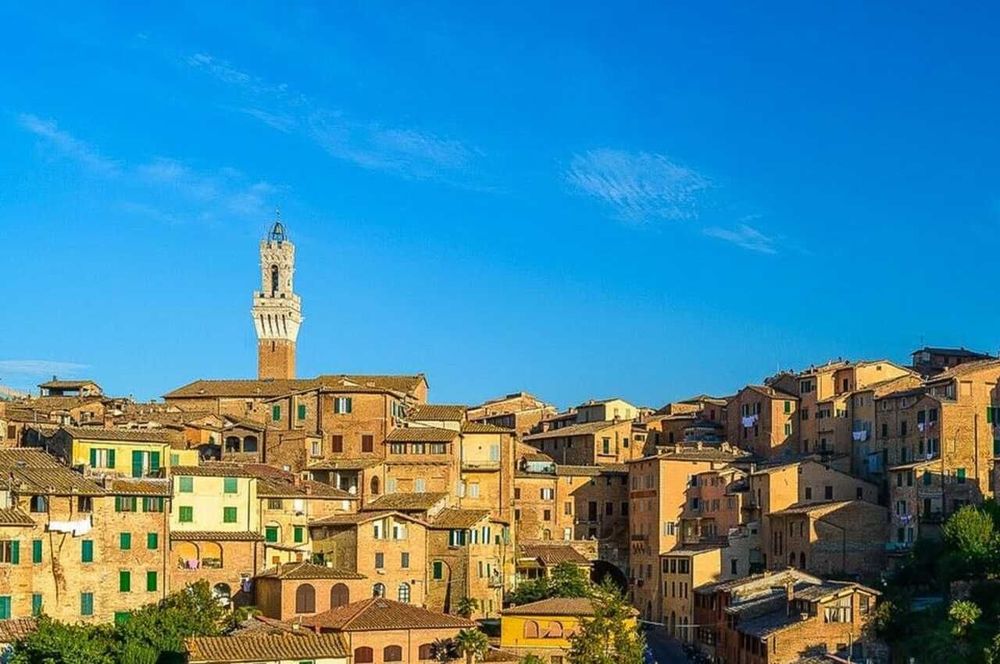
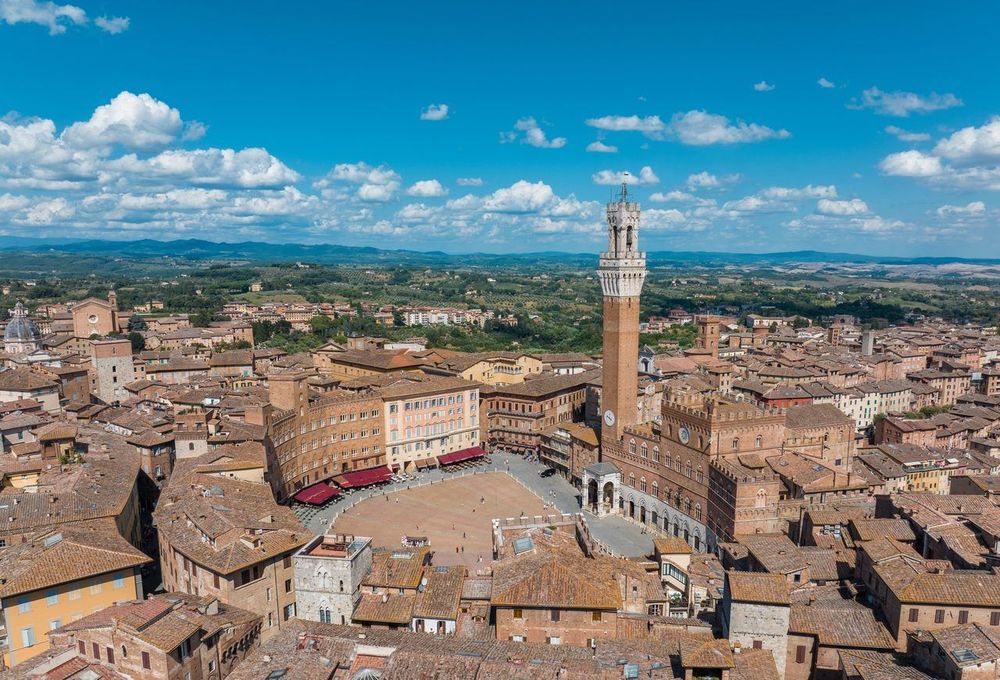
Siena lost its centuries-old rivalry with Florence, and it may be the best thing that ever happened to it. While its neighbor grew rich and expanded from the 15th century onward, Siena stayed frozen in its medieval layout, red brick and fanning lanes, as if time had given up on entering. The Ryo audio-guided tour of Siena begins right on the Piazza del Campo, this shell-shaped square where nine bands of paving stones converge toward the Palazzo Pubblico.
In a weekend in Siena, you climb about 400 steps up an 87-meter tower for a panorama over the Tuscan hills, you look for a door that is open only a few months a year at the top of the cathedral, you eat hand-rolled pasta made without any machine for generations, you walk through a medieval hospital turned museum, and you discover that the city still hides kilometers of hand-dug channels beneath its paving stones. Two days are enough to cover the essentials of the historic center, a UNESCO World Heritage Site since 1995, and to understand why the city's seventeen districts, the contrade, still compete every summer in a horse race as a matter of honor. The rest of this article follows a day-by-day itinerary, from the monumental center to the Chianti hills, with places to eat and sleep and practical information to organize your stay.
Day 1: The Piazza del Campo, the Palazzo Pubblico and the Torre del Mangia
The Piazza del Campo and the Palazzo Pubblico
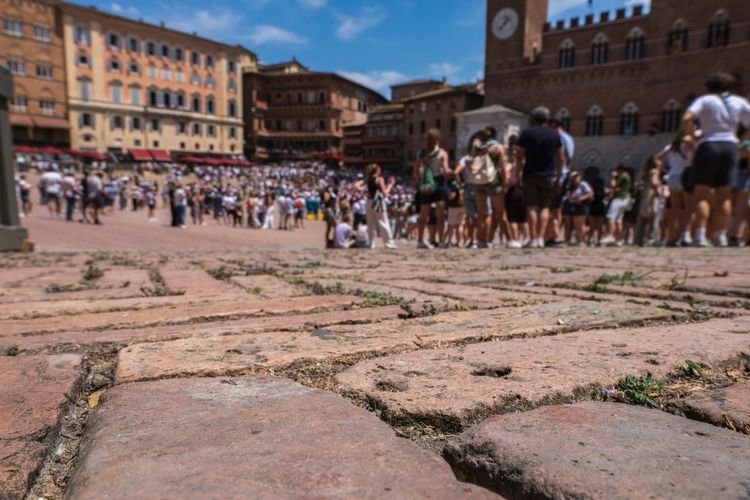
Everything begins here, and it is no accident. The Piazza del Campo slopes gently toward its lowest point, in front of the Palazzo Pubblico, in a design intended from the 13th century so that rainwater would drain naturally without ever flooding the surrounding houses. The ground is divided into nine sections of brick paving, a tribute to the Government of the Nine that ruled the Republic of Siena at its height, between 1287 and 1355.
Twice a year, on July 2 and August 16, this square becomes an improvised racetrack for the Palio, a race of ten bareback horses around the paved perimeter. The rest of the year, it is the place where the Sienese settle on the stone steps to chat, read or simply watch the light change on the facade of the Palazzo Pubblico, the town hall built at the turn of the 14th century.
You can enter the courtyard for free, but it is inside, at the Museo Civico (Piazza del Campo 1, 53100 Siena, Italy, rated 4.7/5 on Google from 2,173 reviews), that you will find the two works that justify the visit. The first is Simone Martini's Maestà, a 1315 fresco depicting the Virgin surrounded by her heavenly court. The second, in the Sala dei Nove, is Ambrogio Lorenzetti's Allegory of Good and Bad Government: two scenes painted in 1338 that compare a prosperous city under just administration with a city ravaged by tyranny. Art historians consider it one of the first great secular political frescoes in Western history, with no religious subject.
Take the time to study the "good government" part: craftsmen at work, dancing women in the street, peasants returning from the fields. It is one of the rare portraits so precise of a medieval city in daily life, and you will recognize certain silhouettes of Siena as you step out.
The Ryo audio-guided tour of Siena begins right on this square before running along the Palazzo Pubblico, with commentary on the Good and Bad Government frescoes before the climb up the tower. It is a simple way to miss nothing without depending on the schedule of a classic guided tour.
Climbing the Torre del Mangia and Visiting the Museo Civico
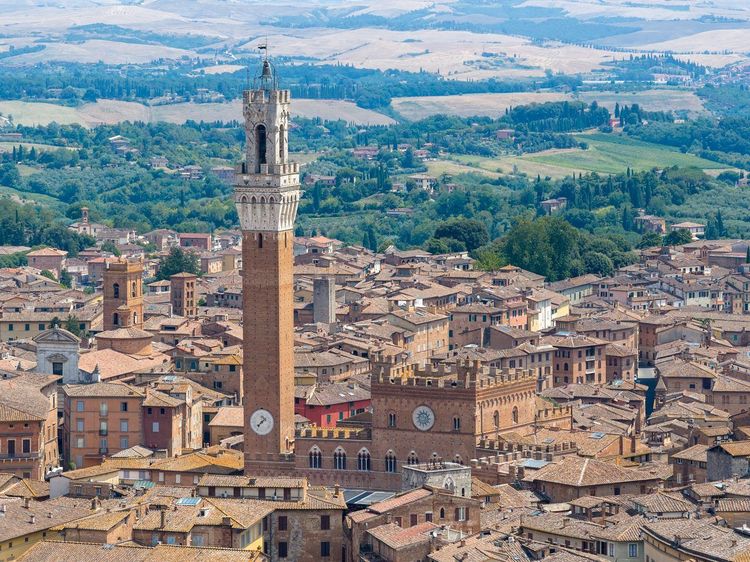
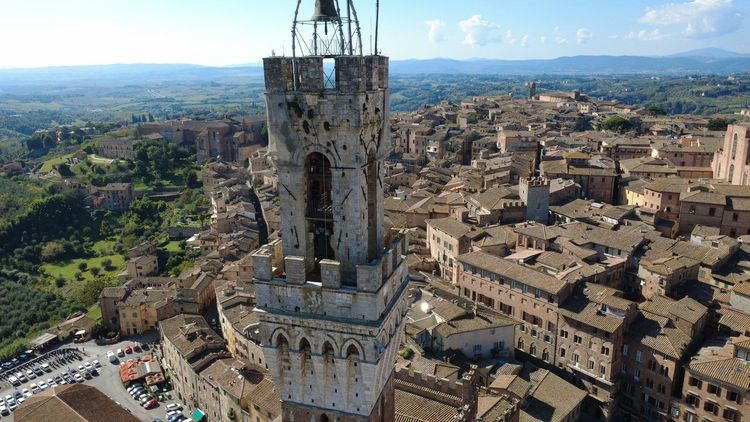
The Torre del Mangia rises to 87 meters, making it one of the tallest civic towers in Italy. Its name comes from a nickname, not a trade: the first bell ringer, known for squandering his wages on food, was called Mangiaguadagni, "he who eats his earnings." The statue representing him, worn by the centuries, still stands near the entrance.
The climb involves about 400 stone steps, in a narrow one-way staircase managed by hourly quotas in high season. Allow 20 to 30 minutes round trip, and wear closed shoes: some steps are uneven and worn down in the middle by seven centuries of footsteps. At the top, the reward is a 360-degree panorama over the city's tiled roofs and, in the distance, the first hills of Chianti.
Two practical tips before you go. First, get the combined Museo Civico + Torre del Mangia ticket (15 euros in 2026), or the triple ticket including Santa Maria della Scala (20 euros) if you plan to go the next day: it is significantly cheaper than separate tickets, and the first entry must then be through the tower. Second, the number of simultaneous visitors is limited and the tower ticket cannot be reserved: it is bought on the day at the ticket offices of the Museo Civico or Santa Maria della Scala. In July and August, show up right at opening, as afternoon slots go fast.
The Museo Civico can be visited in 45 minutes to 1 hour if you limit yourself to the main rooms, or in 1h30 to see everything in detail, including the old maps and the Risorgimento room. Many visitors settle for the Sala del Mappamondo and the Sala dei Nove, which is enough to grasp the essence of the collection without rushing.
Day 1: Siena Cathedral (Duomo) and Its Treasures
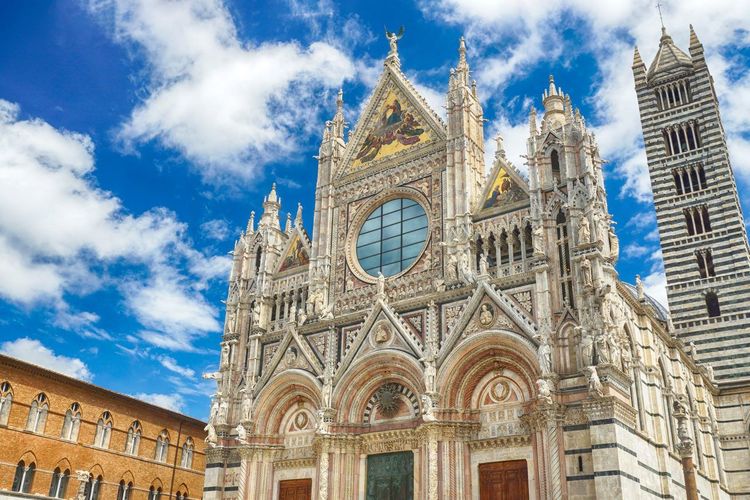
The Duomo, the Baptistery and the Unfinished Facade (Facciatone)
The Siena Cathedral, dedicated to Santa Maria Assunta, first strikes you with its stripes: alternating bands of white marble and greenish-black stone cover the entire facade and interior, a pattern echoing the black-and-white balzana on the city's coat of arms. The interior houses a marble inlaid floor unique in Europe, made up of 56 panels created between the 14th and 19th centuries by Sienese artists, including Domenico di Bartolo and the painter Pinturicchio.
This floor is only fully visible during the "pavimento scoperto" periods (in 2026, from June 27 to July 31 and then from August 18 to November 15); the rest of the year, part of it remains protected by boards to limit wear. If your weekend in Siena falls within this window, the ticket goes from 14 to 16 euros, but don't miss it: some panels, like Pinturicchio's Mount of Wisdom, show a graphic complexity rare for a floor.
Right next door, the Baptistery) nestles under the apse of the cathedral, at a lower level because of the slope of the land. Its treasure is the hexagonal baptismal font created collectively by Jacopo della Quercia, Donatello and Lorenzo Ghiberti between 1417 and 1431, three major sculptors of the Italian Renaissance brought together on a single work.
On the east side of the cathedral stands an isolated wall, tall and pierced with large empty arches: this is the Facciatone. This fragment of unfinished facade belonged to an expansion project launched in 1339 to turn the Duomo into one of the largest churches in Christendom. The plague of 1348, which killed nearly half of the Sienese population in a few months, brought the construction to a dead stop. Today you can climb this abandoned facade for an elevated view of the current cathedral and the city, less high than from the Torre del Mangia but from a different angle, almost inside the Duomo.
Want some context before going in? The Ryo audio guide devotes a stop to this construction site interrupted by the plague, with a suggested listening time so you don't arrive in a rush at the portal.
The Museo dell'Opera and the Porta del Cielo
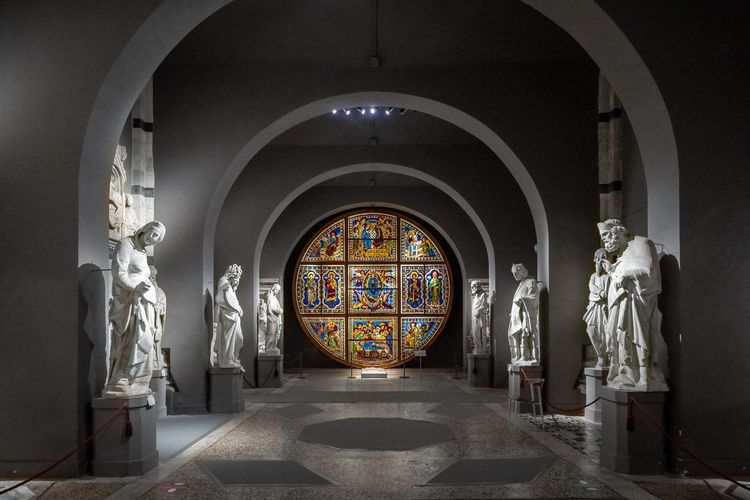
The Museo dell'Opera del Duomo (Piazza del Duomo 8, 53100 Siena, Italy, rated 4.4/5 on Google from 1,718 reviews), housed in what would have been the nave of the never-completed Duomo Nuovo, preserves works removed from the cathedral over the course of restorations, notably the original Maestà by Duccio di Buoninsegna, painted between 1308 and 1311 for the high altar. It is considered one of the peaks of Sienese Gothic painting, with its reverse side entirely painted with scenes of the Passion, visible only in this museum.
It is also from this museum that you climb up the Facciatone mentioned above, via a rather steep interior staircase.
The rarest experience at the Duomo remains the Porta del Cielo, the Gate of Heaven. This guided tour, offered only at certain times of the year and by reservation only, takes you through the cathedral's attics, closed to the public for centuries, before opening onto a view looking straight down over the nave. Tickets are limited to small groups and sell out quickly in high season: if this visit interests you, book as soon as the season's dates are announced, generally several weeks in advance.
Allow about 1h30 to 2 hours for the whole cathedral complex (Duomo, Baptistery, Facciatone, Museo dell'Opera, crypt), covered by the OPA SI PASS at 14 or 16 euros, valid for three days. The Porta del Cielo, however, is paid separately (21 euros). It is the most expensive item of the day, but also the one with the highest density of artworks per square meter of the whole weekend.
Day 1: Fonte Gaia, the Loggias and the Lanes of the Contrade
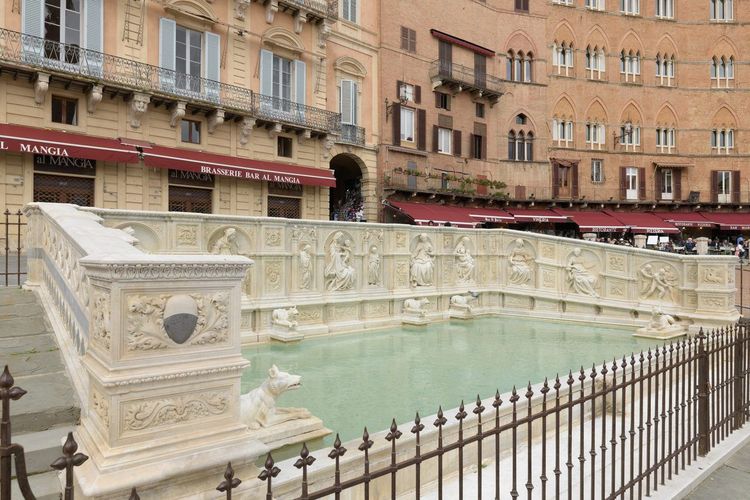
Fonte Gaia, the Loggia della Mercanzia and the Loggia del Papa
Return to the Piazza del Campo in the late afternoon to see the Fonte Gaia, the monumental fountain completed in 1419, fed by a network of underground channels we will come back to tomorrow. The current bas-reliefs are copies: the originals by Jacopo della Quercia, too damaged by the weather, are kept at Santa Maria della Scala.
Heading up toward the medieval business district, the Loggia della Mercanzia (Via Banchi di Sotto, 53100 Siena, Italy, rated 4.5/5 on Google from 2 reviews) marks the junction between the Piazza del Campo and the Via Banchi di Sotto. Built in the 15th century to house the commercial court, it also served as a covered waiting room for merchants, a bit like an open-air stock exchange but sheltered from the weather.
A few streets further on, the Loggia del Papa (or Loggia di San Paolo) is a more discreet arcade, erected in 1462 in honor of the Sienese pope Pius II, Enea Silvio Piccolomini. It is easy to miss if you don't look for the Piccolomini coat of arms carved on one of its columns.
Wandering the Contrade and Understanding the Palio
Beyond the monuments, Siena is best understood by walking without a set route through its seventeen contrade, the city's historic districts. Each has its own colors, its animal emblem (the Goose, the Tortoise, the Dragon, the She-Wolf) and its own neighborhood church, recognizable by the flags hanging from windows and the enameled plaques fixed to corner walls.
These rivalries, which date back to the Middle Ages, culminate in the Palio, the horse race held twice a year on the Piazza del Campo. Ten of the seventeen contrade take part in each edition: the seven that were absent from the corresponding edition of the previous year race by right, and the other three are drawn by lot. The rivalry between some of them has lasted for generations: losing to one's historic enemy hurts more than not winning the race itself. Outside the Palio season, you can still feel this fervor by entering a contrada museum, often open on request, where costumes and trophies from past victories are displayed.
The Ryo audio-guided tour passes through several of these contrade and tells the story of this centuries-old rivalry in audio, enough to understand why a Sienese person may name their contrada even before their profession.
Day 2: Santa Maria della Scala, the Orto dei Pecci and the Bottini
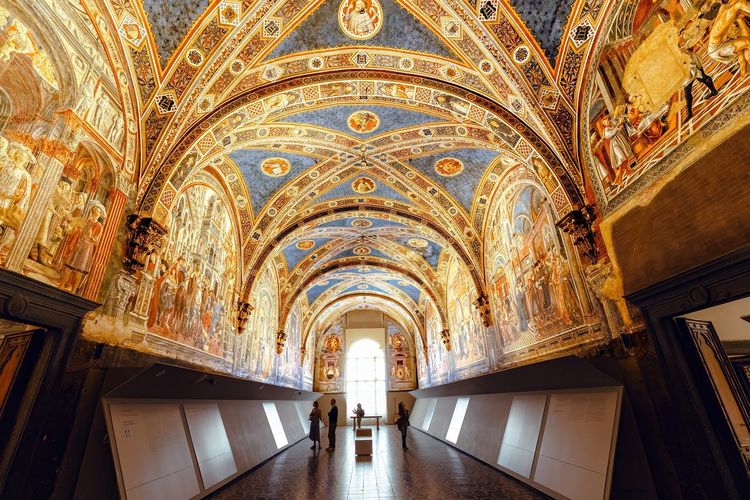
Santa Maria della Scala, the Former Pilgrims' Hospital
The second day starts in the opposite direction from the first: we leave the monuments of power to follow the pilgrims' road. Santa Maria della Scala, the immense building facing the cathedral, operated as a hospital from the Middle Ages until the early 1990s, before opening as a museum in 1995, making it one of the oldest hospital institutions in Europe still identifiable as such.
Its position is no accident: the building stands exactly on the route of the Via Francigena, the medieval pilgrimage road linking Canterbury to Rome. Generations of travelers exhausted by weeks of walking found a bed, care and sometimes a burial place here. The building is now a museum whose centerpiece is the Sala del Pellegrinaio, a long hall covered with 15th-century frescoes depicting daily life at the hospital: distribution of alms to the poor, care of the sick, weddings of the local nobility held within its walls. These frescoes, attributed notably to Domenico di Bartolo, are among the most precise accounts of medieval hospital life preserved in Europe.
The museum's basement also houses the original statues of the Fonte Gaia, the ones you saw as copies the day before on the Piazza del Campo, removed from the square to protect them from pollution and the weather. One stop of the Ryo audio-guided tour of Siena pauses right in front of this building to tell the story of its past as the oldest hospital in Europe on the Via Francigena route, before continuing toward the neighboring garden.
The Orto dei Pecci and the Underground Bottini Aqueduct
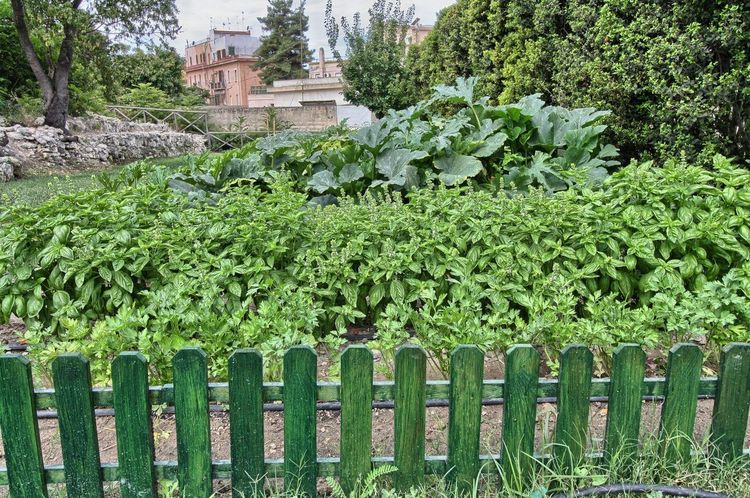
Ten minutes' walk away, behind the Palazzo Pubblico, the stairs of the Piazza del Mercato descend toward the Orto dei Pecci (Via di Porta Giustizia 39, 53100 Siena, Italy, rated 4.5/5 on Google from 2,028 reviews), a large garden below that occupies a valley remarkably green in the middle of the historic center. There you will find an educational farm with a few animals, a medieval vegetable garden, an open-air restaurant and above all a viewpoint at the level of the foundations of the houses and towers of the city, a perspective you won't find anywhere else in Siena.
It is also a good place for a lunch break on the grass if the weather allows, away from the bustle of the center.
Beneath this same valley, and under a good part of the old city, stretches a network that almost no visitor sees: the Bottini, an underground aqueduct dug by hand starting in the Middle Ages to carry rainwater from the surrounding hills to the city's fountains, Fonte Gaia included. The Sienese long searched beneath their feet for a mythical river, the Diana, to the point that Dante mocks them for it in Canto XIII of Purgatorio. The visit is guided only, by reservation with the municipality, in groups of up to 10 people (about 20 euros), on certain weekends only; it is forbidden to children under 8 and not recommended for those who are claustrophobic. Places go fast: book several weeks in advance.
Day 2: The Lesser-Known Gems of the Historic Center
The Palazzo Chigi-Saracini and the Via Banchi di Sopra
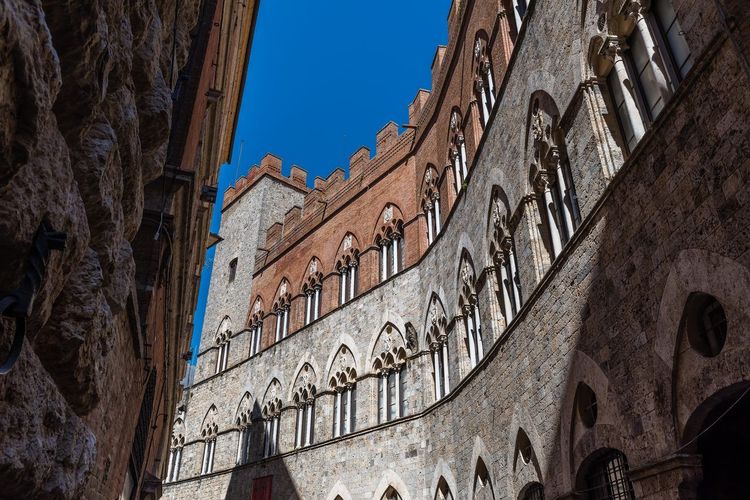
A stone's throw from the Piazza del Campo, the Palazzo Chigi-Saracini (Via di Città 89, 53100 Siena, Italy, rated 4.5/5 on Google from 20 reviews) has housed the Accademia Musicale Chigiana since 1932, one of the most renowned classical music academies in Italy. The palace itself, with its medieval tower and inner courtyard, can be visited during the day, but the real moment not to miss, if the calendar allows, is an evening concert in its historic hall, whose acoustics are reputed to be exceptional for a space of this size.
Continuing north along the Via Banchi di Sopra, the former bankers' street, you pass brick and stone palaces, including the Palazzo Salimbeni, historic headquarters of Monte dei Paschi, founded in 1472 and considered the oldest bank still operating in the world. It is a good shortcut between the monumental center and the northern part of the city, less photographed but just as representative of the medieval urban fabric.
The Legend of Siena's Founding and the Free Walking Tour
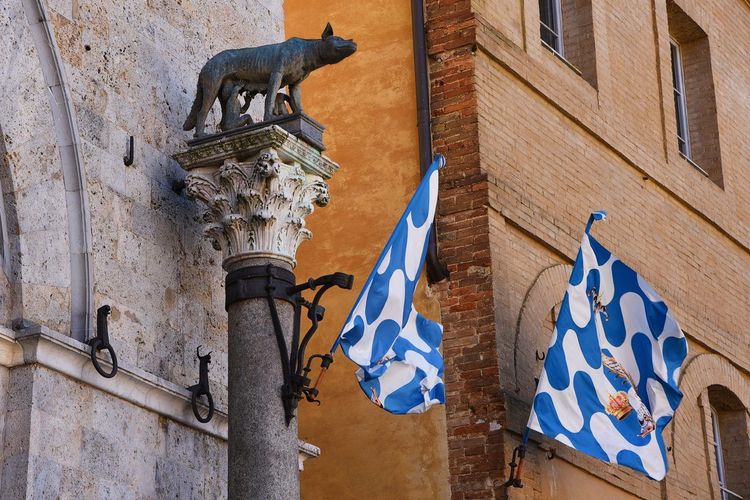
Siena likes to tell itself an origin more heroic than the probable one of a simple Etruscan and then Roman settlement. According to the legend of Siena's founding, the city was founded by Senius and Aschius, the two sons of Remus, himself brother of Romulus, founder of Rome. Fleeing their uncle after the murder of their father, the two brothers supposedly carried with them the statues of the Roman she-wolf, which you now find carved nearly everywhere in the city, on columns, facades and even on some street lamps. This claimed lineage with Rome also explains why the city's black-and-white balzana appears associated with the horses of Senius and Aschius in several historical frescoes.
To delve deeper into these legends and the history of the contrade without spending the whole day, several operators offer a free walking tour, a free guided walk (tip at the end of the route) that generally lasts 2 hours and starts from the center. It is a good option if you are traveling alone and like the group format, but the Ryo audio-guided tour lets you connect these same gems at your own pace, without depending on a group's fixed schedule or the day's weather.
What to Eat in Siena: Specialties and Good Addresses
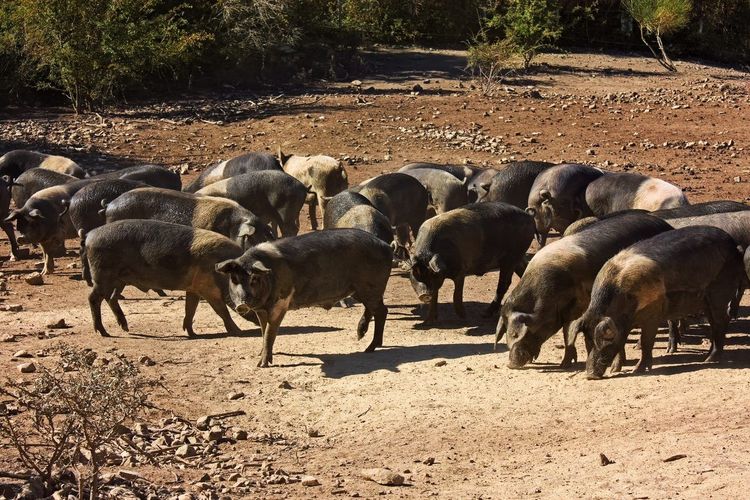
The Sienese table follows an almost immutable order, and respecting it gives meaning to each stage of the meal. You start with a charcuterie board based on Cinta Senese, a breed of black pig raised free-range in the Tuscan countryside since antiquity, now protected by a designation label. Its more pronounced flavor compared with industrial charcuterie comes from a varied diet and slow growth.
Alongside it, the pecorino di Pienza, a sheep's milk cheese aged from a few weeks to several months depending on the producer, ranges from fresh and creamy to very dry and sharp. Many trattorias offer a comparative tasting, often accompanied by local fig or pear preserves that balance the salt.
For the main course, it is hard to escape the pici, long, thick pasta rolled by hand without a machine, without egg, just flour and water. The most common recipe remains pici all'aglione, with a garlic-spiked tomato sauce, but you also find them with wild boar ragù (cinghiale) or simply with butter and sage in autumn. You will quickly spot the good addresses: they are the ones where the menu changes according to the day's market rather than staying fixed all year.
For dessert, two Sienese pastries compete for pride of place. The panforte, a dense cake of candied fruit, honey and spices, keeps for several weeks and was originally travel food for pilgrims on the Via Francigena. The ricciarelli, for their part, are small soft cookies made from almonds and powdered sugar, diamond-shaped, found in almost every pastry shop in the center, sometimes sold individually so you can try several varieties without buying a whole box.
To go with all this, ask for a glass of Chianti Colli Senesi, the DOCG appellation of the hills around the city, not to be confused with the Chianti Classico produced further north: easier to drink, often cheaper on the menu, and distinctive enough to go with both charcuterie and pici. And if you see "Terre di Siena" on a bottle, it is not wine: it is the PDO appellation of the province's extra virgin olive oil, a great souvenir to bring home.
In the late afternoon, wine bars around the Via di Città or the Via Banchi di Sopra offer a Tuscan-style aperitivo: a glass of wine accompanied by chicken liver crostini (crostini di fegatini), a traditional recipe found on almost every menu in the city. It is a good way to take a break between two visits without committing to a full meal, especially if your day's schedule is packed.
As for addresses, avoid the restaurants directly on the Piazza del Campo: the view is paid for in the price of the dish, and the cooking is rarely up to the setting. The best trattorias are generally two or three streets away, in the residential districts of the contrade, where regulars still eat every day. Ask your host for advice: in Siena more than anywhere else, local word of mouth is worth more than an online ranking.
Excursions from Siena: Chianti and Tuscan Villages
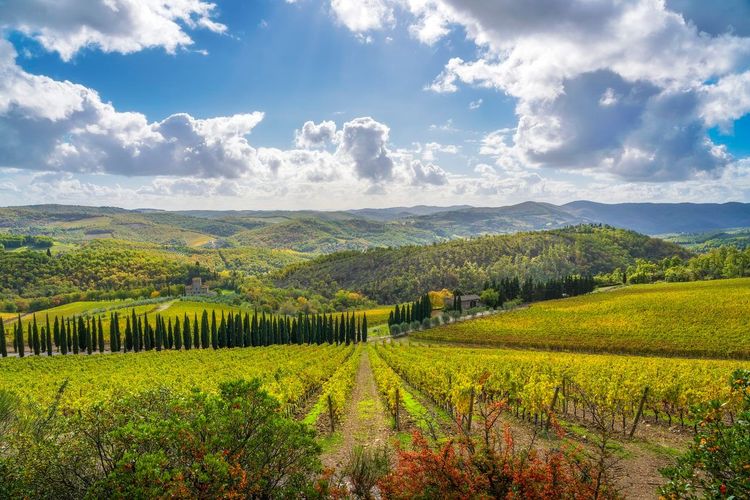
Chianti and Its Vineyards
If your weekend in Siena stretches by half a day, Chianti begins literally at the city gates, to the north. This region of hills, cypresses and vines produces Chianti Classico, recognizable by the black rooster seal (Gallo Nero) on the label, an appellation distinct from the broader Chianti covering a larger geographic area. Many wine estates around Castellina in Chianti or Radda in Chianti open their doors for tastings by reservation, generally between 15 and 30 euros per person, often accompanied by a small plate of local charcuterie and pecorino.
Without a car, several local agencies organize half-day or full-day trips with transport included from the center of Siena, an option to consider if you prefer not to drive after a tasting.
Arezzo, Castelnuovo Berardenga and Neighboring Villages
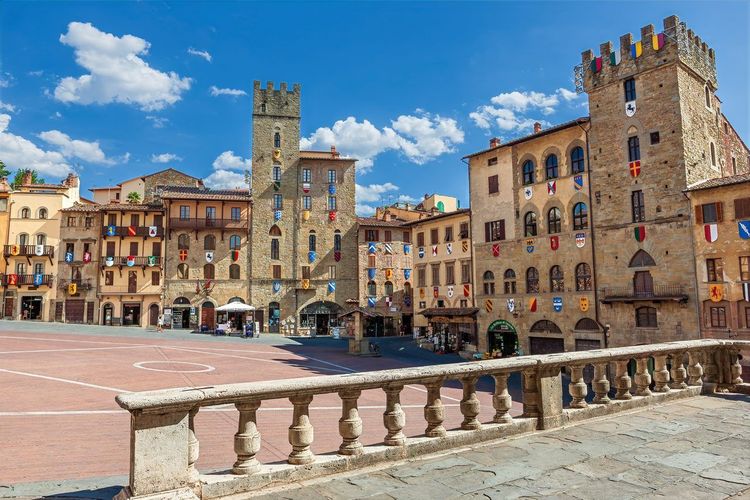
To the east, Arezzo can be visited in a full day from Siena, about 1 hour by road. The city is worth the detour for its sloping Piazza Grande, setting of the famous Giostra del Saracino, a historical jousting tournament, and for Piero della Francesca's fresco cycle at the Basilica of San Francesco, a peak of Renaissance painting on par with Siena's treasures.
Closer, about twenty minutes by road, Castelnuovo Berardenga marks the southern entrance to classic Chianti. This village, more modest than the region's big names, offers easy access to several family-run wine estates, less touristy than those further north near Greve in Chianti.
San Gimignano and Monteriggioni
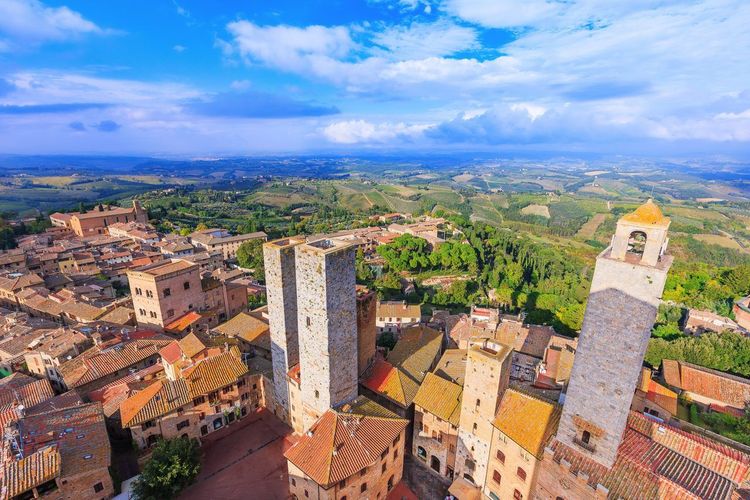
To the west, San Gimignano can be spotted from afar thanks to its fourteen medieval towers still standing out of the seventy-two it had at its height, an urban landscape sometimes nicknamed the Manhattan of the Middle Ages. Allow about 40 minutes by road and half a day on site to climb the Torre Grossa and stroll its lanes, ideally late in the morning before the tourist buses arrive.
On the way back to Florence or as a complement to San Gimignano, Monteriggioni (Monteriggioni, 53035 Siena, Italy, rated 4.6/5 on Google from 6K reviews) deserves a one-hour stop, no more. This small fortified village, whose complete circular wall inspired Dante in the Divine Comedy to describe the giants of Hell, can be visited entirely on foot in 30 to 45 minutes, ramparts included. It is a short excursion, easy to combine with San Gimignano on the same day if you rent a car to extend the weekend by an extra day.
Back in town, keep an hour to resume the Ryo audio-guided tour where you left off: stops missed the day before are easy to catch up on foot, between the Campo and the Duomo.
How to Get to and Around Siena
Siena has no high-speed train station or international airport nearby: the simplest option remains going through Florence. From Florence Santa Maria Novella station, regional trains reach Siena in 1h15 to 1h30 depending on the stops, with a departure roughly every hour during the day. Expect to pay between 8 and 10 euros one way.
By bus, the company Autolinee Toscane (which took over the Tiemme network) offers slightly faster connections from Florence (about 1h15 depending on traffic), with a bus station (Piazza Gramsci) directly adjacent to the historic center, unlike the train station, which is located below the city.
Once there, forget the car. Siena's historic center is entirely a Limited Traffic Zone (ZTL), off-limits to unauthorized vehicles all day. Everything is visited on foot, with a few sometimes steep climbs between neighborhoods: allow 20 to 25 minutes to cross the historic center from one end to the other. If you come by car from the Tuscan countryside, park in one of the peripheral lots signposted around the walls rather than looking for a space in the city center, which would be a guaranteed waste of time.
Where to Stay in Siena for a Weekend
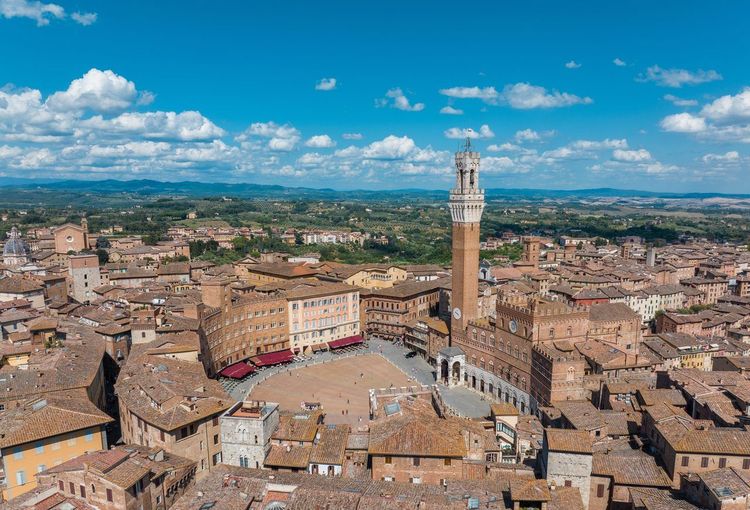
For a short stay, the number one criterion remains a location within the city walls. Sleeping in the historic center, even in a modest establishment, completely changes the evening experience: you can return to the Piazza del Campo after dinner, when the day-trip tourists have left and the square regains its calm, lit by the facades rather than by tour buses.
Accommodations outside the walls generally cost less, but force you to take the car or a bus for every trip, which quickly eats up a good part of the evenings of a two-day weekend.
Another advantage of staying within the walls: the relative silence of the night. After 11 p.m., Siena's historic center, without car traffic, regains a calm that few Italian cities of this size can offer. If you are looking for accommodation with a view, some rooms overlooking the neighborhood's rooftops look directly onto the Torre del Mangia or the dome of the Duomo, a real plus for photographers, even though these options are booked several months in advance in high season.
If you travel in high season, particularly around the Palio dates in early July and mid-August, book several months in advance: the whole city fills up and prices can double during these specific periods. For the rest of the year, booking two to three weeks ahead is more than enough, even for a spring or autumn weekend.
Practical Tips: Ideal Length, Budget and Best Season
Is one day enough to visit Siena? Technically yes, if you limit yourself to the Piazza del Campo, the Duomo and one tower climb. But two days let you add Santa Maria della Scala, the contrade and an excursion to Chianti, turning a flying visit into a real weekend. For a quick trip from Florence in the same day, allow a span of 8 to 10 hours round trip including travel, which leaves barely 5 to 6 hours on site: doable, but frustrating if you like to take your time in front of the frescoes.
As for budget, plan on about 60 to 90 euros per person per day excluding accommodation, entrance tickets to monuments included (allow 14 to 16 euros for the Duomo's OPA SI PASS, 21 euros more for the Porta del Cielo, and 15 euros for the Torre del Mangia and Museo Civico together) and two meals in a trattoria.
For the best season, avoid July and especially the days before and after July 2 and August 16, the Palio dates: the city is then packed and accommodation prices climb sharply. Spring (April-May) and early autumn (September, early October) offer pleasant weather, ideal light for photos on the Piazza del Campo and far more reasonable crowds than in midsummer.
In terms of gear, bring good walking shoes: the cobbled lanes and climbs between neighborhoods are poorly suited to heels or smooth soles. In summer, a reusable water bottle is useful: several public fountains in the historic center dispense free drinking water, a detail that saves you from buying bottles all day in the Tuscan heat.


FAQ
How many days do you need to visit Siena?
Two days cover the essentials: the Piazza del Campo, the Palazzo Pubblico, the Torre del Mangia, the Duomo and Santa Maria della Scala. A third day lets you add an excursion to the Chianti region or San Gimignano. If you only have one day, focus on the square, the cathedral and a single panoramic climb rather than rushing everywhere.
Can you visit Siena in a single day from Florence?
Yes, it is a classic day trip by train (1h15 to 1h30 each way), but it leaves little margin: expect 5 to 6 effective hours on site after the journeys. Leave early in the morning and limit yourself to the Piazza del Campo, the Duomo and a single tower rather than trying to do everything at a sprint.
What is Siena's culinary specialty?
Pici, thick hand-rolled pasta, are the city's signature dish, often served all'aglione or with wild boar ragù. For dessert, panforte and ricciarelli, two pastries made with almonds and spices, can be found in all the shops in the center. Cinta Senese charcuterie and pecorino di Pienza round out the Sienese table.
Why is Siena famous: what is the Palio?
Siena is best known for its intact medieval historic center and for the Palio, a race of ten bareback horses around the Piazza del Campo, held on July 2 and August 16. Ten of the seventeen contrade, the city's historic districts, take part each time (seven by right, three drawn by lot), in a rivalry that has lasted for centuries.
What is the best season to visit Siena?
Spring (April-May) and early autumn (September, early October) offer the best compromise between pleasant weather and reasonable crowds. In summer, especially around the Palio dates in early July and mid-August, the city is packed and accommodation prices rise sharply.
How do you get around Siena's historic center?
On foot only: the historic center is a limited traffic zone, off-limits to unauthorized vehicles. Allow 20 to 25 minutes to cross it from one end to the other, with a few steep climbs between neighborhoods. If you arrive by car, park in one of the lots on the outskirts, along the city walls.
A weekend in Siena fits into a compact format but never lacks substance: two days are enough to go from the political fresco of the Palazzo Pubblico to the underground channels of Santa Maria della Scala, via a plate of hand-rolled pici and a Chianti tasting in the nearby hills. The city rewards above all those who take the time to look up, toward the top of a tower or toward the discreet loggias away from the Campo.
To organize each stage without thinking about it on site, the Ryo audio-guided tour of Siena remains the simplest way to visit at your own pace, headphones on, between the Piazza del Campo and the lanes of the contrade, without depending on the schedule of a group tour or a last-minute booking.