© Shutterstock
 Votre guide Ryo
Things to Do in Verona: 22 Experiences to Visit the City in 2026
What is there to do in Verona when the city of Romeo and Juliet draws millions of visitors every year to photograph a balcony that never existed in the real story? The Venetian city conceals an intact ancient heritage, a historic centre listed as a UNESCO World Heritage Site since 2000, and alleyways where you are more likely to meet local Veronese than organised tour groups — provided you venture off the beaten track. If a future trip to France or Spain is also on the agenda, the Ryo app already offers comparable audio-guided tours in dozens of cities, designed for exploring on foot and without a human guide.
Here, a Roman amphitheatre seating 22,000 still serves as an open-air opera stage every summer. A medieval bridge was rebuilt stone by stone after being blown up in 1945. An inner courtyard is covered in thousands of love notes scrawled on its walls over decades. And twenty minutes' drive away, vine-covered hills produce Amarone, one of Italy's most full-bodied red wines. From ancient monuments to working-class neighbourhoods and nearby vineyards, this guide covers 22 experiences for visiting Verona on foot, over 1, 2, or 3 days, in sunshine or in rain.
1. The Arena di Verona: Roman Amphitheatre and Opera Stage
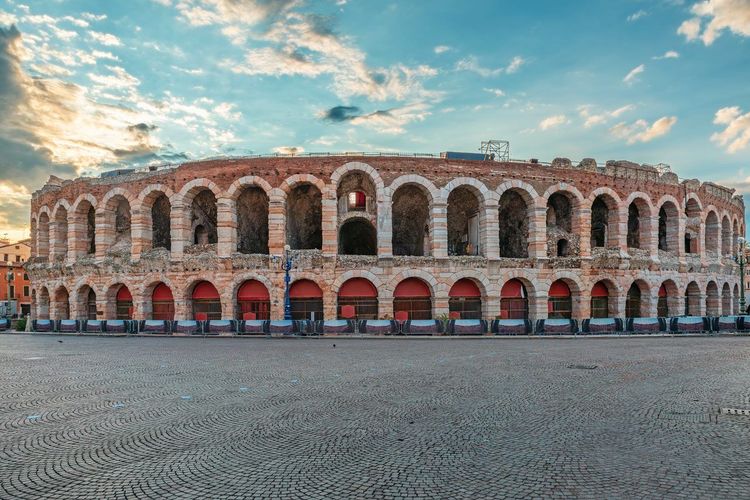
The Arena di Verona (Piazza Bra, 37121 Verona VR, rated 4.7/5 on Google based on 168,407 reviews) is the third-largest Roman amphitheatre still standing, after the Colosseum and the arena at Capua. Built around 30 AD — nearly a century before the Colosseum in Rome — it could hold up to 30,000 spectators in Roman times, compared to 22,000 today for safety reasons. The earthquake of 1117 destroyed much of the outer ring: only four arches remain visible from Piazza Bra, which the Veronese familiarly call the ala, meaning the wing.
What truly sets the Arena apart is its uninterrupted use over two millennia. From June onwards, the amphitheatre transforms into an open-air opera stage for the world's oldest outdoor lyric festival, launched in 1913 to mark the centenary of Verdi's birth. Aida, Nabucco, and Carmen are performed here against monumental sets, sometimes featuring real horses on stage. Stone-tier seats cost a fraction of the price of numbered seats, provided you bring a cushion — sold on site — for the nearly three hours of performance.
During the day, entry requires no advance booking, with a modest admission fee and free admission on the first Sunday of the month from October to March. Climb to the top of the tiers: the view looks down over the ochre rooftops of the historic centre and across the hills encircling the city. Allow 45 minutes for a full visit, longer if you linger over the underground remains visible from certain points of the metal structure installed for performances.
You can also simply sit on the steps of Piazza Bra on a late afternoon, gelato in hand, and watch the golden light play across the limestone. That is often the moment visitors remember most, more than any guided tour. In the evening, the terraces lining the square — known as the Liston — stay lively well into the night, with locals out for their passeggiata and tourists settled over a Spritz.
2. The Casa di Giulietta: Juliet's House
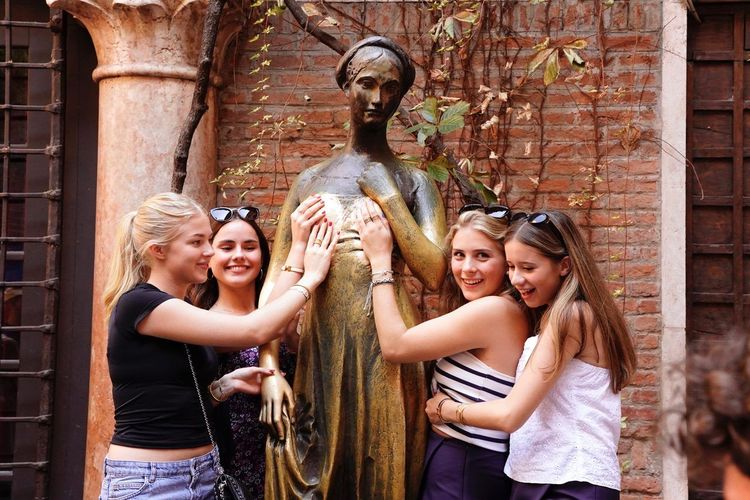
The Casa di Giulietta (Via Cappello 23, 37121 Verona VR, rated 4.1/5 on Google based on 89,230 reviews) owes its fame to Shakespeare rather than to Veronese history: there is no evidence that a Capulet family ever lived in this 13th-century house. The famous marble balcony, added in 1936 during a restoration, has nothing medieval about it. No matter — the inner courtyard remains one of the most photographed spots in the Veneto, its walls blanketed in thousands of love notes, post-its, and metro tickets left as offerings to love.
A bronze statue of Juliet stands in the courtyard, her right breast polished to a shine from being touched by countless visitors — a tradition said to bring luck in love. The queue to step onto the balcony and strike a pose can exceed thirty minutes in high season, between April and September. Many visitors make do with the courtyard, which is free to enter, without paying for the ticket that grants access to the interior, which features period furniture with no direct connection to the legend.
One tip that changes the visit: come early, before 9am, or late in the day after 6pm. The courtyard empties of organised groups, and the light on the old brickwork becomes far more photogenic. Just next door, Via Cappello is lined with souvenir shops on the Shakespearean theme, right down to heart-shaped pasta.
3. Piazza delle Erbe: Market and Beating Heart of the City
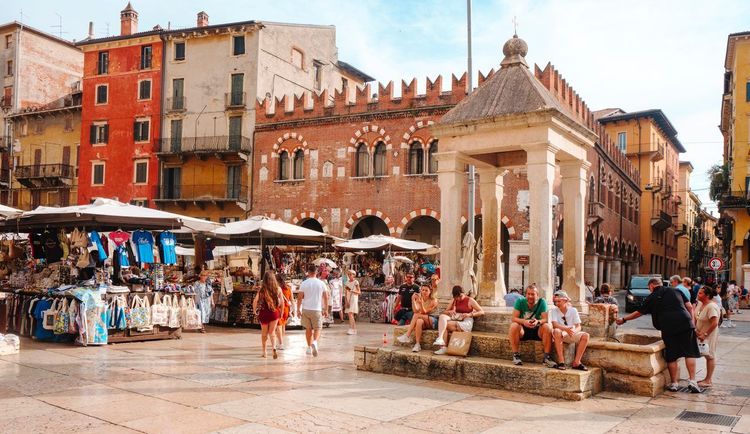
Built on the site of the ancient Roman forum, Piazza delle Erbe (37121 Verona VR, rated 4.7/5 on Google based on 20,399 reviews) has been the commercial and social heart of Verona for two thousand years. Every morning a colourful market sets up its stalls and parasols here, selling fruit, flowers, and souvenirs at the foot of 16th-century painted facades. At the centre stands the Fontana Madonna Verona, a 14th-century fountain incorporating a Roman statue from the 2nd century — the oldest sculpture still on public display in Verona.
The square layers history with little apparent logic: a Venetian column topped by the Lion of St Mark — symbol of Venice's dominion over Verona between 1405 and 1797 — stands alongside the Torre del Gardello, a 14th-century clock tower housing one of Italy's earliest mechanical clocks. The facades of the Case Mazzanti, decorated with 16th-century frescoes depicting mythological scenes, rank among the finest exterior paintings preserved in northern Italy.
Come in the morning to catch the market in full swing, then return in the evening: café terraces spread across the entire square and the facades are bathed in subtle lighting. A covered passageway connects Piazza delle Erbe directly to Piazza dei Signori, just a few metres away.
4. Piazza dei Signori and the Arche Scaligere
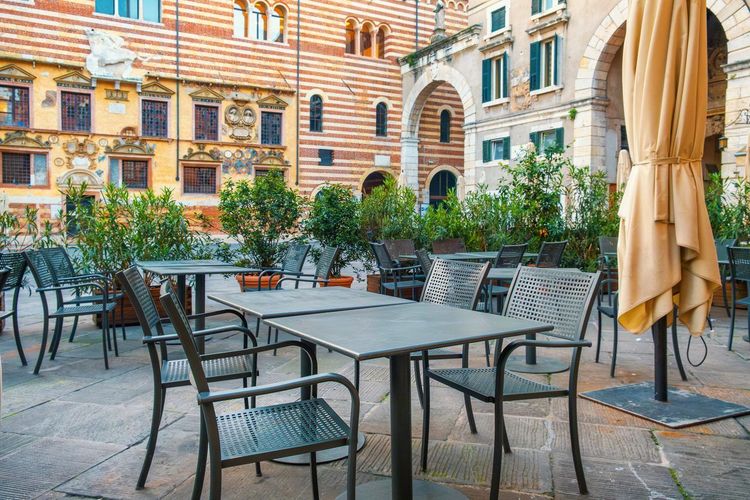
Separated from Piazza delle Erbe by a single arch, Piazza dei Signori shifts the atmosphere entirely: more sober and austere, it concentrates the buildings of Veronese medieval power. A statue of Dante — exiled from Florence and welcomed in Verona by the Della Scala family in the early 14th century — has kept watch over the square since 1865. The poet spent several years of his exile here and completed part of the Divine Comedy under the protection of his Veronese hosts.
Close by, the Arche Scaligere form a Gothic funerary ensemble unique in Europe: the raised tombs of the Della Scala family, who ruled Verona for over a century, stand in a small courtyard enclosed by wrought-iron grilles adorned with the ladder — emblem of the Scaligeri. The tomb of Cangrande I, who died in 1329, bears a replica equestrian statue depicting him smiling, with the original preserved in the Castelvecchio museum to protect it from the elements.
These Gothic tombs are often overlooked by visitors in a hurry to reach Juliet's house. Take ten minutes to study the sculpted details: knights, saints, and battle scenes are layered across several tiers — a work of extraordinary craftsmanship in stone, rarely matched for its era.
5. Torre dei Lamberti: Panoramic Views over the City
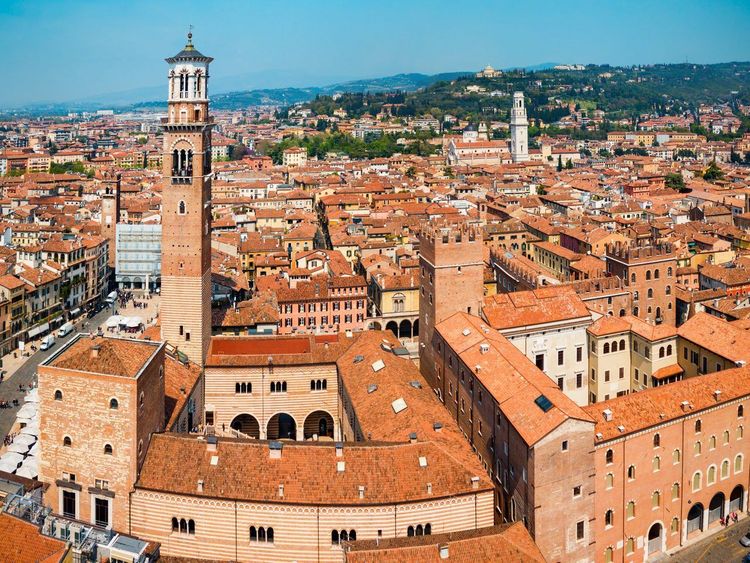
Standing 84 metres tall, the Torre dei Lamberti (Via della Costa 1, 37121 Verona VR, rated 4.5/5 on Google based on 3,937 reviews) has dominated Piazza delle Erbe since the 12th century. A lift installed in the 20th century whisks visitors to the top in seconds, though 368 steps also remain available for those who prefer to climb on foot, with intermediate landings already offering fine views over the red-tiled rooftops.
From the summit platform, the view takes in the entire historic centre enclosed within the bend of the Adige, with the Torricelle hills in the background and, on clear days, the first Alpine foothills to the north. Two historic bells remain visible at the upper level: the Rengo, which rang out as a warning in times of danger, and the Marangona, which once marked the working hours of the city's woodworkers.
It is best to go up in the late afternoon, about an hour before sunset: the raking light across the rooftops offers the finest photographic contrast, and crowds are generally thinner than at midday.
6. Castelvecchio and the Ponte Scaligero
A military fortress built between 1354 and 1376 by Cangrande II della Scala, Castelvecchio (Corso Castelvecchio 2, 37124 Verona VR, rated 4.6/5 on Google based on 20,281 reviews) was designed to protect the city from external enemies while also giving its lord a direct escape route to the far bank of the Adige should his own subjects turn against him. Converted into a museum in 1925 following a renovation by architect Carlo Scarpa — widely regarded as a global benchmark in museography — it now houses collections of Venetian painting, medieval sculpture, and antique weapons spread across three floors.
Scarpa's work is legible in every detail: suspended walkways, deliberate breaks between ancient walls and concrete additions, changes in level that constantly shift the visitor's perspective on the works. The original equestrian statue of Cangrande I, removed from the Arche Scaligere for protection, occupies a central, elevated position — presented almost as a contemporary sculpture rather than a 14th-century artefact.
From the castle's courtyard, the Ponte Scaligero spans the Adige on three asymmetrical arches. Built shortly after the castle, between 1354 and 1356, this crenellated red-brick bridge was completely blown up by retreating German forces in 1945, then rebuilt stone by stone from 1949 onwards using masonry recovered from the river. Walking across it at sunset, with the Torricelle hills turning orange behind the battlements, remains one of Verona's most memorable experiences — free and accessible at any hour.
The castle and bridge together take about an hour and a half to visit, longer if you want to explore all the museum rooms. Those who have already tried a Ryo audio-guided tour in a European city will find the same logic of free-roaming here, with no fixed guided-tour timetable.
7. The Duomo di Verona: Cathedral and Romanesque Cloister
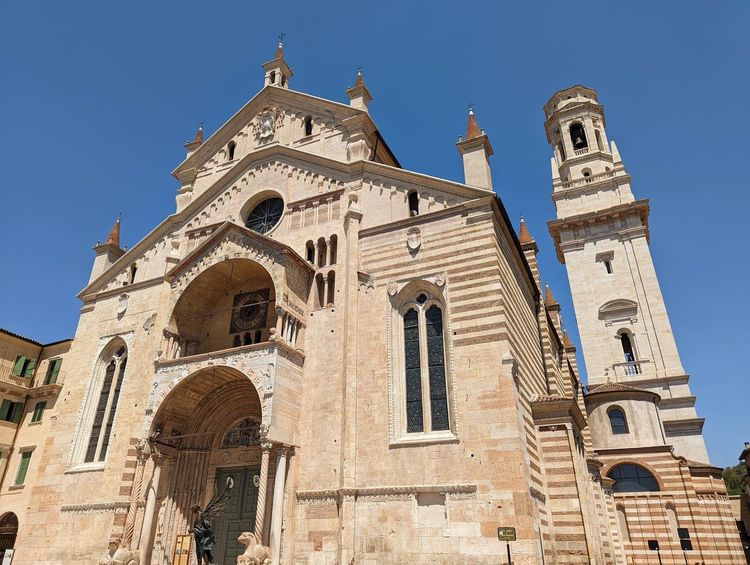
The Duomo di Verona (Via Duomo 21, 37129 Verona VR, rated 4.6/5 on Google based on 10,209 reviews), dedicated to Santa Maria Matricolare, blends Romanesque and Gothic styles on a 12th-century facade adorned with sculptures of Roland and Oliver — two knights from the Carolingian legend rarely associated with Italian religious iconography. Inside, an Assumption of the Virgin painted by Titian around 1535 for one of the side chapels is a major work often overshadowed by his more celebrated Venetian canvases.
The admission ticket, combined with several other Veronese churches under the Chiese Vive scheme, also gives access to the adjoining Romanesque cloister, where fragments of 4th-century Early Christian mosaics can be seen beneath protective glass panels set into the floor. Few visitors venture this far, making it a welcome moment of calm after the crowds of Piazza delle Erbe, just five minutes' walk away.
8. The Basilica di San Zeno Maggiore and Its Cloister
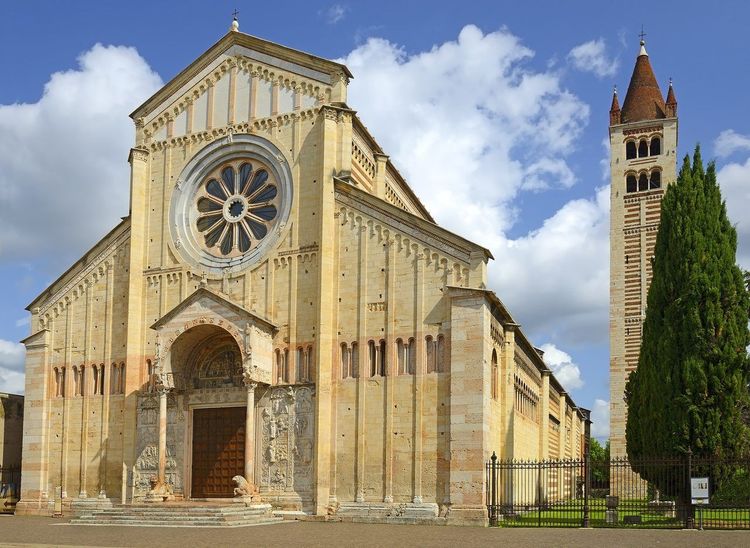
Considered by many art historians to be the finest Romanesque building in the Veneto, the Basilica di San Zeno Maggiore (Piazza San Zeno 2, 37123 Verona VR, rated 4.7/5 on Google based on 9,104 reviews) preserves 11th-century bronze doors made up of 48 panels depicting biblical scenes in a deliberately naive style — regarded as a landmark of European medieval sculpture. The campanile, completed in 1173, reaches 72 metres and long served as a landmark for boatmen navigating the Adige.
Inside, the triptych of the Madonna of San Zeno, painted by Andrea Mantegna around 1459, remains one of the most accomplished works of the Italian Renaissance outside Florence and Venice. The Romanesque crypt, set lower than the rest of the building, is said by local legend to contain the remains of Saint Zeno, the fourth bishop of Verona in the 4th century.
The adjoining cloister, added between the 12th and 13th centuries, alternates twin marble colonnades in Verona's pink marble with an inner garden planted with clipped shrubs. This neighbourhood, set slightly apart to the west of the historic centre, is rarely visited by tourists who stay concentrated around the Arena — which makes it one of the most peaceful spots in the city.
9. Ponte Pietra: Verona's Oldest Bridge
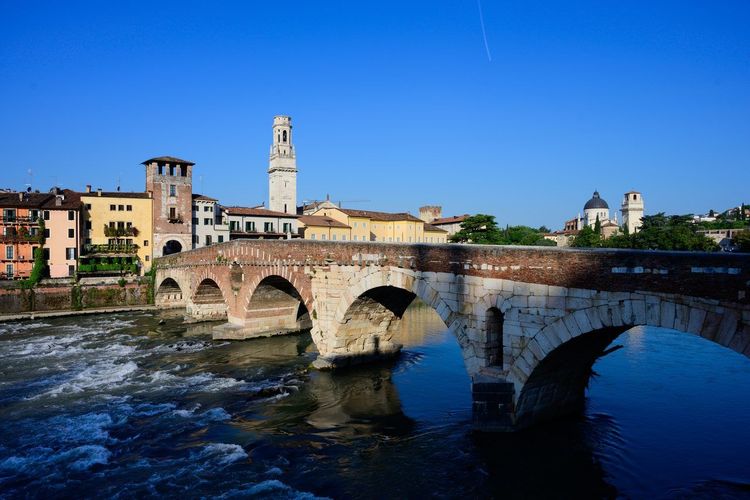
Five arches cross the Adige at Ponte Pietra (37129 Verona VR, rated 4.7/5 on Google based on 17,769 reviews), two of which date from the Roman period, around the 1st century BC. The other three, lighter in colour and built in brick, were reconstructed after 1945 when the retreating German forces blew up the bridge, as they did with virtually every bridge in the city.
The reconstruction, completed in 1957, used as much of the original stonework as possible — recovered from the riverbed — which explains the contrast in hues visible today between the Roman and modern sections. From the bridge, the view of the Teatro Romano and the hill of San Pietro rising directly behind it is one of the most reproduced postcards of Verona, particularly at sunset when the limestone takes on a pinkish hue.
10. Porta Borsari: a 1st-Century Roman Gate
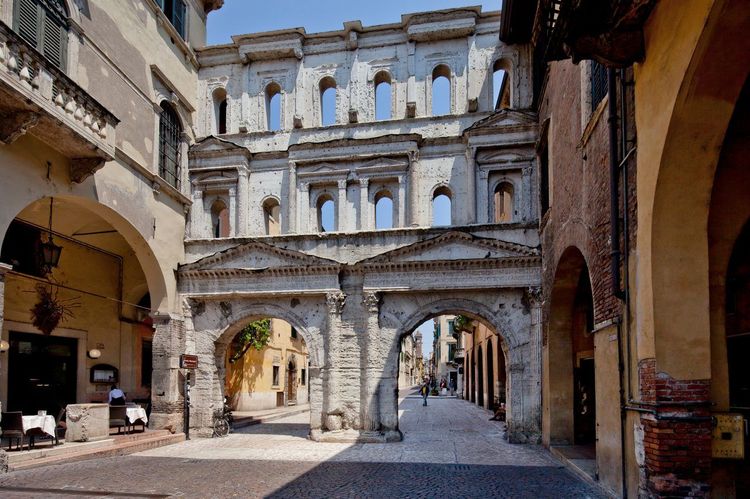
The oldest monument still fully intact in Verona, Porta Borsari (Corso Porta Borsari, 37121 Verona VR, rated 4.6/5 on Google based on 6,855 reviews) marked the main entrance to the Roman city on the via Postumia, one of the great roads linking Genoa to Aquileia. The inscription carved on the facade dates the rebuilding of the gate to 245 AD, although earlier foundations from the 1st century were identified during archaeological excavations.
Two rows of pedimented windows alternate triangular and round-arched forms across the facade — an architectural detail rarely found elsewhere in northern Italy from this period. The gate literally straddles a still-active shopping street, creating a striking effect: cars and cyclists pass beneath an arch nearly eighteen centuries old without almost anyone looking up.
11. Castel San Pietro: a Free Panorama over the City
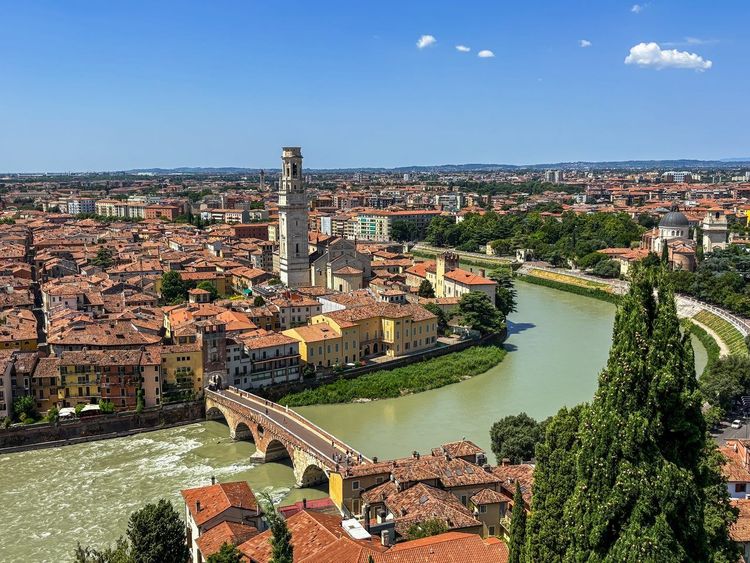
On the hill above Ponte Pietra, Castel San Pietro (Via Castel San Pietro, 37129 Verona VR, rated 4.7/5 on Google based on 6K reviews) has occupied a fortified site since Roman times, when a temple already stood here. The current fortress, in Austrian style, was built in the 19th century during Habsburg rule over the Veneto, between 1815 and 1866, and today houses administrative offices with no public access to the interior.
No matter: the attraction lies in its outer esplanade, freely and freely accessible, which offers the best panorama over the entire historic centre, from the Arena to the Duomo. A funicular, reopened in 2017 after decades of closure, reaches the top in under two minutes from the foot of the hill — a welcome alternative to the 200 steps of the old staircase, still walkable for those who prefer the effort to queuing for the funicular.
Go up at sunset if you can: the low light skims the ochre rooftops and the Torricelle hills turn a violet hue that contrasts with the lights gradually coming on across the historic centre below.
12. Giardino Giusti: a Renaissance Garden and Labyrinth
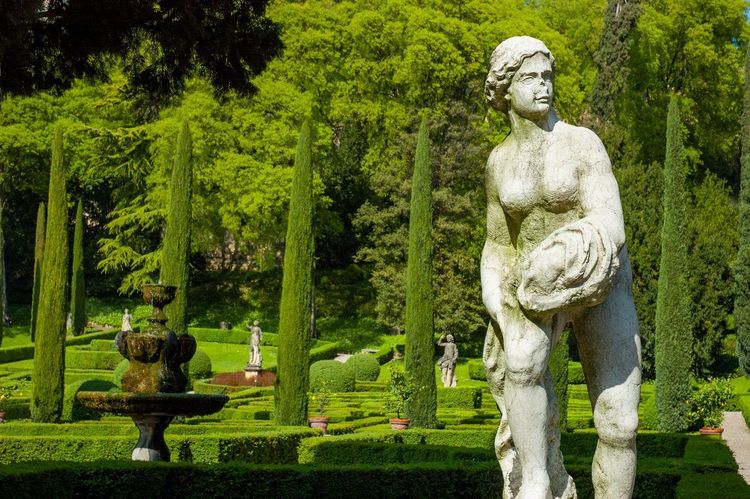
Created in 1580 by the Giusti family, this Italian Renaissance garden rises up the hillside in successive terraces, combining geometric parterres with a box-hedge labyrinth considered one of the oldest in Europe still existing in its original layout.
Goethe visited in 1786 and mentions it in his Italian Journey, admiring the centuries-old cypresses lining the central avenue, some planted at the very time the garden was created. At the top, a belvedere offers a different view from that of Castel San Pietro — more verdant, with the city glimpsed in fragments between the treetops rather than spread out as a complete panorama.
Allow an hour to walk through the whole park, longer if your children want to tackle the labyrinth. The garden attracts far fewer visitors than the monuments in the centre — a real breath of fresh air after a morning spent between the Arena and Piazza delle Erbe.
13. Palazzo Maffei: a Private Art Collection
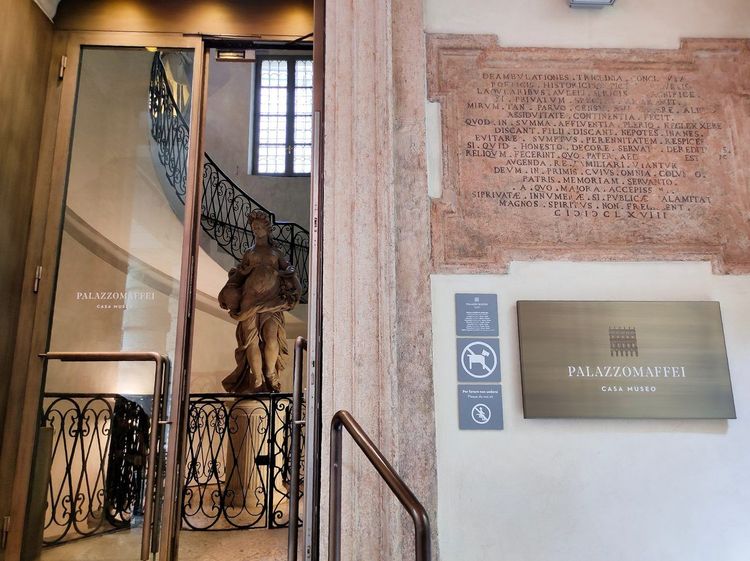
On Piazza delle Erbe, the Baroque facade of Palazzo Maffei (Piazza delle Erbe 38, 37121 Verona VR, rated 4.8/5 on Google based on 2,735 reviews), topped by statues of Roman deities, has housed a private art museum since 2020 that unselfconsciously mixes ancient artefacts, old master paintings, and contemporary works by Warhol and Fontana.
This boundary-crossing approach — relatively rare in traditional Italian museums — allows a 2nd-century Roman bust and a pop art canvas to sit a few metres apart. The visit is short and pairs well with a stroll through Piazza delle Erbe, making it an ideal thirty-minute pause between two monuments - a nice warm-up before Ryo's audio-guided tour of Venice, just across the lagoon.
14. The Teatro Romano and the Museo Archeologico
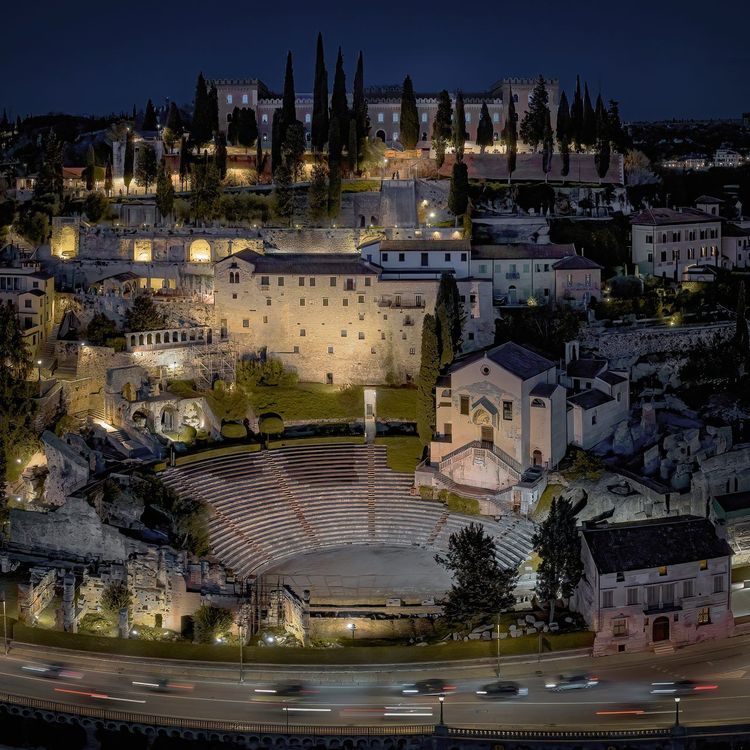
Set against the hillside of San Pietro, the Teatro Romano (Rigaste Redentore 2, 37129 Verona VR, rated 4.5/5 on Google based on 3K reviews), built in the 1st century BC, is still used every summer for a theatre and dance festival — further proof that the Veronese have never stopped treating their ancient heritage as a living tool rather than a mere ruin to be visited.
A former convent built on top of the tiers now houses the Museo Archeologico, reached by a discreet lift and an outdoor staircase that climbs between the ruins. The collections bring together mosaics, bronzes, and ceramics uncovered during various excavations carried out across the city since the 19th century. The museum terrace also offers, as a bonus, one of the finest views of Ponte Pietra and the bend of the Adige.
15. Via Mazzini: Shopping and Designer Brands
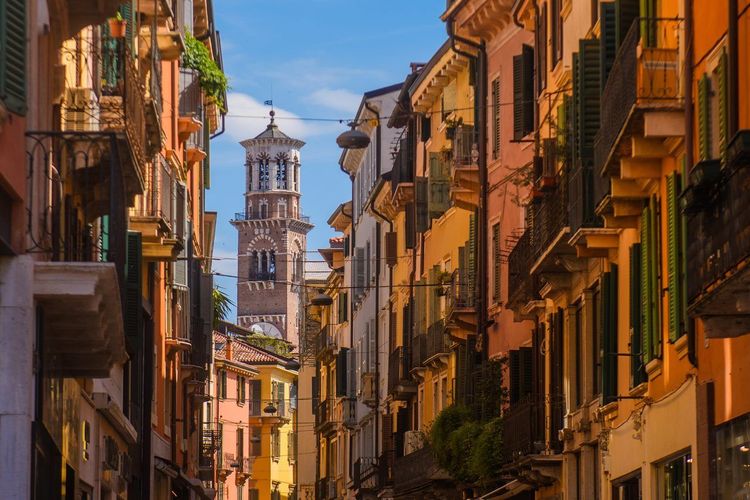
Running between Piazza Bra and Piazza delle Erbe, Via Mazzini (37121 Verona VR, rated 4.7/5 on Google based on 247 reviews) concentrates the boutiques of Italy's great fashion houses — from Prada to Gucci — along a largely pedestrianised stretch of cobblestones and 19th-century facades.
Even without any intention of buying, the street is worth a stroll for its carefully dressed windows and the atmosphere it takes on in the evening, when Veronese come here for the passeggiata. A few traditional pastry shops still sell sfogliatine and almond tortelli — a sweet alternative to the luxury labels that dominate the street.
16. Veronetta: the Other Side of the Adige
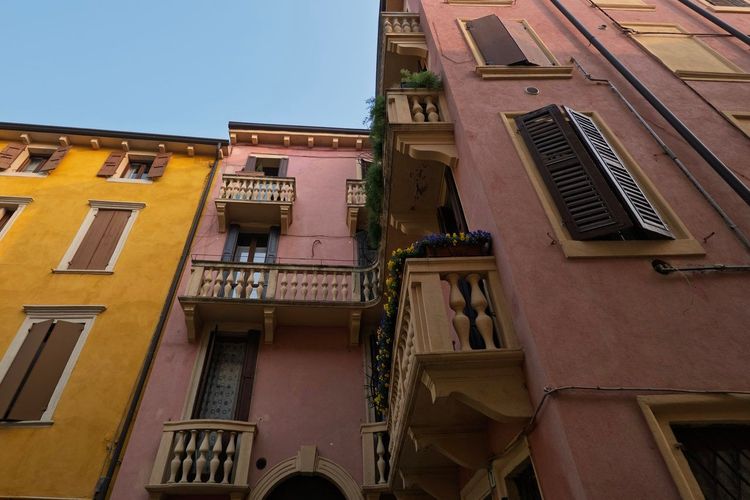
On the far side of the river, the Veronetta neighbourhood offers a noticeably more working-class and student-oriented face of the city, far from the tourist groups clustered around Casa di Giulietta. The University of Verona has several faculties here, which explains the concentration of affordable bars and independent bookshops around Via San Francesco.
The streets of Veronetta, less restored than those of the historic centre, retain peeling facades in places, inner courtyards cluttered with bicycles, and a pace of life that contrasts sharply with the polished atmosphere of the city centre. This is where many of the restaurants with reasonable prices even in high season are found, well away from the tourist menus displayed in five languages around the Arena.
An unscripted afternoon wander is enough to absorb this different atmosphere. You will likely encounter more local students than foreign visitors — a refreshing contrast after a morning spent in the queues of the historic centre.
17. Veronese Cuisine: Risotto, Pastissada, and More
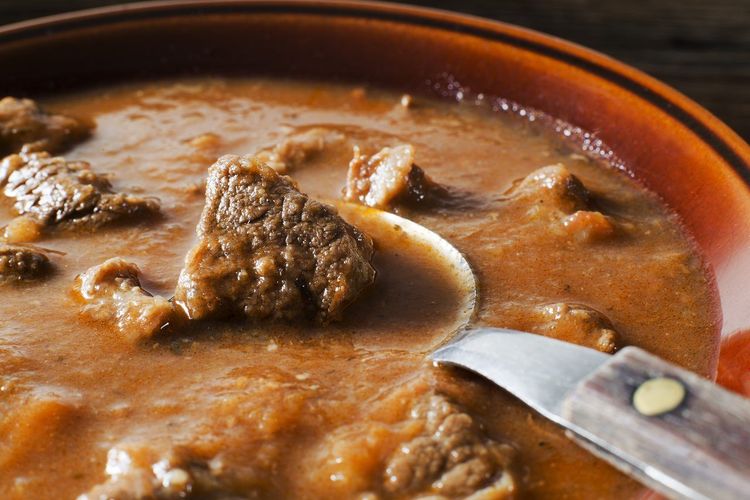
Veronese gastronomy remains largely overlooked behind the fame of neighbouring Venetian cuisine. The city's signature dish, pastissada de caval — a horse-meat stew slow-cooked for several hours in red wine and spices — is said by local legend to date back to a feast organised after a 5th-century battle in which slaughtered horses were cooked to feed the starving population.
Risotto all'Amarone, prepared with the region's most prestigious red wine, features on virtually every trattoria menu in the historic centre. Another local speciality, bollito misto — an assortment of boiled meats served with a green sauce of parsley and anchovies — remains a winter classic in family restaurants geared more towards a local clientele than tourists.
To eat without breaking the bank, it is best to move a block or two away from the Arena and Casa di Giulietta, where prices rise sharply. The Veronetta neighbourhood, mentioned earlier, and the streets around Piazza delle Erbe away from the main tourist axis, offer more affordable and often more authentic addresses. For dessert, pandoro — a star-shaped brioche originally from Verona that has become an Italian Christmas classic — is found in virtually every pastry shop in the city all year round, in smaller individual portions.
On the wine front, it is hard to avoid the Valpolicella wine list: Valpolicella Classico, Ripasso, and above all Amarone — produced from grapes partially dried for several months before fermentation, concentrating the sugars to yield powerful wines often above 15% alcohol.
18. The Valpolicella: Vineyards and Villages Twenty Minutes Away
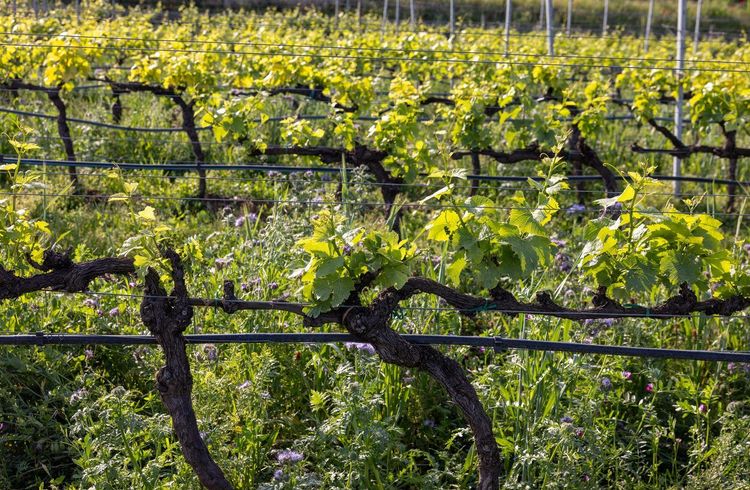
Less than half an hour's drive north of Verona, the wine-producing region of Valpolicella spreads across limestone hills planted with terraced vineyards since Roman times. The area produces Amarone della Valpolicella, one of Italy's most sought-after red wines, made using the appassimento technique: the grapes — principally Corvina and Rondinella — are dried on wooden racks for 100 to 120 days before pressing, losing around 30% of their water weight.
Many family-run wineries, often established for several generations in 18th- or 19th-century stone buildings, offer tours followed by tastings, generally by prior reservation rather than as a walk-in visit. The village of Sant'Ambrogio di Valpolicella and the village of San Giorgio — the latter built directly on a 6th-century Early Christian site — are worth a stop for their views over the vineyards below.
Without a car, several organised excursions from Verona combine transport, a winery visit, and lunch — a practical option for discovering the region in half a day without worrying about driving after tasting. For those who enjoy light hiking, waymarked trails cross the vineyards between the villages of Fumane and Marano di Valpolicella, with explanatory panels on local winemaking techniques.
19. Lake Garda: a Day Trip
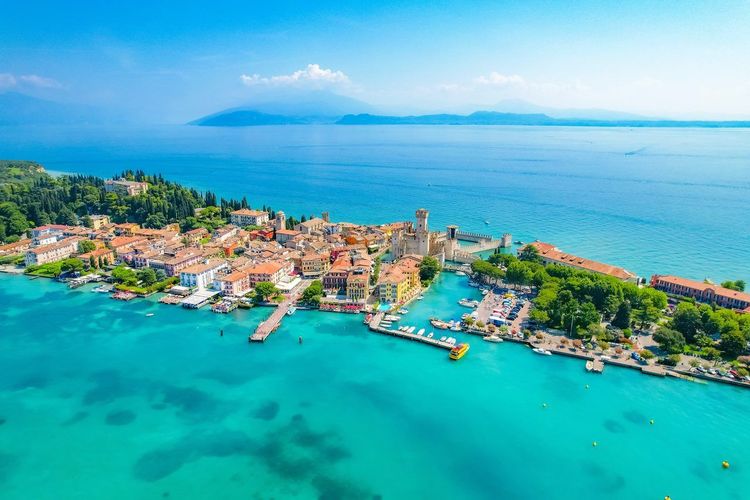
About thirty kilometres west of Verona, Lake Garda — Italy's largest lake at 370 square kilometres — can be reached in under an hour by train or bus from the city centre. The town of Peschiera del Garda, the first stop reachable by direct train, retains 16th-century Venetian fortifications surrounded by canals, a setting that often surprises visitors who come purely for the beach.
Further north, Sirmione juts out on a narrow peninsula closed off by a 13th-century Scaligeri castle that can be visited on foot in half an hour, surrounded by the lake's turquoise waters. The Grotte di Catullo — ruins of a 1st-century Roman villa at the tip of the peninsula — offer a complete panorama of the lake from an open-air archaeological site, with no fixed guided tour schedule.
One day is enough to combine two stops on the lake, provided you set off early in the morning. In summer, it is best to avoid weekends: Sirmione in particular can become overwhelmed with visitors from across northern Italy and neighbouring Austria, the distance between Verona and the lake being short enough for Austrian and German tourists.
20. Hidden Verona: the Places the Guidebooks Forget
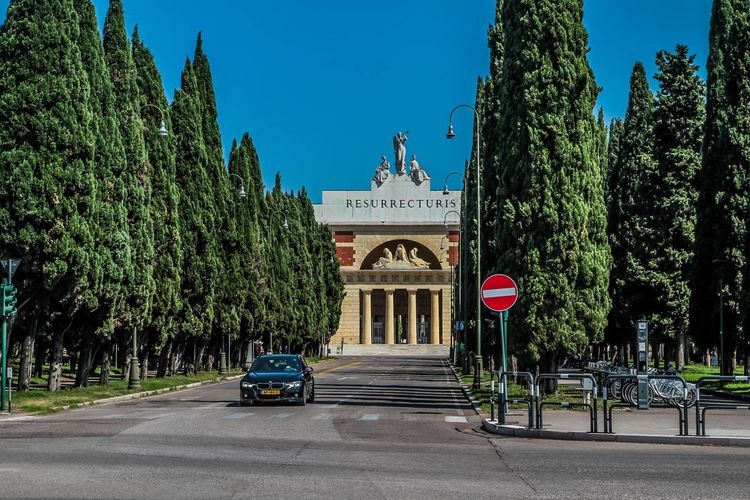
Beyond the unmissable monuments, hidden Verona reveals itself on the fringes of the main tourist routes. The monumental cemetery, built in the 19th century on the model of the Père-Lachaise in Paris, lines up neoclassical sculpted tombs with the care of an open-air museum — freely accessible and practically deserted by foreign visitors.
In the Veronetta neighbourhood, the small church of Santi Siro e Libera conceals an exterior staircase that climbs directly onto its roof — an extremely rare architectural device dating from the 14th century, built to allow access to a bell without passing through the interior of the building. Few guides mention this detail, yet the view from the upper steps over the surrounding rooftops is clearly worth the detour.
Another curiosity: the Fondazione Musei Civici manages several small municipal museums often bypassed in favour of Castelvecchio, such as the Museo di Storia Naturale, housed in a former monastery and containing exceptional fossils from the Bolca deposits — world-renowned for the extraordinary preservation of the fish specimens found there. It offers a scientific perspective on the region, the polar opposite of the romantic image normally associated with the city.
Finally, beneath Piazza delle Erbe and several buildings in the centre, Roman archaeological remains can be seen through glass walkways set at floor level, as part of the Verona Sotterranea route. Little signposted, this underground itinerary allows visitors to grasp the tangible depth of history accumulated underfoot as they hurry from one monument to the next without ever looking down.
21. What to Do in and Around Verona
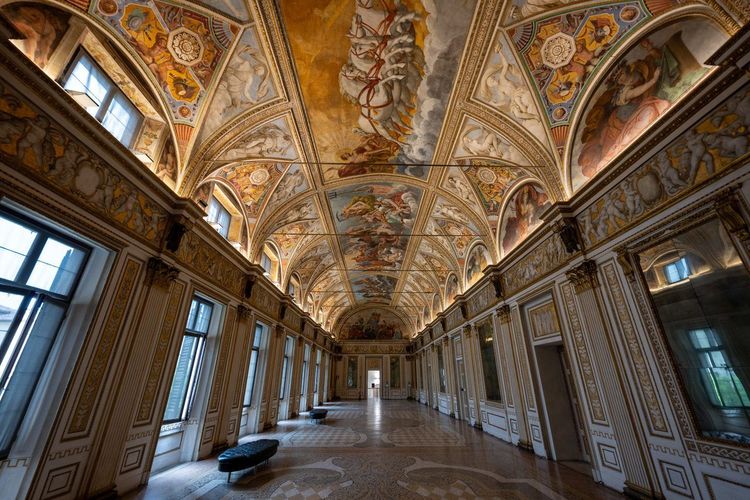
Beyond Lake Garda and the Valpolicella already mentioned, several destinations usefully complement a stay in Verona. Mantua, the UNESCO-listed city of the Gonzagas, is less than an hour away by train and boasts a richly decorated ducal palace as well as a Renaissance basilica designed by architect Leon Battista Alberti — all in a setting far less crowded than Verona itself.
Vicenza, forty-five minutes by train to the east, is worth visiting for the works of architect Andrea Palladio, including the Olympic Theatre — considered the oldest covered theatre still in use in Europe, completed in 1585 with a trompe-l'œil perspective stage set depicting streets in depth. Padua, even closer to Venice, rounds out the picture for those interested in Giotto's frescoes in the Scrovegni Chapel, which must be booked well in advance given the strictly limited visiting slots designed to preserve the work.
For those planning a broader itinerary in northern Italy, the Verona–Venice combination remains the most popular: the direct train links the two cities in just over an hour, making even a day trip possible without changing accommodation. Conversely, those heading back to France after their time in the Veneto will find on the Ryo app audio-guided tours already covering several French cities — a way of continuing the same logic of independent exploration experienced in Verona.
22. Practical Itineraries: 1, 2, or 3 Days, Map and Useful Information
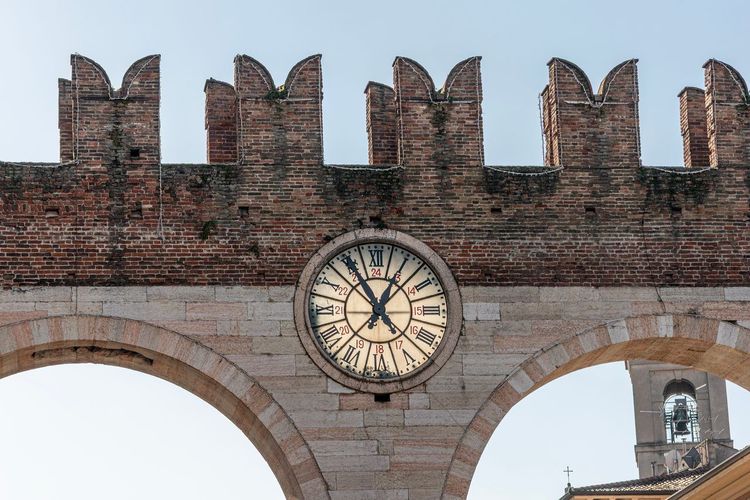
To visit Verona in 1 day, focus on the Arena, Casa di Giulietta, Piazza delle Erbe, and Piazza dei Signori in the morning, then Torre dei Lamberti and Castelvecchio in the afternoon, finishing at Ponte Pietra at sunset. This route, entirely walkable, covers around 5 kilometres and takes in the main sites of the historic centre with no need for motorised transport.
Over 2 days, add the Basilica di San Zeno, Castel San Pietro, Giardino Giusti (Via Giardino Giusti 2, 37129 Verona VR, rated 4.5/5 on Google based on 6,089 reviews), and a wander through the Veronetta neighbourhood on the second day, saving the evening for dinner well away from the tourist routes. Over 3 days, a full excursion to the Valpolicella or Lake Garda becomes possible, turning the stay into a genuine regional immersion rather than a simple city visit.
Verona is very largely walkable: the historic centre, enclosed within the bend of the Adige, spans no more than 2 kilometres between the Arena and the Basilica di San Zeno. A paper map distributed free at the tourist office, located on Via degli Alpini just behind Piazza Bra, is more than enough to find your way without a constant internet connection. Offline mapping apps are still useful, however, for excursions to the Valpolicella or Lake Garda.
When it rains, several covered options take over: the Castelvecchio museum, Palazzo Maffei, the Museo Archeologico, and the interiors of the Duomo and Basilica di San Zeno can fill an entire day without stepping out in the downpour. The covered arcades around Piazza delle Erbe also provide dry routes for moving between monuments.
In terms of season, April to June and September–October offer the best compromise between mild weather and manageable crowds. July and August, the opera festival period, push accommodation prices and visitor numbers up, while winter — quieter — allows monument visits without queuing, provided you accept shorter days and occasional fog. Those who have already used a Ryo audio-guided tour in another city will find the same habits here: offline content downloads, complete freedom over timing, and an itinerary that can be adjusted to suit the weather of the day.
FAQ
How many days do you need to visit Verona?
One day is enough to see the highlights of the historic centre: the Arena, Casa di Giulietta, Piazza delle Erbe, and Castelvecchio. Two days allow you to add Veronetta and the surrounding hills. Three days open up the possibility of a day trip to the Valpolicella or Lake Garda.
Is Verona easy to explore on foot?
Yes, the historic centre fits within a 2-kilometre radius around the Adige. Almost all the landmarks mentioned in this guide can be reached on foot in under 20 minutes, with no need for public transport on a classic 1- to 2-day stay.
What can you do in Verona when it rains?
The Castelvecchio museum, Palazzo Maffei, the Museo Archeologico, and the interiors of the main churches — the Duomo and Basilica di San Zeno in particular — offer covered alternatives. The shopping arcades around Via Mazzini also allow you to move between sights while staying dry.
Is Verona worth a day trip from Venice?
Yes, the direct train journey takes just over an hour, making a day trip very manageable. Verona offers a Roman and medieval heritage that is markedly different from the Venetian atmosphere, with fewer crowds than Venice in high season.
What are the unusual places to visit in Verona?
The monumental cemetery, the exterior staircase of the Santi Siro e Libera church, the Museo di Storia Naturale, and the underground Verona Sotterranea route beneath Piazza delle Erbe are among the city's least-visited curiosities.
Do you need to book the Arena di Verona in advance?
For a daytime visit, no — entry requires no advance booking. To attend an opera in summer, however, booking several weeks ahead is essential, as the most affordable stone-tier seats sell out quickly once the box office opens.
What is there to see near Verona?
Lake Garda, the Valpolicella, Mantua, and Vicenza are all less than an hour away by road or train from Verona, making it easy to combine a visit to the city with one or more regional day trips depending on the length of your stay.
Conclusion: Verona, Far More Than a Stopover
Verona ultimately proves far richer than its reputation as a mere stopover between Venice and Milan suggests. Between a still-living amphitheatre, little-known Gothic tombs, and wine-producing hills within easy reach by bus, the city lends itself equally well to a one-day stopover and to an extended stay that spills comfortably into the Valpolicella and Lake Garda. Whether you have a single afternoon between two trains or a long full weekend, the essentials lie within the bend of the Adige, all within walking distance, and every season reveals a different facet — from the summer opera festival to the quiet, misty lanes of winter. Take the time to look up at the painted facades, push open the door of a deserted cloister, and get lost for an hour without a route through Veronetta: it is often there, away from the queues, that the city truly gives itself.
If this way of exploring a city on foot — without a human guide and at your own pace — has won you over, the Ryo app already offers similar audio-guided tours in several dozen French and Spanish destinations, with offline content downloads and itineraries that can be adjusted to suit your mood. The perfect way to carry the logic of independent exploration experienced between the Arena and the hills of the Valpolicella to your next destination, while waiting for a Verona audio-guided tour to one day join the catalogue.
À lire également