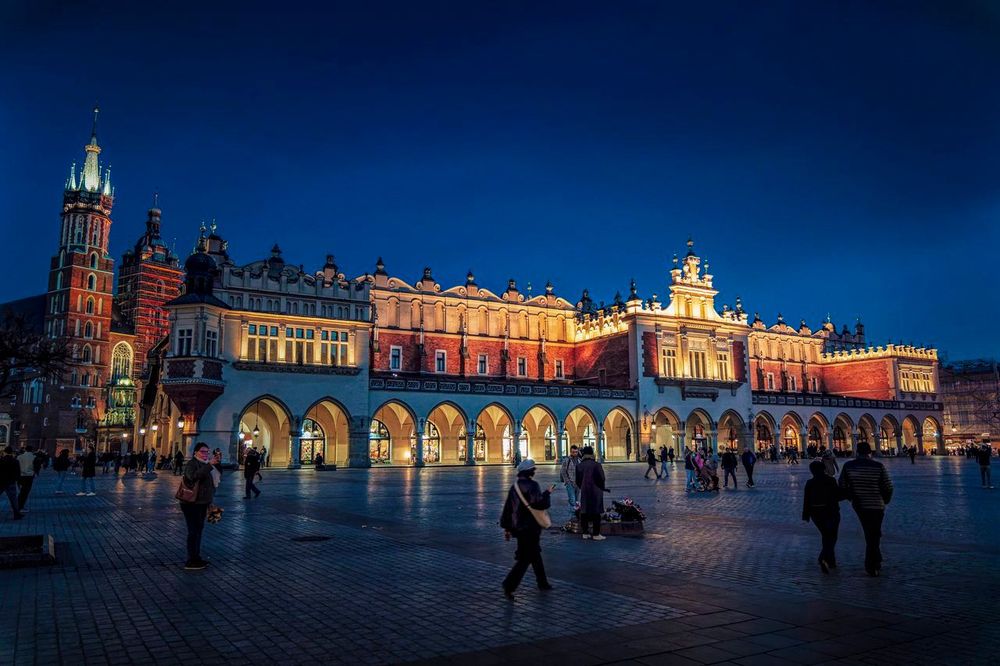
© Shutterstock
 Votre guide Ryo
A Weekend in Krakow in 2026: Day-by-Day Itinerary, Budget and Best Time to Visit
A Friday evening just after arriving on the Rynek Główny, and the belfry already sounds the hejnał, that trumpet melody cut short that has told the story of a never-completed Tatar attack for eight centuries. This is often how a weekend in Krakow begins: with a sound detail you were not expecting, in a city that has kept its medieval center almost intact while Warsaw had to be rebuilt stone by stone after 1945. To miss nothing from the moment you arrive, the Ryo audio-guided tour of Krakow connects the market square, St. Mary's Basilica and Wawel Hill in just a few hours.
In two, three or four days, Krakow reveals itself in layers: first the Old Town and its royal castle, then the Jewish quarter of Kazimierz and its zapiekanki sold on Plac Nowy until late at night, and then, for those with time, an excursion to Auschwitz-Birkenau or to the Wieliczka salt mines, carved out over some 245 kilometers of galleries. Between visits, you come across vodka bars that still serve in frosted glasses, milk bars where a full meal costs around 6 euros, and a city where accommodation remains, even in 2026, clearly cheaper than in Prague or Vienna. This guide details, day by day, what to see, what to eat and how much to budget.
Day 1: Krakow's Old Town and Wawel Hill
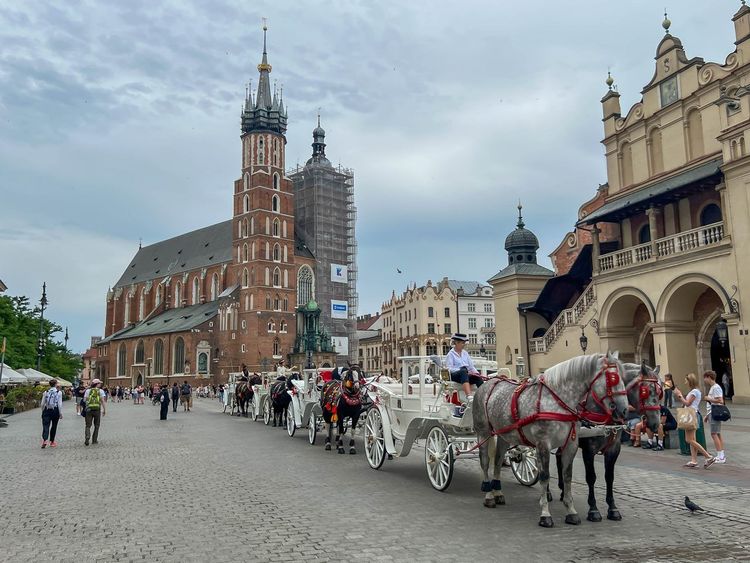
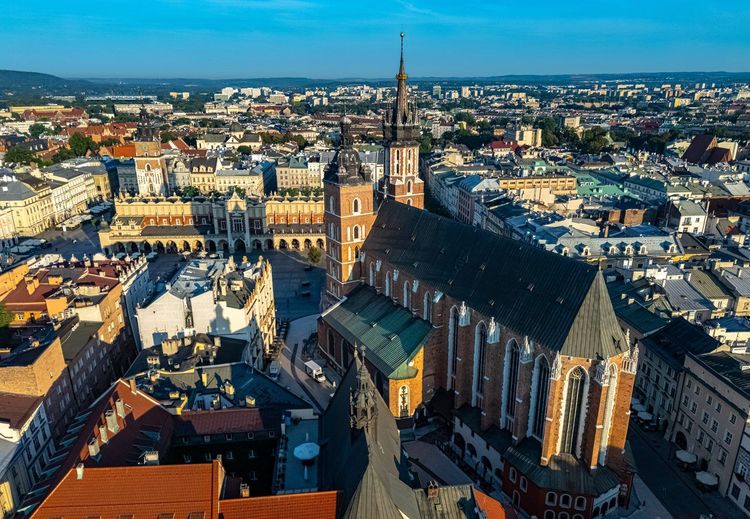
Start with the beating heart of the city: the Rynek Główny, the market square. At 200 meters on each side, it is one of the largest medieval squares in Europe still in use, laid out in 1257 and lined with facades that change shade depending on the daylight.
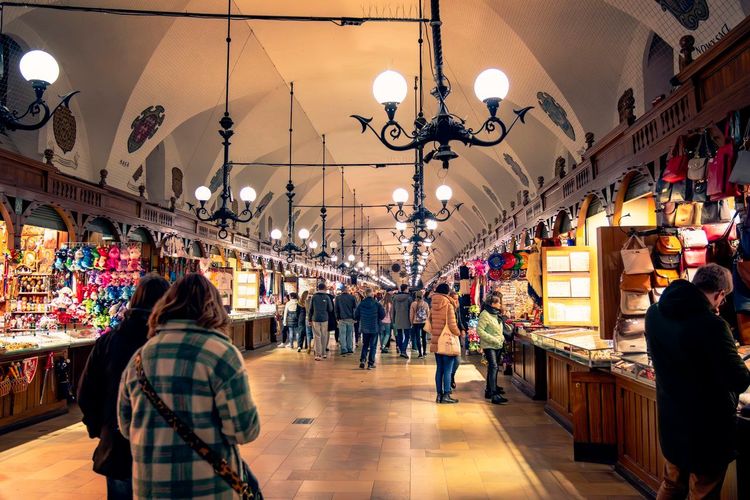
In the center of the square, the Cloth Hall (Sukiennice) (Rynek Główny 1/3, 31-042 Kraków, rated 4.5/5 on Google from 18,936 reviews) stands on the site of a textile market active since the Middle Ages. Its Renaissance gallery now houses amber and handcrafted souvenir stalls, and the upper floor holds an annex of the National Museum devoted to 19th-century Polish painting. Allow a good hour if you want to see both levels without rushing.
Right next to it stands St. Mary's Basilica, recognizable by its two asymmetrical towers. Local legend has it that two architect brothers quarreled over their height, one killing the other before taking his own life out of remorse: a knife hanging under the arcades of the neighboring Sukiennice is said to be the murder weapon. Every hour, a trumpeter plays the hejnał from the taller of the two towers, deliberately interrupted mid-phrase. Inside, the altarpiece carved by Veit Stoss between 1477 and 1489 remains one of the largest Gothic wooden works in Europe.
The Town Hall Tower completes the picture of the square. It is all that remains of the old town hall, demolished in the 19th century: a slightly leaning tower about 70 meters tall that you can climb for a panorama over the red-tiled rooftops.
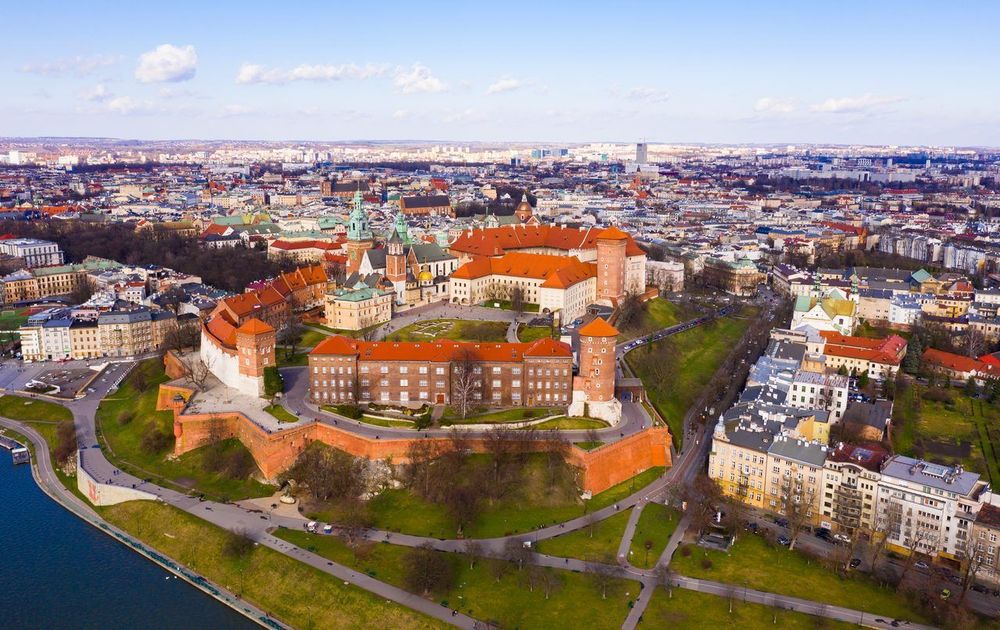
Walking south down Grodzka Street, about fifteen minutes on foot will bring you to Wawel Hill. The Wawel Royal Castle was the residence of the kings of Poland for nearly five centuries, and its Renaissance courtyards are worth a visit even without a ticket for the royal apartments. Right beside it, the Wawel Cathedral saw the coronation of almost all Polish monarchs and houses their tombs, including that of King Casimir the Great. At the foot of the hill, on the banks of the Vistula, the legend of the dragon of Wawel comes to life: a cave called Smocza Jama can be visited by descending into it, and at its exit, a statue actually breathes flames every few minutes, to the delight of children.
Incidentally, the Ryo audio-guided tour of Krakow comments on each of these stops in order, market square, basilica, then Wawel Hill: handy for this first day, with no need to figure out where to look between explanations.
Day 2: The Jewish Quarter of Kazimierz and Podgórze
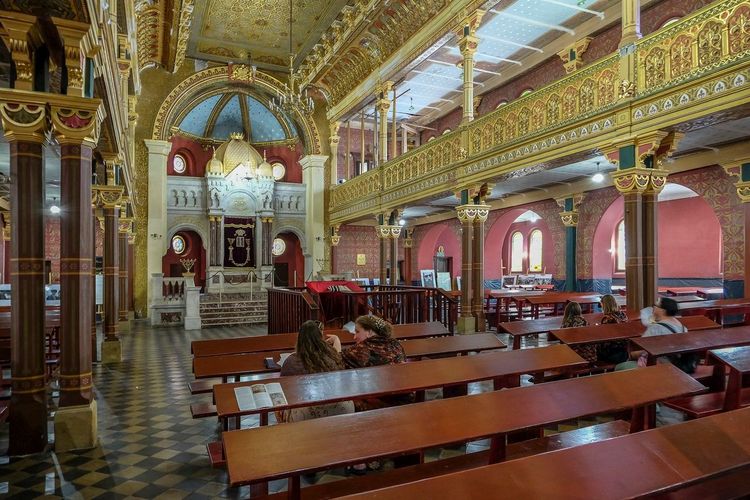
The Kazimierz district is 15 to 20 minutes on foot south of the Old Town, or a few tram stops away. Founded in 1335 by Casimir the Great as a royal town separate from Krakow, it welcomed the Jewish community from the end of the 15th century, which prospered there for more than four hundred years, until the Second World War. Today, its cobbled lanes mix restored synagogues, art galleries and cafés that open late.
At number 4 Lipowa Street, across the Vistula in the Podgórze district, the Schindler's Factory occupies the former enamel factory of industrialist Oskar Schindler, who employed and protected more than a thousand Jewish workers. The museum housed within its walls retraces, through an immersive scenography, the German occupation of Krakow between 1939 and 1945. Allow a good two hours, as the visit is dense and emotionally demanding, and book your slot online: the number of admissions is limited.
The Podgórze ghetto, created by the occupation authorities in 1941, is explored mostly through its memory. The Ghetto Heroes Square is its strongest symbol: 70 empty bronze chairs are arranged there, in tribute to the furniture abandoned during the liquidation of the ghetto and the inhabitants deported to the camps.
To lighten the afternoon, head back to Kazimierz and its Plac Nowy (Plac Nowy, 31-059 Kraków, rated 4.5/5 on Google from 3K reviews), recognizable by its round pavilion nicknamed the okrąglak, a former poultry slaughterhouse turned into a market. This is where you taste zapiekanki, those long baguette halves topped with mushrooms and melted cheese, sold from stalls open until late at night. Locals come here as much as tourists, especially on weekends.
To go deeper into this day, the Ryo audio-guided sub-tour of the Jewish quarter takes you step by step through Kazimierz and Podgórze, with the anecdotes that give depth to every facade: a good continuation of the previous day, without having to research everything yourself.
Day 3: Excursion to Auschwitz-Birkenau or the Wieliczka Salt Mines
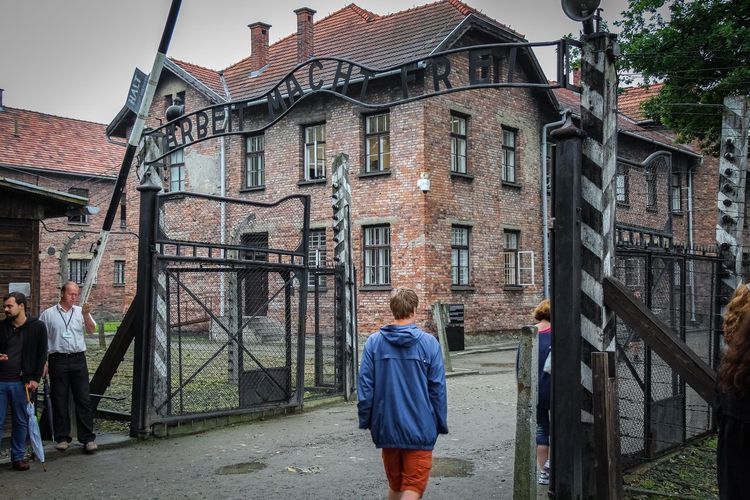
A Krakow and Auschwitz weekend remains one of the most sought-after combinations, for a simple reason: the camp is about 70 kilometers away, or 1h15 to 1h30 by road. The Auschwitz-Birkenau Memorial includes two distinct sites, the main camp and Birkenau 3 km away, connected by a free shuttle. Entry remains free, but since March 1, 2026, reserving a time slot on the museum's official platform is mandatory for all visitors, and no tickets are sold on site anymore. The guided group visit costs around 150 zlotys. Many visitors opt for an organized excursion from Krakow, with transport and guide included, in a long half-day format.
If you prefer an excursion that is less emotionally heavy, the Wieliczka salt mines are only 15 km from the center, reachable in about twenty minutes by train. Listed as a UNESCO World Heritage Site as early as 1978, on the very first list, they were exploited from the 13th century until commercial extraction ended in 1996. The guided tourist route descends 135 meters underground via hundreds of steps, through carved galleries, salt statues and an underground chapel entirely cut from salt, whose chandeliers are themselves made of dissolved and recrystallized salt crystal.
A day excursion from Krakow, to either site, is easily booked online or through your accommodation. Both options fit within half a day, leaving time to return for the evening. If your weekend only has two full days, you will probably need to choose: the salt mines suit a family or rushed format better, while Auschwitz-Birkenau demands more time and emotional availability.
Hidden Gems and Must-Sees Not to Miss in Krakow
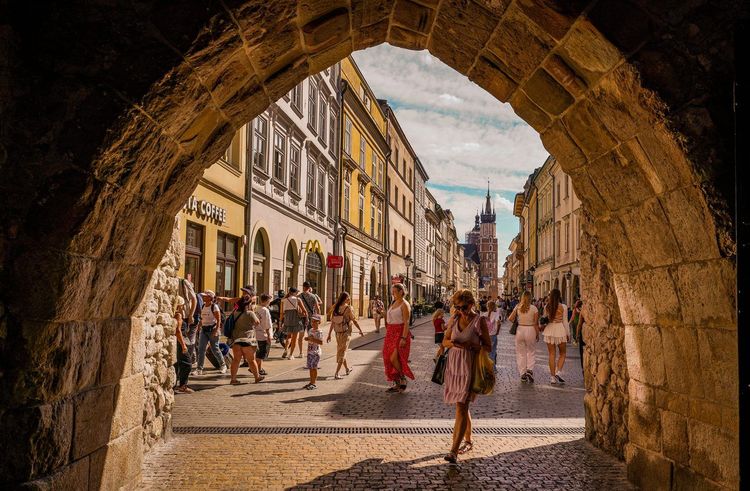
The Floriańska Street links the market square to the old north gate of the city. Lined with merchant houses and cafés, it is one of the liveliest streets in the Old Town, and probably the most photographed after the Rynek itself.
At the end of this street still stands the Krakow Barbican, a circular fortification from the late 15th century once connected to the ramparts by a covered passage. It is one of the few medieval barbicans still standing in Europe, and it can be visited for just a few zlotys.
All around the Old Town stretches the Planty Park, a green ring of about 4 kilometers laid out in the 19th century on the site of the demolished former city walls. You can walk the entire loop in about an hour, and it is also the most pleasant route for connecting two points in the center without passing through the crowded Rynek again.
Farther out, Kościuszko Mound (Al. Waszyngtona 1, 30-204 Kraków, rated 4.7/5 on Google from 25,775 reviews) offers one of the finest panoramas over Krakow, yet most hurried visitors overlook it. This artificial mound, erected between 1820 and 1823 in memory of General Tadeusz Kościuszko, can be climbed in about twenty minutes from the foot of the hill, reachable by tram from the center.
For these off-the-beaten-path detours, the Ryo audio guide to the city points out precisely this kind of place, hidden between the official stops, which is easy to miss when focusing solely on the market square.
How Many Days to Visit Krakow: 2, 3 or 4 Days?
Visiting Krakow in 2 days lets you cover the Old Town, Wawel and half a day in Kazimierz, but without an outside excursion: it is an efficient format for a short city trip, even if it means sacrificing Auschwitz or the salt mines.
What to do in Krakow in 3 days? This is probably the most frequent question, and the answer comes down to a simple formula: one day for the Old Town and Wawel, one day for Kazimierz and Podgórze, one day for an excursion of your choice. This is the balance that suits most visitors, and the one followed by the itinerary in this guide.
A 4-day Krakow weekend frees up room to slow down: an extra morning at Planty Park or Kościuszko Mound, a second museum, or simply more time strolling around Plac Nowy without counting every hour. It is also the format that lets you combine both excursions, Auschwitz-Birkenau and the Wieliczka salt mines, rather than choosing.
To plan this timing, the length of the Ryo audio-guided tour gives a good benchmark: its stops flow comfortably over half a day, which helps you know how much time to keep for the rest.
Where to Eat in Krakow: Specialties and Good Addresses

Pierogi remain the must-try of any Polish trip: these dumplings, boiled and sometimes pan-fried, are filled with potato and fresh cheese, meat, sauerkraut with mushrooms, or in a sweet version with red berries. Almost every restaurant offers a house variation.
The zapiekanka, already encountered in Kazimierz, deserves a special mention: born in the 1970s in a Poland facing shortages, this hot open-faced baguette topped with sautéed mushrooms and melted cheese has become a street food classic, sold for a few zlotys at stands open until the end of the night.
Krakow also maintains a real culture of vodka bars. Some establishments in the center offer tastings of flavored vodkas, with honey, bison grass or fruit, served chilled in small glasses accompanied by pickles or herring.
To eat quickly and truly cheaply, milk bars (bary mleczne) are an institution inherited from the communist era: simple canteens where a full dish, often pierogi or a soup, generally costs between 20 and 30 zlotys. You eat from a tray, at long shared tables, in a no-frills atmosphere.
Finally, the covered market Hala Targowa (ul. Grzegórzecka 5a, 31-559 Kraków, rated 4.4/5 on Google from 2,901 reviews), a little off the tourist track, is worth the detour if you want to see where Krakow residents actually do their shopping: cheeses, cured meats and seasonal fruit are sold there at prices clearly lower than in the historic center. On Sunday mornings, a flea market also sets up around the hall.
Where to Stay in Krakow: The Best Neighborhoods for a Weekend
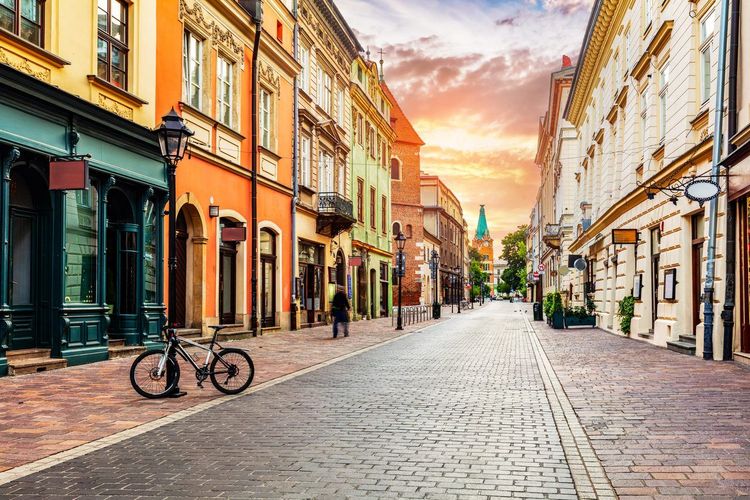
Staying in the Old Town puts everything within walking distance, basilica, Sukiennice, Wawel Hill, but this comfort comes at a price: it is the most expensive and most touristy neighborhood, with sometimes noisy nights around the Rynek on weekends.
Kazimierz, conversely, appeals with its more local, bohemian atmosphere, its independent cafés and its prices generally 20 to 30% lower than those of the center. The flip side: you have to walk or take the tram to reach the major Old Town sites, especially in the evening.
For a weekend as a couple, many visitors choose a compromise between the two: an address on the edge of Kazimierz, ten minutes on foot from the Rynek, combining nighttime calm and quick access to the must-sees. Our Ryo article on Krakow for couples details precisely this kind of itinerary and the addresses that work well for this format.
What Is the Best Time to Go to Krakow
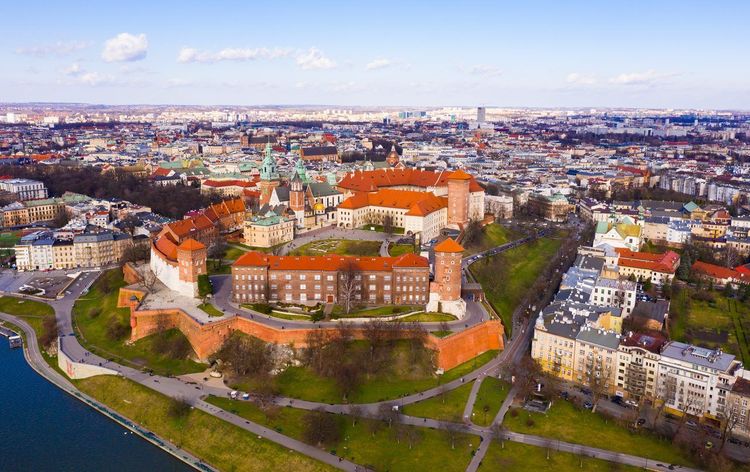
Krakow's weather is clearly split between a hot summer, sometimes above 28 degrees in July and August, and a harsh winter when temperatures regularly drop below zero between December and February.
The ideal season is spring, from May to June, and early autumn, in September: temperatures remain pleasant for walking all day, without the sometimes stifling heat of midsummer.
Tourist crowds vary strongly by period: July and August concentrate the largest number of visitors, with queues at Wawel and Auschwitz-Birkenau slots that sell out several weeks in advance. December, on the other hand, offers a special atmosphere, with the Christmas market on the Rynek, despite the cold. If you are aiming for the best price-to-weather ratio, target a weekend in late May or mid-September.
How to Get to Krakow and Get Around
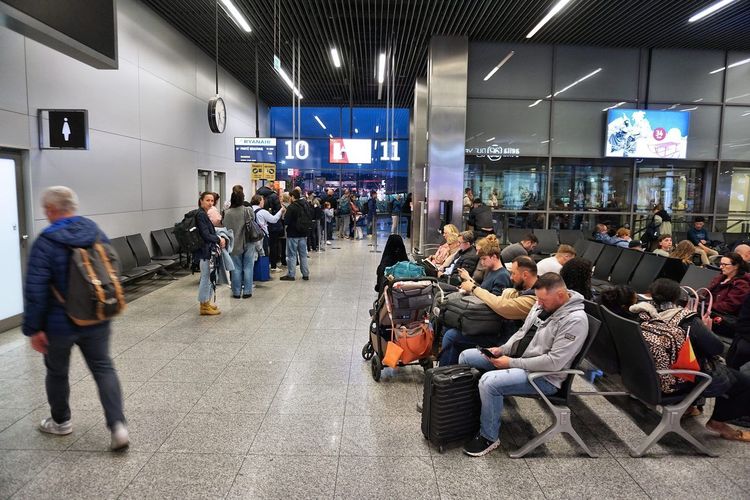
From France, many direct flights connect to Krakow from Paris, Lyon, Marseille, Nice or Nantes depending on the season, for a journey of about 2h15 to 2h30.
The John Paul II Airport is located in Balice, about twelve kilometers west of the center. The direct train reaches the main station, Kraków Główny, in 17 to 20 minutes for around twenty zlotys; city buses, slower (about 45 minutes), remain the cheapest option with a 60-minute ticket at 6 zlotys.
On site, public transport relies on a dense network of trams and buses, enough to reach Kazimierz or head out to Kościuszko Mound. But for the Old Town itself, walking remains the most logical mode: the entire historic center, Rynek, Wawel, Floriańska, can be covered in less than 25 minutes on foot from one end to the other.
What Budget to Plan for a Weekend in Krakow
For accommodation, a decent double room in the Old Town rents for between 60 and 90 euros a night in low season, and more for charming addresses, although well-rated hostels start under 30 euros.
The food budget remains one of the lowest in Central Europe: a meal in a milk bar costs 5 to 7 euros, and dinner in a decent restaurant in the center costs between 15 and 25 euros per person, drinks included.
For activities and excursions, expect around 55 euros for an organized excursion to Auschwitz-Birkenau with transport and guide, and 143 to 169 zlotys (about 33 to 40 euros) for guided entry to the Wieliczka salt mines depending on the season. Visits to the Old Town itself, market square, basilica seen from the outside, Planty Park, remain free.
All-inclusive Krakow weekend deals, flight and hotel included, often start at around 300 to 400 euros per person depending on the season. But for on-site visits, following the Ryo audio-guided tour independently saves you the cost of a human guide while keeping the full commentary on the sites you pass, at your own pace.



FAQ
What is the best time to go to Krakow?
May, June and September offer the best compromise between mild weather and reasonable crowds. July and August remain the hottest and busiest months, while December appeals mostly for the Christmas market atmosphere despite the cold.
Is it worth going to Krakow?
Yes: the city offers a preserved medieval center, a royal castle, a dense historic Jewish quarter and two memorable excursions less than an hour and a half away, at a cost clearly lower than that of the major Western European capitals.
What should you avoid in Poland?
Avoid exchanging money at currency exchange offices advertising "no commission" rates near tourist areas, which are often less favorable than they seem. Also avoid going to Auschwitz-Birkenau without a reservation: since March 2026, no tickets are sold on site.
Is living expensive in Krakow?
No, the cost of living in Krakow remains among the lowest of Europe's major tourist cities: food, transport and accommodation generally cost 30 to 40% less than in Paris or London, even though prices have risen noticeably in recent years.
Do you need to book your Auschwitz-Birkenau ticket in advance?
Yes, it has been mandatory since March 1, 2026, and ideally several weeks ahead for the months of June to September: time slots are limited, are booked online on the museum's platform, free of charge for an independent visit, and sell out quickly in high season.
How much time should you allow to visit the Wieliczka Salt Mine?
Allow about three hours on site, not including the round trip from Krakow: the guided tourist route lasts two to three hours, including the elevator ride back up, plus the time spent at the surface.
Our Advice for a Successful Weekend in Krakow
Krakow closes as it opens, on a sound or an image you were not expecting: one last zapiekanka on Plac Nowy, the hejnał ringing out one last time from the basilica, or the evening light on the ramparts of Wawel. Whether your stay lasts two or four days, the essence lies in the balance between dense history and relaxed pace that this city naturally imposes. Book your slots for Auschwitz-Birkenau and Schindler's Factory before leaving, and keep the rest open.
To find the exact order of the stops once on site, without pulling out this guide at every street corner, the Ryo audio guide to Krakow stays in your pocket and comments on each place at the moment you discover it.