© Shutterstock
 Votre guide Ryo
15 Free Things to Do in Bilbao in 2026
Bilbao is unlike any other Spanish city, and the first surprise is its budget: the list of free things to do in Bilbao is much longer than the brochures suggest. People often imagine that you need to buy lots of tickets to see the essentials, but between titanium façades that change colour with the light, the medieval lanes of the Casco Viejo and the paths climbing to the viewpoints, the big city of the Spanish Basque Country can be explored very largely without opening your wallet. The Ryo audio-guided route of Bilbao follows this same logic, linking most of the places below on foot.
Throughout this article, you will come across an early 20th-century wine warehouse transformed by Philippe Starck into a cultural centre with a rooftop pool, a covered market that claims the title of the largest in Europe, a basilica perched above more than 300 steps and a stadium nicknamed "la Catedral" by Athletic Club supporters. You will also know exactly what remains paid (the interior of the Guggenheim, the cathedral visit, the funicular) and how to work around it. Fifteen stops make up this selection, from the Guggenheim to the pintxos of the Siete Calles, ranked from the must-sees to the gems that even some locals overlook.
1. Admire the Guggenheim Museum (and Make the Most of Its Free Access Areas)
It's impossible to talk about Bilbao without starting with the building that changed its destiny. The Guggenheim Museum Bilbao (Avenida Abandoibarra 2, 48009 Bilbao, rated 4.5/5 on Google from 98,240 reviews) opened in 1997 in a structure designed by Frank Gehry, covered with some 33,000 titanium panels that catch the light differently depending on the time and the weather. Let's be clear on a point that is often vague in guides: the adult ticket costs 18 euros in 2026 (9 euros for students aged 18 to 26 and over-65s). Good news for families: admission is free for under-18s.
Everything outside, however, can be visited without a ticket at any time. Puppy, the giant dog over twelve metres tall covered in living flowers by Jeff Koons, sits in front of the main entrance and changes its outfit with the seasons. On the river side, Maman, Louise Bourgeois's bronze and steel spider, about nine metres high, watches over the basin, while Anish Kapoor's silver spheres (Tall Tree & the Eye) reflect hundreds of images of the building. About every hour, Fujiko Nakaya's fog sculpture wraps the basin in an artificial cloud: stay a few minutes, the effect is worth the wait.
The full tour takes thirty to forty minutes. Climb onto the La Salve bridge, which brushes past the museum: its red arch, added by artist Daniel Buren in 2007 for the Guggenheim's tenth anniversary, offers one of the best photo angles on the titanium.
A little history helps gauge the shock this building represented. In the 1980s, shipyards and steelworks were closing one after another, and the floods of August 1983 had devastated the Casco Viejo. Bilbaínos still speak of the "Guggenheim effect" to describe this renaissance through culture, an expression since adopted by urban planners worldwide. As you walk along the façade on the Ría side, notice how Gehry slid his museum under the La Salve bridge instead of keeping it away: the tower that spans the roadway acts as a signal visible from the city entrance.
The museum also occasionally opens its doors without a ticket for special events: in early October 2026, for example, Pipilotti Rist's video installation Ever Is Over All was freely accessible for three days. These dates are only announced a few weeks in advance, so check the official calendar before your stay. Above all, don't assume the interior is open to everyone by default: it's the most common disappointment among visitors.
A few tips to organise this first stop. Come early in the morning, before the doors open at 10 a.m., or at the very end of the day: the low light makes the titanium literally shine, and you will have the forecourt almost to yourself. On the Ría side, the stairs descending to the basin let you walk all the way around the building, passing under the La Salve bridge. The quayside terraces opposite the museum are perfect for a break, but nothing obliges you to buy anything to enjoy the view from the public benches lining the promenade. Finally, the garden of Tulips, another work by Jeff Koons, can be glimpsed from the upper terrace on the river side: a bouquet of giant polished steel tulips in vivid colours, ideal for a quirky photo. If you are travelling with teenagers, remember that they enter for free: it's often the moment to take them inside while you enjoy the surroundings.
The area surrounding the museum, sometimes called the Bilbao Art District, also deserves a stroll: several contemporary art galleries host openings that are open to the public, and each bridge you cross reveals a new angle on the building. If contemporary architecture already intrigues you at this stage, the Ryo audio-guided sub-route on the city's architectural renewal starts right around the Guggenheim: its 21 audio stops, over 3h00 and 7.3 km, tell how this museum turned an industrial city in crisis into a world cultural destination.
2. Stroll Through the Casco Viejo and the Siete Calles (Zazpi Kaleak)
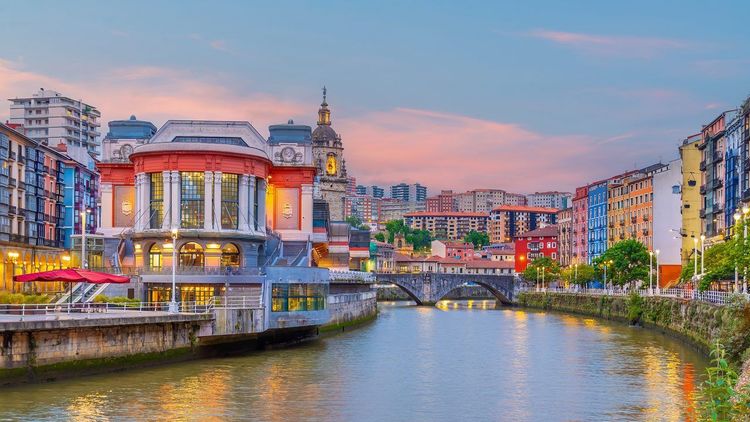
If the Guggenheim represents the Bilbao of the future, the Casco Viejo embodies its medieval past. The neighbourhood is organised around seven parallel streets laid out in the decades following the city's founding in 1300, called Siete Calles in Spanish or Zazpi Kaleak in Basque: Somera, Artekale, Tendería, Belostikale, Carnicería Vieja, Barrenkale and Barrenkale Barrena. Getting lost here is one of the most pleasant ways to understand how Bilbao was born, squeezed between a hill and a meander of the Nervión.
At the heart of the neighbourhood stands the Plaza Nueva (Plaza Nueva, 48005 Bilbao, rated 4.6/5 on Google from 8K reviews), a neoclassical square completed in the mid-19th century and surrounded by arcades on all four sides. On Sunday mornings, a traditional market sets up its stalls of antiques, stamps and bric-a-brac, a free-to-enter activity that transforms the square, which is very quiet during the week.
Each street has kept the trace of its historic specialty: the names Tendería (the shops) or Carnicería Vieja (the old butchery) speak for themselves. Today, it's mostly pintxo bars that occupy the ground floors, but the wrought-iron balconies and vaulted porches recall the medieval merchant organisation. Look up: several buildings still bear carved coats of arms.
Don't leave the neighbourhood without looking for the Dog Fountain (Fuente del Perro), in the small street of the same name. Built around 1800, it is adorned with three lion heads spouting water... which the locals, unfamiliar with big cats, mistook for dogs. The nickname stuck, and so did the street's name. It's the Bilbaínos' favourite anecdote for testing visitors.
To the north of the Siete Calles, Unamuno Square pays tribute to the writer Miguel de Unamuno, born in Bilbao in 1864; it's from here that the staircase to Begoña begins (see section 14). On the Ría side, the Arenal Park, long the favourite promenade of the bourgeoisie, keeps its bandstand where brass band concerts are still held on certain Sundays. A tip: explore the streets early, between 9 and 10 a.m., when the metal shutters go up and the delivery drivers unload crates in front of the bars. You will see the neighbourhood living for its residents, before the groups arrive.
The area can even be visited late in the evening, with street lighting highlighting the façades. The Ryo audio-guided route devotes a stop to each of the seven streets as well as to the construction of the Plaza Nueva: a good way not to simply walk through the neighbourhood without grasping its logic.
3. Visit the Santiago Cathedral
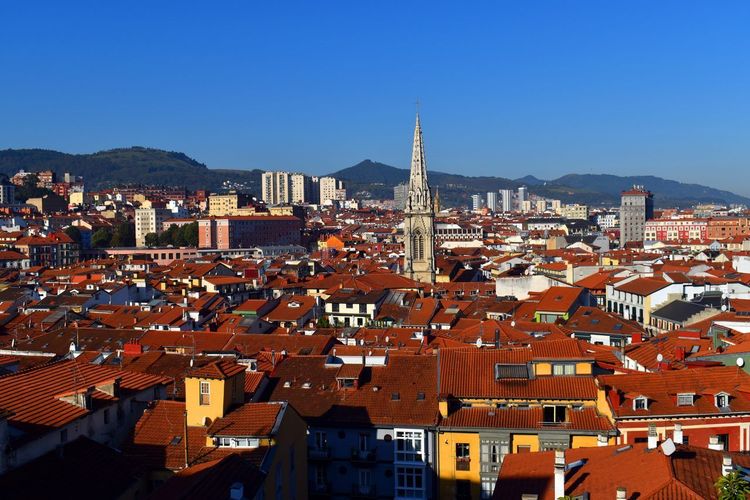
Discreet behind the tight façades of the Casco Viejo, the Santiago Cathedral (Calle Correo 2, 48005 Bilbao, rated 4.3/5 on Google from 9,583 reviews) is the city's most important religious building. Built from the late 14th century in a Gothic style, it only received cathedral status in 1949, with the creation of the Diocese of Bilbao. It is dedicated to Saint James: Bilbao is a stop on the coastal Camino de Santiago.
Be careful: contrary to a common belief, the tourist visit is paid: 10 euros for an adult, with audioguide, a ticket that can be combined with San Antón church. It is, however, free for 12-18 year-olds, students under 25 and jobseekers. To discover the nave without paying, the only way is to attend a service: you will see the ribbed vaults and the altarpiece in a spirit of quiet reflection, provided you remain discreet.
The exterior, on the other hand, can be explored freely. Walk around it to compare the Gothic parts with the neo-Gothic main façade and tower, added in the late 19th century, and take a look at the south portico, where pilgrims once gathered.
Five minutes' walk away, San Antón church, set on the edge of the Ría, completes the visit: its Gothic silhouette topped with a Baroque bell tower appears, along with the neighbouring bridge, on Bilbao's coat of arms. Admire it from the opposite bank, as that's where it photographs best.
4. Cross the Zubizuri Bridge and Walk Up Zuberoa Avenue
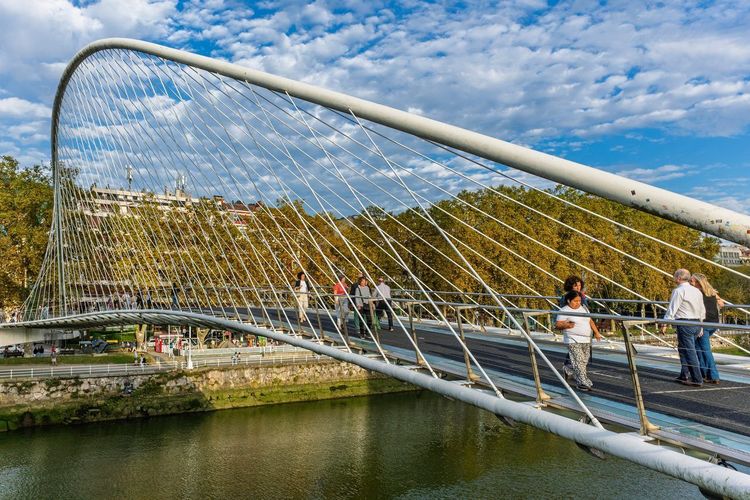
Among the bridges spanning the Bilbao Ría, the Zubizuri Bridge (Campo Volantín, 48001 Bilbao, rated 4.4/5 on Google from 13,356 reviews) contrasts sharply with the stone structures of the historic centre. Designed by Santiago Calatrava and inaugurated in 1997, this pedestrian bridge is recognisable by its tilted white arch and its deck of glass tiles, which lets the light filter through.
It's one of the most photographed spots in Bilbao, especially at sunset, when the structure takes on pink and orange hues. Take care in rainy weather: the glass becomes slippery, a flaw so well known that the city council eventually laid a non-slip mat after numerous falls.
Once across the bridge, head up Zuberoa Avenue, lined with colourful façades that deliberately contrast with the dominant grey of the centre. These houses, repainted as part of an urban renewal programme, have become a must for anyone photographing Bilbao's new architecture, with, a little further along the quays, César Pelli's Iberdrola Tower and Arata Isozaki's two towers, the tallest in the city after it. Calatrava also designed another structure you will inevitably see if you arrive by plane: the Loiu airport terminal, nicknamed "La Paloma" for its bird-like silhouette with outstretched wings.
This walk between a contemporary bridge and vivid façades sums up the philosophy of Bilbao over the last thirty years: an industrial city that bet on colour and boldness to reinvent itself. This same audio itinerary on contemporary Bilbao follows precisely this route and tells the story of the restoration of these houses, a story few visitors know on arrival.
5. Discover the Alhóndiga, Now the Azkuna Centre
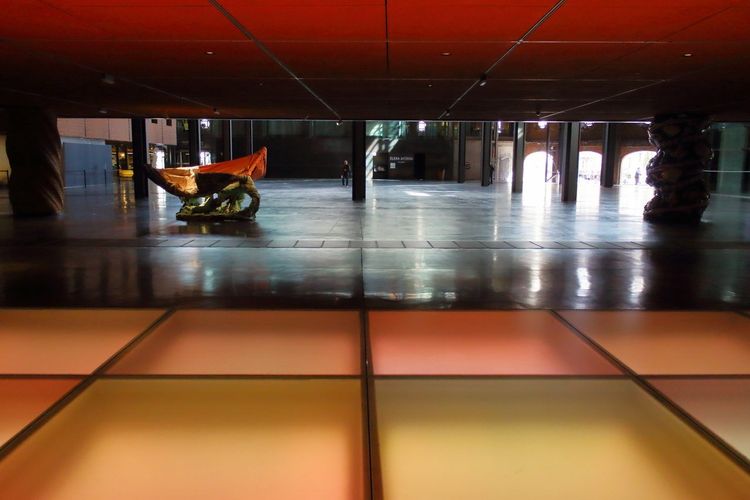
The story of the Alhóndiga sums up Bilbao's urban transformation on its own. Built in 1909 by architect Ricardo Bastida to store the city's wine and oil, this immense warehouse was rehabilitated in 2010 by designer Philippe Starck, then renamed the Azkuna Centre (Plaza Arrikibar 4, 48010 Bilbao, rated 4.5/5 on Google from 19,473 reviews) in tribute to former mayor Iñaki Azkuna.
The main interest for a visitor on a tight budget lies in the common areas, open to all every day: the immense atrium supported by 43 columns, all different (classical, Gothic, oriental and industrial inspirations), is worth the detour on its own. Imagined by Italian film set designer Lorenzo Baraldi, they evoke the cultures, wars and religions that have shaped humanity: have fun looking for the column that speaks to you most. Look up as you enter: the bottom of the top-floor pool is partly glazed, and from the atrium you can see the silhouettes of swimmers who seem to float above you.
The building also houses a media library, a cinema, exhibition rooms that are often free to enter and a sports centre. You can move around the spaces, read the press or settle in the media library without paying anything; only specific activities (pool, screenings, classes) require a ticket. On rainy days, it's one of the best refuges in the city. On the ground floor, check the programme displayed at the entrance: lectures, author meetings or film festivals open to the public follow one another throughout the year, and some open-air screenings are offered in summer on the square bordering the building.
6. Step Into the Arriaga Theatre and the Kafe Antzokia
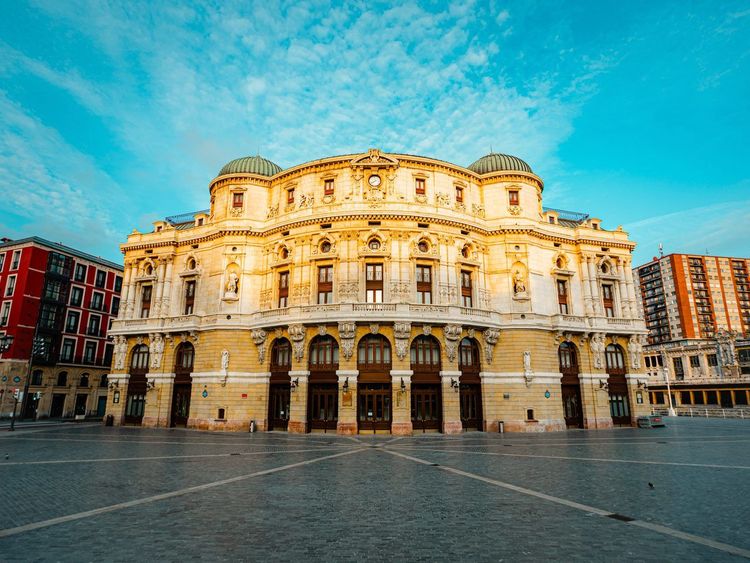
At the junction of the Casco Viejo and the quays stands the Arriaga Theatre, a neo-Baroque building inaugurated in 1890 and inspired by the Paris Opera. Ravaged by a fire in 1914, it reopened five years later. Its architect, Joaquín Rucoba, also designed the neighbouring town hall, on the other side of the Ría, which you can admire from the quays. The theatre's façade, adorned with statues and elaborate balconies, can be admired freely.
Right next door, San Nicolás church, dedicated to the patron saint of sailors, recalls the city's port past. Built in the 18th century on a plan original for the region, it opens to visitors during worship hours, on a quiet little square away from the bustle.
A little further on, the Kafe Antzokia (Calle San Vicente 2, 48001 Bilbao, rated 4.3/5 on Google from 3,118 reviews) occupies a former cinema turned into a concert hall dedicated to Basque culture. Concerts are paid, but the ground-floor bar, lively from daytime, lets you take the pulse of the local scene over a coffee: it's one of the places most representative of Basque music.
Then cross the Arenal bridge to look at the theatre from the other bank: it's from there that you best see its kinship with the Palais Garnier. On this same quay, La Concordia station, inaugurated in 1902, displays a Modernist façade of wrought iron and ceramics that can be admired freely from the pavement.
This triangle can be covered in about twenty minutes on foot and makes an excellent transition between the old town and the quays.
7. Browse the Ribera Market and Walk Along the Riverside Docks
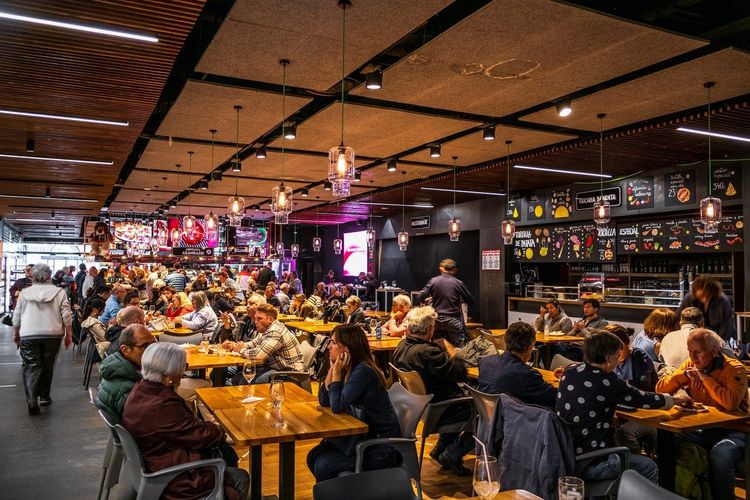
The Ribera Market (Calle Ribera 20, 48005 Bilbao, rated 4.4/5 on Google from 34,324 reviews) claims the title of the largest covered market in Europe, with around 10,000 m² spread over several levels. Inaugurated in 1929 and designed by architect Pedro Ispizua, this Rationalist building with Art Deco touches is recognisable by its coloured stained-glass windows and its long façade that follows the curve of the river.
Entering costs nothing, and wandering among the stalls of fish, fruit and Basque products is an activity in itself: the smells, colours and morning bustle give a very different picture of the city. Come before 11 a.m., when the fishmongers are still unpacking the catch from the Bay of Biscay; in the afternoon, some of the stalls are closed.
On leaving, extend the walk along the redeveloped quays, which some English-language guides call the Riverside Docks. The former warehouses have given way to pedestrian promenades, benches and cycle paths following the banks of the Nervión. Cross the San Antón bridge, whose medieval ancestor appears, along with the neighbouring church, on the city's coat of arms: you slip into Bilbao La Vieja, a working-class and creative neighbourhood where the painted façades of the Marzana quay are reflected in the water. In the evening, its alternative bars attract a young crowd, far from the polished image of the Guggenheim.
To link these neighbourhoods without relying on transport, our article on how to visit Bilbao without a car details the pedestrian routes and useful tram lines. Want someone to tell you the story of the market on the spot? The Ryo audio itinerary in central Bilbao stops in front of its stained-glass windows to explain its role in supplying the city.
8. Walk Along the Abandoibarra Quays and the Maritime Museum
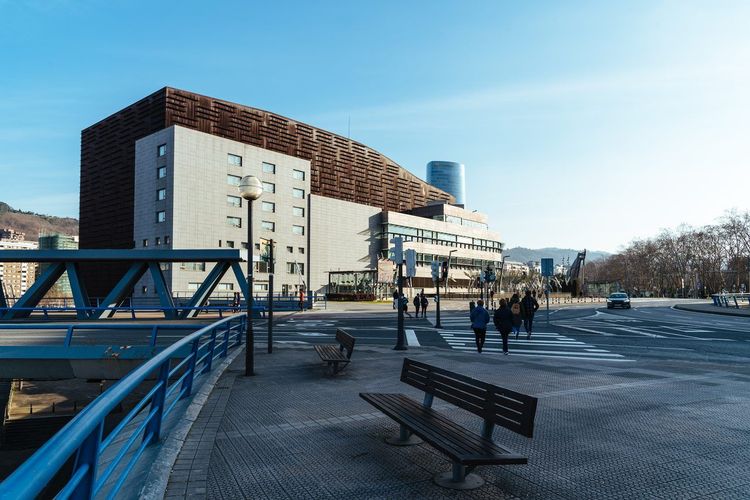
The Abandoibarra district, between the Guggenheim and the Deusto bridge, symbolises Bilbao's most spectacular conversion: former shipyards and warehouses have given way in twenty years to a district of businesses, universities and leisure. The promenade, lined with contemporary sculptures and buildings by international architects, takes about an hour, without rushing. Stop in front of the Iberdrola Tower, 165 metres of glass completed in 2011: it's the tallest skyscraper in the Basque Country, and its base is surrounded by a small public garden where the district's employees have lunch in fine weather. The Pedro Arrupe footbridge lets you reach the University of Deusto, whose neoclassical façade is reflected in the Ría.
At the end of this walk is the Maritime Museum (Muelle Ramón de la Sota 1, 48013 Bilbao), set up on the site of the former Euskalduna shipyards. The indoor exhibitions are paid, but from the quays you can see without a ticket the old dry dock and above all the Carola crane, a red giant of about sixty metres installed in 1957: the workers supposedly named it in memory of a young woman who crossed the Ría every day to go to work.
Right next door, the Euskalduna Palace, an auditorium and conference centre inaugurated in 1999, evokes with its corroded steel silhouette a ship under construction, a nod to the shipyards that once occupied the site. This route alone tells how Bilbao went from port industry to contemporary urban design, without ever completely erasing the traces of its maritime past.
On the practical side, the tram runs along the entire riverfront to the vicinity of San Mamés: handy for getting back if your legs get tired. On Sunday mornings, the quays fill with joggers, cyclists and families on scooters, a good opportunity to observe Bilbaínos in their daily life, far from the museum queues.
9. Make the Most of the Free-Entry Slots at the Fine Arts Museum
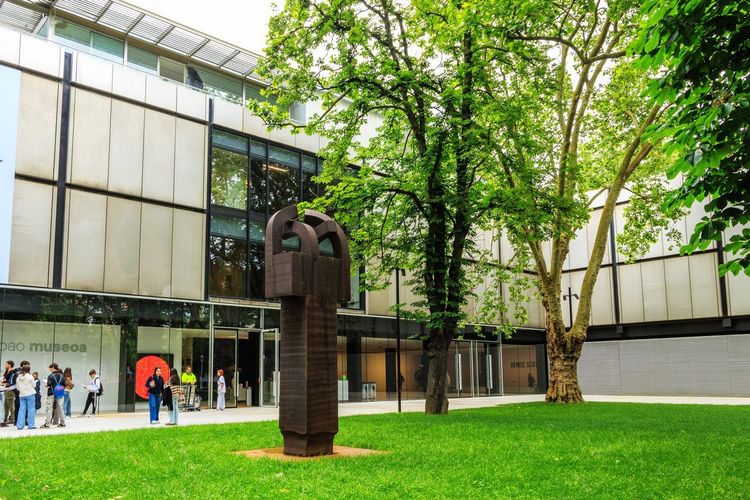
The Bilbao Fine Arts Museum (Plaza del Museo 2, 48009 Bilbao, rated 4.4/5 on Google from 10,363 reviews) holds one of the richest collections in Spain outside Madrid, with works by El Greco, Goya, Gauguin, Francis Bacon and many Basque masters such as Zuloaga. Founded in 1908, it launched a vast expansion project designed by Norman Foster and Luis María Uriarte, which has altered access to some rooms in recent years.
The museum has long offered free-entry periods at the end of the day on certain days of the week. As the arrangements have varied with the works and the gradual reopening of the spaces, check the exact hours on the official website before planning your visit. Arrive a little before the start of the slot: the queue grows quickly in high season. Once inside, concentrate on the rooms devoted to Basque art, often less crowded than those of the great Spanish masters: Ignacio Zuloaga's portraits and Darío de Regoyos's landscapes tell the story of early 20th-century Biscay better than any textbook.
The building stands on the edge of Doña Casilda Park: even without going in, you can compare the original neoclassical pavilion with its modern extensions, and enjoy the sculptures installed around it.
10. Relax at Doña Casilda Iturrizar Park and the Dog Fountain
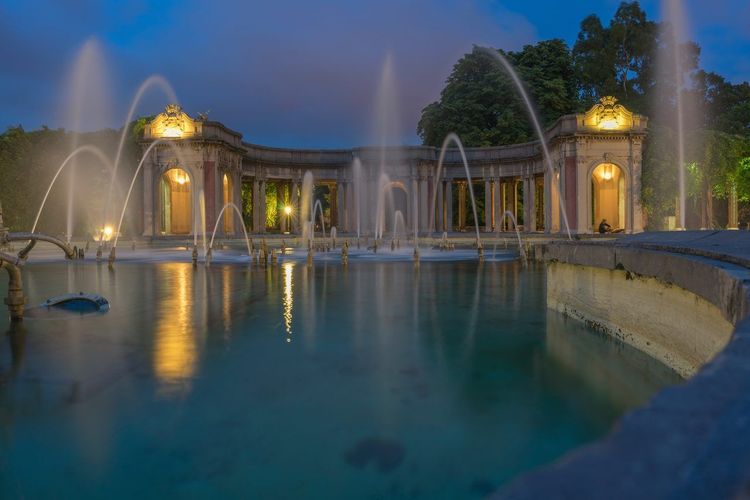
The Doña Casilda Iturrizar Park (Plaza Francisco Combe, 48012 Bilbao, rated 4.6/5 on Google from 12,449 reviews) is the green lung of central Bilbao, designed in the English style with rolling lawns and shaded paths. Inaugurated in 1907, it bears the name of Casilda Iturrizar, a rich widow and great benefactor of the city, who had bequeathed part of her fortune to Bilbao's charities. Locals simply call it "el parque de los patos", the duck park, because of its large pond populated by ducks, swans and geese.
Children love feeding (reasonably) the birds and running on the lawns, while adults enjoy the benches for a picnic between museum visits. The jets of the park's large fountain animate the promenade at the end of the day, and the column pergola near the pond makes a pretty backdrop for photos.
The park also lends itself to an architectural reading: its paths are lined by some of the most opulent buildings of the Ensanche, built in the early 20th century by families enriched by mining and steelmaking. On the north side, recent playgrounds welcome the little ones, and the tall trees (cedars, magnolias, plane trees) offer shade even in the heart of summer. Come on a weekday in late morning if you are looking for calm: at weekends, Bilbao families take over, which also has its charm if you like observing local life.
One clarification, as many guides get it wrong: the famous Dog Fountain is not in this park, but in the Casco Viejo (see section 2). If you combine the two, allow about twenty minutes' walk via the Gran Vía.
The park works particularly well as a midday break between the Fine Arts Museum and the Ensanche, and remains one of the best options for keeping children entertained without spending anything.
11. Breathe in the Albia Gardens and Bizkaia Square
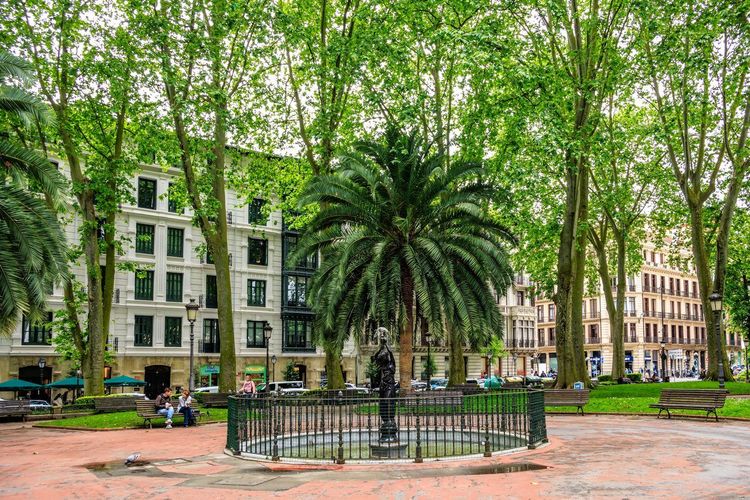
Between the Ensanche and the old town, the Albia Gardens offer a shaded stop under tall plane trees. At the centre stands the statue of the writer Antonio Trueba, a regional literary figure of the 19th century, by sculptor Mariano Benlliure.
Often crossed rather than visited, this small garden deserves five minutes on a bench, if only to look at the San Vicente Mártir church that borders it, one of the oldest in the former municipality of Abando. The Café Iruña, just opposite, with its Mudéjar-inspired azulejos, can also be admired from the pavement: opened in 1903, this historic café is one of the most photographed settings in the Ensanche.
A little further on, Bizkaia Square serves as a landmark between the business centre and the quays. Less picturesque than the Plaza Nueva, it's mostly worthwhile as a stage on a pedestrian itinerary.
From the square, walk up the Gran Vía Don Diego López de Haro, the shopping artery that crosses the Ensanche from Circular Square to Moyúa Square. Window-shopping aside, it's worth it for its façades: the palace of the Provincial Council of Biscay, completed in 1900, displays a richly sculpted eclectic façade, and Moyúa Square, oval and flowery, is bordered by the Chávarri Palace, in neo-Flemish style. At the corner of the square, a curved glass metro entrance designed by Norman Foster, which locals nickname "fosterito", reminds us that the Bilbao metro, inaugurated in 1995, is also a work of architecture.
Neither of these two places justifies a specific detour, but both fit naturally into a walk between the historic centre and the newer districts.
12. Climb Mount Artxanda for a Panorama of the City
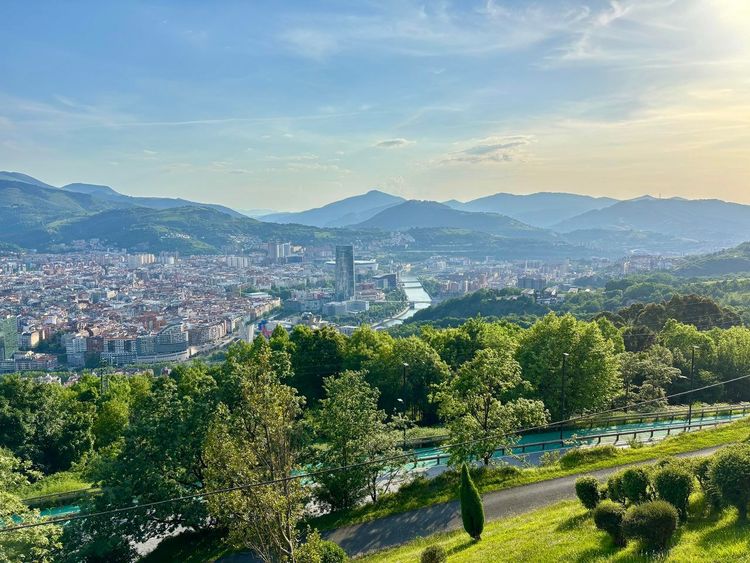
To get a high view of Bilbao without spending a euro, head to Mount Artxanda (Carretera de Artxanda a Santo Domingo, 48015 Bilbao, rated 4.4/5 on Google from 7,602 reviews), the hill overlooking the right bank. The funicular that has climbed it since 1915 costs a few euros, but several paths and staircases lead up on foot from the Castaños district, behind the Zubizuri Bridge, in thirty to forty-five minutes depending on your pace. Bring good shoes: the slope is steep.
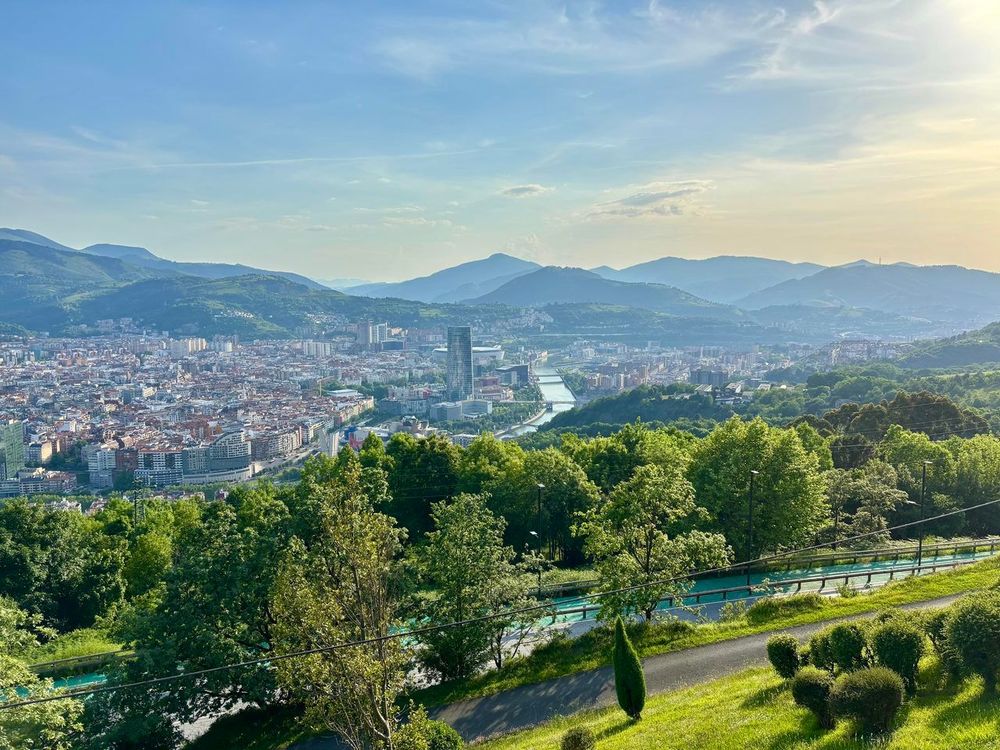
At the top, the viewpoint offers a panorama of the Nervión estuary, the Guggenheim, the rooftops of the Casco Viejo and, in clear weather, the green mountains encircling the city. It's the best spot to grasp at a glance Bilbao's compact topography, wedged between hills and river.
Locals go up on Sundays to walk with the family, exercise or share a picnic on the large lawns. The restaurant terraces are of course paid, but nothing stops you from bringing your own snack. Our article on hiking in the Basque Country offers other routes around Bilbao if the climb makes you want to go further. On the audio side, the Ryo itinerary also climbs to this viewpoint with commentary on the history of the funicular and the view over the estuary, giving meaning to every rooftop you spot.
13. Stop in Front of the San Mamés Stadium, Temple of Athletic Club
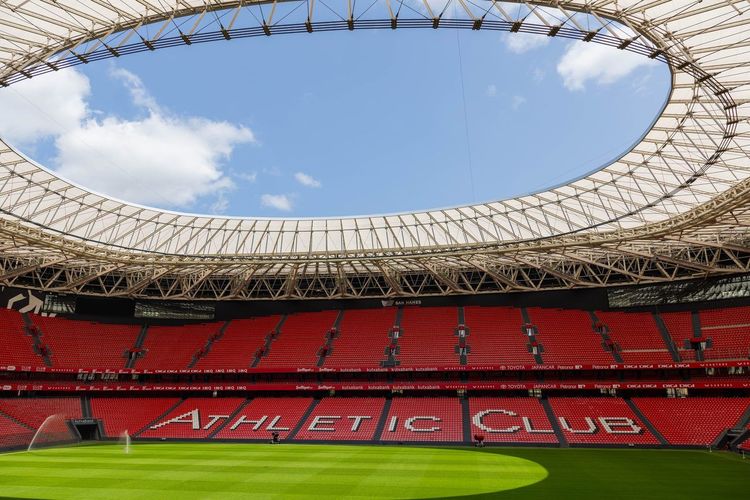
Nicknamed "la Catedral" by supporters, the San Mamés Stadium (Rafael Moreno Pitxitxi 1, 48013 Bilbao, rated 4.7/5 on Google from 32,000 reviews) opened in 2013 right next to the old 1913 stadium, since demolished. Athletic Club, founded in the late 19th century, applies a policy unique in professional football: it only signs players born or trained in the Basque Country. A singularity that did not prevent it from winning the Copa del Rey in 2024, celebrated by an immense crowd on the Ría.
The exterior of the stadium, with its façade of translucent slats that lights up in red and white on match nights, can be explored freely at any time, and the official shop can be visited without a ticket by anyone wanting to admire the shirts in the window. Only the club museum and the behind-the-scenes tour are paid. In front of the main entrance, the statue of former striker Pichichi, whose name now designates the top scorer in La Liga, recalls that before their first visit to the stadium, visiting teams traditionally laid a bouquet of flowers at his feet.
On a match night, even without a ticket, the atmosphere in the bars of the neighbouring streets (Pozas, Licenciado Poza) is worth the trip: striped shirts, Basque chants and giant screens turn the neighbourhood into an open-air stand.
If you are lucky enough to be in town during a title win, look out for the gabarra, the barge on which the players sail down the Ría to cheers: after forty years of waiting, it came out again in April 2024 before hundreds of thousands of people crowded onto the quays and bridges.
14. Climb to the Begoña Basilica
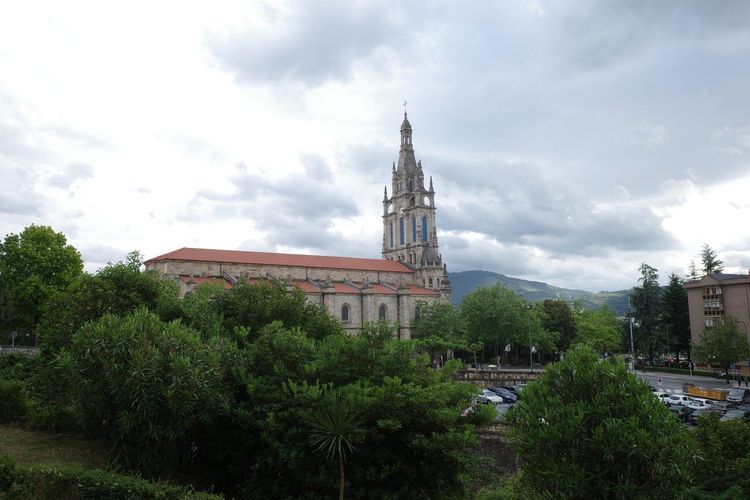
Perched on a hill above the Casco Viejo, the Begoña Basilica (Virgen de Begoña 38, 48006 Bilbao, rated 4.6/5 on Google from 7,046 reviews) houses the statue of the Virgin of Begoña, patron saint of Biscay. From Unamuno Square, the Mallona staircase has more than 300 steps: an effort that costs only a few drops of sweat and is rewarded with a clear view over the rooftops of the old town. For tired legs, the public lift on Esperanza Street goes almost to the top for a symbolic price.
The church, built in the 16th century in a late Gothic style, is open to visitors and pilgrims outside major masses. Halfway up, the former Mallona cemetery, now turned into a park, preserves its monumental gateway. Few tourists make it this far: a restful contrast after the Guggenheim crowds.
On 11 October, the feast day of the Virgin of Begoña, thousands of Biscayans make a pilgrimage up to the basilica, and the neighbourhood takes on the air of a village festival. To come back down, take the Mallona steps again in the late afternoon: the low light on the rooftops of the Casco Viejo offers one of the finest views of the day.
15. Savour Pintxos and Bilbao's Food Culture Without Breaking the Bank
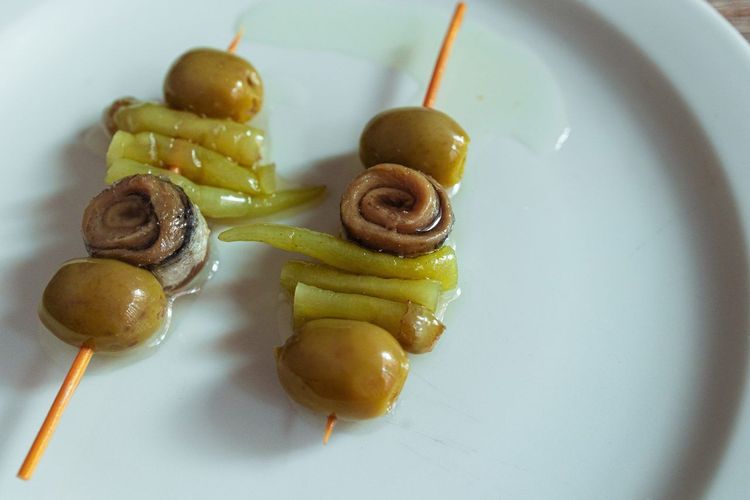
Talking about Bilbao without mentioning pintxos would be missing the essentials. These small bites, lined up on the counter and often skewered with a toothpick, are enjoyed standing in the bars of the Plaza Nueva, the Siete Calles or Licenciado Poza street in the Ensanche. Let's be honest: nothing is free here, each bite generally costing between 2.50 and 4 euros. But wandering from bar to bar to admire the counters, without necessarily ordering everywhere, remains an unmissable cultural experience at a low price.
A few rules will save you from looking like a novice: you often help yourself at the counter, you keep your toothpicks or remember what you've eaten, and you pay at the end by telling the waiter the lot. Try at least once the gilda, a skewer of olive, mild chilli pepper and anchovy, considered the oldest pintxo in the Basque Country.
Locals practise the txikiteo: a small glass of wine (the txikito), a few sips, a bite, then you change venue. The txikito rarely costs more than 1.50 to 2 euros, which lets you taste a lot for little. On Sunday lunchtime, the Plaza Nueva becomes the meeting point for families for the aperitif, a spectacle to observe even with just a coffee in hand.
Other free activities complete the experience: neighbourhood festivals where tastings are sometimes shared, the Ribera market to spot local products (Gernika peppers, Idiazabal cheese), or simply the ballet of cooks behind the windows of historic bars at peak hour. These moments, less photographed than the great monuments, often tell the Basque everyday better than a list of museums.
Our top 6 things to do in Bilbao goes back over the best pintxo spots in detail. And if you want to know why a particular bar in the Siete Calles has become an institution, the Ryo audio guide dwells on it with several anecdotes from regulars told along the walk.



FAQ
How many days should I plan to visit Bilbao?
Two full days are enough to cover the essentials of the places described here: a first day for the Guggenheim, Abandoibarra and the Casco Viejo, and a second for Artxanda, Doña Casilda Park, the Ribera market and Bilbao La Vieja. With three days, you can add the Begoña basilica and San Mamés at a relaxed pace. Our article on visiting Bilbao in 2 days offers a detailed itinerary.
How do I get to Bilbao?
Bilbao airport, in Loiu, is connected to the city centre by the Bizkaibus A3247 bus in about twenty minutes, for a few euros. From Madrid, Alvia trains take around five hours. From France, allow an hour and a half by road from Hendaye, or travel to San Sebastián and then take the bus to Bilbao.
Where should I stay in Bilbao to explore the centre on foot?
The Casco Viejo or the Ensanche, around the Gran Vía, are the best bases. The former appeals for its atmosphere and bars, but can be noisy on weekends; the latter, quieter and better served by the metro, suits families. In both cases, you can walk to most places on this list, from the Guggenheim to the Ribera market, without taking tram or metro rides.
What can I do in Bilbao for free when it rains?
The Azkuna Centre, with its atrium of 43 columns and its media library, remains the best shelter. The Ribera market is covered and lively all year round. Also watch for the free-entry slots at the Fine Arts Museum, or attend a service at the Santiago Cathedral to discover its nave. Finally, large shopping centres such as Zubiarte, opposite the Guggenheim, offer shelter during a downpour, and La Concordia station can be seen at a glance from its hall.
What is the best time of year to go to Bilbao?
Spring (April to June) and early autumn (September-October) offer the best balance between mild weather and moderate crowds. In August, the Aste Nagusia, the great festival week, brings the city to life for nine days with concerts, fireworks and street entertainment open to all, under the gaze of Marijaia, its mascot with raised arms. Winter, rainier, appeals to those looking for a quiet city.
What can I do in Bilbao with the family without breaking the bank?
Doña Casilda Park and its duck pond, the Dog Fountain in the Casco Viejo, the exterior of the Guggenheim with Puppy and the fog sculpture, then a picnic at the top of Artxanda make an ideal programme with children. Remember that the Guggenheim is free for under-18s.
By the end of this list, one thing becomes obvious: Bilbao doesn't need a big budget to reveal itself. Between open-air contemporary architecture, generous parks and historic neighbourhoods that can be explored freely, most of the city's memorable experiences only require time to walk.
These free activities in Bilbao are best linked together in the right order. For a guided walk rather than a string of searches, this Ryo audio guide through Bilbao links many of the places mentioned here in order, with commentary that brings each stop to life. The app works offline once the route is downloaded, handy for saving your data plan during your stay.