© Shutterstock
 Votre guide Ryo
Free Seville in 2026: 15 Experiences to Enjoy without Spending a Cent
In Seville, the biggest expense of the day is sometimes a coffee on a terrace at Plaza del Salvador. Beyond that detail, the Andalusian capital is brimming with monuments, neighborhoods, and traditions that can be enjoyed without a single euro changing hands. Looking for ways to experience Seville for free means redrawing the usual tourist map: fewer ticket booths, more alleyways, half-open patios, and well-chosen opening hours. Before you set off, know that our Ryo app already offers audio-guided tours in several Spanish cities — a complementary way to plan a trip without spending more than necessary once you arrive.
This selection brings together 15 addresses and moments where free entry depends on a specific time slot, a European identity card, or simply the absence of a door to pass through. You will discover why the Real Alcázar opens its last Monday hour to visitors at no charge, how to attend Sunday mass in the cathedral without paying the tourist entrance fee, and where to listen to impromptu flamenco in a Triana bar with no mandatory cover charge. Between Andalusian patios, regional museums, and historic bridges, the city knows how to welcome visitors without sending them a bill.
1. The Real Alcázar and Its Last Monday Hour at No Charge
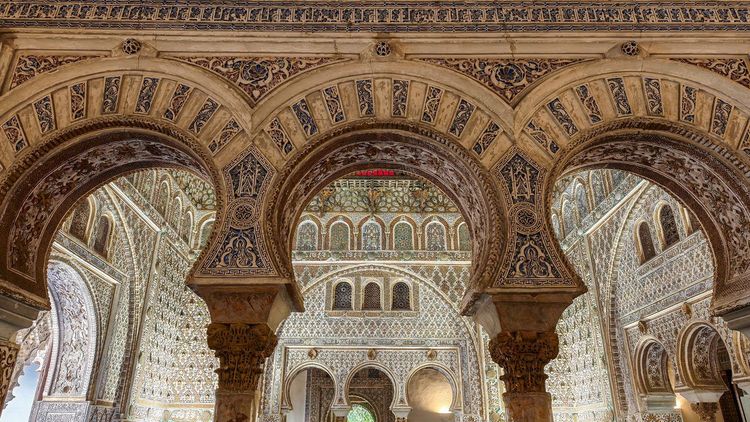
The Real Alcázar de Sevilla (Patio de Banderas, s/n, 41004 Sevilla, rated 4.7/5 on Google with 101,577 reviews) remains the most photographed monument in the city, and yet admission is not always required. Every Monday, year-round, the palace opens its last hour of the day free of charge: from 4 PM to 5 PM from October to March, and from 6 PM to 7 PM from April to September. The number of spots is very limited and online reservations open about a month in advance: note the slot release date on the official Patronato website, as they sell out within minutes.
Built from the 11th century on the foundations of an Almohad fortress, the palace blends horseshoe arches, gilded coffered ceilings, and polychrome ceramics accumulated over more than seven centuries of successive expansions. The Catholic Monarchs lived here, as did the Habsburgs after them, which explains the coexistence of Mudéjar halls and Renaissance galleries within the same building. The series Game of Thrones filmed several scenes of the Gardens of Dorne here, a detail that draws visitors every year who come to recognize the pools and orange trees planted in a quincunx pattern.
If the Monday slot does not fit your schedule, you can always walk along the high crenellated walls from Plaza del Triunfo and the Patio de Banderas, where the turrets and hanging gardens can be glimpsed above the ochre stone. Allow a good hour to photograph the complex from different angles, ideally early in the morning when the raking light still grazes the ramparts and tour groups have not yet taken over the square. A churro vendor almost always sets up at the corner of the square — a useful landmark if you are looking for a simple meeting point with fellow travelers.
2. The Cathedral of Seville, Open during Sunday Mass
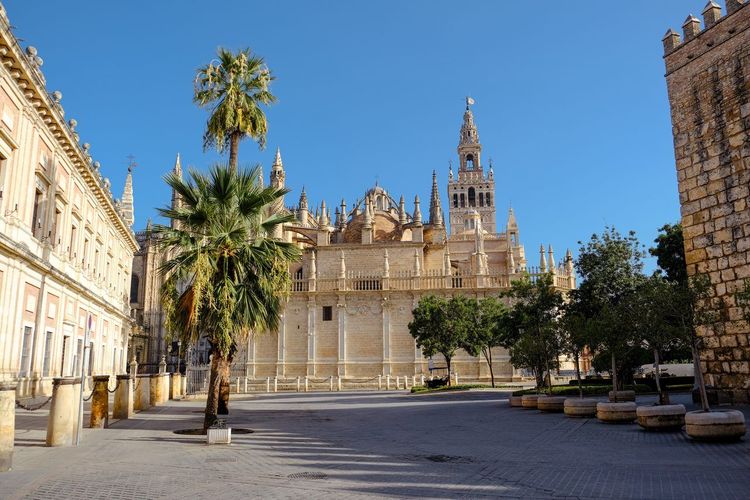
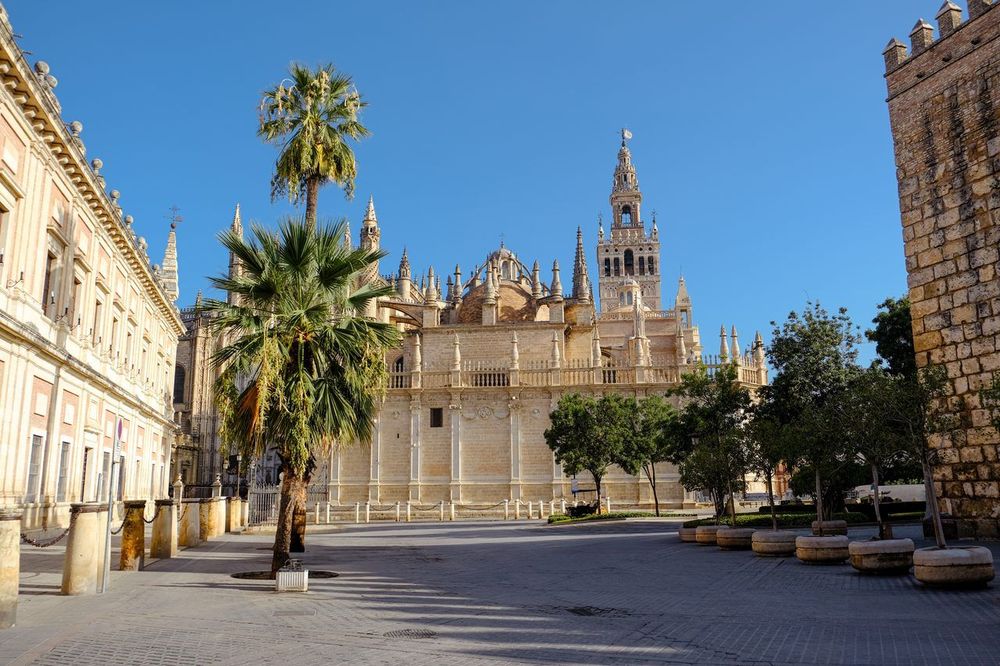
With its 23,500 m² of floor space, the Catedral de Sevilla (Av. de la Constitución, s/n, 41004 Sevilla, rated 4.8/5 on Google with 59,369 reviews) is the largest Gothic cathedral in the world and houses the presumed tomb of Christopher Columbus. The standard tourist ticket grants access to the main body of the building and the Giralda, its Almohad minaret converted into a bell tower — but there is another way in: attending a religious service.
Every Sunday morning, services are open to all worshippers as well as respectful visitors, with no ticket required at the entrance reserved for the faithful. You do not have access to the full tourist route or the climb up the Giralda, but you can admire the main nave, the gold-leaf Gothic altarpiece, and the unique acoustics of the space during the liturgical chanting. Arrive fifteen minutes before the service begins: the entrance queue for worshippers is separate from that of paying tourists and is often much shorter.
Around the building, the south façade opens onto the Patio de los Naranjos, a former ablution garden from the Almohad mosque planted with centuries-old orange trees, freely accessible from the street. It is also one of the best vantage points for photographing the Giralda in its entirety without having to step back into the roadway.
3. The Barrio de Santa Cruz, a Labyrinth to Explore without a Watch or a Ticket
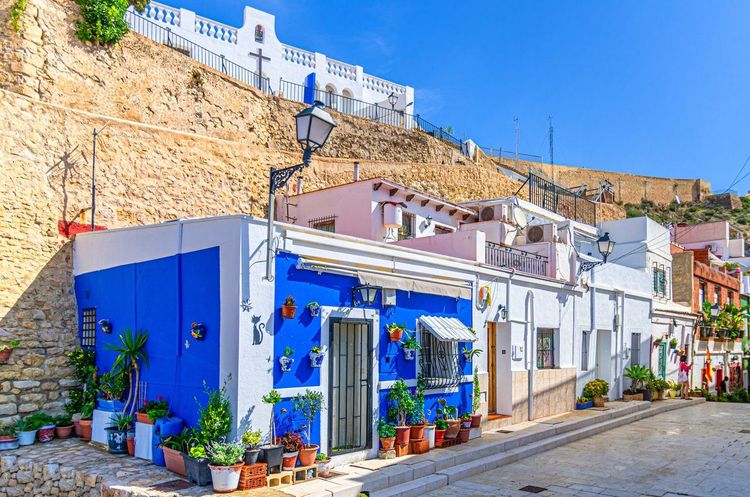
The former Jewish quarter of the city, the Barrio de Santa Cruz (41004 Sevilla, rated 4.6/5 on Google with 14K reviews) can only be explored on foot, making it one of the richest experiences on this list with no door to pass through. Its narrow alleyways, laid out to create shade and channel cool air, wind between whitewashed façades and wrought-iron grilles.
You will regularly come across half-open private patios, where residents sometimes leave the carriage door ajar to let in the cool air: take a discreet look without stepping inside, as local custom tolerates a glance but not an intrusion. Get deliberately lost in the late afternoon, when the slanted light gilds the walls and terraces are just beginning to fill up, before the dinner-hour crowd arrives. To understand what these façades have to tell, a Ryo's Seville audio-guided tour slipped into your pocket brings each neighborhood legend to life as you walk, at your own pace.
4. Plaza de España, a Monumental Setting with No Entrance Fee
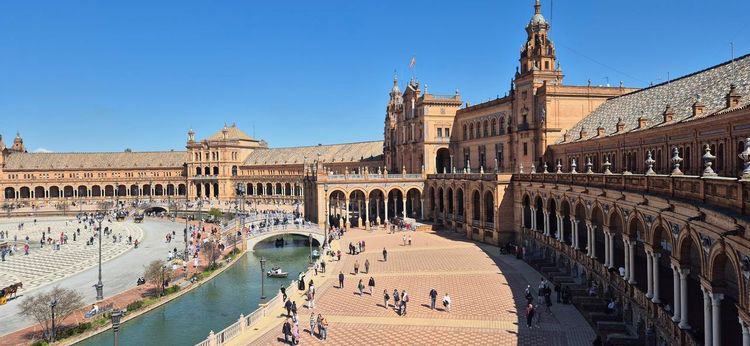
Built for the Ibero-American Exposition of 1929, Plaza de España (Av. Isabel la Católica, s/n, 41004 Sevilla, rated 4.8/5 on Google with 187,377 reviews) impresses with its 200-metre semicircular arcade bordering a navigable canal. Access to the square itself remains open to everyone, day and night, and it is probably the most photographed monument in the city after the cathedral.
Along the arcades, 48 painted ceramic benches each represent one of Spain's provinces, featuring a map and a local historical scene: find the one for your region if you are Spanish, or simply the one for the city where you are staying during your Andalusian trip. Only the rowboat rental on the canal is paid; everything else — from the trencadís bridges to the twin towers flanking the complex — can be admired without spending a cent.
If you want to avoid the midday crowds that flock here, come at opening time, around 8 AM, when the raking light still streams through the arcades and the only other visitors are a few local joggers. Lawrence of Arabia and several scenes from Star Wars: Attack of the Clones were filmed here — a detail that explains why some visitors instantly recognize the location without ever having set foot there before.
5. Parque de María Luisa, 34 Hectares of Cool Open to Everyone
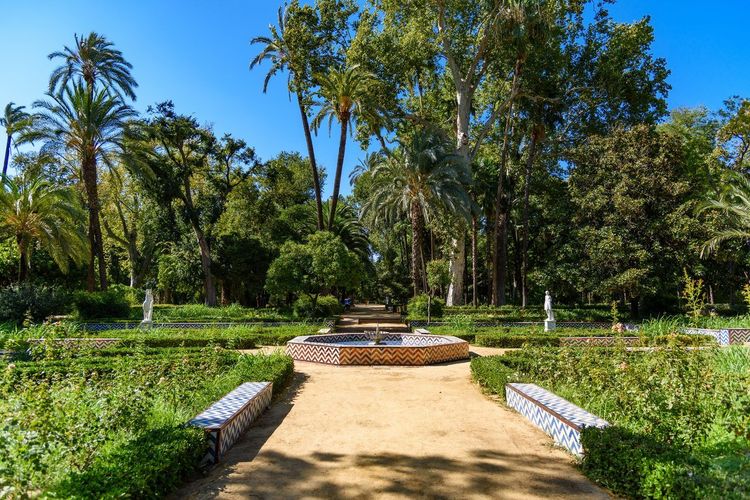
Just behind Plaza de España lies Parque de María Luisa (Paseo de las Delicias, s/n, 41013 Sevilla, rated 4.8/5 on Google with 42,161 reviews), donated to the city in 1893 by Infanta María Luisa Fernanda de Borbón. Its 34 hectares blend Mediterranean species, palm trees, and shaded pools — a true breath of fresh air when temperatures climb above 35 degrees in summer.
Consider renting a bike if you are staying far from the center: several cycling paths cut through the park and connect to the banks of the Guadalquivir. Pigeons are not the only inhabitants: colonies of ring-necked parakeets, escaped from captivity decades ago, nest in the large plane trees and enliven the stroll with their shrill calls at the end of the day. The Isla de los Patos, a small islet at the center of one of the pools, is home to swans and ducks visible from the banks, with no barrier separating visitors from the water, a peaceful detour just off Ryo's audio-guided tour of Seville, which also passes close by Plaza de España.
6. Metropol Parasol, the World's Largest Timber Structure Seen from Below
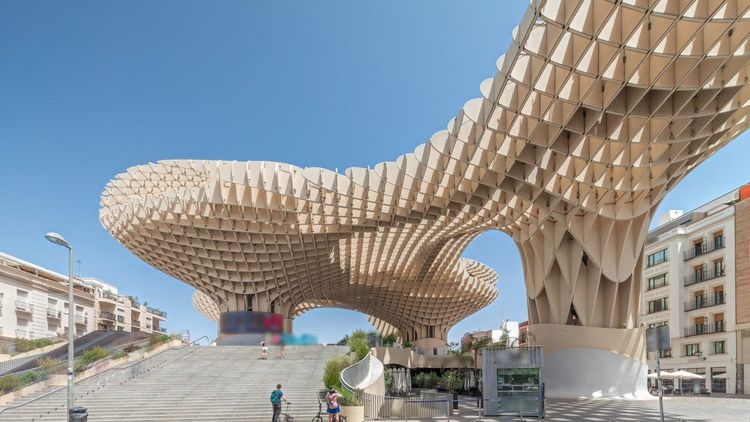
Locally nicknamed "las Setas" (the mushrooms), Metropol Parasol (Pl. de la Encarnación, s/n, 41003 Sevilla, rated 4.4/5 on Google with 109,987 reviews) has dominated Plaza de la Encarnación since 2011. The panoramic terrace at the top, 26 metres above ground, is ticketed, but the square level and the covered market beneath it remain open to everyone.
Beneath the structure, an archaeological site called the Antiquarium displays Roman and Almohad remains uncovered during construction; admission is free on certain days of the week according to the municipal schedule posted at the entrance. Even without going up to the viewing platform, you can appreciate the scale of the project by standing beneath the six giant glued-laminated timber canopies, particularly at sunset, when light plays through the hexagonal cells of the structure.
7. The Triana Bridge and Its Neighborhood, the Other Bank at No Charge
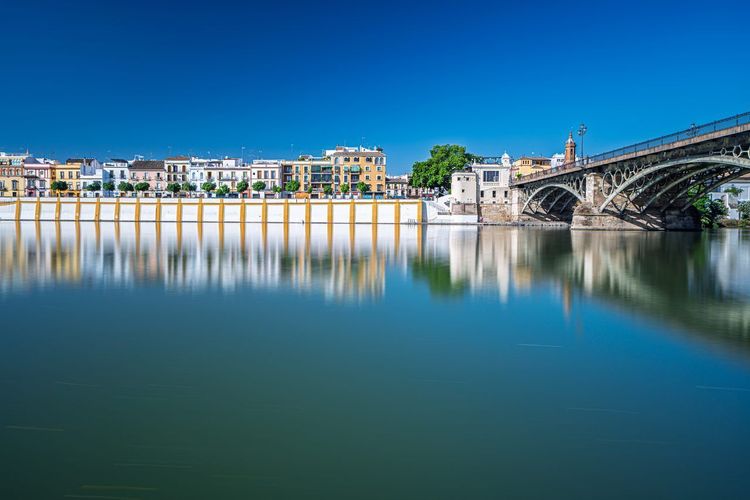
Crossing Puente de Isabel II (41010 Sevilla, rated 4.7/5 on Google with 21,349 reviews), better known as the Triana Bridge, opens the way to a working-class neighborhood long inhabited by Romani people, sailors, and ceramicists. The metal structure, inaugurated in 1852, was one of the first non-suspension bridges built in Spain.
Once on the other bank, stroll along Calle Betis, which runs alongside the river facing the historic center: the view of the Torre del Oro and the cathedral, especially at sunset, costs nothing and is well worth the detour. The Triana market, built on the former site of the San Jorge castle, can be visited freely outside its paid stalls, with its traditional ceramics workshops still active in the basement. To connect these two banks without missing any of the anecdotes along the way, Ryo's Seville audio-guided tour traces a narrative thread from the historic center to the heart of Triana.
8. The Museum of Fine Arts, Free for European Citizens
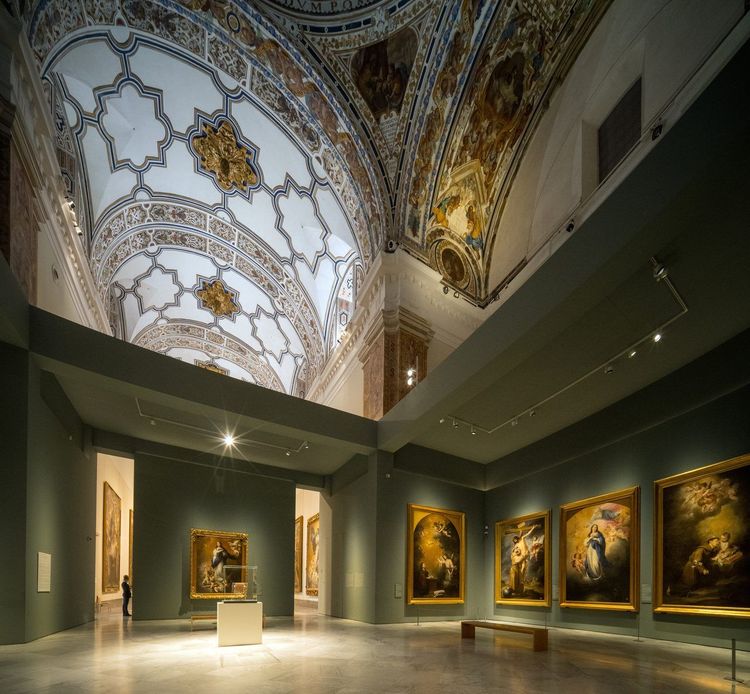
Housed in a 17th-century former convent, the Museo de Bellas Artes de Sevilla (Pl. del Museo, 9, 41001 Sevilla, rated 4.7/5 on Google with 16,584 reviews) holds the second most important collection of Spanish painting after the Prado, with works by Murillo, Zurbarán, and Valdés Leal. Like most museums managed by the Junta de Andalucía, entry is free for European Union citizens and residents upon presentation of an identity document; other visitors pay a nominal fee of €1.50.
The museum also opens its doors to everyone on special occasions, such as May 18 for International Museum Day or February 28 for Andalusia Day. Book your spot online a few days before your visit: the daily quota of free-admission visitors is limited, and the on-site queue can discourage those in a hurry. The central patio, planted with orange trees and lined with an arcaded gallery, is worth the visit in its own right, even for those with little time to spare for Baroque painting.
9. The Andalusian Centre for Contemporary Art, in the Former Charterhouse
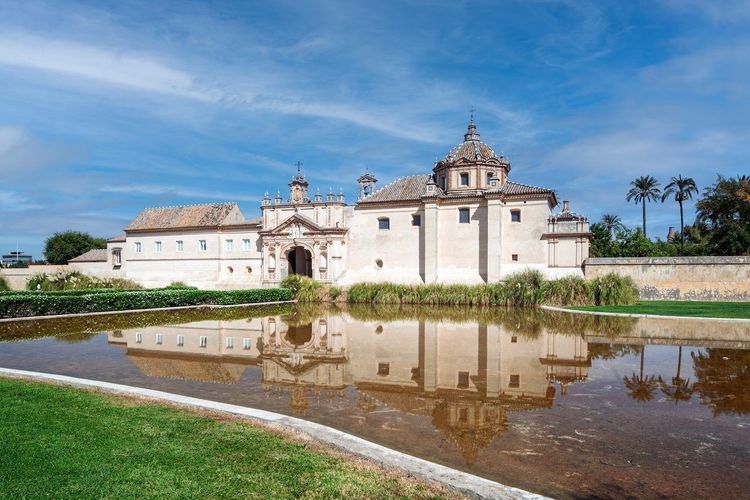
The Centro Andaluz de Arte Contemporáneo (C. Américo Vespucio, 2, 41092 Sevilla, rated 4.4/5 on Google with 3,669 reviews) occupies the monastery of La Cartuja, where Christopher Columbus stayed before his second voyage to the Americas. Entry is free for European residents and set at a nominal fee for other visitors, with complimentary slots announced at the front desk.
The contrast between the 15th-century monastic cells and the video installations or contemporary sculptures now occupying them often surprises visitors who came for the religious architecture. Allow an hour and a half to explore the permanent collections and the cloister, which is far less crowded than the major museums in the historic center.
10. The Torre del Oro, Free Entry on Certain Days
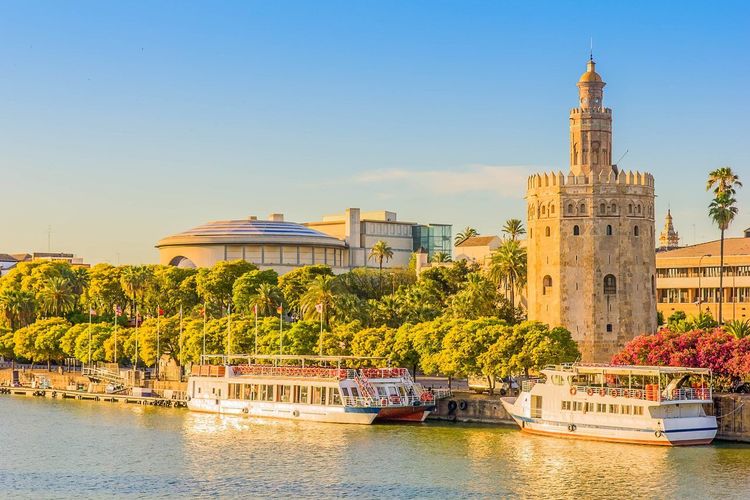
Standing on the banks of the Guadalquivir since the 13th century, the Torre del Oro was used to control river access to the city and to temporarily store gold brought back from the Americas. Its dodecagonal façade, once said to have been covered in gilded ceramics, can be admired from the riverbanks without ever needing to pass through its door.
The interior, which houses a small naval museum, offers one free-admission day per week: check the municipal opening hours posted directly on-site, as they vary by season. Even without going inside, the walk along the river at this exact spot — with the tourist boats moored nearby and the silhouette of the Puente de Triana in the background — remains one of the most photographed scenes in the city at the end of the day, right along the route of Ryo's audio-guided tour past the Torre del Oro and the Guadalquivir.
11. The Basilica of La Macarena, Open to All Year-Round
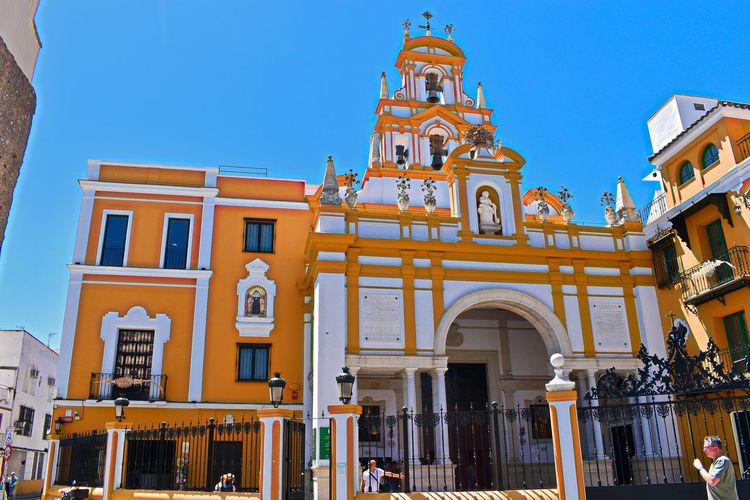
If one church deserves a visit beyond the cathedral, it is the Basílica de la Macarena (C. Bécquer, 1, 41003 Sevilla, rated 4.7/5 on Google with 15,735 reviews), which houses the most venerated Virgin statue of Seville's Semana Santa. Entry into the church itself is open to all year-round, unlike the adjacent confraternity museum, which charges admission.
The Virgin, adorned with jewels offered by generations of the faithful, wears an embroidered gold mantle that weighs over 40 kilograms during Holy Week processions. Right next door, a stretch of the city's ancient Almohad walls, among the best preserved in Andalusia, can be walked freely and serves as a reminder of the defensive scale of medieval Seville.
12. Alameda de Hércules, the Most Vibrant Square in the Center
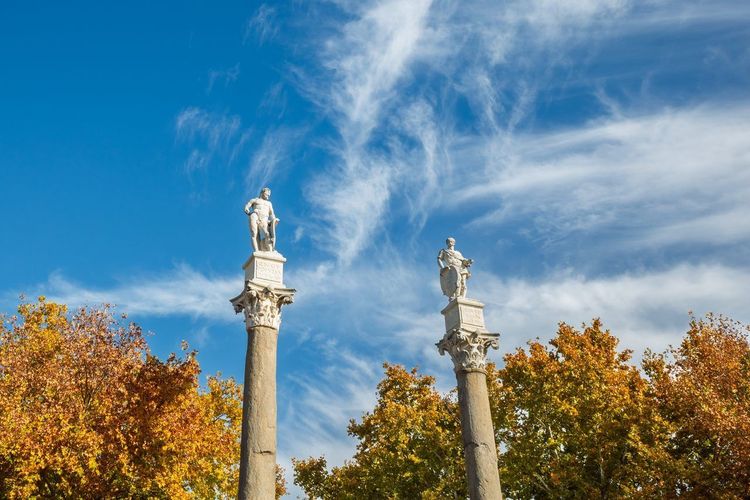
Laid out as early as 1574, Alameda de Hércules (41002 Sevilla, rated 4.3/5 on Google with 3K reviews) is one of the oldest public promenades in Europe. Two Roman columns, salvaged from an ancient temple and topped with statues of Hercules and Julius Caesar, mark its southern end.
As evening falls, the square transforms into a gathering place for local residents, with tapas bars, lively terraces, and sometimes impromptu concerts on the steps. It is a good spot if you are looking for a less touristy atmosphere than the historic center, just ten minutes on foot from the cathedral.
13. A Free Tour of the Historic Center, Tip-Only
Several agencies offer so-called "free" guided walking tours where the guide works exclusively on tips left at the end of the tour. The usual meeting point is at Plaza Nueva, the former square of the San Francisco convent, converted into a public garden in the 19th century.
These tours generally last two to three hours and cover the triangle formed by the cathedral, the Alcázar, and the Barrio de Santa Cruz, with historical anecdotes and local legends scattered along the way. Unlike a Ryo's Seville audio-guided tour that you follow at your own pace, headphones in and with no set schedule, the classic free tour requires you to keep to the group's timing and pace, which can be large during high season.
If you prefer independence, Ryo offers this same kind of urban audio-guided tour in many European cities, built on the same logic of à-la-carte discovery, with no reservation or queue to manage. A useful alternative to keep in mind for your next stops, even beyond Andalusia.
14. Impromptu Flamenco in Triana, No Cover Charge Required
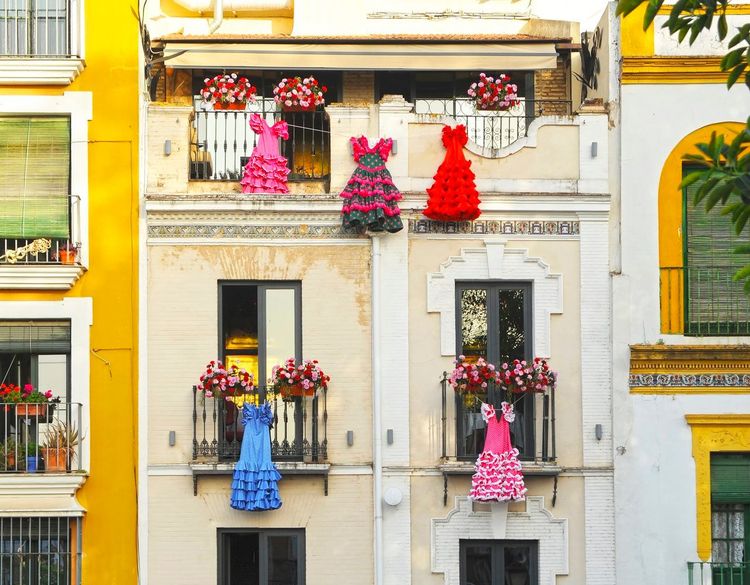
Triana claims to be the historic birthplace of flamenco in Seville, and some bars in the neighborhood keep alive the tradition of tertulias — evenings where singers and guitarists gather without any rehearsed staging. Casa Anselma (C. Pagés del Corro, 49, 41010 Sevilla, rated 4/5 on Google with 1,267 reviews) is the most well-known example, open late at night with no fixed announced schedule.
No ticket is required at the door, but local custom dictates that everyone orders at least one drink at the bar during the evening. Arrive after 11 PM if you want a real chance of witnessing a spontaneous flamenco moment — the atmosphere generally only reaches its peak as midnight approaches. Seats are scarce: expect to stand for a good part of the evening, drink in hand, surrounded by regulars who know every word by heart.
15. The Jardines de Murillo, the Former Green Lungs of the Alcázar
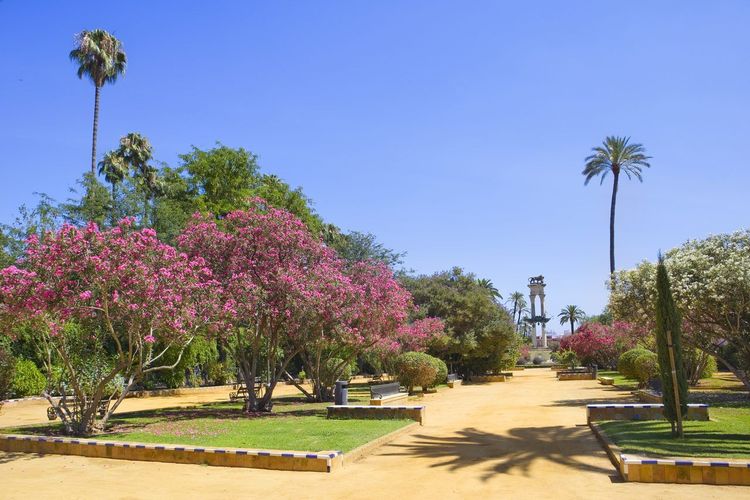
Formerly part of the royal gardens, the Jardines de Murillo (Paseo de Catalina de Ribera, s/n, 41004 Sevilla, rated 4.7/5 on Google with 39 reviews) were handed over to the city in 1911 and laid out as a public garden lined with palm trees and ceramic benches. They naturally extend the walk from the Barrio de Santa Cruz toward the riverbanks.
A monument dedicated to Christopher Columbus, adorned with a bronze ship's prow, stands at the center of the garden. In the late afternoon, it is one of the few spots in the historic center where you can easily find a shaded bench, away from the groups that tend to cluster around the Alcázar. From there, a short walk follows the old palace walls down to the banks of the Guadalquivir, where the calm stands in sharp contrast to the bustle of Plaza de España at the same hour, both featured along Ryo's audio-guided tour The Princess of the Guadalquivir.
FAQ
Is the Real Alcázar truly accessible without a ticket?
Yes, during the last hour on Mondays, open to all visitors upon online reservation: from 4 PM to 5 PM from October to March, and from 6 PM to 7 PM from April to September. Spots are limited and reservations, which open about a month in advance, go very quickly.
Which day can you visit museums for free in Seville?
It depends on each institution: the Museo de Bellas Artes and the CAAC offer permanent free access to European citizens, while other municipal museums open their doors on a specific day of the week, posted on-site.
How much time should you allow to explore Seville for free?
Two to three days are enough to cover the essentials of this list on foot, factoring in the schedules of free-admission slots. A week allows you to add peripheral neighborhoods like Triana in greater depth.
Are there truly free guided tours in Seville?
Free tours operate on a tip-based model rather than being entirely free: the guide lives off whatever each participant decides to leave at the end of the tour, generally between 5 and 10 euros.
Do you need to book free-admission slots in advance?
Yes, almost always for major monuments like the Real Alcázar or the Museum of Fine Arts. Available spots can be reserved online a few days before your chosen date, sometimes a month in advance for the Alcázar.
What is the best time to enjoy Seville on a budget?
Spring (March–May) and autumn (October–November) offer pleasant temperatures and lower crowds than summer, making it easier to access the most sought-after free slots at the main monuments.
Experiencing Seville for free ultimately lives up to its promise: between well-chosen opening hours, European identity cards, and simply the desire to walk, half of the city's treasures can be discovered without going through a ticket booth. Still, keep a little room in your wallet for a glass of manzanilla or a tapa at the Triana market, if only to extend the evening after a day of discoveries that will have cost you almost nothing.
To turn this list into a seamless itinerary, let Ryo's Seville audio-guided tour from the Ryo app be your companion: stories trigger as you walk, with no reservation or set schedule required. And if this city has given you a taste for free walking tours, Ryo already covers many European cities with self-guided audio tours to follow at your own pace — a great way to extend the experience well beyond Andalusia.