© Shutterstock
 Votre guide Ryo
Seville Neighborhoods: the Complete Guide to Finding Your Way Around in 2026
Seville is more than its cathedral and bitter orange trees: it's a mosaic of neighborhoods that contradict each other from one bank of the Guadalquivir to the other. Understanding Seville's neighborhoods is the key to not spending three days stuck in the same tourist alleys while the city breathes freely just a few streets away. On one side, the maze of white lanes of Santa Cruz where Jewish merchants lived in the 15th century. On the other, Triana and its ceramics workshops that have been running for generations. In between, a square lined with nineteen ceramic benches representing each Spanish province, a neighborhood where the night starts after midnight, and a district that even the Sevillians avoid crossing without good reason.
This guide to Seville's neighborhoods details ten districts, their mental map, where to stay according to your travel profile, and the one that genuinely warrants caution. Just as the Ryo audio-guided tour through the grand neighborhoods of Buenos Aires does, the idea is not to tick off monuments but to understand how a neighborhood breathes, at what hour it comes alive, and why certain streets remain deserted at noon.
Santa Cruz, the Former Jewish Quarter at the Heart of the Historic City
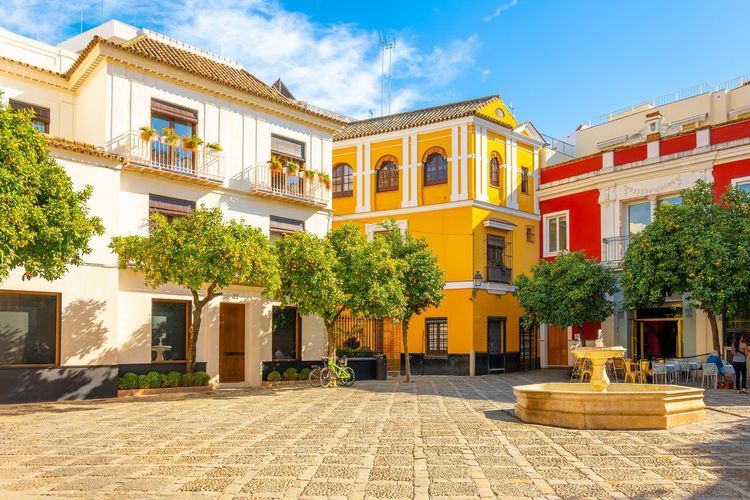
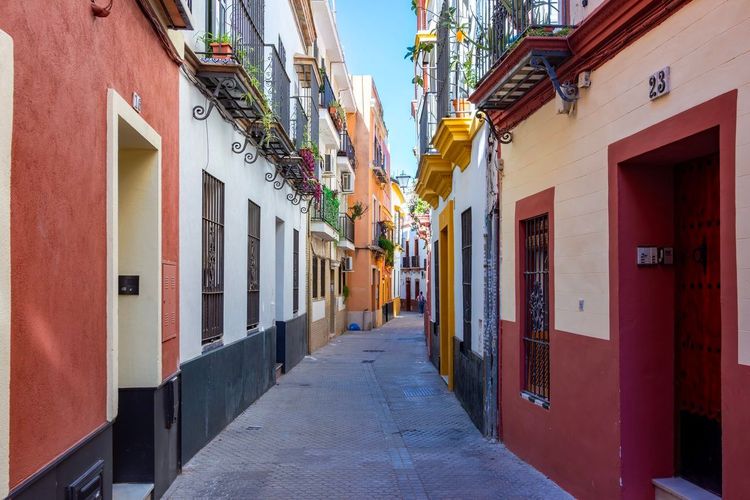
Santa Cruz is the neighborhood that everyone photographs without necessarily knowing it was Seville's former Jewish quarter, emptied of its inhabitants after the expulsion of 1492. The lanes are deliberately narrow, barely two metres wide in places, to create shade in summer. The result is a labyrinth where you get pleasantly lost among white facades, wrought-iron grilles, and flowering patios glimpsed through a half-open door.
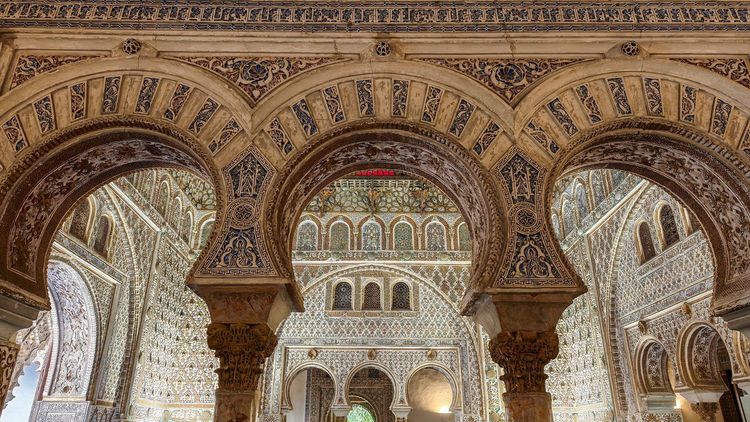
This is where you will find the Real Alcázar de Sevilla, a royal palace still in use today, a spectacular blend of Mudéjar, Gothic, and Renaissance architecture built for Peter I of Castile by craftsmen who came from Granada.
Right next to it stands the Catedral de Sevilla (Av. de la Constitución, s/n, 41004 Sevilla, rated 4.8/5 on Google with 59,328 reviews), the largest Gothic cathedral in the world, whose bell tower, the Giralda, once served as the minaret of the great Almohad mosque.
Climbing the 35 ramps of the Giralda (not steps — they were originally designed so the muezzin could ride up on horseback) offers the best panoramic view over the neighborhood's orange rooftops. Nearby, the Susona, Vida, and Pimienta lanes concentrate most of the tapas bars and souvenir shops, which makes this mechanically the most expensive and most tourist-dense district in the city. You will also find the Hospital de los Venerables, a former hospice for elderly priests turned cultural center, with a Baroque patio that remains surprisingly calm even in high season. If you are looking for a moment of respite, the Murillo gardens just to the south offer benches shaded by palm trees planted in the 19th century. The downside: after 7 p.m. in summer, the tourist density makes some lanes almost impassable, and many restaurants charge tourist prices with no real connection to the quality of the food — a contrast our Seville audio-guided tour helps you sidestep by linking the Giralda straight to the Hospital de los Venerables without lingering in the busiest lanes.
Triana, the Flamenco Soul of the Other Bank
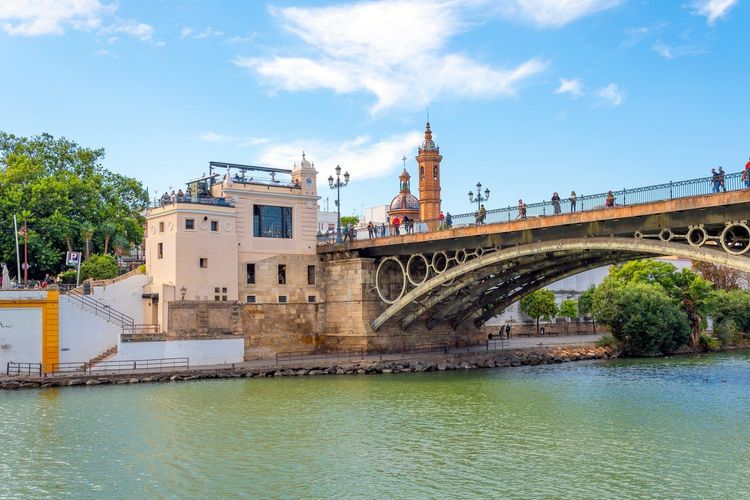
Cross the Puente de Isabel II, better known as the Puente de Triana, and you enter a different city. This metal bridge from 1852, inspired by the Pont du Carrousel in Paris, connects the historic center to the neighborhood of sailors, gypsies, and ceramics makers.
Triana shares with Santa Cruz the claim of having invented flamenco: it was in its corrales de vecinos, the communal courtyards of working-class residents, that the first cantes jondos are said to have been forged in the 19th century. The neighborhood long lived off two industries, fishing and ceramics, and the latter has left traces everywhere: the facades of calle Alfarería are covered in hand-painted azulejos, and some workshops still open their doors to curious visitors.
The Mercado de Triana (Plaza del Altozano, s/n, 41010 Sevilla, rated 4.4/5 on Google with 11,356 reviews) stands on the site of the former Castillo de San Jorge, the local seat of the Spanish Inquisition, whose remains can be visited for free in the market's basement.
Close by, the Capilla de los Marineros houses the Esperanza de Triana, one of the most venerated Virgins of Seville's Holy Week, the historic rival of the Macarena. In the evening, unlike Santa Cruz, Triana remains lively without being overcrowded: the terraces along the river on calle Betis offer the best view of the illuminated Torre del Oro, at prices significantly more reasonable than on the opposite bank. It is also a great neighborhood to stay in if you want a more local atmosphere, with accommodation often 20 to 30% cheaper than in Santa Cruz and only a ten-to-fifteen-minute walk from the center.
El Arenal, Between Bullfighting and the Banks of the Guadalquivir
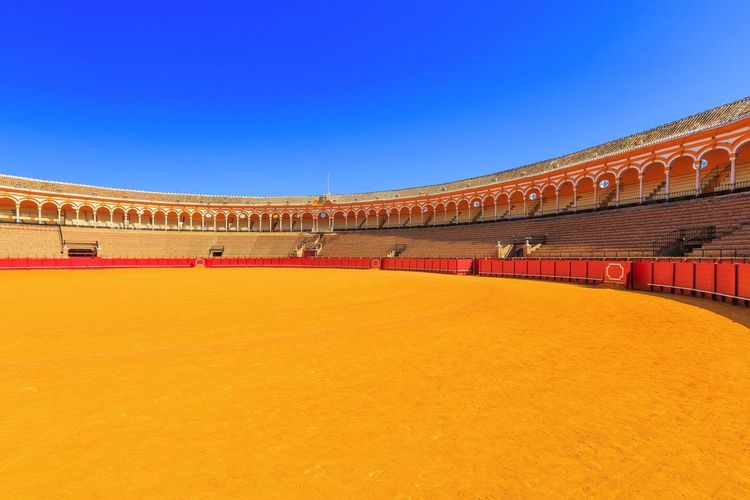
Wedged between the river and the historic center, El Arenal takes its name from the old sandbanks where galleons returning from the Americas used to dock. Today it is the neighborhood of theaters and bullrings.
The Plaza de toros de la Real Maestranza, one of the oldest bullrings in Spain still in operation, can be visited outside of bullfighting season and tells the turbulent history of Andalusian bullfighting better than any book.
Right across from it, the Torre del Oro, a 13th-century Almohad watchtower, was used to close off the port by means of a chain stretched across to the other bank. It now houses a small naval museum.
El Arenal remains more of a passing-through neighborhood than a place to stay: few accommodations, but a concentration of fish restaurants frequented by the Sevillians themselves, far from the multilingual tourist menus of Santa Cruz. The Teatro de la Maestranza, an opera house built for the 1992 World's Fair, hosts a lyric season recognized throughout Spain. In the evenings, you will also encounter regulars of professional flamenco: several historic tablaos have set up here precisely because the neighborhood, less saturated than Santa Cruz, still allows you to book a table without planning three weeks in advance, a mood our Seville audio-guided tour captures well as it follows the riverbank up to the Plaza de Toros and the Torre del Oro.
La Macarena, a Working-Class Neighborhood and Sanctuary of the Brotherhoods
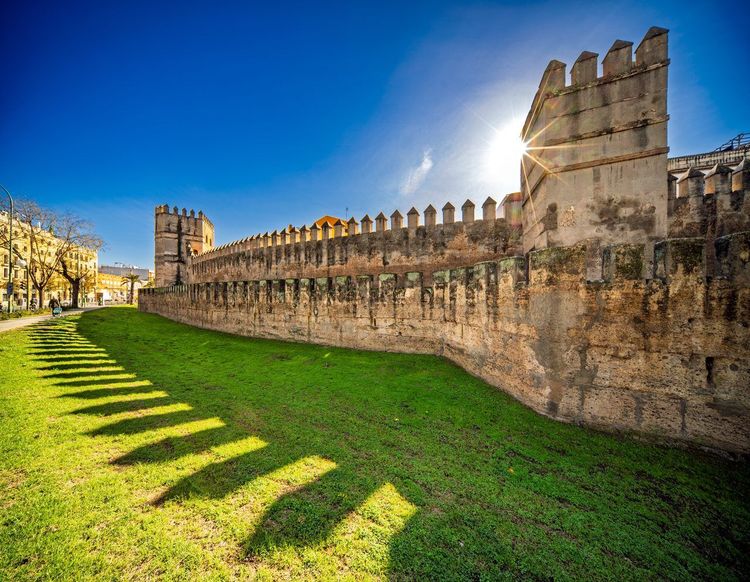
North of the historic center, the Macarena was long the poor relation of Seville's tourism, and that is precisely what makes it such a fascinating neighborhood to explore today. This is where the longest surviving stretch of the city's Almohad walls can be found: more than a kilometer of 12th-century ramparts still standing, which is rare for an Andalusian capital.
The Basílica de la Macarena (Calle Bécquer, 1, 41002 Sevilla, rated 4.7/5 on Google with 15,728 reviews) houses the statue of the Virgen de la Esperanza Macarena, whose procession on the night of Maundy Thursday draws tens of thousands of tearful Sevillians. The statue wears five emerald jewels said to have been gifted by a grateful bullfighter.
In our view, this is one of the few places in Seville where you can still experience the city without a tourist filter: a modest covered market, tapas bars with no English menu, and a working-class residential fabric that stands in stark contrast to Santa Cruz. Just to the south, the Feria neighborhood is worth a detour on Thursday mornings for its flea market, El Jueves, the oldest in Spain according to local tradition, active since the 13th century. As our Ryo guide to the most beautiful neighborhoods of Marseille notes, it is often the working-class neighborhoods, far from the postcard images, that most faithfully reveal the true identity of a city.
San Bartolomé and San Lorenzo, the Discreet Seville of the Locals
Between the center and the Macarena lie two residential neighborhoods that most visitors pass through without stopping — a mistake. San Lorenzo is home to the Basílica del Gran Poder (Plaza de San Lorenzo, 13, 41002 Sevilla, rated 4.8/5 on Google with 6,539 reviews), the sanctuary of the Cristo del Gran Poder, one of the most venerated images in all of Spain, sculpted in the early 17th century by Juan de Mesa.
San Bartolomé, further south, retains traces of its Jewish and Moorish past in the irregular layout of its streets. You will find neither crowds nor souvenir shops, but private patios sometimes glimpsed through a carriage gate left open for ventilation — an Andalusian tradition dating back to Roman times. Property prices here remain among the lowest in the historic center, which explains why many Sevillians continue to live there while Santa Cruz has largely been emptied of its residents in favor of tourist rentals. It is a good accommodation choice if you seek peace and quiet while remaining less than ten minutes' walk from the cathedral.
The Alameda de Hércules, the Epicenter of Seville's Nightlife
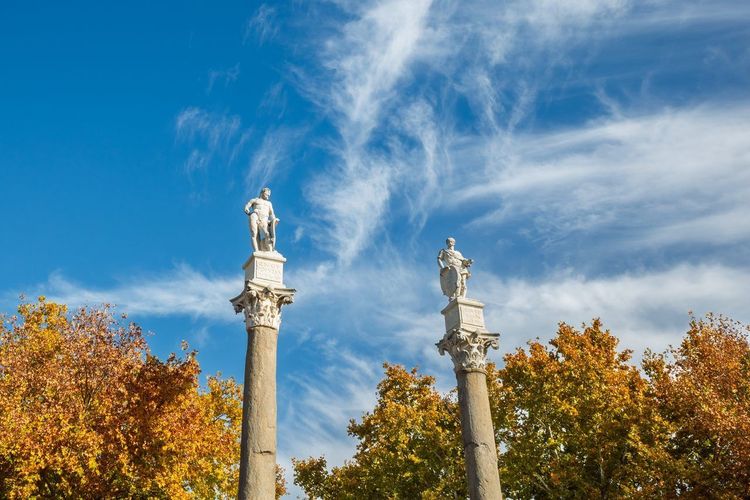
If one question comes up repeatedly, it is which neighborhood is the most lively in Seville at night, and the answer comes down to one name: the Alameda de Hércules (Alameda de Hércules, 41002 Sevilla, rated 4.4/5 on Google with 21,799 reviews). This long rectangular square, laid out in the 16th century on a former marshy arm of the river, is today lined with bars, terraces, and concert venues that are packed from Thursday to Sunday.
Two Roman columns, recovered from an ancient temple dedicated to Hercules and topped with statues of Hercules and Julius Caesar, have marked the southern entrance to the square since the 16th century. The neighborhood long had a bad reputation, associated with prostitution until the 1990s, before becoming within a generation one of the most sought-after areas in the city, driven by a confident LGBT+ scene and a wave of cocktail bars.
On Saturday mornings, an informal flea market sets up on the square, where you can negotiate vinyl records, antique furniture, and vintage clothing. At night, the atmosphere shifts dramatically: from 11 p.m., terraces spill out onto the roadway and music often continues until 3 a.m. on weekends. It is no coincidence that the Ryo article on Barcelona's liveliest neighborhoods describes an almost identical phenomenon: in large cities in southern Europe, it is always the rehabilitated squares, rather than shopping streets, that concentrate the nightlife. If you are looking for a quiet night's sleep, avoid staying within two streets of the square on a weekend.
Nervión, Contemporary and Commercial Seville
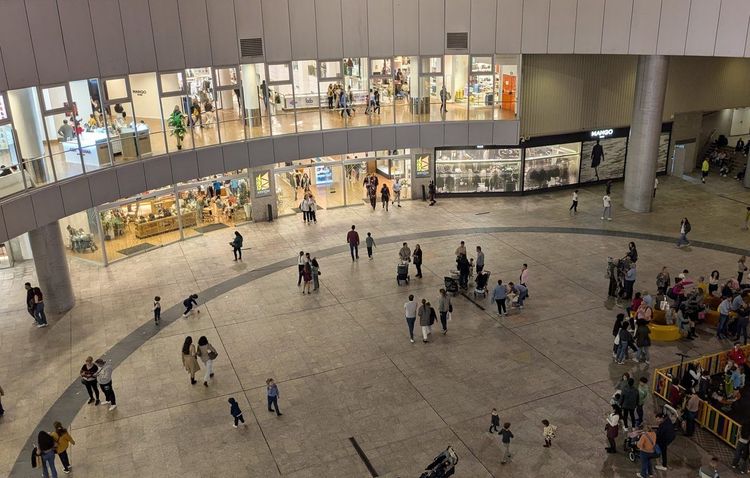
East of the historic center, Nervión stands apart from the rest of the city with its 20th-century urban planning, office buildings, and shopping mall. The Nervión Plaza (Avenida de Andalucía, 5, 41005 Sevilla, rated 4.3/5 on Google with 28,991 reviews), one of the largest shopping centers in Andalusia, concentrates chain shops, cinemas, and chain restaurants.
It is also the neighborhood of the Estadio Ramón Sánchez-Pizjuán, home ground of Sevilla FC, where the atmosphere on match evenings easily rivals any leading Spanish stadium. Few visitors stay here by aesthetic choice, but the value for money at hotels is often better than in the center, for a metro ride that reaches the Puerta de Jerez in under ten minutes. A pragmatic rather than charming choice, but one that has its fans among business travelers and families coming for a match.
The Barrio de los Museos and the Parque de María Luisa
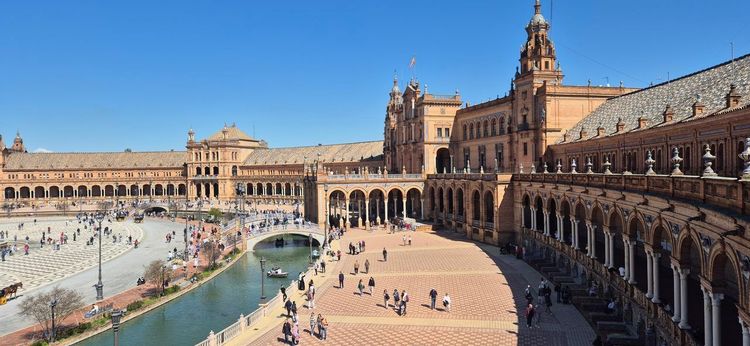
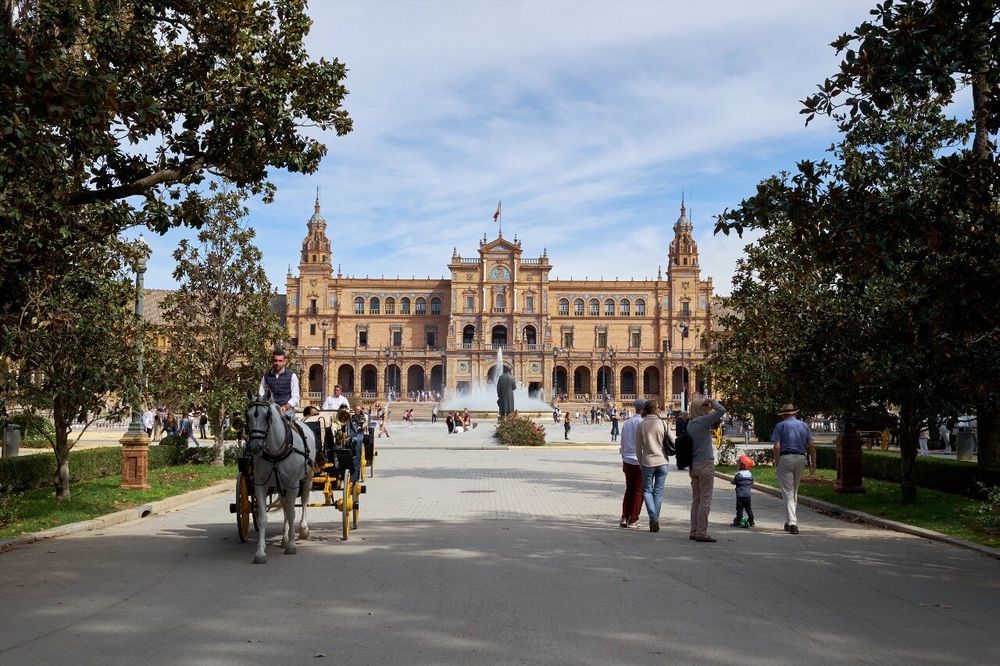
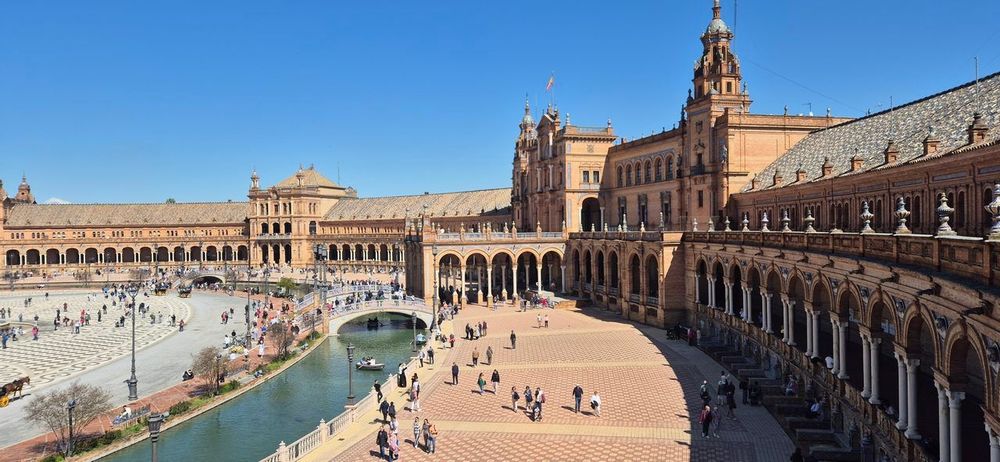
South of the center, the former grounds of the Palacio de San Telmo were donated to the city in 1893 by Infanta María Luisa Fernanda, giving rise to one of the most beautiful parks in Spain. Laid out for the 1929 Ibero-American Exposition, the park borders the spectacular Plaza de España, a 200-metre-long semicircle adorned with ceramic benches representing each Spanish province.
All around, two pavilions from the 1929 Exposition now house museums. The Museo Arqueológico de Sevilla (Plaza de América, s/n, 41013 Sevilla, rated 4.3/5 on Google with 992 reviews) holds the Carambolo Treasure, a collection of gold jewels dating from the 7th century BCE, one of the most important archaeological discoveries in Andalusia.
Renting a small boat on the semicircular canal of the Plaza de España remains one of the most photographed activities in the city, often at sunset when the raking light turns the azulejos orange. This museum district is best explored in the late afternoon, when the heat subsides and the horse-drawn carriages slow their pace. As the Ryo guide to Tokyo's neighborhoods shows, neighborhoods born from a world's fair often retain an architectural coherence found nowhere else in the city.
San Gil and San Jerónimo, Authentic Seville Away From the Crowds
Between the Macarena and the center, San Gil and San Jerónimo form a transitional zone that few guides mention — and that is precisely their appeal. The Iglesia de San Gil Abad (Calle San Luis, 22, 41003 Sevilla, rated 4.7/5 on Google with 3,136 reviews), with its 14th-century Mudéjar bell tower, recalls the Giralda in miniature.
These neighborhoods concentrate tapas bars where prices are still set by and for the Sevillians, with menus often only in Spanish. You will see few wheeled suitcases and plenty of neighbors greeting each other from one pavement to the other. San Jerónimo, further out to the north, retains a semi-rural character with its low houses and kitchen gardens along the riverbank, a remnant of the market-garden suburbs that supplied Seville until the mid-20th century.
Map of Seville's Neighborhoods: How to Navigate Easily
The map of Seville's neighborhoods can be summed up in a simple image: a compact historic center (Santa Cruz, Arenal, San Bartolomé) enclosed within an ancient city wall of which only fragments remain, with Triana isolated on the far bank of the Guadalquivir. To the north spread the Macarena, the Feria, San Gil, and San Lorenzo. To the east, Nervión marks the modern city. To the south, the Parque de María Luisa closes off the ensemble before the outskirts.
On foot, it takes about twenty-five minutes to cross the entire historic center from east to west, which makes most neighborhoods accessible without any form of transport. It is this compactness that makes the city particularly enjoyable to explore by ear, following an audio tour, rather than jumping from one taxi to the next.
Where to Stay in Seville According to Your Travel Profile
The question of the best neighborhood to stay in Seville depends almost entirely on what you are looking for. For a first trip and a desire to do everything on foot, Santa Cruz or the historic center remain the simplest choice, even if it means paying 20 to 30% more than elsewhere for immediate proximity to the cathedral and the Alcázar.
If you want to go out at night without taking a taxi, the Alameda de Hércules is hard to beat, with the logical drawback of noise on weekend evenings. For a more relaxed stay and a controlled budget, Triana offers the best compromise: ten minutes on foot from the center, genuine neighborhood life, and prices noticeably gentler than on the left bank.
Families with children often prefer the area around the Parque de María Luisa for the immediate green space and relative quiet. Travelers coming for a match or on a business trip find better value for money in Nervión, at the cost of a metro ride to reach the center. Finally, those seeking a more local immersion, away from organized tours, would do well to look at San Bartolomé or San Gil, where short-stay rents remain among the most affordable in the city. As our Ryo article on the best neighborhoods to stay in Athens points out, the right neighborhood is never universal: it depends on the holiday pace you want to adopt, not just on the distance to the main monument.
Is There a Neighborhood to Avoid in Seville?
Seville remains, on the whole, a safe city for visitors, including in the evening in the central neighborhoods described above. There is, however, one area that Sevillians themselves avoid without particular reason to go there: the Polígono Sur, also known as the Tres Mil Viviendas, in the south of the city. Built in the 1970s to rehouse precarious populations, this neighborhood has for decades accumulated very high unemployment and a reputation, partly justified, linked to drug trafficking on certain streets.
It is not a tourist neighborhood and nothing in a classic sightseeing itinerary will naturally take you there: it lies outside the areas served by the tram and metro lines most used by travelers. Basic caution is more than sufficient: avoid venturing there at night without a specific reason, as you would in any large European city with socially deprived neighborhoods. For the rest, including the Macarena or Triana sometimes mistakenly cited as unsafe, no particular precaution is needed beyond ordinary common sense.
Getting Around Between Seville's Neighborhoods
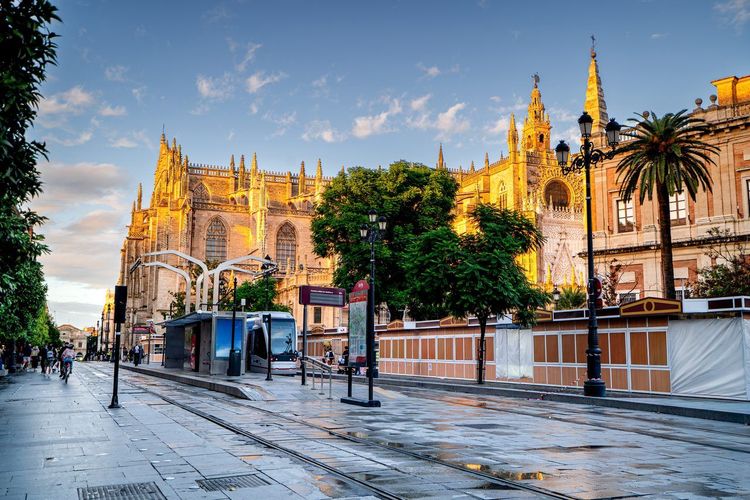
Walking remains the most efficient mode of transport in the historic center, which is largely pedestrianized and closed to cars over large sections. To reach Nervión or cross quickly to Triana, the T1 tram connects the Plaza Nueva to the Puerta de Jerez in just a few minutes. The Sevici bike-share network, one of the first in Spain launched as early as 2007, remains an economical option for covering longer distances, as the city is remarkably flat. Knowing Seville's neighborhood map well before you arrive also saves many unnecessary detours and a few pointless taxi rides.
FAQ
What is the best neighborhood to stay in Seville?
It depends on your travel profile: Santa Cruz for a first trip focused on monuments, Triana for a price-authenticity balance, the Alameda de Hércules for nightlife, and the area around the Parque de María Luisa for families seeking peace and quiet.
Where is the Santa Cruz neighborhood on the map of Seville?
Santa Cruz occupies the south-eastern corner of the historic center, right next to the cathedral and the Real Alcázar, between the Avenida de la Constitución and the Murillo gardens. It is the densest and most tourist-heavy neighborhood in the city.
Which neighborhood is the most lively at night in Seville?
The Alameda de Hércules has the densest nightlife, with its bars and terraces open until late on weekends. Triana offers a calmer but equally vibrant atmosphere in the evenings, especially along the river.
Is there a neighborhood to avoid in Seville?
The Polígono Sur, in the south of the city, concentrates social difficulties and a reputation linked to drug trafficking on certain streets. It does not appear in any classic tourist itinerary and therefore poses no risk to a visitor following a standard route.
How many neighborhoods are there in Seville?
Seville has around thirty barrios administratively, but only about ten concentrate most of the tourist interest: Santa Cruz, Triana, the Arenal, the Macarena, San Bartolomé, San Lorenzo, the Alameda de Hércules, Nervión, the barrio de los Museos, and San Gil.
How do you navigate easily between the neighborhoods of Seville?
The Guadalquivir separates Triana, on the west bank, from the rest of the city. The compact historic center groups Santa Cruz, the Arenal, and San Bartolomé, surrounded to the north by the Macarena and San Gil, to the east by Nervión, and to the south by the Parque de María Luisa.
Understanding Seville's neighborhoods before you arrive saves valuable time on the ground: no more randomly testing accommodation or wondering why one street is empty at 10 p.m. when another is overflowing with people. Each neighborhood serves a different purpose, from the religious sanctuary of the Macarena to the late-night terraces of the Alameda de Hércules.
Like the Sydney audio-guided tour, Au fil de ses quartiers, the best way to absorb this geography is to walk it, neighborhood by neighborhood, rather than learn it from a map. Seville, compact and flat, lends itself particularly well to this.
À lire également