© Shutterstock
 Votre guide Ryo
Visiting Úbeda Without a Car: The Complete Walking Guide for 2026
Visiting Ubeda without a car is no gamble: in Úbeda, the first thing that strikes you is not a monument but an absence. No lines of cars skirting the old town, no parking to hunt for between two Renaissance palaces. The historic centre, a UNESCO World Heritage Site since 2003, spreads over just a few hectares perfectly suited to walking. In a short morning, you can walk from the Plaza Vázquez de Molina and its honey-coloured palaces to a synagogue rediscovered by chance during renovation work in a private home, and a basilica built on the foundations of a former mosque. There is no need to rent a vehicle to link these stops: a direct bus from Jaén or Granada drops visitors ten minutes from the monuments, and Baeza, the twin town, is a quarter of an hour away by bus. This guide explains how to get there without a car, where to walk, what to see in a day, where to stay and how to extend your trip to Baeza, with the Ryo audio-guided tour of Úbeda as a common thread, designed precisely for discovering the town on foot.
Úbeda, a Renaissance Gem Made for Exploring on Foot
Perched on a plateau overlooking the sea of olive trees of the Loma de Úbeda, in the province of Jaén, Úbeda was never designed for cars. Its historic centre, inscribed on the UNESCO World Heritage List in 2003 together with its twin town Baeza under the name “Renaissance Monumental Ensembles of Úbeda and Baeza”, can be crossed from end to end in about twenty minutes on foot. It is one of the few places in Andalusia where Renaissance heritage is concentrated to this degree: several palaces around a single square, monumental churches, a medieval synagogue and a hospital nicknamed the Andalusian Escorial, all accessible on foot.
The town's history goes back much further than its façades. Iberian and then Roman settlements already occupied the Loma, and the present name derives from the Arabic Ubbadat al-Arab: for nearly five centuries, the Muslim city shaped the layout of the narrow, winding lanes you will wander around the Water Synagogue. In 1233, Ferdinand III of Castile took the town, which became a frontier stronghold facing the Nasrid kingdom of Granada.
Its current appearance dates from the 16th century, however, when families close to the court of Charles V, led by the Cobos and the Vázquez de Molina, called on the architect Andrés de Vandelvira to build palaces and chapels. Imperial court money poured into a provincial town, and this paradox explains so many masterpieces in such a small area.
Úbeda lies about fifty kilometres north-east of Jaén, in eastern Andalusia, at the gateway to the Sierras de Cazorla, Segura y Las Villas Natural Park. You will not need any vehicle to enjoy it: the terrain is gentle on the plateau, distances are short, and most of the monuments are grouped along a few connected streets.
Getting to Úbeda Without a Car: Trains, Buses and Airports
From Jaén or Granada by Direct Bus
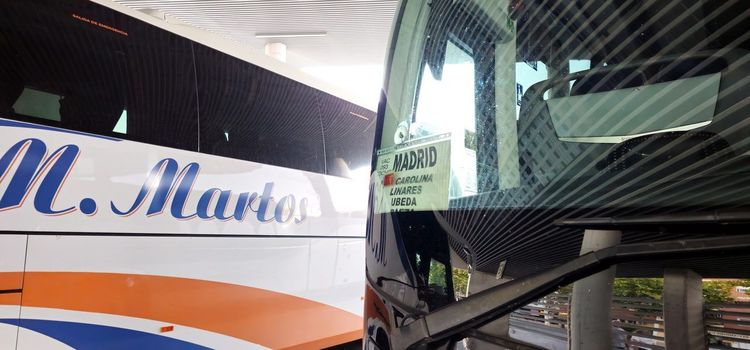
The bus remains the simplest way to reach Úbeda without a car. From Jaén, the company Alsa runs around fifteen daily services, from early morning until the evening, for a journey of one hour to 1h15 and a ticket from about 6 euros. From Granada, direct Alsa buses cover the roughly 120 kilometres in 1h45 to 2h, with several departures a day and tickets from around ten euros.
Buses drop travellers at Úbeda bus station, in the modern town, about ten minutes' walk from the Plaza Vázquez de Molina. You can buy your ticket online a few days before departure, which also lets you check the timetables, which are tighter early and late in the day than in mid-afternoon.
A tip if you are travelling on a Sunday or public holiday: frequencies drop sharply. It is better to schedule your arrival or departure on a weekday if your itinerary allows.
By Train to Linares-Baeza Station, Then the Bus
There is no railway station in Úbeda itself: the nearest is Linares-Baeza, isolated in open countryside about twenty kilometres from Úbeda. It is served by Renfe trains from Madrid or Jaén; from Madrid Chamartín, a few direct trains a day reach Linares-Baeza in 3h20 to 3h40, an interesting option if you are arriving from central Spain.
From the station, a bus reaches Úbeda in 30 to 35 minutes. Departures are timed to the main trains but are scarce otherwise: check the connection before booking your ticket, as a train arriving at the wrong time can mean a long wait on a platform with not much around. If the last bus has already left, a taxi is the only fallback.
From Granada, Seville or Málaga Airports Without Renting a Car
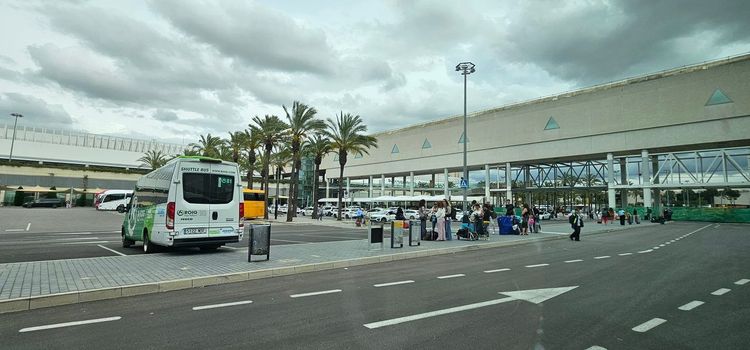
Three airports allow you to reach Úbeda without a car, with quite different journey times. Granada-Jaén airport is the closest: a shuttle reaches central Granada in about 45 minutes, then you take one of the direct buses to Úbeda mentioned above.
From Málaga, expect an additional connection, usually via Granada or Jaén, for a total journey of 3h30 to 4h; as the airport is very well served, long-distance buses remain frequent throughout the day. From Seville, the most direct route goes through Jaén, with a long-distance bus followed by the local service to Úbeda, for a total of around 4 to 5 hours.
One last tip if you arrive late in the day: Úbeda bus station is in the modern part of town, on flat ground. With a wheeled suitcase, the walk up to the old town is doable, but the last cobbled stretches are more tiring. If your accommodation is deep in the Jewish quarter, a taxi for that single leg may be worth the small expense, especially as drivers know the lanes where a car can still squeeze through.
In all three cases, book your first leg in advance and leave some margin for the final connection, whose frequencies thin out late in the day.
Getting Around Úbeda Without a Car: Everything Is on Foot
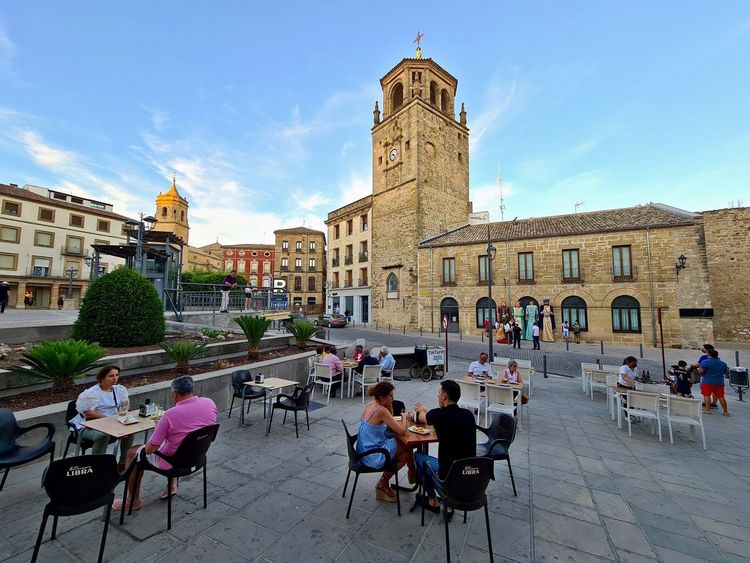
Once you are there, the question of transport almost completely disappears. Úbeda's historic centre can be explored entirely on foot: from the Hospital de Santiago, on the west side of the modern town, to the Plaza Vázquez de Molina, allow about twenty minutes of easy walking, and most other monuments are less than five minutes from one another.
The streets of the centre are largely cobbled and several are pedestrianised or have very restricted traffic. Walking is pleasant, but wear suitable shoes: the old cobblestones, polished by the centuries, become slippery in places. For visitors with reduced mobility, the monumental heart is generally flat, but the lanes of the Jewish quarter and those descending towards the ramparts have slopes and steps that are best checked in advance or bypassed via the main streets. A small tourist train also tours the historic centre in season, a practical solution for tired legs or families with strollers.
To get your bearings, remember one simple landmark: the Plaza de Andalucía and its Torre del Reloj form the hinge between the modern town, to the north-west, and the historic centre, to the south-east. From there, the Calle Real runs down towards the palaces, and all the streets end up reaching the Plaza Vázquez de Molina or the rampart viewpoint. It is hard to stay lost for long, and it is often by straying a little that you come across the most beautiful façades.
If you are staying a little off-centre, a local taxi remains an occasional option for luggage or a late return, but it is never necessary for sightseeing. The old town can be discovered at your own pace, without ever consulting a bus map.
The Plaza Vázquez de Molina and the Renaissance Palaces
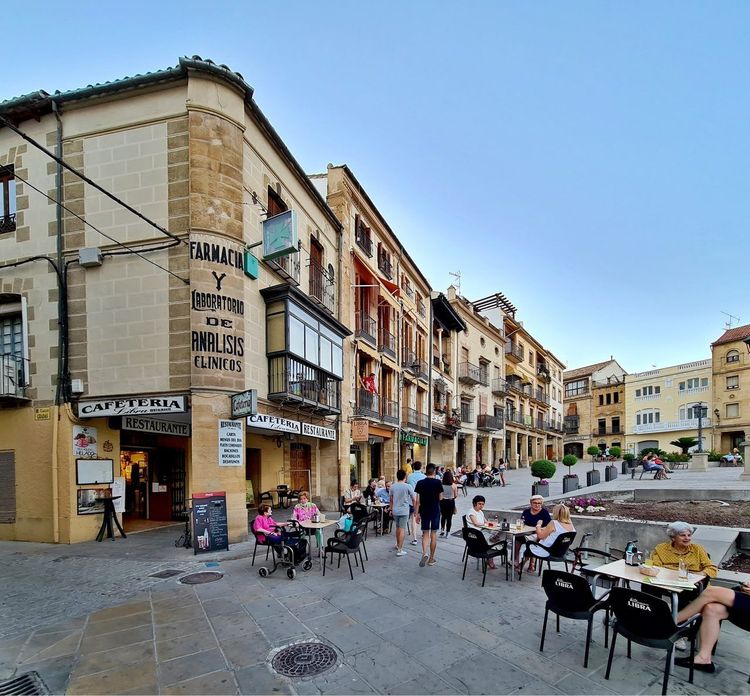
The Plaza Vázquez de Molina, Úbeda's Monumental Heart
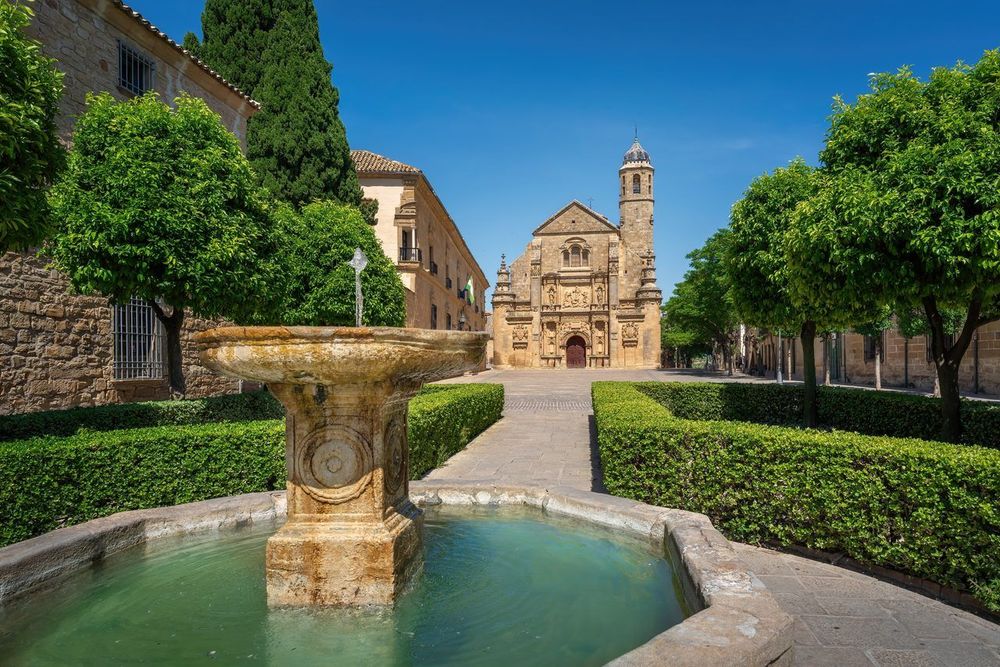
Everything in Úbeda seems to converge on this square. The Plaza Vázquez de Molina has a density of monuments that is rare in Spain: along a long esplanade lined with golden stone stand a funerary chapel, a basilica, several palaces and the town hall, almost all built in the same 16th-century Renaissance surge.
Take the time to walk all the way around the esplanade: besides the monuments detailed below, you will see the Palacio del Marqués de Mancera, with its corner tower, and the former bishop's prison, the Cárcel del Obispo, which now houses judicial offices. The benches in the shade of the trees in the middle of the square offer the best vantage point for comparing the façades.
Andrés de Vandelvira gave this ensemble its unity, with sober façades and carved coats of arms recalling the families that financed each building. In the evening, when the heat subsides and the last groups leave the square, the low light on the honey-coloured stone offers what many travellers consider the true high point of their stay. If you can only remember one moment, this is the one.
The Sacra Capilla del Salvador and the Palacio del Deán Ortega
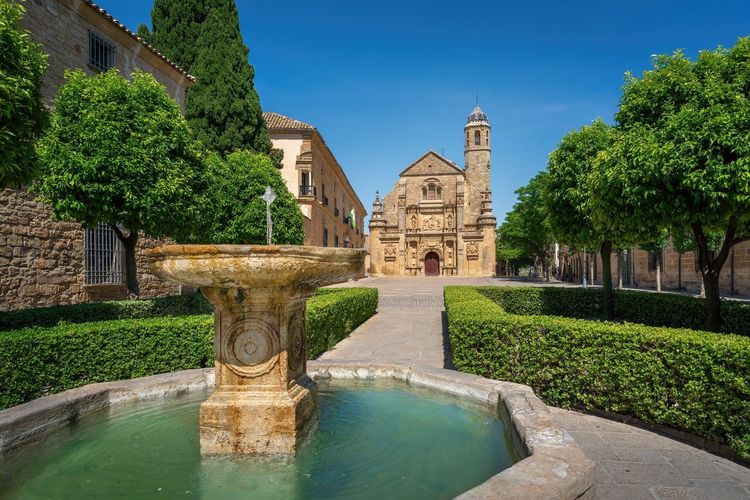
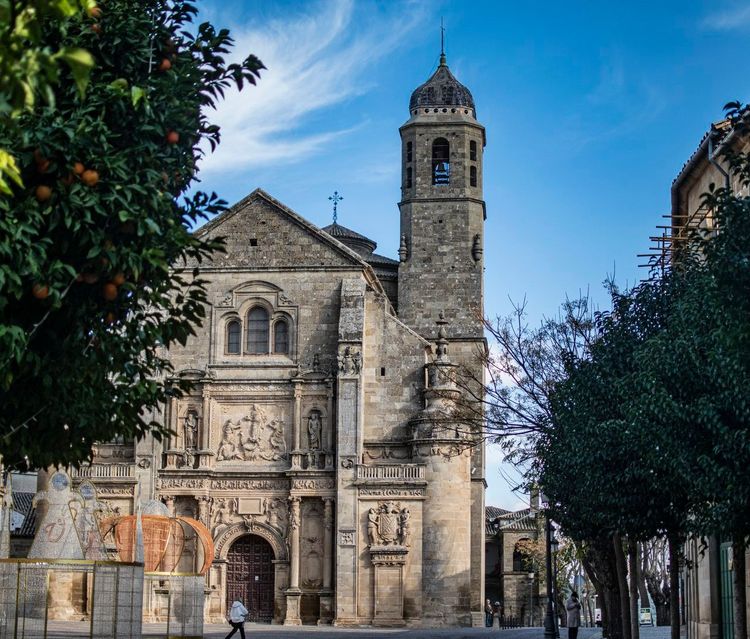
At the eastern end of the square stands the Sacra Capilla del Salvador, a funerary chapel commissioned by Francisco de los Cobos, secretary to Charles V, to house his own tomb. Designed by Diego de Siloé and completed by Vandelvira between 1536 and 1559, it has one of the most accomplished façades of the Spanish Renaissance, with sculpted reliefs around the theme of the Transfiguration. There is an admission fee of a few euros, and the interior is worth the detour for its altarpiece and Vandelvira's sacristy.
Right next door, the Palacio del Deán Ortega, built for Fernando Ortega Salido, dean and first chaplain of the Sacra Capilla, became one of the first Paradores in 1930, those historic hotels run by the Spanish state. You can step inside even without staying the night: the inner patio, with its two-level arcaded gallery, can be seen from the lobby, and the bar is well suited to a cool break.
The Palacio de las Cadenas and the Town Hall
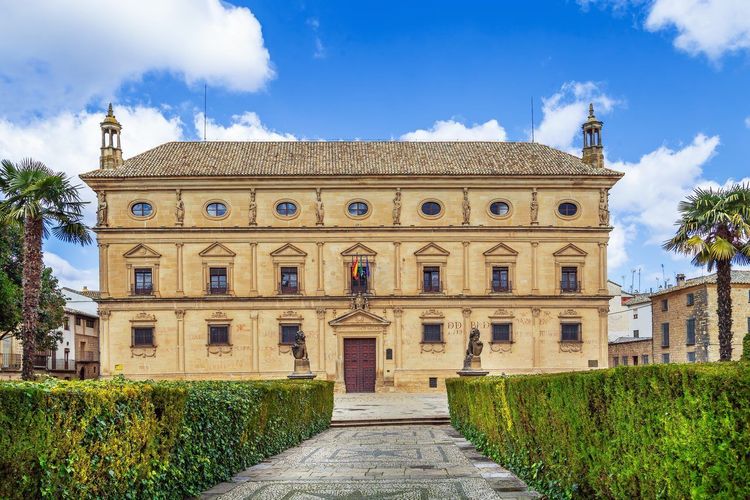
Opposite, the Palacio de las Cadenas (Plaza Vázquez de Molina, 23400 Úbeda, rated 4.5/5 on Google from 650 reviews) owes its name to the chains that once framed its doorway. Designed by Vandelvira between 1562 and 1568 for Juan Vázquez de Molina, nephew of Francisco de los Cobos and secretary to Charles V and then Philip II, it has housed Úbeda's town hall since 1850.
Its three-level façade stacks Corinthian pilasters, then Ionic ones, and finally caryatids replacing the columns on the top floor: an Italian vocabulary adapted to Andalusian stone. You can generally access the inner patio during administrative opening hours, on weekdays.
To hear the details of the family stories and court rivalries that shaped each façade, the Ryo audio-guided sub-tour dedicated to this hidden gem of the Spanish Renaissance focuses precisely on this square and its palaces, with anecdotes about the patrons.
Churches and Synagogue: Úbeda's Religious and Jewish Heritage
The Santa María de los Reales Alcázares Basilica
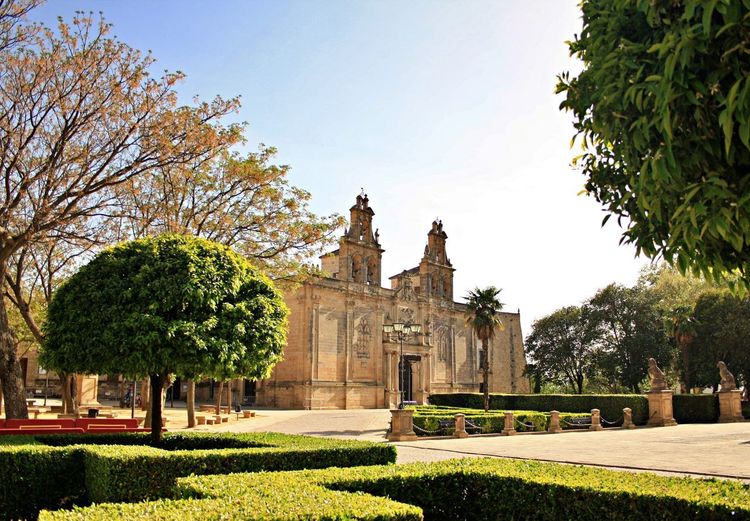
On the south side of the square rises the Santa María de los Reales Alcázares Basilica, built on the site of the former great mosque after the Christian conquest. Its façade blends several centuries of construction, from Gothic to Baroque, making it almost an architectural summary of the town on its own.
The interior is worth visiting for its Gothic cloister, built on the mosque's former ablutions courtyard, and for its side chapels closed off by wrought-iron grilles, a local craft you will see again on several religious buildings in the town. Closed for a long time for restoration, the basilica can be visited again, with a modest admission fee.
The Church of Saint Paul (San Pablo)
A few streets away, to the north of the old town, the Church of Saint Paul (San Pablo) has a flamboyant Gothic portal that contrasts with the Renaissance sobriety of the Plaza Vázquez de Molina. Founded in the 13th century and extensively remodelled since, it preserves a finely carved south portal and a tower that long served as a landmark in the urban fabric.
The Plaza Primero de Mayo surrounding it was long the market square and the site of public festivities. More modest and less crowded than the monumental square, it gives a good idea of what Úbeda looked like before its golden age.
The Water Synagogue, a Relic of the Jewish Quarter
Úbeda's most unexpected site is hidden in the heart of the former Jewish quarter: the Water Synagogue (Sinagoga del Agua (Calle Roque Rojas 2, 23400 Úbeda, rated 4.7/5 on Google from 2,641 reviews)) was discovered by chance during building work in a private home. Its recovery began in 2007 and it opened to the public in 2010. Dating from before the 14th century, it has seven rooms, including the prayer hall, the women's gallery and a mikveh, a ritual bath fed by a still-active underground spring.
The visit is by guided group only, lasting about 35 minutes for a ticket of around 6 euros, and tells the story of the medieval Jewish community as much as that of the place's improbable rediscovery. The Ryo audio guide also revisits this history along the way, between the synagogue and the carved details of the nearby basilica: a way to arrive at the door with the context already in mind.
Museums, Secondary Palaces and Other Must-Sees
The Archaeological Museum and the San Juan de la Cruz Museum
Housed in the Casa Mudéjar, a 14th-century residence in the heart of the Jewish quarter, the Úbeda Archaeological Museum traces the occupation of the territory from prehistory to the medieval period. The collections are modest but well presented, with a section devoted to the region's Iberian remains and another to the Muslim period. Allow a short half-hour, enough to put the neighbouring lanes in context.
Another figure tied to the town: the mystic Saint John of the Cross, who died in Úbeda in 1591 in the Carmelite convent where he had retired. The oratory and small museum dedicated to him, near the Plaza de San Miguel, will mainly interest enthusiasts of religious history and Spanish poetry.
The Palacio de Vela de los Cobos and Other Renaissance Residences
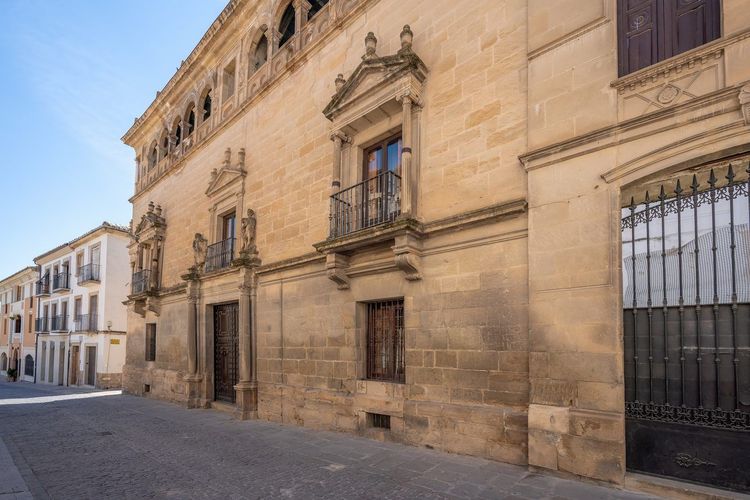
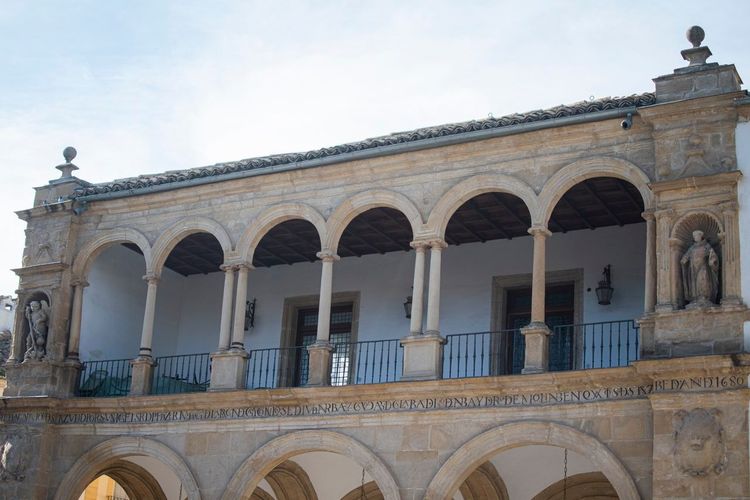
Beyond the Plaza Vázquez de Molina, Úbeda has dozens of palaces scattered through the adjacent streets. The Palacio de Vela de los Cobos stands out for its open gallery on the top floor, an arcaded loggia typical of local civil architecture, visible from the street even when the palace is closed.
A little further on, the Hospital de Santiago (Calle Obispo Cobos, 23400 Úbeda, rated 4.5/5 on Google from 89 reviews), nicknamed the Andalusian Escorial for its monumental sobriety, is worth the detour for its double-gallery inner courtyard and its staircase with a sculpted vault, one of Vandelvira's last great works. It now houses a cultural centre and temporary exhibitions.
Strolling between these addresses, you will come across plenty of lesser-known coat-of-arms façades, most of them still inhabited. They cannot be visited, but their doorways are enough to gauge the heritage density of the centre.
The San Millán Potters' Quarter
To the east of the old town, outside the walls, the Calle Valencia and the San Millán quarter are home to Úbeda's last potters' workshops. Their signature: a deep green glazed ceramic, inherited from Andalusian-era techniques, which some craftsmen still shape on the wheel in front of visitors. The walk there takes ten minutes from the Plaza Vázquez de Molina, descending via the Granada gate, and it is the best place to find a souvenir that fits in a backpack rather than a car boot.
A One-Day Walking Itinerary in Úbeda
Morning: The Old Town and the Monumental Square
If you only have one day, it is better to structure it than to zigzag. Start around 10am at the Hospital de Santiago, to the west, the least crowded monument in the early morning, which can be visited in 30 to 40 minutes.
Then make your way to the historic heart via the Plaza de Andalucía and the Calle Real, Úbeda's shopping street, in about fifteen minutes. Spend the late morning on the Plaza Vázquez de Molina: the Sacra Capilla del Salvador, the Palacio del Deán Ortega, the Palacio de las Cadenas and the Santa María de los Reales Alcázares Basilica take a little over an hour and a half if you go inside everywhere, less if you stick to exteriors and patios.
Finish with a light lunch on a terrace on the square or in the neighbouring streets, while the midday heat sets in, especially between May and September.
Afternoon: Lanes, Shops and Viewpoints
In mid-afternoon, when the monuments reopen after the midday break, head towards the Jewish quarter. The Water Synagogue is visited in guided time slots: book or check the hours before setting out. Allow 45 minutes including the wait.
Then head back up to the Church of Saint Paul and its quiet square, and continue to the Calle Juan Montilla for the façades of the Palacio de Vela de los Cobos. If you still have energy, go down to the potters' workshops on the Calle Valencia.
If you stay two days, keep the second morning for Baeza, detailed below, and come back in the early afternoon for what you did not have time to see the day before: the interior of the basilica, the archaeological museum or the potters' workshops. This slower pace also lets you enjoy the town at siesta time, when the streets empty and the open patios can be discovered without the crowds.
End the day on the promenade running along the old ramparts, south of the centre, where the view opens onto the olive plain and, on a clear day, the peaks of the Sierra Mágina and Cazorla. It is the ideal spot for sunset, without taking a single means of transport. This itinerary largely overlaps with that of the Ryo audio-guided tour, step by step: handy if you prefer to be guided by ear rather than follow a paper map.
Day Trip to Baeza Without a Car, the Other Renaissance Town
Getting to Baeza by Bus from Úbeda
Baeza is Úbeda's twin town in the UNESCO listing, and the good news for those travelling without a car is that it is only 9 kilometres away. Alsa buses connect the two towns about fifteen times a day, from early morning until early evening, in 15 to 20 minutes depending on stops, for a ticket of around 1.40 euros. It could not be simpler, and it is far cheaper than a taxi.
Frequencies are decent on weekdays but drop at weekends: if you are making a round trip in the day, note the time of the last return bus before leaving so you don't get stuck in Baeza.
Baeza's Must-Sees in Half a Day
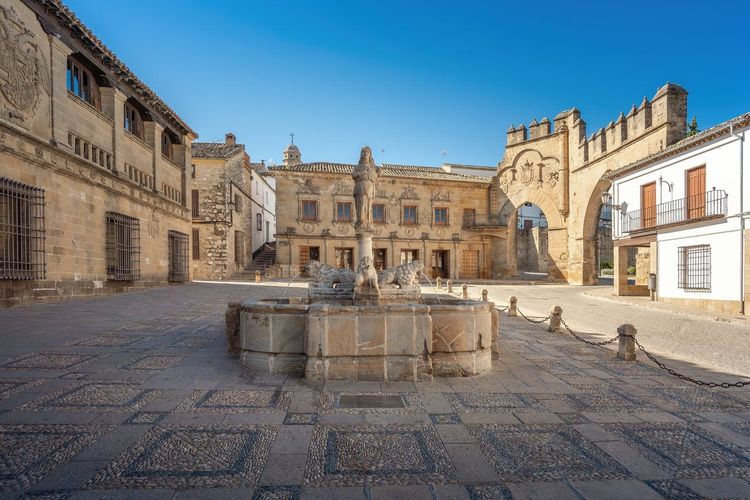
Half a day is enough to see the essentials of Baeza, which is smaller than Úbeda. Start with the Plaza del Pópulo, also called Plaza de los Leones for its lion fountain, which brings together several Renaissance buildings around a much more intimate space than the Plaza Vázquez de Molina. The tourist office is located there, in the former Casa del Pópulo.
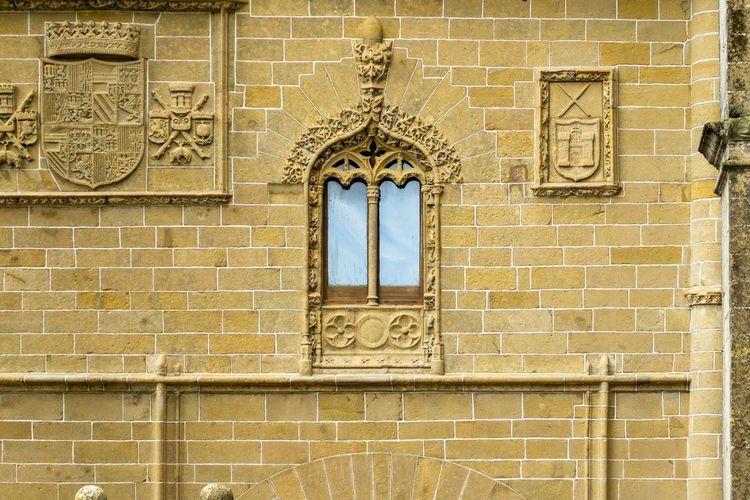
From there, head up to the Baeza Cathedral, built on the former mosque, then pass the Santa María fountain before continuing to the Palacio de Jabalquinto (Cuesta de San Felipe, 23440 Baeza, rated 4.6/5 on Google from 499 reviews), with its Isabelline Gothic façade covered in diamond points, a striking contrast with Úbeda's restraint.
Right opposite stands the Antigua Universidad, founded in 1538. The poet Antonio Machado taught French there from 1912 to 1919, and his classroom has been preserved as it was. Finish with the Paseo de las Murallas, a balcony promenade over the Guadalquivir valley.
And if you have one more day, the surroundings can also be explored by bus. Regular services connect Úbeda to Cazorla, the gateway to the Sierras de Cazorla, Segura y Las Villas Natural Park, in a little over an hour: castle, whitewashed lanes and hiking trails leading to the source of the Guadalquivir. A more athletic excursion, but still doable without renting a vehicle if you check the return times.
If you extend your stay in Andalusia beyond Úbeda and Baeza, still without taking the wheel, the Ryo audio-guided tour across Andalusia links this excursion with other regional stops, from Granada to Córdoba, accessible by public transport.
Where to Stay and Eat in Úbeda Without a Car
Where to Stay in the Historic Centre to Do Everything on Foot
Without a car, the number one criterion for choosing accommodation is not price but location: favour a place in or immediately bordering the historic centre, even if it costs a little more. That way you avoid any motorised travel and can walk home even late after dinner.
The Parador housed in the Palacio del Deán Ortega remains the most emblematic address for sleeping in a Renaissance palace, directly on the Plaza Vázquez de Molina. Several hotels and guesthouses also occupy former noble residences with patios, a few streets away, often at much gentler prices. If you arrive with a heavy suitcase, accommodation between the bus station and the Plaza de Andalucía makes arrival easier without taking you far from the monuments.
Where to Eat Near the Plaza Vázquez de Molina and in the Old Town
As for dining, the Plaza Vázquez de Molina and the adjacent streets concentrate most of the terraces. Local cuisine highlights olive oil from the Loma de Úbeda, one of the densest production areas in Spain, as well as dishes from inland Andalusia: andrajos, a stew of pasta and vegetables, Jaén's pipirrana, a salad of tomatoes and peppers, or ochíos, small bread rolls made with oil and paprika.
Olive oil is worth a detour on its own. Several mills, the almazaras, offer visits and tastings around the town, mainly from November to January, when the harvest is in full swing. Most are located outside the centre: a taxi or an organised visit with transport is then the best option. In town, the delicatessens on the Calle Real sell small bottles that are easy to slip into carry-on luggage.
For a simpler lunch, the tapas bars around the Calle Real and the Plaza de Andalucía offer a quick option between visits. As is often the case in the province of Jaén, a tapa frequently comes with each drink ordered: a good way to taste several specialities without blowing the budget.
Budget and Benefits of Visiting Úbeda Without a Car
Giving up the car in Úbeda is not just a logistical constraint: it is also a concrete saving. Rental, fuel and parking near a historic centre where spaces are scarce often add up to 30 to 50 euros a day for a couple or a small family.
As a guide, here is what a visit entirely by public transport and on foot costs: around 6 to 10 euros for the bus from Jaén, a little more from Granada, 1.40 euros each way to Baeza, 6 euros for the guided visit of the Water Synagogue and a few euros for each major monument. A full day of sightseeing therefore comes in well under 30 euros per person, excluding meals.
As for the weather, avoid July and August if possible for a walking visit: temperatures regularly exceed 35°C in this part of Andalusia. Spring, from April to May, and early autumn, from September to October, offer much more comfortable conditions. Holy Week attracts many people: book your accommodation early if you are visiting at that time.
Finally, check opening hours before setting out: several monuments, including the Sacra Capilla del Salvador, close in the middle of the day and shut earlier on Sundays, and some sites have a weekly closing day. An easy detail to check the day before from your phone.



FAQ
Can you visit Úbeda entirely on foot?
Yes. The historic centre can be explored entirely on foot: the main monuments are just a few minutes from one another, and the furthest, the Hospital de Santiago, is about twenty minutes from the Plaza Vázquez de Molina.
How do you get to Úbeda without a car?
The bus is the most direct option, with around fifteen daily connections from Jaén and direct buses from Granada. Another option: take the train to Linares-Baeza station, then a half-hour bus ride to Úbeda.
How do you get from Úbeda to Baeza without a car?
An Alsa bus connects the two towns in about a quarter of an hour, around fifteen times a day, for roughly 1.40 euros. It is the easiest way to see the two neighbouring UNESCO sites.
How long does it take to visit Úbeda?
A full day lets you see the essentials of the historic centre at a comfortable pace. With an extra half-day, you can add the excursion to Baeza; ideally, plan to stay one night.
What can you visit in Úbeda?
The Plaza Vázquez de Molina and its monuments (Sacra Capilla del Salvador, Palacio del Deán Ortega, Palacio de las Cadenas, Santa María Basilica), the San Pablo church, the Water Synagogue, the Hospital de Santiago and the archaeological museum form the heart of the visit.
How do you get around the historic centre without a car?
On foot: the centre is compact, largely pedestrianised, and requires no internal transport. Just wear shoes suited to the old cobblestones.
Should you book accommodation in the historic centre to visit without a car?
It is not compulsory but strongly recommended: staying in or near the historic centre avoids any motorised travel and lets you walk to all the monuments, including in the evening.
What is the best time of year to visit Úbeda on foot?
Spring (April–May) and early autumn (September–October) offer ideal temperatures for walking. In summer, focus your visits on early morning and late afternoon.
Conclusion
Visiting Úbeda without a car is therefore not a compromise but almost an advantage: the town was built on a scale that walking is enough to embrace, and every bus journey, from Jaén, Granada or Linares-Baeza station, drops you at the gates of a centre designed for pedestrians. Between the Plaza Vázquez de Molina, the Water Synagogue and the excursion to Baeza, one to two days are enough to grasp the essentials of this Renaissance heritage without ever looking for a parking space.
To explore each stop in more depth by ear, independently and at your own pace, the Ryo audio-guided tour of Úbeda accompanies this walking discovery, from the palaces of the monumental square to the lanes of the Jewish quarter.