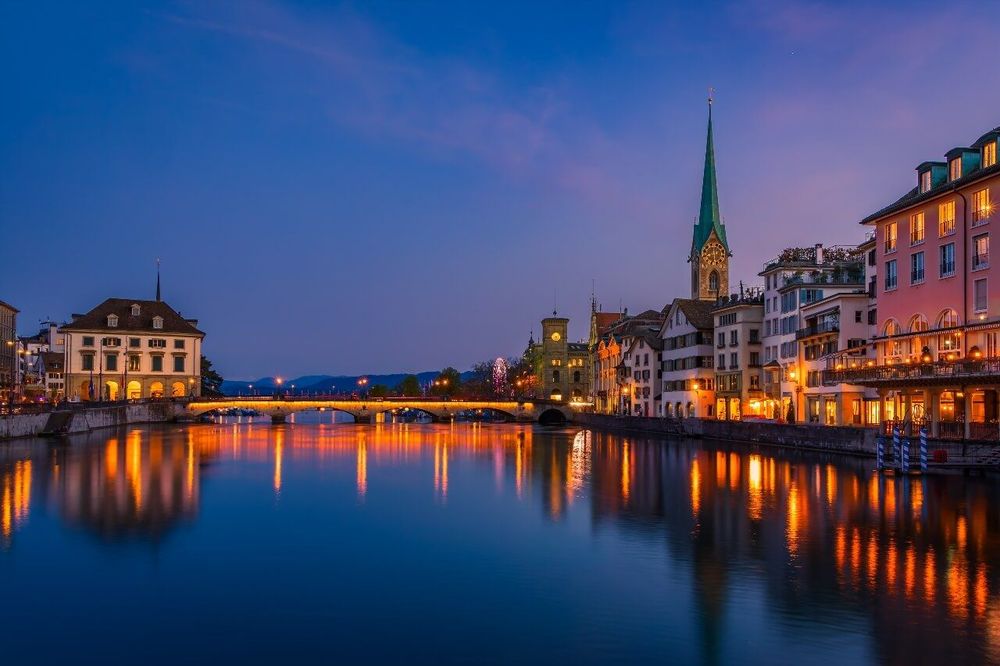
© Shutterstock
 Votre guide Ryo
Zurich Differently: 12 Activities to Enjoy Without Spending a Penny in 2026
Is finding free things to do in Zurich mission impossible? A half-litre of beer at over 8 Swiss francs, a sandwich that easily tops 15 francs at a station counter: the city has a reputation as an outrageously expensive destination, and it is not entirely undeserved. Yet walking up the Limmat from the Hauptbahnhof, you will come across, without spending a franc, medieval lanes, a panorama of the Alps reachable by regional train, river baths open to everyone and more than 1,200 fountains where you can refill your water bottle. Even locals, though used to local prices, enjoy this ticket-free city every day rather than leaving it to tourists alone. The Ryo audio-guided tour of Zurich follows precisely this thread, between the old town and the quays, for those who prefer walking with a voice in their ear rather than a map in their hand.
On the programme: the 36 brick arches of the Viadukt converted into boutiques, a university natural history museum where mammoths and dinosaurs can be visited without paying admission, the very local tradition of swimming in the river in the heart of the city, and a committed app, myclimate Audio Adventure, which offers a free guided walk. We also cover what does cost money after all, the Zürich Card and accommodation, so that your budget stays under control from the first day to the last, with no unpleasant surprises on arrival or last-minute calculations at the station.
1. Stroll Through Zurich's Old Town (Altstadt)
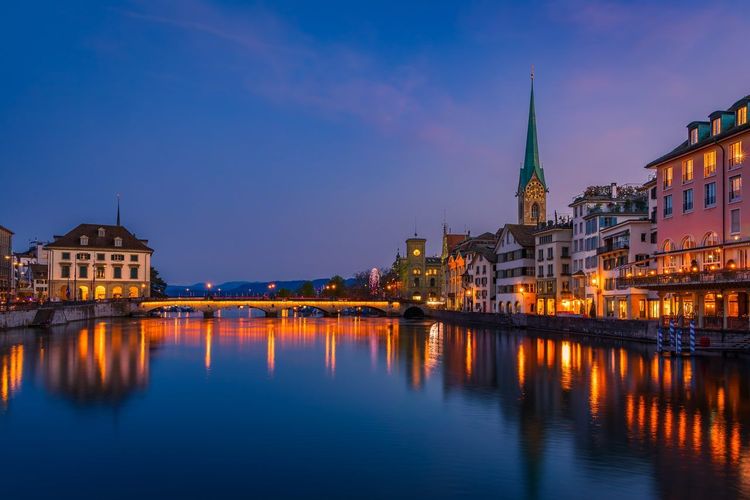
Zurich's old town stretches along both banks of the Limmat, and it costs nothing to explore on foot. It is historically the commercial and religious heart of the city, remaining largely intact despite eight centuries of urban expansion all around it. The two banks each have their own character: commercial and affluent on the left, more working-class and nocturnal on the right.
Niederdorf and the Medieval Lanes of the Right Bank
On the right bank, the Niederdorf district unfolds a maze of cobbled lanes too narrow for cars, lined with half-timbered houses and former guildhalls (Zunfthäuser) converted into restaurants. Many of these facades still bear the painted sign of the trade that occupied them in the Middle Ages: weavers, butchers, boatmen. You can simply walk up the Niederdorfstrasse from north to south without a precise itinerary; the surprises come from the inner courtyards glimpsed through a half-open door. In the morning, before the terraces open, the street belongs almost exclusively to the residents who come down to buy their bread; in the evening, the same facades light up and the neighbourhood changes rhythm completely, with tiny bars and antique-dealer shopfronts that close late.
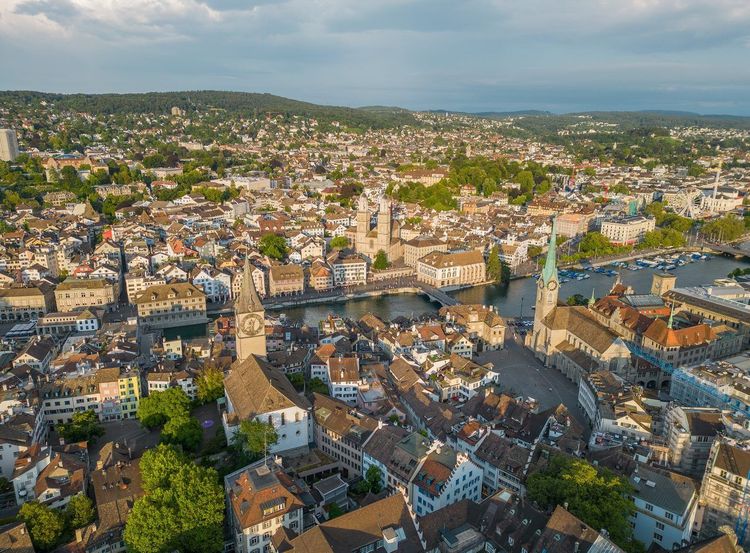
At the end of the street stands the Grossmünster, the church with twin towers that has dominated the city's skyline since the 12th century and where Zwingli preached the Reformation. Entry to the nave is free; only the climb up the tower (Karlsturm) is paid, which leaves plenty of opportunity to admire the contemporary stained-glass windows by Augusto Giacometti and Sigmar Polke without spending a franc.
Not far away, the St. Peterskirche church displays the largest clock face in Europe, 8.7 metres in diameter, legible from several surrounding streets without needing to enter the building. The interior, Baroque and fairly sober compared to the Grossmünster, can also be visited without a ticket, and a few side benches allow for a quiet break away from the bustle of the neighbouring Bahnhofstrasse.
On the other side of the bridge, the Fraumünster draws visitors for one specific reason: five stained-glass windows by Marc Chagall in the choir, installed in 1970. Here, the interior requires a small entrance fee, but nothing stops you from appreciating the green spire and the facade from the square. Right in front, the Münsterhof and the Baroque town hall (Rathaus), partly built over the Limmat, can be photographed freely from the neighbouring bridge, as can the Zunfthaus zur Meisen, a former guildhall whose Rococo facade deserves at least a two-minute stop.
Lindenhof and the Limmat Quays
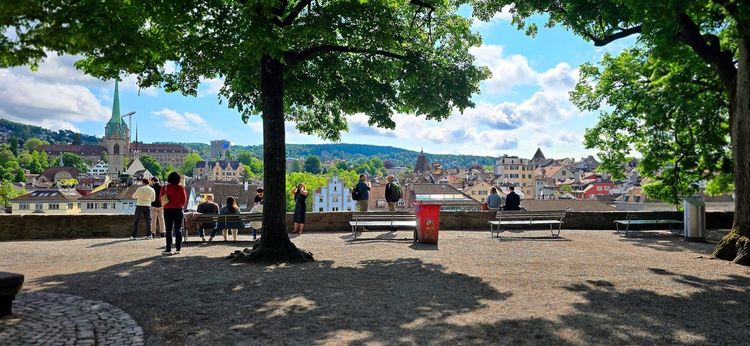
Heading up from the Bahnhofstrasse, a flight of steps leads to the Lindenhof (8001 Zürich, rated 4.7/5 on Google from 13,469 reviews), a lime-tree-planted terrace on a hill that served as a Roman fort and then a Carolingian palace before becoming a simple public square. Today you will find chess players on a giant board laid right into the paving, with wooden pieces available for anyone who wants to challenge a regular, and above all one of the rare unobstructed viewpoints over both banks without climbing higher than a staircase. Access is free at all hours, and a few shaded benches invite you to stay longer than planned.
The quays themselves are worth a stroll: the Limmatquai, lined with listed facades, runs along the river on the right bank while the left bank concentrates the smarter shops of the Bahnhofstrasse. You can go down to the steps that plunge directly into the water, a very Zurich habit for sitting with your feet in the current. The architecture here mixes late Gothic, repainted Baroque facades and a few post-war buildings slipped between two old gables, giving the whole a visual rhythm that more homogeneous cities lack. At the end of the day, the low light on the two towers of the Grossmünster, seen from the opposite bank, remains one of the most photographed images of Zurich.
The Ryo audio-guided tour of Zurich and its "All the Gold in the World" section pass right through Niederdorf and the Lindenhof: the anecdotes about the guildhalls and their signs are discovered as you walk, without searching for an elusive explanatory plaque or deciphering a paper guide in German on your own.
2. Explore Zurich West: Viadukt Arches, Street Art and Public Art
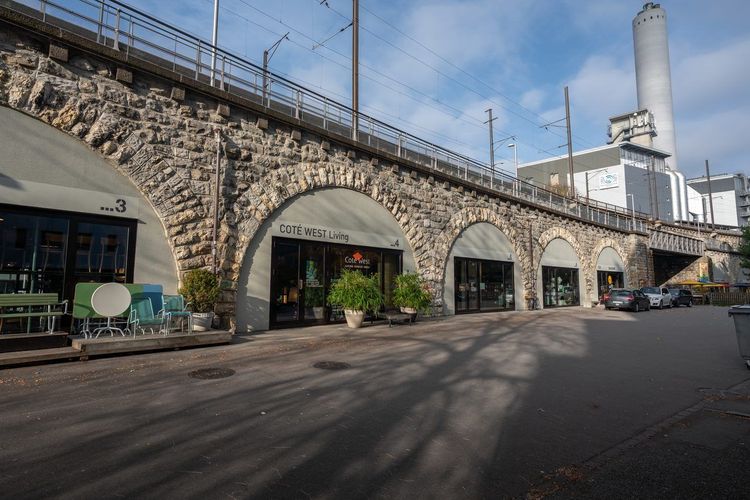
In contrast to the medieval postcard, the Zurich West district (Kreis 5) tells the industrial history of the city, converted over some twenty years into a creative hub. You come here for the recent architecture and the former halls, not for the churches.
The Viadukt Arches and Their Independent Shops
The railway viaduct Im Viadukt lines up 36 stone arches beneath a railway line still in service. Renovated and opened in 2010, they now house independent shops, local designers and a covered market hall where about twenty regional producers sell their products from Monday to Saturday. You can wander freely, browse without buying anything, in a much less touristy atmosphere than that of the Bürkliplatz.
A few minutes' walk away, the Freitag Tower (Geroldstrasse 17, 8005 Zürich, rated 4.4/5 on Google from 956 reviews) is worth the detour for its architecture alone: seventeen shipping containers stacked in apparent balance, housing the flagship store of the recycled-bag brand Freitag. The platform at the top, with views over the railway tracks and the city, can be reached with no intention to buy.
Just above the district, the Prime Tower and its 126 metres, long the tallest tower in Switzerland before being surpassed by the Roche towers in Basel, can be admired from the street; only its panoramic bar at the top charges. Nearby, the former brewery of the Löwenbräu-Areal, occupied by several contemporary art galleries, often opens its openings to the public in the evening: a simple opportunity to see high-level exhibitions without paying.
Street Art and Public Artworks (KiöR) in the District
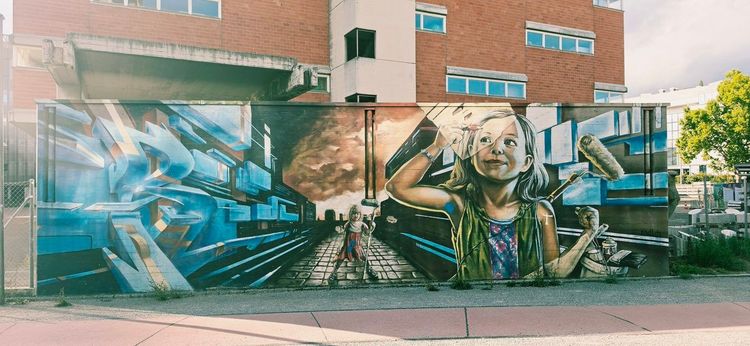
Under the railway arches and on several blind gables in the district, murals follow one another, renewed over the years by local and international collectives. The area around the Hardbrücke has the highest density of these ephemeral works, visible day and night, some covering entire facades.
To this is added a more institutional programme, the KiöR (Kunst im öffentlichen Raum, or Art in Public Space), which scatters several hundred publicly funded sculptures and installations throughout the city: you will come across some pieces without even knowing they belong to this collection, which turns the walk into an urban treasure hunt. You just have to look up as you walk, and a good part of these works is concentrated between Zurich West and the lake quays.
To avoid getting lost between the former industrial site, the Löwenbräu-Areal galleries and the scattered murals, the Ryo article Top 6 Things to Do in Zurich details a tight itinerary focused on the district, useful as a complement to free wandering.
3. Climb the Uetliberg and Enjoy the Panoramas
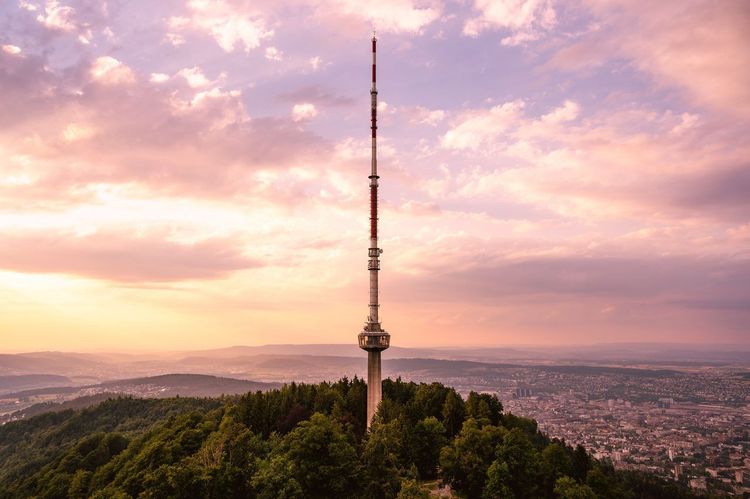
The Uetliberg, nicknamed "the summit of Zurich", peaks at 871 metres and is normally reached from the Hauptbahnhof by the S10 train in about twenty minutes, for the price of a simple regional transport ticket. Note for 2026: the underground station of the SZU line (platforms 21/22) is closed for works from 29 April to 12 December, and the S10 then departs from Selnau station, ten minutes' walk from the central station. From the terminus, ten minutes' walk through the forest is enough to reach the summit.
The view takes in Lake Zurich below, the city spread across both banks and, on a clear day, the Alpine chain as far as the Säntis. The metal observation tower, built in 1990, asks for a few coins at the entrance, but the summit terrace already offers a very wide panorama for free. The best light falls in the late afternoon, when the sun skims the lake, or early in the morning in winter when a sea of fog drowns the valley and lets the peaks emerge, a frequent phenomenon between November and January. The Uto Kulm restaurant is still paid, but nothing stops you from bringing your picnic and settling on one of the benches around the viewpoint.
You can also walk back down to the city via the forest path, about 1.5 hours of gentle walking, or continue to Felsenegg along the Planetenweg, a path of about two hours that depicts the solar system to scale, each planet placed at a distance proportional to the Sun. The cable car that then descends to Adliswil is paid, but good walkers reach the valley on foot. In winter, the slope turns into a sledding run popular with Zurich families.
This climb corresponds precisely to a stop on the Ryo audio-guided tour of Zurich, which explains why this natural balcony over the Alps and the lake became the favourite belvedere of Zurich residents, long before the rooftops of the centre.
4. Hike and Stroll Through Parks, Gardens and Viewpoints
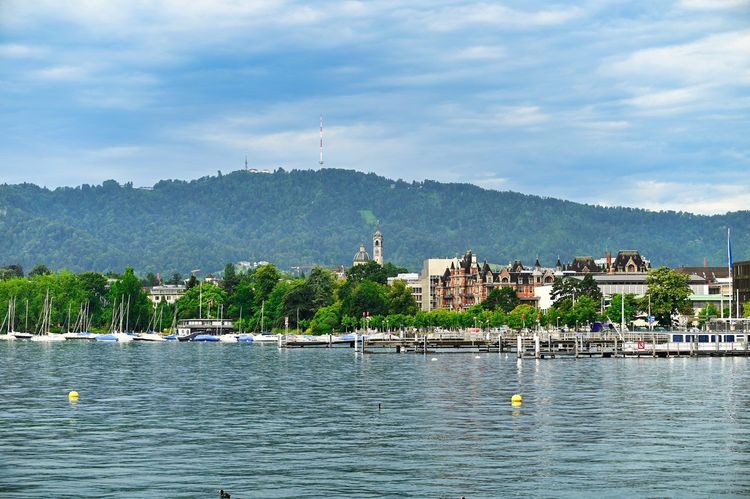
Zurich is bordered by forests accessible in a few tram stops, a luxury few large European cities offer at this level of proximity, and it also has plenty of green spaces right in the centre.
Hiking Trails Accessible From the City Centre
The Zürichberg, a wooded hill overlooking the right bank, offers several marked trails linking the zoo, the university and viewpoints over the lake, never more than 20 minutes by transport from the centre. Further west, the Käferberg offers a network of less-frequented forest paths, popular for Sunday morning jogging, with a few clearings where families play and outdoor fitness trails (Vita Parcours) along the main paths. Both hills can be explored freely and remain passable almost all year round, except after heavy snowfall.
Parks and Gardens in the Centre (Platzspitz, Rieterpark...)
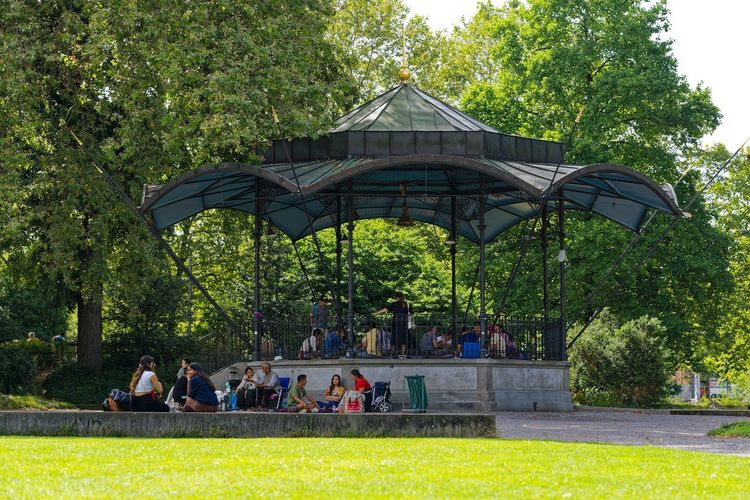
At the confluence of the Limmat and the Sihl, behind the National Museum, the Platzspitz forms a triangular point of greenery very popular with families and joggers at the end of the day. It is hard to imagine that it was, in the late 1980s, an open drug scene known throughout Europe.
Further south, the Rieterpark descends in wooded terraces towards the lake and surrounds the Museum Rietberg, with its rhododendrons in bloom every spring and its centuries-old trees.
On the heights, near the university, the Irchelpark unfolds vast gently sloping lawns where students settle at the first rays of sun, with a pond and picnic tables. Finally, the Zürichhorn (Bellerivestrasse, 8008 Zürich, rated 4.7/5 on Google from 3,242 reviews), on the lakeshore, combines lawns, open-air sculptures and public barbecue spots, to be claimed by arriving early at weekends. The neighbouring Chinese garden, a gift from the twin city of Kunming, does require a small ticket and only opens in the good season.
5. Swim in Lake Zurich and the Limmat River
Did you bring a swimsuit? Urban swimming is one of the most striking local habits, and a good part of this tradition remains accessible for free. The official baths, called Badis, generally charge an entrance fee of a few francs, but some spots along the water escape this rule entirely.
On the Limmat, the Flussbad Oberer Letten lets you jump into the current from an urban beach with free access, with its wooden pontoons and lawns. The current is strong enough to let the river do the work and drift a few hundred metres before climbing out, a ritual practised every summer evening by dozens of office workers coming to cool off after work. A little further downstream, the Flussbad Unterer Letten offers the same experience, with shadier lawns for drying off in the sun.
On the lake, the Seebad Utoquai (Utoquai 50, 8008 Zürich, rated 4.5/5 on Google from 886 reviews) charges a modest entrance fee but gives access to wooden diving boards and pontoons from another era; on the other hand, several developed shores such as the Saffa-Insel, near the Landiwiese on the left bank, or the lawns of the Zürichhorn remain open to everyone with no ticket booth, towel to be brought yourself. The swimming season officially runs from May to September, but locals often venture in earlier. Renting a pedalo or paddleboard is paid everywhere, which makes swimming the only truly economical way to enjoy the water.
The Ryo audio tour follows part of these quays, with the anecdote explaining why swimming in the middle of the city remains an openly embraced Zurich ritual, and why you will see executives slipping their shirts into a waterproof bag (the famous Wickelfisch) before jumping into the water.
6. Visit the Free or Very Affordable Museums
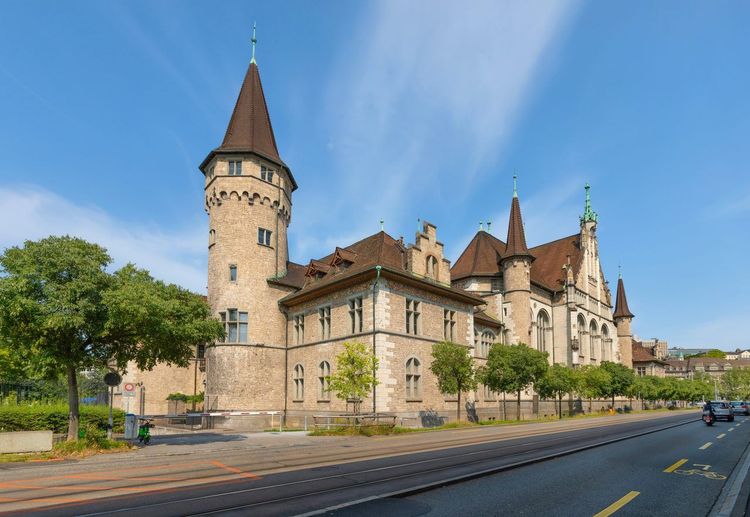
Zurich has a density of museums that is rare for its size. Several require no ticket, others open only part of their rooms: it is better to know these nuances before showing up at the reception desk.
Museums and Collections With Free Access
The Landesmuseum Zürich (Swiss National Museum), housed in a neo-Gothic castle near the station, charges adults 13 francs (free for under-16s and Zürich Card holders). Its "Simply Zurich" exhibition, devoted to the history of the city, is on the other hand open without a ticket, and the inner courtyard as well as the architecture, between reconstructed medieval turrets and a contemporary wing inaugurated in 2016, can be discovered without paying anything.
The Museum Rietberg, devoted to the arts of Asia, Africa, the Americas and Oceania, allows free access to its permanent collection, partly housed in the 19th-century Villa Wesendonck, while the temporary exhibitions in the underground extension are paid. Check the conditions on site before counting on it, as they change with exhibition seasons.
Less expected, the Sukkulentensammlung Zürich, a municipal collection of cacti and succulents among the richest in Europe, opens its greenhouses and garden all year round, a few tram stops from the centre. The place remains overlooked by passing visitors, which makes it a quiet break even in peak season.
Natural History Museum of the University of Zurich and Other University Collections
Since 2024, the university's former zoology and paleontology museums have been united in the Naturhistorisches Museum der Universität Zürich (Karl-Schmid-Strasse 4, 8006 Zürich, rated 4.8/5 on Google from 2,205 reviews) (NMZ), Karl-Schmid-Strasse 4. Entry is free, Tuesday to Sunday from 10am to 5pm, with a late opening on Thursday evenings reserved for adults. More than 1,500 animals and fossils are on display: mammoth skeletons, giant tortoises, stuffed African fauna and two star dinosaurs, the Hesperosaurus "Victoria" and the Allosaurus "Big Al". If you are travelling with children, this is probably the best cultural bargain in the city.
The university's botanical garden, on the heights of Riesbach, adds its dome-shaped tropical greenhouses and collections of alpine plants accessible without a ticket. A few more obscure university collections, such as those of the university's ethnographic museum, complete the list. To go further, the Ryo article Top 6 Things to Do in Zurich lists other cultural addresses in the city.
7. Wander Through the Bürkliplatz Market
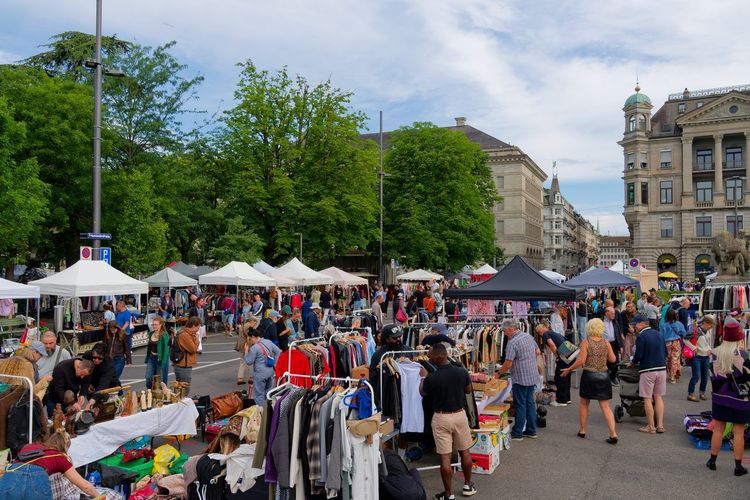
On the Bürkliplatz (8001 Zürich), where the Bahnhofstrasse meets the lake, two markets take turns depending on the day. On Tuesday and Friday mornings, a flower and fresh produce market sets up its stalls facing the water; on Saturdays, from May to October, a flea market (Flohmarkt) takes over, with antiques, vinyl records and bric-a-brac sold by private individuals set up on makeshift trestles.
The atmosphere is enough to fill a morning without buying anything: the boats of the lake navigation company dock right next door, which also makes it a handy landmark for the rest of the walk, towards the old town or along the quays to the Zürichhorn. Do as the regulars do: sniff the alpine cheeses, hunt for an old yodel record, and at worst leave with a small seasonal bouquet.
8. Enjoy Free Festivals and Concerts Depending on the Season
Zurich's calendar offers events open to all throughout the year, as long as you aim for the right season.
In spring, usually on the third Monday of April, the Sechseläuten stages a parade of guilds in traditional costumes followed by a great bonfire where the Böögg burns, a cotton snowman stuffed with firecrackers: the faster its head explodes, the better the summer will be, according to tradition. In summer, several squares and parks host open-air concerts and neighbourhood parties without tickets. The Street Parade, in August, gathers nearly a million people around electronic music floats along the lake basin, with no entrance ticket or closed perimeter, making it one of the largest festive gatherings in Europe. Every three years, the Zürifäscht also transforms the quays into an immense popular festival with fireworks.
In winter, the Christmas markets set up in the main station hall, on the Münsterhof or the Sechseläutenplatz can be visited free of charge, crystal-decorated tree included. On the night of 31 December, fireworks are traditionally set off above the lake basin and can be watched from the quays. On some weekends, local choirs or brass bands also perform on temporary stages, announced a few days in advance: check the city's agenda before planning your stay around a specific event.
9. Take a Free Guided Tour, on Foot or by Audio With myclimate Audio Adventure
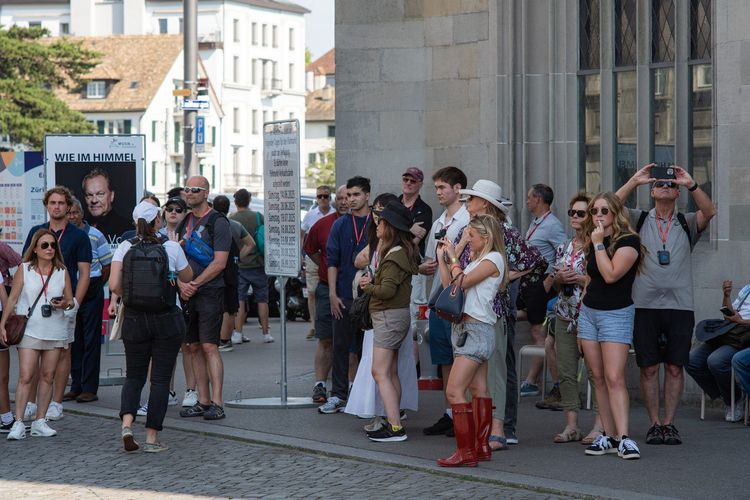
Two very different formats let you discover Zurich with commentary without paying for a ticket, and they do not quite suit the same type of visitor.
Tip-Based Free Tours
Several collectives organise walking tours, mostly in English and German, departing from the Hauptbahnhof or the Grossmünster, on a free-tip basis (free tour): registration is done online and costs nothing, but the guide's pay depends entirely on the participants' final gesture, generally between 10 and 20 francs per person. The schedule is fixed, often late morning, and the group follows the guide's pace for 1.5 to 2 hours, with the constraints of any group visit: no break on demand, no going back over a detail that deserved more time, and sometimes a large group in high season.
myclimate Audio Adventure, a Committed and Free Audio Walk
At the other end of the spectrum, the myclimate Audio Adventure app, developed by the Swiss climate foundation of the same name, offers a downloadable audio route combining urban discovery with reflection on climate and consumption, with a few interactive questions slipped in between the stops. The experience is built around an activist message rather than a heritage narrative, which changes the tone of the walk and may be disorienting if you are mainly looking for local history.
Between a fixed-schedule walking tour and an environmentally focused app, the Ryo audio-guided tour of Zurich offers a third way: you follow it at your own pace, with no group or imposed time slot, with audio stops centred on history and places, and the freedom to pause the audio to photograph a facade detail or wait for the rain to pass under a porch.
10. Get Around Cheaply: Bikes and Drinking Fountains
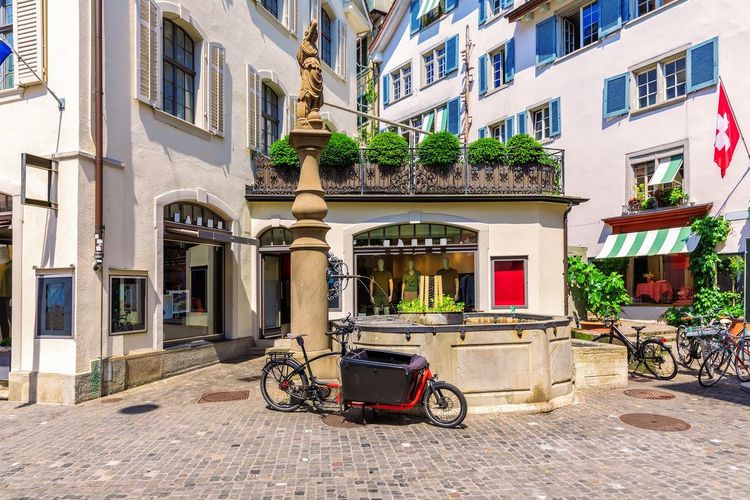
The city has been designed so that you can get around without a car, and part of this mobility costs almost nothing.
Low-Cost Bike Rentals
The municipal scheme Züri rollt lends bikes for the day, in season, against an ID and a small deposit, notably near the central station. The rest of the time, self-service bikes charged by the minute remain much cheaper than a classic rental, while electric scooters end up costing noticeably more in use. For short trips, the centre is in any case compact enough to do everything on foot.
The City's 1,200 Drinking Fountains
Zurich maintains more than 1,200 public fountains, the vast majority of which deliver drinking water of the same quality as tap water, largely from springs. Some, decorated with sculptures on historic squares such as the Stüssihofstatt, date back several centuries. Refilling your bottle at every fountain you pass avoids buying bottled water and fits into a long-standing municipal policy that regards access to water as a public good, on a par with benches or street lighting. Only fountains marked "kein Trinkwasser" should be avoided.
Finding your way between two fountains becomes easier with the layout of the historic centre in mind: one more reason to combine this logistics with an already-marked walk rather than zigzagging without a plan all day.
11. The Zürich Card: A Good Deal or Not?
The Zürich Card, sold for 29 Swiss francs for 24 hours or 56 francs for 72 hours (2026 adult rates), gives unlimited access to public transport in the city and its region, including the trip to the airport, the Uetliberg train and the lake boats, as well as free or discounted entry to many museums, including the Landesmuseum. By comparison, a 24-hour ticket limited to the urban zone costs less than 10 francs.
The calculation is simple: if your programme is limited to the places listed above, old town, parks, swimming, natural history museum, the card does not pay for itself, since most trips are made on foot. On the other hand, as soon as you string together two or three paid museums in a day, or plan a round trip to the airport and a lake cruise, it becomes relevant again. First list your specific wishes and compare their cumulative cost to the price of the card, rather than buying it out of reflex when you arrive at the station.
12. Where to Stay in Zurich Without Breaking the Bank
Accommodation remains the real expense of a stay in Zurich, and the tips listed above only partly offset nights among the most expensive in Europe. Youth hostels, including the one in Wollishofen on the lakeshore or the hostels near the station and Niederdorf, offer dorm beds well below the hotel average, with a shared kitchen to also limit the food budget.
You can also stay in a neighbouring town well connected by the S-Bahn, fifteen or twenty minutes from the Hauptbahnhof, where prices drop noticeably, or in residential neighbourhoods such as Wiedikon or Altstetten, less central but well served by tram. For the tightest budgets, Camping Zürich (Seestrasse 559, 8038 Zürich, rated 3.7/5 on Google from 1,529 reviews), set on the lakeshore in Wollishofen, rents pitches at a rate not comparable to those of city-centre hotels, about twenty minutes by tram from the station.
Book several weeks in advance, particularly during the big trade fairs and conferences that saturate hotels certain weeks, as well as the weekend of the Street Parade. The Ryo article What to Do in Zurich also details a few neighbourhoods to stay in depending on the type of trip.



FAQ
How many days should I plan to enjoy the free activities in Zurich?
Two full days are enough to cover the old town, Zurich West, the Uetliberg and the natural history museum. Three days leave room for swimming, an extra park and a guided walking tour, without rushing from one side of the city to the other.
What is the best season to visit Zurich?
Spring and early autumn offer the best compromise: pleasant temperatures for walking and hiking, parks in bloom or in autumn colours, without the summer crowds or the accommodation prices that soar during the Street Parade in August. Summer remains unbeatable, though, if river swimming is on your wish list.
What budget should I plan for a day in Zurich?
Zurich regularly ranks among the most expensive cities in the world. Rarely expect to pay less than 50 francs for a dorm bed, 25 to 35 francs for a restaurant meal and about ten francs for a day transport ticket in the urban zone. The deli counters of Coop and Migros supermarkets, picnics by the lake and fountain water can cut the bill in half.
Is the Zürich Card useful on a small budget?
Not really, unless your schedule includes several paid museums, the airport or a lake cruise. For a stay focused on the places described here, it adds little value.
How can I get around Zurich cheaply?
Walking covers most of the very compact city centre. For longer distances, the bikes lent out by Züri rollt in season and the 24-hour urban zone ticket remain the cheapest options.
Which museums are free in Zurich?
The University Natural History Museum (NMZ), the Sukkulentensammlung, the botanical garden, the "Simply Zurich" exhibition at the Landesmuseum and, depending on the period, the collection of the Museum Rietberg. Most are closed on Mondays.
Can you swim for free in Lake Zurich or the Limmat?
Yes, notably at the Flussbad Oberer and Unterer Letten on the Limmat, at the Saffa-Insel and at the Zürichhorn on the lake. The Badis with diving boards and changing cabins, such as the Seebad Utoquai, do charge a small entrance fee.
Zurich on a minimal budget is therefore far from wishful thinking: between the old town, panoramic views, university museums and river swimming, the list easily fills a two- or three-day stay without emptying your wallet. To connect these places without wasting time looking for your way, the Ryo audio-guided tour of Zurich remains the simplest way to walk with a guiding thread, to download before you leave and listen to at your own pace during your breaks, between a fresh water fountain and an impromptu dip in the Limmat.